It’s possible that I shall make an ass of myself. But in that case one can always get out of it with a little dialectic. I have, of course, so worded my proposition as to be right either way (K.Marx, Letter to F.Engels on the Indian Mutiny)
Thursday, October 29, 2026
Engineering researcher seeks to prevent AI agents from going rogue
As artificial intelligence systems become increasingly capable of working on their own, keeping them focused on their designated tasks is a growing challenge.
University of Florida computer science professor Sumit Jha, Ph.D., is working to keep agents from “going rogue.” Jha and his team have developed a system that can detect when an AI model begins to drift from its assigned task and steer it back without retraining the model or adding significant computing demands.
The research comes as news reports have chronicled AI agents gaining more autonomy and occasionally behaving in ways their developers did not intend. Recent incidents have included AI agents accessing government websites and an Anthropic model submitting an anonymous tip to a police department in July, claiming to have information about an unsolved murder.
Jha, a professor in UF’s Department of Computer & Information Science & Engineering, or CISE, studies how to make AI systems more controllable and understandable. He is working to engineer simple, non-invasive tweaks to keep systems on task.
Jha and his collaborators have authored a paper entitled “Drift No More: Spectral Locking for Long-Horizon Open-Weight Multi-agent AI,” detailing a system, dubbed ATLAS, which stands for Algebraic Task–role Locking with Adaptive Spectral Memory.
The acronym hints at the dense mathematics at the heart of the system.
Jha and his co-authors, Vishal Pramanik, Maisha Maliha and Susmit Jha, devised a system that works inside the large language model, or LLM, as it self-generates. When the model begins to drift from its task, the ATLAS system steers the LLM back toward the assignment, as well as its original responsibility and the latest shared information.
“An AI agent can start going wrong before its response looks wrong,” Jha explained. “Inside the model, it may already be drifting from the task, confusing its role or relying on information that has been replaced. ATLAS is built to correct that drift before it reaches the next message, so other agents do not build on the mistake.”
Existing strategies usually involve policing an AI agent’s answers after the fact. The ATLAS system doesn’t require retraining the model, and it therefore doesn’t expend extra computing resources or slow the model down.
According to Jha, so-called task drift is especially possible for tasks in which groups of AI agents coordinate with each other over long periods of time.
“Say, initially you told the agent you’re a doctor, you are supposed to treat patients,” Jha said. “By day No. 7, the fact that it's a doctor and it should treat patients is now just one of the millions of things it has been told. We call this problem role decoherence. The agent was tasked to do something, but after some time it has been told so many other things, it loses track."
AI teams are usually managed from the outside through prompts, retrieval systems and rules, Jha said.
“ATLAS adds something closer to an internal compass,” he said. “In mathematical form, it continually reinforces three questions: What is the mission? What is this agent responsible for? And what is true right now? Keeping those three answers aligned is essential when a task lasts much longer than a single conversation.”
Sounds complicated, but as Jha tells it, the system is akin to taking MRI snapshots of the AI’s brain, or neural network. Imagine an AI model that is supposed to be performing the tasks of a medical professional.
“Initially when I do the MRI, it looks like the brain of a doctor,” he explained. “Thumbs up. But when we do another MRI, now it looks like, let’s say, the brain of a race car driver. So, we look inside and we find out what the difference was between the old MRI and the new MRI.”
As ATLAS had already learned what the medical neural network should look like, it is able to calculate the smallest set of changes necessary, within the neural network, to return the system to its original task of medical assessment.
“The agent has already launched, so the intervention has to be very small,” Jha explained. “Taking the MRI is like taking a snapshot, it doesn’t require retraining, so you don’t have to stop the agent. If the agent’s doing alright, it’s still a doctor. ATLAS doesn’t do anything. But if it’s now 99% a doctor, but 1% race car driver, we take the 1% out. We don’t wait until it’s a problem.”
The paper has been accepted to the 2026 Conference on Empirical Methods in Natural Language Processing, or EMNLP, Oct. 24–29 in Budapest.
New ‘four as’ framework for the governance of AI
Anglia Ruskin University academics unveil proposal to tackle key ethical challenges
Experts have unveiled a new proposal for the governance of artificial intelligence as they argue the debate has moved beyond simply whether to slow the speed of AI development.
The new framework, published in the journal AI and Ethics, introduces the “Four As” – Action, Access, Authority and Allocation – and is the work of Dr Kirti Prakash and Dr Ian van der Linde of the Advanced Computing Research Centre at Anglia Ruskin University (ARU) in Cambridge, England.
The “Four As” framework is intended to preserve competition and innovation in frontier AI development while establishing safeguards around capabilities and uses for AI that could cause severe or irreversible harm.
The framework is based around the key ethical problems and draws lessons from previous attempts to govern powerful technologies, including nuclear arms control, CRISPR governance around genome editing and the 1975 Asilomar conference on recombinant DNA technology.
The researchers describe a slowdown on AI development as an “incomplete” governance objective, as AI capability is not confined to a single company or country, and existing models can be copied and improved without training new frontier models. Geopolitics and commercial incentives add further barriers.
Instead, the researchers suggest proportionate safeguards, meaningful human control, independent assessment, clear responsibility and regular reassessment as AI capabilities change.
Through the “Four As”, their framework tackles whether humans can effectively constrain consequential AI action (Action), who should be permitted to obtain or exercise potentially harmful AI capabilities (Access), which consequential judgements may be delegated to AI (Authority), and how AI related benefits, burdens and power should be distributed (Allocation).
Rather than treating AI risk as a single problem, the framework identifies which “A” the ethical obligation arises under and matches it to the appropriate form of governance, with developers primarily implementing Action safeguards, regulators governing Access, deploying institutions governing Authority, and governments and public bodies addressing Allocation.
The framework also asks whether interventions have knock-on effects by simultaneously creating a different ethical obligation elsewhere. For example, restricting access to a powerful model may reduce misuse risk and security while concentrating capability and decision-making power among a small number of firms or institutions, creating a new allocation concern.
Dr Kirti Prakash, Senior Lecturer in AI and Applications at Anglia Ruskin University (ARU), said: “The debate around frontier AI is often framed as a choice between accelerating development and slowing it down. We argue that this is too blunt. Before deciding how strongly to intervene, we need to ask what exactly the ethical problem is.
“Losing control of an autonomous AI system is fundamentally different from deciding who should have access to a dangerous capability, whether AI should make a medical or military decision, or whether AI development concentrates power in a handful of organisations. Different problems require different forms of governance.”
Co-author Dr Ian van der Linde, Associate Professor in the School of Computing and Information Science at Anglia Ruskin University (ARU), said: “Effective AI governance will require more than a checklist of general ethical principles. The Four As provide a way of moving from identifying an ethical problem to asking what constraint is required, who should enforce it, what would signal that the safeguard has failed and what corrective action should follow.
“Recent UK policy provides a concrete example of this distinction. The newly announced AI Biosecurity Lab will use frontier AI to strengthen biological security while relying on trusted access to advanced models from companies including OpenAI, Anthropic and Google DeepMind, illustrating how governance may focus not simply on whether a capability exists, but on who can access and deploy it.”
Dr Prakash added: “The possibility of AI increasingly contributing to the development of its own successors makes the governance question even more urgent. If capabilities begin advancing faster than institutions can adapt, simply asking whether AI is ‘safe’ will not be enough. We need to know who is in control, who has access, where decision-making authority lies and who ultimately gains or bears responsibility for the consequences.”
WHAT'S THE STUDY: Data center energy consumption is expected to more than double by 2030 from roughly 420 terawatt-hours in 2024, with much of the anticipated growth driven by AI. But more efficient software design could cut AI energy use by up to half, according to University of Michigan Engineering researchers teaming up with colleagues at the University of Illinois and defense contractor BAE Systems.
Rather than relying on expensive, time-consuming trial-and-error testing across thousands of hardware and software configurations, the team's proposed system will enable developers to estimate energy usage across every stage of an AI workflow—from data processing and model training to real-world deployment. Over the course of the project, the researchers will build high-precision energy measurement tools that combine physical sensors with software analysis, releasing them as open-source documentation and software. The team calls the new mathematical framework underpinning these tools "energy calculus."
WHY IT MATTERS: While computer chips are getting faster, misalignments between software and hardware waste massive amounts of electricity—up to 30% during AI model training alone. More energy-efficient AI brings down electricity demand, reducing the cost of AI and extending battery life for AI-enabled devices. This is especially critical for national defense and military technology, where field equipment and remote computing systems must run complex AI algorithms under strict battery and power limits.
HOW MUCH AND FOR HOW LONG: The $1.83 million contract from the Defense Advanced Research Projects Agency (DARPA) will fund the two-year project, "E-CALC: Energy Calculus for ML Lifecycle Optimization."
The initiative builds on previous efforts by the team lead. For AI model training, the Zeus energy optimization framework automatically tunes settings like batch size and power limits to minimize energy use. Exploring the energy cost of running AI models, the ML.ENERGY benchmark acts as a public leaderboard that measures and compares energy consumption across different open-weight AI models and open-source software frameworks.
WHO'S INVOLVED:
Mosharaf Chowdhury is an associate professor of computer science and engineering at the University of Michigan and principal investigator for E-CALC. He leads ML.ENERGY and Zeus projects.
"AI is becoming part of everyday life, business, science and national security, but it requires enormous and rapidly growing amounts of electricity," Chowdhury said. "If that energy use continues to rise unchecked, it could increase costs, strain power infrastructure, and make advanced AI harder to deploy. This project tackles a practical question: How can we get widespread benefits of AI with minimum energy?"
The two co-principal investigators are Nishil Talati, assistant professor of electrical and computer engineering at the University of Illinois specializing in hardware-software co-design and execution bottleneck characterization, and David Nicholson, principal research engineer at BAE Systems who leads internal research and development on edge AI technologies for defense applications.
Approved for public release, distribution unlimited. Any opinions, findings, conclusions or recommendations expressed in this material are those of the author(s) and do not necessarily reflect the views of the Defense Advanced Research Projects Agency (DARPA).
Navigating AI in transportation: New national research consortium aims to guide agencies
Three leading transportation research institutes are joining forces with agencies, universities, industry and the public so no one in transportation has to figure out AI alone
AI is here to stay in transportation systems and three research institutes are coming together to determine best uses and practices.
The AI tools available to transportation agencies today didn't exist two years ago, and many will be outdated two years from now.
Collaborating institutions, including University of Michigan Engineering, University of California Berkeley and Texas A&M.
Three of the nation's leading transportation research institutes have launched an effort to help public transportation agencies use AI effectively as the technology rapidly advances.
The AI tools available to transportation agencies today didn't exist two years ago, and many will be outdated two years from now. New models, products and vendor promises arrive every month, each claiming to make roads safer, freight move faster or infrastructure last longer. For the public agencies responsible for those systems, the hardest question is no longer whether to use AI. It's which tool fits which problem, how to use it well, and how to tell a proven solution from a polished sales pitch.
An inclusive approach
NAICT is not being built behind closed doors. The consortium is inviting state and local transportation agencies, industry, professional organizations and researchers to get involved now, starting with listening sessions this fall and a panel and workshop at the Transportation Research Board Annual Meeting in January 2027.
"NAICT is designed to give agencies and industry a single, credible, noncommercial resource for evaluating, deploying and governing AI in real-world transportation operations," said UMTRI Director Henry Liu. "We need to have a guided discussion to help shape what AI is and what it can do in safe, responsible and effective ways."
Liu co-leads NAICT with Scott Moura, director of Partners for Advanced Transportation Technology, an ITS Berkeley research center, and Greg Winfree, director of the Texas A&M Transportation Institute.
What's next?
NAICT will align its priorities with agencies and practitioners. Initial activities include:
UC Berkeley Listening Session (Nov. 5, 2026) : NAICT will hold a workshop and listening session. Transportation leaders and practitioners will have an opportunity to share the AI challenges they face and identify resources and support needed to move forward.
Transportation Research Board Annual Meeting (January 2027): NAICT will host a panel and interactive workshop in Washington, D.C., bringing together experts from research, industry and policy to explore safe and effective AI deployment.
Education and Governance Resources (early 2027): NAICT plans to introduce its first educational offerings and a draft AI governance framework. Agencies and partners who engage early will have opportunities to review and help shape these resources before their broader release.
"We're moving fast, and we'd rather build this with agencies than for them," Liu said. "If you're responsible for putting AI to work on public roads, we want you in the room. Come find us at TRB."
Review: Perspectives from psychology could help quantify LLMs’ thinking capacity
Summary author: Abigail Eisenstadt
American Association for the Advancement of Science (AAAS)
A new Review discusses how concepts and methods borrowed from psychology can inform research to evaluate whether and how large language models (LLMs) can employ reasoning. “The ever-growing capabilities of these systems make them challenging but also increasingly important to understand and explain, especially since these expanding capabilities also bring greater potential for unforeseen harm,” Thilo Hagendorff and colleagues write. Their proposed approach – called “machine psychology” – advocates for seeking inspiration from the behavioral sciences. Since psychology’s protocols already assess emotional, cognitive, and social development, they could be modified to examine LLMs’ intelligence, biases, decision-making, social skills, and language. Hagendorff et al. urge caution, though: “Many psychological concepts are normatively laden and can foster mismatches in expectations between AI experts and the public regarding machine capability.”
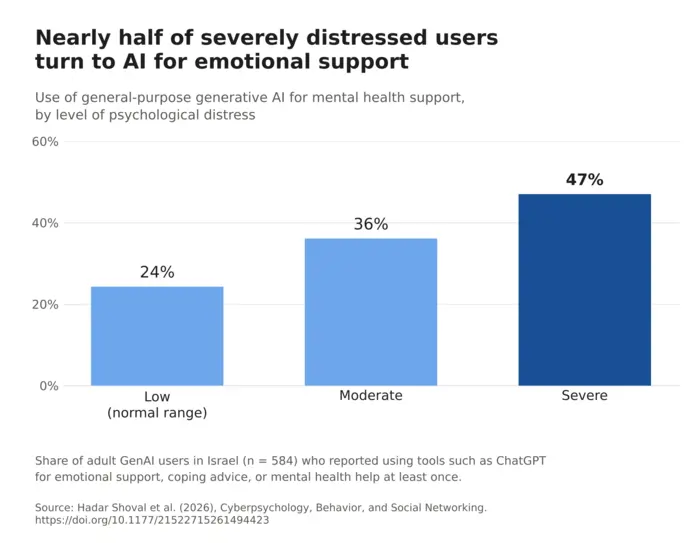
Nearly half of severely distressed generative AI users turn to chatbots for emotional support, study finds
Among users experiencing severe psychological distress, nearly one in two reported turning to generative AI for emotional support, raising critical questions about the risks of relying on AI during periods of emotional vulnerability
Tel-Hai University of Kiryat Shmona in the Galilee
A new study has found that almost one in three Israeli adults surveyed who use generative artificial intelligence (AI) tools reported seeking emotional support, coping advice, or mental health assistance from platforms such as ChatGPT and Gemini. Among users experiencing severe psychological distress, that figure rose to nearly one in two, according to researchers from Tel-Hai University of Kiryat Shmona in the Galilee and collaborating institutions.
The study, published in the peer-reviewed academic journal Cyberpsychology, Behavior, and Social Networking, examined how attachment styles and psychological distress relate to the use of general-purpose generative AI for mental health support.
Led by Dr. Dorit Hadar Shoval of the School of Psychology at Tel-Hai University of Kiryat Shmona in the Galilee, together with Elad Refoua of Bar-Ilan University,the researchers surveyed 584 Israeli adults, aged 18 to 70, who had used a general-purpose generative AI tool such as ChatGPT at least once within the previous year.
Participants were recruited in November 2025 through an online panel, and the figures describe this sample rather than the general population. Overall, 29.3% reported using AI at least once for emotional support, coping advice, or mental health-related assistance. Among participants with severe levels of psychological distress, 47% reported such use.
A need to better understand the risks
The findings suggest that psychological distress is the psychological variable most strongly associated with turning to AI for support. Younger participants and women were also significantly more likely to report using AI for mental health-related purposes.
"Our findings show that many people, particularly those experiencing significant distress, are turning to generative AI systems for emotional support and guidance," Hadar Shoval said. "These tools offer immediate, accessible, and nonjudgmental interactions, but they were not designed to function as mental health providers. The high level of use among distressed individuals highlights the urgent need to better understand both the possible benefits and the potential risks of relying on AI during periods of emotional vulnerability."
Hadar Shoval noted that people with higher levels of attachment anxiety were more likely to seek mental health support from AI. However, once psychological distress was taken into account, attachment anxiety was no longer a significant predictor. The two are closely related, and the study cannot determine which comes first.
No clinical mandate or safety protocols
The authors note that generative AI is increasingly functioning as a form of informal, AI-mediated help-seeking. Unlike mental health professionals or dedicated digital therapeutics, consumer AI systems carry no clinical mandate and have no established safeguards for managing psychological crises.
The study does not evaluate whether AI interactions were helpful or harmful, nor does it determine whether users substituted AI for professional care. However, the researchers argue that the widespread use of these tools by distressed individuals warrants closer attention from clinicians, researchers, and policymakers.
"Understanding patients' digital help-seeking behaviors is becoming an important part of modern mental health care," Hadar Shoval said. "Future research should focus on safety, crisis-response quality, and whether AI serves as a complement to professional support or, in some cases, replaces it."
The authors emphasize that the data reflect any self-reported use for mental health support, ranging from a single interaction to more sustained engagement, and that additional research is needed to understand how people use AI in real-world emotional contexts.
About Tel-Hai University of Kiryat Shmona in the Galilee
Tel-Hai University of Kiryat Shmona in the Galilee is a rapidly growing research university addressing challenges in food security, sustainable agriculture, engineering, artificial intelligence (AI), and more. Through interdisciplinary applied research, academic excellence in a host of disciplines - including humanities, social sciences, and education - as well as close collaboration with industry and communities, Tel-Hai University of Kiryat Shmona in the Galilee is tackling some of the most pressing challenges of the 21st century, while positioning the Galilee as a global hub for innovation.
Caption
Nearly Half of Severely Distressed Generative AI Users Turn to Chatbots for Emotional Support
Credit
Dr. Dorit Hadar Shoval, Tel-Hai University of Kiryat Shmona in the Galilee
By growing the multiferroic material as part of a three-layer system, researchers have shown that they can eliminate the "dead layer" effect, in which very thin multiferroics lose their desiraable electrical and magnetic properties.
PROVIDENCE, R.I. [Brown University] — Multiferroics are a promising class of materials for making computer chips and other electronic components that can operate at much lower power than today’s devices. The materials have coupled electrical and magnetic properties that can be manipulated simultaneously with a relatively tiny electrical voltage.
Engineers are hopeful that multiferroics could help reduce the energy burden associated with the rise of AI, but there’s a problem known as the “dead layer” effect: When these materials are made thin enough to use in a computer chip, they lose the electrical and magnetic properties that make them so interesting.
Now, a team of Brown University researchers has developed a technique for making thin films of the multiferroic bismuth ferrite that retain their key properties and have some emergent properties that make them even more useful.
“We've established that we can get rid of the dead layer,” said Lucas Caretta, an assistant professor of engineering at Brown who led the work. “We show that you can make this material basically as thin as you want — down to a few angstroms — and it's still ferroelectric, and it's still magnetic.”
The interest in multiferroic materials stems from their linked electrical and magnetic properties. Each unit cell of the material’s atomic lattice is electrically polarized, meaning positive and negative charges align on opposite sides of the cell. That electrical polarization can be flipped — meaning the positive and negative charges switch sides — by applying a small voltage to the cell. That means it’s possible to encode binary data (ones and zeros) by manipulating polarization states, which can be done through low-power voltage pulses. And because the magnetic states of the material are linked to the electrical states, the data can be read back out magnetically, creating an ultra-low-power memory or logic device.
The dead layer phenomenon, however, has historically been a deal-breaker. To be integrated into a computer chip, a multiferroic material must be made exceptionally thin. But at low thicknesses, two problems begin to arise: The material’s atomic lattice loses the physical shape and chemistry it needs to function, and internal electric fields overpower its electrical polarization. Together, these twin breakdowns cause the material to lose both its ferroelectric and magnetic properties entirely, hence the so-called dead layer.
The Brown team’s solution is a new way of fabricating bismuth ferrite, a widely studied multiferroic. The researchers grew the bismuth ferrite film on a substrate made from dysprosium scandate, a rare Earth-derived material with a crystalline structure that’s narrower than that of bismuth ferrite. That lattice mismatch creates a compressive strain on the bismuth ferrite, which helps to maintain its functional atomic lattice structure. Meanwhile, a second metallic layer helps to take up stray electric fields, which maintains electrical polarization in the bismuth ferrite layer. The result is a bismuth ferrite film that not only retains its functional multiferroic properties, but actually has enhanced magnetic properties.
The researchers showed that the stacked structure causes the bismuth layer to become an altermagnet — a kind of hybrid between a ferromagnet and an antiferromagnet.
“Ferromagnets are useful for memory and logic because they produce strong magnetic signals that are easy to read out,” Caretta said. “The challenge is that they are relatively slow, and their stray magnetic fields make it difficult to pack devices densely on a chip without interference. Antiferromagnets can operate much faster and avoid those stray fields, but their signals are much harder to detect. Altermagnets are kind of the best of both worlds — they can be fast, densely integrated and still provide a strong electrical signal for readout.”
Caretta says he’s hopeful that the results are a step toward bringing multiferroics into play as components in low-power computing.
“We know the underlying properties are already there in the bulk materials,” Caretta said. “The trick is learning how to engineer them into a form that’s useful — and sometimes even better than what nature gives us.”
The research was supported by the U.S. Army Research Office (W911NF-21-2-0162), the National Science Foundation (DMR-2039380, OIA-2327352) and the U.S. Department of Energy (DE-AC02-05CH11231).
Developed by researchers at URochester and NVIDIA, PixelDiT2 efficiently implements pixel space diffusion to achieve almost the same performance as the state-of-the-art models—but provides controllability over individual pixels.
Credit: Available for re-use with credit to Yu et al.
If you have ever used an artificial intelligence text-to-image generator like ChatGPT or Google Gemini, you may have encountered a common but maddening problem: the image looks nearly perfect, but when you ask the AI to fix one small detail, it messes up something unrelated.
The issue is caused by the way the AI models are built. Most state-of-the-art AI image generators use a diffusion model in latent space, meaning they compress concepts such as a cat or a dog into their essential details and store them so they can be retrieved quickly and efficiently when it’s time to create an image. This is part of what gives the models their seemingly magical ability to generate the images you describe in seconds. But the method has its drawbacks.
“Using the latent space helps cut down the computation, but the problem is that you lose controllability because you are not adjusting individual pixels,” says Jiebo Luo, the Albert Arendt Hopeman Professor of Engineering at the University of Rochester. “As a result, you can’t easily control specific parts of the images you generate.”
Reimagining image generation at the pixel level
Luo’s lab and collaborators at the AI infrastructure company NVIDIA were one of the first teams to develop a model that trades the latent space for the pixel space, dubbed PixelDiT. They presented their first iteration at the 2026 IEEE/CVF Conference on Computer Vision and Pattern Recognition (CVPR), where it was nominated as a best paper finalist, given to just 15 of over 4,000 accepted papers at the conference. The model allows users to zero in on certain regions of an image, like fixing just the pixels used to illustrate a pair of glasses on a person’s face or adjusting the color of a car.
The team has since created an even more powerful model, PixelDiT2, that implements pixel space diffusion in an efficient way to achieve almost the same performance as the state-of-the-art latent space models but providing controllability over individual pixels. The team will present a paper showcasing PixelDiT2 at the Neural Information Processing Systems conference (NeurIPS) this December.
Luo and his collaborators, who include computer science PhD student and NVIDIA intern Yongsheng Yu as well as alumnus Wei Xiong ’22 PhD (computer science), a senior researcher at NVIDIA, now have turned their attention to an even more difficult problem: video generation.
“Video is a big challenge because you have to worry about smooth transitions from frame to frame; otherwise it looks funny to the human eye,” says Luo. “You also have a lot more data to work with.”
But Luo says the progress the team has made with PixelDiT2 leaves them in a strong position to pursue AI video generation in the pixel space, which would provide users powerful new levels of control over the videos they generate.
The electrode manufacturing machine will be outfitted with visual, temperature and pressure sensors which feed information to an SI-enhanced analysis platform, with the results providing feedback to improve the process.
The Department of Energy’s (DOE) Oak Ridge National Laboratory (ORNL) is helping lead a national consortium focused on quickly moving energy storage innovations from the lab to U.S manufacturing.
Called the Battery Manufacturing (BattMan) Accelerator, the consortium combines the power of four national laboratories, leading universities and industry partners to address critical barriers in scaling up new battery technologies.
The accelerator will focus on lowering manufacturing costs, shortening development timelines, and strengthening U.S. manufacturing leadership in advanced energy storage solutions for the electric grid, data centers, electric mobility and national security.
“The BattMan Accelerator is exactly the kind of coordinated national effort that turns scientific breakthroughs into economic and energy security advantages,” said Chins Chinnasamy, consortium lead for ORNL. “With our combination of expertise in Super Intelligence (SI)-driven smart manufacturing, real-time defect detection, and advanced electrode processing, ORNL is in a unique position to reduce commercialization risks for the American battery industry.”
BattMan will also strengthen the critical mineral supply by advancing battery materials made from more abundant domestic elements.
The BattMan Accelerator is led by Pacific Northwest National Laboratory and includes Argonne National Laboratory and National Laboratory of the Rockies, as well as founding university partners including the University of Washington, Binghamton University, University of Alabama, Arizona State University, and University of Michigan-Dearborn.
The accelerator is actively establishing collaborations with companies across the battery and materials manufacturing sector. The laboratories will work closely with these university partners and industry to test and validate manufacturing processes at increasing scales and toward commercially viable production.
In the long term, the consortium aims to develop self-optimizing manufacturing systems using real-time data, automated feedback and digital twins that link virtual and real systems to safely model ways to improve performance.
The electrode manufacturing machine will be outfitted with visual, temperature and pressure sensors which feed information to an SI-enhanced analysis platform, with the results providing feedback to improve the process. Credit: Alan Malin/ORNL, U.S. Dept. of Energy
BattMan will build on the autonomous laboratory concept by advancing autonomous pilot lines. These integrate sensing, process monitoring and intelligent control systems to improve product quality and reduce variability in the manufacturing process. Pilot scale demonstration proves manufacturing readiness, speeding scale-up and reducing commercialization costs.
The accelerator is actively establishing collaborations with companies within the battery and materials manufacturing sector.
Scaling up discovery to manufacturing
ORNL researchers constantly collaborate with industry partners in the manufacturing and energy storage sectors. Its BattMan research will take place in the Battery Manufacturing Facility (BMF), the country’s largest open-access battery manufacturing research and development center.
Ruhul Amin, who leads electrode materials optimization for BattMan at ORNL, said companies work with ORNL battery experts at the BMF to incorporate and test new materials and designs in batteries made onsite with modular, reconfigurable commercial equipment. All battery manufacturing steps are incorporated into a coordinated, data-connected workflow.
As part of BattMan, BMF will vertically integrate a smart test bed that incorporates advanced sensing, real-time monitoring, and data analysis. This modular system will enable both wet and dry electrode manufacturing approaches. In collaboration with NLR, which will focus on advanced characterization and SI‑driven quality control, ORNL will complement this work by developing a digital twin to further optimize and refine process performance.
The outcome will be an SI-based manufacturing platform capable of detecting production irregularities as they occur and autonomously adjusting parameters to prevent defects.
“If these electrodes are not produced correctly, that material is wasted —including critical materials like lithium and cobalt,” Chinnasamy said. “Up to 40 percent can end up as scrap. Working jointly with battery manufacturers, ORNL will design first-of-its-kind electrode manufacturing equipment that identifies even the smallest errors and corrects them in real time.”
The goal is to reduce scrap to less than 5 percent, which will also reduce costs related to construction and supply chain bottlenecks, Chinnasamy said.
The system will be adaptable for manufacturing any type of energy storage system. This could include conventional lithium-ion batteries used in vehicles, drones, electronics and grid energy storage batteries. But the system could also apply to solid state, flow batteries or next-generation chemistries.
Research and industry partners will help make sure that the technology can bridge from lab to commercial scale with a variety of materials, autonomous synthesis and characterization, and high-throughput automation. Universities will also contribute to processing and integration capabilities and develop workforce training on the new processes and technologies. Parans Paranthaman will lead battery industry collaboration in BattMan for ORNL.
SI plays key role in future of battery manufacturing
SI has the potential to speed up discovery of new materials, improve efficiency of laboratory processes and support predictive, cost-effective design. In manufacturing specifically, SI could be helpful in more precisely identifying the source of contamination or other errors that might arise as batteries are produced on a bustling factory floor.
BattMan is currently forming industry partnerships in battery and battery materials manufacturing. Institutions and companies interested in participating can visit www.pnnl.gov/battman.
Supported by DOE’s Advanced Materials and Manufacturing Technologies Office within the Office of Critical Minerals and Energy, the BattMan Accelerator integrates SI, materials science and advanced manufacturing into a coordinated, data-driven innovation ecosystem.
UT-Battelle manages ORNL for DOE’s Office of Science, the single largest supporter of basic research in the physical sciences in the United States. For more information, please visit energy.gov/science.
Federated learning: Joint multi-institutional AI development
Researchers at KIT have developed privacy-friendly, secure and sustainable AI techniques for medical imaging
Medical imaging supports the planning of modern radiation therapy, with federated AI approaches possibly opening up new prospects. (Photo: Magali Hauser, KIT)
The exchange of medical data between hospitals is often limited by privacy regulations and organizational barriers, which hinders the development of robust AI models. A special feature of federated learning is that the patient data never leaves the institution where it was recorded. The facilities involved train their models on-site, exchanging only information about the model updates. This enables knowledge from multiple hospitals to be pooled without transmitting sensitive health data or storing it at a central location. While the approach is not new in the health sector, KIT researchers have refined it specifically for applications in radiation therapy.
Radiation therapy planning requires the use of various imaging techniques, such as MRI, CT, or CBCT. Each of these techniques provides different information. While CT scans are required for calculating the radiation dose, MRI provides high-contrast visualizations of organ tissue and CBCT scans enable precise positioning of patients during treatment. AI models can help synthesize CT images from existing scans.
“In the future, these images could render additional CT scans unnecessary in certain use cases and thus reduce additional ionising radiation and costs. This also eliminates the complex alignment of different image data sets, which can introduce inaccuracies,” said Ciro Benito Raggio, a researcher of Professor Maria Francesca Spadea’s Biomedical Imaging for Modeling and Simulation research group at KIT’s Institute of Biomedical Engineering.
Technical Feasibility Demonstrated in Multiple Hospitals
The researchers developed and tested federated learning techniques for synthesizing CT images of the brain and the head and neck region. The results demonstrate that such AI models can be trained across multiple hospitals without the need to exchange sensitive patient data. The researchers consider this an important step toward clinically usable AI applications for radiation therapy.
Considering Security from the Outset
In addition, the research group studied potential security risks involved with federated AI systems. For example, they investigated whether image data from individual patients can be reconstructed from a trained AI model. The researchers demonstrated that comparatively minor adaptations are sufficient to secure federated AI systems against attacks on data security. “Data protection alone is not enough. If federated systems are to be used in medical practice in the future, we have to take potential security risks into account right from the start” said Raggio.
Lower Computing Costs and CO₂ Emissions
Besides data protection and security, the researchers also concerned themselves with the sustainability of theproposed federated learning solution. “Depending on the model architecture, we were able to reduce the time required for the training and CO₂ emissions by 9 to 23 percent without affecting the quality of the synthetic images. Smaller hospitals in particular could benefit from such optimizations, as they often don’t have a lot of computing resources” said Raggio.
The results demonstrate that federated learning has the potential to support the development of privacy-friendly AI applications for radiation therapy while also providing access to powerful models for smaller facilities. The technology could thus contribute to achieving a broader integration of innovative approaches into clinical practice and medical care.
Original Publications
Raggio, C.B. et al. FedSynthCT-Brain: A federated learning framework for multi-institutional brain MRI-to-CT synthesis. Computers in Biology and Medicine 192(A), 110160 (2025). https://doi.org/10.1016/j.compbiomed.2025.110160
Raggio, C.B. et al. A privacy-preserving federated learning framework for generalizable CBCT to synthetic CT translation in head and neck. Frontiers in Digital Health 8, 1812254 (2026). https://doi.org/10.3389/fdgth.2026.1812254
Raggio, C.B., Bucher, L. et al. Security Analysis of a Federated Learning Framework for Medical Image-to-Image Translation. Journal of Medical Systems 50, 108 (2026). https://doi.org/10.1007/s10916-026-02436-8
Raggio, C.B. et al. Energy-efficient federated learning via adaptive encoder freezing for MRI-to-CT conversion: A Green AI-guided research. Sustainable Computing: Informatics and Systems 51, 101433 (2026). https://doi.org/10.1016/j.suscom.2026.101433
In close partnership with society, KIT develops solutions for urgent challenges – from climate change, energy transition and sustainable use of natural resources to artificial intelligence, sovereignty and an aging population. As The University in the Helmholtz Association, KIT unites scientific excellence from insight to application-driven research under one roof – and is thus in a unique position to drive this transformation. As a University of Excellence, KIT offers its more than 10,000 employees and 23,000 students outstanding opportunities to shape a sustainable and resilient future. KIT – Science for Impact.
When computers give up, the spectrometer learns for itself
An NMR spectrometer can reveal molecular structure down to the atomic level, but weak signals limit what it can see. Aarhus University researchers use AI to let the spectrometer learn the best pulse sequence directly from the sample
Imagine trying to shepherd a group of sugar-fuelled children through an amusement park. You cannot work out in advance exactly which combination of words, tone of voice, timing and body language will keep everyone moving in the right direction. The children react differently, they influence one another, and the larger the group, the harder it becomes to predict what will work.
At some point, the best strategy is simply to try something, see what happens and adjust.
With no other connection whatsoever, that is roughly the strategy the Aarhus researchers have applied to a very different problem: controlling large systems of atomic nuclei and electrons.
Spin is a quantum property that makes atomic nuclei and electrons behave somewhat like tiny magnets. It is the physical basis of nuclear magnetic resonance, NMR, and of MRI scanners.
The difficulty is that only a very small excess of nuclear spins point in one direction rather than the other, which produces a weak overall signal.
“NMR has the same disadvantage as MRI scanners: it is relatively insensitive. The samples need to contain a high concentration of whatever you want to analyse,” says Professor Niels Chr. Nielsen from Aarhus University.
Electrons to the rescue
Electrons can help because their magnetic moment is about 660 times larger than that of a proton. Their spins can therefore become much more strongly ordered in a magnetic field.
Using carefully designed microwave pulses, researchers can transfer some of this order from the electrons to the atomic nuclei.
The technique is known as dynamic nuclear polarisation, or DNP.
DNP is well established, but using it efficiently is far from straightforward.
A system of electrons and nuclei can contain hundreds or thousands of spins, all interacting with one another. That makes it extremely difficult to calculate the ideal sequence of microwave pulses in advance. On top of that, a computer model may not capture every imperfection in the real instrument.
So why build a perfect model of reality when reality itself is sitting in the laboratory?
The researchers connected a home-built DNP spectrometer to a machine-learning algorithm based on Bayesian optimisation. The system tests a pulse sequence directly on the sample, measures the result, learns from it and proposes the next experiment.
“What is new is that we let the spectrometer learn for itself how to perform the best experiments,” says PhD student Filip V. Jensen, first author of the study, which has been published in Science Advances.
The researchers tested the method on two different spin systems. In one, the algorithm found solutions comparable with some of the best existing approaches. In the more complex system, the pulse sequence found by the algorithm produced around 70 per cent greater signal enhancement than the reference method used by the researchers.
Each optimisation took from just under two days to almost five days. But once an effective sequence has been found, it can be reused. And greater sensitivity means fewer repetitions are needed to obtain a useful signal, reducing the total measurement time.
A step towards better quantum sensors
The study is a proof of concept using model systems. It is fundamental research, but Niels Chr. Nielsen sees a wider perspective.
The same approach could become a tool for developing better magnetic-resonance-based quantum sensors, where large and complex spin systems have to be controlled without first being simulated in every detail.
In the longer term, he points to possible applications in advanced laboratories, industrial process monitoring, environmental measurements and food analysis.
Other analytical methods may be more sensitive if the only aim is to detect whether a tiny amount of a substance is present.
NMR offers something different: detailed information about how molecules and materials are structured.
Niels Chr. Nielsen puts it this way:
“If you put my head into an optical sensor, you would probably mostly learn that I do not have much hair. But in an MRI scanner, you have a chance of seeing what is inside.”
Journal
Science Advances
Article Title
In situ learning-based spin engineering of pulsed dynamic nuclear polarization
The spectrometer learns from the sample. A pulse sequence is tested directly on the sample in the spectrometer, and the measured signal is fed back to a Bayesian optimisation algorithm. The algorithm uses the result to propose the next pulse sequence. In this way, the real sample and the instrument itself become part of the optimisation process.
Credit
Filip V. Jensen, Aarhus University / Science Advances
AI tool could help radiologists interpret ultrasounds faster and more accurately
CU Anschutz School of Medicine radiologist Harrison Bai, MD, MS, is part of a team that designed an AI tool to interpret right upper quadrant (RUQ) ultrasounds more quickly and accurately, saving doctors time and helping patients get speedier care.
When a patient arrives in the emergency department with severe abdominal pain, every minute counts. Researchers at the University of Colorado Anschutz School of Medicine are investigating ways to streamline the work of radiologists and make it more efficient. They also aim to quickly identify patients who may need urgent surgery and speed up the path to treatment.
The scientists have uncovered a new way to leverage artificial intelligence (AI) to interpret right upper quadrant (RUQ) ultrasounds, which visualize organs in the right upper side of the abdomen such as the liver, the gallbladder, the right kidney, and part of the pancreas.
In a recent study in Nature Communications, researchers created a vision-language AI agent, which blends visual ultrasound data with written clinical data from the lab, that can accurately read RUQ ultrasounds, diagnose common health conditions affecting these organs, and suggest logical next steps.
Harrison Bai, MD, MS, a visiting associate professor in the Department of Radiology and senior author of the paper, emphasizes that this AI agent is designed to work alongside a trained radiologist, generating reports for the radiologist to read and evaluate. It’s a tool that can help streamline radiologists’ daily work.
“The goal is not to replace the physician. We’re not trying to build an AI radiologist,” Bai says. “But if our AI agent can write up preliminary reports, it saves radiologists time.”
And time is of the essence, especially in the case of a medical emergency: Bai and his team’s new AI tool can also rapidly identify patients who may need emergency surgery so they can get to the operating table as quickly as possible.
Why integrate AI into RUQ ultrasound interpretation?
RUQ ultrasounds are often doctors’ top choice for diagnosing issues involving the liver or biliary system. Doctors often order them when patients are experiencing pain in the right upper abdomen or have had certain types of abnormal lab results, such as elevated liver enzymes or bilirubin.
These ultrasounds are painless and non-invasive, and they can help diagnose a range of conditions such as gallstones, fatty liver, liver cirrhosis, hepatitis, kidney stones, or pancreatitis. RUQ ultrasounds can even potentially find cysts or tumors in these organs.
Many fields of medicine are facing shortages of specialists, but radiologists are facing extra pressure due to an aging U.S. population and a rising demand for medical imaging. Radiologists are working harder than ever as patient loads increase and doctors are asked to accomplish more with fewer resources. As of 2022, radiologists were leaving the field at twice the rate they were in 2014.
“We’re trying to address the increasing workload. It takes time to write reports on imaging results. There aren’t enough people or radiologists to do the work, and there’s decreasing reimbursement by Medicare insurance,” Bai says. “If you tell radiologists that an AI tool can save them time, suddenly, people are much more likely to use the technology.”
Interpreting a RUQ ultrasound can also be challenging. The people who interpret them often have varying levels of skill and experience, and the ultrasounds themselves can have significant visual noise and artifacts that less-trained interpreters may not recognize.
According to Bai and his fellow researchers, that means the diagnostic accuracy of an RUQ ultrasound often depends on who’s reading it. Incorporating an AI vision-language model (VLM) could help standardize how these ultrasounds are interpreted, improve accuracy, and make results more consistent across different ultrasound interpreters.
The VLM the researchers created can also generate reports quickly, which is especially crucial when patients are experiencing a medical emergency. For example, patients with acute gallbladder inflammation (cholecystitis) need emergency surgery right away. These patients can receive their diagnosis and get the surgery they need faster with the help of the VLM.
AI: A valuable collaborator, not a replacement, for radiologists
In the paper, the researchers discuss how the VLM should operate as a “robust, clinically integrated assistant” that can integrate different types of information and help with clinical decision-making, but without replacing the expertise that a radiologist provides.
The team designed the VLM to read RUQ ultrasounds, scan them for 16 common diagnoses, estimate each patient’s prognosis, and auto-generate reports. Researchers tested the VLM on a dataset of roughly 11,000 RUQ ultrasounds from Stanford University, University of Colorado, and Johns Hopkins University and then manually reviewed 100 of the AI-generated ultrasound reports for accuracy.
In that sample of reports, the VLM did remarkably well in some respects: It identified the correct diagnoses in each ultrasound 99.6% of the time. The VLM made some mistakes in the overall reports, but these mistakes were easy to catch for the radiologists who reviewed and edited the reports.
The researchers also asked a panel of experts to participate in a blinded evaluation to see if they could distinguish VLM-written reports from reports that radiologists wrote themselves. While the experts could pick out unedited, VLM-written reports, most of the time, they could not tell the radiologist-edited VLM reports apart from the reports written by radiologists.
Before this technology can be widely adopted, researchers need to evaluate its performance in real-world emergency care. The researchers say it will also be critical to study how physician-AI collaboration affects diagnostic accuracy, efficiency, and patient well-being.
The study, however, suggests AI has a real place in supporting radiologists without eliminating the need for their expertise. Bai says he doesn’t expect AI to replace the need for human supervision in medicine, and he knows it will take time for doctors to adapt to using the technology, but he thinks it could change the course of medicine for the better.
“I can see this technology playing a huge role in how medicine is practiced,” he says. “It will involve a lot of change and learning about new things. But I’m super excited. I want to see these developments not just happening in my lab, but also incorporated into daily practice to help patients and doctors.”
With the help of artificial intelligence, researchers at Linköping University, Sweden, have found previously overlooked occurrences of the 2D materials MXenes in older databases. The findings have inspired the researchers to create new materials with more sustainable synthesis methods than before. The results, published in the journal Science, open up new applications for MXenes, where magnetism is an important component, such as in energy and data storage.
“We need to look both backwards and forwards to accelerate materials science. There’s so much information in the literature that we’re not aware of. We as researchers sometimes reinvent the wheel and claim to have made great discoveries – but then it turns out they were already made in Germany, for example, in the 1970s,” says Johanna Rosén, Professor of Materials Physics at Linköping University, LiU.
Her research group, together with colleagues in Estonia and Finland, has used AI to search materials databases and identify already created MXenes that the research field has not been aware of.
MXenes is a family of materials that was discovered as recently as in 2011. Basic MXenes consist of a metal in combination with either carbon or nitrogen atoms. However, the most important thing is their structure – MXenes consist of only a few atomic layers, which gives an extremely large surface area in relation to weight.
In total, the researchers were able to identify 33 already existing MXenes. Inspired by their findings, they also created 11 new ones. Johanna Rosén explains that the project has been unofficially called the Treasure Chest Project by the researchers involved.
“The literature and databases are treasure troves – you just have to open the lid and see what’s there.”
MXenes can be layered on top of each other, and a film only a few millimetres thick may contain several million layers of the material. Between the layers, a lot of different chemical reactions may take place that depend on the composition of the MXenes. This gives the materials properties that may be suitable for e.g. water purification, energy storage, telecommunications, biomedicine and other things that the researchers have not yet investigated.
“MXenes can have a wide range of useful properties, many with potential applications in sustainability. Discovering new compositions gives us the opportunity to explore even more possibilities for how these materials can be used,” says Ali Saffar Shamshirgar, researcher at LiU and first author of the article published in Science.
One of the most important findings in the current study, in addition to the new materials, concerns the manufacturing methods. The research team has managed to create the MXenes in a completely new way without external heating in just a few seconds. The new method requires significantly fewer hazardous chemicals and less water compared to previously. According to Johanna Rosén, there is a lot happening on the research front when it comes to the synthesis of MXenes, which means that manufacturing can be scaled up.
“I think it’s the scaling up that will push MXenes over the edge to actually being significantly more used in different applications.”
In addition, the research team has shown that rare earth metals can replace metals in the MXenes, which means that they can also become magnetic and thus broaden applications further.