Friday, October 30, 2026

What is Canada’s climate track record as it seeks 'ever closer' ties with Europe?
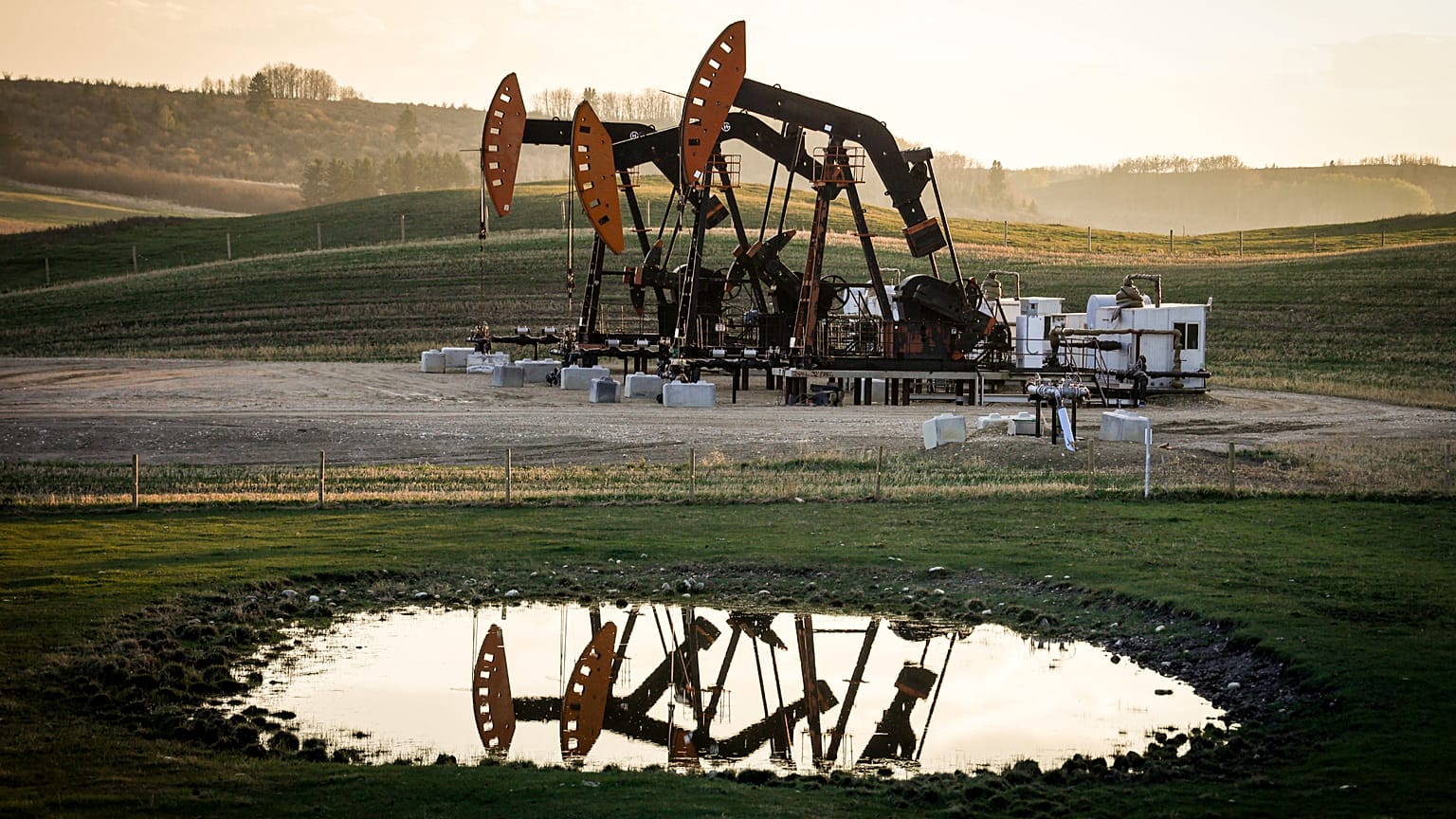
Pumpjacks draw out oil and gas from well heads as wildfire smoke hangs in the air near Calgary, Alberta, May 12, 2024.
Copyright AP Photo / Jeff McIntosh


By Marta Pacheco & Ruth Wright
Published on


Critics say there is a stark contrast between PM Mark Carney's international reputation as a climate champion and his domestic drive to expand oil and gas production.

Last month, European Commission President Ursula von der Leyen made an unexpected offer to Canada: to become the EU's first ever “associate member”.

After pushback on the term from member states, most of all Germany, the EU is now pushing for "ever closer association" with Canada, in the latest draft of a joint declaration due to be adopted at the end of the EU-Canada summit which starts today in Montreal.

There is broad consensus amongst member states on closer cooperation with Canada on areas such as defence, critical raw materials, energy, trade and border security.

Just this week the EU's climate chief has told member states they must prepare for increasingly extreme weather, signalling that the Commission is taking climate preparedness seriously. But what about Canada?

Here we look into Canada's policies on oil and gas, the energy transition, carbon pricing and greenwashing.

What is the Pacific Link oil pipeline?

Since taking office in 2025, Canadian Prime Minister Mark Carney has scrapped key policies which would drive down emissions - such as abandoning a planned cap on oil and gas emissions and weakening industrial carbon pricing, according to global NGOs like Climate Action Tracker and Environmental Defence.

At the same time, Carney's government has made it easier for oil and gas projects to get approval. This includes a proposed oil pipeline - the Pacific Link which will carry one million barrels of oil sands bitumen a day from Alberta to the Pacific Ocean off the coast of British Columbia, threatening the habitat of endangered orcas and could increase greenhouse gas emissions up to 18.7 million tonnes.

These decisions mark a significant departure from the climate credentials Carney cultivated as governor of the Bank of England and as the United Nations' special envoy for climate action and finance.

It also raises questions about whether his ambition to turn Canada into a global energy superpower will come at the expense of the country's climate commitments - and whether additional supplies of fossil fuels could slow the transition to cleaner energy in Europe and Asia.

From climate champion to fossil fuel expansion

Carney has a reputation as a skilled statesman and long-time climate champion. This is partly because of his longstanding warnings about the financial risks of climate change.

In 2015, as governor of the Bank of England, he warned that the consequences of global warming could happen sooner than the timelines used by financial markets and lawmakers.

"The catastrophic impacts of climate change will be felt beyond the traditional horizons of most actors - imposing a cost on future generations that the current generation has no direct incentive to fix," Carney said during a speech at Lloyd's of London.

Carney later helped mobilise financial institutions around net-zero commitments.

As PM of Canada, environmental critics say Carney's agenda prioritises energy production, investment and competitiveness over climate policies designed to reduce fossil fuel consumption.

The changes reach beyond his cancellation of consumer carbon pricing, which made households directly pay for their emissions.

Carney's government has also scrapped the electric vehicle mandate, abandoned the proposed oil and gas emissions cap, weakened the national industrial carbon price and relaxed anti-greenwashing standards. Public transport funding has also been massively cut back.

Taken together, the measures risk weakening both sides of Canada's decarbonisation strategy, climate activists argue, citing incentives to move away from fossil fuels and investment in alternatives.

Carney's government has continued to invest in some clean energy projects, but its emphasis on expanding oil and gas production is creating a tension between its climate commitments and its economic strategy.

New oil and gas projects on a faster track

The clearest expression of that shift is the government's push to accelerate approvals for major infrastructure projects.

The 2025 Building Canada Act created a mechanism to designate projects as being in the national interest and exempt them from certain legal requirements.

The legislation was presented as a way to accelerate projects considered strategically important, including developments in critical minerals, renewable energy, nuclear power, ports and hydropower.

But oil and gas projects have featured prominently in the government's plans.

In September 2026, Carney's government introduced a law that would allow projects to be pre-approved in designated regions of national interest, shorten major project reviews to one year and give a federal minister greater powers to remove environmental conditions attached to previously approved projects.

Environmental groups argue that the legislation weakens safeguards for wildlife and reduces public oversight.

LNG expansion and the global race for gas

Carney's energy strategy also includes expanding Canada's Liquified Natural Gas (LNG) export capacity.

The government has backed plans which could double the facility's export capacity from Canada's west coast. It has also signalled openness to developing gas exports from New Brunswick if the province reverses its fracking ban and establishes a domestic production industry.

Ottawa argues it can provide reliable supplies to international partners seeking to diversify their energy sources. Ahead of the EU-Canada summit this week in Montreal, the two blocs are expected to present a feasibility study on long-term LNG exports to Europe, according to a document seen by Euronews.

For Europe, which has sought to reduce its dependence on Russian fossil fuels, additional supplies from politically stable producers could improve energy security. Asian markets are also potential destinations for Canadian LNG.

But greater availability of gas does not translate into a faster energy transition. New LNG terminals and pipelines require substantial investment and can operate for decades. If they encourage long-term gas consumption or divert capital from electrification and renewable energy, they could slow the transition away from fossil fuels.

Esther Bollendorff, fossil-free program manager at the NGO Climate Action Network (CAN) Europe, said Canada shouldn’t become the EU’s next gas supplier, but a partner in building an affordable and resilient energy future.

The environmentalist said the proposed feasibility study on LNG exports to the EU is a "dangerous distraction" from renewables-based electrification and energy efficiency.

"It risks locking in fossil fuel infrastructure, stranded assets and higher bills for consumers on both sides of the Atlantic, while undermining Europe’s climate goals," Bollendorff says.

Green activists worry that expanding fossil fuel supply can influence the choices available to importing countries, potentially making continued gas consumption more attractive than investing in alternatives like wind and solar.

An energy superpower - but for whose benefit?

Carney has presented fossil fuel expansion as a way to strengthen Canada's economic independence and attract international investment. Yet the ownership of the industry complicates the claim that expanding oil and gas will necessarily translate into greater Canadian economic control.

A report by Canadians for Tax Fairness found that the four largest Canadian oil sands producers are 60 per cent US-owned. LNG Canada is a joint venture involving Shell, Petronas, PetroChina, Mitsubishi and Kogas.

That means a substantial share of the capital and corporate interests behind Canada's energy expansion comes from outside the country.

Carney's argument is that Canada can use its energy resources to strengthen its economic position and reduce its vulnerability to external pressure. But if the industry relies heavily on foreign capital and public support, the distribution of benefits and risks becomes a central question.

Climate targets increasingly out of reach

The retreat from climate policy comes as Canada appears unlikely to meet its emissions-reduction commitments.

According to Climate Action Tracker, planned Canadian policies could reduce emissions by just 14 per cent, well short of the country's target of cutting emissions by 40–45 per cent over the same period.

A September 2026 analysis by the Canadian Climate Institute also concluded that Canada would miss its 2030 emissions target, suggesting the shortfall could persist even towards 2050.

 

Europeans still worry about climate change – but are losing faith in EU green policies

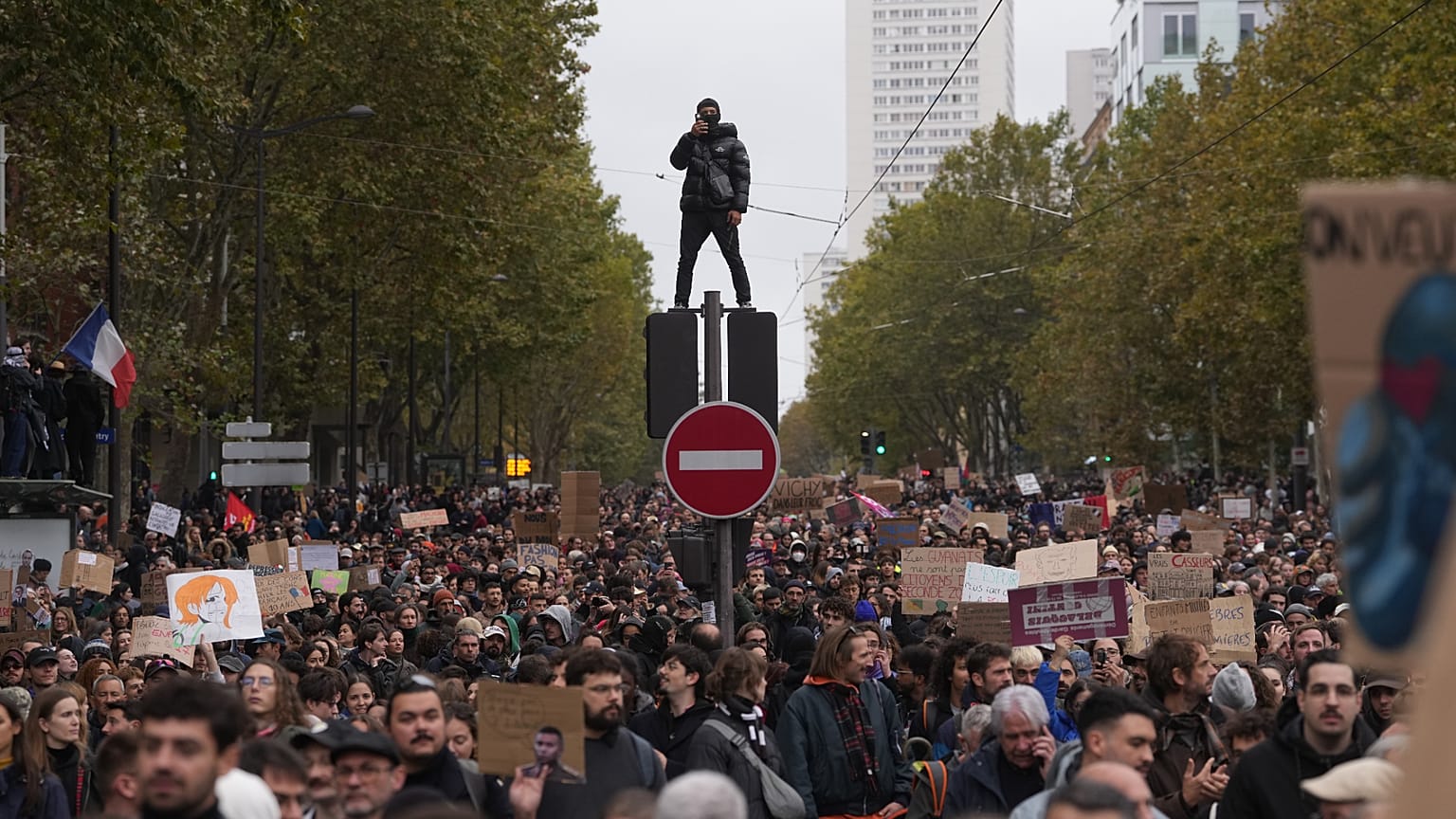
Protesters march during a demonstration against rising living costs in Paris, Saturday, Oct. 24, 2026.
Copyright AP Photo / Thibault Camus

By Marta Pacheco
Published on


A new international poll reveals a widening gap between concern about climate change and confidence in the policies designed to tackle it, as EU governments struggle to reconcile ambitious green targets with mounting pressure to cut energy bills.

Europeans remain concerned about climate change but are increasingly sceptical that existing climate policies are improving their lives, according to a new international poll that exposes growing public frustration with the cost of the green transition.

The survey, commissioned by UK-based research and strategy consultancy Mandate Research, suggests that voters increasingly want governments to prioritise affordable energy over ambitious emissions targets.

Mass protests over the cost of living have erupted in European capitals, including Paris, Brussels, Rome and Lisbon, as households struggle with soaring expenses exacerbated by Europe's energy crisis.

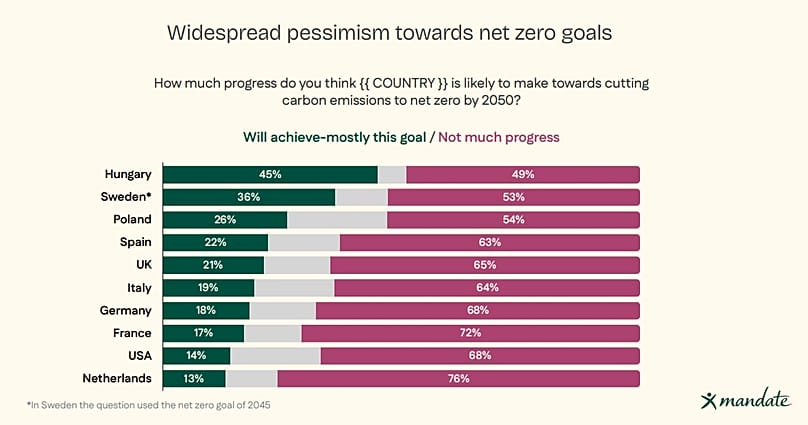
While majorities in all ten countries surveyed – the UK, Germany, France, Spain, Italy, Poland, the US, Sweden, the Netherlands and Hungary – expressed concern about climate change, achieving net-zero emissions by 2050 ranked among their lowest climate priorities.

The findings come as EU energy ministers meet on Thursday to discuss energy efficiency and electrification targets beyond 2030, amid mounting pressure on Brussels to tackle soaring energy prices and reconsider aspects of its climate policies.

The challenge for the EU is increasingly stark: convincing voters not only that climate change matters, but that tackling it will ultimately make their lives more affordable.

In the Netherlands, 54% of respondents said environmental policies had made ordinary people worse off, compared with just 12% who said they had benefited.

The same perception was shared by 46% in Spain, 45% in Germany and France, and 44% in Hungary.

Meanwhile, between 49% and 76% of respondents, depending on the country, considered meaningful progress towards net zero by 2050 unlikely.

Widespread pessimism towards net-zero goals.
Widespread pessimism towards net-zero goals. AP Photo / Mandate

Clean power remains popular

Yet the poll does not suggest that voters want governments to abandon climate action altogether.

Instead, it points to a growing disconnect between public concern about global warming and support for the way politicians have presented the green transition.

Renewable energy remains popular when framed as a means of cutting bills and reducing dependence on imported fossil fuels, rather than as a climate obligation.

Expanding clean power capacity was ranked as the most effective way to reduce energy costs in eight of the ten countries surveyed, ahead of measures such as increasing fossil fuel production or importing more oil and gas from Russia.

In Hungary, 64% believed the shift to renewables would reduce energy bills, compared with 22% who disagreed. In Italy, the figures were 55% and 22%, respectively.

The findings show that voters continue to associate the green transition with financial hardship: climate-skeptic politicians could exploit that frustration to push for weaker targets and delayed implementation.

Fuel hikes threaten climate targets

That tension is already visible in Brussels as immediate economic pressures are beginning to compete with the EU's longer-term climate commitments.

At their 15-16 October summit, EU leaders called for further short-term measures to address soaring energy prices while asking the European Commission to reassess the impacts of the bloc's second emissions trading system, ETS2, which is due to extend carbon pricing to fuels used in buildings and road transport from 2028.

Several governments, led by Italy and backed by the Visegrad Group and Greece, have pushed to postpone the scheme until at least 2030, arguing that it could add to the financial pressure on households and small businesses.

Other countries, including the Nordics, have warned that weakening the system would undermine the predictable investment conditions needed to deliver the transition.

EU leaders ultimately requested an updated assessment rather than agreeing to another delay.

Members of right-wing student groups march through the streets of Rome, Saturday, Oct. 24, 2026, during a demonstration called "Unlock Everything".
Members of right-wing student groups march through the streets of Rome, Saturday, Oct. 24, 2026, during a demonstration called "Unlock Everything". AP Photo / Gregorio Borgia

Post-2030 faces test of political credibility

The debate is likely to shape negotiations over the EU's post-2030 energy and climate framework, as governments consider how to align energy policy with the bloc's binding climate goals, including its 2040 emissions-reduction target and 2050 climate-neutrality goal.

At Thursday's Energy Council, the battle over the EU's post-2030 energy framework is exposing competing visions of the green transition. Ministers discussed potential targets for energy efficiency, electricity interconnection and electrification.

The discussion comes as EU countries seek to reconcile decarbonisation with competitiveness, security of supply and differences in national energy systems.

Calls for more flexible targets and a technology-neutral approach were part of the debate, typically from those countries historically more reliant on fossil fuels. Advocates of stronger climate policies warn against diluting commitments or weakening accountability.

Swedish energy minister Ebba Busch said that an ambitious transition with industrial competitiveness and reasonable energy prices "calls for a paradigm shift".

"If we continue to micro-manage exactly what power source the energy system of Europe should consist of, instead of moving towards steering clearly to overarching targets, we're going to miss what we all agree upon in this room," Busch said.

Cypriot Energy Minister Michael Damianos said the post-2030 framework "will only succeed if targets are realistic, mutually consistent, adequately funded, and simpler to implement".

France and 14 other members of the Nuclear Alliance want a technology-neutral approach that gives nuclear power equal recognition alongside renewables.

Spain, Portugal and Luxembourg are pushing for a dedicated renewable-energy target, while climate campaigners want binding targets and stronger enforcement to prevent greater flexibility from weakening the EU's ambitions.

Despite their differences, most EU governments agree that investment in renewable generation, electricity grids, storage and electrification can reduce exposure to fossil fuel price shocks.

But those investments require time, financing and infrastructure, meaning households may not see the benefits for years.

With several European countries heading to the polls next year, governments face an awkward political calculation: voters want cheaper energy now, while many of the measures designed to deliver it will take much longer to pay off.

Imogen Learmonth, head of the quarterly research programme at Mandate Research, said voters see climate through the prism of “national security, household survival, and national sovereignty”.


How one of Europe’s most polluted cities became a blueprint for nature restoration

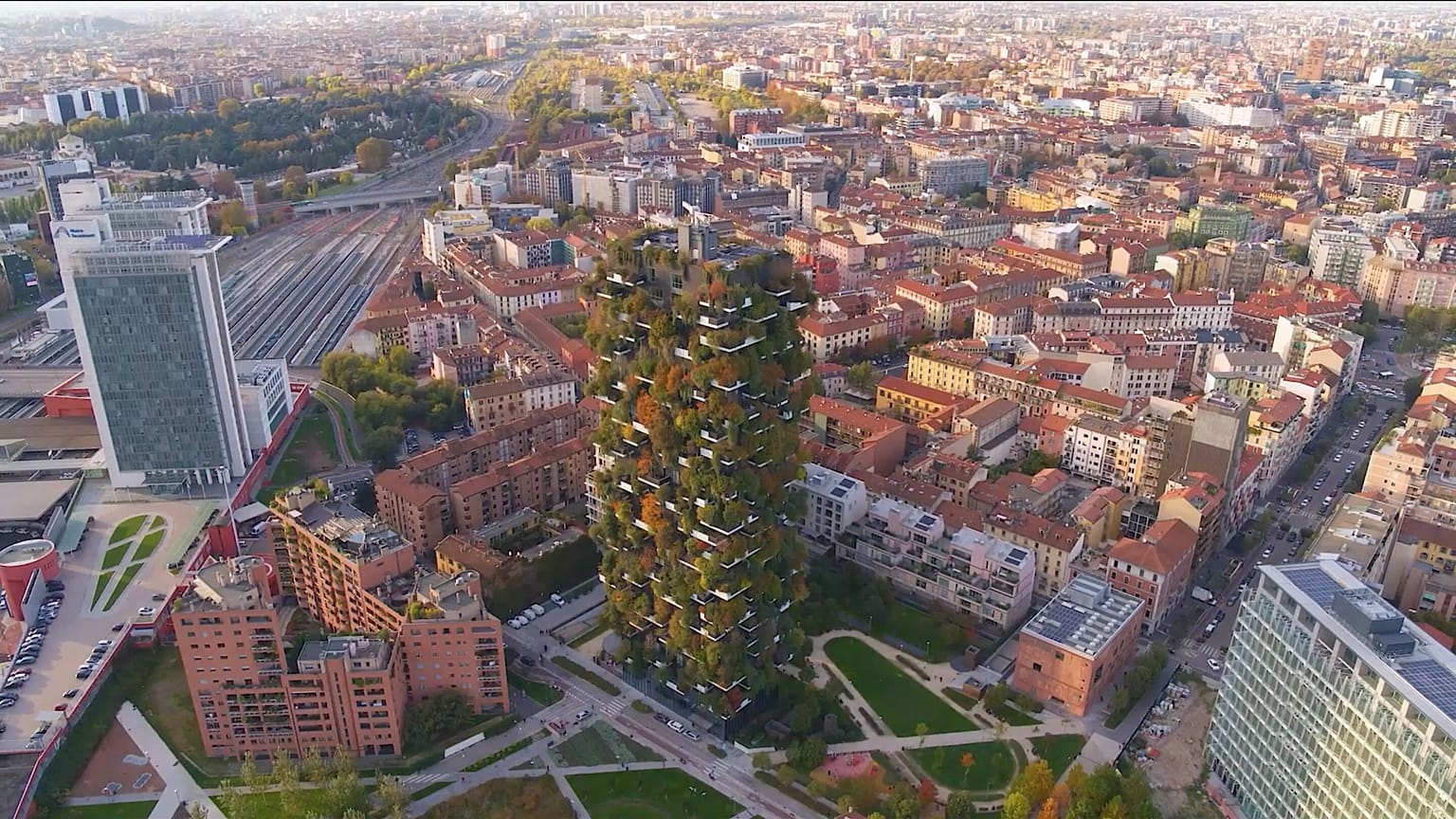
The Bosco Verticale (Vertical Forest) in Milan is a model of a green residential building.
Copyright Forestami - Francesca Russo and Giulia C. Borges

By Angela Symons
Published on


350 football pitches’ worth of degraded urban areas have been restored.

One of Europe’s most polluted cities is getting a verdant makeover. Three million new trees and shrubs will take root in Milan over the next four years, helping to purify its smog-cloaked streets.

An October air quality ranking placed the Italian metropolis seventh in the world’s top 10 most polluted cities – the only European entry on IQAir’s list. This is partly down to its location in the low-lying Po Basin, which limits air circulation, combined with intensive agriculture and emissions as it is an industry-heavy region.

Fondazione Forestami, the organisation behind the project, says more greenery on streets, rooftops and facades is the cheapest and most effective way to filter fine dust, cool the city and improve residents’ wellbeing.

Stefano Boeri, the architect behind the Forestami reforestation project in Milan, Italy
Stefano Boeri, the architect behind the Forestami reforestation project in Milan, Italy UNEP/ Giulia C. Borges

Since it began in 2019, the urban reforestation project has planted nearly 640,000 trees and shrubs, earning its creator – Italian architect Stefano Boeri who built Milan’s famous vertical forest – a European Lung Foundation (ELF) award for his work and commitment to improve air quality.

Now, the project has gained a new accolade: status as a UN World Restoration Flagship. The honour was announced on 29 October during the UN Biodiversity Conference (COP17) in Yerevan, Armenia.

‘One tree for every resident’: Milan one of five new UN World Restoration Flagships

The UN Environment Programme (UNEP) says the title recognises Milan’s efforts to bring nature back into “one of Europe’s most densely populated and polluted metropolitan areas”, by “planting roughly one tree for every resident” and restoring about 350 football pitches’ worth of degraded urban areas.

“The initiative is expanding access to green space, engaging schoolchildren and restoring sites including former industrial areas, parking lots and storage yards,” said UNEP in an announcement.

“The World Restoration Flagships… recognise ambitious and promising examples of large-scale, long-term restoration and contribute to global commitments to restore one billion hectares of degraded ecosystems by 2030.”

Forestami was one of just five projects to receive the title at COP17, and the only one in Europe.

Other recipients include Colombia’s wetland restoration initiative, Urban Nature Reborn; the Green Seattle Partnership, a scheme to restore and maintain the US city’s parklands; Ethiopia’s Great Rift Valley Renaissance, reviving one of the Horn of Africa’s most degraded forest landscapes; and China’s Blue Bay Restoration initiative, a large-scale effort to restore the country’s coastal and marine ecosystems.

Citizens are encouraged to get involved in Forestami's tree-planting initiative.
Citizens are encouraged to get involved in Forestami's tree-planting initiative. Forestami - Francesca Russo and Giulia C. Borges

Nature is making a comeback, UN says – but quicker progress needed

On the same day as the Milan announcement, UNEP published a landmark assessment of global ecosystem restoration progress.

It found that 252 million hectares across 149 countries are being restored – the largest documented global restoration effort to date.

“Today, we are witnessing the makings of one of the largest movements for nature in recorded history,” says Inger Andersen, Executive Director of UNEP. “Yet, at the halfway point of the UN Decade on Ecosystem Restoration, we are still not restoring nature at the scale or speed required.”

There is mixed progress towards the ‘30x30’ goal to protect at least 30 per cent of Earth’s degraded land and sea by the end of the decade.

Restoration of terrestrial ecosystems has reached nearly half the global target, while progress in freshwater, marine and coastal ecosystems – which are degrading at the fastest rates – is lagging. Annual restoration finance, meanwhile, must more than quadruple.

Ecosystem restoration is essential for food and water security, climate resilience and human health.

Restoring just 15 per cent of global priority areas could capture and store 30 per cent of carbon dioxide equivalent emissions since the industrial revolution and help avoid 60 per cent of species extinctions.

Reaching global targets could also generate up to an estimated 32 million new jobs worldwide by 2030, according to UNEP.

“We cannot expect to fix nature with one hand while we destroy it with the other one,” says Astrid Schomaker, Executive Secretary of the Convention on Biological Diversity (CBD) Secretariat, which co-published the report. “Governments must address the drivers of ecosystem degradation and invest in monitoring mechanisms to ensure the durability of the restoration movement to date.”

The report says governments now need to look beyond individual projects and build “restoration economies”, where sustained recovery also supports jobs and livelihoods in the long run.


Under-preparing for severe climate risks can cost the UK far more than over-preparing, experts warn


University of Oxford


Experts in climate, nature, health, national security, and financial risk have joined forces to call for a more integrated approach to government climate and nature risk assessments. In a Comment published in Nature Climate Change, they warn that conflicting advice can give policymakers very different pictures of the severity of the risks ahead, making it harder to judge how seriously to act and how much to spend.

The call comes after a summer that was, provisionally, the UK’s hottest on record, and that ended with almost three-quarters of England in drought. July 2026 was England’s driest July since at least 1836 with 10% of average rainfall. This led to hosepipe bans covering around 30 million people, over 1,100 wildfires, and a winter wheat, oat, and spring barley harvest estimated to be up to 19% below their five-year average.

Deciding how to prepare for climate and nature risks, and how much to spend, draws on two approaches developed for very different purposes. National security assessments consider reasonable-worst-case scenarios, while economic modelling typically focuses on central estimates and cost-benefit calculations. Both inform decisions on fiscal risk, public spending, adaptation, food and security, yet governments generally have no common framework for reconciling them.

Using a reasonable-worst-case approach, a UK national security assessment published in January 2026 concluded with high confidence that global ecosystem degradation and collapse threaten UK security and prosperity. It warned that the world is already experiencing crop failures, intensified natural disasters, and infectious disease outbreaks, and that “every critical ecosystem is on a pathway to collapse”.

Meanwhile, the Office for Budget Responsibility (OBR), which advises Parliament on fiscal sustainability, bases its climate damage estimates on central scenarios rather than reasonable worst cases and can imply that economic consequences are more manageable. In 2024, the OBR estimated that climate damage would leave UK GDP around 5% lower in a scenario where global temperatures rise to just under 3°C by the 2100. Its July 2025 assessment increased that to around 8%, while acknowledging that some potentially severe risks remain difficult to quantify.

The authors say the problem is not unique to the UK. In its 2023 Climate Economic and Fiscal Assessment, New Zealand’s Treasury reported that its modelling suggested the New Zealand economy is “relatively resilient” to more frequent droughts and storms, while the country’s 2023 defence assessment named climate change as one of the two principal challenges to its defence interests. Both fed the same government’s decisions on spending and preparedness, with no shared framework for integrating advice.

Professor Paul Behrens, Oxford Martin School, University of Oxford, said: “Climate risks don’t happen in isolation. This summer’s extreme heat and drought affected farms and food production, put pressure on water supplies and ecosystems, and had consequences for people’s health. Those impacts can ripple out into food prices, infrastructure and the wider economy. Looking at each risk separately can seriously underestimate the overall impact. We need a combined approach where the outputs of risk-assessments and economic modelling can complement one another in a period of increasing crises,”

Drawing on decades of military experience, Lieutenant General (retd) Richard Nugee, of the University of Oxford’s Climate Change and (In)Security Project, describes the importance of a consistent approach to complex risks: “In the military, when planning for future operations or strategies, a well thought through, coherent framework is used to identify all the factors involved, and derive the best, or least-worst, course of action to take.  Given the gravity of the consequences of decisions, it is imperative to have a consistent and comprehensive approach that does not underestimate the challenge, and when the situation changes, so does the plan.” 

Preparing for higher levels of risk need not mean wasted investment. Where potential damage is severe and irreversible, being under-prepared can cost far more than preparing for events that turn out to be less damaging. Some precautionary measures can also bring wider benefits even if the worst-case scenario never materialises.

Professor Nathalie Seddon, Department of Biology, University of Oxford points to the role nature can play in protecting people from climate extremes: “This summer showed how closely the condition of our rivers, soils and ecosystems is tied to food, water and people’s health. Restoring nature is therefore part of preparing for climate risk. Reconnecting rivers to their floodplains, rewetting peatlands and restoring wetlands can slow and store water, reducing flood peaks downstream while helping landscapes hold water through drought and giving wildlife room to recover. These measures can strengthen the resilience of the interconnected social and ecological systems on which we all depend, across a wide range of possible futures.”

The proposed approach would bring expert analysis alongside model estimates, helping decision-makers account for serious risks that are difficult to quantify. It would also bring climate, nature, food, health, economic and security risks into a shared framework, so risks identified in one area are not overlooked elsewhere.

The paper also identifies “no-regret” actions that are worth taking even if the worst-case scenario never happens. Improving energy efficiency, for example, can cut emissions while delivering other benefits, including greater resilience and reduced exposure to some price and supply shocks.

Governments already plan for some severe risks this way. UK pandemic planning has been built around reasonable-worst-case scenarios. 

For climate and nature, the experts say governments should not have to wait for an equivalent shock to find out they were under-prepared.

------------------------ENDS-------------------------

Notes to Editors

Paper: Governments must reconcile dissonant climate assessment approaches, published in Nature Climate Change.

Authors: 

  • Professor Paul Behrens, Oxford Martin School, University of Oxford
  • Dr Jesse F. Abrams, Global Systems Institute, University of Exeter
  • Professor Hugh Montgomery OBE, Department of Medicine, University College London
  • Lieutenant General Richard Nugee CB CVO CBE, former Ministry of Defence climate lead and member of the UK Government's Climate Security Taskforce
  • Professor Nathalie Seddon, Department of Biology, University of Oxford
  • Sandy Trust, Baillie Gifford & Co

DOI: https://doi.org/10.1038/s41558-026-02736-4
Paper link: https://www.nature.com/articles/s41558-026-02736-4

Publication date: 29/09/26

A note on OBR estimates: The Comment cites the Office for Budget Responsibility’s September 2024 figures. In July 2025 the OBR raised its estimate for a scenario of just under 3°C of warming to around 8% of GDP by the early 2070s, drawing on Network for Greening the Financial System scenarios whose damage function rests on a study retracted by its authors in December 2025 and now under revision. The Comment discusses this.

FAQs

1. What evidence is there that relying on average or central estimates can underestimate the severity of plausible climate outcomes?

The paper cites climate modelling showing a wide range of possible outcomes at the same level of warming. At 2°C, severe outcomes in some sectors can exceed the average projected outcome at 3°C or even 4°C. Further details and supporting evidence can be provided to journalists.

2. What important climate and nature risks can be missing from economic estimates used to inform government decisions?

The paper discusses limitations and omissions including catastrophic risks, climate tipping points, sea-level rise, and damage to ecosystems and human health. The authors can explain what these omissions mean and why they matter for decision-making.

3. Does government already have mechanisms for bringing economic, climate, nature and national security risk assessments together?

The paper acknowledges existing whole-of-government approaches but argues that shared methods for integrating these different forms of evidence into mitigation and adaptation decisions remain lacking. The authors can discuss what currently exists, where they see the gaps and how their proposed framework differs.

4. What would change in practice if government adopted the authors' recommendations?

The authors can explain how confidence-tiered expert judgement, different treatment of no-regret and high-stakes decisions, and a shared framework for interconnected risks could affect decisions about preparedness, resilience and public spending.

Media spokespeople: 

Professor Paul Behrens

Professor Paul Behrens is a British Academy Global Professor at the Oxford Martin School, University of Oxford, and an expert on food systems, sustainable diets, climate change and environmental sustainability. His research examines how food systems can be transformed to improve human health, strengthen resilience and reduce environmental impacts in a rapidly changing world.

His work has been published in journals including Nature Food, Nature Sustainability, Nature Energy, PNASand Nature Communications. He is author of The Best of Times, The Worst of Times: Futures from the Frontiers of Climate Science and co-editor of Food and Sustainability. He contributed to the National Emergency Briefing, featured in the People's Emergency Briefing film, and regularly advises policymakers. He was winner of the 2023 Frontiers Planet Prize.

Professor Nathalie Seddon

Professor Nathalie Seddon is Professor of Biodiversity in the Department of Biology at the University of Oxford and Founding Director of the Nature-based Solutions Initiative. Her work focuses on the role of nature-based solutions in social and ecological flourishing and on strengthening the influence of biodiversity science and traditional knowledge on climate and development policy.

She advises governments and the private sector on nature-based solutions and served on the Adaptation Committee of the UK’s Climate Change Committee from 2022 to 2025, where she led its work on the natural environment and agriculture.

Lieutenant General (retd) Richard Nugee CB CVO CBE

Lieutenant General Richard Nugee spent 36 years in the British Army in joint, single-service and international appointments. He led work on the Ministry of Defence's Climate Change and Sustainability Strategic Approach before becoming the MOD's Non-Executive Director for Climate Change and Sustainability in 2021.

He previously served for four years as Chief of Defence People and is currently a Non-Executive Member of the Defence Safety and Environment Committee. He is also a member of the UK Government’s new Ministerial Taskforce on Climate, Nature and Security.