“Politicians like Haley Stevens always had more in common with Republicans like Mike Rogers and Donald Trump than with the Democratic base,” said House candidate Darializa Avila Chevalier. “And now she admits it.”
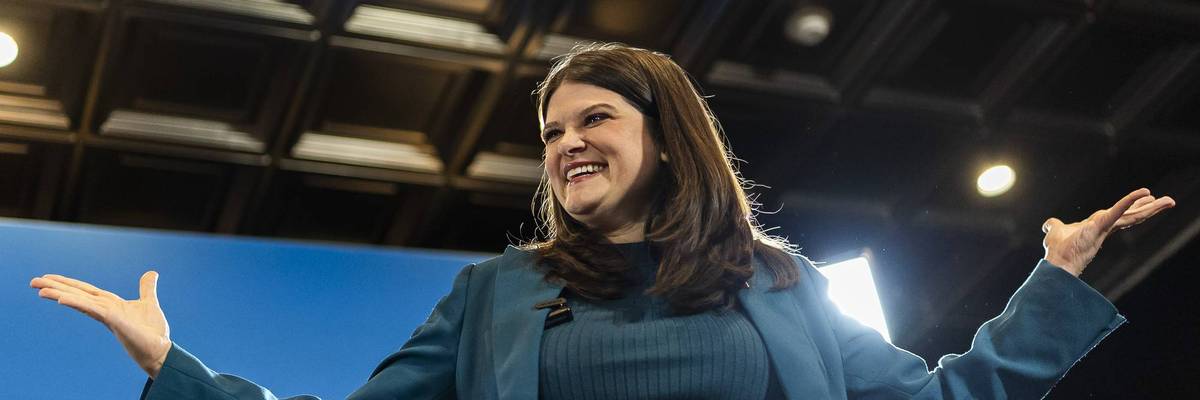
US Rep. Haley Stevens (D-Mich.) speaks on August 4, 2026 in Detroit, Michigan.
(Photo by Finn Gomez/Getty Images)
Julia Conley
Nov 01, 2026
COMMON DREAMS
Rep. Haley Stevens, the pro-Israel Democratic congresswoman who was backed by top party leaders, establishment figures, and tens of millions of dollars from the American Israel Public Affairs Committee and other outside groups in the primary race earlier this year, suggested Sunday that being disinvited from campaigning with Michigan’s Democratic US Senate candidate, Abdul El-Sayed, was all it took to convince her to endorse his Trump-allied Republican opponent, former Rep. Mike Rogers.
But one former Obama administration adviser Ben Rhodes said this weekend that Stevens’ alignment with the Republican was the “logical endpoint” of her politics after months of attacking El-Sayed for his critical views on US military aid for Israel—views that are now shared by a majority of US voters after more than three years of Israel’s relentless assault on Gaza.
Stevens announced her endorsement in a video posted online after she appeared with Rogers at Perfecting Church in Detroit, where she asserted that the Republican would support investments in Black-owned businesses—a ploy, said Melat Kiros, a Democratic congressional candidate in Colorado, to use Black voters “as a prop to embrace a racist who will do nothing but rubber stamp this fascist administration.”
“Abdul was very clear. He said, ‘Don’t come,’” said Stevens, standing next to Rogers at the press conference where she was called “traitor” by one bystander. “When it really comes down to it, this is how I’m casting my ballot.”
She added that “nothing’s perfect” when asked why she was supporting a candidate who “stands so firmly for some of the policies that you’ve stood so firmly against.”
Rep. Debbie Dingell (D-Mich.) made clear Saturday that she, not El-Sayed, had directly asked Stevens to stay away from the candidate’s events in the last days of the campaign after Stevens put out a statement criticizing El-Sayed’s position on Israel. She told CNN: “I’m the one. I am the one that talked to Haley. And I am the one that said this isn’t working.”
On Sunday, Dingell issued a brief statement saying that she, El-Sayed, and Michigan Democrats are “focused on electing Democrats up and down the ballot” instead of Stevens’ “continued efforts to get attention.”
The political action committee American Priorities, which was established to counter AIPAC’s funding of Republicans and Democrats who support Israel, said that with Stevens’ choice, “what’s been clear to us all along is now plain to see: AIPAC and its candidates, including this failed primary one, are committed to electing Republicans.”
“Every Democrat should be crystal clear on what AIPAC is and is not: It is an outside interference in Democratic politics, not a legitimate stakeholder in the party’s future,” said the group.
Stevens’ endorsement came a day after reproductive rights advocates highlighted a recent interview Rogers did with WMUZ radio host Bob Dutko, in which he affirmed he would support a nationwide abortion ban.
“You don’t even have to think about it twice,” said Rogers on Thursday. “I mean, I feel I’ve been very open about all of those issues, including for the time I was in Congress having a 100% pro-life rating... This is the only way that I know how to be when I go back to the United States Senate.”
Stevens’ appearance with and endorsement of Rogers capped the congresswoman’s months of political attacks on El-Sayed, a progressive who has also made Medicare for All a key part of his platform.
El-Sayed’s positions on the Middle East and the human rights of Palestinians, Stevens and other pro-Israel politicians and groups have claimed, threaten the safety of Jewish communities in Michigan—despite the fact that 61% of Jewish Americans last year expressed agreement with leading human rights groups and Holocaust experts, saying in a Washington Post poll that they believed Israel’s US-backed military had committed war crimes in Gaza.
El-Sayed has repeatedly spoken about protecting Jewish communities from acts of antisemitism, and his campaign is engaging directly with Jewish voters on the issue in the final days of the race. Meanwhile, Rogers has joined President Donald Trump in waging anti-Arab and Islamophobic attacks against El-Sayed, accusing him of being aligned with the Muslim Brotherhood and standing alongside Trump at rallies where the president has openly called the Michigan-born candidate, whose family immigrated to the US from Egypt, a “jihadist.”
During the primary, Stevens spent weeks condemning El-Sayed for campaigning with another Arab American, popular streamer and Israel critic Hasan Piker. Last week, nearly three months after losing the primary, she demanded the candidate apologize for statements made in a digital ad by an outside group, which criticized the use of taxpayer dollars to fund Israel’s military.
On Sunday, her appearance with Rogers reportedly led to the collapse of her own political operation, with her chief of staff and other aides abruptly resigning.
El-Sayed was asked about Stevens’ actions, but reiterated his focus on securing a federal government that serves the needs of Michiganders and other families across the country, saying: “At the end of the day, I actually don’t think about Haley Stevens. Because you know what? I’m just less interested in the politics of it all than I am in the policy of it all.”
Jesse Brenneman, an editor for the podcast “Know Your Enemy,” expressed hope that “this debacle drops the blinders from many eyes and allows people to see things clearly.”
“The Democratic establishment is not primarily concerned with winning elections. It is concerned with preserving its power and pushing certain outcomes,” said Brenneman. “They are usually more subtle than this, but when push comes to shove they will explicitly blow things up to serve this end. They don’t want majorities full of popular politicians, unless those politicians serve the interests that they care about.”
Stevens’ decision, said congressional candidate Darializa Avila Chevalier, who is running in New York’s 13th District, showed “that politicians like Haley Stevens always had more in common with Republicans like Mike Rogers and Donald Trump than with the Democratic base. And now she admits it. That’s why it’s so important to run democratic primaries. It’s not enough to send Democrats to Washington, we have to send Democrats who are fighting for the things working-class voters want!”
Stevens’ alignment with Rogers and Trump would leave Democrats across the state “feeling even better today about nominating Abdul El-Sayed to fight for our working-class families,” said Rep. Rashida Tlaib (D-Mich.), the only Palestinian American in the US Congress. “Three days to go, let’s tune out this nonsense and turn out the vote. Let’s make sure Haley loses to Abdul twice.”
After Stevens’ Latest Attack, El-Sayed Reiterates Focus on ‘Beating Mike Rogers’ in Final Weekend of Campaign
“Our campaign is and has always been focused on addressing the most critical challenges Michiganders are facing: skyrocketing gas prices, unaffordable groceries, and the inability to see a doctor.”

Democratic US Senate candidate Abdul El-Sayed speaks with supporters after a midterm campaign rally in Grand Rapids, Michigan on October 25, 2026.
(Photo by Jeff Kowalsky/AFP via Getty Images)
Julia Conley
Oct 31, 2026
COMMON DREAMS
After issuing a brief statement in response to Rep. Haley Stevens’ demand that he apologize for the views he’s expressed—in line with a growing majority of Democrats—that are critical of US funding for Israel, Michigan’s Democratic US Senate candidate, Abdul El-Sayed, headed into the final weekend before the midterm elections with the same focus he has maintained throughout his campaign.
“While Congresswoman Stevens seems intent on relitigating a primary that ended three months ago,” said El-Sayed, “let’s all focus on the task at hand: That’s beating Mike Rogers, holding [President Donald] Trump accountable, and getting money out of politics, putting money in pockets, and passing Medicare for All.”
The statement followed Stevens’ latest attempt to suggest that El-Sayed’s candidacy has threatened Jewish communities, by tying him to an anti-Rogers ad by an outside group, Rebellion PAC, that addressed how the billions of dollars and political support the US provides to Israel each year costs Americans. The Trump administration has publicly said the US launched its illegal war on Iran after being pushed to do so by Israeli Prime Minister Benjamin Netanyahu—a decision that has markedly worsened the affordability crisis for Americans.
El-Sayed’s campaign has said the digital ad does not “speak for” the progressive candidate, while others have pushed back on the claim by the vehemently pro-Israel Stevens and pro-Israel groups that the video is antisemitic, noting that it says nothing about Jewish people.
In his statement Friday evening, El-Sayed appeared to have little interest in engaging with Stevens further regarding persistent accusations by corporate Democrats who have claimed he hasn’t done enough to reach out to Jewish communities, whom his campaign has been speaking with extensively about fighting antisemitism and their views on Israel at “deep canvassing” events.
“Our campaign is and has always been focused on addressing the most critical challenges Michiganders are facing: skyrocketing gas prices, unaffordable groceries, and the inability to see a doctor,” said El-Sayed, noting that his message had allowed him to win the primary in August despite “a historic $70 million in outside spending by big corporations” and the pro-Israel lobby on behalf of Stevens.
Two sources told Politico that El-Sayed’s campaign was asking Stevens not to campaign with him in the final weekend, which the congresswoman had begrudgingly said she planned to do in her statement demanding an apology from the candidate.
But El-Sayed himself was applauded by progressives for “holding firm and ignoring the whines and threats of extremists,” as art director Lindsay Ballant said.
“For those folks demanding that El-Sayed condemn that ad, he isn’t playing your stupid game,” said another observer. “He understands that whatever he does, it won’t be enough. There will always be another demand. So take your cudgel somewhere else.”
Even if El-Sayed took time away from the statewide door-knocking tour he had planned for the weekend to address Stevens’ demand, podcaster and former Obama administration staffer Tommy Vietor asserted that “people would then say he didn’t condemn it firmly enough.”
“The guilt by association shit is endless,” said Vietor. “Meanwhile, Abdul is literally being called a jihadist by the president of the United States!”
Rep. James Clyburn (D-SC) and Sens. Elizabeth Warren (D-Mass.), Elissa Slotkin (D-Mich.), and Angela Alsobrooks (D-Md.) are set to join El-Sayed at the “Knock Out the Vote” canvassing event from Saturday through Monday.
NYT columnist exposes grim warning behind a wild new political betrayal
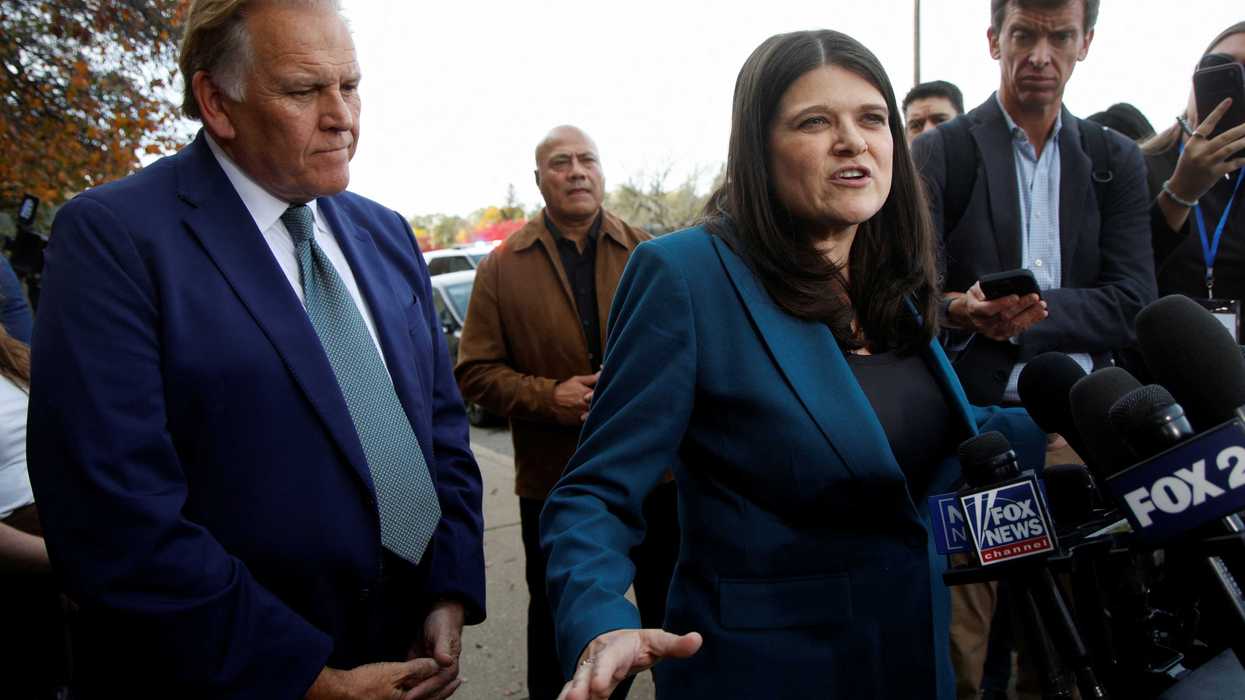
Rep. Haley Stevens, a Michigan Democrat, speaks with the media next to GOP Senate candidate Mike Rogers after attending the Perfecting Church in Detroit, Michigan, November 1, 2026. REUTERS/Rebecca Cook
Rep. Haley Stevens, a Michigan Democrat, speaks with the media next to GOP Senate candidate Mike Rogers after attending the Perfecting Church in Detroit, Michigan, November 1, 2026. REUTERS/Rebecca Cook
November 01, 2026
ALTERNET
The midterm political landscape was rocked this weekend after failed Democratic Senate candidate Haley Stevens broke rank to endorse the race's Republican nominee, and as one prominent New York Times columnist explained, exposed a dire warning about self-serving political aspirants in the process.
Stevens, the Democratic U.S. Representative for Michigan's 11th District, lost the Democratic nomination for her state's Senate seat earlier this year to Abdul El-Sayed, who polling now suggests has a slight edge over Republican nominee Mike Rogers. Despite previously claiming that she would support El-Sayed's candidacy, Stevens had, in recent days, seemed to have become less committed to the idea, before ultimately announcing her endorsement of Rogers on Sunday, just two days out from election day.
Stevens dispute with El-Sayed largely seemed to stem from his critical posture towards Israel, and her break from supporting him appeared to come in response to a controversial ad for his candidacy released by a third-party outfit, which El-Sayed has since disavowed.
Discussing the messy incident on his official YouTube channel, liberal Times columnist Jamelle Bouie offered his take on the psychology underpinning Stevens' decision, arguing that she had exposed how little she truly stands for anything besides her own political advancement.
"Stevens doesn't really seem like she believes anything," Bouie said. "It just seems like she felt that she was entitled to the seat, entitled to the nomination, felt that that was the obvious next step for her and really took it hard; could not reconcile her defeat with her image of where she thought she would be. I think also there's a bit of just bigotry: she can't believe that she lost to a Muslim man, to an Arab Muslim man, and is still full of pique about that."
Returning to that idea later in the video, Bouie argued further that Stevens was now a "cautionary tale" to voters about the dangers of political actors who are not truly devoted to anything but themselves.
"To my mind this is a great example of the problem with candidates who don't seem to really believe anything, who seem only to be running to advance their careers, and who are unable to make themselves subordinate to a larger cause," Bouie said. "Stevens clearly thought that this whole story was about her, and now that it isn't, she is lashing out in a way to make it about her. The story may end up being about her, but in as much as it becomes a cautionary tale about people like Haley Stevens, and I think at a time when Democrats were trying to make their final push, trying to build unity, this actually might be the thing that did it, because now everyone is united in a simple message, which is that Haley Stevens sucks."


