It’s possible that I shall make an ass of myself. But in that case one can always get out of it with a little dialectic. I have, of course, so worded my proposition as to be right either way (K.Marx, Letter to F.Engels on the Indian Mutiny)
Monday, November 02, 2026
Ex-Trump Air Force chaplain issues eye-popping warning on 'religious tyranny'
On Friday, a chaplain who served in the U.S. Air Force Reserve Chaplain Corps during President Donald Trump’s first term warned that Americans must reject the Trump administration’s “religious tyranny.” According to theologian Leigh Larson, Trump and his Christian nationalist allies seek to “illegitimize” any religion but their own.
“I served in the U.S. Air Force Reserve Chaplain Corps as a chaplain candidate during Donald Trump’s first term as president,” writes Larson for Baptist News Global. “I was endorsed through the Disciples of Christ denomination and under their faith code, ‘GE.’ That faith code is now gone.” As she elaborates, earlier this year, Secretary of Defense Pete Hegseth had the number of faith codes recognized by the department cut from more than 200 to 31. These codes, Larson asserts, are about more than mere bureaucracy. As she writes, “Not only do they allow for religious accommodations such as diet and appearance, but the code tells a commander who to call when someone is dying, guidance on holy days, burial and which chaplain gets matched to the soldier for spiritual care. As a chaplain candidate, I understood the faith listed on a dog tag to be the last bit of human freedom a soldier can enjoy in the military. While they are still free to list whatever faith on the dog tag, the bureaucratic paperwork used for advocating for accommodations now will be much narrower.”
The new system now lumps all Christian denominations, for example, under one label, identifying “Catholic,” “Methodist,” or “Lutheran” as the same, regardless of their ideological nuances. Another glaring example: the Southern Baptist Convention and the Progressive National Baptist Convention now both fall under “Baptist,” even though these are two radically divergent denominations, along with the other nearly 30 Baptist-related bodies from the list prior to trimming. The code change also gave the Church of Jesus Christ of Latter Day Saints a code separate from “Christian,” which prompted objections from MAGA Senator Mike Lee (R-UT), who told the Pentagon to “not just reconsider it but undo it.” He urged Secretary of Defense Pete Hegseth to “tear down that wall. This is not cool. Get rid of it — get rid of it now.” The following day, the code list was revised to include Latter-day Saints as “Christian.”
These changes make it clear, writes Larson, that “the state is serving as a theologian and magistrate, defining who is and who is not Christian. Baptists should buck at this notion.” She points to an essay published just after the code changes – Bill Leonard’s “First They Came for the Mormons” – in which he argued the government shouldn’t define a group’s religious identity. “Baptists once were the unrecognized minority in America, forming their own haven of dissenters in Rhode Island, with the first Baptist church in America coming shortly after,” explains Larson, citing theologian and Rhode Island founder Roger Williams, who argued in 1644 that the state had no business sorting true faiths from false ones, urging that “a permission of the most Paganish, Jewish, Turkish, or Antichristian consciences and worships, be granted to all men in all Nations.” According to Larson, “This is about soul freedom and soul competency. Every individual has the competency of soul and the freedom to develop their own conscience.”
While some have claimed that code eliminations are mere acts of administrative consolidation, Larson notes that the change bureaucratically erased scores of religions. As she warns her Baptist audience, “They folded my code (Christian – Other), and yours (Christian – Baptist). Non-Christians, including Wiccan, Unitarian Universalist and Humanist are folded into ‘Other Religions,' and atheists are now no religion. It is concerning that a government that can erase recognition by memo can illegitimize anyone’s.”
There is, however, a solution. According to Larson, “To ensure that the commonwealth protects everyone’s conscience, not about which theology defines it, it will require congressional oversight of the office through the National Defense Authorization Act, regular and accurate auditing of the chaplaincy and force’s beliefs, and institutional policies that reflect the needs of the force.” After urging her readers to join the fight, she concludes, “Protecting religious liberties from religious tyranny and state theological abstraction is about as American, and as Baptist, as it gets.”
Retired general tears Trump apart for forcing 'Holy War' on the military
While Republicans are trying to ban "Sharia Law," President Donald Trump's administration is trying to bring its own version of it to force on the U.S. military.
Sharia is Islamic religious law derived from the Quran and the teachings of the Prophet Muhammad. It guides Muslims’ personal conduct, worship and ethics and, in very few countries, it can control aspects of civil or criminal law. Retired Gen. Mark Hertling can't help but think that Secretary of Defense Pete Hegseth is bringing his own brand of Christianity and forcing it down the throats of every soldier for what he believes is some kind of holy war.
On MS NOW, the conversation turned to Hegseth's recent announcement that he's creating a new Pentagon office to “elevate spiritual readiness." Hegseth has a "menu of options" listing out various religions that military members must identify as.
In a memo in May, Military.com reported that 180 faiths were cut from the list of "recognized religions" in the military. Things like Humanism, Deists, Spiritualists and Unitarian Universalists were cut. While there were once 211 acceptable religions to identify as, there are now 31.
“The Department of War protects the constitutional right of every service member and civilian employee to practice their faith without coercion or discrimination,” Pentagon press secretary Kingsley Wilson told MS NOW. “Despite the Left’s efforts to remove our Christian heritage from our great nation, Secretary Hegseth is among those who embrace it.”
Hertling said the whole thing made him confused.
"I've commanded soldiers of every religious background, including those with no religious beliefs at all. And one of the most important things a leader has responsibilities to do was to make sure every single soldier, sailor, airman, marine feels respected and valued as members of the team," said Hertling.
"Faith is important to soldiers, and so is if they don't have any faith at all. And it's particularly true in combat," the retired general explained. "The military has always protected their right to practice the faith of their choosing. But there's a profound difference between religious freedom and religious favoritism. And that's what the secretary of defense seems to be doing right now. He has a way of worshiping, and god bless him for it. You know, I'm a Christian, and I don't know of anyone who's trying to get Christianity out of the military."
He said that every member of the U.S. armed forces deserves to practice whatever faith they want.
"And I think that we're seeing a real lien by the secretary of defense, one individuals who is trying to persuade people to do a certain kind of faith, which he agrees with. And that's really unfortunate," Hertling continued.
Host and reporter Ayman Mohyeldin sees it as an extension of the Trump administration's agenda to invoke Christian nationalism into government strategy and philosophy.
"They have invoked this kind of white nationalist imagery in the way they recruited people to the Department of Homeland Security," he recalled. "They've tried to characterize and evoke this imagery with the immigration operations that they're using here domestically. We've all seen the pictures of the president with the prayer services and the various evangelical pastors with their hands on him. He's tried to anoint himself as a messenger of God, acting on behalf of Christianity in this country, which I think is very dangerous to the larger issue."
Hertling added that the whole thing plays right into the hands of Islamic extremists who believe they are in a holy war against the Christian West. When Trump and Hegseth try to craft the military into some kind of soldier for Jesus it is quickly used by the extremists to recruit into terrorist groups.
"And it also makes the job of our allies in the region who are predominantly Muslim that much harder," he added.
Evangelicals revolt against Trump's 'culture of death'
A prominent group of conservative Christians are denouncing President Donald Trump's top military official, Secretary of Defense Pete Hegseth, for ordering that convicted terrorist and mass murder Nidal Malik Hasan — who committed the 2009 Fort Hood shooting that led to 13 deaths and 32 injuries — be executed publicly by firing squad. It is the first public execution in modern American history.
"The National Association of Evangelicals (along with several other religious groups) are now joining the USCCB in condemning Defense Sec. Pete Hegseth’s plans to publicly execute Nidal Malik Hasan, also saying doing so promotes a 'culture of death,'" reported journalist Jack Jenkins of the religious news outlet RNS on Friday.
In an excerpt from his report, Jenkins wrote that "Walter Kim, president of the National Association of Evangelicals, told RNS that while he affirms the 'need for justice' regarding Hasan’s crime, 'at the same time, a live-streamed execution by firing squad risks turning one of the state’s most solemn responsibilities into a public spectacle, promoting a culture of death, rather than a culture that upholds the dignity of every human being.'"
Evangelical Christian organizations are not alone in slamming Trump and Hegseth for choosing to publicly execute Hasan. On the social media platform X, prominent commentators from all sides of the political spectrum expressed disgust with the decision.
Billy Binion, reporter for the libertarian magazine Reason Magazine, posted, “This is sick. You can support justice for Nidal Hasan’s victims without making his execution a source of entertainment. This administration so often governs for the online mob. It’s depraved.”
Glenn Greenwald, formerly of The Intercept and ideologically heterodox, argued, “There are a very small number of countries that still carry out public executions. Those are the countries we are constantly told are uniquely primitive, barbaric, sick and evil. It’s revealing that Pete Hegseth wants the US to join that group but also entirely unsurprising.”
Wajahat Ali of the liberal Substack The Left Hook stated, “Public lynchings will be next.”
"Since January 2025," Michael N. Schmitt, a law professor at New York University, wrote for Just Security in June, "the Defense Department has removed, replaced, or forced the early retirement of a remarkable concentration of operationally experienced senior officers. Among them are the chairman of the Joint Chiefs, the chief of naval operations, the chief of staff of the Army, and the commander of U.S. Cyber Command, who concurrently serves as director of the National Security Agency. Most recently, Gen. Christopher Donahue, one of the most decorated and combat-experienced officers of his generation, has been forced out as commander of U.S. Army Europe and Africa and, in his NATO (North Atlantic Treaty Organization) role, as commander of Allied Land Command. Public explanations have been sparse and, to the extent they have been offered, largely general."
Schmitt added, "The question regarding these departures is not whether the president and secretary of defense have broad lawful authority to reshape the senior officer corps. They unequivocally do. Nor is it a question of whether personnel decisions of this kind are ever warranted. Sometimes, they certainly are. Instead, at its core, a central question is their impact on the combat effectiveness, indeed the lethality, of our armed forces."
The New York Times reports that once formidable law firms have gone lapdog after striking deals with President Donald Trump in his second term.
Attorney Norm Eisen, a leader of the legal resistance against Trump’s Constitutional incursions, is finding that white shoe law firm Paul Weiss chairman Brad Karp is now keeping its head down and refusing to offer advice as Trump maneuvers to interfere in the midterm elections.
“He was one of the greatest champions of voting and civil rights — and for democracy — in the country, and to have someone like that advising you, resourcing you and fighting for you was indispensable,” Eisen told the Times
But Paul Weiss was one of nine firms that struck deals with the administration to avoid Trump’s threat of crippling executive orders stripping progressive law firms and individual lawyers’ federal contracts and security clearances. Now the company is effectively neutered and sidelined, according to Eisen and a lawyer with direct knowledge of the matter.
“The void left by Paul Weiss is only a sliver of the impact of the deals the nine firms made with Mr. Trump early in his second term,” reports the Times. “In exchange, they pledged to do nearly a billion dollars in free legal work to causes Mr. Trump champions, casting doubt on whether they would be willing to stand up to the president.”
The Times notes that the final stretch of the midterm elections offers clues into just how much damage Trump did to the American legal system by brandishing threats from the White House. Once the go-to firms for legal advice and work against democratic threats, few of the nine firms are now publicly involved in the major legal efforts to “check Trump and his administration’s attempts to meddle,” according to a review of public documents and interviews with democracy advocates, election lawyers and voting rights litigators shows.
In fact, critics say the deafening silence from what was once democracy’s most able champions has raised worries about whether the legal profession is equipped to respond to the bullying Trump administration, which the Times reports has “already begun to file litigation intended to sow confusion about the outcome of the election.”
“Some of the firms have scrubbed their websites of their storied histories working on voting rights cases. At one firm that made a deal with Mr. Trump, several lawyers are quietly volunteering to help voting rights causes, hoping that their bosses do not find out, according to a lawyer at one of the firms who spoke on the condition of anonymity,” reports the Times.
Worse, interviews with attorneys suggest Trump’s chilling effect on big name firms has extended to several top 100 U.S. firms that did not cut deals with Trump. According to interviews, neighboring law firms now fear being similarly targeted, and they have avoided politically sensitive cases that draw Trump’s ire.
“I’ve been told, ‘We don’t do civil rights work involving the administration anymore,’ and, ‘We don’t do voting rights work anymore,’’’ said John Powers, the legal director at the Advancement Project, which litigates voting rights cases by joining with better-financed private firms.
Most recently, the Times reports that when the Advancement Project filed suit with the N.A.A.C.P. against some of the Trump DOJ’s election-monitoring tactics, it had to initially do so on its own without a private partner.
“In some cases, Mr. Powers added, partners at firms working with the Advancement Project pulled back their support, dropped out entirely or agreed only to help on the condition that they not be named publicly,” reports the Times.
“All too often we’re having to find workarounds because we don’t have the support,” Powers told the Times.
The Times added that Paul Weiss and seven other firms “did not respond to questions asking for examples of voting rights cases or other matters the firm is working on in opposing the administration.”
The 1972 chart that explains why America hasn’t completely collapsed yet
In a politically polarized American electorate, it can be hard to find bipartisan consensus on many issues. Ahead of the US midterm elections, however, there is one thing almost everyone can agree on: concern about government corruption.
A record 89% of Americans recently said in a Gallup poll that government corruption is widespread, with Republicans, Democrats and independents all in agreement (ranging between 83-91%). This marks a significant increase from 73% in Gallup’s polling from 2024.
Out of 132 countries Gallup polled on the question since 2023, only four have recorded higher overall levels of concern: Lebanon and Peru (both 92%), and Ghana and Nigeria (both 90%).
As much as cost of living issues have defined much of the recent campaign rhetoric, a recent Fox News Poll found that concern about corruption in government (88%) ranked higher among voters than inflation (85%) or gas prices (83%).
A CNBC survey similarly found government corruption to be the most important issue facing the country, above any concerns about the economy.
And according to the ad-tracking firm AdImpact, of the US$11.6 billion that will be spent in political advertising this election cycle, more than US$275 million has gone to corruption-themed ads – around US$173 for Democrats and US$93 for Republicans.
Who do Americans blame?
As much as Democrats point to the unprecedented gifts from foreign governments to the Trump family and the massive expansion of the Trump family wealth during Donald Trump’s second presidential term, Americans are by no means exclusively blaming the Trump administration for corruption.
When the Brennan Center for Justice, a voting rights organisation, asked a representative sample of 2,000 Americans this year whether certain individuals or institutions were corrupt, respondents had negative views across the political spectrum. These included view about Congress (85%), Trump (68%), Joe Biden (63%) and the Supreme Court (62%).
And when asked whether this is a problem driven by individuals making unethical choices or a problem “deeply embedded in the institutions of the US government”, about two-thirds of respondents chose the latter. Only 7% said they were not concerned about corruption influencing elected officials.
This does not appear to be a new phenomenon. Levels of trust in American politicians, political parties, news media, government institutions and even the “American people” have been declining since Gallup began polling on the issue in the 1970s. And they’ve hit record lows in recent years. While 86% of Americans trusted the American people in 1976, today barely half do.
Adding further nuance to this issue: Gallup also highlights the significant gap between American perceptions of corruption in government (89%) versus corruption in business (71%). The survey says few countries have gaps this large.
And, interestingly, this public perception of corruption does not trickle down to local politics.
In another survey by YouGov many more respondents deemed US senators and representatives to be corrupt (75%) than mid- or low-level government workers (39%).
This gets to an important reason why such high levels of distrust in institutions have not led to more unrest: Americans still appear to have trust in their local governments.
And this has largely not changed since Gallup first polled on the topic more than 50 years ago. Today, two-thirds of Americans trust their local government, which is actually slightly higher than the 63% who did in 1972.
On the whole, Americans also retain trust in the ability of elections – like the midterms – to act as political circuit breakers.
What about the midterms?
Candidates running for office this year have taken note of the deep voter distrust in Washington elites, parties and institutions.
One need only watch a few of the many viral political ads this campaign to see a well-worn script: candidates blame Washington insiders for corruption and other issues, while touting their local bona fides.
It should come as no surprise that many candidates are eschewing party labels altogether, often going so far as to criticisetheir own party.
But this is not the first time politicians of all stripes have appeared keen to distance themselves from the ruling class, and from political insiders viewed as corrupt and detached from the everyday realities of most Americans.
After all, with the exceptions of Biden and George H.W. Bush (both former vice presidents who served under popular two-term presidents), every US president of the last half century has come to the Oval Office with fewer than five years of experience in Washington – if any.
Americans have largely been against Washington insiders for decades – particularly when economic anxiety is high.
Yet what’s different in this year’s midterm elections is how many are trying to fuse corruption with that economic anxiety. Not since the 2006 midterm elections has corruption been such a prominent theme in an election.
James Talarico, the Democratic hopeful for the Senate in Texas, has said on the campaign trail, “we have an affordability crisis because we have a corruption crisis”.
And in Georgia, Democratic Senator Jon Ossoff routinely tells voters “corruption is why things don’t work for ordinary people.”
These Democratic efforts follow similar efforts by Republicans to portray Democrats as the more corrupt party costing American taxpayers money.
Elon Musk’s Department of Government Efficiency, for instance, sought to target what it called “waste, fraud and abuse”. And Republicans in Minnesota have highlighted a welfare-fraud scandal that essentially forced Democratic Governor Tim Walz to abandon his plans for a third term of office.
It’s unclear whether these sorts of accusations will inspire the political backlash that other issues – namely abortion, immigration and the economy – have in past elections.
However, Democrats do have one advantage in the midterms. They are currently seen as the preferred party (by 10 percentage points in recent polling) to fight corruption. This explains why they are spending nearly twice as much on ads about corruption than Republicans.
However, should Democrats be successful and take control of Congress, they will be expected to act on this issue, and not just become part of the ongoing problem.
Polling is looking grim for Republicans ahead of the U.S. midterm elections on Nov. 3, 2026, due in large part to deep pessimism among the public about the economy.
This has prompted a debate over whether mere “vibes” are in play, or whether these long-used metrics are no longer capturing something fundamental to Americans’ economic well-being.
This debate matters politically because voters are placing an overwhelming priority on the economy as an issue in the midterms. A Pew Research survey in early October 2026 found that 84% of registered voters said the economy was very important to their vote, and the concern is bipartisan. Among the issues in that Pew survey, for example, “the economy” was the least polarizing, with 82% of Republicans and 88% of Democrats ranking it as very important.
Meanwhile, the overall drop in voters’ economic outlook has largely been driven by growing pessimism among Republicans. While Democrats remain much gloomier about the economy than Republicans, the gap is narrowing.
These trends help explain why Democrats are expected to make significant gains in Congress: This election will likely be seen as an indictment of how well the economy is working for ordinary Americans under President Donald Trump and the Republican-controlled Congress, despite strong macroeconomic measures.
So what is going on?
As a scholar of financial markets and global inequality, I believe the relationship between how people see their own finances and their view of the broader economy is also changing on a more fundamental level. And this shift will affect how they judge the next class of lawmakers in power.
Reality versus ‘vibes’
When scholars try to understand how people judge the economy – and how they separate their own personal circumstances from the broader economy – one of their key reference points is the University of Michigan’s consumer sentiment index. It asks respondents about their personal finances, their short-term and long-term economic outlook, and whether they think it’s a good time to make major purchases.
This gauge has historically tracked key economic measures of consumer spending and inflation: The state of the broader economy usually shapes the way people think about their own financial well-being.
But in recent years, these have diverged. By many measures, the economy is doing well, but people feel they’re falling behind. And this has only become more pronounced ahead of the midterms.
Some commentators point to ongoing inflation as the reason for gloom. It has remained stubbornly above the Federal Reserve’s annual 2% target rate due to drivers like tariffs, energy price hikes stemming from Middle East turmoil, and massive amounts of investment in the artificial intelligence build-out.
But what’s really happening is that consumer sentiment data and inflation data have become untethered. Inflation has actually dropped sharply from its 21st-century peak of 9.1% in June 2022 after the pandemic to 3.7% in September 2026, but consumer sentiment is lower now than it was even then.
What about wages? Here, too, the data also doesn’t fully explain this disconnect. While inflation makes consumer goods pricier, it also lifts pay. Inflation-adjusted wages actually increased between 2022 and the first half of 2026, all while consumer sentiment remained weak. What has changed in recent months is that inflation-adjusted wages are now falling – which could help explain the darkening outlook among voters. Inequality versus growth
One possibility is that deeply entrenched inequality explains this divergence.
This trend is important for understanding which consumers are shelling out cash. The Fed has consistently cited strong consumer spending in its economic assessments, but the richest 10% of Americans account for half of that spending today. Meanwhile, spending by the bottom 80% of earners has fallen behind inflation.
In other words, the strong total consumer spending figures reported as official data are being driven by very wealthy Americans and fail to reflect the experience of typical consumers who are the bulk of the electorate.
This trend of increasing inequality has been particularly acute in terms of wealth: The top 0.1% of American households together own five times as much wealth as the bottom 50%. Much of this reflects the uneven gains of the stock market boom and how wealth is taxed.
In short, Americans’ economic malaise might be driven by concerns over income and wealth that conventional measures don’t fully capture.
It’s not just about me
When it comes to consumer surveys like the University of Michigan index, economists generally assume that the answers reflect the personal experience of respondents.
But I agree with other scholars who argue that sometimes these answers may be based less on people’s own circumstances and more on how they view the economy as a whole. This assessment could reflect, for example, concerns like equity, equality of opportunity and economic justice.
When responses are driven by a concern for collective well-being rather than just personal material self-interest, social scientists refer to such perceptions as “sociotropic.”
This last point isn’t just theoretical. Research suggests voters tend to weight their perceptions of the economy more heavily than their personal financial circumstances when deciding whether to vote for the incumbent party.
Trade is one good example. Americans’ preferences for trade policy are driven less by how a particular measure, like tariffs, would impact them personally and more by how they think it would affect the country as a whole.
If consumer sentiment follows a similar path, that could explain the divergence between generally strong economic trends and weak consumer sentiment. People are thinking not just about their own conditions but those of the U.S. as a whole, and it’s possible that their understanding of “the economy” includes its relationship to inequality.
Understanding the disconnect between the economic data traditionally used to assess the economy’s health and Americans’ perceptions of that economy is important not just to the scholars trying to make sense of it – it could also help set an agenda for the incoming Congress. If economic insecurity punishes the governing party at the polls, the next Congress will be expected to do something about it once sworn in.
Voters generally back the incumbent party when the economy is doing well and the out-party when it’s not. But how they judge the health of the economy is not straightforward, and the past six years suggest that improving headline measures of economic health – without regard to Americans’ lived experience and their concerns about what kind of economy is being built – may not be enough to assuage voters’ concerns. Erin Kay Lockwood, Assistant Professor of Political Science, University of California, Irvine
Donald (“pretend-I’m-on-the-ballot”) Trump has made this election into a referendum on him. Good.
He is a historic anomaly whose election to the highest office in the land — twice! — will forever be a stain on the judgment of the American people. A president who lies incessantly; who generates fear and fuels hatefulness; who viciously attacks the free press, political opponents, and all who disagree with him; who uses his office for personal gain; and who cozies up to dictators such as Vladimir Putin while turning against our historic friends, such as Canada.
For the sake of our democracy and our future, we must send a clear signal on Tuesday that we find Trump repugnant. A rejection beyond mere repudiation. A clear vote of no confidence.
While Trump and his Republican enablers have manufactured false threats to America — Americans who are Muslim, Mexican Americans, Latino Americans, transgender Americans, fraudulent voters, “globalists” — they dismiss the real threats to America that are growing worse by the day: climate change; widening inequalities of income, wealth, and political power; unregulated AI; and the most expensive and least effective healthcare system in the world.
We must get back to work on what is critical to our future.
Every branch of the federal government is now under the control of the Republican Party, and the Republican Party is under the control of Trump. Unless constrained, he and they will be emboldened — to eliminate what’s left of the Affordable Care Act, to further cut Medicare and Medicaid, to eviscerate Social Security, to give even more tax cuts to the rich and large corporations.
The Republican Party has lost its right to govern. It once stood for a set of ideas that, while not always appropriate to America’s needs, at least gave the party some reason for being: states’ rights, free trade, and fiscal prudence. Now it stands for nothing but Trumpism.
It is time to renounce the hatemongering and race-baiting that has engulfed this nation.
It is time to affirm that we are a tolerant and courageous people — not the bigots and fearful cowards Trump and the Republicans have made us out to be.
It is time to lead the world again, not pretend we can isolate ourselves from it. Our greatness isn’t found in the color of our skin or the uniformity of our ethnicity. It is found in our dedication to democracy, equality of opportunity, tolerance of others, and freedom.
It is time to throw the bums out.
Vote Tuesday as if your life and the lives of those you love depend on it.
They do. Robert Reich is a professor of public policy at Berkeley and former secretary of labor. His writings can be found at https://robertreich.substack.com/.
Future presidents can't be trusted to undo Trump's power grabs: analysis
U.S. President Donald Trump reacts as he participates in a signing ceremony in the Oval Office at the White House in Washington, D.C., U.S., January 14, 2026. REUTERS Evelyn Hockst
Jon Sopel is a veteran journalist who previously served as the North America editor for the BBC. Writing for The i Paper on Sunday, he argued that "Trump's scheming" might very well have altered the structure of power in the U.S. government "forever," and outlined his case for why Americans should not bet on even a future Democratic president reversing the damage.
"If the Democrats do well in the midterm elections – as they are forecast to do – that might change things a bit," Sopel wrote. "Some of the more egregious behaviour of Trump and those around him will probably be curtailed because of the investigative powers that congressional committees will now have. There will be more oversight, and an increasing sense that the President is a lame duck with his powers on the wane. Maybe, just maybe that will encourage Republicans to regain some moral backbone – but that is far from certain."
He added: "Yet the president and the presidency has never been more powerful. Academics call it the unitary executive theory. And which new president coming to the Oval Office is going to say, 'I think I ought to have less power?' Sure, a new Democrat president could rule in a much more traditional way, obeying the norms that went before Trump. But he won’t have to. He might just enjoy flexing his muscles in just the same way that the present incumbent has."
A new president, even one ideologically opposed to the MAGA agenda, is far from guaranteed to roll back Trump's excesses, with Sopel highlighting the potential for them to continue running U.S. foreign policy without input from Congress, continue treating the DOJ as their personal law firm and continue to keep Trump's historic tariffs in place.
Even if a Democrat inclined to roll back these things enters the White House in 2029, Sopel argued that "there are structural shifts that are much more long lasting" which Trump has also inflicted on the country.
"The most notable is the Supreme Court," Sopel wrote. "With its six-three conservative majority, it will continue to be a massive influence on all America’s hot-button issues: abortion, guns, voting rights. And a ruling it made in the [tail] end of the Biden administration on presidential immunity and power will be felt long after Trump leaves office. In effect, the Supreme Court ruled that in the conduct of his duties the president can claim widespread immunity from prosecution. And you can be sure there will be pre-emptive pardons issued to his family before he leaves office to shield them from investigation, just as Biden did – disreputably in my opinion – with his son, Hunter, before he left the White House."
He concluded: "America’s democracy has rarely been tested, twisted and warped in the ways it has across Trump’s two terms in office. On January 6, 2021, when the mob ran amok it was one man, the vice president, Mike Pence, refusing to do his boss’s bidding that saved the US from a full-blown constitutional crisis. Would you bet on that happening again?"
Damning supercut of corruption features all the grifting in Trumpworld REUTERS/Jonathan Ernst
The cardinal sin of MAGA world appears to be grifting without giving President Donald Trump either a cut of it or permission from him to do it, said The Bulwark's Jonathan V. Last and Catherine Rampell on the Friday episode of "Receipts."
The two began by discussing Alina Habba Mildon, who allegedly signed a contract with a Venezuelan family for $50 million while also working for the Justice Department, the New York Times reported. The contract was for a year working as general counsel for a the company started by the daughter of Julio Herrera Velutini. Herrera was seeking a pardon from Trump at the time of the contract.
Last joked that Herrera appears to have been pardoned for bribery with bribery.
"It's funny to me that the people in Trump's orbit don't understand that they need to be making him whole," Last said.
Rampell quibbled with the idea of "whole," saying that it "implies there's a deficit there. He is not rich enough. That he has not siphoned off enough public dollars or private dollars in the process of being president."
The Times report revealed that Trump was furious about the deal and its size. He ultimately said that the family shouldn't pay out the rest of the contract after they'd given her $10 million. The message got back to them.
Last talked about former Secretary of Homeland Security Kristi Noem and her aide Corey Lewandowski, who were caught in a number of pay-to-play scandals and accusations. A friend's company handled a $220 million ad campaign. The commentators explained that, at one point, Lewandowski wanted to send a threatening letter, but realized it likely wouldn't be smart to put threats in writing, so he wrote down what he wanted a staffer to say and then sent the staffer. Last remarked that the whole situation was like "a mob movie."
Rampell said it was more like a satire of a mob movie. "This is bumbling people trying to emulate the mafia and the mob and failing and then pointing the finger at each other and sometimes making a lot of money but ultimately clowning themselves."
Last explained it like a drug deal where someone who works under a "boss" says they have a $15 million deal on something and would give the "boss" something to bless the deal. What Last said that Habba Mildon didn't do is give Trump a cut.
"None of these people seem to do that! Go to Eric. Go to Barron! Say, I'll throw $10 million into your stupid Trump coin so I can do this. Make sure the boss is ok," said Last. "And none of them do that!"
Others on the list include Kimberly Guilfoyle, who was recently fired after text messages revealed that she begged a Trump donor to pay her $100,000 American Express bill before her confirmation hearing for the Ambassador post.
Two others who recently surfaced were James Blair and Chris LaCivita. Both men were working for a pro-Russian government in a Balkan election, Bloomberg reported. The men traveled to Republika Srpska, a self-governing part of Bosnia and Herzegovina. There they "consulted" on voting issues ahead of Sunday's election for the nationalist party.
Rampell noted that she believes the reports said that gave much of the money to the Trump Presidential Library after the president got mad.
Brad Parscale, the former Trump campaign manager, had a falling out with the president when an ad from The Lincoln Project revealed how much money Parscale was making off of the campaign.
Trump is the grim result of 239-year-old warning ignored by the Founders President Donald Trump speaks to reporters, during the swearing-in ceremony for Sergio Gor as U.S. Ambassador to India at the White House in Washington, D.C., November 10, 2025. REUTERS/Kevin Lamarque
The Founding Fathers of the United States were warned about the potential for rampant, corrupt abuses of the pardon powers, and now, one veteran political reporter argued for The Guardian that President Donald Trump is the grim end result of them ignoring that warning.
Writing for the outlet on Sunday morning, James Rosen, an award-winning and long-tenured former political and Pentagon correspondent, predicted that historians will one day rank Trump's "utter abuse" of his pardon authorities at the top of the "shameful list" of his second-term corruption. So far, these abuses have ranged from his unprecedented mass pardon of January 6 participants on his first day back in the White House, to the "astonishing" recent reports about his "robust pardons market in which friends or relatives of criminals offer to pay millions for presidential clemency."
As Rosen explained further, these rampant abuses were foreseen 239 years ago by George Mason, a Founding Father often credited with his critical influence over the Bill of Rights. During the constitutional convention of 1787, Mason warned his fellow framers about the dangers he saw in the pardon powers they were planning to give the presidency.
"At the 1787 Constitutional Convention in Philadelphia, Mason cautioned the new country’s most powerful men – among them George Washington, James Madison, Benjamin Franklin and Alexander Hamilton – against the dangers of giving future American presidents too much power," Rosen explained. "The risk was greatest, he told other delegates, in the absolute pardon power then being enshrined in our supreme law. Mason spoke out strongly against granting a president 'power of pardoning because he may frequently pardon crimes which were advised by himself.'"
He added further: "Washington, who would become the newborn nation’s first president in 19 months, presided as Mason addressed his peers. It was as if he had a crystal ball displaying Trump’s cynical visage... Mason spoke on 15 September 1787, two days before the convention concluded. Perhaps they were too hot and exhausted to focus, but the delegates voted against limiting presidents’ pardon power. Even when Mason begged them at least to put treason beyond the pardon realm, they deferred."
“It may happen, at some future day, that he will establish a monarchy and destroy the republic," Mason warned.
Mason added later, during the Virginia Ratifying Convention: "The president of the United States has the unrestrained power of granting pardons for treason, which may be sometimes exercised to screen from punishment those whom he had secretly instigated to commit the crime, and thereby prevent a discovery of his own guilt."
Mason's efforts were doomed, Rosen explained, due to the insistence of future President James Madison that any president who issued pardons for treason could be met with impeachment and removal, a possibility that has seemed laughable during Trump's second term, given the overwhelmingly deferential GOP Congress that he has governed with.
Trump Plan to Deport Afghan Immigrants, Refugees Condemned as ‘Sickening’
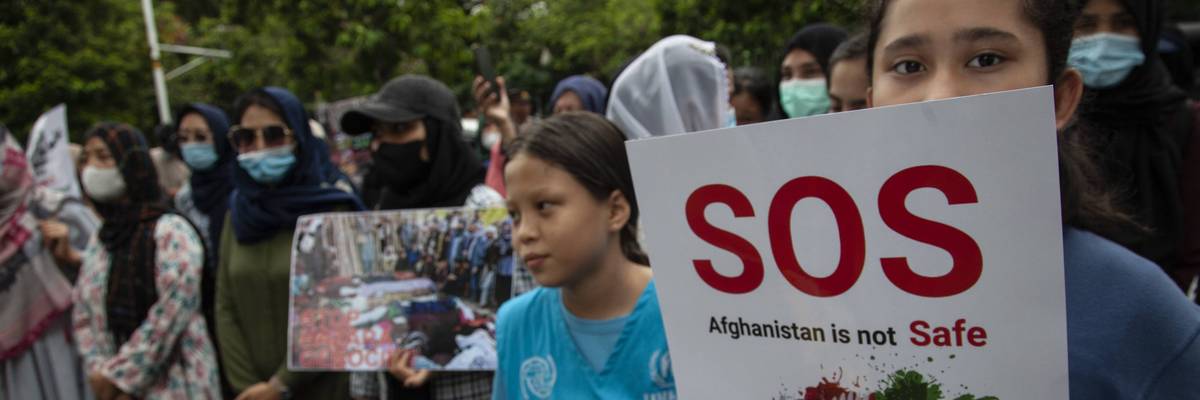
“The consequences could be prison, torture, or worse,” said one human rights defender. Refugees from Afghanistan, Somalia, Iraq, and Myanmar hold a demonstration in front of the US Embassy in Jakarta, Indonesia, on June 19, 2025. (Photo by Aditya Irawan/NurPhoto via Getty Images)
The Trump administration is preparing to deport more than 150 Afghan immigrants and refugees to Taliban-controlled Afghanistan via Pakistan, a move that drew fierce condemnation Friday from a range of critics—including human rights defenders and Democratic US lawmakers—who warned that such expulsions would place many of the deportees’ lives in grave danger.
The New York Timesreported that US Immigration and Customs Enforcement (ICE) has transferred Afghan detainees from facilities around the country to Louisiana in preparation for a chartered deportation flight expected to leave as soon as Monday.
The administration reportedly intends to send the Afghans to Pakistan, whose government would then expel them across the border into Afghanistan, where the Taliban has ruled since the US withdrew from the country in defeat over five years ago.
According to the Times, those slated for deportation include relatives of people who aided the US military invasion and occupation and at least one gay man. Both categories of people would face possible execution or severe persecution by the Taliban.
“Five years ago, Americans watched Afghans cling to planes to escape the Taliban. On Monday, our government plans to charter one back to their persecutors’ hands,” Krish O’Mara Vignarajah, president and CEO of refugee resettlement organization Global Refuge, said in a statement Friday.
“For the people on that manifest, the consequences could be prison, torture, or worse,” she added. “For their families here, some of whom served alongside US servicemembers, it means losing a loved one without knowing whether they’ll ever hear from them again.”
Vignarajah implored the Trump administration to halt or reverse the plan before the flight departs.
“Pakistan is patently unsafe for Afghans,” she said. “Its own government has made that clear by hounding them out of the country by the millions. Deporting Afghans into that crackdown is a deliberate decision to put them in harm’s way.”
Since 2023, Pakistan’s government has expelled more than 2.7 million Afghans, according to Global Refuge, and has vowed to remove approximately 1.5 million who remain in the country regardless of their immigration status. The United Nations has documented killings, arbitrary detention, and torture of people associated with Afghanistan’s former US-backed government and security forces.
The Taliban has also systematically stripped Afghan women and girls of the rights they gained during the US invasion, banning them from secondary schools, universities, and most employment, while imposing sweeping and draconian restrictions on their lives.
“Individuals returned to Afghanistan face grave, systematic dangers, including arbitrary detentions, executions, public flogging, and retaliatory violence,” the group Human Rights First said Thursday. “Women and girls face severe restrictions on basic freedoms, including systematic denials of education, employment, and public speech.”
Several Democratic US lawmakers, including Democrats on the Senate Foreign Relations Committee, decried the planned deportations.
“We made a promise to our Afghan allies—that after aiding and protecting our troops during the conflict in Afghanistan, America would not abandon them,” said Sen. Richard Blumenthal (D-Conn.). “This administration is betraying that promise, deporting them to potential torture and death.”
Sen. Chris Coons (D-Del.) posted: “While he hopes nobody is watching, Trump greenlit the expulsion of more than 150 Afghans back to Taliban rule, where they will face almost certain persecution, torture, or worse. Accountability for Trump’s cruel immigration agenda cannot come soon enough.”
Sen. Tim Kaine (D-Va.) also weighed in, writing on social media, “Our Afghan allies risked everything to help the United States.”
“Now Trump plans to send their relatives back to Taliban-ruled Afghanistan,” he added. “Repaying their sacrifice with betrayal is shameful and will make it much harder for America to secure assistance in future conflicts.”
Debt After Death: How Unchecked Corporate Power Even Makes Dying More Expensive
“No one should be forced into debt just to bury a loved one, but as corporations exploit families,” said Groundwork Collaborative’s leader, “loved ones are being driven to the brink to pay for a dignified death.”
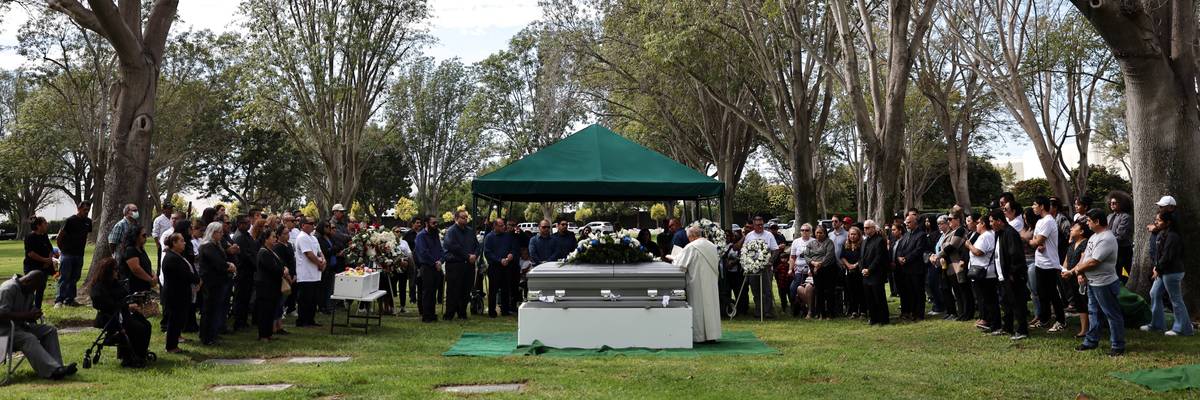
People gather around Ismael Ayala-Uribe’s casket during his burial service at Westminster Memorial Park and Mortuary on October 9, 2025 in Westminster, California. The 39-year-old, who was originally from Mexico, died the previous month while in US Immigration and Customs Enforcement custody. (Photo by Mario Tama/Getty Images)
Americans are struggling with the soaring cost of living—and dying, according to a Groundwork Collaborative report released Thursday.
The think tank’s associate director of policy and advocacy, Zoe Butler, analyzed data on related topics, from life insurance to funeral expenses, and explained how deaths—especially unexpected ones—can affect US households.
Data from 2023 shows that “funeral homes charge a nondeclinable basic services fee of $2,495 for both cremation and burial, along with $395 to transfer the body to the funeral home,” plus additional charges for using facilities for services. The report notes that “even lower-cost options still carry added fees, including about $400 for cremation and $295 for an urn.”
“For burial, costs increase further with additional required services,” the publication continues. “These include over $1,000 for embalming and other preparation of the body, as well as $2,500 for a casket. Burial also introduces a separate set of expenses outside the funeral home, including $1,000 to $3,000 for a headstone, around $1,000 for a burial vault, and $1,000 to $2,500 to open and close the grave.”
“Prices have surged 310% since 1986, far outpacing overall inflation of 193%,” Butler highlighted. “As prices increase, more families are going into debt to cover funerals, with the share rising from 14% in 2024 to 37% in 2025.”
Deaths can also mean navigating probate, “the often costly legal process of settling a loved one’s estate,” she wrote. Probate fees can take 3-8%, so “even modest estates in probate can lead to thousands of dollars in legal and administrative expenses.”
“For example, a family inheriting a $250,000 home may have to pay $7,500 to $20,000 in probate-related expenses,” the document says. “Fewer than 1 in 4 Americans have a will, and just 13% have a living trust, one of the few tools that lets assets pass to heirs without going through probate.”
Some families dealing with a relative’s death are assisted by life insurance, but “coverage is uneven and increasingly inadequate,” the report stresses. “Nearly half of Americans do not have life insurance, meaning many families cannot cover funeral expenses or manage immediate costs after a loss.”
“Access to employer-sponsored coverage is also highly unequal,” according to the analysis. “While 77% of full-time workers have access to employer-provided life insurance, only 14% of part-time workers do. Just 20% of workers in the bottom tenth of wages have access to coverage, compared to 91% of top earners.”
Additionally, 40% of new policies “are term-limited rather than permanent, meaning coverage can expire before a person dies,” the report explains—so some “families may spend years paying into life insurance policies that ultimately provide no support for funeral expenses or other end-of-life costs.”
It not only catalogs the costs of death in the US, it also points out that “median household savings are roughly $8,200, meaning many households have little cushion to absorb these costs.”
The publication also offers “a path forward,” urging Congress to cut prices and boost transparency with legislation that would “require funeral homes to provide standardized and itemized pricing online, including all fees and third-party costs,” as well as “prohibit hidden fees and forced bundling of services.”
Other actions Congress could take include expanding the Social Security Death benefit and creating a basic life insurance program administered through the Social Security Administration. There are also several probate-related proposals for states and localities.
“No one should be forced into debt just to bury a loved one, but as corporations exploit families at their most vulnerable moments, more and more grieving loved ones are being driven to the brink to pay for a dignified death,” said Groundwork president and CEO, Lindsay Owens in a statement.
“Funeral companies are raising prices, hiding costs, and taking advantage of a system that gives grieving families no time and no transparency,” she added. “Policymakers must act to bring down prices, increase accountability, and ensure families can access what is already theirs without delay.”