Monday, November 02, 2026


Why We Must Stand with U.S. Major Jason Watson


by | Oct 29, 2026

For almost two months, an Air Force officer has been sitting alone in a cell, twenty-four hours a day. When they let him out to eat or exercise, he’s still alone, according to his attorney.

His name is Major Jason Watson. He hasn’t been convicted of anything. Under military law he is presumed innocent, yet he’s still in that cell.

I know something about solitary confinement. I also know what it feels like when a government would rather silence you than answer for its transgressions. That’s why I can’t stay quiet about Major Watson. And it’s why I think we need to talk about the kind of courage this country says it admires, right up until someone actually shows it.

What Major Watson Did

On July 1, Major Watson walked up the House steps of the U.S. Capitol in uniform and stood there holding a sign that read “Impeach. Convict. Remove.” He was calling for the removal of President Trump and Vice President Vance. Capitol Police arrested him. The D.C. charges were dropped, but he was taken from the courthouse straight into Air Force custody and restricted to base. In August he went on CNN and said it again. The next day, the Air Force ordered him into pretrial confinement.

He now faces ten charges under three articles of the Uniform Code of Military Justice (UCMJ): three under Article 88 for allegedly using “contemptuous words” against the president, five under Article 92 for failing to obey orders or regulations, and two under Article 133 for “conduct unbecoming an officer,” as his lawyers confirmed in a public statement.

I’m not here to argue about uniform regulations. What bothers me, and what should bother anyone paying attention, is what the Article 88 charges and that solitary cell tell us about how power handles real dissent.

Watson didn’t hide behind a fake name. He didn’t retain or leak anything classified. He put his own name and face on what he believed, in public, knowing what it would cost.

Before he took that stand, he asked himself, “What’s the highest price that I’m willing to pay?” His answer was, more or less, whatever it takes. That’s what bravery looks like. You’re still afraid. You go anyway, knowing hell is coming.

Punished Before He Is Tried

Here is what troubles me most. The military is punishing Major Watson while claiming to follow the very rules that forbid it. Article 13 of the UCMJ says no one being held for trial may be punished, and that pretrial confinement may be no “more rigorous than the circumstances require to insure his presence.” The idea is straight-forward. Someone waiting for a court-martial is presumed innocent, and the military isn’t allowed to treat him as guilty.

Locking a person alone in a cell for months is punishment by any ordinary meaning of the word. Watson’s attorney has said solitary is usually reserved for people who are violent or disobedient, and even then only for a few days or a week. At Watson’s Article 32 hearing, the hearing officer said the isolation was required because he can’t be housed with civilian inmates.

Even if you accept that explanation, it doesn’t undo what isolation does to a person’s mind. And it doesn’t answer the bigger question: why is a peaceful man whose only “offense” was speaking locked up at all? You can’t even argue that the punishment doesn’t fit the crime, because officially it isn’t punishment. When the people offended by your words also get to decide what counts as a crime, and what counts as punishment, the law stops being fair or predictable.

I can tell you from experience that solitary is built to grind you down. I was thrown into solitary in prison because I wouldn’t let a guard on a power trip treat me as anything less than a human being. My punishment for standing up for my dignity was a cell less than half the size of my usual cage. No window. No sunlight. Nothing to remind me there was a world outside. No contact with anyone, including my family, who went days without hearing from me and had no idea what was happening.

That kind of isolation isn’t about safety or order or paperwork. It’s about breaking someone, and about sending a message to everyone else. Major Watson stood up against an administration he believes is trampling the Constitution. For that act of conscience, they’re trying to make him disappear.

Article 88 and the Espionage Act

Article 88 makes it a crime for a commissioned officer to use “contemptuous words” against the president, the vice president, Congress, and certain other officials. It is almost never used. A CNN review found only two convictions under it since the modern military code took effect in 1950.

The military’s own Manual for Courts-Martial, as one legal analysis explains, says that criticism of an official in the course of political discussion, even strongly worded criticism, shouldn’t be charged under this article unless it is personally contemptuous. Watson put it simply at his hearing: “discomfort is not contempt.”

How the article gets used is concerning. In 2021, Marine Lt. Col. Stuart Scheller posted videos in uniform demanding accountability from senior leaders over the Afghanistan withdrawal, at one point saying he felt “contempt” for them. He was charged under Article 88 too. With prominent supporters cheering him on, his case went to a special court-martial, the lower-level forum. He spent nine days in the brig, pleaded guilty, and walked away with a letter of reprimand and a $5,000 forfeiture of pay. Watson’s lawyers summed up the problem: “The law will not make the same word a virtue in one officer’s mouth and a felony in another’s.”

I recognize this double standard because I’ve lived it. The Espionage Act of 1917 was written to catch spies. Today it’s regularly used against whistleblowers who tell the public what the government would rather keep quiet, and defendants usually aren’t allowed to argue that their disclosures served the public interest. Groups like PEN America, the ACLU, and Human Rights Watch have warned for years that laws this broad invite selective prosecution. The cases of John Kiriakou, Reality Winner, and Thomas Drake show those warnings were right.

Look at Courtney Williams, who worked in a support role for Delta Force at Fort Bragg from 2010 to 2016. She talked to an investigative reporter about sexual harassment and discrimination inside the unit. In April, the FBI arrested her, and she now faces four Espionage Act counts, each carrying up to ten years. Prosecutors say some of what she shared was classified. The reporter she spoke with calls the case retaliation against a whistleblower. Either way, plenty of former special operators talk openly about their units on popular podcasts without ending up in handcuffs.

Article 88 and the Espionage Act are different laws, but they end up doing the same job. They’re old, broad nets that can be thrown over anyone who speaks uncomfortable truths about those in power. Whether the target is a whistleblower or an outspoken officer, the result is silence. And every time we let these tools get dusted off, we make it easier to use them on the next person.

The Oath Wasn’t to a Person

Every public servant, civilian or military, swears to support and defend the Constitution. None of them swears loyalty to a president, a party, or a movement.

There’s a difference between the enlisted and officer oaths worth knowing. Enlisted members promise to “obey the orders of the President of the United States and the orders of the officers appointed over me.” Officers don’t make that promise. Under the officer’s oath, they swear to support and defend the Constitution and to “well and faithfully discharge the duties” of their office. That difference, as the Marine Corps itself explains, is deliberate. An officer’s final loyalty belongs to the Constitution and the rule of law, not to whoever is sitting in the Oval Office.

Watson has said his oath is exactly why he went to those Capitol steps, and that he acted out of duty, not partisanship. His point is that no leader is above the law. Yet “support and defend the Constitution” keeps getting bent into a demand for personal loyalty. People who stand on principle end up in solitary. People who look the other way get promoted.

Service and Speech

I have deep respect for the military and its traditions. The military can’t be anyone’s political tool, and service members have to follow lawful orders. The rules that keep uniforms out of partisan politics exist for good reason: they keep the military under civilian control and out of the hands of any one side. Those rules matter.

But this is about proportion. Joining the military doesn’t mean giving up your basic rights. Courts have long held that service members keep some free-speech protection, even if it is narrower than a civilian’s, as long as their speech doesn’t seriously threaten discipline or the mission.

So it’s fair to ask where the line really is. Does one peaceful protest justify criminal charges and months in solitary? A military confident enough to handle criticism from within its own ranks is stronger than one that keeps people in line through fear.

“I Was Only Following Orders”

We settled the question of blind obedience after World War II. At Nuremberg, the world rejected “just following orders” as an excuse. The principle that came out of those trials says acting on orders doesn’t relieve you of responsibility “provided a moral choice was in fact possible.” Our own military law requires service members to obey lawful orders, not unlawful ones.

We rightly honor people like Hugh Thompson, the Army helicopter pilot who landed his aircraft between American soldiers and fleeing Vietnamese civilians at My Lai in 1968. He was treated as an outcast for years. The Army didn’t award him the Soldier’s Medal until 1998, thirty years later. We can’t keep telling every generation of service members that they have a duty to refuse wrongdoing, then crush the ones who actually say so out loud.

Dr. Martin Luther King Jr. wrote about this from a Birmingham jail cell. We have a duty to obey just laws, he said, and an equal duty to disobey unjust ones. But “one who breaks an unjust law must do so openly, lovingly, and with a willingness to accept the penalty.”

That’s the tradition Major Watson acted in. He didn’t hide. He stood in the open, told his superiors where he stood, and accepted the consequences. If the right of conscience doesn’t belong to every citizen, it doesn’t really belong to anyone. And a country where no one can tell the powerful the truth isn’t a free country.

What We Owe Him

Major Watson has shown a steady, stubborn courage that’s rare anywhere, and rarer still when your career and freedom are on the line. He didn’t hide behind technicalities or double-talk. He put everything on the line for the principles he swore to uphold.

We owe him our voices, for his sake and for our own. When the government turns its full weight against someone who takes his oath seriously, we can’t just wait for politicians or courts to fix it. It takes ordinary people, standing together, to demand fairness, shine a light into those cells, and make sure the people who tell the truth don’t have to stand alone.

I encourage everyone to show support for Major Watson by spreading the word about his courage and how he is being persecuted for standing up for truth. You can also help by sending letters of support to Major Watson while he is being confined to the following address:

Jason P. Watson
Calvert County Detention Center
P.O. Box 9
Barstow, MD 20610

Reprinted with permission from Progressive Hub.

Jeffrey Sterling is a CIA whistleblower and the author of Unwanted Spy (Bold Type Books, 2019). He served two and a half years in federal prison after a conviction under the Espionage Act that he has long contested. A New York-licensed attorney, he is a Whistleblower Advocate for RootsAction and a board member of Defending Rights and Dissent. He writes and speaks on national security law, civil liberties, press freedom, and government accountability.

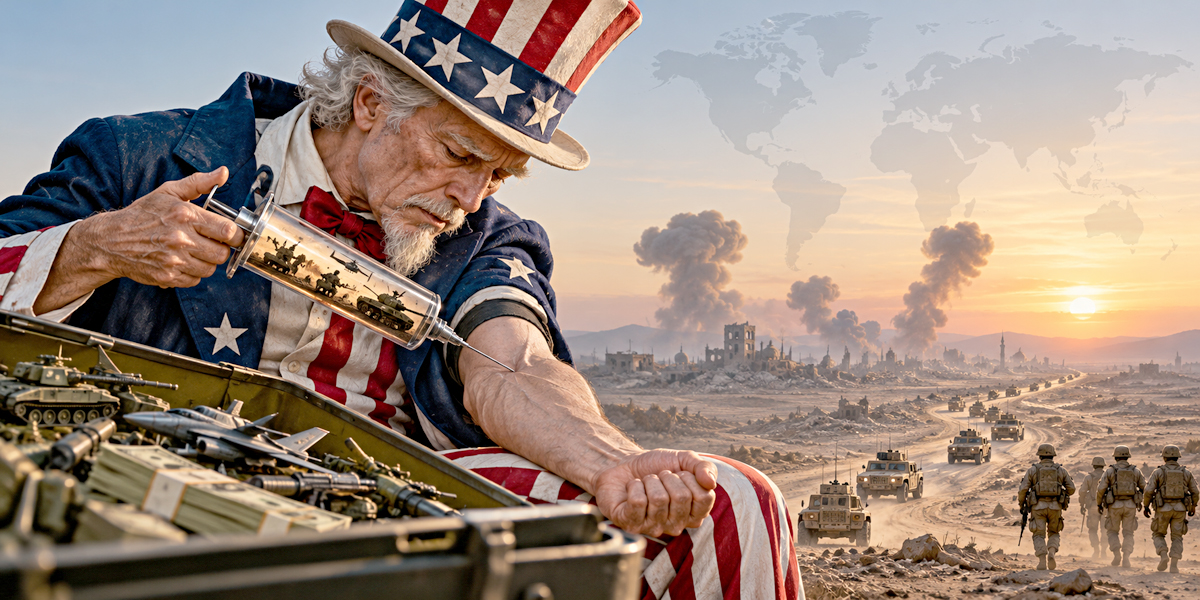
America’s Deadly Addiction to War

by | Oct 30, 2026 | 

America has a deadly addiction to war. Since 1950, presidents of both political parties have sent American troops into conflicts across the globe, killed countless people, sacrificed the lives and limbs of American servicemen and women, and wasted trillions of dollars. Yet these wars have consistently failed to achieve the objectives proclaimed when the killing began.

Enemies are replaced by new enemies, dictators give way to new dictators, and supposedly decisive victories become endless occupations. The beneficiaries are the military-industrial complex, the intelligence agencies and the politicians who confuse the exercise of power with the achievement of peace.

The American people deserve an answer to a simple question: What have we gained from this perpetual warfare? The answer is NOTHING in national security, and a great deal in lost lives, national debt, diminished liberty and shattered constitutional government.

The pattern is familiar. The government tells the public that a foreign adversary threatens our existence, that diplomacy has failed and that military action will be limited, necessary and successful. Then the bombs fall, the casualties mount and the mission changes. What began as a narrowly defined operation becomes a wider war, regime change, counterinsurgency or an open-ended commitment to demonstrate American domination. Then spying at home and federal borrowing are ratcheted up — all accompanied by the false message of spreading democracy and liberty.

Americans were told that Vietnam was essential to containing communism, that Iraq possessed weapons of mass destruction, that Afghanistan was a necessary campaign against terrorism, that Iran could “take out” Los Angeles. In each case, the distance between official assurances and eventual reality exposed the dangers of trusting government claims without demanding evidence. We now know these excuses were absurd.

And the constitutional order has been systematically circumvented.

The Constitution gives Congress the power to declare war. The framers deliberately withheld from the president the unilateral authority to plunge the nation into war because they understood the danger of concentrating the power to initiate hostilities in one person’s hands.

Yet since 1950, American presidents have repeatedly committed American forces to major conflicts without formal declarations of war. Korea, Vietnam, Kosovo, Iraq, Afghanistan, Libya, Ukraine, Iran and numerous other military operations have proceeded under various presidential theories of authority, vague congressional resolutions and claims of inherent executive power.

Some operations have received congressional authorization to use military force. But a vague authorization to use military force is not a blank check for perpetual war. Nor should a president’s authority to respond to an attack become a license to initiate hostilities wherever the president chooses.

When does the war end? Who decides that its objectives have been achieved? What event obligates the president to bring the troops home?

Too often, there is no satisfactory answer.

Congress has surrendered much of its constitutional responsibility, preferring to criticize a war when it becomes unpopular rather than accept responsibility for prohibiting it. Presidents enjoy the appearance of exercising decisive power while spreading the costs of their decisions across generations of taxpayers.

The intelligence agencies compound the problem. The CIA has conducted covert operations, fomented coups, participated in foreign interventions and murdered and tortured in ways that escape public scrutiny. Its clandestine capabilities can become instruments of presidential foreign policy operating beyond the ordinary accountability expected of a constitutional republic.

The author Tom Woods has observed, “No matter who you vote for, you get John McCain.” The point is not about the late senator’s personality. It’s about the bipartisan foreign policy and deep state establishment’s enduring and triumphant commitment to intervention, military primacy and American dominance of the world — no matter who is president.

The military-industrial complex benefits. Intelligence agencies expand their influence. Defense contractors receive lucrative government contracts. Politicians posture as guardians of national security. Meanwhile, ordinary Americans pay the bills through taxes, inflation, mounting debt and the opportunity costs of spending money on destruction rather than productive activity at home; and our civil liberties are curtailed.

A republic that cannot distinguish national defense from global domination will eventually sacrifice both its resources and its principles.

Secretary of State Marco Rubio’s Oct. 7, 2026, address in Greece exemplifies this. He offered a shameful expression of ambition. He called for the unapologetic pursuit of American dominance and warned that the West — a euphemism for the U.S. — must fight to maintain its position at “the head of the world.” This was a deeply misguided and utterly ignorant view that somehow American freedom, security and prosperity depend on American military dominance over the whole planet.

Russia and China have legitimate security interests, regional spheres of influence and militaries nearly as powerful as America’s. Recognizing that fact does not require endorsing their governments, approving their actions or militarily siding with their adversaries. It requires acknowledging that other major powers will resist what they perceive as hostile military encroachment near their borders.

If we expect Russia and China to respect legitimate American security interests, we must respect theirs. Reciprocity is not appeasement; it is a foundation for peaceful and prosperous coexistence.

Contrary to Rubio, the emerging international order is better understood as tripolar, not unipolar, with the United States, China and Russia exercising different degrees of military, economic and geopolitical influence. Their power is not equal, and their interests often conflict. But pretending that Washington can indefinitely dictate the terms of world affairs is a recipe for perpetual confrontation, not stability.

Is America a constitutional republic or a fading military empire?

A republic defends its people and their lands against genuine threats. An empire seeks to shape the behavior of other nations through force, coercion, colonization and the constant threat of intervention. The former requires vigilance; the latter endless violence.

The most dangerous enemy of American security is not a foreign power. It is our own government’s inability to recognize that the power to wage war is not an unlimited license to rule the world.

A people whose country cannot say no to perpetual wars will eventually discover that wars have said no to their personal freedoms.

Andrew P. Napolitano, a former judge of the Superior Court of New Jersey, is the senior judicial analyst at Fox News Channel. Judge Napolitano has written seven books on the US Constitution. The most recent is Suicide Pact: The Radical Expansion of Presidential Powers and the Lethal Threat to American Liberty. To find out more about Judge Napolitano and to read features by other Creators Syndicate writers and cartoonists, visit www.creators.com. COPYRIGHT 2025 ANDREW P. NAPOLITANO – DISTRIBUTED BY CREATORS.COM


Empire Without Guardrails: The Global Toll of U.S.-Israel Arrogance


by | Oct 30, 2026 | 

Imperial systems historically fall by the weight of their insatiable greed, reckless wastefulness and institutional hubris. Today, the United States stands as the sole imperial power, with Israel – the last remaining colonizing state – serving as its vanguard in West Asia. Both are showing the first signs of fundamental decline.

A single miscalculation can forge a new reality.  Driven by imperious delusions, the US and Israel launched deadly wars of choice against Iran in June 2025 and again in February 2026.  The folly of their acts was believing that Iran, a civilizational nation, could be easily defeated. Instead of a swift victory, the flawed assumption has triggered a wider regional quagmire and undermined America’s global power and credibility.

After eight months of military and economic turmoil, the ongoing war is an existential crisis for both Iran and the United States.

For 47 years, the United States and Israel have been a threat to Iran.  Tehran is mindful that Washington and Tel Aviv are bent on destroying the country, and that the war is an existential fight it must win. The start of Operation Epic Fury, on February 28, was the Islamic Republic’s 9-11.

Iran also knows that it cannot continue to live with America’s threatening regional presence (40,000 to 50,000 U.S. soldiers stationed across at least 19 bases) and with the crippling economic sanctions that have hindered development.

In addition, after a long track-record of betrayals, Iranian leaders are keenly aware that the U.S. is not interested in honest negotiations or peaceful coexistence. By starting an unprovoked war that violated international law, destroyed vital infrastructure, and killed 3,468 Iranians – including Supreme Leader Ayatollah Ali Khamenei, members of his family and senior leadership – Washington proved it cannot be trusted.

Concurrently, the United States is desperately trying to hold onto its military and economic supremacy.  Both Washington and Tel Aviv had little idea when they started the war that they had set in motion a revolutionary shift, regionally and globally. The unrestrained devastation has shattered the illusion of U.S.-Israeli political, economic and military invincibility, that has remained unchallenged for 81 years.

Since emerging as the strongest economy following World War II, the American empire has maintained its prosperity and hegemony through resource exploitation, global militarization, strategic partnerships with merciless regimes, the promise of trickle-down wealth and subtlety-managed domestic indoctrination.

American supremacy has relied heavily on dollar hegemony. By making the U.S. dollar the default currency for global commerce, Washington secured an exaggerated structural advantage that has underpinned its wider geopolitical leverage.

This is particularly true in West Asia, where the dollar, pegged to petroleum  – the currency used worldwide in the oil trade since the 1970s – has been employed to exert control over countries in the region.

In July 1944, at Bretton Woods, a new international financial system, centered around the dollar, was established by the United States.  Countries agreed to

link the value of their currency to the greenback, and institutions like the International Monetary Fund and World Bank were created under U.S. leadership, governance and control.

Because financial transactions are typically processed through U.S-dominated institutions, like SWIFT (Society for Worldwide Interbank Financial Telecommunication), an electronic interbank payment platform, dollar dominance gives Washington expansive power to impose far-reaching sanctions against other countries and to freeze them out of the global economy.

The United States has weaponized its currency by imposing sanctions and blocking perceived adversaries, like Iran, from SWIFT, using economic isolation to achieve economically what it has failed to do militarily.

As the U.S. and Israel witness their historic chokehold over global resources and defense capabilities slip away, they have reacted with fierce ruthlessness against Palestinian resistance, Iran, Hezbollah in Lebanon and Ansar Allah in Yemen, who are fearlessly contesting their hegemony.

For decades, the United States has preserved its global power through unholy alliances with Israel and through military and economic partnerships with authoritarian Arab regimes, tasked with containing regional opposition.

The Zionist colony was originally embedded in West Asia to protect British imperial interests.  Following Britain’s decline, Israel secured another willing benefactor.  It has served America as a projection of U.S. power in the region for decades.

Paradoxically, Tel Aviv’s long-sought war against Iran might actually trigger its own ruin, topple Arab dictators, and shatter America’s regional and global supremacy.

The coordinated U.S.and Israeli attacks on Iran set off long-standing anti-imperialist sentiments across the region.  These revolutionary undercurrents emerged in 1979 when Iran rejected foreign domination, overthrew the U.S.-backed Pahlavi monarchy, and asserted its independent sovereignty.

For 47 years, the U.S. has been conducting economic warfare against the Islamic Republic through comprehensive economically destructive sanctions.

In 2008, Iran was cut off from CHIPS (Clearing House Interbank Payments System); and in 2012, all Iranian banks were disconnected from SWIFT. To counter the devastating effects of being cut off from the international financial network, Iran has been forced to change strategies and to seek alternative partners, specifically Russia and China.

In an effort to overcome the impact of U.S. sanctions, Iran became a full member of China-led BRICS, joining Brazil, Russia, India, China and South Africa in January 2024. Tehran has been urging the bloc to adopt alternative payment systems and national currency settlements to bypass the U.S. dollar and mitigate Western sanctions.

The U.S.-Israel plan for reshaping the region was laid out long ago. In a 1996 policy document titled, “A Clean Break: A New Strategy for Securing the Realm,”  senior national security officials, neoconservative hardliners, argued that Israel’s security would be best served, not through the pursuit of peace, but through “regime” change in surrounding countries, starting with Iraq, then Syria and finally Iran.

The enduring geopolitical campaign to restructure West Asia by crushing resistance and establishing absolute U.S. and Israeli dominance finally reached its peak in 2026 with the Iran war.

The urgency of “securing the realm” was reflected in a nativist speech by Secretary of State Marco Rubio delivered in the shadow of the Parthenon in Athens; significantly on October 7 (anniversary of the Palestinian rebellion in Gaza). In addition to extolling its virtues, Rubio stated that Western civilization was at a critical “inflection point” in which the U.S. and Europe must rediscover the values of exploration and conquest that once drove centuries of expansion or face decline or irrelevance.

One passage in particular reveals the jingoistic and arrogant path the United States has been on in West Asia for decades:

“And now, today, we find ourselves at a crossroads. Because the next decade and the decision we make will write the story of the next century.  The course we take will determine whether the West maintains its place at the head of the world or resigns itself to a future of atrophy and servitude or decline.  We will either choose to act now or lose the choice to act at all….We choose the unapologetic pursuit of national power: to take back control of our critical supply chains (translated as the Strait of Hormuz in the Persian Gulf and Bab al-Mandeb in the Red Sea), to reindustrialize our economy…to rebuild our defense, to fight for dominance of the technologies and industries of the future.”

The U.S. and Israel have chosen the “unapologetic pursuit of national power” in the resource-rich region.  Only now have they met their asymmetrical military match in the Islamic Republic, Ansar Allah and Hezbollah, and in the determination of Palestinians to resist subjugation.

The United States has demonstrated that it is incapable of equality; of being one nation among many. It irrationally insists on “maintaining its place at the head of the world,” no matter the cost in lives and treasure.

© M. Reza Behnam, Ph.D.

Dr. Behnam is a political scientist who specializes in comparative politics with a focus on West Asia. His “Cultural Foundations of Iranian Politics,” published by University of Utah Press, and still in print, was recognized by Choice as Outstanding Academic Book for 1987–1988.


Israel Breached Iranian Airspace This Weekend but Iran Chose Not To Respond. Why?


Meeting in Tehran between Saudi, Turkish, Pakistani, and Iranian officials was an important factor.

by | Oct 28, 2026 |

Reprinted with permission from Trita Parsi‘s Substack: 

Much of the Middle East was on edge this past weekend, fearing that President Donald Trump and Israeli Prime Minister Benjamin Netanyahu would restart the Iran war. Thankfully, hostilities didn’t resume, but it’s not because of a lack of effort. According to Iranian sources, Israeli fighter jets did breach Iranian airspace, but Tehran surprisingly chose not to respond. Today’s meeting in Tehran between Saudi, Turkish, Pakistani, and Iranian officials is partly why Iran showed restraint.

Israel has made no secret of its desire and plans to restart the Iran war, but on a larger scale than previous rounds. Earlier this month, Israeli Defense Minister Israel Katz told Israeli TV that Israel is ready to strike Iran with “full force” and that this time around it will target Iranian energy infrastructure to “set Iran back 40 years, to the age of darkness and to the Stone Age.”

Over the weekend, news broke of an alleged rift between Netanyahu and the IDF Chief of Staff Lt. Gen. Eyal Zamir over a proposed military operation against Iran ahead of Israel’s election, with Zamir pushing back over its timing and potential impact on the Israeli elections tomorrow. The Israelis had also conducted numerous mock practice attacks against Iran in Iraqi airspace in the past week.

All these developments added to an explosive situation where war was just one tiny, dumb decision away. Tehran had, of course, also hinted that it would no longer wait to be attacked, but strike preemptively against the U.S. and Israel if it felt strikes against its territory were imminent.

Which is why Iran’s decision not to strike after Israeli fighter jets allegedly breached its airspace is all the more surprising. But sources in Tehran tell me that a variety of factors prompted this Iranian decision, rooted in two key Iranian assessments: that time is still on Iran’s side and that Israel is trying to goad Iran into striking first to get the war started at a moment in which it is still not a foregone conclusion whether Trump has opted for war or not.

The Iranians have made clear that they will respond ferociously to Israeli and American strikes and that Saudi Arabia in particular will likely face significant destabilization in such a scenario, in addition to other Gulf Cooperation Council states. The irony, of course, is that such a response would serve Israel quite well. The more Iran retaliates against GCC states, particularly Saudi Arabia, the more these Arab states will feel compelled to turn to Israel for support and protection, undermining Iran’s longer-term goal of inviting these states to join Iran in forming a security arrangement in the Middle East.

In that scenario, the dream of an Israeli-Arab anti-Iran bloc like the Abraham Accord could be revived. Consequently, Tehran has to weigh its options very carefully and not rush into responding to Israeli provocations, as it could amount to a trap. It appears that Israel’s maneuvers in Iraq ultimately convinced Tehran that Israel was bluffing and that an Iranian response would be counterproductive. For now, that assessment may have been correct.

Another factor was today’s meeting of Saudi, Pakistani, and Turkish officials in Tehran. Iranian media and officials have touted the meeting as a clear sign that American efforts to isolate Iran or exclude it from regional security discussions have failed. For all three countries to come to Tehran, on relatively short notice, is seen as a win in Tehran — a victory that would have been jeopardized if Iran responded to Israeli provocations over the weekend.

Contrary to speculation, the meeting was not a stepping stone toward inviting Iran into the Mecca Pact. Rather, it was driven by a more urgent matter: the Ansar Allah-Saudi war that is not only destabilizing Yemen, but also now Saudi Arabia itself. (Ansar Allah is often referred to as the “Houthis.”)

But the content-less statement from the Tehran meeting reflects how difficult this issue will be to resolve. From the Iranian perspective, Riyadh has committed the same mistake as Trump: starting a war that it cannot end on the battlefield and is unwilling to end at the negotiating table.

In Trump’s case, the hold-up is the lifting of the Persian Gulf blockade. In Riyadh’s case, it is the lifting of the air blockade on Yemen. Tehran is willing to help, a source in Iran tells me, but it won’t challenge Ansar Allah’s condition of lifting the air blockade, just as Tehran won’t budge on the lifting of Trump’s blockade.

Nevertheless, the gathering in Tehran further validates the logic restrainers have put forward for years: as the U.S. pulls back militarily, contrary to Washington’s conventional wisdom, regional states are showing greater agency and taking greater responsibility for the region’s security themselves.

This agency does not mean that all problems will be resolved or that conflict and chaos will be avoided. But whatever is achieved or not achieved, it will be their conflicts, their chaos, and their responsibility — not that of the U.S.

Trita Parsi is the Executive VP of the Quincy Institute for Responsible Statecraft and an award-winning author. Washingtonian Magazine has named him one of the 25 most influential voices on foreign policy. Noam Chomsky calls him “one of the most distinguished scholars on Iran”

Visit Trita Parsi’s Substack and subscribe.