Saturday, November 07, 2026

‘Should Terrify All of Us’: Google Sued After AI Chatbot Allegedly Helped Teen Plan Suicide

As Google faces allegations that its Gemini chatbot helped a 13-year-old girl plan how to kill herself, the company, plus Meta and TikTok, sued to block a California law meant to safeguard minors from social media addiction.



A teen girl holds a cellphone in this undated stock photo.
(Photo by Getty Images)

Brett Wilkins
Nov 05, 2026
COMMON DREAMS

The parents of a 13-year-old girl who allegedly used Google’s Gemini artificial intelligence chatbot to plan her suicide sued the tech titan Wednesday on the child’s behalf, a move that came as Google, Meta, and TikTok filed lawsuits to block California from enforcing a new law designed to protect children from the addictive features of social media platforms.

Parents of a girl identified as “Emma” in a lawsuit filed in Santa Clara County Superior Court in California alleged that Google effectively turned a school-issued Chromebook laptop computer into a tool allowing a dangerous psychological relationship between their daughter and Gemini.

Although Emma ultimately did not attempt to kill herself, the lawsuit states that she “told her mother that she had thought about wanting to be dead.”

“Over several months, [Google’s] Gemini chatbot diagnosed a previously active, well-adjusted 13-year-old girl with a battery of severe psychological disorders, helped her plan her suicide and funeral, and coached her to conceal her distress and self-harm from her family—all without providing a single alert to school personnel or her parents,” EdTech Law Center, which is representing the plaintiffs along with the firm Quereshi Law, said in a statement.

According to the lawsuit, at one point, Emma reportedly pleaded with the chatbot, “How do i stop my addiction of asking AI random questions and yappi[n]g with AI?”

“Emma never sought out Gemini—it just showed up in [a] Google search one day—but by March 2026, she was exchanging thousands of messages a month, unable to free herself from the chatbot’s grip,” EdTech said.

“The complaint alleges that Google executives knew that the Gemini model it released in December 2025 was the most dangerous yet but rushed it out anyway to gain ground on its competitors,” the firm explained. “Emma brings claims for defective design, failure to warn, negligence, fraudulent concealment, and infliction of emotional distress, as well as a claim under California’s Companion Chatbot Law (Cal. Bus. & Prof. § 22601), which took effect in 2026.”

Google spokesperson José Castañeda said Thursday in a statement that “for years, we’ve shown hotline information directly in search when someone may be experiencing a mental health crisis.”

“We’ve built those same protections into search AI features, connecting people with real-world support,” he added.

Brendan Bouffard, associate general counsel for AI and privacy at the children’s advocacy group Fairplay, said Thursday: “The idea of an untested AI chatbot helping a 13-year-old girl plan her own suicide should terrify all of us, but this is the sick new reality Google has created by forcing its AI products onto school-issued devices.”

“Google claims its Chromebooks are there to help students learn, but in reality, the company was experimenting on kids like Emma by pushing them to use Gemini, a product the company knew was dangerous but rushed out anyway,” Bouffard continued.

“As this lawsuit shows, AI chatbots are not safe for kids,” he added. “They also undermine students’ ability to learn and think critically. Yet just this week, Google announced it would turn off ‘search’ for schools that refuse to use its AI products. It’s clear this massive corporation does not care about children’s safety—it only cares about profits.”

There has been an increasing number of lawsuits targeting AI companies whose chatbots have allegedly helped users plan to kill themselves or others.

Emma’s suit was filed on the same day that Google, TikTok, and Meta—which operates platforms including Facebook, Instagram, and Threads—launched separate lawsuits seeking to stop California from enforcing AB 1709, a law signed by outgoing Democratic Gov. Gavin Newsom in September prohibiting social media platforms from providing children under 16 with features deemed psychologically exploitative and addictive.

The tech titans argue that the restrictions violate their First Amendment rights and Section 230 of the Communications Decency Act, which generally shields online platforms from liability for content posted by third parties.

Meta’s lawyers asserted that California’s attempt to “appoint the state as the editor, curator, and controller of online speech” and “override Meta’s editorial judgment about how to curate and display these billions of posts of third-party speech” runs afoul of the Constitution.

In 2023, Democratic California Attorney General Rob Bonta joined dozens of other states in suing Meta, alleging that the company deliberately designed Facebook and Instagram to addict children and teenagers through features such as infinite scrolling, personalized recommendations, and constant notifications, while concealing evidence of the platforms’ mental health harms.

A proposed $17 billion settlement was announced in August, under which Meta agreed to changes including restrictions on nighttime use, notifications, and certain features available to minors.

A Los Angeles jury found in March that Meta and Google acted negligently by harming a child user with their social media platforms’ addictive design features in a landmark verdict that came on the heels of a $375 million fine imposed on Meta by a New Mexico jury, which found that the company violated the state’s Unfair Practices Act by misleading users and exposing children to harm.

The 988 Suicide & Crisis Lifeline—which offers 24/7, free, and confidential support—can be reached by calling or texting 988, or through chat at 988lifeline.org.
CANADIAN WOLVES* IN U$A

Outrage Over ‘Depraved’ Idaho Program Paying Hunters Thousands of Dollars to Kill Wolf Pups

“Let’s call this what it is,” said one conservationist. “It’s a goddamned bounty.”


Canadian wolf pups play in their enclosure at the Berlin Zoo in Germany in 2013.
(Photo by Britta Pedersen/picture alliance via Getty Images)

Brett Wilkins
Nov 06, 2026

Idaho officials paid hunters $24,000 to kill a dozen newborn wolf pups this spring, including what appears to have been at least one entire litter massacred in or near its den, according to Friday reporting that has sparked outrage among conservationists and wildlife advocates.

The killings—which were first reported by the investigative news site Public Domain—took place in late April in Idaho’s northern panhandle. Three hunters received reimbursements of $2,000 per wolf through a state-backed program intended to reduce the Idaho’s wolf population in service of the livestock industry and big game hunters.

“It’s an abomination,” said Brooks Fahy, executive director of the conservation group Predator Defense. “Let’s call this what it is—it’s a goddamned bounty.”


“What kind of receipts are you going to show for 12 pups who weigh 12 pounds?” she asked. “It’s ridiculous on its face, and the state of Idaho should be ashamed.”

The records obtained by Public Domain describe the killings as “still stalk,” suggesting hunters spotted and approached the animals before shooting them. But wolf experts questioned that account, suggesting the hunters may instead have located dens and removed the pups.

In one instance, a full litter was apparently massacred in or near its den. Doug Smith, a biologist who formerly oversaw Yellowstone National Park’s wolf program, warned in an interview with The Guardian that killing entire litters can fracture or dissolve packs.

Contrary to popular belief, wolves typically do not protect their young; they usually flee about 50 yards and bark.

“It’s easy to do,” Smith said of taking a whole litter of pups. “If you can’t reach them, you dig them out with a shovel.”

“Wolves breed once a year, so the birth of the pups is a very important thing,” Smith said. “The pack’s life hinges on those pups. They’re the glue that holds the pack together.”

The killings were made possible by Idaho’s increasingly permissive wolf management regime. In 2021, Republican lawmakers passed Senate Bill 1211, which established year-round wolf trapping on private property, eliminated limits on the number of wolf tags an individual could purchase, expanded permissible killing methods, and authorized private contractors to kill wolves.

That same year, Idaho wildlife officials signed an agreement with the Foundation for Wildlife Management, which reimburses hunters and trappers for expenses associated with killing wolves. Covered costs include fuel, ammunition, vehicle payments, and outdoor clothing. The program is financed through a combination of public money, hunting license revenue, and private contributions.

The state’s 2023 wolf management plan called for reducing the population to approximately 650 animals during the spring, when wolf numbers typically peak. Idaho’s estimated population nevertheless remained above 1,100 this year, down from a peak of approximately 1,600 in 2019.

The Idaho controversy comes amid broader concerns about the future of gray wolves in the United States. In September, President Donald Trump signed an executive order directing the Interior Department to consider removing federal Endangered Species Act protections for gray wolves across the continental United States.

Wolves remain federally protected in most of the Lower 48 states, while Idaho, Montana, and Wyoming have authority over their populations.

Those are the only three states that received the nation’s lowest grade—a “D”—on the conservationist group Team Wolf’s “State Wolf Management Report Card.”


“Trump says you can go out and kill wolves now—how many people took him at his word?” Fahy told Public Domain. “These are sentient creatures. They’re basically dogs. They form family bonds. They mate for life, pretty much. They have a pack structure that is very similar to our social structure. How could we be so wantonly cruel to something that is so similar to us?”


* US WOLVES ORIGINATED FROM CANADA 
IN A REPOPULATION DRIVE TWO DECADES AGO


Time for a Green New Deal 2.0

With Trump’s repudiation in the 2026 midterm elections, it is time to end Green New Deal hushing and instead consider what a Green New Deal revamped for today should be.


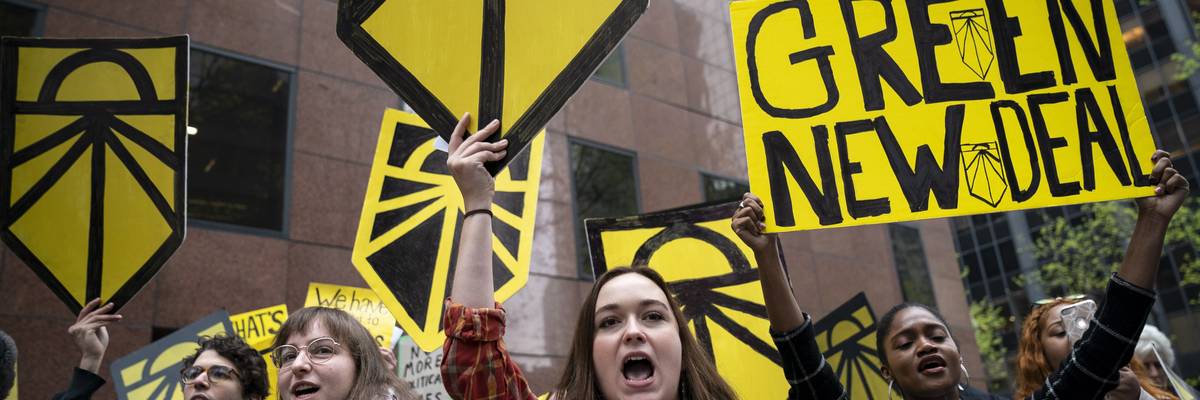
Activists rally in support of proposed Green New Deal legislation outside of Senate Minority Leader Chuck Schumer’s (D-NY) New York City office, April 30, 2019 in New York City.
(Photo by Drew Angerer/Getty Images)

Jeremy Brecher
Nov 06, 2026
Common Dreams


The overwhelming repudiation of President Donald Trump in the 2026 midterm elections may make it possible to constrain his worst depredations. But that will hardly be enough to solve the multiple crises facing the American people or the world. The Green New Deal represents the best vision we have for addressing those realities, but it needs to be updated and expanded for the world we face today. We need a “Green New Deal 2.0.”

Trump’s pet whipping boy was the Green New Deal. His excoriating attacks led many Democratic politicians to engage in “Green New Deal hushing.” With Trump’s repudiation in the 2026 midterm elections, it is time to end Green New Deal hushing and instead consider what a Green New Deal revamped for today should be.

The Green New Deal project has been promoted by a wide array of social forces. It has brought together people operating inside political systems with social movements organizing outside of them. It has used both the institutions of representative democracy and the direct-action power of the people to implement its objectives. The Green New Deal 2.0 will draw on comparable sources of power.

The Green New Deal has proven perennial because it addresses the basic problems faced by our people and planet.

No doubt there are many in both the Republican and Democratic parties who would like to see the Green New Deal where Trump believed he consigned it—in the grave. But the Green New Deal has proven perennial because it addresses the basic problems faced by our people and planet. It is a project that in all its varied manifestations takes the necessity for climate protection as the basis for a broad program for social reconstruction—a visionary program designed to protect the Earth’s climate while creating good jobs, reducing injustice, and eliminating poverty. It will rise again transformed.
The Heritage of the Green New Deal

In 2008, in the depths of the Great Recession, United Nations Secretary-General Ban Ki-moon called for “investment that fights climate change, creates millions of green jobs, and spurs green growth.” He said what the world needs, in short, is a “Green New Deal.”

The project of a Green New Deal rapidly picked up momentum around the world. Green New Deals became official policy in many countries, endorsed by the UN, the international trade union movement, and even by the International Monetary Fund. China, India, and the European Union began implementing some of the policies envisioned by the Green New Deal. But within a couple of years a global counterattack demanding austerity stymied much of the drive for massive investment to implement climate protection and economic justice. The Green New Deal appeared dead.

Even in the Trump era the Green New Deal has continued as a force in American life—from below.

The Green New Deal was reborn a decade later when the Sunrise youth climate movement held a sit-in in the office of US Democratic House leader Nancy Pelosi (Calif.) demanding she support a resolution for a Green New Deal proposed by newly elected Rep. Alexandria Ocasio-Cortez (D-NY). Drawing on the proposals a decade earlier for a Global Green New Deal, the resolution called for a “new national, social, industrial, and economic mobilization on a scale not seen since World War II and the New Deal.” The Green New Deal amassed support among congressional representatives, progressive organizations, and young people across the country. A poll found that more than 80% of registered voters “strongly support” or “somewhat support” the general concepts behind a Green New Deal. A poll five years later found that “the Green New Deal is still incredibly popular.”

Notwithstanding its popularity with the public, the Green New Deal met implacable opposition from the fossil fuel industry and hostile forces in both the Democratic and Republic parties. Upon his election as president, Trump declared the Green New Deal dead and proceeded to devastate both climate protection and social justice.

Nonetheless, even in the Trump era the Green New Deal has continued as a force in American life—from below. It has continued to be implemented through little-noticed initiatives by community groups, unions, city and state governments, tribes, and other nonfederal actors pursuing the climate protection and social justice goals of the Green New Deal. I have described it as the “Green New Deal from Below.”


The Green New Deal 2.0

The Green New Deal 2.0, like earlier Green New Deals, is a project to abolish the extraction and burning of fossil fuels while rapidly expanding equality, justice, and well-being. To do that it will have to learn from the earlier Green New Deals but also develop far beyond them. It will be aided in doing so by the radical reduction in the cost of fossil free energy and the ways in which energy is used—the Greentech Revolution. But the Green New Deal 2.0 will also have to function within—and help transform—the period of American dysfunction and global disorder that has come to be known as the Polycrisis.

To succeed, the Green New Deal 2.0 will need to be multilevel: local, state, regional, national, and global. From the start it needs to be global in its perspective and to transcend national borders in many of its actions. But it will initially have to be built from the bottom up, community by community, jurisdiction by jurisdiction. Eventually it will need to control and wield the power of national governments.

Achieving the goals of the Green New Deal 2.0—abolishing fossil fuel extraction and burning while rapidly reducing inequality, injustice, and deprivation—will require simultaneous action at many levels from local communities to global institutions.

The Green New Deal 2.0 won’t happen all at once; it will have to develop over time. In the US the Green New Deal 2.0 may start with an Emergency Green New Deal addressing the catastrophe now being experienced by the American people and its impending intensification. This catastrophe includes the crises of food, housing, energy, health, public safety, climate, inequality, democracy, and the rule of law—a veritable American Polycrisis. In some ways it resembles the “Yeltsin Era” that followed the collapse of the Soviet Union when systems from employment to food to healthcare to housing to the rule of law broke down; male life expectancy at birth fell by six years just between 1990 and 1994.

There is little likelihood of immediate federal solutions to this catastrophe. The newly-elected Congress has an important role to play in limiting Trump’s freedom of action, proposing alternatives, and supporting popular mobilizations. But as long as Trump remains in office, he can veto legislation and wield the powers of the executive branch. Addressing the crises we face requires people organizing themselves from below to implement an Emergency Green New Deal that will put people to work doing the things are that are necessary to ensure survival and well-being in the face of the American Polycrisis.

Achieving the goals of the Green New Deal 2.0—abolishing fossil fuel extraction and burning while rapidly reducing inequality, injustice, and deprivation—will require simultaneous action at many levels from local communities to global institutions. It will constitute an era of social reconstruction.

Elements of the Green New Deal 2.0

Here are some of the ways in which the Green New Deal 2.0 can incorporate but go far beyond previous Green New Deals:

The Greentech Revolution: Protecting the climate by replacing fossil fuels with fossil-free energy was the central pillar of the original US Green New Deal. Since then, climate catastrophe has truly arrived. But the global Greentech Revolution has created a new basis for moving to fossil-free communities, countries, and world. The Green New Deal 2.0 will accelerate the timetable for the transition to climate safety, while utilizing it as the pivot for other transformations.

Jobs: The original US Green New Deal resolution noted a “four-decade trend of wage stagnation, deindustrialization, and anti-labor policies.” It proposed to use climate mobilization as a vehicle to transform the world of work through high-quality union jobs, worker rights, labor standards, and a “job guarantee” that would ensure a job for every worker who wants one doing the work that is necessary to protect the climate and create a more just society. Since then, inequality has exploded and artificial intelligence (AI) threatens to eliminate millions of jobs and turn millions of others into excruciating daily oppression. The Green New Deal 2.0 will expand the jobs programs proposed by the Green New Deal, ensure that there are good jobs for those affected by AI, and empower workers to organize and act collectively on the job.

Affordability: Rising prices for the necessities of life are a crucial concern for working people today. The Green New Deal 2.0 will address this from the start by replacing fossil fuels with far cheaper fossil-free energy, reducing the price of everything that uses energy—that is to say, everything. It will also make massive investment in energy-conserving housing, food production, and other necessities of life that will both protect the climate and reduce the cost of living. It will tax the rich to reduce inequality and provide resources for the 99%.

Human Needs: The Green New Deal specifically addressed the unmet needs for housing, education, healthcare, and other necessities of life as part of the transition to a climate-safe society. Recent bills in Congress have proposed Green New Deals for housing and education. The Trump administration has devastated all aspects of our already inadequate social provision and is taking aim at what’s left. The Green New Deal 2.0 will establish new systems of social provision that empower local communities while providing the resources necessary to meet individual and social needs.

Justice and Equity: The original Green New Deal resolution proposed to use its programs to “promote justice and equity by preventing current and repairing historic oppression” of “indigenous peoples, communities of color, migrant communities, deindustrialized communities, depopulated rural communities, the poor, low-income workers, women, the elderly, the unhoused, people with disabilities, and youth.” Today the further degradation of all these groups is being actively promoted by the Trump administration and its supporters in all spheres of life. The Green New Deal 2.0 will use resources, policies, democratic processes, and law to reverse both historic and new forms of injustice and inequality.

Democratization: The original US Green New Deal was defeated in large part by the inordinate wealth and power of the fossil fuel industry and its power base within both Republican and Democratic parties. Since then, the Trump administration and the forces of plutocracy have further degraded our democracy and empowered the billionaire class. The initial US Green New Deal resolution called for “ensuring the use of democratic and participatory processes that are inclusive of and led by frontline and vulnerable communities and workers to plan, implement, and administer the Green New Deal.” The Green New Deal 2.0 will rebuild democracy from the bottom up. That includes establishing democratic institutions at the grassroots and establishing genuine political equality for all people. It will also extend democracy within workplaces and the economy. Donald Trump has greatly expanded the role of government in the economy for the worst of purposes, to enrich kleptocrats and war contractors. The Green New Deal 2.0 will utilize that expansion of powers to provide planning and investment to serve the common good.

Constraining Corporations and Technologies: The original New Deal of the Great Depression aimed to control the anti-social behavior of “malefactors of great wealth.” The startling growth of hyperscale data centers controlled by a handful of tech billionaires has forced new attention to the need to constrain corporations and their technology. To realize its objectives, the Green New Deal 2.0 will have to go far beyond previous green new deals in halting the anti-social behavior of today’s malefactors of great wealth, the corporations they control, and the destructive technologies they are seeking to impose. It will need to implement the “precautionary principle” that forbids introduction of new technologies until they are proven safe. More broadly, it will need to make the actions of private economic entities accountable to the public and those they affect.

Global Cooperation: Neither the climate nor the economy can be fixed at a purely local or national level. The growing chaos of the global Polycrisis, with its breakdown of international cooperation, has led to a collapse of climate protection, proliferating warfare, economic chaos, and an inability of any nation to provide security and well-being for its people. The Green New Deal 2.0 will treat a worldwide Green New Deal as a common project of the world’s people and will make cooperation among movements and nations a primary part of its local and national programs. It will promote mutually managed international trade in the interest of protecting the climate and the world’s people rather than either economic nationalism or unconstrained globalization.

The elements of the Green New Deal 2.0 will rapidly improve the lives of workers, communities, and ordinary Americans. The Greentech Revolution will not only retard climate devastation, it will reduce pollution and reverse soaring energy costs. Putting millions of people to work addressing human and environmental needs will not only provide quality employment but rapidly expand provision of food, housing, medical care, public safety, and other necessities of life. Rebuilding democracy from the bottom up will offer protection against the agressions of authoritarian government and promote our ability to control our common life.

By itself the Green New Deal 2.0 won’t quell the global Polycrisis. But working with other forces it can begin to constrain Polycrisis dynamics while also starting to transcend them. The rapid reduction in burning fossil fuels and the transition to fossil-free energy can slow and eventually reverse the destruction of the Earth’s climate. The reduction in inequity and injustice, the meeting of social needs, the provision of full employment, and the constraining of corporate power all address the inequality promoted by right-wing policies and the Polycrisis. The drive for international cooperation can help begin to bring war making, war crimes, nihilistic geopolitics, and global plunder under control and start to develop an alternative world order


Our work is licensed under Creative Commons (CC BY-NC-ND 3.0). Feel free to republish and share widely.


Jeremy Brecher
Jeremy Brecher is a historian, author, and co-founder of the Labor Network for Sustainability. His book, "Climate Insurgency: A Strategy for Survival," or free download at his personal website. His other books include: "Save the Humans? Common Preservation in Action" (2020), "Strike!" (2020), and, co-edited with Brendan Smith and Jill Cutler, "In the Name of Democracy: American War Crimes in Iraq and Beyond" (Metropolitan/Holt).
Full Bio >
Post-Midterms Report Stresses Economic Populism Propelled Democrats to Victory

“Americans are hungry for leadership that challenges the status quo, ends America’s forever wars, and takes on entrenched wealth and corporate power,” said Data for Progress’ executive director.


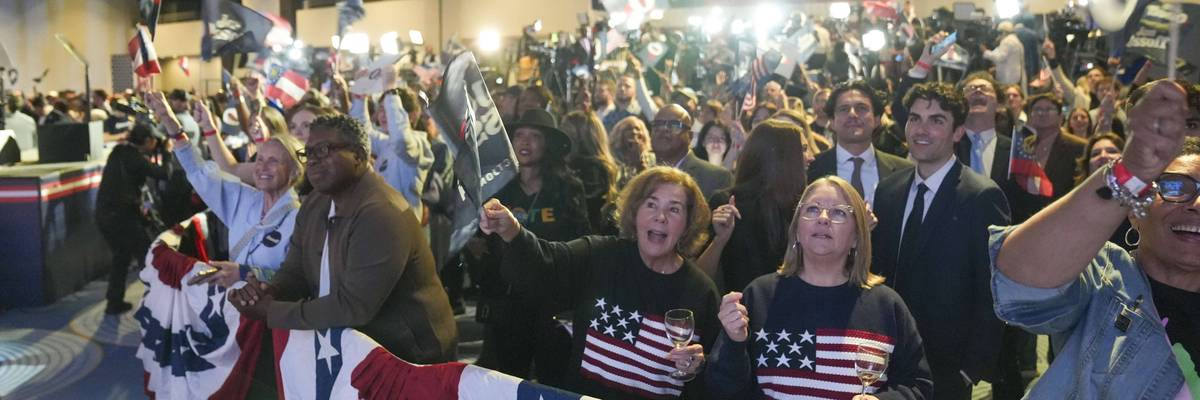
Supporters of US Sen. Jon Ossoff (D-Ga.) hold signs and flags during a midterm election night watch party at The Hyatt Regency on November 3, 2026 in Atlanta, Georgia.
(Photo by Megan Varner/Getty Images)


Jessica Corbett
Nov 05, 2026
COMMON DREAMS


Progressive Democrats’ midterm victories from Maine to Michigan to Texas signaled that US voters are fed up with GOP officials bought by billionaires and want lawmakers in Congress who fight for the needs of everyday people—and a Data for Progress report released Thursday, two days after the election, supports that conclusion.

The think tank and polling firm’s “2026 Post-Election Report: How Democrats Rode Economic Populism to Landslide Victory” lays out “where the election was won,” how Democratic candidates attracted voters as “the GOP playbook flopped,” the issues that defined this cycle, and what the 2028 contests may look like. It highlights various pieces of polling.

“When swing voters were asked which issue they consider most when deciding whom to vote for, a clear plurality (41%) said the economy, jobs, and the cost of living,” the publication says, citing surveys conducted in September and October. “Among that plurality of swing voters, about 3 in 4 (76%) said ‘inflation or the cost of living’ best explained why the economy was their top issue.”

“When asked which political party they trust more to handle inflation and the cost of living, 34% of swing voters said the Democratic Party, while 19% said the Republican Party... A plurality (47%) said they don’t know which party they trust more,” the report notes. “Democrats also carried a large trust advantage on healthcare (+29) and programs like Social Security and Medicare (+23),” but “at least 40% of swing voters said they didn’t know which party they trust more on nearly every issue tested.”

Reiterating that lack of trust in both major parties, large majorities of swing voters also said they don’t think that either Democrats or Republicans “have a solution for the cost of living.” However, over 70% specifically said they don’t think GOP President Donald Trump, who returned to power last year after losing reelection in 2020, has a solution.

Since Trump’s second inauguration, he has been intensely criticized for enriching his family and wealthy allies while driving up costs for the public with his key policies, including sweeping tariffs, a deadly crackdown on immigrants, and the ongoing illegal war on Iran. Faced with soaring prices for everything from gasoline and groceries to healthcare and housing, voters on Tuesday ousted enough of Trump’s fellow Republicans to give Democrats majorities in both chambers of Congress.

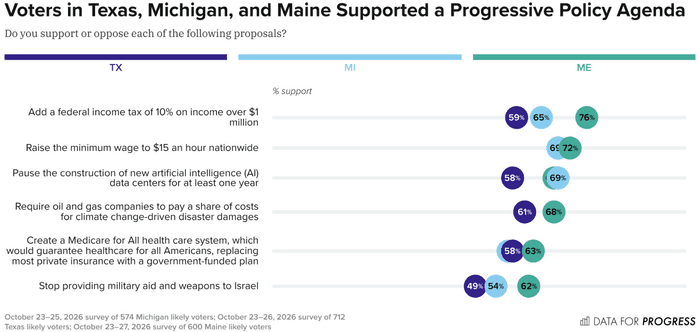
Key wins that helped Democrats secure the US Senate occurred in Maine, Michigan, and Texas, which elected Troy Jackson, Abdul El-Sayed, and James Talarico, respectively. Data for Progress surveyed likely voters in all three states in the weeks before the election and found that the economy and cost of living were most important to them, followed by government corruption.

Voters in these three states trusted Democrats over Republicans on cost of living, and also expressed significant support for a range of progressive policies, including higher taxes on millionaires, a $15 minimum wage, a pause on construction of artificial intelligence data centers, making fossil fuel giants pay for climate disasters, creating a Medicare for All healthcare system, and ending military aid to Israel.


While some Democratic leaders and consultants have argued that the party’s candidates need to embrace “moderate” platforms to get elected—particularly in districts or states previously won by Trump—Data for Progress found that this cycle, voters “associated Democrats with an economic populist platform” and “the more centrist messages registered far less.”

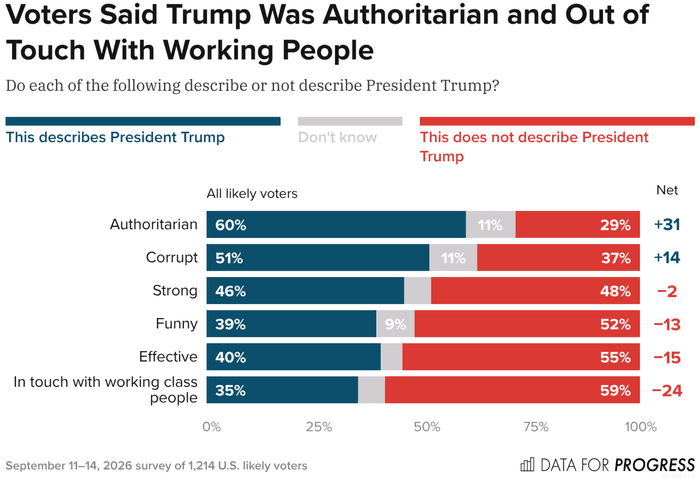
As for Republicans, likely voters believed congressional candidates would “mostly support” the president’s agenda if elected, and residents of Maine, Michigan, and Texas similarly thought the party’s Senate candidates “would mostly follow Trump’s lead.” Majorities said that the president hasn’t kept key campaign promises, including gasoline below $2, no more wars, ending inflation, cutting electricity prices in half, eradicating veteran homelessness, and capping credit card interest rates.

During Republicans’ federal trifecta over the past nearly two years, their biggest legislative “accomplishment” was passing the 2025 budget package they dubbed the One Big Beautiful Bill Act (OBBBA). The Data for Progress report points out that with Trump’s popularity tanking, some GOP candidates tried to focus on that law—but “the argument wasn’t convincing.”

“When asked if Republican claims that their tax cuts had helped working families were mostly true or false, a majority (61%) said false,” the document details. “In the days ahead of the election, a majority of voters (54%), including 61% of independents, also said wealthy people and large corporations benefited most from the bill’s tax cuts.”

When voters were asked which Trump administration policies concerned them most, passage of the OBBBA ranked second, only behind the Iran War. Other top issues included directing US Immigration and Customs Enforcement to conduct mass deportations, the tariff regime, Trump promoting his family’s cryptocurrency and enriching properties like Mar-a-Lago, and the Department of Justice withholding files about his dead former friend, sex criminal Jeffrey Epstein, while probing the president’s political enemies.

Political advertisements attacking Democrats that caught the attention of voters this round often focused on socialism, immigration, and transgender girls and women participating in sports. The report says that the GOP’s “focus on culture war issues—and on attacking transgender people specifically—was misaligned with what voters wanted to hear from their candidates.”


A majority of all voters told Data for Progress that they wanted candidates to talk more about food prices, fuel prices, healthcare costs, and political corruption—topics that have long been key focuses of Sen. Bernie Sanders (I-Vt.), who caucuses with Democrats and ran for the party’s presidential nomination in 2016 and 2020. In the wake of the “blue tsunami,” as some have described Tuesday’s results, Sanders has been widely recognized for his impact on the Democratic Party and its priorities over the past decade.

“The Bernie Sanders economic playbook is now mainstream in the Democratic Party—the data is clear that economic populism was central to these historic election results,” Data for Progress executive director Ryan O’Donnell said in a statement about the group’s new report.

“Candidates across the country made fighting billionaires, elites, and corporations the centerpiece of their campaigns, successfully connecting affordability and anti-corruption,” he continued. “But while swing voters strongly rejected Trump and the Republican Party’s handling of the cost of living, our data underscores that they are not yet convinced Democrats have a solution either. This gap presents both a risk and an opportunity.”

“Data for Progress has found that voters’ trust in the Democratic Party increases after hearing it supports anti-corruption and economic populist policies,” he added. “Americans are hungry for leadership that challenges the status quo, ends America’s forever wars, and takes on entrenched wealth and corporate power.”

Sanders himself argued after the midterms that the job of the new Democratic majorities in Congress “is to represent where working families are.” Citing a poll that found “well over 60% of the American people want Medicare for All,” the senator proposed passing his longtime healthcare policy—and said that “if Trump wants to veto it, that’s his constitutional right.”

Medicare for All is just part of what many progressive lawmakers and advocacy groups want Democrats to take on in the next two years, whether or not the White House fights back. Other priorities include a federal wealth tax, ending the Iran War, and possibly even impeaching Trump a third time.

While the New York Democrats who currently lead the party in the Senate and House of Representatives, Chuck Schumer and Hakeem Jeffries, may become majority leader and speaker in January, progressives have emphasized that “we need commitments” from them, as Sen. Chris Van Hollen (D-Md.) put it, because “it’s not a time for incrementalism. It’s a time to move forward a very bold kitchen table agenda.”

US Sen. Elizabeth Warren’s (D-Mass.) similarly stressed in a post-election op-ed that “now, Democrats must deliver,” and the party should force Trump “to do that on the affordability and corruption issues that drove this election—or call his bluff.”
‘This Is a War They Started,’ Says Mamdani After JD Vance Blames Iran Debacle for GOP Losses


“He’s the vice president of the United States of America. He is not just some commentator online. And there has to be a reckoning.”


New York City Mayor Zohran Mamdani speaks to attendees during an event for the New York City Police Department Memorial Wall in New York City on October 13, 2026.
(Photo by KHemaz/GVN via Getty Images)

Julia Conley
Nov 06, 2026
COMMON DREAMS

New York City Mayor Zohran Mamdani this week was unimpressed with Vice President JD Vance’s attempt at soberly diagnosing the problem that caused the Republican Party to lose their majorities in the US Senate and House, with Democrats flipping seven Senate seats and 43 House seats and stunning the GOP with victories in Texas, Kansas, and South Carolina.

After the election, Vance wrote a lengthy post on the social media platform X, saying, “The reason we lost is the war” in Iran, which President Donald Trump joined Israel in launching in February—sending gas prices soaring to over $4 per gallon in a country where working families were already struggling with the cost of living, a problem Trump had pledged to solve.

Vance was initially unsupportive of Trump’s decision to go to war, but has been one of the administration’s staunchest defenders of the United States’ actions in Iran—declaring that the US “never targets civilians” despite multiple bombings of schools; writing another verbose social media post falsely claiming that the decision to go to war lies only with the president—not Congress; and denying in September that the conflict that has killed more than 3,400 Iranians, 13 US service members, and thousands of people across the Middle East, is a war at all.

On Thursday, Mamdani expressed disbelief that Vance, thought to be the likely heir to Trump’s MAGA movement and a potential 2028 presidential contender, would attempt to distance himself from the war the US is waging while still serving as one of the highest-ranking political officials in the country.


“I find it quite ironic to read a post from the vice president as if he’s describing the actions of a different administration,” said Mamdani. “He’s the vice president of the United States of America. He is not just some commentator online. And there has to be a reckoning of the fact that this is a war that they started.”

“It’s a war they can end,” continued the democratic socialist mayor, who since entering the mayoral race in a long-shot bid early last year has rapidly become one of the most influential and popular Democratic politicians in the country. “If they think it was a part of their political demise, then why don’t they actually start to take some action to reflect that?”

Vance said in his post that Republicans must focus on ending the Iran War, bringing down the cost of living, putting “America First,” and changing the US relationship with Israel, which the administration has said pushed it to launch its attacks on Iran.

Vance’s comments were taken by some as an initial attempt to begin distancing himself from the actions of an increasingly unpopular administration, in preparation to run for president.

Mamdani’s response, said Jacobin writer Branko Marchetich, offered a “preview of the struggles” that the vice president will face in doing so.

“He’s done his best to leak stories that he opposed it and thread the needle in public,” said Marchetich. “But end of the day it’s his administration too, so he owns it.”
El-Sayed Pledges to Probe RFK Jr. Over Summer’s ‘Crap Lettuce’ Outbreak That Hit Michigan Hard

The senator-elect said he aims to probe “the decision-making that’s gone on and what we need to do to solve the problem in its depth. And that takes understanding the nature of the problem.”


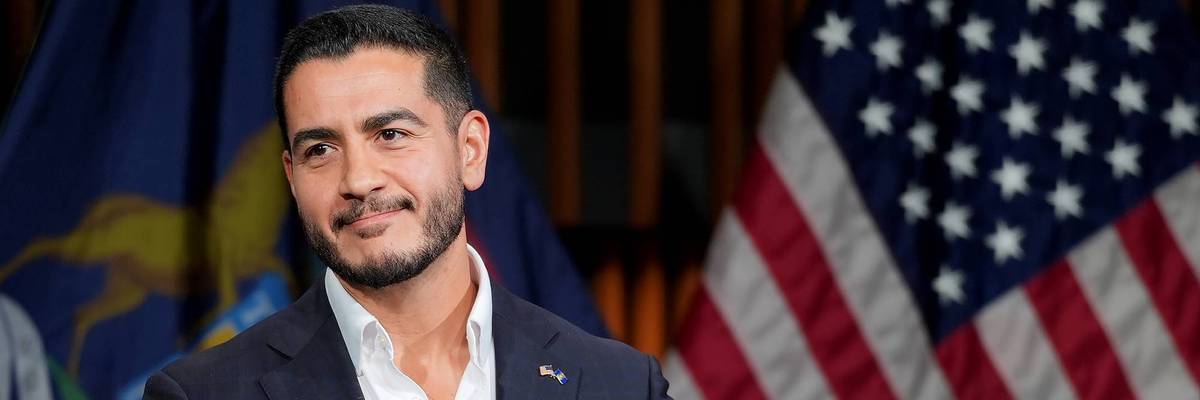
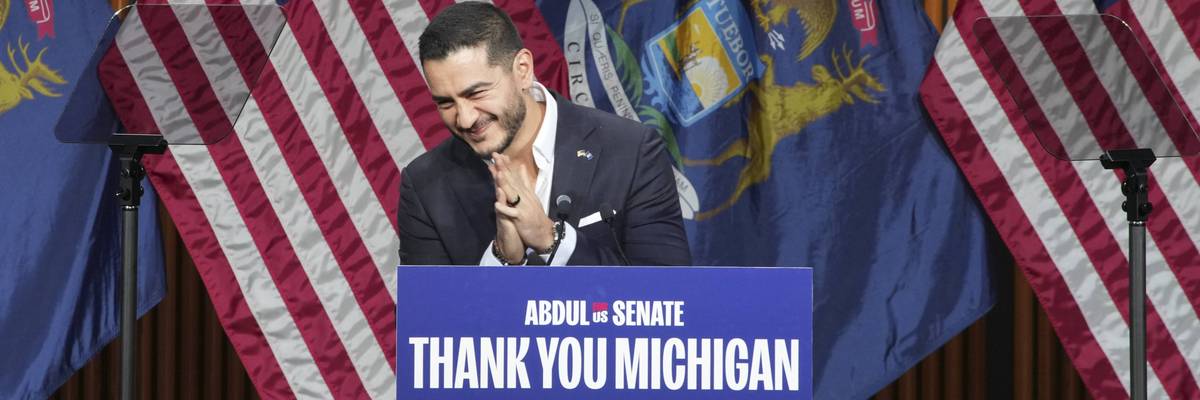
Democratic Sen.-elect Abdul El-Sayed of Michigan speaks after winning his election on November 4, 2026 in Detroit.
(Photo by Salwan Georges/Getty Images)

Julia Conley
Nov 06, 2026
COMMON DREAMS

Michigan was the epicenter of the cyclosporiasis outbreak that hit the United States last summer, and the state’s new Democratic senator-elect plans to find out why after taking office in January.

Sen.-elect Abdul El-Sayed, who faced virulently racist attacks from members of the Trump administration, including Health and Human Services (HHS) Secretary Robert F. Kennedy Jr., during his campaign, told CNN Thursday that he plans to investigate Kennedy’s handling of the outbreak of the illness caused by the Cyclospora parasite, which sickened more than 15,000 Michiganders, hospitalized more than 370, and killed two people in the state.


El-Sayed emphasized that he is not out for “retribution for something past,” but said an investigation into staffing cuts at HHS would be focused on “understanding what happened, holding people accountable for what they did, and then solving the problem moving forward.”

“People need to feel it in their back pockets and in their homes,” said El-Sayed.


The former public health official said the Trump administration had “DOGE-ed out the part of the Food and Drug Administration and the [Centers for Disease Control and Prevention] that was intended both to protect you from eating lettuce that had been defiled by somebody else, and counting the number of cases,” referring to the Department of Government Efficiency.

Under the leadership of GOP megadonor Elon Musk, DOGE cut staffing at a CDC lab tasked with responding to Cyclospora and other parasitic outbreaks from 11 people to just three.

The US Department of Agriculture shut down three key research projects regarding the parasite, which can cause explosive diarrhea and other gastrointestinal symptoms when it contaminates food. Two of the projects were defunded by the Republican-controlled Congress, while a third was moved from Maryland to Iowa as part of a reorganization of the agency, and the scientists working on the research declined to relocate, jeopardizing the study.

The CDC also removed Cyclospora from its Foodborne Diseases Active Surveillance Network, or FoodNet, in 2025 as part of Kennedy’s changes to the agency.

Kennedy said the outbreak was “under control” on July 21, when 1,600 people were sick across the country. Dozens of people in Michigan continued to become ill over the following month. The outbreak was ultimately linked to lettuce that was grown in central Mexico by Taylor Farms de Mexico.

The HHS secretary claimed that the allegations that his cuts had reduced the government’s ability to respond to the outbreak were “invalid,” saying there were “no cuts in the surveillance program.”

“We did cuts in the FoodNet program, but they were redundant surveillance,” said Kennedy.

El-Sayed said Thursday that he aims “to understand why he’s... done this, the decision-making that’s gone on, and what we need to do to solve the problem in its depth. And that takes understanding the nature of the problem.”

He added that legislation could come out of an investigation.

“There’s no reason that we couldn’t have one clean bill, right? The Crap Lettuce Elimination Act, whatever we want to call it, to just make sure that we have a FDA that’s functioning,” said El-Sayed. “It’s not just lettuce. We’re talking—seeing recalls in blueberries. We’re seeing recalls in blackberries. We’re seeing recalls in meat. And that’s because the FDA’s not working.”

The senator-elect also said the ascent of Kennedy, who has publicly questioned the safety of vaccines and halted immunization research, is among the Trump administration appointments that raise questions about how President Donald Trump is selecting his nominees for top government positions.

“I think this administration has shown that the decisions that they make about who is engaged in government, leading government, that that’s more about backroom deals and who curries favor than it is about their capacity to do the job,” said El-Sayed. “When you nominate somebody like RFK Jr., who is anti-science, to run HHS, what you get is a bunch of nasty crap lettuce in the state of Michigan.”

When considering Trump’s nominees as a senator, El-Sayed added, “I’m going to assume I’m not going to support you until proven otherwise. So the bar is going to be extremely high. I want to know that this person was chosen on their merit and the capacity to serve the American


Warren Lays Out How Democrats Can Deliver for the Working Class—Even With Trump in the White House

“Democrats won this election by claiming we are on the side of working people, and working people are counting on us to deliver.”


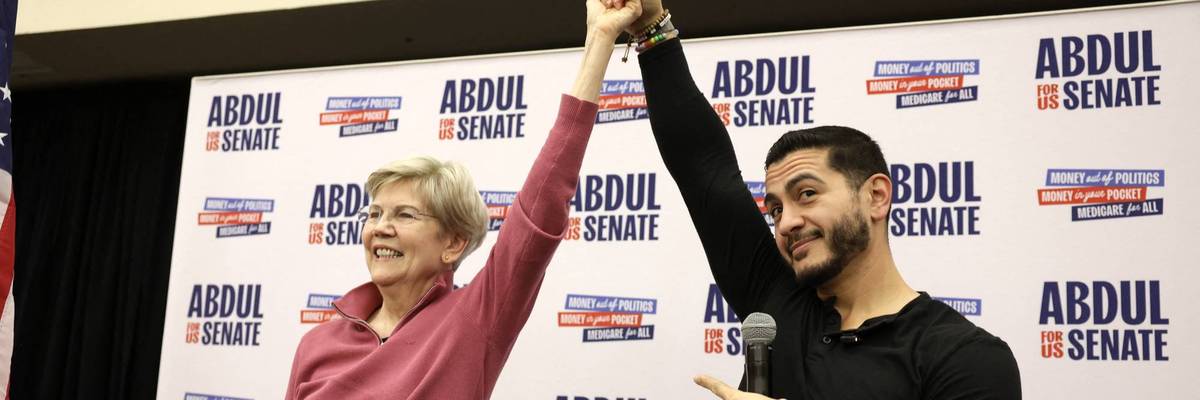
US Sen. Elizabeth Warren (D-Mass.) joined Abdul El-Sayed at a midterm campaign rally in Ann Arbor, Michigan on November 2, 2026.
(Photo by Jeff Kowalsky/AFP via Getty Images)

Jake Johnson
Nov 05, 2026
COMMON DREAMS

“Americans need Democrats to deliver now, not in two years.”

That was US Sen. Elizabeth Warren’s (D-Mass.) post-election message to her fellow congressional Democrats on Thursday as she outlined how the party can use its impending control of the House and Senate to deliver real gains for the working class—even with corrupt billionaire President Donald Trump in the White House

In an op-ed for TIME, Warren argued Democrats succeeded in midterm contests across the country “by being populist economic fighters who were unafraid to call out the corrupt politicians and corporate interests who have rigged the system at the expense of everyone else.”

“Now, Democrats must deliver,” the progressive senator wrote, urging her party to push Trump to live up to his vow to work with Democrats in the new Congress. “We should force him to do that on the affordability and corruption issues that drove this election—or call his bluff.”

Warren laid out what she views as top priorities for the new Democratic majority, including: Ending Trump’s illegal war in Iran, cutting costs for working families, moving to cancel Trump-GOP cuts to Medicaid and nutrition assistance, reversing Trump’s tax cuts for the rich, and holding “Big Tech CEOs, Wall Street executives, and giant corporations” accountable for “ripping off the American people to make themselves richer.”

The senator expressed openness to working with Republicans but wrote that Democrats must be willing to use the filibuster-proof reconciliation process—or eliminate the Senate’s 60-vote filibuster entirely—to advance an ambitious agenda.

But what if Trump decides to wield his veto power against Democratic legislation, as he has suggested he could do?

Warren argued that Democrats must “test that out by passing legislation the American people support to make life more affordable and our government less corrupt.”

“It would be a breach of faith with the people from South Carolina to Texas, who voted for us to address costs and corruption, to spend the next two years waiting for some future Democratic trifecta to hopefully deliver meaningful change,” Warren wrote. “Democrats won this election by claiming we are on the side of working people, and working people are counting on us to deliver.”

Another leading progressive in the Senate Democratic caucus, Bernie Sanders (I-Vt.), similarly argued that Democrats’ historic midterm wins were “important,” but “not enough.”

“The American people want change. Real change. And the midterm election confirms just that,” Sanders said in a video message, pointing to the urgent need to address out-of-control income and wealth inequality, the starvation-level federal minimum wage, unfettered artificial intelligence, the corrupt campaign finance system, the broken for-profit healthcare system, and more.

The solutions to those crises, he argued, “are not radical,” pointing to broad public support for Medicare for All, expanding Social Security, and other progressive proposals.

“What we are talking about now is not only the need to fight for economic justice,” said Sanders. “We are fighting to give hope to the American people—to allow them to understand that their government can work for them, can address the crises that they face, and will pay attention to the needs of the men, women and children in our country who are struggling, and not just the very, very wealthy campaign contributors.”

“That is, in my view, what Democrats have got to do when they assume power in January,” he added. “We can do it. We must do it.”

Will the Blue Tsunami Bring a New Deal for Unions?


What American workers—and American democracy—need most is a larger, more powerful labor movement. Unions should take advantage of this moment to build one.


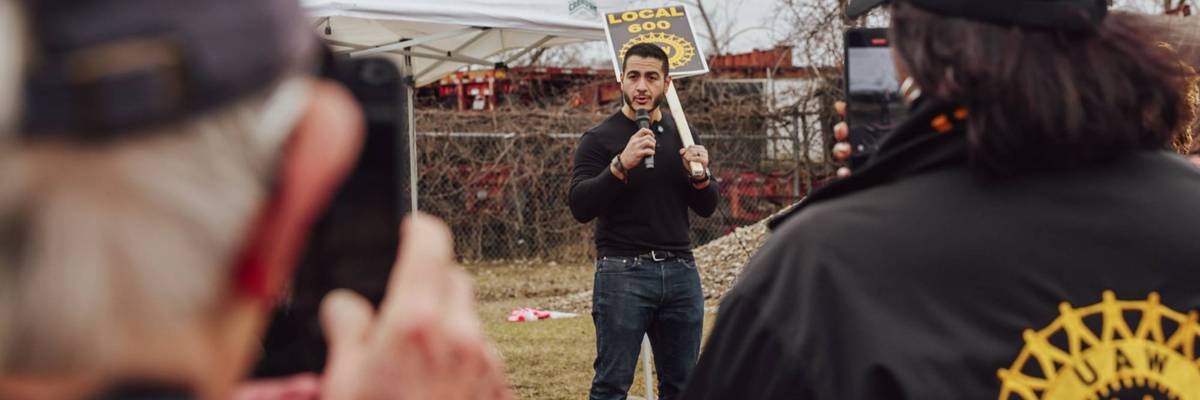
Democratic Michigan Senate candidate Abdul El-Sayed speaks to members of United Auto Workers (UAW) Local 600 in Dearborn, Michigan on March 9, 2026.
(Photo from Abdul El-Sayed/X)

Lowell Peterson
Nov 06, 2026
Common Dreams

Union activists like me can be forgiven a certain degree of giddiness after Donald J. Trump’s agenda got walloped in the midterm election. After all, Trump has been one of the most anti-worker presidents in history. He stripped millions of federal employees of the right to bargain collectively, he gutted the National Labor Relations Board, and he sliced back regulations that gave overtime to millions of employees and that protected people from being improperly classified as independent contractors without labor rights. He cut taxes for corporations and billionaires and slashed food and medical benefits for working Americans.

Congress is now in the hands of Democrats, including many who trend younger and more progressive, and even more who proclaim themselves to be the friend of the working person (some even say “working class”). Alas, Trump remains in place. It would take some extraordinary parliamentary maneuvering to undo all—or perhaps any—of Trump’s anti-worker policies. There is no reason to shy away from uphill battles, but we cannot expect complete victory in the next two years.

Anyway, the agenda is broader than a few immediate policy initiatives. As I argue in my upcoming book, Building Power: Collective Action, the Writers’ Strike Against Hollywood, and Organizing for the Future (Cornell University Press), what American workers—and American democracy—need most is a larger, more powerful labor movement. That is the key to making sure the federal government acts in the interest of working people over the long haul. (By “working people” I mean everyone who earns a living by their own labor, whether by putting up buildings or tending to patients or teaching kids or writing software or working on the assembly line.)

If unions and their members (and potential members) want to make meaningful, sustainable advances, now is the time to commit to doing the hard work of organizing.

Here is the painful truth: Only about 10% of American workers are represented by unions. In the private sector, it’s closer to 6%. It is difficult to get corporate chieftains and elected politicians to fight for working people in the face of corporate opposition when union density is such a small fraction of the overall labor force and economy.

Things were this bad when Franklin Delano Roosevelt was elected. Union density was about 11% in 1934. The New Deal transformed federal labor law, FDR proclaimed that every worker should join a union, and the labor movement got to work organizing the unorganized. By 1945, density skyrocketed to nearly 35%.

Union density remained between 30-35% for decades, and tens of millions of union members won a measure of economic security. Wages and productivity increased at about the same rate, roughly doubling from 1948 to 1973 (Sven Beckert, Capital: A Global History (Penguin Press 2025) at p. 949). In other words, working people won a reasonable share of the wealth they created.

Union density nosedived after the early 1970s, and economic inequality exploded. From 1980 to 2020 income gains for the top 1% were more than triple those in the middle. The gap became even larger between the truly wealthy and the less well-off; the top 0.1% saw gains 12 times as large as those of the lowest 20% between 1979 and 2022.

A recent Economic Policy Institute study estimated the gains working people would make if union membership tripled to about 30%: $1.2 trillion a year, or about a third of the increase in economic inequality since 1979. Thus, if union density returned to where it was during the New Deal, this would put a serious dent in the economic inequality that has roiled American politics and ruined household finances. It is difficult to imagine a more powerful outcome for the Blue Tsunami than a New Deal for unions.

However (and sorry, this is a distinctly non-giddy point), one midterm election does not lock in a long-term political realignment. We need politicians to support pro-worker legislation for as long as it takes—decades, not years. The first legislative step would be to transform federal labor law to support, rather than hinder, unionization. That would make it vastly less difficult to increase union density.

None of this will happen by itself. Political candidates and consultants do not build movements. Organizers and leaders and activists and members do. Political winds shift and elections swing like pendulums. More important, politicians respond to leverage, not good vibes. They will only adopt labor law reforms if they feel sustained pressure to do so. If unions and their members (and potential members) want to make meaningful, sustainable advances, now is the time to commit to doing the hard work of organizing and bargaining, of engaging working people directly, of building their power in a sustainable way. They can use that power to exert leverage on whichever politicians seek their support. That is the surest way to capitalize on the gains that working people made in the midterm elections.


Our work is licensed under Creative Commons (CC BY-NC-ND 3.0). Feel free to republish and share widely.


Lowell Peterson
Lowell Peterson was the executive director of the Writers Guild of America East from 2008 to 2023. Cornell University Press is publishing his book, Building Power: Organizing for the Future, with Lessons from the Writers’ Strike Against Hollywood, later this year.
Full Bio >
Most Jewish Voters Backed El-Sayed Despite Relentless ‘Antisemitism’ Smear by Israel Apologists

Meanwhile, a new poll revealed that a supermajority of Jewish Americans believe that the actions of Israel and AIPAC fuel antisemitism.


Democrat Abdul El-Sayed makes remarks in Detroit on November 4, 2026, after becoming the first Muslim elected to the US Senate.
(Photo by Katie McTiernan/Anadolu via Getty Images)


Brett Wilkins
Nov 06, 2026
COMMON DREAMS

Despite an expensive campaign to distort his vocal criticism of Israeli crimes in Palestine as “antisemitic,” progressive Michigan Democrat Abdul El-Sayed won his US Senate race with the support of a majority of the state’s early Jewish voters, while a survey published Thursday revealed that 8 in 10 Jewish Americans believe Israel’s actions and lobbying increase antisemitism.

An analysis of Michigan voting data published by the Jewish newspaper The Forward found that El-Sayed, who will be the first Muslim senator in US history, received approximately 60% of the vote among Jewish early voters.

The survey’s results imply a rebuke of the efforts by groups like the American Israel Public Affairs Committee (AIPAC), which spent nearly $30 million on opposing El-Sayed and supporting his primary opponent, Rep. Haley Stevens (D-Mich.).

“The media spent October obsessing over Abdul El-Sayed’s ‘problem’ with Jewish voters,” writer and labor organizer Joe Wrote said on social media, noting that corporate outlets including The Washington Post, New York Times, Associated Press, and NPR “ran constant articles.”

“In the end, El-Sayed got 60% of the Michigan Jewish vote, 1.3% less than Elissa Slotkin did in 2024,” he added, referring to Michigan’s Democratic junior US senator, who is Jewish. “The mainstream media is a joke.”

While AIPAC’s enormous spending helped make the contest one of the most expensive Senate primaries in US history, El-Sayed’s focus on issues affecting working families—the affordability crisis, fixing the nation’s broken healthcare system via Medicare for All—in addition to broader topics like getting money out of politics and ending US militarism and aid to Israel, led to his Tuesday victory.

AIPAC—whose super political action committee, United Democracy Project (UDP), only started financially supporting congressional candidates in 2021—has flexed its electoral muscles in recent years. In 2024, it helped defeat progressive Reps. Jamaal Bowman (D-NY) and Cori Bush (D-Mo.). However, Rep. Summer Lee (D-Pa.) survived a UDP spending blitz during the previous midterms in 2022, and El-Sayed’s victories in both the Michigan primary and general election demonstrate the limits of its largesse.

El-Sayed’s victory coincided with the release of a new GBAO survey commissioned by the liberal Jewish lobby group J Street showing that overwhelming majorities of Jewish Americans believe the actions of Israel and AIPAC contribute to antisemitism in the United States.

According to the survey, 80% of respondents believe that Israel’s actions in Gaza and the West Bank increase hatred of Jews, while 66% said that AIPAC funding advertisements against candidates who criticize Israel worsens antisemitism, and 60% agree that “Jewish organizations that condemn harsh criticism of Israel as antisemitic are exploiting concerns about antisemitism to defend unpopular Israeli government policies.”

Tellingly, more respondents believe that Israel is committing genocide in Gaza (31%) than that Israel deserves unconditional support (30%).

A United Nations Commission of Inquiry, as well as many experts, including Israeli and other Jewish scholars, say that Israel is committing genocide in Gaza. A genocide case against Israel filed by South Africa and formally backed by nearly 20 nations is proceeding through the International Court of Justice.

Israeli Prime Minister Benjamin Netanyahu and former Defense Minister Yoav Gallant are wanted by the International Criminal Court for alleged crimes against humanity in Gaza, including murder and forced starvation, committed during a war that has left more than 250,000 Palestinians dead or wounded and nearly 2 million people forcibly displaced.

In the illegally occupied West Bank, Israel has been accelerating its decadeslong campaign of apartheid, settler colonization, land theft, and ethnic cleansing, expanding illegal settlements and outposts while systematically dispossessing Palestinians of their homes, farms, and ancestral lands.

The far-right Netanyahu government has openly embraced annexation, with ministers pushing to formally absorb Palestinian territory into Israel and explicitly declaring their intention to prevent the establishment of an independent Palestinian state.

Armed Israeli settler-colonists, frequently operating with the protection, participation, or complicity of Israeli occupation forces, have unleashed increasingly brazen pogroms against Palestinian communities, burning homes, mosques, and vehicles, destroying olive groves, stealing livestock, beating residents, and killing Palestinians.

Appearing Thursday on MS NOW’s “Morning Joe,” El-Sayed was asked by host Willie Geist what message he had for Jewish voters who had been concerned about his positions and how he would protect them against antisemitism.


“I was really privileged to grow up in a community where about 40% of my high school class was Jewish,” he said. “I grew up going to synagogue, going to Seder, going to bar and bat mitzvahs growing up. I have so much respect for the Jewish faith and Jewish contributions to American life.”

“I also know what it’s like to be discriminated against for how I pray,” the senator-elect continued. “And I want an America where nobody is discriminated against under our Constitution.”

“I know what it’s like to drop off my kids to a mosque and wonder if they’re going to be safe, and am I going to be able to pick them up safely afterwards,” El-Sayed continued. “I’m committed to the safety of Jewish children like I’m committed to the safety of my own children.”

“But I want to ask us this,” he said. “We spend billions of dollars subsidizing a foreign government unconditionally buying bombs and tanks that have been used to do genocide and apartheid and make war we have no business fighting.”

“And we’re told that if you want to stand up against the murder of innocent Palestinian children, that that’s somehow about hate for anybody. It’s not about hate for anybody,” El-Sayed stressed. “It’s about equal love for those Palestinian children, as you would have for a Jewish child growing up in the Holy Land.”

“So if I stand up and say, hey, maybe we shouldn’t be sending our money to do the worst things to other people, people are like, well, it must be because you hate the people who are doing the worst things,” he said. “I’m like, that’s insane.”

“We have to separate between Judaism and the Jewish people and Israel and its actions,” the senator-elect asserted. “And by the way, I apply the same approach to the government of Egypt where my family came from. And I would hate that somebody would assume that I would be OK with the human rights abuses of the government of Egypt simply because I share the ethnicity of the majority of people who are in Egypt.”

El-Sayed concluded by saying he wants to see a world in which “a Palestinian child and a Jewish Israeli child growing up in the Holy Land can look forward at their life and say, my life is not going to be curtailed by somebody’s violence.”
The Midterms Weren’t Red vs. Blue, They Were Bought vs. Not Bought

The 2028 lesson is not to find the most “electable,” most “moderate,” or most anti-MAGA Democrat. It’s to nominate one who is boldly and proudly against corporate money.


Then-Democratic candidate for US Senate in Michigan Abdul El-Sayed speaks during a rally at The Congregation on August 3, 2026 in Detroit, Michigan.
(Photo by Scott Olson/Getty Images)


Paula Pecorella
Nov 06, 2026
Common Dreams

This week, voters in red and purple states sent Democrats to the Senate who ran against corporate money. James Talarico won in Texas. Annie Andrews won in South Carolina. Adam Hamilton won in Kansas. All three took $0 in corporate PAC money.

More than 16 years after Citizens United gave corporations a free speech right to unlimited political spending, I believe Americans have reached a breaking point. A fundamental realignment is underway, and the midterms are the clearest evidence yet. The 2028 lesson is not to find the most “electable,” most “moderate,” or most anti-MAGA Democrat. It’s to nominate one who is boldly and proudly against corporate money. A candidate who is not bought.

I know because I’ve spent years reporting on it. I was the fifth hire at More Perfect Union, a news start-up that would focus on the working class issues the mainstream media so often ignored. We told working-class stories across all 50 states: minor league ballplayers living in abject poverty, corporate chains flagrantly breaking the law, baristas organizing their Starbucks one store at a time, each inspired by a video of the last. We filmed factory workers at Kellogg’s and John Deere, resident doctors, Hollywood writers. The struggle was the same in every state and county, and in every workplace. It wasn’t a blue one or a red one. It was a working-class one.

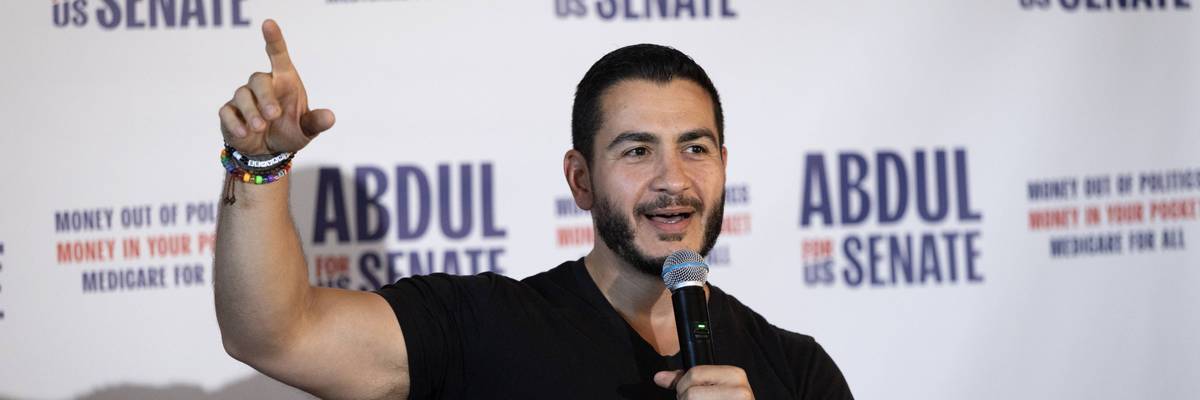
Abdul El Sayed’s slogan, “Money out of politics, money in your pocket, and medicare for all” is the blueprint, and we must follow it.

It came into focus covering freight rail. In 2022, rail workers nearly shut down the US economy by refusing a contract with zero guaranteed sick days. President Joe Biden, the self-proclaimed “Union President,” brokered the deal rail workers had just rejected, then asked Congress to impose it on the 125,000 workers anyway. The Congress that did so had taken millions from the same railroads. In the 2020 cycle alone, rail PACs gave $3.7 million to congressional candidates.

That was the corporate Democrat playbook in one decision: Say you stand with workers, then side with the people who fund you when it counts. That’s the Democratic Party voters have been rejecting, and it’s the one we have to leave behind.

Now look at the midterms. Abdul El-Sayed won in Michigan, Peggy Flanagan in Minnesota, Josh Turek in Iowa, and Jon Ossoff in Georgia, all at $0 in corporate PAC money. Mary Peltola in Alaska and Scott Colom in Mississippi, whose races are too close to call as I write, fit the same mold. Angie Nixon took no corporate money and came within 200,000 votes in Florida, a state considered solidly red. Roy Cooper and Sherrod Brown won without this message, but I believe they’re the exceptions to the rule.

Abdul El Sayed’s slogan, “Money out of politics, money in your pocket, and medicare for all” is the blueprint, and we must follow it.

Talarico, the first Democrat to win a Senate seat in Texas since 1988, pointed out over and over in his campaign that “in America, we have an affordability crisis because we have a corruption crisis.” Andrews was proud to say that “I don’t take a dime of corporate PAC money.” and differentiated herself from her opponent by saying, “Unlike Senator Graham, I will not sell out to big money or take any corporate PAC money.” This is the same anti-swamp, outsider message President Donald Trump won on, only this one has spine.

Voters are sick of watching the cost of everything rise while we send billions overseas for new wars. They’re sick of being forced to work longer hours, adopt AI without guardrails, and produce more without seeing their paychecks go up, all while the US produces its first trillionaire.

Campaign finance is public record. Tools like the Political Integrity Index let anyone see which candidates are selling out to corporations and which have taken an integrity pledge to the people who elected them. To win the presidency in 2028, Democrats must take a bold stand against corporate influence over politicians and campaigns. To save our democracy, we must do as much.


Our work is licensed under Creative Commons (CC BY-NC-ND 3.0). Feel free to republish and share widely.


Paula Pecorella
Paula Pecorella is a labor and political communicator who worked on the Fight the Oligarchy tour, the Harris for President campaign, SEIU, and was an early hire at More Perfect Union.
Full Bio >