It’s possible that I shall make an ass of myself. But in that case one can always get out of it with a little dialectic. I have, of course, so worded my proposition as to be right either way (K.Marx, Letter to F.Engels on the Indian Mutiny)
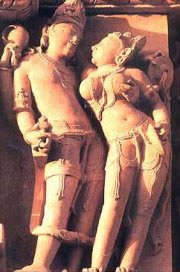
on the social level, the Kartābhajās bring together members of all classes and social factions, rejecting caste distinctions and proclaiming the divinity of all human beings; and third, on the gender level, the Kartābhajās offered a new social space in which men and women could mix freely, even providing new opportunities for women in roles of spiritual authority. The result is a rather ingenious religious fusion – or “subversive bricolage,” which skilfully adapts and reconfigures elements from a wide range of sources – a kind of poaching or pilfering by poor lower-class consumers in a dominated religious market that demanded the subtle use of secrecy, both, as a tactic of appropriation, and as a key social strategy or way of life. The Economics of Ecstasy - Tantra, Secrecy and Power in Colonial Bengal
Much like the early Agape Feasts of the Christians and their predecesors in the Mithras Cult. Religions of the Ancient Lowly are democratic in nature in their earliest forms, since they exist outside and against the dominantant Religious State. They offer a safe place for a declasse melange of participants, and women are notably amongst them.
These 'Love Feasts' offered the participants the free exchange of goods; potlach, a sharing of communal supper, and after that convivality, socializing, and all that could be found scandalous by the salacious.
In ancient Greece the Bacchanae were a rebellion against the rigid State Religion (see Themis by Jane Harrison) embracing the life affirming spontaniety of nature, in the form of a dead and ressurected god; Bacchus/Dionysous/Pan.
Once Christianity lost its spontaneous inclusiveness it became a State religion of Constantinople the Byzantine seat of power of the former Hellenic world. The State declared Jesus the one and only dead and ressurected god, no others need apply.
IMAGE: DR ANITA RADINI, UNIVERSITY COLLEGE DUBLINview more
CREDIT: JASON CLARKE PHOTOGRAPHY
The Dan David Prize, the largest history prize in the world, has announced University College Dublin (UCD) Archaeologist, Dr Anita Radini, as one of nine recipients for 2023.
Each of the winners - who work in Kenya, Denmark, Israel, Canada, the US and Ireland - will receive $300,000 (USD) in recognition of their achievements as emerging scholars and to support their future endeavours in the study of the human past. Dr Radini is the first in Ireland to receive this award.
“Our winners represent the next generation of historians,” said Ariel David, board member of the Prize and son of the late founder. “They are changing our understanding of the past by asking new questions, targeting under-researched topics and using innovative methods. Many of the winners we are recognising today are in the early stages of their careers, but they have already challenged how we think about history. Understanding the past, in all its complexity, is critical to illuminating the present and confronting the challenges of the future.”
Dan David, the founder of the Prize, believed that knowledge of the past enriches us and helps us grapple with the challenges of the present. David lived through persecution in Nazi-occupied and then Communist Romania, becoming an accomplished photographer and later an entrepreneur and philanthropist.
The Dan David Prize Selection Committee said: “Anita Radini is developing novel techniques to track the artists and craftspeople of ancient times by their skeletal remains. In addition, Radini studies the elements present in dental calculus in order to obtain data on diet, activities and health. This is a radically pioneering line of research with extraordinary potential to answer fundamental questions about the lifestyles and environmental contexts of past populations. Radini’s multi-disciplinary approach to past diet, environment and health has important implications for society today.”
Professor Orla Feely, UCD Vice-President for Research, Innovation and Impact and incoming University President said: "I congratulate Dr Anita Radini on this very prestigious award. It is wonderful to see a UCD archaeologist recognised on such a global and high-profile platform. We are very proud of Anita's research and I look forward to seeing it continue to flourish."
While we may be familiar with ancient monuments and artwork that exemplify ancient craft skills, the crafters themselves often remain invisible. An Archaeological Scientist and Human Palaeoecologist at UCD School of Archaeology, Dr Radini analyses the tiny remains of dust in dental plaque on ancient people’s teeth to uncover more about their lives.
“Multiple aspects of an individual’s life history are preserved in their teeth for millennia.” Radini said. “These people were exposed to particular kinds of dirt when practising their crafts - wood carving, traditional leather work, fabric dyeing, etc. By approaching the human mouth as a ‘depositional environment’ and using Experimental Archaeology, we can reveal more about who they were and the conditions they worked in.”
In 2019, a unique discovery by Dr Radini and her colleagues helped to illuminate the role of women in mediaeval crafts and to challenge the widespread assumption that male monks were the sole producers of books in the Middle Ages. The team identified particles of blue pigments in the dental plaque of a mediaeval woman’s remains as lapis lazuli, a stone more precious than gold at the time. These findings were the first to provide direct archaeological evidence from skeletal remains that women were involved in illustrating mediaeval manuscripts.
The study suggested potential to track other “dusty” crafts and reveal the invisible workforce behind many ancient forms of art. Dr Radini is currently developing novel methodologies to understand exposure to dirt and pollution and their links to health in past populations.
”Our knowledge of occupational health in ancient times is limited by paucity of historical texts and lack of specific markers on ancient skeletal remains. My research aims to push the boundaries of how we approach labour division, by exploring health impacts and inequalities in past societies I believe we can gain valuable insights for our modern world. Dust entrapped in teeth, combined with demographic (age/sex) and other osteoarchaeological parameters, can reveal many unknown aspects of past lives.”
The significant Dan David Prize fund will help Dr Radini to expand her work in this field and to create a better understanding of how labour division and crafts affect health through time.
“I am thrilled to receive this prize and deeply honoured to be recognised among leading scholars of the human past from all over the world. I am particularly delighted to see the great diversity of studies and people that were awarded the prize.”
Projects from this year’s Dan David Prize recipients include a virtual reality tour of mediaeval Angkor Wat and a digital archive of disappearing architecture in Kenya, as well as explorations of interfaith rifts after the Holocaust, illicit sexuality in colonial Nigeria and white women’s complicity in slave ownership in the US South.
All nine winners for 2023 will be honoured at the Dan David Prize Award Ceremony in Tel Aviv this May. The recipients were selected from hundreds of nominations submitted by colleagues, institutions and the general public in a worldwide open nomination process.
THE FIRST MASONS Like it or not, building in Italy means mastering concrete
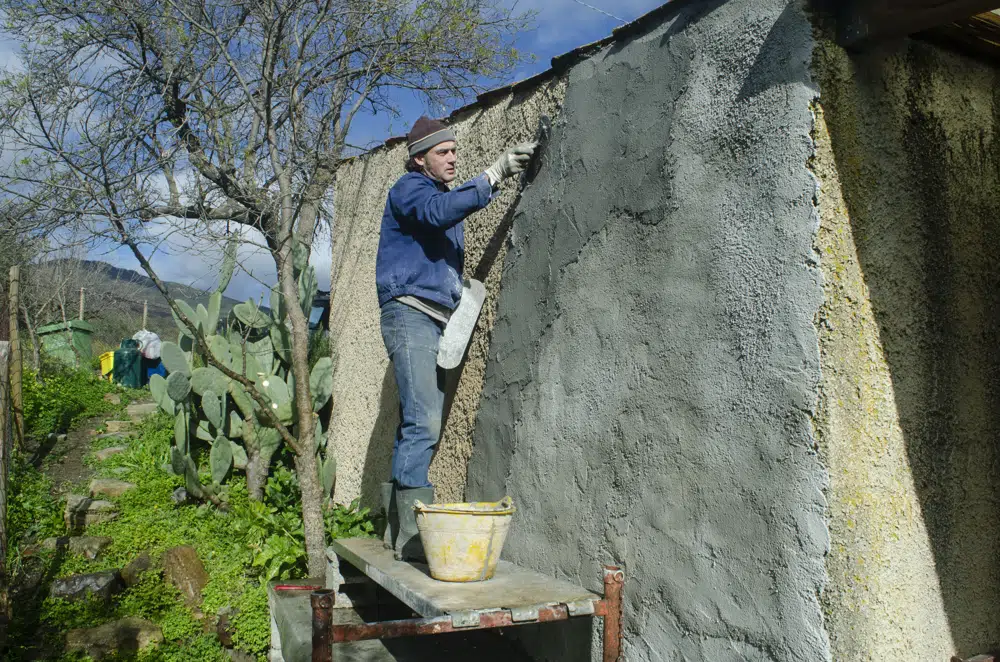
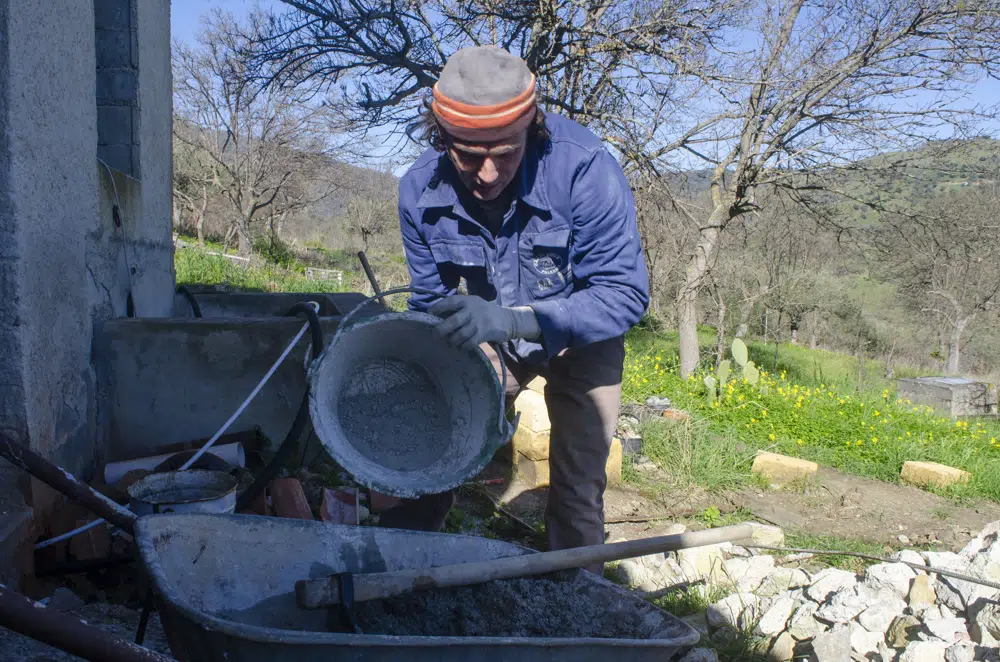
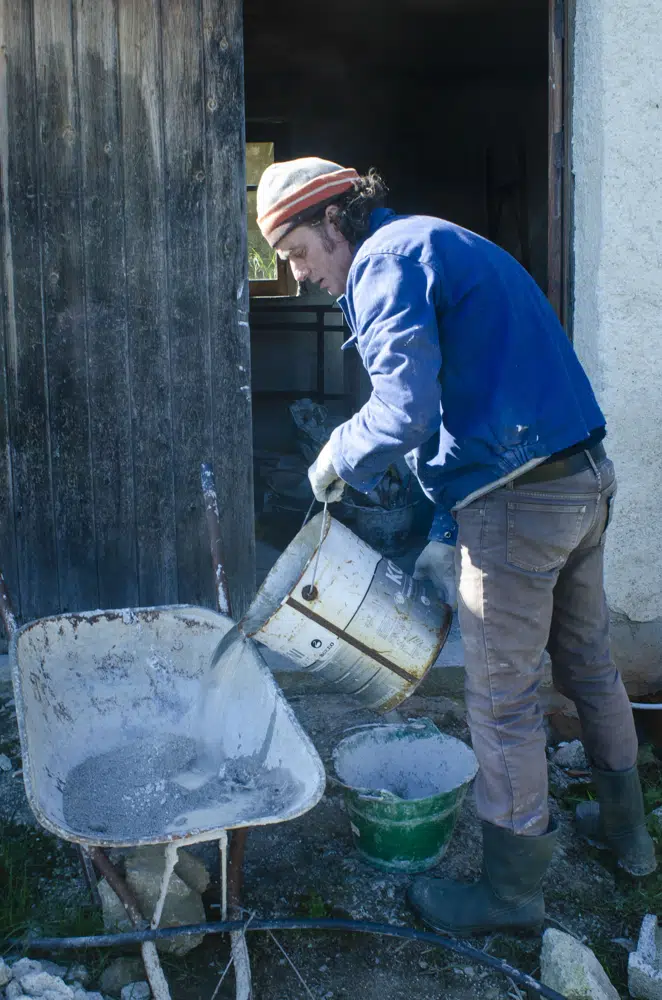
By CAIN BURDEAU This image provided by Audrey Rodeman shows Cain Burdeau covering a wall of a small concrete house where he lives with his family outside Castelbuono, Sicily, Italy, in a coat of concrete plaster. Burdeau had to become familiar with masonry to build in Italy, a land where laborers have long excelled with trowels, chisels, mortar mixes, stones and bricks. (Audrey Rodeman via AP)
CONTRADA PETRARO, Sicily (AP) — Everywhere you look in Italy, it’s there: It can be hulking and gray but also colorful and fun. Ominous but also beautiful.
Masonry using concrete and its old ingredient, cement, are inescapable here. It’s a crucial difference between construction in North America and in Europe: the carpenter versus the stone worker.
That was the difficult reality I faced when I moved from the U.S. with my family into a long-abandoned farm property 3 kilometers (a couple of miles) outside a town called Castelbuono in the Madonie Mountains in north-central Sicily.
I had a whole bunch of ugly and crumbling concrete to deal with. Or that’s how I saw it at first.
Coming from a background in American carpentry, the art of masonry was entirely new to me. But here, in a land where laborers have long excelled with trowels, chisels, mortar mixes, stones and bricks, I realized I’d have to become familiar with them too.
Masonry is especially legendary in Italy, home to many of the world’s most spectacular examples of stone and mortar work. The country also boasts the largest un-reinforced concrete dome still in existence: the Pantheon of ancient Rome.
As I began experimenting with concrete work and got a little better at it, I also came to appreciate more all those concrete buildings around me in Sicily — from the ancient beauties to the clunkier, Brutalist-style versions that went up in a post-World War II building boom.
The farm’s main part consists of two barns: an old stone structure, and a newer, tower-like one made of concrete blocks. Nearly five years went by before I finally attempted to turn the barns into a house.
During those years, my family had been living comfortably in a tiny modern home, also built in concrete blocks, a few yards from the barns where the farmer who built this place kept animals and tools, and made wine and olive oil. The 430-square-foot home – with a flushing toilet, lights, shower, windows, veranda and tiled floors – was the reason we’d bought the property.
The hulking barns, though, remained always at the back of my mind, holding the potential to be transformed into a bigger, more beautiful house.
Finally, one day I picked up a borrowed, hand-held jackhammer and started busting into the work.
My first objective was to remove a concrete-and-stone bench sitting against a sagging wall of the old barn. After a few weeks of work, I’d burnt through my friend’s jackhammer and a cheap new one.
It was hard going. Hand chisels were more apt to bounce off than accomplish any demolition. Normal drills were absolutely useless. The hours accumulated, along with a pile of busted concrete bits, stones of many sizes, lots of sand and cement, steel rods, broken bricks, pebbles.
My back was sore. I was exasperated. I looked up and sighed at the thought of what still awaited:
One side of the two-story barn was bereft of even a coat of plaster, and bats flew in and out of its gaping cracks. A big concrete trough was pulling away from the wall of the main barn. Inside the barns, the walls had no electrical outlets. Water lines and windows were scarce. The floors needed to be layered in new concrete.
And maybe worst of all, concrete beams throughout the structure were showing cracks.
Overwhelmed, I went back to jackhammering, chiseling, cutting steel re-bar, piling up rubble, cutting electrical lines into the concrete walls and, eventually, even beginning to plaster.
“Rome wasn’t built in a day, I suppose,” I bolstered myself.
In town, a friend and marble worker tried to teach me the mysteries of Italian construction, running his hand over a massive stone and mortar edifice.
“Look at this ancient place’s walls; look at how thick these walls are,” said Antonio Capuana, admiration in his voice. “These are load-bearing walls that keep up the entire house. This wall was part of a barn for an old monastery.”
Back then, he said, cement didn’t exist. The builders used stone and cocciopesto — a clay mixed with lime — to make huge structures.
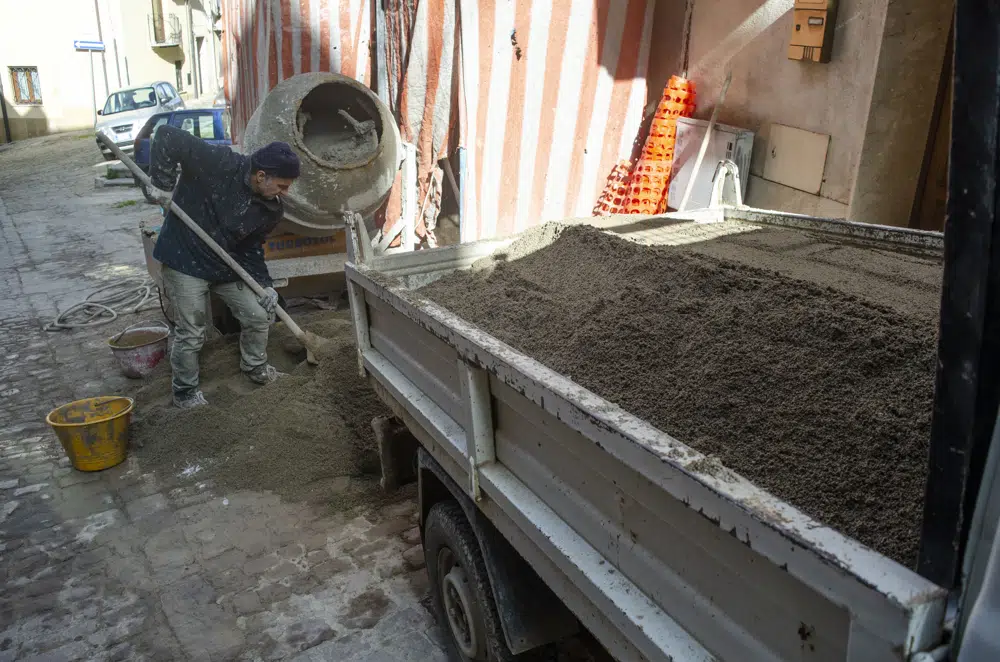
This image provided by Cain Burdeau shows a construction worker mixing concrete on a street in Castelbuono, Sicily, Italy. In Italy, masonry using concrete is an inescapable aspect of construction and a crucial difference between home building in North America and in Europe. (Cain Burdeau via AP)
Widespread use of modern concrete and cement arrived in Sicily in the early 1900s and boomed after World War II, as it did in much of the world.
“Cement changed the world,” Nicolo Pierlucio Raimondo, an architect in Castelbuono, told me.
The art of mortar-making goes back to the ancient Romans and Arabs, he said. They experimented with the binding qualities of pozzolans, naturally occurring cements such as volcanic ash and gypsum. The invention of Portland cement in the 1820s, and its mass adoption in the early 1900s, was another game changer.
“Think about how much bigger cities have gotten in these last 100 years. Cement had a big part in this,” the architect said. “It helped speed up construction.”
But he added a cautionary note: “How long will these concrete structures last? No one knows.”
Capuana, the marble worker, pointed across the street to a row of concrete homes built in the 1960s and ’70s.
“Look at the overhangs on all those buildings,” he said. “They were made with steel and concrete. Over time, we’ve had to rebuild them all.”
By contrast, experts are still trying to understand the secret to the longevity of the ancient Romans’ concrete.
Modern concrete’s biggest weakness is water seeping through its tiny pores, a major factor in hairline cracks. Once water penetrates and rusts the steel used to reinforce concrete, a cracking process known as spalling worsens.
Gioacchino Allegra, a master builder overseeing the remodeling of a concrete home on the outskirts of Castelbuono, said today’s concrete is more compact than that of the building boom of the 1960s, which reduces spalling.
I also reached out to the International Masonry Institute for guidance.
Amy Lamb Woods, a concrete expert and preservationist there, said the post-World War II boom in concrete construction — the Brutalist stuff — was made possible by the advent of better kilns in the early 1900s.
On the down side, concrete became associated with urban decay. On the plus side, its use helped create so much modern infrastructure, from highways to hospitals.
“There’s this onslaught of: ‘Oh, it’s concrete, it’s ugly,’ and they want to tear them down,” Woods said. “All of us preservation people are advocating for their preservation because we believe these buildings are iconic, breathtaking, especially when they’re maintained well.”
In the U.S., that debate has intensified because concrete structures older than 50 years are now eligible for landmark status.
Also, because concrete is now recognized as causing some 8 percent of all carbon dioxide emissions, most of that from cooking that cement in those kilns.
Yet as Woods noted, “The most green building you can build is the one that you restore and preserve. You’re in essence keeping the building. And so, you’re not putting it into a landfill, and you’re continuing its use.”
Listening to her made me feel so much better about the potential in my towering and downright ugly concrete barn, and about all the concrete work waiting to be done.
——
The ancient lowly; a history of the ancient working people from the earliest known period to the adoption of Christianity by Constantine
While poring over nearly century-old photos documenting the University of Cincinnati’s historic excavation at Troy, archivist Jeff Kramer was struck by just how many people worked behind the scenes for years to contribute to its success.
The archivist and research associate in UC’s Department of Classics created a digital archive of pictures and documents from UC archaeologist Carl Blegen’s influential 1930s project that identified nine periods of reconstruction and evidence of a great battle and fiery devastation that some historians said was suggestive of the ransacking of Troy.
But in the four double volumes published on the project, the workers who made the team’s discoveries possible are mentioned briefly and only once, Kramer said. While this omission was hardly unusual in the early days of archaeology, Kramer said it ignores their important contributions to our understanding of ancient civilizations.
“All the big excavations owe their results to these individuals who are unheralded and unacknowledged,” he said. “They’re not given their due. They’re simply not mentioned.”
One worker in particular stood out in the extensive documentation from the seven-year project: an Albanian laborer named Emin Kani Barin who went by Kani. Kramer wrote about him and the broader question of acknowledging the invisible workers of archaeology in a paper published in the journal Bulletin of the History of Archaeology.
“These are the people who put shovels in the ground and swung the picks. They were the ones who pulled the artifacts out of the ground,” he said.
Troy was the backdrop for one of Greek mythology’s most dramatic stories: the Trojan War between the Greeks and Trojans and the ransacking of Troy mentioned in Virgil’s Aeneid.
Stories of Troy in Homer’s Iliad and Odyssey tell of the mythic figures Odysseus, Hector, Ajax and Achilles, cut down by an arrow to his heel. And its legends persist today, particularly that of the Trojan horse sculpture within which the Greeks allegedly hid to gain entry to the fortified city.
The ancient cities of Troy were first unearthed in the 1870s and studied again in expeditions over the next 20 years before UC’s Blegen arrived on the site in the early 1930s.
“This was an unbelievably vast undertaking,” Kramer said.
Despite the Great Depression, amateur archaeologist and heiress Louis Taft Semple funded the expedition. She was wife to William T. Semple, the head of UC’s Department of Classics, and niece to President William Howard Taft, who served as dean of UC’s College of Law.
Semple and his wife took part in the excavations throughout the project. When they were away, Blegen kept Semple apprised of developments via telegram, including this 1936 update: “Digging begun, still believe in Helen.”
Kramer said this was a cheeky reference to Helen of Troy, “the most beautiful woman in the world,” according to legend, whose abduction by Paris launched the Trojan War.
In 1914 another war had erupted across Europe. Kani’s family had sent him to Canada, where he learned English. He later moved to Akron, Ohio, where as a teenager he worked at a tire-rubber plant. He had a knack for languages and learned English, Polish and Russian from his factory co-workers.
After the war, he returned to Albania to find it fundamentally changed, Kramer said.
With the local economy in shambles, Kani and his new wife and child fled to Greece. But they found no refuge there. Instead, they were deported to Turkey as part of the 1923 compulsory population exchange in which Greece forcibly expelled more than 400,000 Muslims while Turkey deported an estimated 2 million Greek Orthodox Christians in what amounted to mutual ethnic cleansing.
“This compulsory population exchange resulted in a great deal of poverty in both countries,” Kramer said.
When Kani applied to work at Troy, Blegen wrote in his excavation log, he was “particularly ragged, unshaved, and seedy-looking.” But “employee No. 62,” as he was identified in the excavation records, quickly made himself indispensable to the project, Kramer said.
Kani helped Blegen translate instructions to the worker refugees. He was assigned with other skilled workers to mend pots broken over the millennia. He demonstrated such prowess that by his third year he was training others in the painstaking process of rebuilding the pots from tiny fragments.
In 1935 Kani was promoted to foreman where he took over bookkeeping duties and was entrusted with purchasing supplies. He also supervised the construction of the site guardhouse, a pottery room annex, a railway storeroom and a prefabricated house Blegen shipped from the United States.
And because of his knack for languages, he served as tour guide to visitors at the site when the UC representatives were not available.
Kramer said while just one photo of the workers was published in Blegen’s scholarly works documenting the excavation, Kani shows up in dozens of other photos the expedition captured of the archaeological site and daily life at Troy.
“If you look at the photos, you see he was everywhere. His energy was boundless,” Kramer said. “And in the daily journals, it’s clear when they needed something to be done they would call on Kani and his response was, ‘On it.’”
More than that, Kramer said, the photos and documents and Blegen’s later address to the Cincinnati Literary Club where he calls Kani the dig’s most important worker show a genuine fondness.
“It showed not just his interest in Kani’s story but also their friendship,” Kramer said.
Eric Cline, a professor at George Washington University, said the work of laborers was often overlooked in published scholarship because of class bias.
“It was a very colonialist attitude but common for the day,” he said.
Allison Mickel, an associate professor at Lehigh University, examined the unrecognized work of archaeology laborers in her 2021 book “Why Those who Shovel are Silent.”
“Archaeological excavations are, in many ways, microcosms of broader power structures in science and society,” she said.
Mickel said archaeology projects today are far more inclusive and typically include members of the community as valued partners in all stages of the project’s planning and execution.
“Luckily, I think a lot of archaeologists are really interested in building a more inclusive archaeology because that is the bedrock of better science,” she said.
After the excavation concluded in 1938, Kani continued to correspond with Blegen, noting that he had taken a job with the British American Tobacco Co.
Kramer said the tale of Kani’s life spanning continents, war, love, loss and tragedy was emblematic of this volatile time in world history.
“He was caught up in this stream that was so highly representative of what was being faced by millions of people,” Kramer said. “So I saw how remarkable his life was but also how his life reflected what was going on in Greece and Turkey at that time.”
TROY (IMAGES)
Emin Kani Barin, a laborer from Albania, holds one of the pots he helped repair at Troy. A new paper by University of Cincinnati Archivist Jeff Kramer examines the important but unheralded role workers played in the 1930s excavation
University of Cincinnati Classics Professor Carl Blegen led excavations at Troy in the 1930s that identified nine periods of city reconstruction along with evidence of a great battle and fiery devastation suggestive of the sack of Troy mentioned in Homer's Iliad.
University of Cincinnati archaeologist Marion Rawson gets some help from workers to take video of Troy from atop a ladder.
University of Cincinnati Classics Professor Carl Blegen discovered mosaics while excavating Troy.
CREDIT
UC Classics
University of Cincinnati Classics researcher and archivist Jeff Kramer holds up a photo of Emin Kani Barin, a laborer from Albania who served an important role in archaeological excavations of Troy in the 1930s.
Digging Up Troy: The Workers of the University of Cincinnati Expedition to the Troad
Monday, February 13, 2023
International Condom Day: A brief history of rubbers
Carla Bleiker
Condoms are pretty great, preventing both diseases and unwanted pregnancies. They were first used in 3000 BC. Ancient Egyptians color-coded theirs while the Romans supposedly made them from the muscles of fallen enemies.
No one can agree on what should be considered humanity's greatest invention. The wheel? Antibiotics? The dishwasher? All valid contenders. But today we are looking at another scientific innovation that, although perhaps innocuous, has transformed life on Earth: The condom.
Thanks to these little latex sleeves, humans can have sex without passing on STDs or getting (someone) pregnant. The protection isn't 100% guaranteed ― according to Planned Parenthood in the US, condoms are 98% effective at preventing pregnancy when used perfectly. Since humans are not, in fact, perfect, in reality the contraceptive is about 87% effective ― around 13 of 100 people who use condoms as their only birth control will conceive.
Still! Condoms have saved lives and granted women autonomy in periods of history when getting pregnant out of wedlock threatened them with pariah status, if not worse. Let's dive into the history of happy hats, as the Internet calls them.
The first mention of a condom-like device dates back to 3000 BC. King Minos ― whom you might remember for his giant labyrinth containing a minotaur at its center ― was said to use a goat bladder to protect his sexual partners from contracting a rather unusual sexual disease: Legend has it, Minos' semen contained serpents and scorpions.
Sounds unpleasant indeed. Some accounts claim that Minos sheathed his penis with the goat bladder, while others say his wife Pasiphae inserted it into her vagina in order to prevent those pesky animals from biting her private parts. Either way, it's the earliest account of a barrier device used to prevent what we today would consider a sexually transmitted disease. Class-coded condoms
The ancient Egyptians used protection as well. Archaeologist Howard Carter and his team found a condom in Tutankhamun's tomb containing samples of the pharaoh's DNA. It was made of fine linen soaked in olive oil and had been attached to a string that, the researchers believe, would have tied around his waist. They dated it to around 1350 BC.
Condoms weren't just for the god-kings, either. Other Egyptians used them too ― but only in the color assigned to their social class. No chance at fooling your date into believing you were part of the pharaoh's inner circle when the color of your condom made you out to be a lowly farmer.
In Ancient Egypt it wasn't the condom wrappers that came in different colors, but the contraceptives themselves.
Image: Oleksandr Latkun/Zoonar/picture alliance
In ancient Rome, condoms were also made of linen, as well as intestines or bladders of sheep and goats. The Romans did not wrap up as a way to prevent conception ― rather, the main motivator was stopping the spread of diseases like syphilis. They were also said to make condoms out of muscle tissue from men they killed in battle, "but no hard evidence for this exists," the authors of a study published in the Indian Journal of Urology point out.
The rubber revolution
There are various theories about where the term "condom" originated. It could go back to the Latin word "condus," meaning receptacle or vessel, or to the Persian word "kemdu," which refers to a long piece of animal intestine used for storage, the authors of the Indian study point out.
In their book "Contraception through the ages" from 1964, B.E. Finch and Hugh Green write that the name most likely comes from a physician at the court of King Charles II, who ruled in the 17th century. Charles was, as the story goes, upset about the growing number of his illegitimate children. So Dr. Condom (yes, that was his actual name) did some research. He came up with a sheath made from softened lamb intestine and advised his master to wear it during sex to finally stop impregnating his mistresses.
We have to thank American inventor Charles Goodyear for the first version of the modern condom as we know it today. In the mid-1800s, he discovered the process of vulcanization, in which natural rubber is heated up together with sulfur to form a material that is more malleable, durable and elastic. By 1860, condoms were produced on a large scale. They were expensive, but back in the day, men were told to clean and then reuse them. (Condoms today are strictly one-use only!) Second-most popular contraception method globally
The invention of latex in the 1920s revolutionized the condom industry.
Today's latex condoms can be stretched to up to eight times their original size before they rip and also come pre-lubricated, ribbed or flavored.
Today's condoms don't break easily, as participants in a World AIDS Day event showed in 2021
.Image: TONY KARUMBA/AFP/Getty Images
According to a UN study, the male condom was the second-most common contraceptive method used worldwide in 2019, beaten only by female sterilization. In 2019, 21% of people using contraception used a condom ― some 189 million users that year.
International Condom Day, which is celebrated on February 13, was established by the AIDS Healthcare Foundation, a US-based non-profit founded in 1987 in response to the AIDS epidemic. The organization celebrates the holiday by handing out free condoms.
Edited by: Clare Roth
Tuesday, August 04, 2026
MERDE 💩
How an ‘explosion of excrement’ changed Earth's ecosystems forever
An international study led by Flinders University has found a fertile area of inspiration to explain an important step in evolution – and it’s a whole lot of poop.
The new study describes the ‘faecal revolution’ to explain a crucial turning point in animal and environmental evolution on Earth.
In a new article in Trends in Ecology & Evolution, fossil and evolutionary experts credit the buildup of lowly excrement for being a key cause for the ‘Cambrian Explosion’ about 540 million years ago, a brief period when the first marine ecosystems developed and most of the major animal groups started to appear.
The scientists from Australia and Germany describe how these pieces of fossilised pellets or ‘coprolites’ deposited by primitive sea creatures in the early Cambrian times played a vital part in evolution, encouraging marine life to evolve and diversify.
The new research, to be published in Trends in Ecology & Evolution, gives an alternative view to this remarkable diversification.
“Next to rising oxygen levels and other contributing factors, the importance of faeces in ancient ecosystems is often overlooked,” says Dr Russell Bicknell, an Australian Research Council Early Career Researcher Award (DECRA) fellow at Flinders University’s College of Science and Engineering.
“We have considered these ancient diets, increasingly sophisticated digestive systems and trophic interactions as part of a much bigger picture to help explain how more organic matter and nutrients poured into the ancient oceans to accelerate ecosystem development at the end of the Ediacaran and early Cambrian periods.”
After the earliest animals appeared around 600 million years ago during the Ediacaran Period, more complex digestive systems and the first fossilised coprolites start to appear at the onset of the Cambrian Period.
Dr Bicknell, with lead author Dr Julien Kimmig from Germany’s Karlsruhe Institute of Technology (KIT), says the complexity, shapes and sizes of coprolites and fossil gut systems increased as the Cambrian progressed – with evidence of this from more than 35 deposits around the globe.
“The faecal matter includes microscopic pellets through to centimetre-scale coprolites containing shells and other animal fragments,” says Dr Bicknell, an evolutionary biologist and palaeobiologist who specialises in arthropods.
“With this shift, we see increasingly complex digestive systems, particularly in early anthropods which evolve specialised foreguts and digestive glands capable of processing a wider variety of food.
“It becomes clear in the fossil record that the evolution of feeding strategies aligns with the production and distribution of organic carbon and nutrients to start creating conditions we see in modern oceans and later on land where fertiliser today is used to produce our food,” adds Dr Bicknell.
The Cambrian fecal revolution: Fueling the Cambrian Radiation
Article Publication Date
4-Aug-2026
Tuesday, November 17, 2026
When was the earliest recorded labour strike in history?
Modified: 12/11/2026 - RFI
The earliest recorded labour strike took place in Egypt, in the village of Deir el-Medina during the New Kingdom – 1550 to 1070 BC. It was here that a community of craftsmen had settled. They were in charge of carving out and decorating the pharaohs’ tombs in the Valley of the Kings. It was these workers who were to launch the world’s first known strike.
Sakinah is an important word and a very important concept in both Islamic and Jewish thought.
In Islamic thought, it refers to the tranquility, serenity and peace of mind that results when an individual believer becomes totally aware of God’s near by presence. Although Sakinah dwells in the heart of one who is already a sensitive and faithful believer; it now comes to him or her directly from God’s close presence and personal interest; to confirm and strengthen that believer’s faith.
As the Qur’an says “It is God who sent down tranquillity into the hearts of the believers, that they would increase in faith along with their (present) faith.” (48:4)
Thus, the experience of Sakinah is both God’s gift of enhanced, confirming faith; as well as the product of one’s own faithfulness. (Qur’an 9:26 & 40) This is clearly stated in the example given in the Qur’an about Prophet Samuel’s selection of Saul to be the first King of Israel,
“Their prophet (Samuel) said to them (The People of Israel), “Indeed, a sign of his (Saul’s) kingship is that the chest (ark of the covenant) will come to you in which is Sakinah- assurance from your Lord, and a remnant of what the family of Moses and the family of Aaron had left (the broken ten commandments’ stone tablets in the wooden ark), carried by angels. Indeed, in that is a sign for you, if you are (already) believers.” (2:248)
The Biblical Hebrew word Shekinah is a noun from the verb ‘to dwell’. Thus God tells the Jewish People; “I will dwell among the children of Israel and will be their God; and they shall know that I am the LORD their God who brought them out of the land of Egypt, that I might dwell among them” (Exodus 29:45-46)
This concept, that God made a personal commitment to dwell among the People of Israel, is often repeated by the Hebrew Prophets. For example, Prophet Ezekiel (37:27) says: “My dwelling place also will be with them; and I will be their God, and they will be My people.” And Prophet Zechariah (2:10) says: ‘”Sing for joy and be glad, O daughter of Zion; for behold I am coming and I will dwell in your midst,’ declares the LORD.”
Of course, this does not mean that God only dwells amidst one religious community: the Jewish community. That was true for over one thousand years when the Jewish community was the only on-going monotheistic community in the world. But with the advent of Prophet Jesus and Prophet Muhammad; another prophecy of Prophet Zechariah came true:
“Many nations will join themselves to the LORD in that [distant] day and will [also] become My people. Then I will dwell in your midst, and you will know that the LORD of hosts has sent Me to you.” (Zechariah 2:11)
Unlike ancient Christianity which claimed to have replaced the Jewish law of Moses with the Christian love of Jesus, Islam claimed it was the confirmation of all prior prophets and holy scriptures.
Then, in the centuries between Prophet Jesus and Prophet Muhammad, the rabbis expanded the aspect of God’s dwelling presence from the nation to the individual, by following the guidance of Prophet Isaiah (57:15) “For thus says the high and exalted One Who lives forever, whose name is Holy, ‘I dwell on a high and holy place, and also [I dwell on earth] with the contrite and lowly of spirit in, order to revive the spirit of the lowly and to revive the heart of the contrite.'”
The rabbis asserted that Torah scholars may experience a Shekinah blessing during study: “Rabbi Chananiah ben Teradion said . . ‘when two sit together and words of Torah pass between them, the Shekinah dwells between them’ ” (Mishnah Avot 3.3)
And the rabbis also taught that community prayer is a place where one can experience the Shekinah as Talmud B’rachot 6a says: “Whenever ten (or more) are gathered for prayer, there the Shekinah dwells.”
The Shekinah/Sakinah can also dwell in a sacred object like the ark of the covenant or in a lowly bush (Qur’an 2:248). Those who are truly “Blessed by the Lord…with the best gifts of the earth and its fulness, and the favor of Him who dwells in the bush”. (Deuteronomy 33:16)
The Sakinah can also dwell on or in a holy person; a saint, a sage. or a Prophet like Muhammad: “Allah sent down His Sakinah (tranquillity) upon His Messenger and upon the believers and imposed upon them the word of righteousness, and they were more deserving of it and worthy of it. (Qur’an 48: 26)
Thus, the word/concept Shekinah in Jewish rabbinic thought became more a name for God that focuses mostly on an individual’s feeling of God’s presence that may manifest itself during several types of ordinary religious activities such as the prayer and Torah study already referred to; and also when visiting the sick (Shabbat 12b). practicing hospitality (Shabbat 127a & Sanhedrin 103b), giving charity (Baba Batra 10a), practicing chastity before marriage (Derek Ereẓ i.) and faithfulness within marriage (Soṭah 17a).
It is true that doing all these things frequently will help produce greater faith, confidence, and peace of mind. But the Jewish focus is more on the opportunity to personally experience God’s presence in a daily activity, rather than on an individual’s personal spiritual growth.
This somewhat different emphasis between Sakinah and Shekinah are not opposites. They are simply two different perspectives: like seeing a lion from the front, or from the side. Sakinah and Shekinah thus compliment each other; and proclaim the interactive reciprocities between humans love of God and God’s love of humans.
From another perspective, Shekinah, a rabbinic name for God, shifts the view from the community to the individual’s experience, just as Sakinah shifts the focus from Jihad to calmness, serenity and effortless peace of mind. Both of these shifts are complementary; not contradictory,
The connection between our faithfulness and God’s Shekinah is described in Exodus 25; when God directs the People of Israel to build a sanctuary. But first God says, each person should make a voluntary offering: “The Lord said to Moses “Tell the Israelites to bring me an offering. You are to receive an offering for me, from everyone whose heart prompts them to give.” (Exodus 25:1-2)
Six verses later God says,”Then have them make a sanctuary for me, and I will dwell (Shekanti) among them.” (25:8) First humans choose to make a heart felt offering to God; then God chooses to dwell among, and within, faithful humans and their religious communities.
When God is well pleased by faithful people, God’s gift of inner peace and reassurance is sent down to them. As it is written: “Certainly Allah was pleased with the believers when they pledged allegiance to you, (Muhammad), under the tree, and He knew what was in their hearts, so He sent down Sakinah (tranquillity) upon them and rewarded them with an imminent conquest”. (Qur’an 48:18)
And as Prophet Zechariah proclaimed: “Many nations will join themselves to the LORD in that day and will become My people Then I will dwell in your midst, and you will know that the LORD of hosts has sent Me to you.” (2:11)
Perhaps now is a good time to expand the concept of Shekinah/Sakinah even wider to include all human’s responsibility [vice-regency] to not defile the whole natural world’ in accord with God’s command (Torah Numbers 35:34) ‘You shall not defile the land in which you live, in the midst of which I dwell…'”
Muslim prayer beads. Photo by Muhammad Rehan, Wikipedia Commons.
Rabbi Allen S. Maller
Allen Maller retired in 2006 after 39 years as Rabbi of Temple Akiba in Culver City, Calif. He is the author of an introduction to Jewish mysticism. God. Sex and Kabbalah and editor of the Tikun series of High Holy Day prayerbooks.
 (see Themis by Jane Harrison) embracing the life affirming spontaniety of nature, in the form of a dead and ressurected god; Bacchus/Dionysous/Pan.