Construction of new Korean reactor begins
First safety-related concrete has been poured for the reactor building of unit 3 at the Shin Hanul nuclear power plant in South Korea. The APR1400 unit is scheduled to be completed in 2032.
_34897.jpg)
Korea Hydro & Nuclear Power (KHNP) announced "the start of full-scale structural work by pouring the first concrete for the reactor building, a key construction process for Shin Hanul unit 3, at the Shin Hanul units 3 and 4 construction site on 20 May".
In November 2014, KHNP signed an agreement with Ulchin County to build Shin Hanul 3 and 4. The company applied for a construction licence for the units in January 2016. Site preparation for the two units was originally scheduled to begin in May 2017, with commercial operation of unit 3 scheduled for December 2022, with unit 4 following a year later.
However, KHNP announced in May 2017 that it had instructed Kepco Engineering & Construction - which signed a design contract in March 2016 - to suspend work for the planned units as a result of the then new President Moon Jae-in's policy of phasing out nuclear power. Work towards licensing the new units continued.
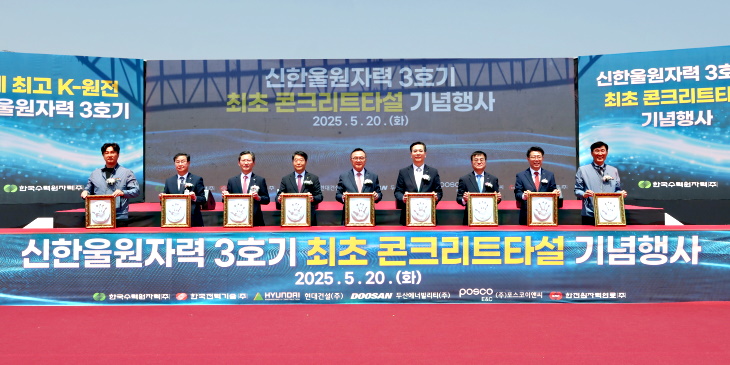
A ceremony marked the pouring of first concrete (Image: KHNP)
President Yoon Seok-yeol - who assumed power in May 2022 - reversed the former president's policy of phasing out nuclear power. In July 2022, Yoon encouraged a speedy restoration of the country's "nuclear power plant ecosystem" after Minister of Trade, Industry and Energy Lee Chang-yang set out plans for revitalising South Korea's nuclear power industry, including the aim for work on Shin Hanul 3 and 4 to resume as early as 2024.
Preparatory groundwork began for the construction of the two APR1400s following the approval by the South Korean government of the project's implementation plan in June 2023. This effectively approved 20 licensing and permitting procedures under the jurisdiction of 11 ministries required for the construction of nuclear power plants. South Korea's Nuclear Safety and Security Commission issued a licence to KHNP for the construction of Shin Hanul 3 and 4 in September last year. A ceremony was held the following month to mark the start of work on the two units.
In March 2023, KHNP and Doosan Enerbility signed a KRW2.9 trillion (USD2.2 billion) contract for the supply of the main equipment for Shin Hanul 3 and 4. Under the contract - which will run for 10 years - Doosan Enerbility will supply the nuclear reactors, steam generators and turbine generators for the two APR1400 units.

An artistic impression of Shin Hanul 3 and 4 (Image: KHNP)
"We will do our best to raise K-Power's status in the global nuclear power plant construction market by achieving the goal of 'On-Time, Within Budget' as well as the safe construction of Shin Hanul units 3 and 4," said KHNP President Hwang Joo-ho.
"Shin Hanul unit 3 is scheduled to be completed in 2032 after structural construction, installation of equipment such as the reactor, and stage-by-stage testing," KHNP said. "Shin Hanul units 3 and 4 are expected to contribute significantly to the revitalisation of the nuclear power industry economy as a symbol of strengthening the nuclear power ecosystem after the resumption of operations in 2022, and will become the safest nuclear power plant representing Korea."
South Korea has four operational APR1400 units - Saeul units 1 and 2 (formerly Shin Kori 3 and 4) and Shin Hanul units 1 and 2. Two further APR1400s are under construction as Saeul units 3 and 4. Four APR1400 units have also been built at the Barakah nuclear power plant in the UAE, which are all now in commercial operation.
Article researched and written by WNN's Warwick Pipe
Swiss nuclear fuel contract for Framatome
France's Framatome is to supply ATRIUM 11 fuel assemblies to the Leibstadt nuclear power plant in Switzerland following the signing of a long-term contract with operator Kernkraftwerk Leibstadt AG.
_71753.jpg)
The ATRIUM-11 design uses an 11x11 rod array and chromia-enhanced uranium oxide pellets. This allows operators to run plants with more flexibility in response to fluctuating power demands while improving uranium utilisation and plant efficiency, resulting in lower costs for utilities, Framatome said.
The contract covers the supply of the fuel over the period 2028-2035. Framatome has been supplying fuel to Kernkraftwerk Leibstadt (KKL) since 2008, and has supplied it with ATRIUM 11 fuel since 2012.
"This contract underlines the solid relationship we have with our longstanding customer, KKL," said Lionel Gaiffe, Senior Executive Vice President, Fuel Business Unit at Framatome. "We are proud to continue supporting Leibstadt by providing our safe, reliable and high-performance ATRIUM 11 fuel assemblies for the long term."
Bruno Zimmermann, a member of KKL's board of directors, added: "With this contract signed with Framatome, KKL confirms its commitment to the long-term operation of the nuclear power plant through solutions that are geared towards the safety, reliability and efficiency of the plant."
The first lead fuel assemblies of ATRIUM 11 were inserted into plants in Europe in 2012 and in the USA in 2015, and the first reloads using the fuel were delivered and inserted in Europe in 2018 and in the USA in 2020.
Leibstadt features a single boiling water reactor built in the early 1980s. The plant produces 1165 MWe for six utilities with various stakes and provides electricity for two million households. Since 1984, KKL has invested a total of around EUR1.5 billion (USD1.6 billion) in the modernisation and maintenance of the plant. A further EUR1 billion is planned for renovations in the coming years to ensure safe, reliable and economical electricity generation until at least 2045.
Go-ahead for Columbia plant uprate
The Bonneville Power Administration has given the go-ahead to a USD700 million project which, together with planned energy efficiency upgrades, will add a total 186 MWe of capacity to the only operating nuclear power plant in the USA's Pacific Northwest region by 2031.
_91449.jpg)
The Bonneville Power Administration (BPA) announced on 20 May that it has given Energy Northwest the go-ahead for the Extended Power Uprate (EPU) at its Columbia Generating Station after 18 months of in-depth analysis. Over the next six years, Energy Northwest and BPA will collaborate on planning and implementation of the project, which will involve around 30 individual upgrades, primarily focused on increasing the size of pumps and motors. The work will be timed to coincide with biennial refuelling outages, and will increase the station's output by 162 MWe - enough capacity to power around 12,500 homes, the companies said.
Alongside the EPU, energy efficiency upgrades incorporated during the next three scheduled refuelling outages - in 2027, 2029 and 2031 - are expected to add 24 megawatts of output capacity, bringing the total increase to 186 megawatts.
Energy Northwest intends to submit a licence amendment request for the EPU to the US Nuclear Regulatory Commission in 2028.
Energy Northwest CEO Bob Schuetz applauded BPA for its decision to approve the project and for its "strategic vision in advancing our region's future with additional, reliable capacity that nuclear energy can provide," saying the Administration's support for the initiative "underscores a commitment to affordable and carbon-free electricity for the Northwest region, including our public power member utilities and their customers."
"This is a great value for ratepayers in the Pacific Northwest," said BPA Administrator and CEO John Hairston. "Upgrading an existing resource to provide additional reliable energy will help BPA keep pace with its customers growing electricity needs and keep rates low."
Capacity uprates and licensing extensions to existing nuclear plants are specifically mentioned in the raft of executive orders signed on 23 May by President Donald Trump, seeking to reinvigorate the US nuclear energy sector and triple nuclear generating capacity by 2050.
"President Trump and Secretary Wright have made it clear: expanding America's nuclear energy capacity will be essential for meeting growing demand for affordable, reliable and secure energy," said Department of Energy Acting Undersecretary for Infrastructure Michael Goff. “This project exemplifies the energy vision for America by unleashing new power generation for the people of the Pacific Northwest without raising costs."
The Columbia Generating Station, near Richland, is a single boiling water reactor that began commercial operation in 1984. It is currently licensed to operate until December 2043.
Energy Northwest is a Washington state public power joint operating agency comprising 29 public power member utilities and serving more than 1.5 million customers. It owns and operates hydroelectric, solar, battery storage and wind facilities, as well as the Columbia nuclear power plant. The agency recently announced an agreement with Amazon and X-energy for an initial development of four advanced small modular reactors (SMRs) generating about 320 MWe, at a site near the Columbia plant, with an option to treble that number to 12 reactors.
The BPA is a federally owned, non-profit wholesale power marketer, responsible for marketing the electricity produced from federally owned and operated hydroelectric dams in the Columbia River Basin as well as the output from the Columbia nuclear plant.
Article researched and written by WNN's Claire Maden
Norwegian firms select partners for uranium, decommissioning
Norwegian nuclear project developer Norsk Kjernekraft is to cooperate with Aurum Green Energy, a private company exploring for uranium resources in Norway. Meanwhile, Norwegian Nuclear Decommissioning has selected Amentum for the next phase of Norway's nuclear clean-up programme.
_72999.jpg)
Norsk Kjernekraft is a private company that aims to build, own and operate small modular reactor (SMR) power plants in Norway in collaboration with power-intensive industry. It has initiated joint projects in several places, along with power companies and municipalities.
Aurum is in the process of mapping and assessing uranium occurrences in several places in Northern Norway. Initial geological investigations indicate the occurrences may be of interest and are located a short distance from ports or main roads.
The aim of the agreement between Aurum and Norsk Kjernekraft is to examine the possibility that future nuclear power plants in Norway and other Western countries may someday be powered by Norwegian uranium. As part of the agreement, Norsk Kjernekraft will assist Aurum with its knowledge of regulatory, commercial and political issues related to nuclear power.
"Energy security and self-sufficiency are becoming increasingly important, both for Norway and for Europe," said Norsk Kjernekraft CEO Jonny Hesthammer. "Uranium processing facilities are located in Germany, the Netherlands, the United Kingdom and France, where uranium product can be converted into fuel that could power Norwegian and European nuclear power plants for many decades."
Aurum Green Energy CEO Barry Stoffell added: "Norsk Kjernekraft has shown that it is possible for communities, politicians and industry to support building nuclear power plants in Norway. We are pleased to work with them to do the same when it comes to the search for domestic sources of uranium."
In June 2024, the Norwegian government appointed a committee to conduct a broad review and assessment of various aspects of a possible future establishment of nuclear power in the country. It must deliver its report by 1 April 2026.
Norsk Kjernekraft noted that the Geological Survey of Norway carried out geological mapping of uranium deposits in the country during the 1950s, 1960s and 1970s and conducted an extensive nationwide exploration and assessment campaign in the early 1980s. The renewed effort to explore for uranium in Norway is taking place at the same time as the Swedish government is working toward encouraging uranium exploration and potential extraction.
"We can currently buy uranium from allied countries such as Australia, Canada, the USA and Ukraine, as well as several other countries," Hesthammer said. "In the future, if exploration is successful, we may also be able to buy it from Norway and Sweden."
Support in decommissioning
US-based engineering company Amentum and its joint venture partner Multiconsult Norge AS have been selected by Norwegian Nuclear Decommissioning (NND) to deliver safety case management and training for Norway's nuclear clean-up programme.
This contract is focused on delivering a new methodology for robust and well-documented safety cases for new design and existing legacy nuclear facilities, including reactors in shut down conditions, post-operational clean-out and decommissioning, as well as facilities for storage and management of used fuel and radioactive waste. It covers work at KLDRA - a combined storage and disposal facility for low and intermediate-level radioactive waste in Himdalen in Aurskog/Høland - and two research sites - the nuclear fuel and materials testing reactor at Halden and the JEEP-II neutron scattering facility at Kjeller.
Established as an agency under the Ministry of Trade, Industry and Fisheries in February 2018, NND is responsible for decommissioning the research reactors and other related nuclear infrastructure, as well as the safe handling, storage and disposal of radioactive waste.
Amentum and Multiconsult have been working for NND since summer 2022 under an engineering and technical framework, helping to develop a decommissioning strategy, including approaches for used fuel and radioactive waste management.
"This contract award is a strong vote of confidence from a client and comes at a pivotal time when Norway is considering the deployment of small modular reactors to meet its future energy needs," said Andy White, senior vice president of Amentum Energy and Environment International. "We will bring our extensive global experience in nuclear safety analysis - spanning the entire lifecycle - to this project, with particular emphasis on assessing legacy facilities and supporting their decommissioning in line with advanced safety standards."
Article researched and written by WNN's Warwick Pipe
Fast-tracked US uranium project receives federal approval
The US Department of the Interior has approved Anfield Energy Inc's Velvet-Wood uranium-vanadium project in San Juan County, Utah, after the Bureau of Land Management completed its review of the project in less than 14 days.
_36584.jpg)
The project is the first to be approved under a new accelerated review process launched as part of a strategic response to the national energy emergency declared by President Donald Trump in January. The Department of the Interior (DOI) announced on 14 May that it had selected Velvet-Wood for expedited review.
The DOI announced its approval of the project on the same day that Trump signed a raft of executive orders aimed at reinvigorating the US nuclear industry and supply chain, with aims to quadruple US nuclear generating capacity by 2050.
"This approval marks a turning point in how we secure America's mineral future," Secretary of the Interior Doug Burgum said. "By streamlining the review process for critical mineral projects like Velvet-Wood, we're reducing dependence on foreign adversaries and ensuring our military, medical and energy sectors have the resources they need to thrive. This is mineral security in action."
Anfield acquired the Velvet-Wood project, along with other conventional uranium mining assets, from Uranium One in 2015. The two areas making up the project had been historically held by separate companies: previous owner Atlas Minerals recovered some 4 million pounds U3O8 (1539 tU) - as well as 5 million pounds of V2O5 - from the Velvet deposit between 1979 and 1984. The Wood area was drilled by then-owner Uranerz between 1985 and 1991, but was not mined. The combined Velvet and Wood historical mines are currently estimated to contain 4.6 million pounds U3O8 of measured and indicated resources and inferred resources of 552,000 pounds U3O8.
"With the final environmental assessment completed by the Bureau of Land Management, Anfield Energy has the necessary approval from Interior for restarting the old Velvet Mine and developing the nearby Wood mineralisation," the DOI said. With most of the work taking place underground and targeting known mineral deposits left from earlier operations, the operation will result in only three acres (1.2 hectares) of new surface disturbance, it added.
"We are very pleased that the Department of the Interior has greenlit our Velvet-Wood project in an expedited manner," Anfield Energy CEO Corey Dias said. "This confirms our view that Velvet-Wood was well-suited for an accelerated review, given that it is a past-producing uranium and vanadium mine with a small environmental footprint. The Company will now pivot to advancing the project through construction and, ultimately, to production."
Anfield is also working to advance its Shootaring Canyon mill to production-ready status concurrently with Velvet-Wood. The mill is one of only three licensed and permitted conventional uranium mills in the USA and has been on standby since 1982.
Article researched and written by WNN's Claire Maden
MoU paves way for further collaboration on BWRX-300 deployment
The Emirates Nuclear Energy Company and GE Vernova Hitachi Nuclear Energy have signed a memorandum of understanding to jointly evaluate the deployment of BWRX-300 small modular reactor technology internationally.
_80279.jpg)
The agreement, signed during a private ceremony on the sidelines of the World Utilities Congress in Abu Dhabi, UAE, builds on a memorandum of understanding signed during the COP28 conference in 2023 to evaluate the technology as part of ENEC’s ADVANCE programme. The two companies have committed to explore opportunities for international deployment by collaborating on a development roadmap to include site identification, licensing pathways, investment and commercialisation strategies, and supply chain development.
"As we continue to power the UAE with clean, baseload electricity around the clock, we are glad to move to the next level of cooperation with GE Vernova Hitachi to accelerate the deployment of new advanced nuclear reactor technologies in the UAE and internationally," ENEC Managing Director and CEO Mohamed Al Hammadi said. "This MoU will bring together our complementary expertise to identify a clear roadmap for deployment, which is essential to ensure safe, efficient and quality-led nuclear delivery, as we have experienced here in the UAE. As global power demand continues to grow at pace, we look forward to advancing new solutions to meet this growth in a sustainable manner."
Maví Zingoni, CEO of GE Vernova's Power Businesses, said the company was pleased to advance its collaboration with ENEC as the UAE seeks to be an early mover for nuclear innovation. "With projects moving forward in Canada and in the United States, collaborating with ENEC further strengthens our ties with the UAE and ability to deliver this technology and achieve a more sustainable energy future," she said.
Teams from ENEC and GE Vernova Hitachi (GVH) will now work together to evaluate and develop a comprehensive roadmap for deployment of the BWRX-300.
ENEC brings significant expertise following the successful deployment of civil nuclear energy to the UAE's grid as the developer and operator of the four-unit Barakah nuclear power plant, having brought each unit of the plant onto the grid in a "highly efficient" 7.9 years. GE Vernova's Nuclear Power business, through its global alliance with Hitachi, is a provider of nuclear fuel bundles, services, and advanced nuclear reactor designs, and describes the BWRX-300 as "one of the simplest, yet most innovative boiling water reactor designs".
The BWRX-300 design is a 300 MWe water-cooled, natural circulation small modular reactor (SMR) with passive safety systems that leverages the design and licensing basis of the ESBWR boiling water reactor developed by GE Hitachi. GVH says it will be the first SMR to be built in the western world: this month, the Canadian province of Ontario approved the construction of the first BWRX-300 at Ontario Power Generation's Darlington site, while the Tennessee Valley Authority submitted an application for construction of a BWRX-300 at Clinch River, near Oak Ridge, Tennessee, to US regulators.
First carbon-14 dispatched from Chinese plant
China's first batch of the carbon-14 isotope produced at a commercial reactor was officially dispatched on 16 May from the Qinshan nuclear power plant in Zhejiang province.
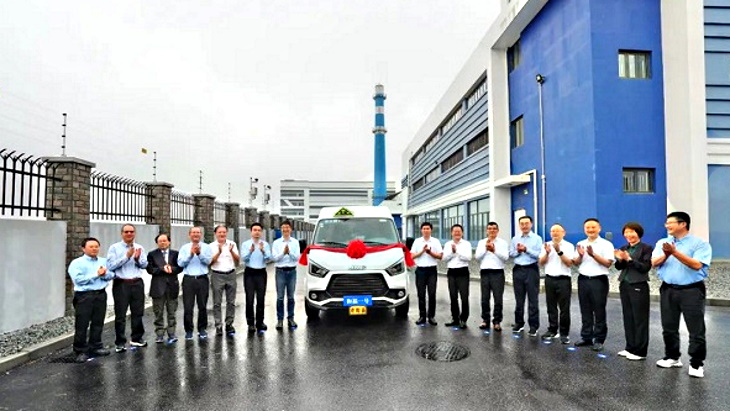
China National Nuclear Corporation (CNNC) said the milestone "marks the first mass production achievement under He Fu No.1, China's first isotope production technology brand, and signifies the establishment of China's fully integrated industrial chain for carbon-14 isotope development, from independent R&D and production to commercial supply."
The company noted that "only a handful of countries in the world" are currently able to produce carbon-14 on a commercial scale. "Under the support of the China Atomic Energy Authority, Qinshan Nuclear Power, relying on China's commercial heavy water reactor, began independent R&D in 2019 through joint efforts with China Isotope & Radiation Corporation and other partners, and successfully overcame technical barriers to produce carbon-14 through commercial reactor irradiation."
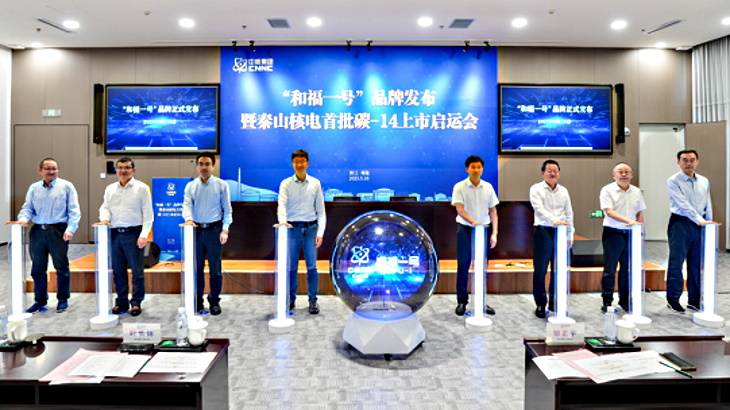
(Image: CNNC)
The first irradiated carbon-14 target was successfully extracted from the Qinshan plant's heavy water reactor unit on 20 April last year. After purification and processing, the first batch of carbon-14 products meeting quality standards have now passed final testing and been dispatched.
Carbon-14 is used in medical and scientific research and in fields including agriculture and chemistry as well as in medicine and biology. According to CNNC, the expected annual output at Qinshan will be sufficient to meet domestic market demand.
"This marks a new stage in China's isotope supply system - shifting toward greater self-reliance and innovation," CNNC said. "Looking ahead, CNNC will continue to leverage its resources and technological advantages to accelerate the localisation and scaled production of more medical isotopes, contributing to the Healthy China initiative."
Currently, cobalt-60 produced at the Qinshan plant is used in a wide range of fields, including food preservation, meeting most of the domestic market demand and even starting export. "Looking ahead, He Fu No.1 will take on the task of scaling up production of various short half-life medical isotopes, such as lutetium-177, with production capacity expected to meet domestic needs," CNNC said.
Qinshan is China's largest nuclear power plant, comprising seven reactors. Construction of Phase I of the plant - a 300 MWe pressurised water reactor (PWR) which was the first indigenously-designed Chinese nuclear power station to be built - began in 1985, with the unit entering commercial operation in 1994. Qinshan Phase II is home to four operating CNP-600 PWRs, built with a high degree of localisation. Units 1 and 2, comprising the first stage of Phase II, began operating in 2002 and 2004, respectively. Units 3 and 4 entered commercial operation in October 2010 and April 2021. Phase III consists of two 750 MWe pressurised heavy water reactors supplied by Atomic Energy of Canada Ltd and commissioned in 2002 and 2003.

No comments:
Post a Comment