Shipping between EU ports in the Arctic is driving the rapid loss of sea ice, report warns
Black carbon emissions from ships in the Arctic nearly doubled in six years.
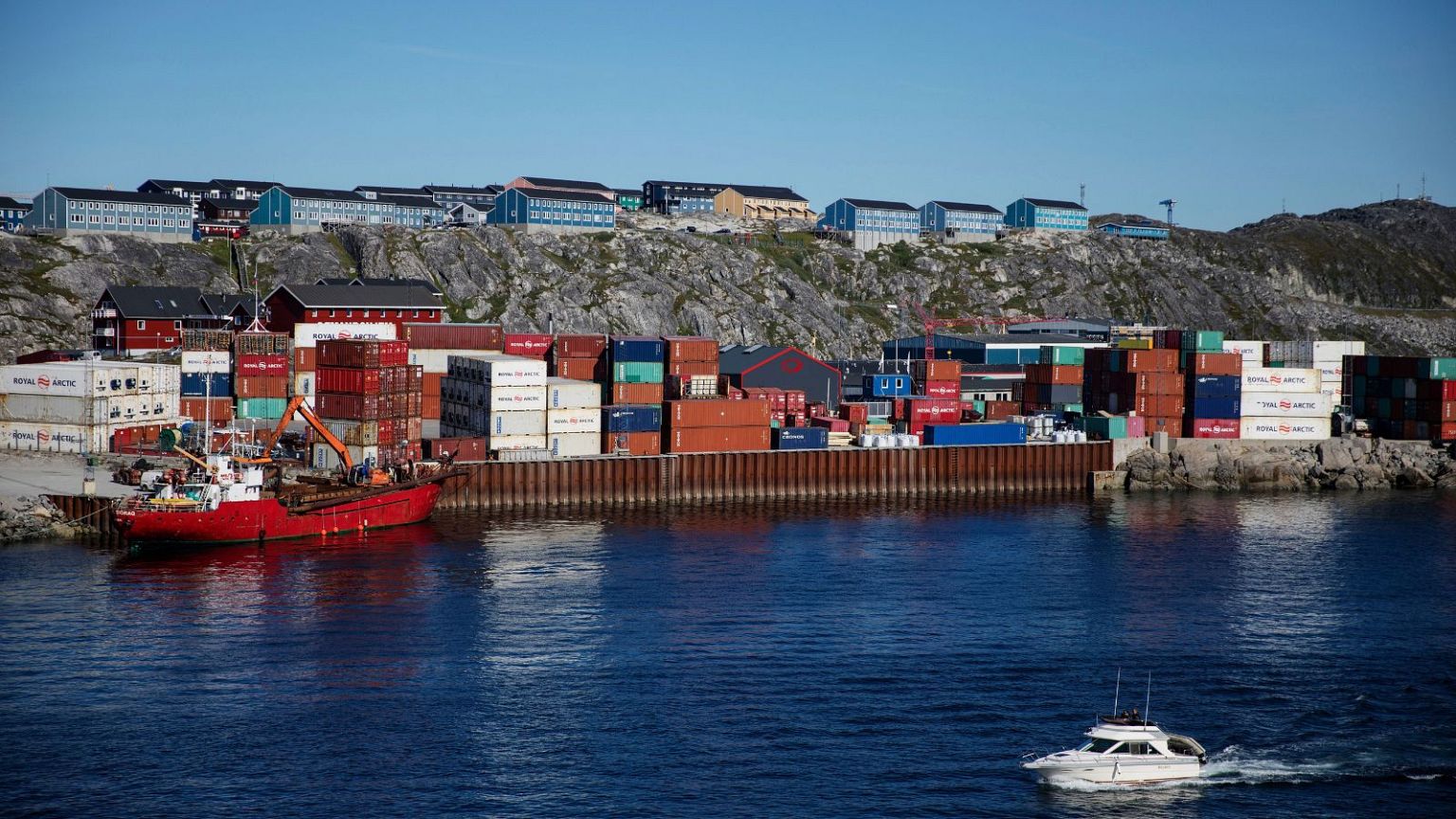
Copyright AP Photo/David Goldman
By Euronews Green
Published on 28/05/2025
Black carbon emissions from European shipping in the Arctic have been significantly underestimated, a new study suggests.
Produced by the incomplete combustion of fuels in ship engines, black carbon is contributing to the rapid loss of Arctic sea ice.
Previous reports have only focused on vessels flying EU flags, overlooking the impact of ships travelling to and from EU ports.
“Our findings show that ships connected to EU trade, regardless of their flag, are major drivers of black carbon pollution in the Arctic,” says Liudmila Osipova, senior researcher at the International Council on Clean Transportation (ICCT), and lead author of its new study.
“Recognising these emissions in future policies could help the EU better align its climate goals with its real footprint in the Arctic.”
Black carbon emissions doubled in six years
As Arctic shipping activity increases, so too are the associated black carbon (BC) emissions.
Between 2015 and 2021, BC emissions in the International Maritime Organisation (IMO)’s definition of the Arctic nearly doubled, according to the study.
In the more broadly defined Geographic Arctic, shipping emitted 1.5 kilotonnes (kt) of BC and 12 kt of CO₂ in 2021. About a quarter of these emissions occurred within the IMO definition of the Arctic, indicating a strong growth in BC emissions in the polar area, from 193 tonnes in 2015 to 413 tonnes six years later.
As Arctic shipping activity increases, so too are the associated black carbon (BC) emissions.
Between 2015 and 2021, BC emissions in the International Maritime Organisation (IMO)’s definition of the Arctic nearly doubled, according to the study.
In the more broadly defined Geographic Arctic, shipping emitted 1.5 kilotonnes (kt) of BC and 12 kt of CO₂ in 2021. About a quarter of these emissions occurred within the IMO definition of the Arctic, indicating a strong growth in BC emissions in the polar area, from 193 tonnes in 2015 to 413 tonnes six years later.
How does black carbon melt sea ice?
This growth trend is concerning, since one tonne of black carbon has a global warming effect equivalent to 900 tonnes of CO₂, as it absorbs more heat in the atmosphere.
BC’s impact is particularly pronounced in the Arctic. When the sooty particles settle on snow or ice, they reduce the albedo of these surfaces, meaning they reflect less light and so melt faster.
This compounds the climate challenges in a region which is already heating up three to four times faster than the global average.
Despite its potent climate and health impacts - it is linked to lung cancer, respiratory illness, and cardiopulmonary disease - BC remains one of the most unregulated short-lived climate and air pollutants.
The hidden carbon cost of EU trade in the Arctic
Brussels typically only accounts for the emissions from its EU-flagged ships in the Arctic. To give a truer picture of the pollution over which the bloc has control, ICCT has also totted up BC and CO₂ from EU-regulated ships, which answer to the EU Monitoring, Reporting, and Verification (MRV) system as they voyage between EU ports.
These vessels are the bigger polluters, it found. BC and CO₂ emissions from EU-regulated ships of at least 5,000 gross tonnage were nearly double those from EU-flagged ships in the IMO Arctic in 2021.
That year, nearly three-quarters of the ships operating in the Geographic Arctic and half of those in the IMO Arctic were navigating to or from EU ports.
To address a significant gap in its maritime regulation, the researchers say that EU policymakers could include BC among the pollutants measured and reported within the bloc’s MRV system.
Beyond improved emissions tracking, there are various ways to reduce BC emissions, such as incentivising ships to use distillate instead of residual fuel, and encouraging the installation of diesel particulate filters on board.

Copyright Roni Rekomaa/Lehtikuva via AP
By Alice Tidey
Published on 28/05/2025
The country's prime minister stressed on Wednesday that although the island nation doesn't have a military, "that doesn't mean we don't have strong defences and a role to play in NATO."
Iceland needs to have "skin in the game" when it comes to defence and security in the High North and is looking at how to adjust its defence posture and spending accordingly, the country's prime minister said on Wednesday.
"When it comes to the Arctic, this is a place where we have to step up. This is our area. We need to have skin in the game when it comes to the Arctic and have an opinion on that, not that just being run by others," Kristrún Frostadóttir said in Brussels following a meeting with NATO chief Mark Rutte.
"I see a lot of possibilities coming out of that as well, even though we're in a situation where this is also run a bit from a threat position, there's still possibilities for build-up in Iceland as well. So this is something we're looking into. We will have concrete points going into the Hague summit and then also going forward in our spending reviews," she added, referring to a NATO summit scheduled to take place in the Dutch city in late June.
US President Donald Trump has threatened to annex Greenland by force, arguing that US control of the semi-autonomous Danish territory is necessary for "international security".
"We have a lot of our favourite players cruising around the coast and we have to be careful," Trump told Rutte in March.
"The whole area is becoming very important and for a lot of reasons, the routes are very direct to Asia, to Russia, and you have ships all over the place and you have to have protection. So we're going to have to have a deal on that," he added.
RelatedWe believe in free trade, Iceland Prime Minister Frostadóttir tells Euronews
Russia and China have increased their presence on the Northern Sea Route (NSR), a shipping lane in the Arctic Ocean that connects the Atlantic and Pacific Oceans. This is due to warming temperatures, which makes the route more manageable for longer, and Chinese growing appetite for Russian commodities including fossil fuels.
Rosatom, a Russian state corporation primarily focusing on energy and high-tech products, said last month that the volume of cargo transportation along the NSR reached a record high of 37.9 million tonnes, a 4.4% increase on the previous year and a near ten-fold increase from ten years ago.
China, which describes itself as a "near-Arctic state", and Russia are also increasing their military presence in the natural resources-rich area, with joint patrols and military exercises.
Denmark, an EU and NATO member state, announced shortly after Trump's return to the White House that it will inject €1.95 billion into boosting its military presence in the Arctic and North Atlantic region.
Iceland, together with Norway and UK, two fellow NATO allies, is also now using AI to detect hostile activity in the Arctic.
Frostadóttir stressed on Wednesday that although the island nation doesn't have a military, "that doesn't mean we don't have strong defences and a role to play in NATO".
Members of the military alliance are currently negotiating an increase to its defence spending target from its current 2% of GDP threshold. Allies appear to have landed on 5% of GDP target, a number repeatedly called for by Trump, although it would be split in two: 3.5% of GDP for hard military spending, and a further 1.5% on defence-related spending including, for instance, infrastructure and cybersecurity.
NATO defence ministers will continue negotiations next week at a meeting in Brussels, with leaders set to adopt the new target at the June summit in The Hague.
"We're willing to spend more when it comes to defence-related investments, to strengthen our facilities when it comes to Keflavik Air Base, when it comes to ports, when it comes to general host nation support," Frostadóttir said.
"And also very good and constructive talks on Arctic security. We're aware of our position in the north. This is obviously our home. It's not just a conceptualised idea."
"Russia's aggression towards Ukraine is something that is relevant to us, even though it's far away, because if they win on the eastern flank, they might move their views towards the north, which is where we live. So this is also our fight," she added.
Rutte, speaking alongside Frostadóttir on Wednesday, said positive steps have been taken by the seven allies that have stakes in the Arctic - Canada, Denmark, Finland, Iceland, Norway, Sweden, and the US - but that the alliance as a whole needs to be better organised, including when it comes to intelligence gathering.
"We do not have enough icebreaker capacity within NATO potentially, so we have to look into that," he also said.

No comments:
Post a Comment