The Forgotten 10 Billion Lives: A Tale of Suffering, Survival, and the Fight to See Farmed Animals
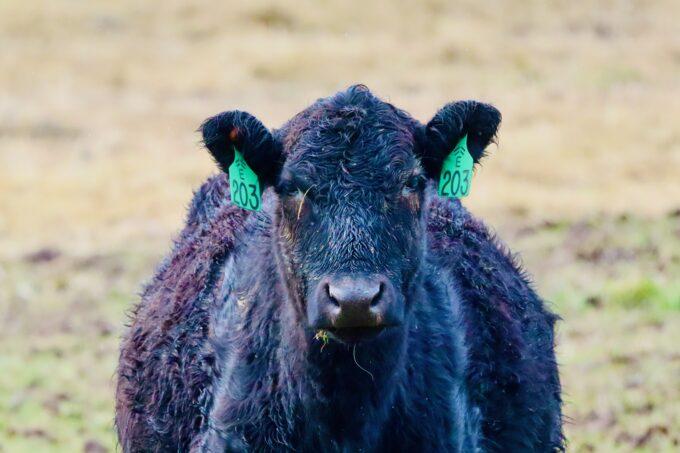
Black angus, cattle farm, Tillamook, Oregon. Photo: Jeffrey St. Clair.
In 2012, in Turlock, California, 50,000 hens were abandoned in an egg farm. Every one of those trapped birds embodied a tragic irony. Birds can fly in the sky, unassisted by metal structures or fossil fuels. They are emblematic of freedom. “Free as a bird,” goes the cliché. For her whole life, each of those hens had been crammed in a rusted cage with three, four, five, even six others; her whole life eclipsed by an obsessive desire to bust out of the cage, to spread her wings and feel the sun and the rain and the breeze, to sashay on solid ground under an open sky, to make a nest and raise her babies.
I imagine the grim days that followed. Now her relentless craving for escape amplified by an urgent need for food and water, the air growing louder—deafening—with the sound of 50,000 hens shrieking from thirst and starvation. Now a cagemate is dead. Now more hens immobile in the cages, their sounds muted. Now the air is thickening with the stench of rotting flesh. Second by minute by hour, two weeks passed. Finally, state officials began gassing birds by the thousands. After three more days, animal sanctuaries negotiated to take custody of the surviving 4,460 hens.
A year later, I photographed the empty facility. The filthy warehouses I found there did nothing to alleviate my nightmarish imaginings. The ammonia stink of chicken urine still lingered.
Chickens recognize beauty, protect their young, and exhibit empathy. A rooster signals danger from predators with various calls, depending on the threat. Anyone who has seen baby goats together cannot doubt they are jumping with joy. Stressed fish seek out caresses even from robot fish. The cow bellows and is beaten back as her bleating calf is dragged away. Sentience—the capacity to experience feelings—connects humans with birds, with fishes, with mammals.
The photographs I made that February day in Turlock became the inspiration for Censored Landscapes, a photographic exploration that tells a story in which the central characters are innocent of any crime and yet are condemned to imprisonment, torture, and death. It’s a true story of ecological destruction, of worker exploitation—mostly people of color—and of secretive corporations protected by laws and enriched by government subsidies and lobbies. It is also a story that offers insight and healing.
A photograph is a love song to the ecological implications of the landscape contained inside its frame. Carleton Watkins hauled thousands of pounds of photographic equipment through Yosemite. His photographs influenced Abraham Lincoln to sign a bill that protected Yosemite Valley. William Henry Jackson’s photographs persuaded Ulysses S. Grant to designate Yellowstone as a national park. Ansel Adams’ work inspired Congress to establish Kings Canyon National Park. American landscape photography evolved in conjunction with the conservationist and environmental movement.
The tale told in photographic history books illustrates that American landscape photography, like US history writ large, has been dominated by white men. Their mythologizing of a pristine landscape colluded in the ethnocide of millions of people who lived in this country before colonization. In 1975, the New Topographics: Photographs of a Man-Altered Landscape exhibition was considered radical in that it depicted a stark view of human impacts on the land. But only one of the ten artists was a woman, and none were people of color.

The tale of American landscape photography is also one of human exceptionalism. Though humans are now integral to landscape photography, farmed animals have almost entirely been excluded, despite their prodigious numbers. Terrestrial farmed animals account for 59 percent of vertebrates on earth, humans 36 percent, all other terrestrial animals only 5 percent. Approximately ten billion land animals in the U.S. are slaughtered every year. The absence of farmed animals from landscape photography reflects their exclusion from environmental activism even though animal agriculture is a leading cause of climate change, deforestation, ocean acidification, habitat destruction, loss of biodiversity, and mass species extinction.
In the agricultural industry, nonhuman animals do not exist as individuals but as capital to be exploited for profit. The word capital comes from the Latin capitalis, meaning head, in the sense of a head of cattle. In medieval Europe, the number of cattle owned by a family stood for wealth and prestige. Cattle were used as currency for large transactions. In the U.S., mercenary corporations are granted personhood, meaning they are entitled to at least some of the legal status, rights, and protections of humans. They can own land and money. Nonhuman animals, however, are deemed property, with none of those rights or protections.
How, then to portray the individuals hidden away in remote places and windowless warehouses? A number displayed with each landscape in this project represents the number of animals bred, confined, or slaughtered in the facility depicted in the photograph.
Accessing the numbers wasn’t easy. People who breed, confine, and slaughter animals conceal their enterprise aggressively. In more than half of the U.S. state legislatures, the industry has attempted to pass “ag-gag” laws that criminalize photographing sites of animal agriculture. These laws are contrary to the First Amendment of the US Constitution, but they are currently in effect in eleven states. The Animal Enterprise Terrorism Act is a federal law that criminalizes economic damage to an animal enterprise, including loss of profits. Photographers who expose the practices of these corporations can be lumped into the same category as Timothy McVeigh and the Unabomber.
The numbers that form an essential element in this project are revealing, but they’re a pitiful substitute for even one of the animals whose identity, sentience, emotions, and existence are obliterated. Censored Landscapes also includes portraits and stories of individual animals exploited by the industry. The animals I portrayed in this project serve as ambassadors of their species. Their stories are meant to individualize the vast numbers of farmed animals bred, confined, and slaughtered.
Extensive and meticulously documented facts included in Censored Landscapes regarding the treatment of farmed animals substantiate the barbarism and injustice of the industry. For example, virtually all farmed birds, including chickens, ducks, geese, and pigeons, are kept indoors in extremely crowded conditions for their whole lives. In 2022, 9.54 billion chickens, 208.2 million turkeys, and 26.7 million ducks were slaughtered for food in the U.S. Each of the phases involved in arrival at the slaughter facilities causes more suffering for the birds. About twenty million chickens die on the way to slaughter every year.
At the slaughterhouse, the birds are hung by their legs in metal shackles, which causes them more stress, pain, and injury. They are carried upside down to an electrified bath meant to stun them, their necks are sliced, and they are dunked in scalding water. The speed at which the USDA allows facilities to slaughter birds continues to increase. In 2023, the rate was 140 birds per minute, though some facilities have received waivers that allow them to slaughter 175 birds per minute. The stunning technique can be ineffective, so many of the birds are conscious as the blade cuts their throats. Or the saw misses, and they are boiled alive. Almost one million chickens and turkeys are boiled alive every year in slaughtering facilities. Birds raised for food are excluded from the Humane Methods of Slaughter Act and the Animal Welfare Act. The standard treatment of other species exploited by the industry is similarly abhorrent.
Well-documented impacts of animal agriculture on almost all facets of our world, including human health, the economy, wildlife, and the environment, illustrate the industry’s far-reaching effects. For example, workers in the U.S. meat industry suffer an estimated three times as many serious injuries as the average American worker, including repetitive stress injuries, fractures, burns, head trauma, and amputations. Respiratory disorders are rampant. The rate of injuries and illness is likely higher than estimated; many workers refrain from reporting for fear of retribution. Employers may also underreport to avoid higher costs. Workers do not receive proper safety training and disproportionately lack health insurance.
In 2020, 37.5 percent of workers in animal slaughtering and processing were foreign-born. An unknown but substantial number of workers in this industry are undocumented. In one of the most dangerous industries, they cannot advocate for their own safety, health, fair compensation, or benefits for fear of losing their job or deportation.
Censored Landscapes does not focus on the kind of graphic depictions of cruelty found all over the Internet, of men beating turkeys with iron rods and throwing them aside or slamming piglets onto a concrete floor by the hind legs. Atrocities against animals are rife in the industry, but I don’t have the heart to investigate. Most heartbreaking is the innocence of the animals. They can’t possibly understand why this is happening to them—why the contempt, why the cyclonic rage. Beyond unbearable pain, they must feel utterly forsaken by all things good. The men must also feel bereft of goodness, to be so possessed by monstrous resentment or whatever drives them to viciously harm those creatures. My intention is not to expose any specific worker, company, or owner. The dingy, wretched structures revealed in this project insinuate everyone and everything—farmed animals, wildlife, humans, rivers, oceans, forests, soil, air—into their abyss. Censored Landscapes scrutinizes animal agricultural industry standards, business as usual.
Homo sapiens have existed at least 300,000 years and have only been farming animals less than 12,000 years, a bizarre blip on this end of the human timeline. North and Central Americans did not farm animals until the invasion of the European colonists about 400 years ago. Veggies, legumes, grains, nuts, and fruit are the basis for superb cuisines of all flavors. Plant-based restaurants of every variety are proliferating like wildflowers in spring. Meat, dairy, fish, and egg alternatives are available in all chain grocery stores and even at fast food restaurants.
Numerous studies evidence the human health and environmental benefits of a plant-based diet. A plant-based diet protects against cancer, type 2 diabetes, obesity, heart disease, and other illness. A 2022 study shows that “rapid global phaseout of animal agriculture has the potential to stabilize greenhouse gas levels for thirty years and offset 68 percent of CO2 emissions this century.”
But no matter, Americans continue to consume more animals than ever. Animal agriculture is a ruthless and avaricious business that results in ecological devastation, grievous health effects, and colossal suffering. This I know to be true: environmentalism and social justice must include the other animals who share our planet.
Imagine flipping the script—subverting the colonizing, profiteering paradigm. Sentient nonhuman animals instead of corporations would be granted personhood; forests, rivers, and oceans valued much more than money; prisons and animal farms morphed into homes and sanctuaries. Every transformation, no matter how preposterous or sensible or liberating or urgent, is kindled with sparks of inspiration. Let this be a spark.
May all beings everywhere be joyful and free.
This is excerpted and adapted by Isabella La Rocca González from her book Censored Landscapes: The Hidden Reality of Farming Animals (Lantern Publishing, 2024). This article was produced by Earth | Food | Life, a project of the Independent Media Institute.
The Extreme Cruelty of Confining Mother Pigs to “Gestation Crates”

Smithfield Foods gestation crates, Smithfield Foods/Murphy Brown pig breeding facility, Waverly, Virginia. Photo: Humane Society.
Pigs, intelligent and social creatures, possess a strong maternal instinct. In the wild, a pregnant pig will walk several miles to carefully select the perfect spot to build a nest for her newborns. A sow, or mother pig, is pregnant for almost four months before the arrival of her babies. Pregnancy can be an exciting and momentous time for humans as families prepare and anticipate the joy of welcoming a new life into the world. After she welcomes her babies into the world, she will spend the first few months of their lives caring for them, nursing and grooming them. They will play and forage for food together as a family unit. Mother pigs have an instinct to love, protect, and nurture their newborn babies, just like humans do.
In factory farms, however, this natural maternal bond is broken. The meat industry doesn’t see sows as mothers with the capacity to love. Instead, they treat them like inanimate breeding machines, repeatedly impregnating sows just to raise and kill their babies. These sows will spend the majority of their pregnancies trapped in a “gestation crate” (gestation is another term for the period when an animal is pregnant before giving birth). This metal cage is about seven feet by two feet, an area barely larger than the sow’s body, so small that she can’t even turn around. At the core of gestation crate use is a desire to maximize space and exercise tight control over breeding cycles. In these confined spaces, sows are reduced to production units, and their ability to exhibit natural behaviors is entirely curtailed. Trapped in this horrific contraption, a sow will never be able to feel sunshine on her skin or grass beneath her hooves. For the entirety of her pregnancy, she only knows the cold, iron confines of this crate.
After birth, mother pigs do not get a chance to care for their babies as they naturally want to. Instead, pork producers take each litter of piglets from their mother when they’re only around three weeks old, raising and killing them for food. This separation is not only traumatic for the mother and her babies, but it’s also unnatural. In nature, mother pigs nurse their babies for up to 17 weeks.
Then, this exploitative cycle starts again. The industry repeatedly impregnates sows, forcing them to give birth to new litters of piglets until their bodies are completely exhausted. When a sow is “spent” (i.e., no longer able to give birth), she is sent to slaughter at only around one and a half to two years old. In the wild, pigs can live up to 20 years. But after just two years of life, a sow will be killed for her meat, just like her offspring.
The Pork Industry: Purveyors of Intense Cruelty
Tragically, this abuse is standard practice in the pork industry, where companies view these intelligent, emotional, feeling animals merely as machines for maximizing profit. All of this is done in the secrecy of factory farms, which the vast majority of consumers will never encounter firsthand. Imagine a mother pig kept in a cage barely bigger than her body for most of her pregnancy, unable to walk or move more than a few steps, unable even to turn around, and able to interact only with the two mothers on either side of her, who are also caged. Imagine her water spouting from dirty pipes at the front of this cage, with a food trough below. Imagine floors slatted to allow excrement to flow downwards before collecting in vast outdoor lagoons. Factory farms imprison mother pigs in these conditions for the entirety of their four-month pregnancies.
While the cruelty of this system is evident, its implications extend far beyond the sows’ suffering. This practice encapsulates a range of ethical, environmental, technological, and economic dilemmas that lie at the heart of modern factory farming. Due to the cruel, horrific conditions they are forced to endure in captivity, sows are among the most abused animals on the planet. In 2022, Mercy For Animals released evidence from a heartbreaking investigation that shines a light on the cruelty that mother pigs endure trapped in factory farms.
The pork industry forces millions of sows across the U.S. and worldwide to suffer through these horrific conditions every day. Many consumers are unaware of the cruel conditions under which their pork products are produced.
Alternative Systems: Group Housing and Free-Range Models
In contrast to the intense suffering caused by gestation crates, alternative systems such as group housing enable sows to interact socially and move more freely. In group housing, pigs can engage in instinctive behaviors like rooting, foraging, and socializing, which are essential for their psychological and physical well-being.
Although these systems require careful oversight to manage issues like aggression and resource competition, they offer the possibility of a higher quality of life by restoring a degree of natural behavior.
Taking this approach a step further, free-range or pasture-based systemsallow pigs to roam in outdoor environments where they can forage, build nests, and form natural social bonds. This shift from a sterile, confined environment to one that more closely mimics nature addresses animal welfare concerns while also challenging the long-held industrial model that has defined modern agriculture. The philosophical reorientation toward respecting an animal’s intrinsic value is a central element in the debate over how best to produce food humanely.
Beyond animal welfare, the environmental consequences of intensive farming practices are profound. Traditional systems that rely on gestation crates centralize waste production in confined spaces. The concentrated waste from these systems not only disrupts the natural cycle of decomposition and nutrient distribution but also contributes to water contamination and greenhouse gas emissions. The localized accumulation of pollutants can lead to broader ecological degradation, affecting soil health, water quality, and atmospheric conditions.
In contrast, alternative systems that provide pigs with more space encourage a more natural dispersion of waste. In pasture-based systems, waste becomes part of a cyclical process where it can enhance soil fertility through natural carbon sequestration rather than acting as an environmental burden. This approach aligns with the principles of sustainable agriculture, suggesting that a system designed to work with nature rather than against it can mitigate many of the environmental impacts associated with factory farming.
The Legal Landscape: A Global Shift Away from Gestation Crates
Legislation around the world increasingly reflects a growing ethical and environmental consciousness. Numerous regions have moved to restrict or ban gestation crates, signaling a broader reevaluation of the values underpinning intensive animal production. Several countries have banned the use of cruel gestation crates, including the United Kingdom and Sweden. These legal reforms are not solely about improving animal welfare: they also acknowledge the interconnectedness of ethical treatment, environmental sustainability, and economic viability. Although alternative systems may initially entail higher production costs, proponents argue that the long-term benefits, such as improved animal health and reduced environmental impact, justify the investment.
Policies that restrict gestation crates serve as catalysts for social change, challenging both producers and consumers to reconsider the ethics of modern food production. By enforcing higher standards of animal treatment, legislators are not only protecting animal welfare but also prompting the industry to explore models of production that respect the environment and align with contemporary ethical values.
Tech for Compassion: Innovations Supporting Humane Farming
Technological innovation is a promising avenue for transforming animal agriculture. Advances in electronic feeding systems and smart monitoringtools are making it increasingly feasible to manage group housing systemswithout sacrificing efficiency. Electronic feeding systems, for instance, can deliver tailored diets to individual sows in a group setting, thereby reducing competition and minimizing conflict. Smart monitoring technologies—often utilizing artificial intelligence—track animal health and behavior in real time. By detecting early signs of stress or illness, these systems allow for prompt interventions that can enhance overall welfare.
These technological innovations demonstrate that it is possible to balance the demands of efficient production with the imperatives of humane treatment. By integrating advanced management tools into alternative housing systems, producers can maintain high productivity levels while also offering environments that respect pigs’ natural behaviors. This blend of technology and animal welfare not only supports a more ethical production model but also contributes to long-term economic sustainability.
The economic rationale for gestation crates has traditionally hinged on lower upfront costs and maximized production. However, this short-term economic calculus often overlooks the hidden costs associated with animal health issues, environmental cleanup, and shifts in consumer behavior. Alternative systems, despite requiring more significant initial investments, can offer long-term economic benefits.
Improved animal health leads to lower veterinary costs and a reduction in the negative externalities that can plague intensive farming. Moreover, as consumers become more aware of the origins of their food, there is a growing market for products that are produced through humane and sustainable methods.
This evolving consumer preference is reshaping the pork industry’s economic landscape. Modern buyers increasingly favor ethical production methods, and their willingness to support such practices is driving market forces that favor alternative systems. In this light, investing in more humane production methods is not only a moral imperative—it is also a sound economic strategy that can lead to a more resilient and future-proof industry.
Forgotten Voices: Farm Workers in Factory Farming Systems
An often overlooked aspect of the debate is the impact of intensive confinement systems on farm workers. The repetitive, high-risk tasks in factory farms mirror the restrictive conditions imposed on the animals. Workers may suffer from physical strain, hazardous exposures, and low job satisfaction as a result of these monotonous and stressful environments.
Transitioning to alternative systems, such as group housing or free-range management, could also improve working conditions. More open and dynamic production environments offer the potential for safer, more engaging work experiences. When animals are treated with respect and allowed to exhibit natural behaviors, the overall atmosphere on the farm can shift toward one that values care, safety, and dignity for both animals and the people who work with them.
A Vision for the Future: Compassionate, Ethical, and Sustainable Farming
Reimagining the pork industry through the lens of compassion and sustainability requires a comprehensive reexamination of established practices. It challenges the entrenched economic models that have long prioritized short-term gains over long-term environmental health and ethical treatment. By embracing innovative technologies and alternative management systems, the future of animal agriculture could be defined by an integration of efficiency with humane practices.
In this vision, ethical considerations become a central component of production rather than an afterthought. Producers, policymakers, and consumers are invited to participate in a transformative movement—one that redefines modern agriculture to respect the natural world and its inhabitants. This transformation is about more than eliminating practices like gestation crates; it is about forging a new relationship with nature, one that acknowledges the intrinsic value of all living beings and the importance of sustainability.
The pork industry’s reliance on gestation crates reveals a fundamental tension between the imperatives of industrial efficiency and the ethical demands of humane, sustainable production. As society becomes increasingly aware of the broader costs of intensive animal farming—both environmental and human—the call for change grows ever stronger. By shifting toward alternative systems, such as group housing and free-range management, the pork industry can move from a model of confinement and exploitation to one characterized by innovation, compassion, and resilience.
This reimagined approach respects pigs’ natural behaviors and dignity and promotes a healthier environment and improved working conditions for farm laborers. While the best way to avoid animal cruelty is to keep animals off our plates, as long as there is a demand for meat, more humane solutions need to be implemented. In the end, transforming the industry is a shared responsibility—one that involves ethical reflection, technological advancement, and a commitment to sustainability. Such a change represents not only a more humane way to produce food but also a promising model for the future of agriculture, where profit and compassion are not mutually exclusive but mutually reinforcing.
This article was produced by Earth | Food | Life, a project of the Independent Media Institute.

No comments:
Post a Comment