On the Superhighway to Nuclear Hell
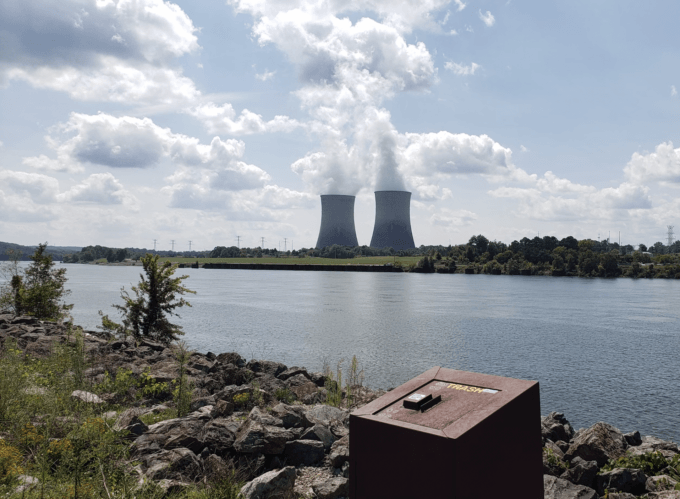
Photo by Lee Lawson
On May 23rd, with several strokes of his pen, President Trump issued orders that would roll back US energy policy about 50 years.
On that day, Trump signed five Executive Orders (EOs): Restoring Gold Standard Science; Ordering the Reform of the Nuclear Regulatory Commission; Reinvigorating the Nuclear Industrial Base; Reforming Nuclear Reactor Testing at the Department of Energy; and Deploying Advanced Nuclear Reactor Technologies for National Security. (This page keeps a running tally of all the White House executive orders.)
All of this madness was announced in a press release headlined “President Trump Signs Executive Orders to Usher in a Nuclear Renaissance, Restore Gold Standard Science.” Just in case there was any confusion about what this meant, the press release included an explanation that read: “Gold Standard Science is just that—science that meets the Gold Standard.”
Collectively, the four orders that focused on the nuclear sector would: reduce and undermine the already inadequate safety oversight authority of the US Nuclear Regulatory Commission (NRC); fast-track unproven new reactor projects without regard for safety, health or environmental impacts; curtail or possibly even end public intervention; weaken already insufficient radiation exposure standards; and reopen the pathway between the civil and military sectors, all while “unleashing” (Trump’s favorite verb) nuclear power expansion on a dangerous and utterly unrealistic accelerated timeline.
The precursive warning shot to all this had been fired on February 5th with Energy Secretary Chris Wright’s own Executive Order: Unleashing the Golden Era of American Energy Dominance, ‘dominance’ being another of Trump’s favorite big beautiful words, along with ‘big’ and ‘beautiful’ (—see his One Big Beautiful Bill Act.) “It’s time for nuclear, and we’re going to do it very big,” Trump told industry executives when he signed the orders.
Perhaps it’s no surprise to find that ‘dominance’ appears 35 times in the Heritage Foundation’s 2023 handbook, Authoritarianism for Dummies, officially known as Project 2025. Variations on the word ‘unleash’ appear 19 times. ‘Tremendous’ shows up 11 times. So does ‘gold standard’.
Which brings us to the fifth executive order of May 23, Restoring Gold Standard Science. While it does not specifically reference nuclear power, the order determines a hierarchy that will put political appointees in charge of specialized federal agencies, including the NRC. The order also itemizes a set of requirements on how scientific research and activities must be conducted, including “without conflicts of interest.”
But guess whose stocks soared after the release of Trump’s nuclear Executive Orders? Answer: Oklo, the company attempting to deliver the first US micro-reactors. Guess who was on the board of Oklo before his appointment as Trump’s Energy Secretary? Yes, Chris Wright.
Uranium mining company Centrus Energy and the U.S. Navy’s main nuclear reactor supplier, BWX Technologies, also saw their stock prices soar after Trump’s executive orders were released.
An Oklo executive, Jacob DeWitte, who was present at the signing, brought along a golf ball to help Trump understand just how little uranium is needed for the lifetime needs of a single human being (an entirely irrelevant statistic given the lethality contained in that glowing little golf ball.) Trump called the golf ball show-and-tell “very exciting” before teeing up another order that will not only muzzle but actually persecute scientists for any findings with which the Trump hive don’t agree.
The definition of ‘sound science’, under Trump’s ‘gold standard’, is simply anything happening now or under the previous Trump administration. Anything that happened under the Biden administration is “politicized science”.
Among the enforcers who will police and punish the NRC, along with other federal agencies who stray from Trump’s “science” script, is the Director of the Office of Science and Technology Policy, one Michael Kratsios.
Kratsios is the former chief of staff to AI entrepreneur, venture capitalist and nuclear promoter, Peter Thiel. Thiel’s venture capital firm, Founders Fund, supported nuclear fuel start-up General Matter, in contention to produce high-assay low-enriched uranium (HALEU) for advanced nuclear reactors. One of the executive orders will “seek voluntary agreements pursuant to section 708 of the DPA with domestic nuclear energy companies that could deliver HALEU fuel.”
Kratsios is already sharpening his knives to go after the NRC, viewed as an obstacle to fast-tracking the new nuclear projects that Kratisios’s former boss, among others, will be pushing.
“Today’s executive orders are the most significant nuclear regulatory reform actions taken in decades,” said Kratsios on May 23. “We are restoring a strong American nuclear industrial base, rebuilding a secure and sovereign domestic nuclear fuel supply chain, and leading the world towards a future fueled by American nuclear energy. These actions are critical to American energy independence and continued dominance in AI and other emerging technologies.”
There has already been some pushback against allowing a political appointee to be the arbiter of scientific integrity. “Putting that power in the hands of a political appointee who doesn’t need to consult with scientific experts before making a decision is very troubling,” Kris West of COGR, an association of research universities, affiliated medical centers, and independent research institutes, told Science.
A group of scientists has written an open letter, retitling the order “Fool’s Gold Standard Science,” declaring that it “would not strengthen science, but instead would introduce stifling limits on intellectual freedom in our Nation’s laboratories and federal funding agencies”.
Part of the “regulatory reform” outlined as “gold standard science” and that Kratsios will oversee, is gutting the NRC, which, complains the White House, “charges applicants by the hour to process license applications with prolonged timelines that maximize fees while throttling nuclear power development.”
Somehow, “throttling nuclear power development” is not what springs to mind when reviewing the record of an agency that consistently favors the financial needs of the nuclear industry over the interests of public safety and the environment.
Furthermore, charges the White House, the NRC “has failed to license new reactors even as technological advances promise to make nuclear power safer, cheaper, more adaptable, and more abundant than ever.”
Trump, who seems to treat executive orders like a Nike slogan (“just do it”), has commanded that the US quadruple its nuclear energy capacity by 2050. This will be achieved not only by stripping the NRC of its power to scrutinize the safety assurances for new, primarily small modular reactors, but by expediting their licensing while keeping current reactors running longer and hotter and even reopening permanently closed ones.
Licensing timeframes will be slashed to “a deadline of no more than 18 months” for final decisions on construction and operating license applications for new reactors, and to just one year “for final decision in an application to continue operating an existing reactor of any type.”
The Trump order will also require “the reactivation of prematurely shuttered to partially completed nuclear facilities.” The former refers to Palisades, Three Mile Island and Duane Arnold so far. The latter is about the abandoned two-reactor Westinghouse AP 1000 project at V.C. Summer in South Carolina.
Currently operating reactors will be expected to add “5 gigawatts of power uprates”, which comes with its own set of safety concerns given the age of the US nuclear reactor fleet.
Everything has been put on a superhighway to nuclear hell, unhinged from the very real obstacles to fast-tracking nuclear expansion, most notably the cost and risks.
“A pilot program for reactor construction and operation outside the National Laboratories,” will require the Energy Secretary to “approve at least three reactors pursuant to this pilot program with the goal of achieving criticality in each of the three reactors by July 4, 2026,” one order said.
An astonishing “10 new large reactors with complete designs under construction by 2030,” is another aspirational command.
The Secretary of Energy must also designate at least one site for advanced reactor technologies within three months of the order, and ensure that it will host a fully operational reactor there “no later than 30 months from the date of this order.”
None of these timelines share any precedent with the track record of nuclear power plant construction, and bullying or handcuffing the NRC won’t change that.
That’s because, as Toby Dalton and Ariel Levite of the Carnegie Endowment for International Peace point out in their recent column in The Hill: “The Nuclear Regulatory Commission has not presented the key obstacle to nuclear development in the U.S.” The orders, they said “underestimate the addition of time to market due to limitations on workforce availability, supply chain, financing, specialty fuels and community buy-in.”
The Carnegie authors also criticized the way the orders treat nuclear power as if it is similar to any other form of energy. “The orders downplay or ignore the special magnitude of nuclear risks, the series of traumatic accidents suffered by leading nuclear power nations and the unique environmental and multi-generational footprint of nuclear waste and spent fuel,” they wrote.
What reining in the NRC will achieve is an even greater reduction in confidence over the safe operation of current and future nuclear reactors.
“This push by the Trump administration to usurp much of the agency’s autonomy as they seek to fast-track the construction of nuclear plants will weaken critical, independent oversight of the U.S. nuclear industry and poses significant safety and security risks to the public,” said Ed Lyman, a physicist and Director of Nuclear Power Safety at the Union of Concerned Scientists.
To set all this right, the DOGE kids will soon be paying a visit to the NRC to fire people. DOGE, says the Reform the NRC order, will “reorganize the NRC to promote the expeditious processing of licensing applications and the adoption of innovative technology. The NRC shall undertake reductions in force in conjunction with this reorganization, though certain functions may increase in size consistent with the policies in this order, including those devoted to new reactor licensing.”
But “reorganizing” the NRC will have the reverse effect, argues Senator Ed Markey (D-MA) a longtime nuclear watchdog on Capitol Hill, including during his earlier years in the US House of Representatives. “It will be impossible for NRC to maintain a commitment to safety and oversight with staffing levels slashed and expertise gone,”Markey said.
“Allowing DOGE to blindly fire staff at the NRC does nothing to make it easier to permit or regulate nuclear power plants, but it will increase the risk of an accident,” said ranking member of the House Energy and Commerce Committee, Frank Pallone (D-NJ), who called the orders “dangerous.”
But then the Trump administration doesn’t actually consider nuclear power itself to be dangerous, and instead accuses the NRC of being overly cautious, saying: “Instead of efficiently promoting safe, abundant nuclear energy, the NRC has instead tried to insulate Americans from the most remote risks without appropriate regard for the severe domestic and geopolitical costs of such risk aversion.”
Consequently, it’s no surprise to find a clause in the order that reads: “The personnel and functions of the Advisory Committee on Reactor Safeguards (ACRS) shall be reduced to the minimum necessary”. The ACRS panel is composed of cream-of-the-crop scientists from the national laboratories, universities and other areas of academia. Its mandate, ironically and in place for decades, has been precisely to uphold “Gold Standard Science” in the nuclear power sector.
Like everything else Trump does, all of this constitutes another accident waiting to happen. “If you aren’t independent of political and industry influence, then you are at risk of an accident,” confirmed former NRC chair Allison Macfarlane of efforts to undermine her former agency.
The orders are a “guillotine to the nation’s nuclear safety system”, another former NRC chair Greg Jaczko told the Los Angeles Times.
Also guillotined is any pretense about protecting the public from the harm caused by exposure to the ionizing radiation released by the nuclear power sector.
No longer must we adhere to the standard, endorsed by the National Academy of Sciences, that exposure to any amount of radiation, no matter how small, could be harmful to human health. (This is especially true if it involves consistent and chronic longterm exposure even to what might be considered “low” doses.)
Instead, say Trump’s orders, “the NRC shall reconsider reliance on the linear-no-threshold (LNT) model for radiation exposure and the ‘as low as reasonably achievable’ standard, which is predicated on LNT.” Those models, says the White House, are “flawed.”
This will of course open the door to the hormesis advocates who, without any firm basis in actual science, insist that a little radiation is good for all of us.
“It’s time to set the record straight on radiation and the damage it causes, particularly to pregnancy, children and women,” responded Cindy Folkers, radiation and health hazard specialist at Beyond Nuclear. “Contrary to what Trump’s recent EO claims, abundant and largely officially ignored scientific evidence demonstrates that childhood cancers increase around normally operating nuclear facilities, with indications that these cancers begin during pregnancy. The uranium mining needed to produce fuel for reactors, is associatedwith a number of health impacts. Even already existing background radiation is associated with childhood cancers.”
The already flimsy separation between the civil and military nuclear sectors is all but erased in the new EOs, most notably in the emphasis on a return to the reprocessing of irradiated reactor fuel. This operation separates out the uranium and plutonium while producing a vast amount of so-called low- and intermediate-level liquid and gaseous wastes that are routinely released into the air and sea.
Reprocessing was rejected in the US by the Ford and Carter administrations as too proliferation risky, given that plutonium is the trigger component of a nuclear weapon. It is still carried out in France — and until recently in the UK — where radioactive isotopes released by these operations have been found as far away as the Arctic Circle. The UK reprocessing activities at Sellafield rendered the Irish Sea the most radioactively contaminated sea in the world.
But, wrote the White House in the Deploying Advanced Nuclear Reactor Technologies EO: “Within 90 days of the date of this order, the Secretary of Energy shall identify all useful uranium and plutonium material within the Department of Energy’s inventories that may be recycled or processed into nuclear fuel for reactors in the United States.” That sounds like a return to mixed oxide fuel, or MOX, another program that was abandoned, but not until after a protracted opposition campaign launched by our movement — Nix MOX — finally prevailed.
Another order directs “The Secretary of Defense, through the Secretary of the Army” to “commence the operation of a nuclear reactor, regulated by the United States Army, at a domestic military base or installation no later than September 30, 2028.”
Some of those closed civil nuclear power plants could find themselves repurposed by the Department of Defense, serving as “energy hubs for military microgrid support.” Advanced nuclear reactor technologies will also be expected to power AI datacenters “within the 48 contiguous States and the District of Columbia, in whole or in part, that are located at or operated in coordination with Department of Energy facilities, including as support for national security missions, as critical defense facilities, where appropriate.”
Pronounced Kratsios in the May 23 press release: “We are recommitting ourselves to scientific best practices and empowering America’s researchers to achieve groundbreaking discoveries.”
Until they come and arrest you for telling the truth.
Trump’s Nuclear Power Obsession
June 6, 2025
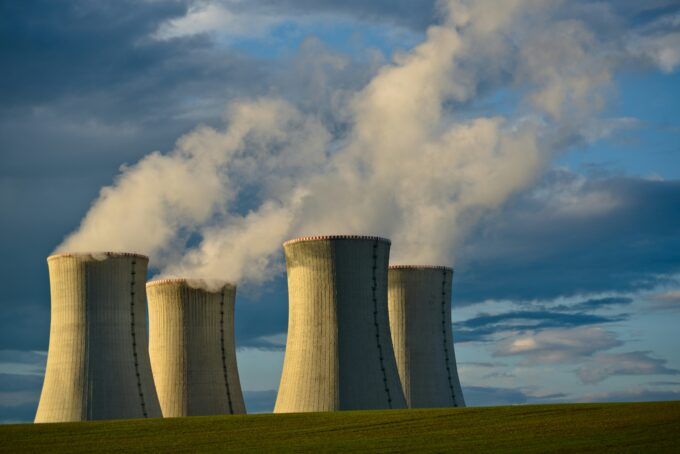
Image by Lukáš Lehotský.
Donald Trump on May 23rd declared nuclear power to be “a hot industry.” Nuclear power plants are “very safe and environmental,” he said. He made the claims as he issued executive orders to quadruple nuclear energy capacity in the United States.
He failed to mention that nuclear power plants are subject to catastrophic accidents—such as the Fukushima, Chernobyl and Three Mile Island disasters. And in routine operation, they release deadly radioactive emissions. Also, the nuclear fuel cycle—including mining, milling, enrichment of nuclear fuel—is highly carbon-intensive.
He missed the fact that in pure economic terms they portend the largest economic debacle in human history. He omitted mention of who would pay for 300+ new nuclear plants in the U.S. to be built under his executive orders. (There are currently 94 nuclear plants operating in the U.S.)
Trump didn’t say why the nation would quadruple nuclear power capacity when renewables—primarily wind turbines and solar panels—account for more than 80% of the world’s new electric generating capacity and are coming in at up to 90% cheaper than nukes and years faster to deploy.
He failed to mention the “nuclear clause” in all homeowners insurance policies in the U.S. which states: “This policy does not cover loss or damage caused by nuclear reaction or nuclear radiation or radioactive contamination.”
That’s been the situation since 1957 when, with the insurance industry refusing to cover nuclear plant disasters, the Price-Anderson Act was enacted limiting liability in the event of a nuclear plant catastrophe. Congress passed it to jump-start the “Peaceful Atom” program of seven decades ago. The Price-Anderson Act has been extended and extended and Congress recently renewed it for another four decades to cover the untested “Small Modular Reactors” now all the rage in the latest ultra-hyped so-called “nuclear renaissance.”
Trump was surrounded at a signing ceremony in the Oval Office of The White House by executives of the nuclear power industry, including Joe Dominguez, president and CEO of Constellation Energy, the largest nuclear power plant operator in the U.S., Jake Dewitte, CEO of Oklo Inc., and promoters, including Maria Korsnick, president and CEO of the Nuclear Energy Institute, the main nuclear power lobbying organization in the U.S.
Also present was U.S. Interior Secretary Doug Burgum who said: “This is a huge day for the nuclear industry.”
It was a flip from Trump’s comments on the Joe Rogan podcast last year in which he said: “I think there’s a little danger in nuclear.” An article about this on the E&E energy website of Politico said his reservations “seem to qualify his campaign promise to ‘unleash energy production from all sources, including nuclear.’”
But it was a total nuclear advocacy declared by Trump in his executive orders.
One of the four, titled “Ordering the Reform of the Nuclear Regulatory Commission,” notes that since 1978 “only two reactors have entered into commercial operation….Instead of efficiently promoting allegedly “safe, abundant nuclear energy,” the NRC has instead tried to insulate Americans from the most remote risks without appropriate regard for the severe domestic and geopolitical costs of such risk aversion. The NRC utilizes safety models that posit there is no safe threshold of radiation exposure and that harm is directly proportional to the amount of exposure. Those models lack sound scientific basis and produce irrational results.”
“Beginning today,” said this order, “my Administration will reform the NRC, including its structure, personnel, regulations, and basic operations. In so doing, we will produce lasting American dominance in the global nuclear energy market…”
The order then says: “It is the policy of the United States to: Reestablish the United States as the global leader in nuclear energy” and “Facilitate the expansion of American nuclear energy capacity from approximately 100 GW [gigawatts] in 2024 to 400 GW by 2050.”
To avoid a politically suicidal brush with economic reality, Trump ducked this simple calculation: the most recent new U.S. reactors, at Vogtle, Georgia, have come online seven years late, at a price of $18 billion each. (They were originally estimated to cost $7 billion each.) Meanwhile, the other two reactors, the construction of which began also this century, an expected $9.8 billion project at the V.C. Summer nuclear plant site in South Carolina, was abandoned when its estimated cost increased to $25 billion, having generated no electricity at all,
Today there are no large reactors under construction in the U.S. Based on the Vogtle/Summer experiences, to build another 300 nuclear power plants from scratch would cost a “base price” minimum of $5.4 trillion, though the historic likelihood is that they would cost at least double or triple that. Each would likely require 15 years or more to build.
A parallel and thus far theoretical fleet of the much-hyped Small Modular Reactors (“silly mythological rip-offs”) is certain to cost more. Their development has been plagued with soaring price projections, lagging production schedules and a series of cancellations. SMRs produce more radioactive waste per kilowatt-hour than the older, bigger nukes, nuclear proliferation concerns, and there are other problems.
Edwin Lyman, director of nuclear power safety at the Union of Concerned Scientists, in an article last year titled “Five Things the ‘Nuclear Bros’ Don’t Want You to Know About Small Modular Reactors” on its publication “The Equation” starts off with: “1. SMRs are not more economical than large reactors.” He said, “According to the economies of scale principle, smaller reactors will in general produce more expensive electricity than larger ones,” and he elaborates. He further exposes other SMR issues.
Of the Trump order to “reform” the Nuclear Regulatory Commission, in an article published last week in the Bulletin of the Atomic Scientists, Lyman wrote it “mandates that the NRC fundamentally change its mission to support the absurd and reckless goal of quadrupling of U.S. nuclear energy capacity to 400 gigawatts by 2050—which would, if achieved, add the equivalent of 300 large nuclear plants to the U.S. fleet—by prioritizing speedy licensing over protecting public health and safety from radiation exposure. This would effectively make the NRC a promotional agency not unlike its predecessor, the Atomic Energy Commission, thereby undoing the NRC’s 51-year history as the independent safety regulator established by the 1974 Energy Reorganization Act.” The piece was titled: “NRC’s new Mission Impossible: Making Atoms Great Again.”
Another Trump executive order, specifically on “advanced reactors,” was titled “Deploying Advanced Nuclear Reactor Technologies for National Security” and say they “have have the potential to deliver resilient, secure, and reliable power…”
The nuclear industry in recent years has been touting what it calls “advanced” nuclear power plants—which include the SMR—claiming they are safer than current designs.
However, the Union of Concerned Scientists conducted extensive research on the “advanced” plants and its 140-report, authored by Lyman, a physicist, “found that they are no better—and in some respects significantly worse—than the light-water reactors in operation today.”
Another Trump order, “Reforming Reactor Testing at the Department of Energy,” directs “the Department of Energy, the National Laboratories, and any other entity under the [Energy] Department’s jurisdiction to significantly expedite the review, approval, and deployment of advanced reactors.”
And a fourth executive order, “Reinvigorating the Nuclear Industrial Base,” states: “Swift and decisive action is required to jumpstart America’s nuclear energy industrial base and ensure or national and economic security by increasing fuel availability and production, securing civil nuclear supply chains, improving the efficiency with which advanced nuclear reactors are licensed, and preparing our workforce to establish America’s energy dominance and accelerate our path towards a more secure and independent energy future.”
A former chairman of the U.S. Nuclear Regulatory Commission, Dr. Gregory Jaczko, a physicist, commented that the Trump orders show that “he is committed to further lawlessness, more nuclear accidents, and less nuclear safety. This guillotine to the nation’s nuclear safety system will only make the country less safe, the industry less reliable, and the climate crisis more severe….The executive orders look like someone asked an AI, ‘how do we make the nuclear industry worse in this country?’”
Lyman in a statement distributed by the Union of Concerned Scientists said: “Simply put, the U.S. nuclear industry will fail if safety is not made a priority. By fatally compromising the independence and integrity of the NRC, and by encouraging pathways for nuclear deployment that bypass the regulator entirely, the Trump administration is virtually guaranteeing that this country will see a serious accident or other radiological release that will affect the health, safety and livelihoods of millions. Such a disaster will destroy public trust in nuclear power and cause other nations to reject U.S. nuclear technology for decades to come.”
Paul Gunter, director of the Reactor Oversight Project of the organization Beyond Nuclear, said of the order on “reform” of the NRC, that it “most explicitly exposes the Trump Administration’s deliberate attack upon the public’s democratic due process regarding undisputably still hazardous nuclear power and strips away the appearance of maintaining an ‘independent’ federal regulatory agency exercising its due diligence in the interest of public health, safety, security and environmental protection.”
Gunter cited the 1974 Energy Reorganization Act, as did Lyman in his article in the Bulletin of the Atomic Scientists. “The U.S. Atomic Energy Commission (AEC) was abolished by Congress” by the act “precisely because it could no longer maintain the façade of being both the chief promoter and regulator” of nuclear power, said Gunter. This Trump order, said Gunter, “illuminates the obvious 50-year throwback to AEC and its abolition by Congress in 1975 for its blatant ‘conflict of interest’ as simultaneously a promotional agency for atomic power and supposedly an unbiased regulator.”
Tim Judson, executive director of the Nuclear Information and Resource Service, said: “After 70 years of promoting nuclear power, it is still too expensive and produces radioactive waste that will be dangerous for over a million years. President Trump’s executive orders will not fix those problems….There is no ‘fixing’ or ‘reviving’ nuclear energy. The orders are a shortsighted, wasteful effort that will only make nuclear power less safe and more polluting. They will further weaken the Nuclear Regulatory Commission and forever sabotage its already dubious ability to protect public safety and national security.”
Judson said, “One order ignores decades of scientific findings and thousands of families’ tragic experiences with radioactivity, directing the NRC to reduce radiation protections. The National Academy of Sciences has repeatedly found that radiation increases the risk of cancer and other diseases. Only kooks and crackpots under the spell of a Dr. Strangelove-like infatuation with nuclear power say otherwise.”
“Another order,” Judson continued, “will slash the NRC’s staff and subjugate the agency to White House approval of its regulations and licensing decisions, ending even the pretense that an independent regulator will be there to protect the public health and safety. The root of the Fukushima Daichi nuclear meltdowns in 2011 was found to be the subjugation of a nuclear safety regulator to politicians and corporations. The disaster displaced over 100,000 people, shut down the whole nuclear industry, and will cost Japan up to $700 billion. President Trump’s executive orders will increase the changes that could happen here.”
And Judson, like many others, concludes: “The truth is, we can meet all of our energy needs, safely, securely, and affordably, with renewable energy sources that are ready to deploy today. In the last two years alone, the world brought online as much new wind and solar as the entire nuclear industry worldwide can generate after 60 years.”
The Trump pro-nuke executive orders have sparked immediate stock market jumps for Trump’s insider atomic cronies while promising almost incomprehensible losses for the rest of us which includes the spread of atomic machines prone to catastrophe, regularly spewing lethal radioactivity, producing unmanageable waste and this funded by trillions of public dollars.
It further will sink us all into what Forbes Magazine in 1985 described as “the largest managerial failure in business history, a disaster on a monumental scale,” in a lead article titled “Nuclear Follies.”
Meanwhile, renewables are more than ready now, safe power which we can live with. Yet while prices and production times for renewable sources plummet, Trump and his anti-green minions have been vigorously assaulting the wind, solar and other green energy technologies. Trump has attacked not only tax breaks and clean energy grants for the clean energy movement, he has also assaulted the permitting process for renewables, at the same time pushing to expedite it for nuclear power.
He has been joined by California’s “Green Democrat” Governor Gavin Newsom, who has showered subsidies on two decrepit reactors at Diablo Canyon while slashing permits and rate and tax supports for renewables and forcing California ratepayers to fork over $11 billion for the Diablo reactors which are near multiple earthquake fault lines and slated to now be closed, Diablo Canyon is the last nuclear plant running in California. Newsom has devastated the state’s once-booming rooftop solar industry, destroying at least 17,000 green jobs, while sticking California with the continental U.S.’s highest electric rates.
Democratic governors in Michigan, Massachusetts, Pennsylvania, Illinois and elsewhere have also boosted nuclear power while assaulting renewables.
Led by Trump and Newsom, the corrupt corporate leadership of both political parties thus seems bound and determined to bankrupt and irradiate us all with deadly, “nuclear-clause”-covered atomic reactors that can’t compete with the otherwise vibrant, fast-evolving renewable revolution which they are so cynically aiming to kill.
This first appeared on Beyond Nuclear International.

No comments:
Post a Comment