Building Real Student Power
Source: Hammer and Hope Chairs line the windowsill of Hamilton Hall, which was renamed “Hind’s Hall” by students at the Columbia University Gaza Solidarity Encampment to honor 6-year-old Hind Rajab, whom Israel killed alongside her family in Gaza. (Photo: Kholood Eid for Hammer & Hope)
Student movements have been essential to social progress in the United States for more than a century. Over the past year we have entered a new cycle of activism on college campuses. Students are standing up for the people of Gaza and defending free speech. They are fighting for voting rights, sexual and gender justice, and fair wages and workplace protections in higher education. They want to learn America’s true history in their classes, not a fabricated version created to absolve white people of responsibility for racism, slavery, and oppression, and they want to be able to study without being saddled with a lifetime of life-destroying debt.
So much positive social change has been launched by young people unafraid to act on their strong convictions. Many of them arrive at college open to experience, emboldened by the new freedom and independence the transition into adulthood offers, and eager to express their creativity. But as much as we should encourage students when they raise their voices for social change, spontaneous protests are no substitute for building long-lasting power. And right now, today’s students have very little organizing infrastructure to support them on the national front.
If progressives want to move national policy and win elections, they need young people to be in organized communities with one another. We aren’t going to defeat fascism with one-off or single-issue protests and cherry-picked student influencers. What’s needed is a resilient, autonomous organizing infrastructure that persists year after year, one that would help students to collaborate across institutions, building durable youth power at the local, state, and national levels. Conservatives have worked hard to prevent it by attacking the structures that cultivate student organizing in two ways over the past decade: policing students’ speech and dismantling the power students have over campus budgets.
Students once coordinated with one another across school systems to organize for lower tuition and expanded Pell grants, to control campus budgets and participate in hiring decisions, and to lobby in the halls of Congress with students in their states even if they were enrolled at different schools. But in recent years, elected officials and university administrations have taken agency away from students in order to control the access and leverage they have to interrupt business as usual on campus. This has debilitated student governments and disempowered students, with consequences that extend far beyond the rules of hosting events on campus.
The broader progressive movement can’t engage or hire new young folks with substantive leadership experience if we don’t have the organizations that place them in roles that provide that experience. The Covid-19 pandemic dealt another blow to students. Without in-person mentorship to pass down institutional and strategic knowledge, every new class of students is left to figure out how to do things on its own. The pandemic shut down campus organizing and cut off leadership transitions for two years, leaving a gap in information and training. Picture new students who spent their first two years attending college on the computer, away from their new community. How would they learn what organizing is like if they never had the chance to meet other students face to face?
Students have returned to campus, but the organizations they depend on need attention. Unfortunately, the right may understand the importance of student organizing better than the left. The right has not just been attacking progressive student networks — it has been investing in a countervailing campus infrastructure that empowers conservative students and cultivates the next generation of leaders and organizations to sustain its cause. It’s time for those of us on the left to step in and build a brand-new national student organization that fights for progressive values and protects freedom of speech.
Iunderstand the power of campus infrastructure because I am a product of the United States Student Association (USSA), which introduced me to the career I have today. USSA began in 1946 as the National Student Association (NSA) after American students met with 37 other student organizations in Prague, where the International Student Union was launched. It created a Student Bill of Rights, establishing 12 fundamental rights essential to the full development of the individual and to the fulfillment of every student’s responsibilities as a citizen, including “the right to establish democratic student governments with adequate democratic safeguards against abuse of their powers.” USSA became the largest student-run and student-led organization in the U.S. and the vehicle that cultivated power, community, and training for student leaders. (In 1967 it was revealed that the NSA, like many other Cold War–era groups ranging from the United Auto Workers to the National Education Association, received financial backing from the CIA, a fact most students and staff were unaware of. As a result of the exposé, the CIA’s covert funding operation unraveled, and the NSA became even more radical.)
In 2012, USSA represented four million college students across the country. It had full-time professional staff including a training director, a communications department, a development department, a field team, an operations manager, and student interns. It coordinated two national student conferences a year: one set the agenda and elected the organization’s leadership for the year, and the other, always held in Washington, D.C., in tandem with a national student march, trained student leaders in how to conduct an effective lobbying meeting with an elected official. In between the national convenings, staff worked with elected student leaders to train them in organizing grassroots campaigns, recruiting and retaining new leaders, and running campus-wide electoral engagement drives. Staff hosted weeklong trainings on how to fill out campaign strategy charts and power-map decision makers, and those trainings turned into recruitment drives to find young leaders who would run for elected positions on campus, in their statewide student association, and in the USSA. After graduation, many of those new leaders were recruited by progressive organizations to work across the country and continue to dedicate themselves to social justice organizing.
USSA helped create organizers who went on to become civil rights directors, field directors of labor unions, vice presidents of foundations, and political strategists running candidate campaigns on the state and national levels, historians, educators, business executives, lawyers, presidential appointees, and community leaders. The alumni of this giant network then mentored the next generation of student leaders in USSA. It was an organization rooted in leadership development, strategy and progressive policies.
More than 50 years after USSA’s founding, I arrived at the University of California, Santa Cruz. I was a high-achieving, broke student excited to have made it to a four-year institution that had been home to the organizers and activists bell hooks, Huey P. Newton, Bettina Aptheker, and Angela Davis, among others. While looking for a work-study job, I went to an open house for the Student Union Assembly, our student government. In high school I had been the president of the Black Student Union but knew little about policy, good governance, or advocacy. I interned for the chair of the assembly my first year and in spring 2008, I was accepted into a slate of candidates endorsed by a large coalition of students-of-color organizations.
I grew close with the people I ran with. We discussed, debated, and finally agreed on a set of core values to use in our campaign agenda: putting students first, affirming that education is a right, and promoting democracy on campus. Students needed agency both to hold the campus administrators and the school system’s president accountable and to ensure that the student government truly belonged to the students. Whether fighting for affordable tuition or against hate crimes on campus, we had to target the decision makers, whether they were the administrators, the chancellor, or the state and federal governments. We were clear that we weren’t student government officers to throw events and be complicit — we had authority and used it.
But we had a lot of learning to do. We wanted to create a platform that would explain our plans and help recruit other students to lead with us, and we had to practice transparency, teamwork, and accountability to accomplish that. We had to support one another while discovering our own strengths and weaknesses as leaders. Student governments at other campuses were negotiating similar demands. We were often fighting close to the same battles, and where we differed it inspired us to advocate for change in other ways. We communicated through USSA, and that structure enabled us to be students and leaders at the same time, part of a national network that magnified our impact.
As members of USSA, we elected the national board of directors and officers, and I was elected in 2008 chair of the National People of Color Student Coalition. After I graduated from college in 2011 I was elected vice president of USSA and in 2012 I was president. When the Higher Education Act was up for reauthorization or the House Appropriations Committee was considering funding for higher education and public service, we lobbied Congress as the official voice of college students nationwide. We fought for fee freezes, women’s safety and reproductive access, campus climate sustainability, and better financial aid, including Pell Grant increases and a more accessible FAFSA. We collaborated with national labor unions to build alliances with workers on the local level and to fight for accountability. As part of a national voter registration drive in 2008, we raised money to pay students to do electoral organizing; those organizers then became campus leaders who could institutionalize USSA priorities beyond the election. We built coalitions on campus to fight for protections against hate crimes. In 2008, student leaders were some of the first staff and board members of United We Dream, which spearheaded support for the federal DREAM Act and organizing for comprehensive immigration reform.
Globally we were the official voice for students in America, alongside the European Student Union, the African Student Union, and National Student Union of India, to name a few. We learned that in Finland and Brazil college was often free and students sometimes even got stipends to cover living expenses. I left the U.S. for the first time to keynote the Canadian Federation of Students’ 63rd Annual National General Meeting. USSA hosted officers from the Confederation of Chilean Student Federations in 2012. Later that year President Obama invited USSA to the Oval Office to discuss affordability issues in education. I’ll never forget how that moment made my family feel. It made me feel like I was making a difference and on the right path.
Everyone has a slightly different explanation for why USSA collapsed in 2016. As a co-chair of the foundation board at the time, I know it was a combination of factors, but more significant than the typical intra-organizational disputes were the external attacks. When right-wing politicians and conservative activists successfully challenged student governments’ power to lobby, they defunded the statewide student associations that contributed the most in membership fees to the national organization. Without funds from membership dues, USSA could no longer operate. Over a few years of financial decline, the staff left to find other work, student leaders graduated, and there was no transition to bring in the next year’s leadership. USSA wasn’t able to fundraise enough money to fill the budget gap. The organization shut down, but the foundation continued to operate to manage closing out the bills, turn in funding reports, and file taxes.
What has happened to progressive student governments across the country reflects what has happened in state and national politics more broadly. A state statute governing the University of Wisconsin system, first adopted in 1974, stipulated that students “shall be active participants in the immediate governance of and policy development for such institutions.” But in 2015, a budget signed by the notorious conservative former governor Scott Walker changed the statute’s wording to downgrade students to having “primary responsibility for advising the chancellor regarding the formulation and review of policies concerning student life, services and interests.” A document that once empowered students now strips them of their agency.
While USSA was fighting for economic and social justice and to make education a right for all, conservatives were busy trying to undo progress and make education a privilege for the few. When Charlie Kirk and Bill Montgomery founded a nonprofit organization called Turning Point USA in 2012, the stated mission was to “build the most organized, active, and powerful conservative grassroots activist network on high school and college campuses across the country.” The website now boasts “freedom chapters” at more than 3,500 campuses. The Guardian reported Turning Point’s revenues jumped from $4.3 million in 2016 to almost $39.8 million in 2020. In comparison, USSA received less than $100,000 in contributions in 2018, the year it closed down.
Similar to how the right has used litigation to limit the ability of organized labor to collect union dues, conservative groups work to undermine student power by challenging the use of student fees to fund the student government budget. Just a handful of students, bolstered by conservative networks, could object to the student government sending students to D.C. in support of the DREAM Act and prevent that trip from happening, for example. While progressive groups are starved of student fees, Turning Point rakes in cash from shadowy donors and institutions such as the Heritage Foundation.
The strategy to dismantle student organizing has two prongs. First, it empowers conservative students to build their own organizations and to question the premise of student government itself by claiming that those groups can’t represent all student issues fairly. When the student government advocates for reproductive freedom and inclusive health care for queer communities, pro-life and homophobic students might challenge the student government’s ability to be the official campus student voice. In other words, as conservatives rail against racial diversity, they cynically call for ideological diversity, framing themselves as the true victims of discrimination and marginalization on campus. Second, it challenges the way student governments disbursed funding, drawn from the fees students pay every year. Lobbying from the libertarian Goldwater Institute in Phoenix inspired 2013 legislation that would have prevented student fees from supporting the Arizona Student Association (ASA). Goldwater Institute objected to the fact the ASA had backed a ballot measure that would have raised taxes to fund public goods, including education and health care.
USSA’s statewide student associations were challenged and lost critical funding elsewhere across the country. United Council in Wisconsin, established in 1960, lost so much funding that it had to shut down in 2016. In 2023, the University of California Student Association was forced to enter a memorandum of understanding with the school system that limits its independence in return for additional financial support. In October 2024, the Oregon Student Association declared that it “faced challenges related to our organizational structure and funding mechanisms which have made it increasingly difficult to maintain sustainable operations” and closed its doors after 49 years.
Attacks on student power are escalating in response to students protesting the ongoing genocide in Gaza and calling for divestment from Israel — and they often have bipartisan support. In April 2024 Katie Hobbs, the Democratic governor of Arizona, signed HB2178, which allows students at state universities to choose which campus groups their student activity fees support, over the objections of the Arizona Student Association. The bill was introduced by Republican Rep. Alexander Kolodin, an attorney who worked with the Trump team to try to overturn the 2020 election and who is rated a 97.44 out of 100 by Turning Point Action, Turning Point’s electoral arm. Kolodin stated that he introduced the bill because he wanted Jewish students to be able to opt out of funding groups promoting Palestinian solidarity. Mother Jones reported that dozens of schools have implemented new “expressive activity” policies “effectively banning many forms of protest,” including encampments and the use of sidewalk chalk.
+++
My entire career benefited from my time in student-run organizations. Over the six years I spent at USSA, my peers shaped and tested my leadership, training experience, relationships, and values. Being in student government was not a hobby — it was a boot camp that taught me organizing and gave me community. We have to do something about the state of student organizing, and we need to do it now. We can’t continue to depend on spontaneous demonstrations and siloed issue-based advocacy, leaving student engagement to big national nonprofits that mobilize but don’t organize. This is why I have joined a network of people now working to bring back a new national student organization.
In April 2024 a group of students met in Washington, D.C., to learn USSA’s history and begin advocating for its return. Since then, every other Friday they have gathered virtually to discuss three things: winning debt-free college, protecting freedom of speech, and building an organization that will serve as a national student body and voice. Nine statewide student associations are now working to recruit campuses in other states. We’re still going to have to figure out the financial challenges, but that won’t stop us from building relationships across school systems and fighting for the right to a quality education for all.
There are plenty of ways to mobilize students and engage them in advocacy, but the best way to build student power is not seasonal, conditional, or single-issue. It is relational, strategic, hard, exciting and student-run and student-led. If the progressive movement truly believes in the power of the people, then we must help students regain that power by building robustly funded organizations able to train young people in leadership on a mass scale and by protecting their freedom of speech. Only then can we guarantee the success of our movements and give democracy a fighting chance.

Student movements have been essential to social progress in the United States for more than a century. Over the past year we have entered a new cycle of activism on college campuses. Students are standing up for the people of Gaza and defending free speech. They are fighting for voting rights, sexual and gender justice, and fair wages and workplace protections in higher education. They want to learn America’s true history in their classes, not a fabricated version created to absolve white people of responsibility for racism, slavery, and oppression, and they want to be able to study without being saddled with a lifetime of life-destroying debt.
So much positive social change has been launched by young people unafraid to act on their strong convictions. Many of them arrive at college open to experience, emboldened by the new freedom and independence the transition into adulthood offers, and eager to express their creativity. But as much as we should encourage students when they raise their voices for social change, spontaneous protests are no substitute for building long-lasting power. And right now, today’s students have very little organizing infrastructure to support them on the national front.
If progressives want to move national policy and win elections, they need young people to be in organized communities with one another. We aren’t going to defeat fascism with one-off or single-issue protests and cherry-picked student influencers. What’s needed is a resilient, autonomous organizing infrastructure that persists year after year, one that would help students to collaborate across institutions, building durable youth power at the local, state, and national levels. Conservatives have worked hard to prevent it by attacking the structures that cultivate student organizing in two ways over the past decade: policing students’ speech and dismantling the power students have over campus budgets.
Students once coordinated with one another across school systems to organize for lower tuition and expanded Pell grants, to control campus budgets and participate in hiring decisions, and to lobby in the halls of Congress with students in their states even if they were enrolled at different schools. But in recent years, elected officials and university administrations have taken agency away from students in order to control the access and leverage they have to interrupt business as usual on campus. This has debilitated student governments and disempowered students, with consequences that extend far beyond the rules of hosting events on campus.
The broader progressive movement can’t engage or hire new young folks with substantive leadership experience if we don’t have the organizations that place them in roles that provide that experience. The Covid-19 pandemic dealt another blow to students. Without in-person mentorship to pass down institutional and strategic knowledge, every new class of students is left to figure out how to do things on its own. The pandemic shut down campus organizing and cut off leadership transitions for two years, leaving a gap in information and training. Picture new students who spent their first two years attending college on the computer, away from their new community. How would they learn what organizing is like if they never had the chance to meet other students face to face?
Students have returned to campus, but the organizations they depend on need attention. Unfortunately, the right may understand the importance of student organizing better than the left. The right has not just been attacking progressive student networks — it has been investing in a countervailing campus infrastructure that empowers conservative students and cultivates the next generation of leaders and organizations to sustain its cause. It’s time for those of us on the left to step in and build a brand-new national student organization that fights for progressive values and protects freedom of speech.
Iunderstand the power of campus infrastructure because I am a product of the United States Student Association (USSA), which introduced me to the career I have today. USSA began in 1946 as the National Student Association (NSA) after American students met with 37 other student organizations in Prague, where the International Student Union was launched. It created a Student Bill of Rights, establishing 12 fundamental rights essential to the full development of the individual and to the fulfillment of every student’s responsibilities as a citizen, including “the right to establish democratic student governments with adequate democratic safeguards against abuse of their powers.” USSA became the largest student-run and student-led organization in the U.S. and the vehicle that cultivated power, community, and training for student leaders. (In 1967 it was revealed that the NSA, like many other Cold War–era groups ranging from the United Auto Workers to the National Education Association, received financial backing from the CIA, a fact most students and staff were unaware of. As a result of the exposé, the CIA’s covert funding operation unraveled, and the NSA became even more radical.)
In 2012, USSA represented four million college students across the country. It had full-time professional staff including a training director, a communications department, a development department, a field team, an operations manager, and student interns. It coordinated two national student conferences a year: one set the agenda and elected the organization’s leadership for the year, and the other, always held in Washington, D.C., in tandem with a national student march, trained student leaders in how to conduct an effective lobbying meeting with an elected official. In between the national convenings, staff worked with elected student leaders to train them in organizing grassroots campaigns, recruiting and retaining new leaders, and running campus-wide electoral engagement drives. Staff hosted weeklong trainings on how to fill out campaign strategy charts and power-map decision makers, and those trainings turned into recruitment drives to find young leaders who would run for elected positions on campus, in their statewide student association, and in the USSA. After graduation, many of those new leaders were recruited by progressive organizations to work across the country and continue to dedicate themselves to social justice organizing.
USSA helped create organizers who went on to become civil rights directors, field directors of labor unions, vice presidents of foundations, and political strategists running candidate campaigns on the state and national levels, historians, educators, business executives, lawyers, presidential appointees, and community leaders. The alumni of this giant network then mentored the next generation of student leaders in USSA. It was an organization rooted in leadership development, strategy and progressive policies.
More than 50 years after USSA’s founding, I arrived at the University of California, Santa Cruz. I was a high-achieving, broke student excited to have made it to a four-year institution that had been home to the organizers and activists bell hooks, Huey P. Newton, Bettina Aptheker, and Angela Davis, among others. While looking for a work-study job, I went to an open house for the Student Union Assembly, our student government. In high school I had been the president of the Black Student Union but knew little about policy, good governance, or advocacy. I interned for the chair of the assembly my first year and in spring 2008, I was accepted into a slate of candidates endorsed by a large coalition of students-of-color organizations.
I grew close with the people I ran with. We discussed, debated, and finally agreed on a set of core values to use in our campaign agenda: putting students first, affirming that education is a right, and promoting democracy on campus. Students needed agency both to hold the campus administrators and the school system’s president accountable and to ensure that the student government truly belonged to the students. Whether fighting for affordable tuition or against hate crimes on campus, we had to target the decision makers, whether they were the administrators, the chancellor, or the state and federal governments. We were clear that we weren’t student government officers to throw events and be complicit — we had authority and used it.
But we had a lot of learning to do. We wanted to create a platform that would explain our plans and help recruit other students to lead with us, and we had to practice transparency, teamwork, and accountability to accomplish that. We had to support one another while discovering our own strengths and weaknesses as leaders. Student governments at other campuses were negotiating similar demands. We were often fighting close to the same battles, and where we differed it inspired us to advocate for change in other ways. We communicated through USSA, and that structure enabled us to be students and leaders at the same time, part of a national network that magnified our impact.
As members of USSA, we elected the national board of directors and officers, and I was elected in 2008 chair of the National People of Color Student Coalition. After I graduated from college in 2011 I was elected vice president of USSA and in 2012 I was president. When the Higher Education Act was up for reauthorization or the House Appropriations Committee was considering funding for higher education and public service, we lobbied Congress as the official voice of college students nationwide. We fought for fee freezes, women’s safety and reproductive access, campus climate sustainability, and better financial aid, including Pell Grant increases and a more accessible FAFSA. We collaborated with national labor unions to build alliances with workers on the local level and to fight for accountability. As part of a national voter registration drive in 2008, we raised money to pay students to do electoral organizing; those organizers then became campus leaders who could institutionalize USSA priorities beyond the election. We built coalitions on campus to fight for protections against hate crimes. In 2008, student leaders were some of the first staff and board members of United We Dream, which spearheaded support for the federal DREAM Act and organizing for comprehensive immigration reform.
Globally we were the official voice for students in America, alongside the European Student Union, the African Student Union, and National Student Union of India, to name a few. We learned that in Finland and Brazil college was often free and students sometimes even got stipends to cover living expenses. I left the U.S. for the first time to keynote the Canadian Federation of Students’ 63rd Annual National General Meeting. USSA hosted officers from the Confederation of Chilean Student Federations in 2012. Later that year President Obama invited USSA to the Oval Office to discuss affordability issues in education. I’ll never forget how that moment made my family feel. It made me feel like I was making a difference and on the right path.
Everyone has a slightly different explanation for why USSA collapsed in 2016. As a co-chair of the foundation board at the time, I know it was a combination of factors, but more significant than the typical intra-organizational disputes were the external attacks. When right-wing politicians and conservative activists successfully challenged student governments’ power to lobby, they defunded the statewide student associations that contributed the most in membership fees to the national organization. Without funds from membership dues, USSA could no longer operate. Over a few years of financial decline, the staff left to find other work, student leaders graduated, and there was no transition to bring in the next year’s leadership. USSA wasn’t able to fundraise enough money to fill the budget gap. The organization shut down, but the foundation continued to operate to manage closing out the bills, turn in funding reports, and file taxes.
What has happened to progressive student governments across the country reflects what has happened in state and national politics more broadly. A state statute governing the University of Wisconsin system, first adopted in 1974, stipulated that students “shall be active participants in the immediate governance of and policy development for such institutions.” But in 2015, a budget signed by the notorious conservative former governor Scott Walker changed the statute’s wording to downgrade students to having “primary responsibility for advising the chancellor regarding the formulation and review of policies concerning student life, services and interests.” A document that once empowered students now strips them of their agency.
While USSA was fighting for economic and social justice and to make education a right for all, conservatives were busy trying to undo progress and make education a privilege for the few. When Charlie Kirk and Bill Montgomery founded a nonprofit organization called Turning Point USA in 2012, the stated mission was to “build the most organized, active, and powerful conservative grassroots activist network on high school and college campuses across the country.” The website now boasts “freedom chapters” at more than 3,500 campuses. The Guardian reported Turning Point’s revenues jumped from $4.3 million in 2016 to almost $39.8 million in 2020. In comparison, USSA received less than $100,000 in contributions in 2018, the year it closed down.
Similar to how the right has used litigation to limit the ability of organized labor to collect union dues, conservative groups work to undermine student power by challenging the use of student fees to fund the student government budget. Just a handful of students, bolstered by conservative networks, could object to the student government sending students to D.C. in support of the DREAM Act and prevent that trip from happening, for example. While progressive groups are starved of student fees, Turning Point rakes in cash from shadowy donors and institutions such as the Heritage Foundation.
The strategy to dismantle student organizing has two prongs. First, it empowers conservative students to build their own organizations and to question the premise of student government itself by claiming that those groups can’t represent all student issues fairly. When the student government advocates for reproductive freedom and inclusive health care for queer communities, pro-life and homophobic students might challenge the student government’s ability to be the official campus student voice. In other words, as conservatives rail against racial diversity, they cynically call for ideological diversity, framing themselves as the true victims of discrimination and marginalization on campus. Second, it challenges the way student governments disbursed funding, drawn from the fees students pay every year. Lobbying from the libertarian Goldwater Institute in Phoenix inspired 2013 legislation that would have prevented student fees from supporting the Arizona Student Association (ASA). Goldwater Institute objected to the fact the ASA had backed a ballot measure that would have raised taxes to fund public goods, including education and health care.
USSA’s statewide student associations were challenged and lost critical funding elsewhere across the country. United Council in Wisconsin, established in 1960, lost so much funding that it had to shut down in 2016. In 2023, the University of California Student Association was forced to enter a memorandum of understanding with the school system that limits its independence in return for additional financial support. In October 2024, the Oregon Student Association declared that it “faced challenges related to our organizational structure and funding mechanisms which have made it increasingly difficult to maintain sustainable operations” and closed its doors after 49 years.
Attacks on student power are escalating in response to students protesting the ongoing genocide in Gaza and calling for divestment from Israel — and they often have bipartisan support. In April 2024 Katie Hobbs, the Democratic governor of Arizona, signed HB2178, which allows students at state universities to choose which campus groups their student activity fees support, over the objections of the Arizona Student Association. The bill was introduced by Republican Rep. Alexander Kolodin, an attorney who worked with the Trump team to try to overturn the 2020 election and who is rated a 97.44 out of 100 by Turning Point Action, Turning Point’s electoral arm. Kolodin stated that he introduced the bill because he wanted Jewish students to be able to opt out of funding groups promoting Palestinian solidarity. Mother Jones reported that dozens of schools have implemented new “expressive activity” policies “effectively banning many forms of protest,” including encampments and the use of sidewalk chalk.
+++
My entire career benefited from my time in student-run organizations. Over the six years I spent at USSA, my peers shaped and tested my leadership, training experience, relationships, and values. Being in student government was not a hobby — it was a boot camp that taught me organizing and gave me community. We have to do something about the state of student organizing, and we need to do it now. We can’t continue to depend on spontaneous demonstrations and siloed issue-based advocacy, leaving student engagement to big national nonprofits that mobilize but don’t organize. This is why I have joined a network of people now working to bring back a new national student organization.
In April 2024 a group of students met in Washington, D.C., to learn USSA’s history and begin advocating for its return. Since then, every other Friday they have gathered virtually to discuss three things: winning debt-free college, protecting freedom of speech, and building an organization that will serve as a national student body and voice. Nine statewide student associations are now working to recruit campuses in other states. We’re still going to have to figure out the financial challenges, but that won’t stop us from building relationships across school systems and fighting for the right to a quality education for all.
There are plenty of ways to mobilize students and engage them in advocacy, but the best way to build student power is not seasonal, conditional, or single-issue. It is relational, strategic, hard, exciting and student-run and student-led. If the progressive movement truly believes in the power of the people, then we must help students regain that power by building robustly funded organizations able to train young people in leadership on a mass scale and by protecting their freedom of speech. Only then can we guarantee the success of our movements and give democracy a fighting chance.
Assault On Campus Free Speech Faces Growing Fightback
By Lois Danks
Source: Socialism Gaza solidarity campus encampment
The kidnapping of Mahmoud Khalil on the pretext of fighting antisemitism is just the start of moves to smash all dissent, but major resistance is mounting.
The March arrest of Columbia University graduate Mahmoud Khalil at his doorstep — without warrants or due process — is just the tip of a repression iceberg. He had broken no laws, yet the Trump administration justified his detention, saying his pro-Palestinian activism was “contrary to the interests of the United States.”
Leveling false claims of antisemitism at supporters of Gaza is a tactic spelled out in Project Esther. This plan, created by the right-wing Heritage Foundation, lays out steps to destroy the Palestinian solidarity movement and, ultimately, to crush all dissent against any government policy.
First, they come for campus protesters …
Alleging that demonstrators are supporters of Hamas, labeled a terrorist group, the government began targeting international students.
As of late April, 1,900 overseas enrollees at 210 U.S. colleges had their visas revoked by Marco Rubio’s State Department, putting them at risk of being snatched by Immigration and Customs Enforcement (ICE) and deported. Most were involved in Gaza defense. At the University of Michigan, the FBI raided the homes of Palestine solidarity organizers, confiscating laptops and phones.
Rubio went so far as to revoke permanent residency green cards, as he did with Khalil. In one outrageous case, Columbia University anti-genocide activist Mohsen Mahdawi was detained during his citizenship interview for being “a threat to American foreign policy.”
The U.S. Citizenship and Immigration Services posted, “Coming to America and receiving a visa or green card is a privilege. … If you advocate for violence, endorse or support terrorist activity … you are no longer eligible to stay in the U.S.”
The State Department widened its net, revoking residency for any green card holder with a violation of the law, even a parking ticket. Public outrage and a slew of lawsuits forced them to reverse some actions.
A showdown is at hand
The Trump administration is also threatening to cancel billions in funding unless universities outlaw demonstrations, shut down protest groups, expel their students, and close departments, especially those with a Middle East connection. This is pure extortion.
Some caved in to this intimidation. Columbia University expelled foreign student activists. Florida colleges deputized campus cops to work with ICE. Other schools provided ICE with lists of people to question.
However, many more institutions are resisting. Harvard refused to comply with the government’s demands. In retaliation, Trump froze $2.3 billion in federal research funding. A day later, more than 220 higher education leaders from around the country signed a joint statement condemning this “political interference.”
Faculties at many large colleges have urged their administrations to adopt a mutual defense compact. This includes universities in Indiana and Maryland, as well as Rutgers, Northwestern, and 14 others. The University of Washington gives legal help to those whose visas are cancelled. Academic and graduate student labor unions are urging schools to stand against Trump’s attacks.
Thousands have hit the streets across the U.S. in protest of Mahmoud Khalil’s detention. Jewish students chained themselves to the gates of Columbia University. New encampments and protests are spreading on campuses and at ICE headquarters.
Targeted for free speech
The Trump outfit wants to stop all dissent because it threatens their authoritarian control.
They started with the most vulnerable, hoping to minimize the outcry. Immigrants, especially when accused of anti-Jewish bigotry, are vulnerable because of today’s rampant xenophobia and Islamophobia.
It didn’t take long, however, for the Trumpists to expand their assault. Next came Latinos accused of being gang members and deported to a vile Salvadoran prison. Then, their propaganda went after “homegrown terrorists,” that is, U.S. citizens, especially leftists. Trump rails against “Marxist lunatics” for making universities “woke,” reminiscent of the anti-communist Red Scare of the ’50s.
The government claims that anyone who opposes administration policies or expresses views “contrary to U.S. interests” is not protected by the First and Fifth Amendments of the U.S. Constitution. This means that civil liberties can be trampled, and due process dismantled. If they have their way, they would expand executive power to permit arresting — and disappearing — anyone, citizen or permanent resident, based solely on their ideas and beliefs.
With these would-be fascists, no one is safe. Join protests being held in towns and cities across the country. Support those being targeted. Donate, write letters, join united fronts and resist!
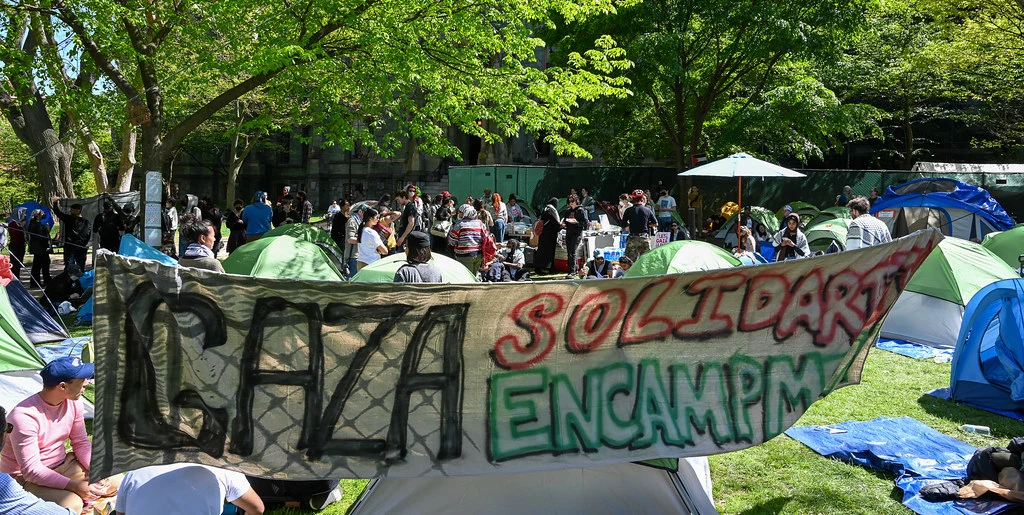
The kidnapping of Mahmoud Khalil on the pretext of fighting antisemitism is just the start of moves to smash all dissent, but major resistance is mounting.
The March arrest of Columbia University graduate Mahmoud Khalil at his doorstep — without warrants or due process — is just the tip of a repression iceberg. He had broken no laws, yet the Trump administration justified his detention, saying his pro-Palestinian activism was “contrary to the interests of the United States.”
Leveling false claims of antisemitism at supporters of Gaza is a tactic spelled out in Project Esther. This plan, created by the right-wing Heritage Foundation, lays out steps to destroy the Palestinian solidarity movement and, ultimately, to crush all dissent against any government policy.
First, they come for campus protesters …
Alleging that demonstrators are supporters of Hamas, labeled a terrorist group, the government began targeting international students.
As of late April, 1,900 overseas enrollees at 210 U.S. colleges had their visas revoked by Marco Rubio’s State Department, putting them at risk of being snatched by Immigration and Customs Enforcement (ICE) and deported. Most were involved in Gaza defense. At the University of Michigan, the FBI raided the homes of Palestine solidarity organizers, confiscating laptops and phones.
Rubio went so far as to revoke permanent residency green cards, as he did with Khalil. In one outrageous case, Columbia University anti-genocide activist Mohsen Mahdawi was detained during his citizenship interview for being “a threat to American foreign policy.”
The U.S. Citizenship and Immigration Services posted, “Coming to America and receiving a visa or green card is a privilege. … If you advocate for violence, endorse or support terrorist activity … you are no longer eligible to stay in the U.S.”
The State Department widened its net, revoking residency for any green card holder with a violation of the law, even a parking ticket. Public outrage and a slew of lawsuits forced them to reverse some actions.
A showdown is at hand
The Trump administration is also threatening to cancel billions in funding unless universities outlaw demonstrations, shut down protest groups, expel their students, and close departments, especially those with a Middle East connection. This is pure extortion.
Some caved in to this intimidation. Columbia University expelled foreign student activists. Florida colleges deputized campus cops to work with ICE. Other schools provided ICE with lists of people to question.
However, many more institutions are resisting. Harvard refused to comply with the government’s demands. In retaliation, Trump froze $2.3 billion in federal research funding. A day later, more than 220 higher education leaders from around the country signed a joint statement condemning this “political interference.”
Faculties at many large colleges have urged their administrations to adopt a mutual defense compact. This includes universities in Indiana and Maryland, as well as Rutgers, Northwestern, and 14 others. The University of Washington gives legal help to those whose visas are cancelled. Academic and graduate student labor unions are urging schools to stand against Trump’s attacks.
Thousands have hit the streets across the U.S. in protest of Mahmoud Khalil’s detention. Jewish students chained themselves to the gates of Columbia University. New encampments and protests are spreading on campuses and at ICE headquarters.
Targeted for free speech
The Trump outfit wants to stop all dissent because it threatens their authoritarian control.
They started with the most vulnerable, hoping to minimize the outcry. Immigrants, especially when accused of anti-Jewish bigotry, are vulnerable because of today’s rampant xenophobia and Islamophobia.
It didn’t take long, however, for the Trumpists to expand their assault. Next came Latinos accused of being gang members and deported to a vile Salvadoran prison. Then, their propaganda went after “homegrown terrorists,” that is, U.S. citizens, especially leftists. Trump rails against “Marxist lunatics” for making universities “woke,” reminiscent of the anti-communist Red Scare of the ’50s.
The government claims that anyone who opposes administration policies or expresses views “contrary to U.S. interests” is not protected by the First and Fifth Amendments of the U.S. Constitution. This means that civil liberties can be trampled, and due process dismantled. If they have their way, they would expand executive power to permit arresting — and disappearing — anyone, citizen or permanent resident, based solely on their ideas and beliefs.
With these would-be fascists, no one is safe. Join protests being held in towns and cities across the country. Support those being targeted. Donate, write letters, join united fronts and resist!
Militant Grad Workers Build Union Power to Fight Attacks on Education and Labor
Source: Truthout The University of Minnesota's Graduate Labor Union gathered union authorization cards representing nearly half the bargaining unit in the first 24 hours of the drive. Photo: Nolan Ferlic.
A shining light within the U.S. labor movement over the past several years has been the rising wave of unionization and militancy among graduate workers, whose labor helps prop up the entire system of U.S. higher education. Tens of thousands of graduate workers have unionized over the past half-decade at institutions like Stanford, UChicago, MIT, Duke, Minnesota, and many more. According to one study, as of January 2024, around 38 percent of graduate student employees were represented by unions, with over 150,000 graduate workers across 81 units.
Grad workers across the U.S. have also engaged in militant protests and strikes not just over recognition and contract fights, but also to oppose attacks on the Palestine solidarity movement. Many graduate unions see their mission as not merely to secure gains around bread-and-butter issues, but to fight for social justice and to defend liberatory values of higher education in the face of the neoliberalization and militarization of universities.
At the same time, graduate workers are facing intensified challenges under a Trump administration that is attacking higher education, cutting federal funding, looking to gut the National Labor Relations Board and intensifying attacks against immigrants and Palestine solidarity activists. While campus repression isn’t new, with precedents under the Biden administration, there are clear signs that attacks are escalating. And university administration efforts to undermine grad unions long predate Trump.
What’s behind the rise of graduate worker militancy? How should we understand this moment in the graduate worker movement? How should graduate workers respond to attacks? Truthout spoke with representatives from three graduate worker unions to discuss these questions.
Jess Fournier is a Ph.D. candidate and graduate teaching assistant in the Feminist Studies Department at the University of California, Santa Cruz and an organizer with UAW 4811, which represents 48,000 workers across the University of California system. Janvi Madhani is a Ph.D. candidate and graduate worker in physics and astronomy at Johns Hopkins University and the national liaison and political action coordinator of TRU-UE 197, which won union recognition in 2023. Shreya (last name withheld by request to avoid retaliation) is a Ph.D. student at the University of Michigan and an organizer and steward with GEO 3550, one of the first graduate unions to form in the U.S. back in the early 1970s.
Derek Seidman: How do you understand the rise of graduate worker unionization and militancy over the past several years?
Shreya (UMichigan): The conditions that grad workers face today necessitate militancy and power. Our universities are getting so neoliberalized, and this has put grad workers in increasingly precarious conditions. There’s a selling out of our universities to major donors and a decline in the liberatory values of higher education.
Grad workers face a lot of the same attacks that students face, but we also face attacks as workers. Grad workers across the country also talk to each other a lot. I talk to comrades at other universities every single week. We’ve gotten better at networking and sharing our struggles.
Jess Fournier (UC Santa Cruz): I think it reflects a general trend in labor militancy in the U.S., like with campaigns at Starbucks and Amazon. COVID-19 also really impacted people’s lives and working conditions. The cost of living, especially rent, has also been a big driver of unionization and militancy. It’s just so unsustainable. You’re not paid enough to live where you work.
Another reason is the cross-pollination among grad workers during the last five years. Folks at Santa Cruz, University of Michigan, Dartmouth, Boston University, CUNY, Princeton — we’re all in touch with each other and learning from each other’s experiences.
Janvi Madhani (Johns Hopkins): A large part of the growth of this militancy stems from the recognition that U.S. universities act as profit-maximizing hedge funds and outposts of U.S. imperialism. They develop war-profiteering technologies and research and they’re financially entangled with an international system that seeks to maintain U.S. imperial interests.
Within this context, our research as graduate students is responsible for producing the science, technology and intellectual theories that end up influencing these global systems. We’re struggling not only against the exploitation of our own labor but also against the exploitation of our research to support and even justify policing, militarization and genocide.
What are the biggest challenges the grad worker movement is facing now?
Fournier: Even before Trump, universities were planning austerity programs and trying to winnow away the number of unionized workers. The Trump administration will exacerbate this. Administrators are trying to break the back of organized workers and offload the teaching functions to the most precarious workers who have the least protections. They’re increasing reliance on AI, even as it degrades the quality of education, as a way to automate grading work now done by academic workers who can potentially strike.
We’re learning how to organize more effectively, but the employer is also learning. There was tremendous repression across the country against Palestine solidarity encampments. At Santa Cruz, the intense repression we saw against our 2024 strike was radically different from our strike in 2022. It was sort of a bellwether. All the different attacks happening now are tied together. Our universities are not standing up for workers, and in cases like Columbia, really capitulating.
Shreya: There aren’t any fights the grad worker movement is facing now that we haven’t always been facing. There are new manifestations of issues that began far before the Trump administration. Following our 2023 strike, UMichigan has been implementing austerity measures in retaliation for our militancy and has increasingly been using AI to replace grad labor.
The Regents and the university laid the foundation for the Trump administration by criminalizing pro-Palestinian activism through an aggressive campaign of repression. The crackdown against student immigrants is a broadening of the repression of pro-Palestine activists. The university has done very little to respond to the federal funding cuts or attacks on immigrants. They’ve just thrown their hands up and say they can’t do anything, which isn’t true. It’s an excuse to not do anything.
Madhani: Universities are also not helpless in fighting back against the federal government. When we make demands to divest from Israel or fund grad workers, these are material demands we know they can fulfill. To protect their endowments, these institutions are allowing extrajudicial kidnappings of their own students and meeting ridiculous demands posed by the federal government. They’re cowering and capitulating, even when they have the resources to fight back.
At Hopkins, they’re increasing budgets for policing and surveillance, but then saying they don’t have money to support funding. It’s truly just a crisis of priorities, not a lack of financial wealth or institutional resources. One of the biggest challenges grad workers are facing is restructuring the entire purpose of universities.
How should grad worker unions respond to this moment?
Fournier: The labor movement needs to have a loud, full-throated, no-capitulation response. Many universities are saying, ‘Let’s keep quiet,’ but unions need to do the exact opposite. We need a vision that encompasses all different types of workers at the university. The grad worker movement is well positioned to build a broader coalition among higher ed workers — lecturers, adjuncts, food service, janitorial, administrative staff — which could have a wall-to-wall orientation within common demands. We need that level of organization.
International workers on university campuses are really scared. We recently had a campus Know Your Rights training and we’re working on getting Know Your Rights trainings in every department. Grad unions need to make the kinds of demands of our employer that will protect everyone. The building trades have been very supportive of Kilmar Abrego García. That’s what we all need to be doing.
We need to be showing how these issues are all connected. This is a moment where organized labor can actually intervene to defend people but also articulate a different vision. We should think about what our leverage actually is and build our capacity to strike over these demands on employers.
Madhani: Our responsibility is not just to other grad workers, but also to the larger Hopkins community. We’ve sent the university a list of demands around things like enforcing a sanctuary campus and an end to campus militarization. We’re demanding the deletion of surveillance records of protesters and of incriminating data that the university could hand over to the federal government.
Hopkins has done a really incredible job at student repression. The fight for Palestinian liberation on campus has been a mask-off moment for many students and workers. Members of our bargaining committee were systematically targeted, identified through surveillance, and denied union representation in disciplinary proceedings for participating in the encampment.
Hopkins also put up AI smart surveillance towers, which had a chilling effect on campus. But instead of demoralizing students, it radicalized people. Our union organized a campaign to take the towers down. We also held an internal vote on making our financial practices as a local compliant with BDS. It passed with 72 percent support despite the administration’s attempts to intimidate us.
We are very aware that this is not just a fight for fair wages, but that as workers at a university like Johns Hopkins, which has been long manufacturing the methods and tools to suppress popular movements both on campus and globally, we have a responsibility to use our leverage in a socially responsible way.
Shreya: We’re intentionally focusing our attention on our workplace. We recognize that the university could act right now. The University of Michigan has a lot of power and a massive endowment. We’ve been thinking about how to pressure the university to act.
That leads me back to militancy, meaning a really principled and steadfast response to the situation rooted in careful deliberation among grad workers. We’ve been holding many department meetings where we talk together about what’s happening, formulate demands for the university, and discuss how to win those demands.
What are the most important lessons you’d share with other grad workers?
Fournier: For us at UCSC, it’s been important to have a cohesive, militant form of organization at the department level. Those are the people you work with every day. If you actually want to be able to strike strong and strike long, you need that level of organization with your direct coworkers.
Collective decision-making structures are really important. We need to encourage people to take ownership of the direction of their union. You need a culture of people deliberating together. The locus of where you actually have power is in building with your direct coworkers in your workplace. That’s the biggest lesson that I’ve learned — create those spaces for people to connect with their direct coworkers and institute a culture of people making decisions together.
We’re also really focused on building up our network of stewards, not as a representative position, but as people who regularly check in with everyone in their department or lab. It’s this middle layer of organization that keeps people engaged.
Shreya: Building and sustaining a powerful graduate worker union has to be rooted in bottom-up, worker-to-worker organizing in our workplaces. This means forming organizing committees within your department or lab, talking with your coworkers to process your situation together and cohering around clear demands.
It’s not easy. It requires a lot of patience and capacity for collective reflection and strategic thinking about how the boss is trying to disorganize us and how to respond. All of that is really hard, which is why I emphasize talking to your coworkers. Any moment that I’ve felt confused or hopeless, talking to my coworkers has always helped. A strong grad worker union is rooted in relationships.
Many grad workers are isolated and overworked, so it’s important to build communication and social infrastructure. You could just literally walk around your office and talk to your coworkers. I do that all the time. You could set up a group chat or organize a casual lunch. That’s a great starting point.
Some departments are stronger than others, and you can leverage that. If you’re struggling, start with one or two departments with widely felt demands or strong social networks. If those departments can become organized, they can become models for other departments to get organized.
Madhani:This model of organizing by department with your most proximal coworkers has worked really well for us. That infrastructure has carried us through contract enforcement and now in this more escalatory current phase.
It’s our job as worker leaders to militantly organize our peers and steer our movements in the direction of collective liberation. That means taking on radical fights that go beyond bread-and-butter issues, maintaining strong member-led unionism, and not replicating the power imbalances that made us unionize in the first place. I’m personally really proud of how we brought a radical fight for abolition to the bargaining table despite fears that police abolition is not typically understood as a union issue.
We’ve also learned a lot from other grad locals. I still remember some of the initial conversations we had with our UE siblings. MIT has been a pioneer in the new wave of higher education organizing, and they passed on really helpful guidance. Michigan helped us formulate our BDS fight. The UCs talked to us about building strike power. It’s a very large collective project of grad labor.
Finally, what keeps you inspired and hopeful?
Madhani: I see grad workers really embracing radical change, not just incremental reforms. People desire a better world and know the current failings of our systems. There’s a real understanding of what’s at stake that’s driving our movement right now. Even those who aren’t facing immediate risk understand the urgency of collective organizing that goes beyond any one person’s individual interests and is rooted on the basis of fighting for each other. I think that’s a really beautiful form of collective power.
Shreya: What really keeps me excited is just the experience of solidarity between grad workers. Going to our rally defending international grad workers, taking action together, was very energizing for me. We’ve had small wins at the department level, such as departments agreeing to have regular town halls about immigration or funding issues. These are small victories, but they show that we can force change. We’re so powerful together. Moments like this, where there’s so much fear and chaos, can be really disorganizing, which is exactly what the boss wants. The more I stay grounded in the power we have as workers, the more hopeful I feel.
Fournier: The way my coworkers rise to the occasion under very difficult circumstances inspires me. I’ve seen people do amazing things and make incredible sacrifices of their time and energy. I’ve seen people take risks. Our statewide Spring 2024 strike wasn’t for material demands for ourselves, but because our coworkers have been targeted for defending Palestine. Seeing that kind of sacrifice and people’s willingness to keep fighting makes me believe we’re going to win. It’s going to be hard, but I think of the Mike Davis quote: “Fight with hope, fight without hope, but fight absolutely.” I see people doing that every day, fighting and caring for one another, and that is a really beautiful thing.
Note: These interviews were conducted separately and subsequently edited into a roundtable format.

A shining light within the U.S. labor movement over the past several years has been the rising wave of unionization and militancy among graduate workers, whose labor helps prop up the entire system of U.S. higher education. Tens of thousands of graduate workers have unionized over the past half-decade at institutions like Stanford, UChicago, MIT, Duke, Minnesota, and many more. According to one study, as of January 2024, around 38 percent of graduate student employees were represented by unions, with over 150,000 graduate workers across 81 units.
Grad workers across the U.S. have also engaged in militant protests and strikes not just over recognition and contract fights, but also to oppose attacks on the Palestine solidarity movement. Many graduate unions see their mission as not merely to secure gains around bread-and-butter issues, but to fight for social justice and to defend liberatory values of higher education in the face of the neoliberalization and militarization of universities.
At the same time, graduate workers are facing intensified challenges under a Trump administration that is attacking higher education, cutting federal funding, looking to gut the National Labor Relations Board and intensifying attacks against immigrants and Palestine solidarity activists. While campus repression isn’t new, with precedents under the Biden administration, there are clear signs that attacks are escalating. And university administration efforts to undermine grad unions long predate Trump.
What’s behind the rise of graduate worker militancy? How should we understand this moment in the graduate worker movement? How should graduate workers respond to attacks? Truthout spoke with representatives from three graduate worker unions to discuss these questions.
Jess Fournier is a Ph.D. candidate and graduate teaching assistant in the Feminist Studies Department at the University of California, Santa Cruz and an organizer with UAW 4811, which represents 48,000 workers across the University of California system. Janvi Madhani is a Ph.D. candidate and graduate worker in physics and astronomy at Johns Hopkins University and the national liaison and political action coordinator of TRU-UE 197, which won union recognition in 2023. Shreya (last name withheld by request to avoid retaliation) is a Ph.D. student at the University of Michigan and an organizer and steward with GEO 3550, one of the first graduate unions to form in the U.S. back in the early 1970s.
Derek Seidman: How do you understand the rise of graduate worker unionization and militancy over the past several years?
Shreya (UMichigan): The conditions that grad workers face today necessitate militancy and power. Our universities are getting so neoliberalized, and this has put grad workers in increasingly precarious conditions. There’s a selling out of our universities to major donors and a decline in the liberatory values of higher education.
Grad workers face a lot of the same attacks that students face, but we also face attacks as workers. Grad workers across the country also talk to each other a lot. I talk to comrades at other universities every single week. We’ve gotten better at networking and sharing our struggles.
Jess Fournier (UC Santa Cruz): I think it reflects a general trend in labor militancy in the U.S., like with campaigns at Starbucks and Amazon. COVID-19 also really impacted people’s lives and working conditions. The cost of living, especially rent, has also been a big driver of unionization and militancy. It’s just so unsustainable. You’re not paid enough to live where you work.
Another reason is the cross-pollination among grad workers during the last five years. Folks at Santa Cruz, University of Michigan, Dartmouth, Boston University, CUNY, Princeton — we’re all in touch with each other and learning from each other’s experiences.
Janvi Madhani (Johns Hopkins): A large part of the growth of this militancy stems from the recognition that U.S. universities act as profit-maximizing hedge funds and outposts of U.S. imperialism. They develop war-profiteering technologies and research and they’re financially entangled with an international system that seeks to maintain U.S. imperial interests.
Within this context, our research as graduate students is responsible for producing the science, technology and intellectual theories that end up influencing these global systems. We’re struggling not only against the exploitation of our own labor but also against the exploitation of our research to support and even justify policing, militarization and genocide.
What are the biggest challenges the grad worker movement is facing now?
Fournier: Even before Trump, universities were planning austerity programs and trying to winnow away the number of unionized workers. The Trump administration will exacerbate this. Administrators are trying to break the back of organized workers and offload the teaching functions to the most precarious workers who have the least protections. They’re increasing reliance on AI, even as it degrades the quality of education, as a way to automate grading work now done by academic workers who can potentially strike.
We’re learning how to organize more effectively, but the employer is also learning. There was tremendous repression across the country against Palestine solidarity encampments. At Santa Cruz, the intense repression we saw against our 2024 strike was radically different from our strike in 2022. It was sort of a bellwether. All the different attacks happening now are tied together. Our universities are not standing up for workers, and in cases like Columbia, really capitulating.
Shreya: There aren’t any fights the grad worker movement is facing now that we haven’t always been facing. There are new manifestations of issues that began far before the Trump administration. Following our 2023 strike, UMichigan has been implementing austerity measures in retaliation for our militancy and has increasingly been using AI to replace grad labor.
The Regents and the university laid the foundation for the Trump administration by criminalizing pro-Palestinian activism through an aggressive campaign of repression. The crackdown against student immigrants is a broadening of the repression of pro-Palestine activists. The university has done very little to respond to the federal funding cuts or attacks on immigrants. They’ve just thrown their hands up and say they can’t do anything, which isn’t true. It’s an excuse to not do anything.
Madhani: Universities are also not helpless in fighting back against the federal government. When we make demands to divest from Israel or fund grad workers, these are material demands we know they can fulfill. To protect their endowments, these institutions are allowing extrajudicial kidnappings of their own students and meeting ridiculous demands posed by the federal government. They’re cowering and capitulating, even when they have the resources to fight back.
At Hopkins, they’re increasing budgets for policing and surveillance, but then saying they don’t have money to support funding. It’s truly just a crisis of priorities, not a lack of financial wealth or institutional resources. One of the biggest challenges grad workers are facing is restructuring the entire purpose of universities.
How should grad worker unions respond to this moment?
Fournier: The labor movement needs to have a loud, full-throated, no-capitulation response. Many universities are saying, ‘Let’s keep quiet,’ but unions need to do the exact opposite. We need a vision that encompasses all different types of workers at the university. The grad worker movement is well positioned to build a broader coalition among higher ed workers — lecturers, adjuncts, food service, janitorial, administrative staff — which could have a wall-to-wall orientation within common demands. We need that level of organization.
International workers on university campuses are really scared. We recently had a campus Know Your Rights training and we’re working on getting Know Your Rights trainings in every department. Grad unions need to make the kinds of demands of our employer that will protect everyone. The building trades have been very supportive of Kilmar Abrego García. That’s what we all need to be doing.
We need to be showing how these issues are all connected. This is a moment where organized labor can actually intervene to defend people but also articulate a different vision. We should think about what our leverage actually is and build our capacity to strike over these demands on employers.
Madhani: Our responsibility is not just to other grad workers, but also to the larger Hopkins community. We’ve sent the university a list of demands around things like enforcing a sanctuary campus and an end to campus militarization. We’re demanding the deletion of surveillance records of protesters and of incriminating data that the university could hand over to the federal government.
Hopkins has done a really incredible job at student repression. The fight for Palestinian liberation on campus has been a mask-off moment for many students and workers. Members of our bargaining committee were systematically targeted, identified through surveillance, and denied union representation in disciplinary proceedings for participating in the encampment.
Hopkins also put up AI smart surveillance towers, which had a chilling effect on campus. But instead of demoralizing students, it radicalized people. Our union organized a campaign to take the towers down. We also held an internal vote on making our financial practices as a local compliant with BDS. It passed with 72 percent support despite the administration’s attempts to intimidate us.
We are very aware that this is not just a fight for fair wages, but that as workers at a university like Johns Hopkins, which has been long manufacturing the methods and tools to suppress popular movements both on campus and globally, we have a responsibility to use our leverage in a socially responsible way.
Shreya: We’re intentionally focusing our attention on our workplace. We recognize that the university could act right now. The University of Michigan has a lot of power and a massive endowment. We’ve been thinking about how to pressure the university to act.
That leads me back to militancy, meaning a really principled and steadfast response to the situation rooted in careful deliberation among grad workers. We’ve been holding many department meetings where we talk together about what’s happening, formulate demands for the university, and discuss how to win those demands.
What are the most important lessons you’d share with other grad workers?
Fournier: For us at UCSC, it’s been important to have a cohesive, militant form of organization at the department level. Those are the people you work with every day. If you actually want to be able to strike strong and strike long, you need that level of organization with your direct coworkers.
Collective decision-making structures are really important. We need to encourage people to take ownership of the direction of their union. You need a culture of people deliberating together. The locus of where you actually have power is in building with your direct coworkers in your workplace. That’s the biggest lesson that I’ve learned — create those spaces for people to connect with their direct coworkers and institute a culture of people making decisions together.
We’re also really focused on building up our network of stewards, not as a representative position, but as people who regularly check in with everyone in their department or lab. It’s this middle layer of organization that keeps people engaged.
Shreya: Building and sustaining a powerful graduate worker union has to be rooted in bottom-up, worker-to-worker organizing in our workplaces. This means forming organizing committees within your department or lab, talking with your coworkers to process your situation together and cohering around clear demands.
It’s not easy. It requires a lot of patience and capacity for collective reflection and strategic thinking about how the boss is trying to disorganize us and how to respond. All of that is really hard, which is why I emphasize talking to your coworkers. Any moment that I’ve felt confused or hopeless, talking to my coworkers has always helped. A strong grad worker union is rooted in relationships.
Many grad workers are isolated and overworked, so it’s important to build communication and social infrastructure. You could just literally walk around your office and talk to your coworkers. I do that all the time. You could set up a group chat or organize a casual lunch. That’s a great starting point.
Some departments are stronger than others, and you can leverage that. If you’re struggling, start with one or two departments with widely felt demands or strong social networks. If those departments can become organized, they can become models for other departments to get organized.
Madhani:This model of organizing by department with your most proximal coworkers has worked really well for us. That infrastructure has carried us through contract enforcement and now in this more escalatory current phase.
It’s our job as worker leaders to militantly organize our peers and steer our movements in the direction of collective liberation. That means taking on radical fights that go beyond bread-and-butter issues, maintaining strong member-led unionism, and not replicating the power imbalances that made us unionize in the first place. I’m personally really proud of how we brought a radical fight for abolition to the bargaining table despite fears that police abolition is not typically understood as a union issue.
We’ve also learned a lot from other grad locals. I still remember some of the initial conversations we had with our UE siblings. MIT has been a pioneer in the new wave of higher education organizing, and they passed on really helpful guidance. Michigan helped us formulate our BDS fight. The UCs talked to us about building strike power. It’s a very large collective project of grad labor.
Finally, what keeps you inspired and hopeful?
Madhani: I see grad workers really embracing radical change, not just incremental reforms. People desire a better world and know the current failings of our systems. There’s a real understanding of what’s at stake that’s driving our movement right now. Even those who aren’t facing immediate risk understand the urgency of collective organizing that goes beyond any one person’s individual interests and is rooted on the basis of fighting for each other. I think that’s a really beautiful form of collective power.
Shreya: What really keeps me excited is just the experience of solidarity between grad workers. Going to our rally defending international grad workers, taking action together, was very energizing for me. We’ve had small wins at the department level, such as departments agreeing to have regular town halls about immigration or funding issues. These are small victories, but they show that we can force change. We’re so powerful together. Moments like this, where there’s so much fear and chaos, can be really disorganizing, which is exactly what the boss wants. The more I stay grounded in the power we have as workers, the more hopeful I feel.
Fournier: The way my coworkers rise to the occasion under very difficult circumstances inspires me. I’ve seen people do amazing things and make incredible sacrifices of their time and energy. I’ve seen people take risks. Our statewide Spring 2024 strike wasn’t for material demands for ourselves, but because our coworkers have been targeted for defending Palestine. Seeing that kind of sacrifice and people’s willingness to keep fighting makes me believe we’re going to win. It’s going to be hard, but I think of the Mike Davis quote: “Fight with hope, fight without hope, but fight absolutely.” I see people doing that every day, fighting and caring for one another, and that is a really beautiful thing.
Note: These interviews were conducted separately and subsequently edited into a roundtable format.

No comments:
Post a Comment