Canada signals approval of US gov’t stakes in mining firms
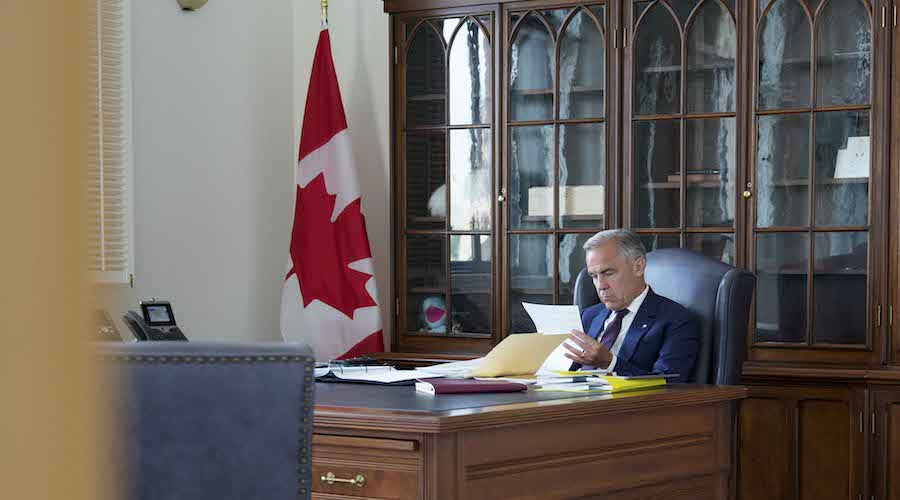
Canada is unlikely to object to US government investments in two Vancouver-based mining companies, Energy Minister Tim Hodgson said, describing the deals as “capitalism in action.”

The Trump administration announced last week that it would take a 10% stake in Trilogy Metals as part of a $35.6 million investment to boost critical minerals projects in Alaska. The US also recently agreed to acquire an interest in Lithium Americas Corp., which is developing the Thacker Pass lithium project in Nevada.
The federal government has rules under the Investment Canada Act for acquisitions by state-owned entities, and Canada’s industry minister has said the government will evaluate deals on a “case-by-case” basis.
But Hodgson said Thursday the US stakes are “small minority investments” in firms with US projects.
“The fact that an ally of ours chooses to make an equity investment into a Canadian company whose sole asset is in the United States, I don’t think that bothers us at this time,” he said at a news conference in London, where he was promoting critical minerals and energy deals.
“I think that’s capitalism in action. If they’re interested in doing that, that’s up to them.”
If a country acts in a way that isn’t a “net benefit” to Canada, then the Investment Canada Act allows the government to address that, Hodgson added.
US President Donald Trump’s tariffs and repeated remarks that Canada should become the 51st US state have angered many Canadians, helping to propel Hodgson’s Liberal Party to an election win earlier this year. During the campaign, Prime Minister Mark Carney repeatedly warned that Trump was trying to “break” Canada so he could “own” the country.
Since then, Carney has softened his approach, removing many retaliatory tariffs against the US and holding two friendly meetings with Trump in the White House. Canadian negotiators remain in Washington, pushing for relief from steel and aluminum tariffs, while the impact of auto tariffs was underscored this week as Stellantis NV shifted some Canadian production to the US.
Hodgson stood by his use of the word “ally” to describe the US.
“Our two countries have been allies for many, many, many years. We have had our differences of opinions at various points in time. We’ve had our trade frictions at various points in time,” he said. “We are very hopeful that we can get through this difficult time and we can resume the type of relationship that we’ve had with the Americans for a long, long time.”
During his recent White House visit, Carney raised the prospect of reviving South Bow Corp.’s Keystone XL pipeline project to the US. Hodgson said Thursday the Trump administration is very interested in energy security.
“What we shared with the Americans is to the extent that they want to talk about a shared North American energy security, in conjunction with shared North American views in some of the other affected areas of our negotiations, we’d be very open to that,” said Hodgson, a former investment banker at Goldman Sachs Group Inc.
“If that means sharing some of our oil, we we’re not hung up on a particular route. If the Americans want to explore a particular route and it’s part of those larger discussions, we’re open to that.”
(By Laura Dhillon Kane)
Critical mineral firms boost Washington lobbying as US expands investments
Critical mineral companies are boosting lobbying efforts in Washington, hoping to share in the ambitious investments that US President Donald Trump has pledged to firms deemed essential to national security, a Reuters review of public records and interviews with executives and officials showed.
At least a dozen companies — including lithium, copper, rare earths and geothermal firms — have signed with major Washington lobbying firms since January, the review found.
There has been a sharp uptick in influence campaigns aimed at securing federal investment, permitting support and long-term procurement guarantees.
The White House has pivoted from a historical focus on industry subsidies to one focused on partial ownership of MP Materials (NYSE: MP), Lithium Americas (TSX: LAC) and other companies to counter China’s dominance in critical minerals.
“Once the US government started giving money away earlier this year, every minerals boardroom in America started to think, ‘What about us?'” said Ken Hoffman, a commodity strategist with mining investment bank Red Cloud Securities and a former mining industry consultant.
Even with recent moves by JPMorgan to invest up to $10 billion in critical minerals and other industries, Hoffman said government funding is crucial as many private investors remain anxious about funding junior miners and novel processing technologies.
The shift has sent stock prices soaring across the sector as companies scramble to align themselves with Washington’s industrial strategy. The Sprott Lithium Miners ETF , for instance, has jumped more than 35% in the past month.
The roster of lobbying firms includes Ballard Partners, run by Trump ally and top Republican fundraiser Brian Ballard, who helped raise more than $50 million for Trump’s 2024 campaign.
Another prominent firm, The Bernhardt Group, is tied to David Bernhardt, who in Trump’s first term ran the US Interior Department, a key player in permitting critical mineral projects.
Bernhardt and Ballard did not respond to requests for comment.
Understanding the complex sector can require detailed knowledge of scientific arcana, geopolitics, trade and procurement, so lobbyists often see themselves as educators for the 535 members of Congress and hundreds of executive branch offices.
“You need to have someone on the ground in Washington educating lawmakers on what you’re doing and the science behind it,” said Jim Sims of NioCorp (NASDAQ: NB) The company is developing a Nebraska scandium mine that has received $10 million from the Pentagon and is under consideration for an $800 million loan from the US Export-Import Bank.
In April, NioCorp tapped the lobbying firm Navigators Global, whose roster includes Secretary of State Marco Rubio’s former legislative staffer Cesar Conda.
Some companies that recently hired lobbyists are in talks with the administration or have landed deals.
Lithium Americas hired lobbying firm Guidepost Strategies in July and reached a deal this month to give Washington a 5% equity stake in the company, opens new tab and its Thacker Pass project with General Motors in exchange for access to a $2.26 billion loan.
The company has paid Guidepost at least $200,000 so far this year, filings show. Tim Crowley, vice president of government affairs for Lithium Americas, said that “for years, we’ve worked to share the positive impact of Thacker Pass with an array of critical stakeholders, including Congress, the White House and relevant federal agencies.”
Critical Metals Corp. (Nasdaq: CRML), which hired Cornerstone Government Affairs in February, has held talks with the White House about a possible US equity investment in its rare earths deposit in Greenland, Reuters reported earlier this month. The company has paid Cornerstone $210,000 so far this year.
Critical Metals chairman Tony Sage said the West’s limited access to rare earths “makes it even more important to ensure our deposit and vision are on the radar of key decision makers in the United States.”
United States Antimony (NYSE-A: UAMY) has paid $130,000 to Cassidy & Associates since hiring them last November. Last month, the company won a $245 million contract with the Pentagon’s Defense Logistics Agency. US Antimony CEO Gary Evans said the lobbying firm has helped with outreach to state officials in Alaska and Montana, where the company aims to mine and process antimony.
“The whole intent and purpose of this lobbying is to help legislators understand what we’re doing,” Evans said. “Some didn’t even know we existed.”
BHP Minerals Service, a subsidiary of mining giant BHP (ASX: BHP), registered with Bernhardt’s firm last month to lobby on critical minerals-related trade issues. BHP declined to comment.
Trigg Minerals, which is developing a Tennessee tungsten mine, hired Bernhardt’s firm in July to help secure US government support. Trigg did not respond to a request for comment.
Ballard’s firm has signed at least six critical mineral companies, including Korea Zinc, US Strategic Metals, Techmet and Falcon Copper, records show.
Korea Zinc, which has agreed to help The Metals Company process polymetallic nodules from the seafloor, has lobbied the administration. Trump has been advancing efforts to open seabeds for minerals production.
Falcon CEO Matthew Hornor said: “This is a critical time for industry to be engaged with the US government.” The company has copper, gallium, tungsten and other mining projects in the country.
Korea Zinc and US Strategic Minerals were not immediately available to comment. TechMet declined to comment.
(By Jarrett Renshaw and Ernest Scheyder; Editing by Veronica Brown and David Gregorio)

No comments:
Post a Comment