Shipowners Take Steps to Avoid U.S. and Chinese Port Fees
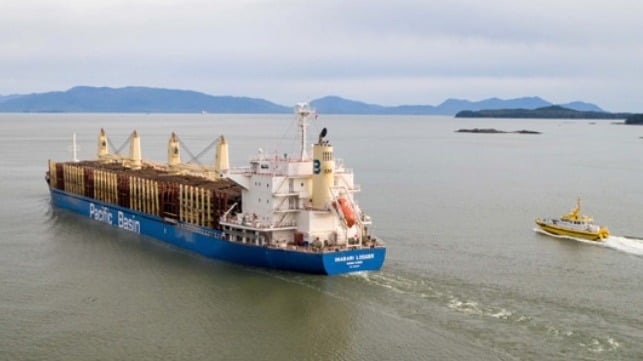
Shipowners are starting to reveal some of the steps that are being taken to avoid the port fees instituted by the U.S. and China this week, targeting ships built, owned, or operated by companies in the respective countries. The steps come as the industry also flagged the uncertainties in the programs and continues to seek guidance from the respective authorities on how elements, especially ownership, will be interpreted.
There had been reports that some of the large companies were considering structural changes to their corporations or their fleets, while many of the carriers were reported to be redeploying ships across routes. While the issue of where a vessel was built is definitive, how a ship is owned and managed is less specific, and now owners appear to be moving to take advantage of some of the opportunities.
Pacific Basin Shipping, which with 246 ships, is one of the largest operators in the dry bulk fleet, detailed a series of proactive steps in its areas of control that it is taking to mitigate its exposure. It starts with expanding its Singapore company and moving strategic leadership to Singapore from the company’s traditional headquarters in Hong Kong. It notes that it used the retirement of a board member and appointment of a new board member to also mitigate the applicability of the USTR 301 Annex I about Chinese ownership and control.
The company reports it has already transferred several of its 107 owned vessels to the Singapore registry under a plan to move about half its ships to that flag. Further, it says going forward, only ships owned or chartered through its operations in Singapore will be deployed on voyages calling at U.S. ports.
Commenting on market conditions in the dry bulk sector, it notes a rally and says the sector is “firm.” However, it expects the tariffs will add to existing disruption and ultimately contribute to higher freight rates and volatility. It believes that some market participants have “started self-sanctioning,” meaning that some owners are keeping ships outside the U.S., and some charters are preferring non-Chinese vessels.
Pacific Basin says it has also sought further clarity from the USTR on the 25 percent ownership rule. It notes that as a public company, its shares are held broadly, and while it does not have a controlling shareholder, it cannot know the nationality of each shareholder.
This issue is emerging as a broader uncertainty for the publicly traded companies. Global Ship Lease, a Greece-based owner and lessor of containerships, issued a similar statement on October 15. It declares that it is not “owned, operated, or controlled by any U.S. enterprise,” while highlighting that it received limited information on its individual shareholders, most of whom hold their shares via brokers or managers. Public companies only have details on major shareholders and institutional investment managers. Global Ship declares that it does not believe it has 25 percent or more direct or indirect ownership in the U.S. and that its company is located in Greece, and is owned and controlled by Greek citizens.
Other owners are also believed to be taking steps to mitigate their exposures to the fees, either in the U.S. or China. Seaspan, which with 241 containerships calls itself the largest independent owner and lessor, has quietly been restructuring. Media reports last month suggested the company would be moving over 100 vessels into the Singapore registry, and a review of the databases shows Seaspan now has over 130 ships registered and managed from Singapore. It still has over 70 ships flagged in Hong Kong, according to the databases. It has not publicly commented, but the reports said it would also establish a headquarters in Singapore.
While much of the attention has been on how the new reciprocal programs impact commercial shipping, it appears the cruise sector is also concerned. China's Caixin news outlet is reporting that the premium cruise ship Riviera operated by Norwegian Cruise Line Holdings' Oceania Cruises also diverted today. The ship which carriers 1,250 passengers was on a Pacific crossing trip and due to stop today in Shanghai. Caixin reports the ship built in Italy but operated by a company based in the United States was likely to have encountered a $1.64 million additional fee for docking in China.The Riviera, like two Maersk Line containerships, has elected to divert to Busan, South Korea instead of paying the additional port fee under China's retaliatory program.
Oil Tanker Rates Soar as U.S. and China Escalate Port Trade War
- China has imposed steep new port fees on U.S.-owned, operated, built, or flagged vessels — mirroring U.S. tariffs on Chinese ships.
- This new system of levies triggered turmoil in the global tanker market and drove freight rates sharply higher.
- Around 13% of the global crude tanker fleet could be affected, with VLCC rates on the Middle East–China route surging and a two-tier market emerging between China-compliant and non-compliant vessels.
The latest tit-for-tat fees on port callings in the U.S.-China trade spat threaten to create additional vortexes in global oil flows.
Shipowners and charterers are scrambling for clarity after China imposed this week a fee on U.S.-owned, operated, built, or flagged vessels, in retaliation for a similar U.S. move on Chinese ships. China-built ships are exempted from the new Chinese fee, but the impact on oil trade flows would still be significant, at least until owners and charterers find a way to move forward more smoothly in the choppy waters of renewed trade spats.
In these early days of the port fee escalation, the oil tanker market is in chaos as freight rates are rising on expectations of millions of U.S. dollars in additional costs per voyage, and cargoes are being delayed or canceled.
This new chaos creates inefficiencies in the tanker market, drives up freight costs, and adds to already upended flows with sanctions on Chinese crude import terminals and U.S. pressure on Russia’s buyers to halt imports of Russian oil.
Tit-for-Tat Port Fees
The latest turmoil in the tanker market began at the end of last week when China announced it would impose, effective October 14, a port fee of $56 (400 Chinese yuan) per ton on U.S.-flagged, built, operated, or owned vessels at Chinese ports. The fee is set to rise each year, to reach as much as $157 (1,120 yuan) per ton by April 2028.
“China's position is consistent. If there's a fight, we'll fight to the end; if there's a talk, the door is open,” a spokesperson for the Chinese commerce ministry said on Tuesday, as carried by the BBC.
“The US cannot demand talks while simultaneously imposing new restrictive measures with threats and intimidation. This is not the right way to engage with China,” the spokesperson said in a statement.
The Chinese retaliatory fees are equivalent to the United States Trade Representative (USTR) charges imposed on Chinese owned/operated vessels.
And these have just thrown the tanker market into turmoil.
“It seems that, not for the first time, the shipping industry is caught up in the geopolitical jostling between the United States and China,” U.S.-based brokers Poten & Partners said on Friday, shortly after China announced its tit-for-tat fees.
This week, shipowners are scrambling to obtain all relevant paperwork, and some are reshuffling corporate structures to lower American ownership to below 25%. A U.S.-held stake below 25% does not trigger the port fees in China.
Even if China-built vessels are exempted from the Chinese fees, 13% of the global crude tanker fleet will be affected by the port fees in China, according to Jefferies analyst Omar Nokta.
Tanker Rates Surge, Again
The result of all the tanker market chaos and uncertainty is soaring freight rates for supertankers to ship crude from the Middle East to China.
The spot rate for a very large crude carrier (VLCC) – capable of transporting up to 2 million barrels of oil – on the Middle East to China route jumped this week to the highest in nearly three weeks.
The previous surge in supertanker freight rates occurred last month as rising crude supply from OPEC+ and South America and a jump in longer-haul routes hiked freight rates for supertankers to levels last seen nearly three years ago.
VLCC rates on the benchmark Middle East-to-China route hit the threshold of $100,000 per day in September. That was the highest in almost three years and well above the previous 2025 high during the Israel-Iran conflict in June, when fears of disruption to supply or trade flows sent charter rates soaring.
Traders estimate for Reuters that a VLCC linked to the U.S. would now be hit with as much as a $15 million surcharge if it calls at a Chinese port—and no one is paying such massive fees.
“It’s not just the dearth of China-compliant ships, it’s also uncertainty of what is a China-compliant ship that’s driving up freight costs in the near term,” Anoop Singh, global head of shipping research at Oil Brokerage Ltd, told Bloomberg.
Due to the port fees and ongoing uncertainties, some ships were idling off China as of Wednesday, shipbrokers and traders tell Bloomberg.
As shipowners and charterers scramble to ease into the new tanker market reality, a two-tier market is emerging, they added. One group of vessel owners is willing to ship cargoes to China, while the other isn’t. The former group is charging premiums to transport crude and other goods to China. The latter is seeking workarounds and is considering mid-voyage ship-to-ship transfers to avoid multi-million dollar fees at a Chinese port for a U.S.-linked vessel.
The port fees are the latest in a series of sudden shifts in global crude flows.
This week, supertankers have started to divert from their original destination of the Chinese port of Rizhao, after the U.S. blacklisted around 100 individuals, vessels, and companies—including the Rizhao Shihua Crude Oil Terminal, which is co-owned by Sinopec, China’s top refiner.
Global crude flows are shifting again due to sanctions and trade disputes, and they could alter yet again in the near term if the U.S. succeeds in pressuring India to reduce Russian crude imports.
By Tsvetana Paraskova for Oilprice.com

No comments:
Post a Comment