WAIT, WHAT?!
Saudi Arabia and China to Conduct Joint Exercise in the Gulf
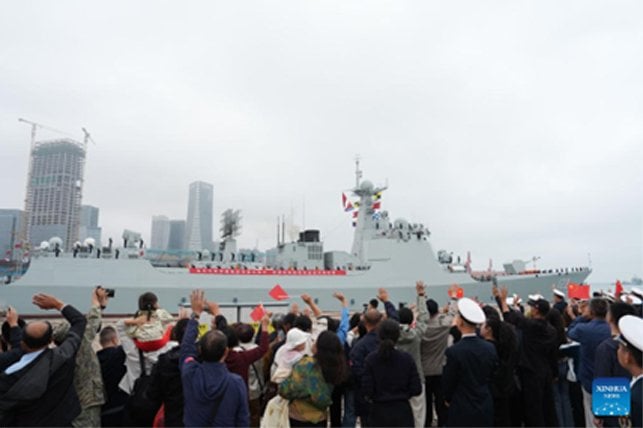
The official China Military Online website has announced that the Chinese PLA Navy and the Royal Saudi Naval Forces (RSNF) are to conduct a joint training exercise in the second half of October. The exercise, entitled Blue Sword 2025, will be the third joint naval exercise that the two countries have conducted together.
The last exercise in the series was carried out over two weeks in the same period in 2023. It was conducted in Zhanjiang, Guangdong Province, and focused on naval infantry and special forces operations. Saudi forces for the exercise would have been drawn from the two naval infantry brigades the RSNF maintains, each with a special forces element, one subordinate to the Eastern Fleet in the Gulf, and the other under the Western Fleet in the Red Sea. The PLA Navy troops came from the PLA Marine Corps. The exercise in 2023 culminated in a maritime assault and rescue of a hijacked merchant ship.
The first Blue Sword exercise was held in 2019 and was specifically a naval special forces exercise. The exercise was sponsored by the RSNF Western Fleet, based in Jeddah.
This year’s exercise is to be based on the King Abdulaziz Naval Base in Jubail, which is home to the Eastern Fleet’s naval infantry brigade. Observers will be watching closely to determine if the scope of the training is extended from the naval special forces domain, the focus hitherto, into joint operations at sea.
If there is a sea phase to the training, it could exploit the PLA Navy and Marine Corps permanent presence at the PLA’s Project 141 Overseas Support Base at Doraleh, in Djibouti. The presence is maintained by a three-ship flotilla on a six-month rotation, with ships provided by the PLA’s North Sea, East Sea, and Southern Sea Fleets in rotation. The current 47th Naval Escort Group is coming towards the end of its rotation and consists of Type 052D guided-missile destroyer Baotou (F113), Type 054A guided-missile frigate Honghe (F523), and the Type 903A replenishment ship Gaoyouhu (K904).
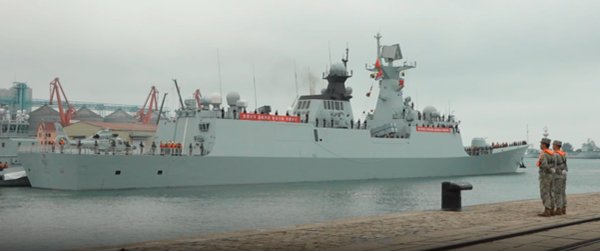
Type 054A guided-missile frigate Daqing (F576) sets off from Qingdao, with a Harbin Z-9 helicopter on the flight deck (from Chinese PLA video)
Usually, the overlap of an incoming and an outgoing flotilla presents an opportunity for the PLA Navy to mount joint exercises with allies in the Indian Ocean region, often with Iran and Pakistan. Notwithstanding understandings achieved with the Chinese over the transfer of Diego Garcia to Mauritius, neither the old nor new flotillas are expected to exercise with the UK HMS Prince of Wales carrier strike group currently exercising in the Indian Ocean, although their paths could cross.
The incoming flotilla, the 48th Naval Escort Group, set off on October 11 (video) from Qingdao, in China's Shandong Province, and home of the North Sea Fleet. The new flotilla consists of Type 052DL guided-missile destroyer Tangshan (F122), Type 054A guided-missile frigate Daqing (F576), and Type 903A replenishment ship Taihu (K889), recognizable due to its striking similarity to the French Durance class. Tangshan is a new variant of the Type 052D frigate, with a flight deck extended by four meters. Both ships had a single Harbin Z-9C helicopter (based on the Eurocopter AS.565 Panther) on the flight deck as they left the harbor.
Arrival of Chinese Heavy-Lift Ship Briefly Disrupts Shetlands' Exports
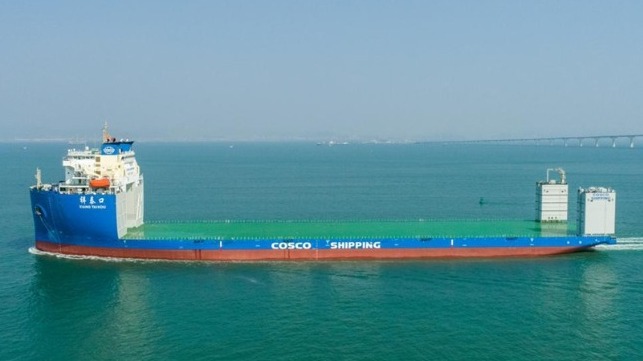
The arrival of a Chinese heavy-lift ship at a small harbor in the Shetland Islands caused days of consternation for local shipping interests, blocking the transit of a cargo vessel that plays a key role in the regional economy.
On the evening of October 11, the COSCO semisubmersible heavy-lift ship Xiang Tai Kou arrived at Leith, carrying a cargo of wind turbine foundations. Xiang Tai Kou is reasonably large, with a deadweight of 66,000 tonnes, a beam of 46 meters and a length of 231 meters - far in excess of the Leith inner harbor's acceptable dimensions, which are limited by the Forth Lock.
Fortunately for Xiang Tai Kou, the port has a deepwater pier just seaward of the lock complex, on the eastern edge of the shipping channel. This is where the heavy lift ship berthed. However, the pier has a limitation: the moored ship takes up most of the fairway, and the concrete structure of the lock complex crowds the south end of the berth. When Xiang Tai Kou pulled in, the channel was effectively blocked for merchant vessel traffic. Getting Helliar past Xiang Tai Kou's stern in a 100-meter-wide channel - with a sharp turn to port to clear the lock - would be a feat of shiphandling, even if there were space.
Helliar finished the planned drydocking on time and exited in the early hours of the 14th, mooring alongside in the inner harbor to wait for the heavy lift ship to clear the shipping channel. Unfortunately for Shetland's economy, this small-scale blockade happened to coincide with peak season for livestock exports from the island. The limited truck capacity aboard ro/pax ferries - booked up at this time of year for passenger traffic - would not offset the dedicated freight vessel's absence, according to the Shetland Times.
"Forth Ports clearly do not appreciate how fundamental [Helliar] is to Shetland and how vital it is that our perishable product reaches the seafood industry’s national and international markets on time," said Seafood Shetland CEO Ruth Anderson in a statement earlier this week. "Holding the Helliar has serious financial implications for both suppliers and their customers."
Port operator Forth Ports sped up the unloading operation of Xiang Tai Kou in response to the complaints. “The vessel was on the port’s outer berth delivering substantial offshore wind farm components and, due to its size, this restricted access to the port’s lock gates," the port operator said in a statement. "This was planned well in advance and had been widely communicated to port users.”
At about 0800 hours on the morning of the 16th, Xiang Tai Kou cast off and transited briefly out into the Firth of Forth, allowing Helliar to depart for Aberdeen at last, AIS data provided by Pole Star Global shows.
US Calls China's Sanctions on Hanwha Ocean Irresponsible Interference
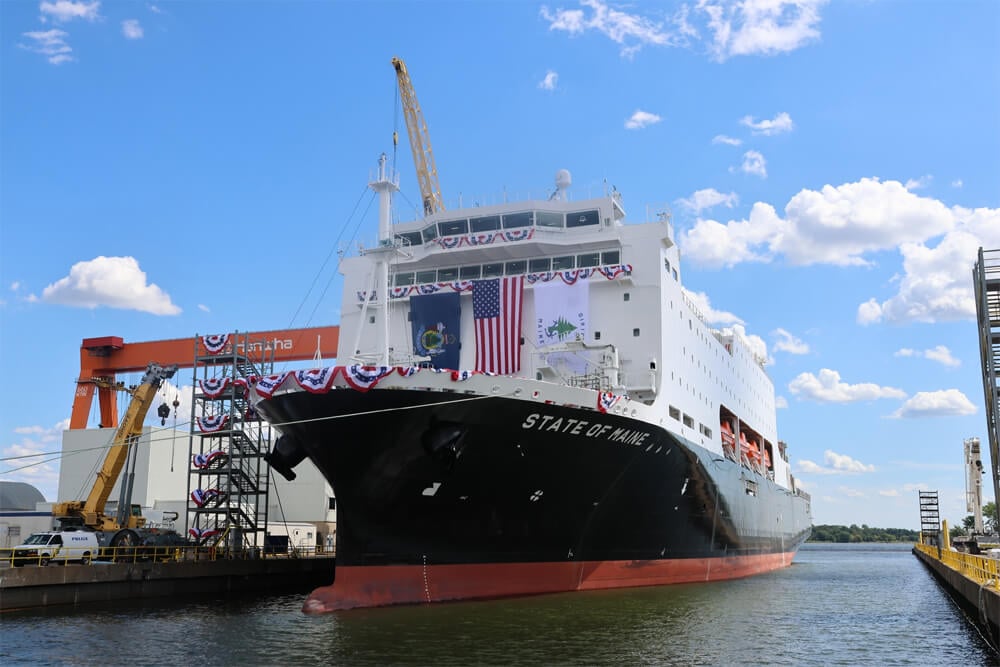
The U.S. State Department is speaking out after the Chinese government announced sanctions earlier this week on the U.S. operations of Hanwha Ocean, including the Philly Shipyard. The actions came as part of the reciprocal port fees announced by China in response to the USTR’s port fees, which target China-built ships in an effort to rein in China’s dominance of the shipbuilding industry.
China sanctioned five U.S. operating units of South Korea’s Hanwha Ocean, citing the company’s efforts in supporting the U.S. port fee program. In addition to the Philly Shipyard, China targeted Hanwha Shipping, which has committed to building and operating U.S.-flagged tankers and gas carriers.
Responding to media questions, a spokesperson for the U.S State Department called the sanctions “irresponsible” and said China was “interfering” with a private company’s operations. According to reports from Reuters and South Korea’s Yonhap News Agency, the U.S. said it was another example of China’s attempts to coerce South Korea.
Hanwha Ocean has been moving strongly to develop shipbuilding operations in the United States, including the $100 million purchase of the Philly Shipyard and commitments for large investments in U.S. shipbuilding. The company has also begun repairs of U.S. Navy auxiliary vessels at its shipyard in Korea.
The company looks to play a key role in South Korea’s promised “Make American Shipbuilding Great Again” (MASGA) initiative, which emerged as a cornerstone of U.S.-Korea trade negotiations. While many have questioned the execution of the program, South Korea promised to invest $150 billion in the U.S. shipbuilding during trade negotiations with the U.S.
The Chinese sanctions bar companies from trading with the Hanwha companies. While many have said it would not have an immediate effect, one South Korean lawmaker said it could cost the Philly Shipyard $60 million over the next two years. Another South Korean official told Reuters that it would be difficult to make all the needed materials and suppliers for the Philly Shipyard in the U.S.
The State Department called the sanctions an effort to interfere with Donald Trump’s efforts to rebuild the U.S. shipbuilding industry. They said the U.S. stands firmly with South Korea despite the Chinese efforts to undermine the cooperation in shipbuilding.
The statements came as South Korean officials were in Washington, D.C., to discuss the MASGA initiative. After the meeting, the South Koreans said they had “constructive discussions.” They said the sanctions imposed on Hanwha Ocean had not been discussed.


No comments:
Post a Comment