DW
November 11, 2025
The Trump administration has trivialized COP30, and is not sending anyone to the climate talks in Belem. But local and regional leaders from across the US want the world to know they're not giving up.

The Trump administration has trivialized COP30, and is not sending anyone to the climate talks in Belem. But local and regional leaders from across the US want the world to know they're not giving up.

In this photo projection, protesters reference the COP30 climate talks in Brazil. Hosted by the nation's President Luiz Inacio Lula da Silva (left), they are going ahead without Donald Trump, who believes climate change is a hoax
Image: Fabio Teixeira/Anadolu/picture alliance
Washington is not sending a top-level team to this year's COP climate summit in Belem, Brazil.
The global community expected as much from a president who has pulled the United States out of the Paris Agreement for the second time, slashed funding for renewable energy, championed fossil fuel projects and told world leaders at the UN in September that climate change is the "greatest con job ever perpetrated on the world."
But delegates from Washington state, along with governors, mayors and other representatives from states and cities across the US, are determined to pick up the slack. Together, they represent about two-thirds of the US population and produce nearly three-quarters of the country's economic output.
"It's a long way to come from Seattle to Rio, but I made the trip, and others made the trip, because it's important for the rest of the world not to give up on the United States," said Jay Inslee, the former Democratic governor of Washington. Inslee was speaking to DW from Rio de Janeiro, where he was taking part in pre-COP events last week ahead of the main climate talks.
Washington is not sending a top-level team to this year's COP climate summit in Belem, Brazil.
The global community expected as much from a president who has pulled the United States out of the Paris Agreement for the second time, slashed funding for renewable energy, championed fossil fuel projects and told world leaders at the UN in September that climate change is the "greatest con job ever perpetrated on the world."
But delegates from Washington state, along with governors, mayors and other representatives from states and cities across the US, are determined to pick up the slack. Together, they represent about two-thirds of the US population and produce nearly three-quarters of the country's economic output.
"It's a long way to come from Seattle to Rio, but I made the trip, and others made the trip, because it's important for the rest of the world not to give up on the United States," said Jay Inslee, the former Democratic governor of Washington. Inslee was speaking to DW from Rio de Janeiro, where he was taking part in pre-COP events last week ahead of the main climate talks.
US is giving up on climate — others are cashing in 09:53
"The United States have not pulled out of Paris. One part of the United States has, and that's the federal government," said Inslee, a founding member of the US Climate Alliance, a bipartisan coalition of governors that includes 23 states and one territory. The group was spurred into action during the first Trump presidency in 2017.
"It's very important that we not allow a misperception to exist that somehow progress has stopped because we have a bloviating, anti-wind turbine, climate-denying narcissist in the White House. That's a very important message, I think, for the world to give them confidence to move forward."
Speaking in Belem, California's Governor Gavin Newsom told AFP any future Democratic president would rejoin the Paris Agreement "without hesitation," adding that it's both a "moral commitment" and an "economic imperative."
"It's an abomination that he has twice, not once, pulled away from the accords," Newsom said. "Donald Trump is doubling down on stupid."
Will Trump's tariff diplomacy derail COP?
While Trump's team is not expected in Belem, some observers are concerned the president could disrupt the negotiations from afar.
"The signal sent to countries around the world is that the US may penalize in trade terms countries that take stronger climate action," said Maha Rafi Atal, an associate professor in political economy at the University of Glasgow in Scotland.
She told DW in an email that Trump's hostility to climate action could see other countries "less willing to prioritize emissions reductions over economic growth" and funding the energy transition.
"Yes, the [US] federal government may continue to be disruptive," said Gina McCarthy, co-chair of America Is All In (AIAI), a climate action coalition, in an email. "Our delegation is focused on what we know for sure: local leaders and businesses across the United States are pressing forward on clean energy and are eager to collaborate with international partners to strengthen the Paris Agreement."
Local efforts add up
More than 100 subnational leaders from the US Climate Alliance, Climate Mayors and AIAI — representing state and city officials as well as tribal nations, businesses, schools and other institutions — are taking part in the high-stakes negotiations in the Amazon, which run from November 10 to 21.
While many of the decisions at COP shape how nations tackle climate change at the federal level, the local leaders believe the US, the world's second-biggest polluter after China, can still meet the goals of the 2015 Paris accord and reach net-zero emissions by mid-century. Even with Trump boosting oil and gas projects, which contribute significantly to global warming.
"[Trump] often talks and makes a lot of noise, but he cannot stop us moving forward," said Inslee. "Yes, he has reduced some of our federal efforts, but we retain the ability to control our own destiny in these states and cities."
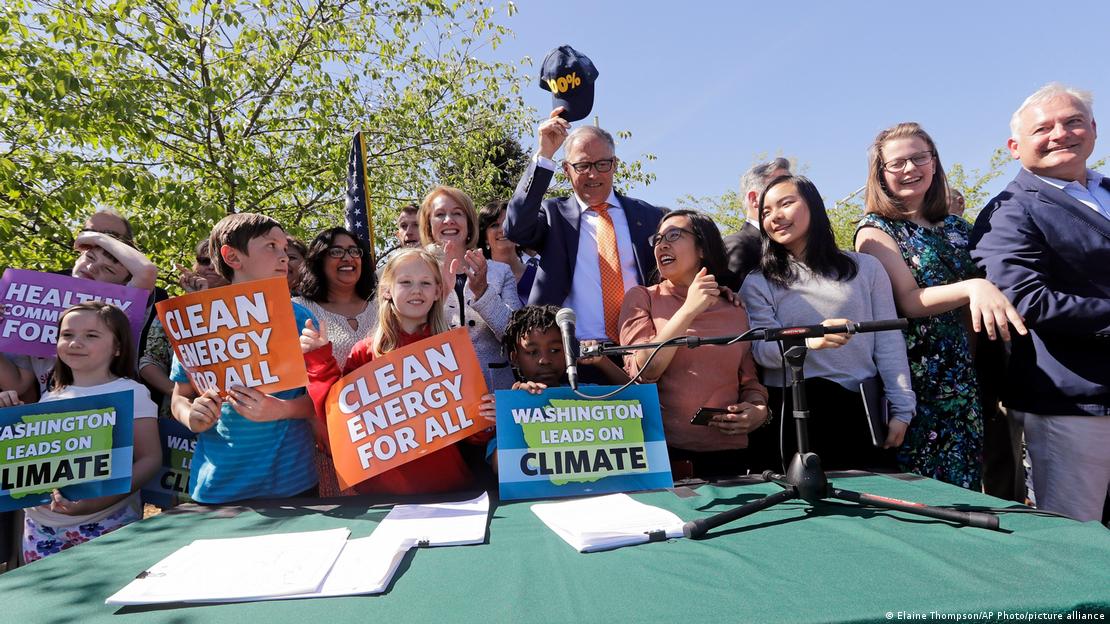
As governor of Washington, Jay Inslee (center, seen here in May 2019) made climate action a central focus
Image: Elaine Thompson/AP Photo/picture alliance
In fact, an analysis released by AIAI last month shows that expanded climate action on the local level, along with renewed support from Washington after 2028 — when Trump is due to leave office — could see the US reduce its greenhouse gas emissions 56% below 2005 levels by 2035. Under the Biden administration, the US 2035 pledge was to cut net emissions by up to 66%.
Many of those reductions in the coming years would come from local policy changes in three key areas: electricity, transportation and reducing methane emissions from leaky gas infrastructure and organic waste.
"Our findings show that innovative local policies and market-driven clean technology investments can keep the US on a path toward significant emissions reductions, even in challenging times," said Nate Hultman, director at the Center for Global Sustainability at the University of Maryland, which led the study.
'Change happens from the bottom up'
Speaking at the COP30 Local Leaders Forum last week, McCarthy — a climate adviser for the Biden administration and former head of the Environmental Protection Agency — told attendees that "change happens from the bottom up."
She said local efforts were "leading the charge on clean energy," pointing out that the 24 states in the US Climate Alliance had already managed to collectively reduce greenhouse gas emission by 24% below 2005 levels, while increasing their GDP by 34%.
"They're supported by the majority of Americans that want their leaders to lower energy costs, protect public health and create jobs," McCarthy told DW.
Inslee, whose policies on clean energy, energy-efficient building and low-emission transportation as governor of Washington from 2013 to 2025 helped shape Joe Biden's approach to climate change, said job creation and economic growth could go hand-in-hand with reducing emissions.
In fact, an analysis released by AIAI last month shows that expanded climate action on the local level, along with renewed support from Washington after 2028 — when Trump is due to leave office — could see the US reduce its greenhouse gas emissions 56% below 2005 levels by 2035. Under the Biden administration, the US 2035 pledge was to cut net emissions by up to 66%.
Many of those reductions in the coming years would come from local policy changes in three key areas: electricity, transportation and reducing methane emissions from leaky gas infrastructure and organic waste.
"Our findings show that innovative local policies and market-driven clean technology investments can keep the US on a path toward significant emissions reductions, even in challenging times," said Nate Hultman, director at the Center for Global Sustainability at the University of Maryland, which led the study.
'Change happens from the bottom up'
Speaking at the COP30 Local Leaders Forum last week, McCarthy — a climate adviser for the Biden administration and former head of the Environmental Protection Agency — told attendees that "change happens from the bottom up."
She said local efforts were "leading the charge on clean energy," pointing out that the 24 states in the US Climate Alliance had already managed to collectively reduce greenhouse gas emission by 24% below 2005 levels, while increasing their GDP by 34%.
"They're supported by the majority of Americans that want their leaders to lower energy costs, protect public health and create jobs," McCarthy told DW.
Inslee, whose policies on clean energy, energy-efficient building and low-emission transportation as governor of Washington from 2013 to 2025 helped shape Joe Biden's approach to climate change, said job creation and economic growth could go hand-in-hand with reducing emissions.
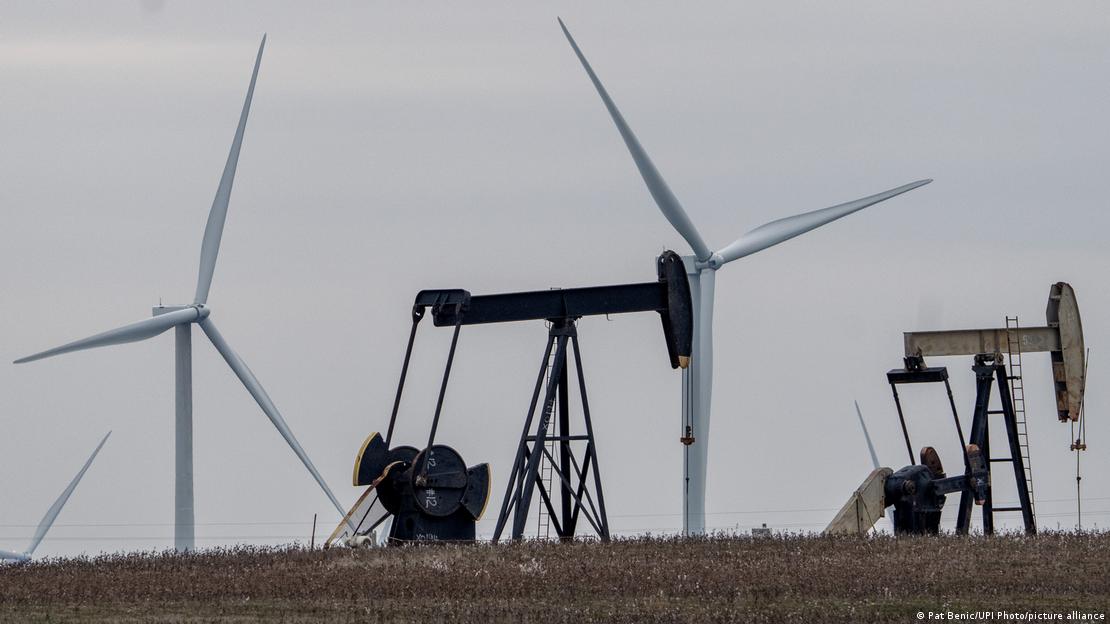
The southern US state of Texas, known for its oil fields,
has seen a boom in solar and wind energy
Image: Pat Benic/UPI Photo/picture alliance
Even in states like Texas, which is not a part of the US Climate Alliance, renewable energy is taking off because, as Inslee put it, Americans "want cheaper sources of energy." Texas, where voters backed Trump in the last three elections, leads the US when it comes to the development of renewable energy generation and battery capacity. Average electricity prices in the southern state are among the lowest in the country, according to August data from the US Energy Information Administration, a government agency.
Through their participation at COP, McCarthy told attendees in Rio that local leaders were looking to build partnerships and inform negotiations in Belem.
"We have power, we have agency, we have authority, and damn it, we are going to use it!" she said to applause.
Edited by: Tamsin Walker
Martin Kuebler Senior editor and reporter living in Brussels, with a focus on environmental issues
Even in states like Texas, which is not a part of the US Climate Alliance, renewable energy is taking off because, as Inslee put it, Americans "want cheaper sources of energy." Texas, where voters backed Trump in the last three elections, leads the US when it comes to the development of renewable energy generation and battery capacity. Average electricity prices in the southern state are among the lowest in the country, according to August data from the US Energy Information Administration, a government agency.
Through their participation at COP, McCarthy told attendees in Rio that local leaders were looking to build partnerships and inform negotiations in Belem.
"We have power, we have agency, we have authority, and damn it, we are going to use it!" she said to applause.
Edited by: Tamsin Walker
Martin Kuebler Senior editor and reporter living in Brussels, with a focus on environmental issues
California's Newsom takes US climate stage as White House sits out COP30
American voices took the stage on day two of the COP30 climate conference, but none represented the federal government. California Governor Gavin Newsom, a Democrat, spoke at the UN climate summit in the Brazilian Amazon after the Trump administration opted not to send a delegation.
Issued on: 12/11/2025 - RFI

American voices took the stage on day two of the COP30 climate conference, but none represented the federal government. California Governor Gavin Newsom, a Democrat, spoke at the UN climate summit in the Brazilian Amazon after the Trump administration opted not to send a delegation.
Issued on: 12/11/2025 - RFI
California Gov. Gavin Newsom speaks during a rally to push for a redistricting measure on Thursday, Aug. 14, 2025, in Los Angeles. AP - Marcio Jose Sanchez
Newsom said a Democratic administration would rejoin the Paris Agreement "without hesitation."
"It's a moral commitment, it's an economic imperative, it's both -- and it's an abomination that he has twice, not once, pulled away from the accords," Newsom said in response to a question by French press agency AFP in Belem, the Brazilian Amazon city hosting the COP30 climate summit.
Newsom appeared alongside Helder Barbalho, the governor of Para state, of which Belem is the capital, at an event on the city's docks.
Meanwhile, US President Donald Trump's absence from COP30 marked a departure from traditional climate diplomacy, in which the White House typically leads US delegations at annual UN climate negotiations. State officials filled the void left by Washington's decision to stay away.
Since taking power, Trump has strongly criticised international climate efforts, including the UN-sponsored Conference of Parties, or COP30, and has chosen not to send any top-level US officials to the climate gathering in Brazil, which takes place in the city of Belém from 10–21 November.
White House spokesperson Tyler Rogers said that Trump "will not jeopardise our country's economic and national security to pursue vague climate goals that are killing other countries", asserting that climate policies such as the Paris Agreement would have "killed America" had it not been for Trump's intervention.
Trump frequently refers to climate change as "the greatest con job ever perpetrated on the world", and his administration has rolled back numerous climate policies in favour of "common-sense energy" – including signing an executive order on 20 January to withdraw from the Paris Agreement.
Showcase California
Dubbed the "anti-Trump" by Politico Newsom is showcasing how California's clean energy transition is driving economic growth, creating jobs and reducing pollution, positioning climate action as a defining opportunity of the 21st century.
"We are doubling down on stupid in the United States of America – not in my state of California," Newsom told an audience at the Global Investors Symposium at the Milken Institute in São Paulo on Monday, drawing a sharp contrast between his state's green economic growth and federal retreat.
"What the hell is going on here? This is the country we should be engaging with instead of giving the middle finger with 50 per cent tariffs," he said, referencing the Trump administration's trade approach to Brazil.
In Belém, Newsom's high-profile delegation – including leaders in resources, agriculture and energy – will hold meetings with Brazilian officials, climate investors and Indigenous leaders. He promoted California's track record: a 21 per cent reduction in greenhouse gas emissions since 2000, a surging green economy and a $50 billion climate investment programme he says is producing "jobs, clean air and lower costs".
California now counts seven times as many green jobs as fossil fuel positions, even as its economy has become the world's fourth largest.
2026 US Midterms
Newsom's trip comes as COP30 gathers world leaders and civil society ten years after the Paris Agreement, amid speculation about Democratic strategies for the 2026 midterms and the 2028 presidential race.
Newsom’s efforts at COP30 are intertwined with his recent domestic initiatives.
Last week, he celebrated a redistricting win in California that added five Democratic congressional seats, urging other blue-state governors to follow suit ahead of the midterms.
“We cannot rest until we take back the House,” he told supporters after his party's win.
For the Democratic Party, Newsom’s strategy is clear: recast climate action as the engine of economic opportunity, deepen partnerships across the Americas, and use galvanising events like COP30 to project American leadership—even when Washington steps back.
Polls now suggest Democrats could net twelve seats in the 2026 midterms, and Newsom’s name is increasingly floated as a contender for the White House in 2028.
Newsom said a Democratic administration would rejoin the Paris Agreement "without hesitation."
"It's a moral commitment, it's an economic imperative, it's both -- and it's an abomination that he has twice, not once, pulled away from the accords," Newsom said in response to a question by French press agency AFP in Belem, the Brazilian Amazon city hosting the COP30 climate summit.
Newsom appeared alongside Helder Barbalho, the governor of Para state, of which Belem is the capital, at an event on the city's docks.
Meanwhile, US President Donald Trump's absence from COP30 marked a departure from traditional climate diplomacy, in which the White House typically leads US delegations at annual UN climate negotiations. State officials filled the void left by Washington's decision to stay away.
Since taking power, Trump has strongly criticised international climate efforts, including the UN-sponsored Conference of Parties, or COP30, and has chosen not to send any top-level US officials to the climate gathering in Brazil, which takes place in the city of Belém from 10–21 November.
White House spokesperson Tyler Rogers said that Trump "will not jeopardise our country's economic and national security to pursue vague climate goals that are killing other countries", asserting that climate policies such as the Paris Agreement would have "killed America" had it not been for Trump's intervention.
Trump frequently refers to climate change as "the greatest con job ever perpetrated on the world", and his administration has rolled back numerous climate policies in favour of "common-sense energy" – including signing an executive order on 20 January to withdraw from the Paris Agreement.
Showcase California
Dubbed the "anti-Trump" by Politico Newsom is showcasing how California's clean energy transition is driving economic growth, creating jobs and reducing pollution, positioning climate action as a defining opportunity of the 21st century.
"We are doubling down on stupid in the United States of America – not in my state of California," Newsom told an audience at the Global Investors Symposium at the Milken Institute in São Paulo on Monday, drawing a sharp contrast between his state's green economic growth and federal retreat.
"What the hell is going on here? This is the country we should be engaging with instead of giving the middle finger with 50 per cent tariffs," he said, referencing the Trump administration's trade approach to Brazil.
In Belém, Newsom's high-profile delegation – including leaders in resources, agriculture and energy – will hold meetings with Brazilian officials, climate investors and Indigenous leaders. He promoted California's track record: a 21 per cent reduction in greenhouse gas emissions since 2000, a surging green economy and a $50 billion climate investment programme he says is producing "jobs, clean air and lower costs".
California now counts seven times as many green jobs as fossil fuel positions, even as its economy has become the world's fourth largest.
2026 US Midterms
Newsom's trip comes as COP30 gathers world leaders and civil society ten years after the Paris Agreement, amid speculation about Democratic strategies for the 2026 midterms and the 2028 presidential race.
Newsom’s efforts at COP30 are intertwined with his recent domestic initiatives.
Last week, he celebrated a redistricting win in California that added five Democratic congressional seats, urging other blue-state governors to follow suit ahead of the midterms.
“We cannot rest until we take back the House,” he told supporters after his party's win.
For the Democratic Party, Newsom’s strategy is clear: recast climate action as the engine of economic opportunity, deepen partnerships across the Americas, and use galvanising events like COP30 to project American leadership—even when Washington steps back.
Polls now suggest Democrats could net twelve seats in the 2026 midterms, and Newsom’s name is increasingly floated as a contender for the White House in 2028.

No comments:
Post a Comment