Philipp Sandner
DW
Thirty years ago, nine environmental activists from the Niger Delta were executed. They have since been honored but the protest against oil pollution continues.

Destructive oil extraction begins in the Niger Delta
In the 1950s, Shell, then a Dutch company, discovered oil in the Niger Delta. It kicked off unchecked environmental destruction — against the will of the Ogoni people living there. Soon, oil pollution became visible: water was no longer drinkable, large areas were no longer suitable for farming. Decades of protests by Ogoni representatives were unsuccessful.
The resistance gained new momentum when Saro-Wiwa, already known as an author and playwright, founded the Movement for the Survival of the Ogoni People (MOSOP) in 1990. MOSOP argued Shell's activities were destroying the region's environment and did not benefit local people.
The organization garnered global attention, and in 1994, Saro-Wiwa and MOSOP won the prestigious international Right Livelihood Award.
Saro-Wiwa's resistance
Nnimmo Bassey, also an author and Right Livelihood laureate, says Saro-Wiwa was fearless: "People like to be more politically correct. But he just called what was going on: an environmental genocide against the Ogoni people."
November 10, 2025
Thirty years ago, nine environmental activists from the Niger Delta were executed. They have since been honored but the protest against oil pollution continues.

The Bodo River in the Niger Delta is so heavily polluted that using the water for drinking and fishing is banned
Image: Yasuyoshi Chiba/AFP/Getty Images
The late Nigerian writer and teacher Ken Saro-Wiwa put the disastrous oil extraction in the Niger Delta on the international agenda and dispelled the notion that oil would bring prosperity to Nigeria.
"If we had a proper system, they would find that there is not so much oil money around anyway," Saro-Wiwa told DW in November 1993.
"Oil is causing a lot of devastation, which the country has not paid for and which it will pay for in due course. So people should go and look for other sources of sustenance instead of eyeing oil," he said.
A few days later, General Sani Abacha established a brutal dictatorship in Nigeria. Two years after that, Saro-Wiwa — along with eight other activists, known as the "Ogoni 9" — was dead.
Their supporters say the activists were murdered by a corrupt system wanting to continue profiting from oil extraction. Yet Saro-Wiwa's legacy lives on.
The late Nigerian writer and teacher Ken Saro-Wiwa put the disastrous oil extraction in the Niger Delta on the international agenda and dispelled the notion that oil would bring prosperity to Nigeria.
"If we had a proper system, they would find that there is not so much oil money around anyway," Saro-Wiwa told DW in November 1993.
"Oil is causing a lot of devastation, which the country has not paid for and which it will pay for in due course. So people should go and look for other sources of sustenance instead of eyeing oil," he said.
A few days later, General Sani Abacha established a brutal dictatorship in Nigeria. Two years after that, Saro-Wiwa — along with eight other activists, known as the "Ogoni 9" — was dead.
Their supporters say the activists were murdered by a corrupt system wanting to continue profiting from oil extraction. Yet Saro-Wiwa's legacy lives on.
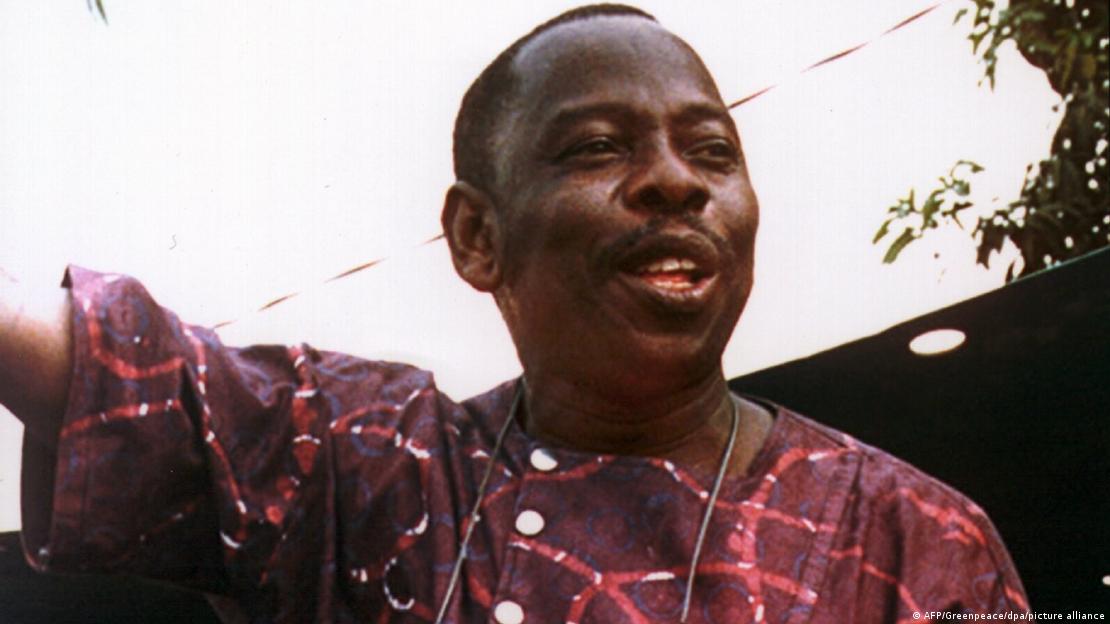
Ken Saro-Wiwa, seen here during a protest in 1993, became a pioneer of environmental activism in Nigeria
Image: AFP/Greenpeace/dpa/picture alliance
Nnimmo Bassey, now one of the most prominent environmental activists in the Niger Delta, calls him a "courageous man" and a "visionary."
"He was very much ahead of his time," Bassey told DW.
Nnimmo Bassey, now one of the most prominent environmental activists in the Niger Delta, calls him a "courageous man" and a "visionary."
"He was very much ahead of his time," Bassey told DW.
Destructive oil extraction begins in the Niger Delta
In the 1950s, Shell, then a Dutch company, discovered oil in the Niger Delta. It kicked off unchecked environmental destruction — against the will of the Ogoni people living there. Soon, oil pollution became visible: water was no longer drinkable, large areas were no longer suitable for farming. Decades of protests by Ogoni representatives were unsuccessful.
The resistance gained new momentum when Saro-Wiwa, already known as an author and playwright, founded the Movement for the Survival of the Ogoni People (MOSOP) in 1990. MOSOP argued Shell's activities were destroying the region's environment and did not benefit local people.
The organization garnered global attention, and in 1994, Saro-Wiwa and MOSOP won the prestigious international Right Livelihood Award.
Saro-Wiwa's resistance
Nnimmo Bassey, also an author and Right Livelihood laureate, says Saro-Wiwa was fearless: "People like to be more politically correct. But he just called what was going on: an environmental genocide against the Ogoni people."
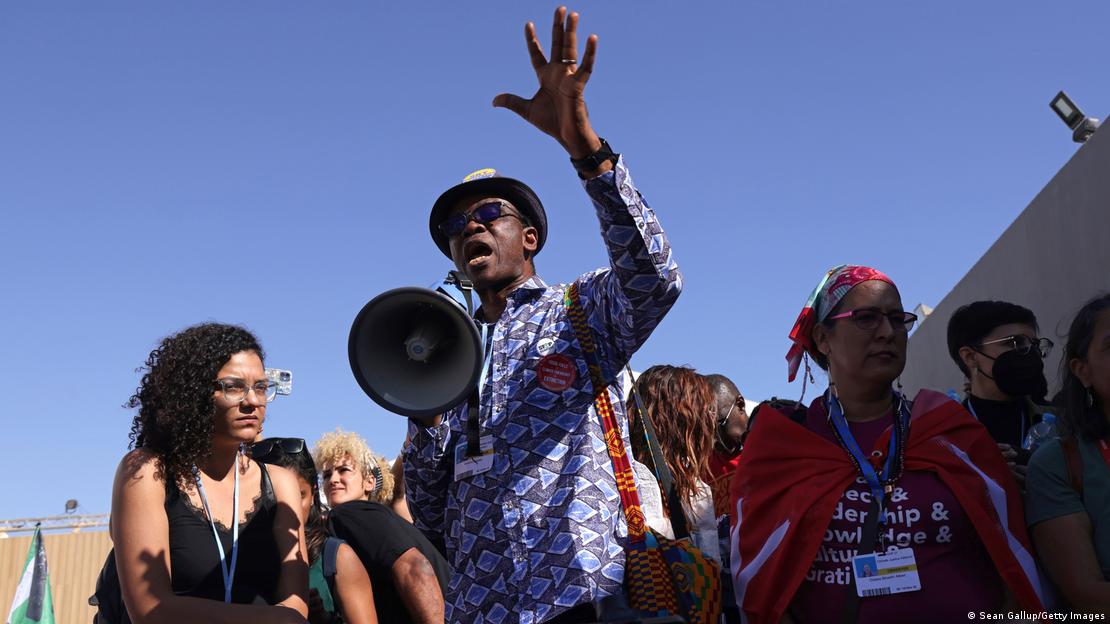
Nnimmo Bassey — like Saro-Wiwa — received the Right Livelihood Award, and his activism took him to events such as the 2022 World Climate Conference in Egypt
Image: Sean Gallup/Getty Images
In 2011, the United Nations Environment Programme (UNEP) published the first scientific analysis of the pollution, confirming oil production in Ogoniland had indeed led to an ecological disaster.
Saro-Wiwa's protest movement also threatened to disrupt oil operations. In early 1993, MOSOP organized a peaceful protest involving nearly 300,000 Ogoni in Rivers State. Shortly afterward, Shell withdrew most of its staff for safety reasons and drastically cut production. Saro-Wiwa told DW in November of the same year: "When the federal government takes away 97% of the oil money, but does not take away 97% of the pollution, it is doing something wrong."
Nigeria's military dictatorship
After Abacha seized power, tensions escalated. The government exploited divisions within the protest movement. In May 1994, four Ogoni leaders were murdered. The government blamed Saro-Wiwa and eight other Ogoni leaders. Despite international support and awards for Saro-Wiwa and MOSOP, the Ogoni 9 were sentenced to death and hanged on November 10, 1995.
The executions sparked global outrage, leading to Nigeria's suspension from the Commonwealth of Nations for more than three years.
In 2011, the United Nations Environment Programme (UNEP) published the first scientific analysis of the pollution, confirming oil production in Ogoniland had indeed led to an ecological disaster.
Saro-Wiwa's protest movement also threatened to disrupt oil operations. In early 1993, MOSOP organized a peaceful protest involving nearly 300,000 Ogoni in Rivers State. Shortly afterward, Shell withdrew most of its staff for safety reasons and drastically cut production. Saro-Wiwa told DW in November of the same year: "When the federal government takes away 97% of the oil money, but does not take away 97% of the pollution, it is doing something wrong."
Nigeria's military dictatorship
After Abacha seized power, tensions escalated. The government exploited divisions within the protest movement. In May 1994, four Ogoni leaders were murdered. The government blamed Saro-Wiwa and eight other Ogoni leaders. Despite international support and awards for Saro-Wiwa and MOSOP, the Ogoni 9 were sentenced to death and hanged on November 10, 1995.
The executions sparked global outrage, leading to Nigeria's suspension from the Commonwealth of Nations for more than three years.
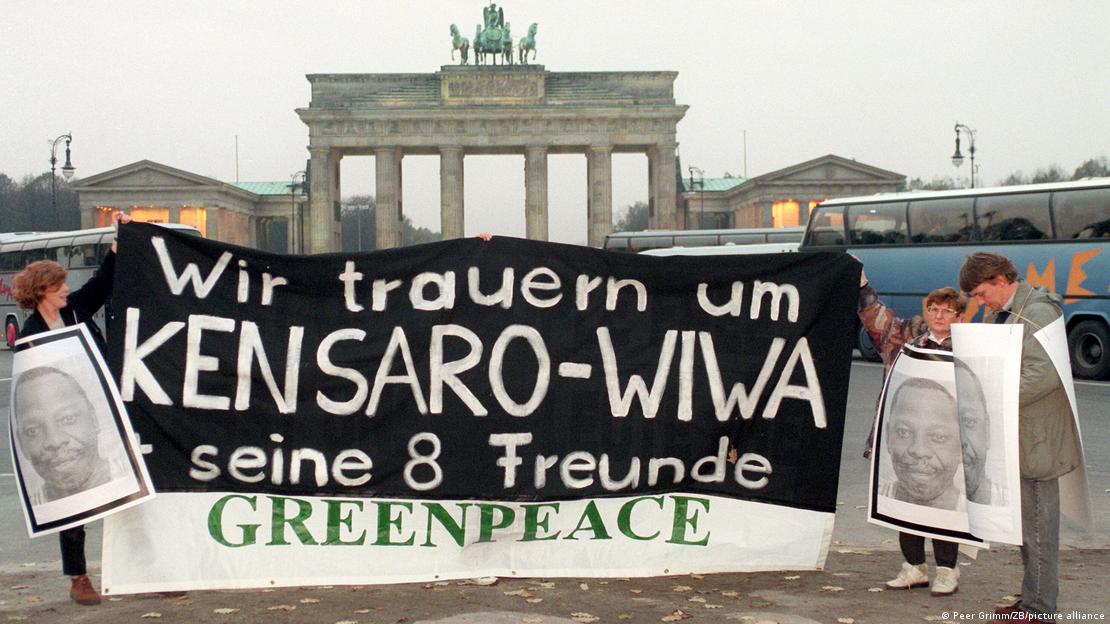
There were international protests — here in Berlin in 1995 — against the execution of Ken Saro-Wiwa and his eight fellow activists
Image: Peer Grimm/ZB/picture alliance
Some witnesses later claimed they had been bribed by the government or said Shell had promised them jobs. Shell's exact role could never be fully clarified. In 2009, the oil company paid a total of $15.5 million (around €13 million today) to the relatives of the Ogoni 9. Shell said this was a "humanitarian gesture" and not an admission of guilt.
Little progress
Economist Priscilla Airohi-Alikor from the Centre for the Study of the African Economies sees slow progress on oil pollution in the Niger Delta. She says one key success of the MOSOP movement is that "Shell has not drilled oil in Ogoniland since 1993."
Yet leaks from oil facilities continued to pollute the environment.
After the Abacha dictatorship, Nigeria established the Niger Delta Development Commission (NDDC). In 2016, then-President Muhammadu Buhari followed a UN recommendation to launch a multi-billion dollar effort to clean up the Niger Delta.
Some witnesses later claimed they had been bribed by the government or said Shell had promised them jobs. Shell's exact role could never be fully clarified. In 2009, the oil company paid a total of $15.5 million (around €13 million today) to the relatives of the Ogoni 9. Shell said this was a "humanitarian gesture" and not an admission of guilt.
Little progress
Economist Priscilla Airohi-Alikor from the Centre for the Study of the African Economies sees slow progress on oil pollution in the Niger Delta. She says one key success of the MOSOP movement is that "Shell has not drilled oil in Ogoniland since 1993."
Yet leaks from oil facilities continued to pollute the environment.
After the Abacha dictatorship, Nigeria established the Niger Delta Development Commission (NDDC). In 2016, then-President Muhammadu Buhari followed a UN recommendation to launch a multi-billion dollar effort to clean up the Niger Delta.
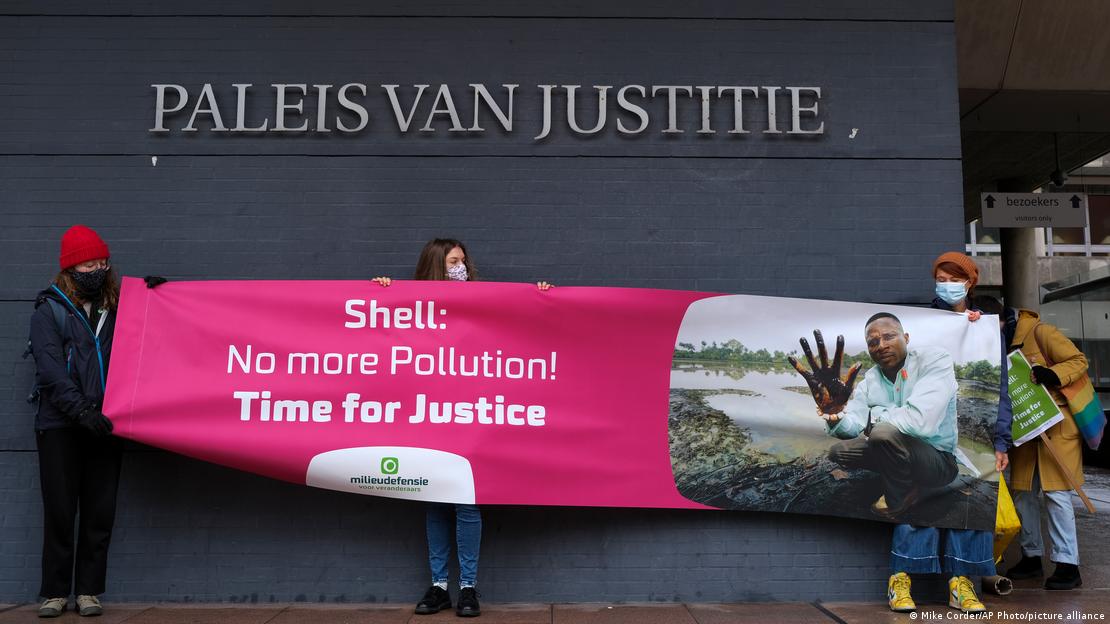
Partial victories against Shell were hard-won — with actions like this one in 2021
in The Hague
Image: Mike Corder/AP Photo/picture alliance
Shell's responsibility remains a crucial point: in 2021, after a long legal battle, the company was ordered to compensate farmers in the Niger Delta.
"In most cases, they've actually settled with a lot of these communities," says Airohi-Alikor.
"But it's on the admission that they shouldn't be held liable for what these communities are suffering. The company has also evaded a cleanup of the community."
Shell argues most of the pollution was due to sabotage, Airohi-Alikor says.
In June, a British court ruled that Shell can indeed be held liable for environmental damage in the Niger Delta. Whether this will lead to binding verdicts is unclear.
Pardon 'not enough'
Thirty years after the execution of the Ogoni 9, Nigeria's government announced the pardon of Ken Saro-Wiwa and his fellow activists, granting them high national honors. The four previously murdered Ogoni leaders were also honored.
For Nnimmo Bassey, this is a mockery: "That is not enough. You do not pardon a man who did not commit an offence."
Accepting a pardon, he says, is an admission of guilt. Bassey is also outraged that Nigeria is holding talks on new oil production in the Niger Delta — while the old damage is far from repaired. Shell now wants to shift to deep-sea drilling, thereby evading national jurisdictions. He argues it is time to leave the fossil fuel era behind.
The cost of oil
Depending on the data source, oil, petroleum products, and gas generates 85% to 92% of Nigeria's export revenues.
Nigeria is also being battered by climate change related flooding and heat waves — and urgently needs resources to cope with these impacts, says expert Priscilla Airohi-Alikor. Ken Saro-Wiwa's warning not to rely too heavily on oil revenues sounds prophetic to her: "If the country does not take action in due course, oil revenues would go into cleaning up of these communities. If we account for the environmental cost of gas flaring or oil spillage you find that the nation is at a loss."
This article was originally published in German.
Shell's responsibility remains a crucial point: in 2021, after a long legal battle, the company was ordered to compensate farmers in the Niger Delta.
"In most cases, they've actually settled with a lot of these communities," says Airohi-Alikor.
"But it's on the admission that they shouldn't be held liable for what these communities are suffering. The company has also evaded a cleanup of the community."
Shell argues most of the pollution was due to sabotage, Airohi-Alikor says.
In June, a British court ruled that Shell can indeed be held liable for environmental damage in the Niger Delta. Whether this will lead to binding verdicts is unclear.
Pardon 'not enough'
Thirty years after the execution of the Ogoni 9, Nigeria's government announced the pardon of Ken Saro-Wiwa and his fellow activists, granting them high national honors. The four previously murdered Ogoni leaders were also honored.
For Nnimmo Bassey, this is a mockery: "That is not enough. You do not pardon a man who did not commit an offence."
Accepting a pardon, he says, is an admission of guilt. Bassey is also outraged that Nigeria is holding talks on new oil production in the Niger Delta — while the old damage is far from repaired. Shell now wants to shift to deep-sea drilling, thereby evading national jurisdictions. He argues it is time to leave the fossil fuel era behind.
The cost of oil
Depending on the data source, oil, petroleum products, and gas generates 85% to 92% of Nigeria's export revenues.
Nigeria is also being battered by climate change related flooding and heat waves — and urgently needs resources to cope with these impacts, says expert Priscilla Airohi-Alikor. Ken Saro-Wiwa's warning not to rely too heavily on oil revenues sounds prophetic to her: "If the country does not take action in due course, oil revenues would go into cleaning up of these communities. If we account for the environmental cost of gas flaring or oil spillage you find that the nation is at a loss."
This article was originally published in German.
Ogonis wary of more oil drilling in Niger Delta
Bello Muhammad
Amid the tropical heat, intense humidity, and foggy greenery of the delta, deserted houses are all that remain of what was once the bubbling and thriving community of Goi. Situated deep in Nigeria's Niger Delta, around 50 kilometers from the regional center Port Harcourt, Goi was just one of 10 Ogoniland communities devastated by severe oil spills in 2008.
Signs near the river bank prohibit using the water source, warning of crude oil contamination. It's emblematic of how oil extraction and spills have left slick scars in the Niger Delta.
Despite oil being extracted from the Niger Delta since the 1950s, the resource certainly does not seem to have enriched the local communities. In fact the precious resource has been blamed for destroying the agricultural livelihoods of the Ogoni people. In the 1990s, Ogoni activists such as Ken Saro-Wiwa and others drew the world's attention to the crippling effects of oil extraction in Ogoniland, which resulted in Shell, the biggest multinational in the area, stopping drilling operations in 1993. It also cost Saro-Wiwa and other activists their lives.
But the United Nations Environmental Program's (UNEP) landmark assessment in 2011 laid bare just how severely oil extraction had damaged Ogoniland, and Nigeria's federal government declared a state of emergency.
It initiated the Hydrocarbon Pollution Remediation Project (HYPREP) to address the environmental damage caused by oil spills, particularly in Ogoniland. Despite some relief, the cleanup's progress is slow, with key stakeholders continue to disagree on priorities.
Delta villages poisoned
Some of the riverine communities, intertidal creeks and shorelines of Bodo West are heavily polluted. Mangrove vegetation, vital for regulating water flows and storing carbon, have been destroyed. Water bodies around various communities are contaminated with hydrocarbons that decimate fish populations.
But it's not just the water bodies suffering: extensive soil contamination, sometimes meters deep, can be seen across the land, even from the air, including areas like Nisisoken Ogale and Ejama Ebubu. Ground water, which is the primary source of drinking water for many communities, is still heavily contaminated with benzene type toxins. As a result, affected farms deliver poor, or unconsumable, crop yields.
Nearby Bori, the capital of Ogoniland, is visibly more lively, with businesses and social activities picking up. Recently, about 100 Ogoni youths completed three months of an intensive training program initiated by the UN Development Programme and Global Environment Facility (GEF). They learnt about solar energy installation, maintenance systems and business models.
But such opportunities are few and far between. DW spoke to young Ogonis in various Niger Delta communities who expressed fears of a bleak future: opportunities destroyed, and environmental devastation that cripples farming and fishing, which also hold ancestral and cultural value. Many also fear the mooted resumption of oil drilling in Ogoniland, which had been iced since 1993.
Bleak prospects
Godsgift Stella, an entrepreneur in southern Kono Boue community, told DW how her business prospects remain meagre.
"There are no jobs for the youths and this encourages social vices," the 27-year-old said, adding that environment pollution had robbed farmers and fishers of livelihoods, and caused them them to migrate to Bori.
"It is tough, things have not changed a bit, people are still dying of hunger, youths go out to steal in broad daylight. If our lands were all cleaned up, and we go back to farm, things will not be like this," she said.
Electrical technician Joel Yigale, 36, from the Biem-gwara community, said oil drilling should not resume.
"The basic thing the federal government ought to do is deal with the Ogoni Bill of Rights. As far as I know this has not been attended to, these are some requirements we the Ogoni youths want," he said.
The Ogoni Bill of Rights,adopted in August 1990, calls for greater autonomy and control over resources in Ogoniland. Yigale points out that oil drilling brings back painful memories, saying that as many as "4,000 people" were killed in protests related to oil extraction.
"It is very tough for me, no jobs, poverty worries me as it stands, there is no help coming from anywhere, our lands and water are polluted, no fish in the river," Yigale said.
Oil: Cause or answer to Ogoniland woes?
But veteran Ogoni broadcaster Bamene Tanem told DW the majority of Ogonis were open to oil exploration if it is conducted safely and responsibly, and there are tangible benefits.
Tanem said the Nigerian government had shown reasonable seriousness by conducting discussions with local people.
"The major road that links Ogoni people, the East-West road, is being reconstructed now. The seriousness is very clear. But a lot needs to be done. HYPREP is constructing a standard hospital, the issue of portable water is being addressed in most of our Ogoni communities and that is impressive," he said.
Building, and in many cases repairing, infrastructure will take time. In 2011, the UN estimated it would take 30 years to clean up the oil-rich Niger Delta. Along with many abandoned or neglected oil facilities, crude oil leaks remain a menace, and oil thieves continue to operated illegal, "artisanal" refineries, causing new spills and new contamination.
Despite this, the paramount ruler of Dee Eewa village in Khana Local Government Area, Chief Magnus Edooh, also supports oil drilling.
"I am 100% in total support of oil resumption in Ogoniland, we want our community to develop. We are more informed than before, so no oil company can use oil without developing Ogoni. There should be total agreement between the Ogoni people and the federal government," he told DW.
Edited by: Cai Nebe
Bello Muhammad
DW
November 10, 2025
Whispers of renewed oil drilling in the Niger Delta may promise prospects for much-needed infrastructure and job creation. But oil extraction is also blamed for impoverishing the area through environmental devastation.

Whispers of renewed oil drilling in the Niger Delta may promise prospects for much-needed infrastructure and job creation. But oil extraction is also blamed for impoverishing the area through environmental devastation.

Land smothered in oil: A villager's feet in Ogoniland are drenched in crude oil that poisons rivers and farmlands
Image: Muhammad Bello/DW
Amid the tropical heat, intense humidity, and foggy greenery of the delta, deserted houses are all that remain of what was once the bubbling and thriving community of Goi. Situated deep in Nigeria's Niger Delta, around 50 kilometers from the regional center Port Harcourt, Goi was just one of 10 Ogoniland communities devastated by severe oil spills in 2008.
Signs near the river bank prohibit using the water source, warning of crude oil contamination. It's emblematic of how oil extraction and spills have left slick scars in the Niger Delta.
Despite oil being extracted from the Niger Delta since the 1950s, the resource certainly does not seem to have enriched the local communities. In fact the precious resource has been blamed for destroying the agricultural livelihoods of the Ogoni people. In the 1990s, Ogoni activists such as Ken Saro-Wiwa and others drew the world's attention to the crippling effects of oil extraction in Ogoniland, which resulted in Shell, the biggest multinational in the area, stopping drilling operations in 1993. It also cost Saro-Wiwa and other activists their lives.
But the United Nations Environmental Program's (UNEP) landmark assessment in 2011 laid bare just how severely oil extraction had damaged Ogoniland, and Nigeria's federal government declared a state of emergency.
It initiated the Hydrocarbon Pollution Remediation Project (HYPREP) to address the environmental damage caused by oil spills, particularly in Ogoniland. Despite some relief, the cleanup's progress is slow, with key stakeholders continue to disagree on priorities.
Delta villages poisoned
Some of the riverine communities, intertidal creeks and shorelines of Bodo West are heavily polluted. Mangrove vegetation, vital for regulating water flows and storing carbon, have been destroyed. Water bodies around various communities are contaminated with hydrocarbons that decimate fish populations.
But it's not just the water bodies suffering: extensive soil contamination, sometimes meters deep, can be seen across the land, even from the air, including areas like Nisisoken Ogale and Ejama Ebubu. Ground water, which is the primary source of drinking water for many communities, is still heavily contaminated with benzene type toxins. As a result, affected farms deliver poor, or unconsumable, crop yields.
Nearby Bori, the capital of Ogoniland, is visibly more lively, with businesses and social activities picking up. Recently, about 100 Ogoni youths completed three months of an intensive training program initiated by the UN Development Programme and Global Environment Facility (GEF). They learnt about solar energy installation, maintenance systems and business models.
But such opportunities are few and far between. DW spoke to young Ogonis in various Niger Delta communities who expressed fears of a bleak future: opportunities destroyed, and environmental devastation that cripples farming and fishing, which also hold ancestral and cultural value. Many also fear the mooted resumption of oil drilling in Ogoniland, which had been iced since 1993.
Bleak prospects
Godsgift Stella, an entrepreneur in southern Kono Boue community, told DW how her business prospects remain meagre.
"There are no jobs for the youths and this encourages social vices," the 27-year-old said, adding that environment pollution had robbed farmers and fishers of livelihoods, and caused them them to migrate to Bori.
"It is tough, things have not changed a bit, people are still dying of hunger, youths go out to steal in broad daylight. If our lands were all cleaned up, and we go back to farm, things will not be like this," she said.
Electrical technician Joel Yigale, 36, from the Biem-gwara community, said oil drilling should not resume.
"The basic thing the federal government ought to do is deal with the Ogoni Bill of Rights. As far as I know this has not been attended to, these are some requirements we the Ogoni youths want," he said.
The Ogoni Bill of Rights,adopted in August 1990, calls for greater autonomy and control over resources in Ogoniland. Yigale points out that oil drilling brings back painful memories, saying that as many as "4,000 people" were killed in protests related to oil extraction.
"It is very tough for me, no jobs, poverty worries me as it stands, there is no help coming from anywhere, our lands and water are polluted, no fish in the river," Yigale said.
Oil: Cause or answer to Ogoniland woes?
But veteran Ogoni broadcaster Bamene Tanem told DW the majority of Ogonis were open to oil exploration if it is conducted safely and responsibly, and there are tangible benefits.
Tanem said the Nigerian government had shown reasonable seriousness by conducting discussions with local people.
"The major road that links Ogoni people, the East-West road, is being reconstructed now. The seriousness is very clear. But a lot needs to be done. HYPREP is constructing a standard hospital, the issue of portable water is being addressed in most of our Ogoni communities and that is impressive," he said.
Building, and in many cases repairing, infrastructure will take time. In 2011, the UN estimated it would take 30 years to clean up the oil-rich Niger Delta. Along with many abandoned or neglected oil facilities, crude oil leaks remain a menace, and oil thieves continue to operated illegal, "artisanal" refineries, causing new spills and new contamination.
Despite this, the paramount ruler of Dee Eewa village in Khana Local Government Area, Chief Magnus Edooh, also supports oil drilling.
"I am 100% in total support of oil resumption in Ogoniland, we want our community to develop. We are more informed than before, so no oil company can use oil without developing Ogoni. There should be total agreement between the Ogoni people and the federal government," he told DW.
Edited by: Cai Nebe

No comments:
Post a Comment