What Al-Sharaa’s White House Visit Means For US-Syrian Relations And Syria’s Global Standing – Analysis
November 12, 2025
Nothing perhaps better illustrates the dramatic geopolitical shift underway in the Middle East than the footage that emerged on Sunday of Syrian President Ahmed Al-Sharaa playing basketball with Admiral Brad Cooper, commander of the US military’s Central Command.
The footage, apparently filmed the day before Al-Sharaa’s historic meeting with US President Donald Trump at the White House, was released on social media by Syrian Foreign Minister Asaad Al-Shaibani, along with a simple caption: “Work hard, play harder.”
The Syrian president has certainly been working hard.
Not that many years ago, the commander of CENTCOM, responsible for all US military operations in the Middle East, had his sights set on Al-Sharaa as a designated terrorist with a $10 million bounty on his head.
Now, here he was shooting hoops with the man CENTCOM had once been under orders to shoot to kill.
It was not the first time Al-Sharaa has rubbed shoulders with a former enemy. In September, he shared a stage at the 2025 Concordia Annual Summit in New York with David Petraeus, the retired US general.
In 2006, Petraeus was commander of the US troops in Iraq who captured Al-Sharaa, then an insurgent, and imprisoned him for five years.
At the summit in September, Petraeus admitted he was “a fan” of his former enemy, adding: “His trajectory from insurgent leader to head of state has been one of the most dramatic political transformations in recent Middle Eastern history.”
It is only 11 months since Bashar Assad was overthrown after 24 years in power — the last 13 of which Syria spent engulfed in a bloody civil war.
Yet in those 11 months, Syria’s international rehabilitation and the acceptance of Al-Sharaa has been as fast and comprehensive as it has been dramatic.
Monday’s meeting in Washington between Trump and Al-Sharaa was the culmination of months of pragmatic diplomacy by the US and its allies in the region — and of a determination by Al-Sharaa to prove he is a president for all Syrians.
In February, Al-Sharaa’s very first foreign trip as leader was to Saudi Arabia, where he met with Crown Prince Mohammed bin Salman.
In September, Al-Sharaa made history when he became the first Syrian leader to address the UN General Assembly in six decades.
In those 60 years, he said, Syria had fallen “under the rule of a tyrannical regime that ignored the value of the land it ruled, and oppressed a kind and peaceful people.” Now, Syria was “reclaiming its rightful place among the nations of the world.”
He added: “On behalf of the Syrian people, I extend gratitude to all who stood by their cause, who aided them in their tragedy, who welcomed them in their countries, and to all nations and peoples who rejoiced in the victory of the Syrian people’s will, and who stand with them today in their march toward peace and prosperity.”
Particular thanks, he said, went to Saudi Arabia, Turkiye, Qatar, the US, and the EU.
The following month, Al-Sharaa was back in Riyadh, this time for the Future Investment Initiative conference. At a session attended by the crown prince, Al-Sharaa made no secret of the importance he placed on Saudi support.
“Our first external visit was to Saudi Arabia because we recognize that the key to the world lies here in the Kingdom,” he said.
The immediate prelude to Monday’s historic meeting in the White House was the removal of Al-Sharaa and his interior minister, Anas Hasan Khattab, from the UN Security Council’s sanctions list targeting Daesh and Al-Qaeda.
In May, Trump announced he planned to lift US sanctions on Syria to “give them a chance at greatness.”
The sanctions, he said, “were brutal and crippling and served as an important — really an important function — nevertheless, at the time. But now it’s their time to shine … So, I say good luck, Syria. Show us something very special.”
In a statement at the time, the White House said: “The world should take notice — if you want to take meaningful steps towards peace and stability, then the US is willing to move rapidly to support you.”
Trump, it added, believes “there is great potential in working with Syria to stop radicalism, improve relations, and secure peace in the Middle East.”
At the time, restrictions on trade and investment in Syria, imposed under the US Caesar Act, were suspended for six months.
On Monday, that suspension was renewed for a further six months, permitting “the transfer of most basic civilian use US-origin goods, as well as software and technology, to or within Syria.”
Syria had sought the complete removal of restrictions rather than a further suspension. It is clear the US remains prepared to wield the Caesar Act as both a carrot and a stick.
The suspension of the act, said US Secretary of State Marco Rubio in a statement, “supports Syria’s efforts to rebuild its economy, restore ties with foreign partners, and foster prosperity and peace for all its citizens.”
Trump, he added, had “made clear the US expects to see concrete actions by the Syrian government to turn the page on the past and work towards peace in the region.”
When Trump and Al-Sharaa met and shook hands in Riyadh in May, it was the first meeting between a US and Syrian leader for a quarter of a century.
At the time, Al-Sharaa still had a $10 million bounty on his head as a Specially Designated Global Terrorist — a decade-long designation that was only formally withdrawn on Friday last week.
Al-Sharaa was the leader of Hayat Tahrir Al-Sham, formerly the Syrian off-shoot of Al-Qaeda, which emerged as an independent group in 2016 and went on to overthrow the Assad regime. The US designation of HTS as a foreign terrorist organization was revoked in July.
Since then, the State Department has sought to persuade the other 14 members of the UN Security Council to remove restrictions on Syria’s new leadership. The result was Resolution 2799, adopted with just one abstention by China on Thursday.
After the UN vote, Trump said Al-Sharaa was “doing a very good job. It’s a tough neighborhood, and he’s a tough guy, but I got along with him very well. And a lot of progress has been made with Syria.”
Burcu Ozcelik, a senior research fellow at the London-based defense and security think tank RUSI, said the outcome of the vote will allow Syria to confront several challenges.
“The moderation trajectory of Al-Sharaa’s approach to government and his own pragmatism, if harnessed and supported by the international community, can wield economic and democratic dividends for Syria,” she told Arab News.
“But we need to be realistic about the severity of the multisided pressures on Al-Sharaa’s rule and the herculean task of building Syria.”
A report in October by the World Bank said that nearly one third of the country’s “pre-conflict gross capital stock” was damaged, and estimated the cost of reconstruction at $216 billion — about ten times Syria’s projected gross domestic product for 2024.
But the report made clear there was an appetite for investment in the new Syria among the 189 member states of the World Bank, an international cooperative which provides low- or no-interest loans and grants to developing countries.
“The challenges ahead are immense, but the World Bank stands ready to work alongside the Syrian people and the international community to support recovery and reconstruction,” said Jean-Christophe Carret, World Bank Middle East division director, in October.
“Collective commitment, coordinated action, and a comprehensive, structured support program are critical to helping Syria on its path to recovery and long-term development.”
Funding aside, Al-Sharaa also faces internal political challenges.
“We also need to recognize that the federalism debate for the future governance of Syria is not one that is taken up seriously inside the country — it is largely an externally driven set of ideas,” said Ozcelik.
Nevertheless, “pragmatic diplomacy can be a constructive driver of change in Syria, and Monday’s meeting is a reflection of the much-needed mood of optimism that Al-Sharaa has been able to muster for the country.”
She added: “The external legitimation offered by President Trump is important, but it needs to be matched with domestic and inclusive political legitimation within Syria. This will take time but is essential for the country’s stabilization.”
Sanam Vakil, director of the Middle East and North Africa program at the London-based think tank Chatham House, told Arab News: “Al-Sharaa’s visit to the White House marks a pivotal reset in US-Syria relations.
“By welcoming him and signalling support for sanctions relief, the Trump administration is betting that engagement can yield greater regional stability than containment ever did.”
The move, she added, also “reflects Washington’s recognition of Syria’s strategic role, not just in counter-terrorism and regional energy routes but also as a country searching for stability and economic renewal after decades of war and external interference.”
After Monday’s White House meeting, it emerged that Syria had agreed to join the Global Coalition Against Daesh, formed in 2014, becoming the 90th country to do so and joining regional members including Saudi Arabia, the UAE, Iraq, Kuwait, Qatar, Bahrain, and Jordan.
According to a US statement, Syria was “partnering with the US to eliminate ISIS (Daesh) remnants and halt foreign fighter flows.” The US, it added, “will allow Syria to resume operations at its Embassy in Washington to further counterterrorism, security, and economic coordination.”
Trump’s invitation for the new Syrian government to join the coalition “signals a new level of trust in Al-Sharaa and his administration,” Caroline Rose, director of the Crime-Conflict Nexus and Military Withdrawals portfolios at the New Lines Institute, told Arab News.
“Over this last year, Washington and Damascus have coordinated closely and have exchanged intelligence regarding ISIS (Daesh) activity, facilitating tip-offs that prevented several ISIS attempted attacks.”
The US, she said, also wants to bring about “a security integration deal” between Damascus and the Kurdish-led Syrian Democratic Forces, which have discussed integration but have clashed with the forces of the new government on a number of occasions.
“The US seeks to use Syria’s admittance into the Global Coalition as a tool to expedite talks and pressure both sides to reach relative consensus.”
Arab News
Arab News is Saudi Arabia's first English-language newspaper. It was founded in 1975 by Hisham and Mohammed Ali Hafiz. Today, it is one of 29 publications produced by Saudi Research & Publishing Company (SRPC), a subsidiary of Saudi Research & Marketing Group (SRMG).
November 12, 2025
Arab News
By Jonathan Gornall
By Jonathan Gornall
Nothing perhaps better illustrates the dramatic geopolitical shift underway in the Middle East than the footage that emerged on Sunday of Syrian President Ahmed Al-Sharaa playing basketball with Admiral Brad Cooper, commander of the US military’s Central Command.
The footage, apparently filmed the day before Al-Sharaa’s historic meeting with US President Donald Trump at the White House, was released on social media by Syrian Foreign Minister Asaad Al-Shaibani, along with a simple caption: “Work hard, play harder.”
The Syrian president has certainly been working hard.
Not that many years ago, the commander of CENTCOM, responsible for all US military operations in the Middle East, had his sights set on Al-Sharaa as a designated terrorist with a $10 million bounty on his head.
Now, here he was shooting hoops with the man CENTCOM had once been under orders to shoot to kill.
It was not the first time Al-Sharaa has rubbed shoulders with a former enemy. In September, he shared a stage at the 2025 Concordia Annual Summit in New York with David Petraeus, the retired US general.
In 2006, Petraeus was commander of the US troops in Iraq who captured Al-Sharaa, then an insurgent, and imprisoned him for five years.
At the summit in September, Petraeus admitted he was “a fan” of his former enemy, adding: “His trajectory from insurgent leader to head of state has been one of the most dramatic political transformations in recent Middle Eastern history.”
It is only 11 months since Bashar Assad was overthrown after 24 years in power — the last 13 of which Syria spent engulfed in a bloody civil war.
Yet in those 11 months, Syria’s international rehabilitation and the acceptance of Al-Sharaa has been as fast and comprehensive as it has been dramatic.
Monday’s meeting in Washington between Trump and Al-Sharaa was the culmination of months of pragmatic diplomacy by the US and its allies in the region — and of a determination by Al-Sharaa to prove he is a president for all Syrians.
In February, Al-Sharaa’s very first foreign trip as leader was to Saudi Arabia, where he met with Crown Prince Mohammed bin Salman.
In September, Al-Sharaa made history when he became the first Syrian leader to address the UN General Assembly in six decades.
In those 60 years, he said, Syria had fallen “under the rule of a tyrannical regime that ignored the value of the land it ruled, and oppressed a kind and peaceful people.” Now, Syria was “reclaiming its rightful place among the nations of the world.”
He added: “On behalf of the Syrian people, I extend gratitude to all who stood by their cause, who aided them in their tragedy, who welcomed them in their countries, and to all nations and peoples who rejoiced in the victory of the Syrian people’s will, and who stand with them today in their march toward peace and prosperity.”
Particular thanks, he said, went to Saudi Arabia, Turkiye, Qatar, the US, and the EU.
The following month, Al-Sharaa was back in Riyadh, this time for the Future Investment Initiative conference. At a session attended by the crown prince, Al-Sharaa made no secret of the importance he placed on Saudi support.
“Our first external visit was to Saudi Arabia because we recognize that the key to the world lies here in the Kingdom,” he said.
The immediate prelude to Monday’s historic meeting in the White House was the removal of Al-Sharaa and his interior minister, Anas Hasan Khattab, from the UN Security Council’s sanctions list targeting Daesh and Al-Qaeda.
In May, Trump announced he planned to lift US sanctions on Syria to “give them a chance at greatness.”
The sanctions, he said, “were brutal and crippling and served as an important — really an important function — nevertheless, at the time. But now it’s their time to shine … So, I say good luck, Syria. Show us something very special.”
In a statement at the time, the White House said: “The world should take notice — if you want to take meaningful steps towards peace and stability, then the US is willing to move rapidly to support you.”
Trump, it added, believes “there is great potential in working with Syria to stop radicalism, improve relations, and secure peace in the Middle East.”
At the time, restrictions on trade and investment in Syria, imposed under the US Caesar Act, were suspended for six months.
On Monday, that suspension was renewed for a further six months, permitting “the transfer of most basic civilian use US-origin goods, as well as software and technology, to or within Syria.”
Syria had sought the complete removal of restrictions rather than a further suspension. It is clear the US remains prepared to wield the Caesar Act as both a carrot and a stick.
The suspension of the act, said US Secretary of State Marco Rubio in a statement, “supports Syria’s efforts to rebuild its economy, restore ties with foreign partners, and foster prosperity and peace for all its citizens.”
Trump, he added, had “made clear the US expects to see concrete actions by the Syrian government to turn the page on the past and work towards peace in the region.”
When Trump and Al-Sharaa met and shook hands in Riyadh in May, it was the first meeting between a US and Syrian leader for a quarter of a century.
At the time, Al-Sharaa still had a $10 million bounty on his head as a Specially Designated Global Terrorist — a decade-long designation that was only formally withdrawn on Friday last week.
Al-Sharaa was the leader of Hayat Tahrir Al-Sham, formerly the Syrian off-shoot of Al-Qaeda, which emerged as an independent group in 2016 and went on to overthrow the Assad regime. The US designation of HTS as a foreign terrorist organization was revoked in July.
Since then, the State Department has sought to persuade the other 14 members of the UN Security Council to remove restrictions on Syria’s new leadership. The result was Resolution 2799, adopted with just one abstention by China on Thursday.
After the UN vote, Trump said Al-Sharaa was “doing a very good job. It’s a tough neighborhood, and he’s a tough guy, but I got along with him very well. And a lot of progress has been made with Syria.”
Burcu Ozcelik, a senior research fellow at the London-based defense and security think tank RUSI, said the outcome of the vote will allow Syria to confront several challenges.
“The moderation trajectory of Al-Sharaa’s approach to government and his own pragmatism, if harnessed and supported by the international community, can wield economic and democratic dividends for Syria,” she told Arab News.
“But we need to be realistic about the severity of the multisided pressures on Al-Sharaa’s rule and the herculean task of building Syria.”
A report in October by the World Bank said that nearly one third of the country’s “pre-conflict gross capital stock” was damaged, and estimated the cost of reconstruction at $216 billion — about ten times Syria’s projected gross domestic product for 2024.
But the report made clear there was an appetite for investment in the new Syria among the 189 member states of the World Bank, an international cooperative which provides low- or no-interest loans and grants to developing countries.
“The challenges ahead are immense, but the World Bank stands ready to work alongside the Syrian people and the international community to support recovery and reconstruction,” said Jean-Christophe Carret, World Bank Middle East division director, in October.
“Collective commitment, coordinated action, and a comprehensive, structured support program are critical to helping Syria on its path to recovery and long-term development.”
Funding aside, Al-Sharaa also faces internal political challenges.
“We also need to recognize that the federalism debate for the future governance of Syria is not one that is taken up seriously inside the country — it is largely an externally driven set of ideas,” said Ozcelik.
Nevertheless, “pragmatic diplomacy can be a constructive driver of change in Syria, and Monday’s meeting is a reflection of the much-needed mood of optimism that Al-Sharaa has been able to muster for the country.”
She added: “The external legitimation offered by President Trump is important, but it needs to be matched with domestic and inclusive political legitimation within Syria. This will take time but is essential for the country’s stabilization.”
Sanam Vakil, director of the Middle East and North Africa program at the London-based think tank Chatham House, told Arab News: “Al-Sharaa’s visit to the White House marks a pivotal reset in US-Syria relations.
“By welcoming him and signalling support for sanctions relief, the Trump administration is betting that engagement can yield greater regional stability than containment ever did.”
The move, she added, also “reflects Washington’s recognition of Syria’s strategic role, not just in counter-terrorism and regional energy routes but also as a country searching for stability and economic renewal after decades of war and external interference.”
After Monday’s White House meeting, it emerged that Syria had agreed to join the Global Coalition Against Daesh, formed in 2014, becoming the 90th country to do so and joining regional members including Saudi Arabia, the UAE, Iraq, Kuwait, Qatar, Bahrain, and Jordan.
According to a US statement, Syria was “partnering with the US to eliminate ISIS (Daesh) remnants and halt foreign fighter flows.” The US, it added, “will allow Syria to resume operations at its Embassy in Washington to further counterterrorism, security, and economic coordination.”
Trump’s invitation for the new Syrian government to join the coalition “signals a new level of trust in Al-Sharaa and his administration,” Caroline Rose, director of the Crime-Conflict Nexus and Military Withdrawals portfolios at the New Lines Institute, told Arab News.
“Over this last year, Washington and Damascus have coordinated closely and have exchanged intelligence regarding ISIS (Daesh) activity, facilitating tip-offs that prevented several ISIS attempted attacks.”
The US, she said, also wants to bring about “a security integration deal” between Damascus and the Kurdish-led Syrian Democratic Forces, which have discussed integration but have clashed with the forces of the new government on a number of occasions.
“The US seeks to use Syria’s admittance into the Global Coalition as a tool to expedite talks and pressure both sides to reach relative consensus.”
Arab News
Arab News is Saudi Arabia's first English-language newspaper. It was founded in 1975 by Hisham and Mohammed Ali Hafiz. Today, it is one of 29 publications produced by Saudi Research & Publishing Company (SRPC), a subsidiary of Saudi Research & Marketing Group (SRMG).
DW
November 12, 2025
This week, Syria joined the US-led global coalition fighting the "Islamic State." But Syria's move is a much bigger deal than membership of the coalition. It's potentially a sign of regional realignment, experts say.

'Islamic State' in Syria still dangerous
So, Syria becoming the 90th member of what is officially called the Global Coalition against Daesh (the organization uses the Arabic acronym for the "IS" group) actually makes sense. It is also a logical move because "IS" remains a threat inside Syria.
Between 2,500 and 3,000 "IS" loyalists are still in Syria and in the year since the Assad regime was ousted, they have increased their activities.
"[The 'IS' group] thrives on instability and chaos," Tanya Mehra, a researcher at the International Centre for Counter-Terrorism, or ICCT, in the Netherlands, wrote in a recent opinion piece. "The more internal fighting among rebel groups and the more the de facto government has to deal with attacks from neighboring [countries], the more favorable the situation becomes for ISIS," using another common acronym for "IS."
The "IS" group exploited security chaos following the fall of the Assad regime to reestablish presence in parts of Syria it had previously left, researchers at the Washington-based Middle East Institute, or MEI, confirmed in an October analysis.
This week, Syria joined the US-led global coalition fighting the "Islamic State." But Syria's move is a much bigger deal than membership of the coalition. It's potentially a sign of regional realignment, experts say.

Syrian interim president Ahmad al-Sharaa's (left) visit to the White House this week was the first ever by a Syrian leader
Image: SANA/AFP
Long-time observers of politics in the Middle East called it a "surreal" moment.
Syria's interim president, Ahmad al-Sharaa, who formerly fought with al-Qaeda and was jailed by the US as a terrorist, was welcomed at the White House by US President Donald Trump — even if he and his delegation did arrive for the meeting through a side door.
Also surreal for some: The fact that a former al-Qaeda member would then also sign his country up to the global coalition fighting the extremist "Islamic State" group. The "Islamic State," or "IS," group was originally an offshoot of al-Qaeda in Iraq.
But in fact, Hayat Tahrir al-Sham, the militia group al-Sharaa eventually formed actually split from al-Qaeda in 2016, and focused more on fighting the regime of Syrian dictator Bashar Assad. The militia, known as HTS, was also opposed to the "IS" group and battled it inside Syria for years.
Long-time observers of politics in the Middle East called it a "surreal" moment.
Syria's interim president, Ahmad al-Sharaa, who formerly fought with al-Qaeda and was jailed by the US as a terrorist, was welcomed at the White House by US President Donald Trump — even if he and his delegation did arrive for the meeting through a side door.
Also surreal for some: The fact that a former al-Qaeda member would then also sign his country up to the global coalition fighting the extremist "Islamic State" group. The "Islamic State," or "IS," group was originally an offshoot of al-Qaeda in Iraq.
But in fact, Hayat Tahrir al-Sham, the militia group al-Sharaa eventually formed actually split from al-Qaeda in 2016, and focused more on fighting the regime of Syrian dictator Bashar Assad. The militia, known as HTS, was also opposed to the "IS" group and battled it inside Syria for years.
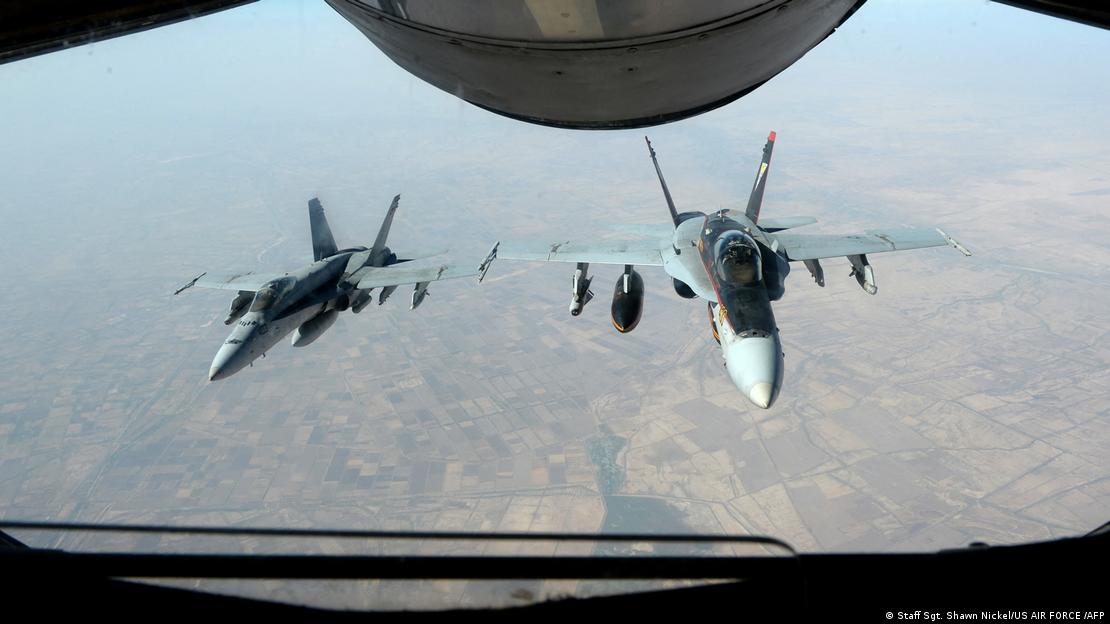
US fighter jets deployed against 'IS': This week Syria joined neighbors, Turkey, Iraq, Jordan and Lebanon, as well as the European Union and NATO, in the global coalition to defeat the 'Islamic State' group
Image: Staff Sgt. Shawn Nickel/US AIR FORCE /AFP
'Islamic State' in Syria still dangerous
So, Syria becoming the 90th member of what is officially called the Global Coalition against Daesh (the organization uses the Arabic acronym for the "IS" group) actually makes sense. It is also a logical move because "IS" remains a threat inside Syria.
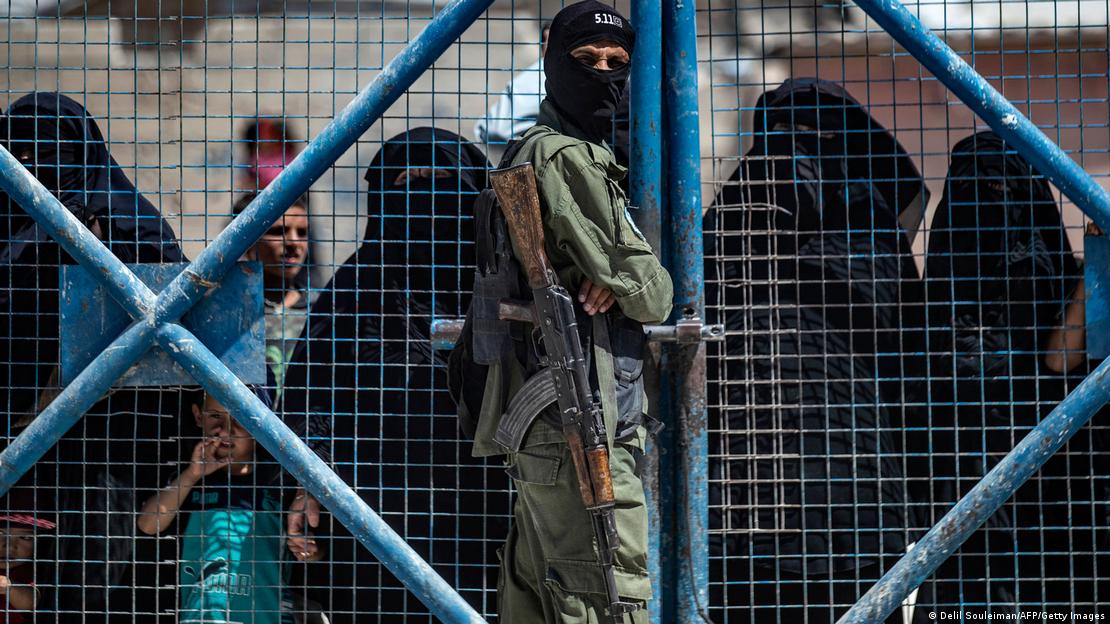
Between 2,500 and 3,000 "IS" loyalists are still in Syria and in the year since the Assad regime was ousted, they have increased their activities.
"[The 'IS' group] thrives on instability and chaos," Tanya Mehra, a researcher at the International Centre for Counter-Terrorism, or ICCT, in the Netherlands, wrote in a recent opinion piece. "The more internal fighting among rebel groups and the more the de facto government has to deal with attacks from neighboring [countries], the more favorable the situation becomes for ISIS," using another common acronym for "IS."
The "IS" group exploited security chaos following the fall of the Assad regime to reestablish presence in parts of Syria it had previously left, researchers at the Washington-based Middle East Institute, or MEI, confirmed in an October analysis.
Syrian media say that the 'IS' group has been activating sleeper cells inside camps housing 'IS' families and fighters, as well as trying to recruit more fighters there
Image: Delil Souleiman/AFP/Getty Images
Extremists' new strategy
The group now operates with much smaller cells, of only around 10 fighters each, who conduct rapid night ambushes or plant improvised explosive devices. Also in "IS's" revised repertoire are lone wolf attacks, blackmail to fund its operations — it apparently offers new recruits $400 (€346) a month in pay — and exploiting the intercommunal divisions that already threaten Syria's stability.
Syrian media reports that the group has been trying to recruit more members and gain favor with locals by targeting former members of the Assad regime. It is trying to sell itself as the only party that will take real revenge and achieve "justice" after 14 years of civil war. The group has also been trying to infiltrate the ranks of the new Syrian security forces, in order to spy, recruit and sell itself there too, Syrian journalists say.
"According to field observers, these developments reflect a shift toward a strategy of 'flexible dormancy,'" the MEI researchers explained, "centered on endurance and disruption rather than territorial control."
As "IS" activities have increased, so have operations by Syrian security forces against it. Last weekend, Syrian security forces conducted over 60 raids around the country, arresting 71 individuals associated with the "IS" group. Some of those raids were reportedly based on information received from the US. And in other cases, too, the Syrians had already been cooperating with the global coalition, well before officially becoming members this week.
A bigger deal than it seems?
There are more implications to Syria joining the global coalition than just the ongoing fight to contain extremist violence.
The move will likely impact Syrian Kurdish groups that control northern parts of Syria and who have been negotiating with the government in Damascus as to how and where they fit into the new Syrian political system.
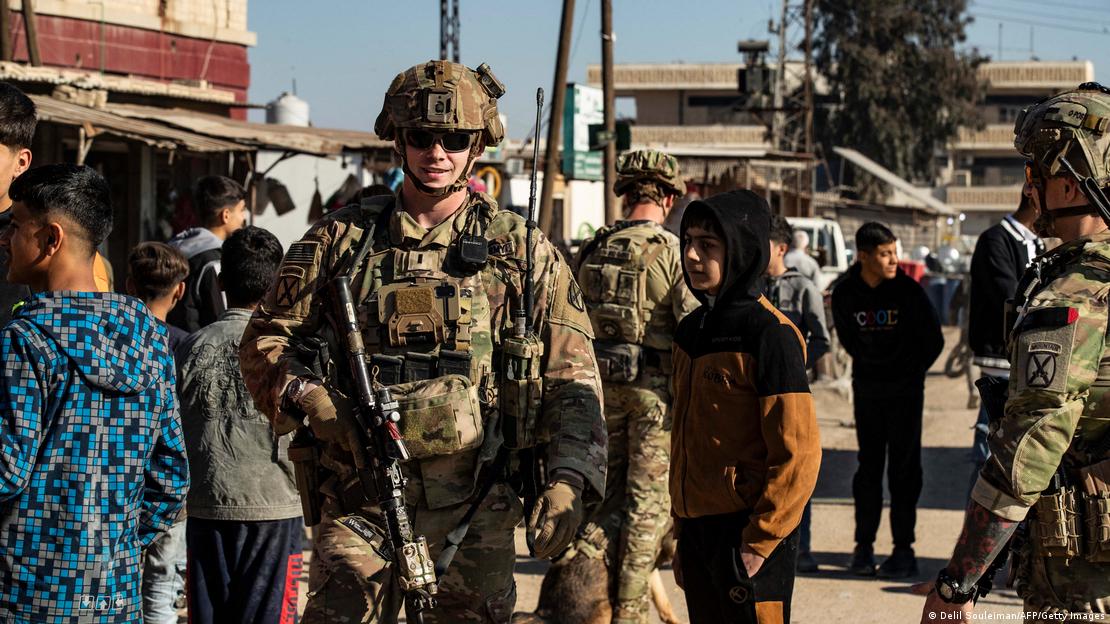
Syria's Kurds were semi-independent throughout the civil war and the main Kurdish group, the Syrian Democratic Forces, or SDF, played an essential role battling the "IS" group between 2014 and 2019. The SDF now manages large camps and several prisons, holding an estimated 45,000 "IS" members and their families.
As a result, the SDF became the US's most important partners on the ground, combatting the "IS" group and receiving funding, arms and training from the Americans.
But now that the Syrian government also plans to play an official part in combatting the "IS" group, that will "undermine the SDF's exclusive status as the coalition's [only] official partner in Syria, thereby weakening its leverage in negotiations with the Syrian government," MEI researchers argued.
But it could also lead to better relations between Damascus and the SDF, the ICCT's Mehra told DW. "The SDF have been crucial in combatting 'IS' and I don't necessarily see al-Sharaa joining the anti-Daesh coalition as a step back," she argues. "The government in Damascus will hopefully rely on integrated SDF fighters who have considerable experience in combatting 'IS.'"
The group now operates with much smaller cells, of only around 10 fighters each, who conduct rapid night ambushes or plant improvised explosive devices. Also in "IS's" revised repertoire are lone wolf attacks, blackmail to fund its operations — it apparently offers new recruits $400 (€346) a month in pay — and exploiting the intercommunal divisions that already threaten Syria's stability.
Syrian media reports that the group has been trying to recruit more members and gain favor with locals by targeting former members of the Assad regime. It is trying to sell itself as the only party that will take real revenge and achieve "justice" after 14 years of civil war. The group has also been trying to infiltrate the ranks of the new Syrian security forces, in order to spy, recruit and sell itself there too, Syrian journalists say.
"According to field observers, these developments reflect a shift toward a strategy of 'flexible dormancy,'" the MEI researchers explained, "centered on endurance and disruption rather than territorial control."
As "IS" activities have increased, so have operations by Syrian security forces against it. Last weekend, Syrian security forces conducted over 60 raids around the country, arresting 71 individuals associated with the "IS" group. Some of those raids were reportedly based on information received from the US. And in other cases, too, the Syrians had already been cooperating with the global coalition, well before officially becoming members this week.
A bigger deal than it seems?
There are more implications to Syria joining the global coalition than just the ongoing fight to contain extremist violence.
The move will likely impact Syrian Kurdish groups that control northern parts of Syria and who have been negotiating with the government in Damascus as to how and where they fit into the new Syrian political system.
Syria's Kurds were semi-independent throughout the civil war and the main Kurdish group, the Syrian Democratic Forces, or SDF, played an essential role battling the "IS" group between 2014 and 2019. The SDF now manages large camps and several prisons, holding an estimated 45,000 "IS" members and their families.
As a result, the SDF became the US's most important partners on the ground, combatting the "IS" group and receiving funding, arms and training from the Americans.
But now that the Syrian government also plans to play an official part in combatting the "IS" group, that will "undermine the SDF's exclusive status as the coalition's [only] official partner in Syria, thereby weakening its leverage in negotiations with the Syrian government," MEI researchers argued.
But it could also lead to better relations between Damascus and the SDF, the ICCT's Mehra told DW. "The SDF have been crucial in combatting 'IS' and I don't necessarily see al-Sharaa joining the anti-Daesh coalition as a step back," she argues. "The government in Damascus will hopefully rely on integrated SDF fighters who have considerable experience in combatting 'IS.'"
Currently there are still around 2,000 American troops in SDF-controlled areas, there to help the Syrian Kurds combat the 'IS' group
Image: Delil Souleiman/AFP/Getty Images
Over the past week, news agency Reuters has also reported rumors that, as a result of Syria joining the coalition, the US might establish a base near Damascus.
Local media reported that a delegation from the global coalition against "IS" visited Al-Seen air base, around 80 kilometers (50 miles) from Damascus in the Syrian desert. There are also rumors that a Trump hotel or tower could be built in Damascus.
Observers say a new US base would put to rest suspicions about al-Sharaa's own previous links to extremist groups in some American quarters, as well as assuage Israeli fears about Syria becoming a threat to it. Such a US presence would also diminish the influence of other countries in Syria, including Iran, Russia and even Turkey.
"This is part of the larger picture … I think it is more than symbolic," Mehra suggests.
"All signs point toward a US vision of integrating the new Syria firmly into the Washington-led regional order," Marc Lynch, a professor of political science and international affairs at George Washington University, wrote in Foreign Policy magazine this week. This "represents one of the shrewdest things the Trump administration has done in the Middle East," Lynch added on his personal blog.
There are basically two main obstacles to this working out, Lynch suggests. Al-Sharaa's ability to navigate intercommunal divisions, including with the SDF, and Israel, the academic says.
"Israel has stood defiantly outside this US-led support for al-Sharaa's state-building efforts," Lynch writes. "If the US really does establish an air base in Damascus, it would quickly be forced to grapple with the fact that the most dangerous and destabilizing external threat to Syria currently is Israel. That makes Syria the unexpected leading edge of the little-noticed emerging divide in priorities between the US and Israel, which could have wide-ranging implications for the regional order," Lynch concluded.
Over the past week, news agency Reuters has also reported rumors that, as a result of Syria joining the coalition, the US might establish a base near Damascus.
Local media reported that a delegation from the global coalition against "IS" visited Al-Seen air base, around 80 kilometers (50 miles) from Damascus in the Syrian desert. There are also rumors that a Trump hotel or tower could be built in Damascus.
Observers say a new US base would put to rest suspicions about al-Sharaa's own previous links to extremist groups in some American quarters, as well as assuage Israeli fears about Syria becoming a threat to it. Such a US presence would also diminish the influence of other countries in Syria, including Iran, Russia and even Turkey.
"This is part of the larger picture … I think it is more than symbolic," Mehra suggests.
"All signs point toward a US vision of integrating the new Syria firmly into the Washington-led regional order," Marc Lynch, a professor of political science and international affairs at George Washington University, wrote in Foreign Policy magazine this week. This "represents one of the shrewdest things the Trump administration has done in the Middle East," Lynch added on his personal blog.
There are basically two main obstacles to this working out, Lynch suggests. Al-Sharaa's ability to navigate intercommunal divisions, including with the SDF, and Israel, the academic says.
"Israel has stood defiantly outside this US-led support for al-Sharaa's state-building efforts," Lynch writes. "If the US really does establish an air base in Damascus, it would quickly be forced to grapple with the fact that the most dangerous and destabilizing external threat to Syria currently is Israel. That makes Syria the unexpected leading edge of the little-noticed emerging divide in priorities between the US and Israel, which could have wide-ranging implications for the regional order," Lynch concluded.
Syria's al-Sharaa to meet Trump at the White Hous 02:04
Cathrin Schaer Author for the Middle East desk.

No comments:
Post a Comment