It’s possible that I shall make an ass of myself. But in that case one can always get out of it with a little dialectic. I have, of course, so worded my proposition as to be right either way (K.Marx, Letter to F.Engels on the Indian Mutiny)
Wednesday, November 12, 2025
SPACE/COSMOS
The Pleiades is part of an enormous stellar complex birthed by the same star-forming event
New research advances our understanding of the Pleiades, or Seven Sisters, stars that have been studied by humans since antiquity
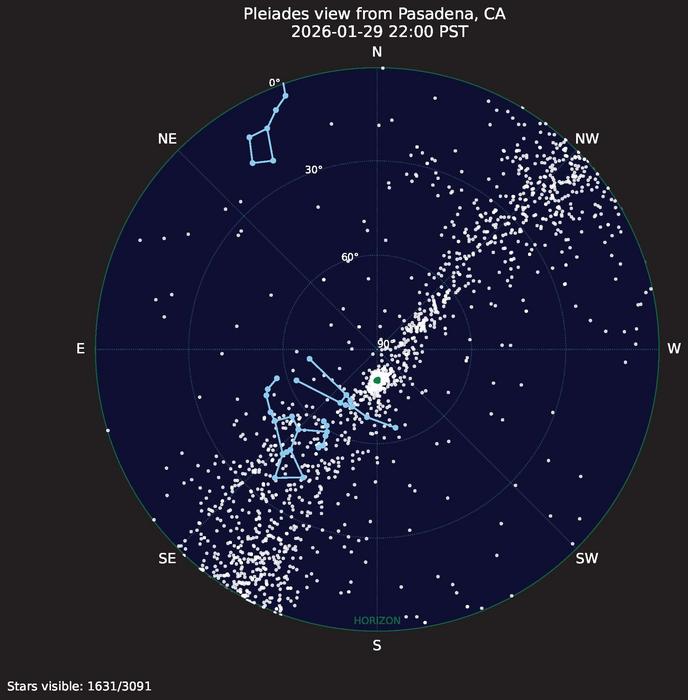
This starmap shows the full extent of the Greater Pleiades Complex as it would appear on the Pasadena night sky if every star in it were visible. Of the 3,019 stars that make up the complex, 1,631 are visible above the horizon. The seven stars that comprise the Pleiades, or Seven Sisters, constellation are shown in green while all the other members of the complex are in white. The Big Dipper, Orion, and Taurus are overlaid in blue.
Credit: Image is courtesy of Andrew Boyle/University of North Carolina Chapel Hill.
Pasadena, CA—New work from a research team including Carnegie’s Luke Bouma demonstrates that the Pleiades star cluster—also known as the Seven Sisters—is part of an enormous stellar complex spread over nearly 2,000 light-years. Their work uses one of the most historically significant stellar clusters to demonstrate a new approach for tracing stellar origins—which have posed long-standing challenges for astronomers.
Stars are born in clouds of dust and gas. Pockets of this material clump together, eventually collapsing in on themselves to create what becomes a star’s hot core. Star formation often happens in bursts, with many stars forming in close proximity and succession.
Groups of stars that formed in the same molecular cloud are called a cluster. They remain gravitationally bound to each other for many millennia. Eventually—tens to hundreds of millions of years after their formation—the star-forming material from which they emerged is ejected from their vicinity by cosmic winds, radiation, and other astrophysical phenomena.
When this occurs, individual stars dissolve into their host galaxy and it can be extremely challenging to identify their relationships and trace the chronology of their origin story, especially after 100 million or more years have passed.
Bouma, along with first author Andrew Boyle and co-author Andrew Mann, both of University of North Carolina Chapel Hill, combined data from NASA's TESS mission, ESA's Gaia spacecraft, and the Sloan Digital Sky Survey (SDSS) to show that the Pleiades cluster constitutes the core of a much larger structure of related stars that are distributed over more than 1,950 light-years.
“We are calling this the Greater Pleiades Complex,” Bouma said. “It contains at least three previously known groups of stars, and likely two more. We were able to determine that most of the members of this structure originated in the same giant stellar nursery.”
The key to their approach is the fact that the speed of a star’s rotation slows as it ages. Their work leveraged a combination of stellar rotation observations from TESS—which was designed to identify exoplanets that transit in front of their host stars—and observations of stellar motion from Gaia—which was designed to map our Milky Way galaxy. Using this information, they developed a new rotation-based way to single out and identify stars that share an origin story.
“It was only by combining data from Gaia, TESS, and SDSS that we were able to confidently identify new members of the Pleiades. On their own, the data from each mission were insufficient to reveal the full extent of the structure. But when we integrated them—linking stellar motions from Gaia, rotations from TESS, and chemistry from SDSS—a coherent picture emerged,” Boyle explained. “It was like assembling a jigsaw puzzle, where each dataset provided a different piece of the larger puzzle.”
Beyond having similar ages, the team demonstrated that the stars in the Greater Pleiades Complex have similar chemical compositions, and that the stars used to be closer together. Data from the Sloan Digital Sky Survey’s fifth generation, directed by Carnegie’s Juna Kollmeier, was used for chemical abundance analysis.
“The Pleiades has played a central role in human observations of the stars since antiquity,” Bouma concluded. “This work marks a big step toward understanding how the Pleiades has changed since it was born one hundred million years ago.”
Looking ahead their methodology can be used to age-date hundreds of thousands of stars in our neighborhood of the galaxy.
Astronomers at the University of North Carolina at Chapel Hill have discovered that the famous Pleiades star cluster, the “Seven Sisters” often spotted on winter nights, is just the bright tip of a much larger stellar family. By combining data from NASA’s Transiting Exoplanet Survey Satellite (TESS) and the European Space Agency’s Gaia space telescope, the team uncovered thousands of hidden siblings spread across the sky, a sprawling structure they call the Greater Pleiades Complex. The discovery shows the Pleiades is 20 times larger than previously thought.
Most stars, including our own Sun, are born in groups. Over time, these stellar siblings drift apart, making it difficult to trace their origins. Using stellar spin rates as a “cosmic clock,” young stars spin quickly, while older stars rotate more slowly. The UNC-Chapel Hill team identified long-lost members of the Pleiades scattered across the sky. By combining rotation measurements from NASA’s TESS with precise position and motion data from ESA’s Gaia, the researchers redefined the Pleiades not as a small star cluster but as the dense heart of a vast, dissolving stellar association.
“This study changes how we see the Pleiades—not just seven bright stars, but thousands of long-lost siblings scattered across the whole sky,” said Andrew Boyle, lead author and graduate student in physics and astronomy at UNC-Chapel Hill.
The findings have broad implications. The Pleiades is not only an astrophysical benchmark for young stars and exoplanets but also a cultural touchstone featured worldwide in the Old Testament and Talmud, celebrated as Matariki in New Zealand, and even represented by the logo of Subaru in Japan. “We’re realizing that many stars near the Sun are part of massive extended stellar families with complex structures,” said Andrew Mann, co-author and professor of physics and astronomy at UNC-Chapel Hill. “Our work provides a new way to uncover these hidden relationships.”
By tracking stellar rotation, the team’s approach offers a fresh framework for mapping our cosmic neighborhood. The researchers anticipate that many seemingly independent star clusters are in fact parts of sprawling stellar families. Future studies using this method could even help astronomers trace the origins of the Sun itself, uncovering whether it, too, was born in a much larger stellar family.
“By measuring how stars spin, we can identify stellar groups too scattered to detect with traditional methods—opening a new window into the hidden architecture of our Galaxy,” Boyle said.
This research aids in efforts to reconstruct the birth environments of stars and planets, an essential step toward understanding how solar systems, including our own, form and evolve.
Abu Dhabi, UAE, November 12, 2025: Scientists from New York University Abu Dhabi (NYUAD) have uncovered new evidence that water once flowed beneath the surface of Mars, revealing that the planet may have remained habitable for life much longer than previously thought.
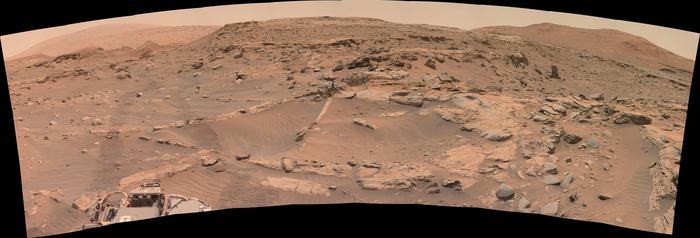
The study, published in theJournal of Geophysical Research – Planets, shows that ancient sand dunes in Gale Crater, a region explored by NASA’s Curiosity rover, gradually turned into rock after interacting with underground water billions of years ago.
Led by Dimitra Atri, Principal Investigator of NYUAD’s Space Exploration Laboratory, with research assistant Vignesh Krishnamoorthy, the research team compared data from the Curiosity rover with rock formations in the UAE desert that formed under similar conditions on Earth.
They found that water from a nearby Martian mountain once seeped into the dunes through tiny cracks, soaking the sand from below and leaving behind minerals such as gypsum, the same mineral found in Earth’s deserts. These minerals can trap and preserve traces of organic material, making them valuable targets for future missions seeking evidence of past life.
“Our findings show that Mars didn’t simply go from wet to dry,” said Atri. “Even after its lakes and rivers disappeared, small amounts of water continued to move underground, creating protected environments that could have supported microscopic life.”
The discovery provides new insight into how Mars evolved over time and highlights the potential of subsurface environments as promising sites to search for signs of ancient life.
Supported by the NYUAD Research Institute, the study was conducted at NYUAD’s Center for Astrophysics and Space Science, which leads innovative research to advance understanding of the universe and contribute to the UAE’s growing role in global space exploration. This study was conducted in collaboration with James Weston of NYUAD’s Core Technology Platform and Panče Naumov’s research group.
Times Higher Education ranks NYU among the world’s top 31 universities, making NYU Abu Dhabi the highest globally ranked university in the UAE. Alumni achievements include 24 Rhodes Scholars, underscoring the caliber of talent nurtured at the University. On the faculty and research front, NYUAD now has four Nobel Laureates and established more than 90 faculty labs and projects, producing over 9,500 internationally recognized publications. According to the Nature Index, NYUAD ranks number one in the UAE for publications in the world’s top science journals.
ENDS
About NYU Abu Dhabi
www.nyuad.nyu.edu NYU Abu Dhabi is the first comprehensive liberal arts and research campus in the Middle East to be operated abroad by a major American research university. Times Higher Education ranks NYU among the top 31 universities in the world, making NYU Abu Dhabi the highest globally ranked university in the UAE. NYU Abu Dhabi has integrated a highly selective undergraduate curriculum across the disciplines with a world center for advanced research and scholarship. The university enables its students in the sciences, engineering, social sciences, humanities, and arts to succeed in an increasingly interdependent world and advance cooperation and progress on humanity’s shared challenges. NYU Abu Dhabi’s high-achieving students have come from over 120 countries and speak over 100 languages. Together, NYU's campuses in New York, Abu Dhabi, and Shanghai form the backbone of a unique global university, giving faculty and students opportunities to experience varied learning environments and immersion in other cultures at one or more of the numerous study-abroad sites NYU maintains on six continents.
Aeolian Sediment Lithification From Late-Stage Aqueous Activity in the Gale Crater: Implications for Habitability on Mars
Article Publication Date
10-Nov-2025
The Bright Side: Scientists witness supernova's early stages for the first time
Scientists have observed the early stages of a star's violent death – a supernova – for the first time. The shape of these cosmic explosions has been hard to specify until now because of how rapidly they take place.
Scientists have observed for the first time the very early stages of a supernova, the explosive death of a star that is one of the most violent cosmic events.
The researchers used the European Southern Observatory's Chile-based Very Large Telescope, or VLT, to observe the supernova, which involved a star roughly 15 times the mass of our sun residing in a galaxy called NGC 3621 about 22 million light-years from Earth in the direction of the constellation Hydra.
A light-year is the distance light travels in a year, 9.5 trillion kilometres.
The shape of such explosions has been hard to nail down until now because of how rapidly they take place, so it took quick action with this supernova.
The explosion was detected on April 10, 2024, around the time astrophysicist Yi Yang of Tsinghua University in China had landed on a long flight to San Francisco.
Yang's formal request, just hours later, to aim the VLT at the supernova was granted.
The researchers thus were able to observe the explosion just 26 hours after the initial detection and 29 hours after material from inside the star first broke through the stellar surface.
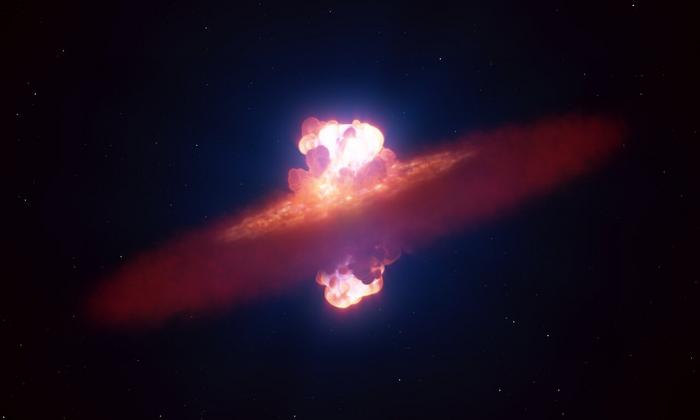
What they saw was the doomed star surrounded at its equator by a preexisting disk of gas and dust, with the explosion pushing material outward from the stellar core to distort the star's shape into one resembling a vertical-standing olive.
The explosion notably did not blow the star apart in a spherical shape.
Instead, the explosion pushed violently outward at opposite sides of the star.
"The geometry of a supernova explosion provides fundamental information on stellar evolution and the physical processes leading to these cosmic fireworks," said Yang, lead author of the study published on Wednesday in the journal Science Advances.
"The exact mechanisms behind supernova explosions of massive stars, those with more than eight times the mass of the sun, are still debated and are one of the fundamental questions scientists want to address," Yang said. 600 times greater than the sun
Big stars like those live relatively short lives. This one, a type called a red supergiant, was about 25 million years old at the time of its demise. In comparison, the sun is more than 4.5 billion years old and has a few more billion years to go.
At the time it exploded, this star's diameter was 600 times greater than the sun. Some of the star's mass was blown into space in the explosion.
The remainder is believed to have become a neutron star, a highly compact stellar remnant, according to study co-author Dietrich Baade, a Germany-based astrophysicist at the European Southern Observatory.
When a star exhausts the hydrogen fuel for the nuclear fusion occurring at its centre, its core collapses, which then sends material blasting outward, penetrating the stellar surface and into space.
"The first VLT observations captured the phase during which matter accelerated by the explosion near the centre of the star shot through the star's surface, the photosphere," Yang said.
"Once the shock breaks through the surface, it unleashes immense amounts of energy. The supernova then brightens dramatically and becomes observable. During a short-lived phase, the supernova's initial 'breakout' shape can be studied before the explosion interacts with the material surrounding the dying star," Yang said.
This shape, Yang said, offers clues about how the explosion was triggered at the heart of the star. The new observations seem to rule out some current scientific models of the explosion process, Yang said, as scientists refine their understanding of the deaths of massive stars.
(FRNCE 24 with Reuters)
First confirmed sighting of giant explosion on nearby star
Astronomers using the European Space Agency’s XMM-Newton space observatory and the LOFAR telescopehave definitively spotted an explosive burst of material thrown out into space by another star – a burst powerful enough to strip away the atmosphere of any unlucky planet in its path.
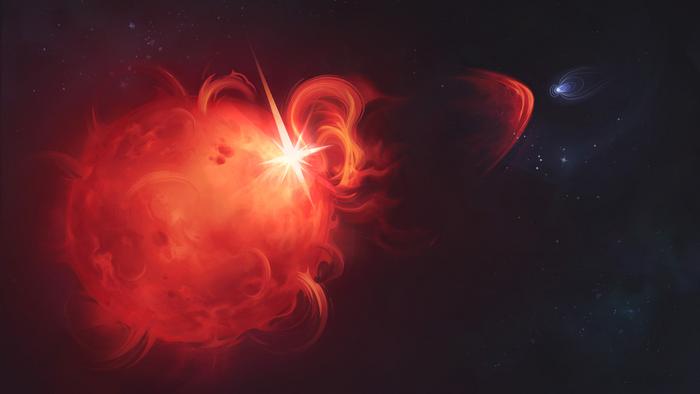
The burst was a coronal mass ejection (CME), eruptions we often see coming from the Sun. During a CME, massive amounts of material are flung out from our star, flooding the surrounding space. These dramatic expulsions shape and drive space weather, such as the dazzling auroras we see on Earth, and can chip away at the atmospheres of any nearby planets.
“Astronomers have wanted to spot a CME on another star for decades,” says Joe Callingham of the Netherlands Institute for Radio Astronomy (ASTRON), author of the new research published in Nature. “Previous findings have inferred that they exist, or hinted at their presence, but haven’t actually confirmed that material has definitively escaped out into space. We’ve now managed to do this for the first time.”
As a CME travels through the layers of a star out into interplanetary space, it produces a shock wave and associated burst of radio waves (a type of light). This short, intense radio signal was picked up by Joe and colleagues and found to come from a star lying around 40 light-years away (just under 15 times the diameter of the Solar System, close by cosmic standards).
“This kind of radio signal just wouldn’t exist unless material had completely left the star’s bubble of powerful magnetism,” adds Joe. “In other words: it’s caused by a CME.”
A danger to any planets
The matter-flinging star is a red dwarf – a type of star far fainter, cooler, and smaller than the Sun. It is nothing like our own star: it has roughly half the mass, it rotates 20 times faster, and has a magnetic field 300 times more powerful. Most of the planets known to exist in the Milky Way orbit this kind of star.
The radio signal was spotted using the Low Frequency Array (LOFAR) radio telescope thanks to new data processing methods developed by co-authors Cyril Tasse and Philippe Zarka at the Observatoire de Paris-PSL. The team then used ESA’s XMM-Newton to determine the star’s temperature, rotation, and brightness in X-ray light. This was essential to interpret the radio signal and figure out what was actually going on.
“We needed the sensitivity and frequency of LOFAR to detect the radio waves,” says co-author David Konijn, a PhD student working with Joe at ASTRON. “And without XMM-Newton, we wouldn’t have been able to determine the CME’s motion or put it in a solar context, both crucial for proving what we’d found. Neither telescope alone would have been enough – we needed both.”
The researchers determined the CME to be moving at a super-fast 2400 km per second, a speed only seen in 1 of every 20 CMEs taking place on the Sun. The ejection was both fast and dense enough to completely strip away the atmospheres of any planets closely orbiting the star.
In search of life
The atmosphere-stripping ability of the CME is an exciting discovery for our hunt for life around other stars. A planet’s habitability for life as we know it is defined by its distance from its parent star – whether or not it sits within the star’s ‘habitable zone’, a region where liquid water can exist on the surface of planets with suitable atmospheres. This is a Goldilocks scenario: too close to the star is too hot, too far is too cold, and in between is just right.
But what if that star is especially active, regularly throwing out dangerous eruptions of material and triggering violent storms? A planet regularly bombarded by powerful coronal mass ejections may lose its atmosphere entirely, leaving a barren rock behind – an uninhabitable world, despite its orbit being ‘just right’.
“This work opens up a new observational frontier for studying and understanding eruptions and space weather around other stars,” adds Henrik Eklund, an ESA research fellow based at the European Space Research and Technology Centre (ESTEC) in Noordwijk, The Netherlands.
“We’re no longer limited to extrapolating our understanding of the Sun's CMEs to other stars. It seems that intense space weather may be even more extreme around smaller stars – the primary hosts of potentially habitable exoplanets. This has important implications for how these planets keep hold of their atmospheres and possibly remain habitable over time.”
The finding also informs our understanding of space weather, something that’s long been a focus for ESA missions and is currently being explored by SOHO, the Proba missions, Swarm, and Solar Orbiter.
XMM-Newton, meanwhile, is a leading explorer of the hot and extreme Universe. Launched in 1999, the space telescope has gazed into the cores of galaxies, studied stars to understand how they evolve, investigated the environs of black holes, and spotted intense bursts of energetic radiation from distant stars and galaxies.
“XMM-Newton is now helping us discover how CMEs vary by star, something that’s not only interesting in our study of stars and our Sun, but also our hunt for habitable worlds around other stars,” says ESA XMM-Newton Project Scientist Erik Kuulkers. “It also demonstrates the immense power of collaboration, which underpins all successful science. The discovery was a true team effort, and resolves the decades-long search for CMEs beyond the Sun.”
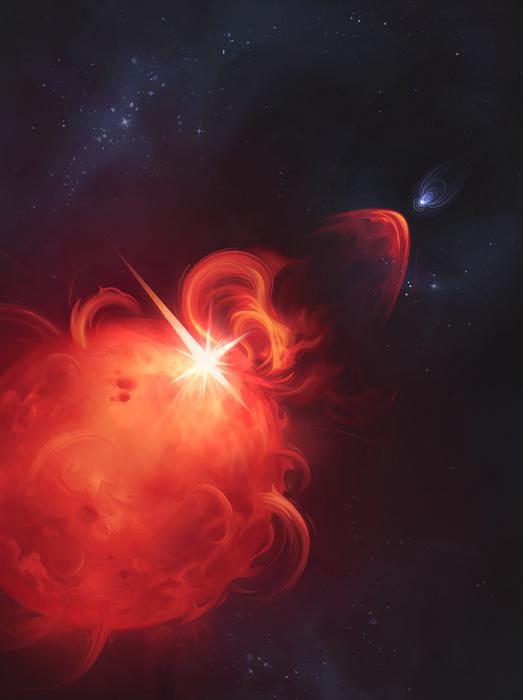
An artist’s impression of a large red star releasing a bright, explosive burst of light. Swirling red and orange patterns surround the star, suggesting intense activity. In the background, a smaller blue planet appears with a faint, wispy trail extending away from it, indicating its atmosphere being blown off. The scene is set against a dark space backdrop dotted with stars.
An artist’s impression of a large red star releasing a bright, explosive burst of light. Swirling red and orange patterns surround the star, suggesting intense activity. In the background, a smaller blue planet appears with a faint, wispy trail extending away from it, indicating its atmosphere being blown off. The scene is set against a dark space backdrop dotted with stars.
This artist’s impression shows a star going supernova. About 22 million light-years away the supernova, SN 2024ggi, exploded in the galaxy NGC 3621. Using the ESO’s Very Large Telescope, astronomers managed to capture the very early stage of the supernova when the blast was breaking through the star’s surface. Observing the breakout so early on — 26 hours after the supernova was first detected — revealed its true shape. The supernova broke out in an olive-like form. This marks the first ever observation of the shape of a supernova explosion at this very early stage.
Swift observations with the European Southern Observatory’s Very Large Telescope (ESO’s VLT) have revealed the explosive death of a star just as the blast was breaking through the star’s surface. For the first time, astronomers unveiled the shape of the explosion at its earliest, fleeting stage. This brief initial phase wouldn’t have been observable a day later and helps address a whole set of questions about how massive stars go supernova.
When the supernova explosion SN 2024ggi was first detected on the night of 10 April 2024 local time, Yi Yang, an assistant professor at Tsinghua University in Beijing, China, and the lead author of the new study, had just landed in San Francisco after a long-haul flight. He knew he had to act quickly. Twelve hours later, he had sent an observing proposal to ESO, which, after a very quick approval process, pointed its VLT telescope in Chile at the supernova on 11 April, just 26 hours after the initial detection.
SN 2024ggi is located in the galaxy NGC 3621 in the direction of the constellation Hydra ‘only’ 22 million light-years away, close by in astronomical terms. With a large telescope and the right instrument, the international team knew they had a rare opportunity to unravel the shape of the explosion shortly after it happened. “The first VLT observations captured the phase during which matter accelerated by the explosion near the centre of the star shot through the star’s surface. For a few hours, the geometry of the star and its explosion could be, and were, observed together,” says Dietrich Baade, an ESO astronomer in Germany, and co-author of the study published today in Science Advances.
“The geometry of a supernova explosion provides fundamental information on stellar evolution and the physical processes leading to these cosmic fireworks,” Yang explains. The exact mechanisms behind supernova explosions of massive stars, those with more than eight times the mass of the Sun, are still debated and are one of the fundamental questions scientists want to address. This supernova’s progenitor was a red supergiant star, with a mass 12 to 15 times that of the Sun and a radius 500 times larger, making SN 2024ggi a classical example of a massive-star explosion.
We know that during its life a typical star keeps its spherical shape as a result of a very precise equilibrium of the gravitational force that wants to squeeze it and the pressure of its nuclear engine that wants to expand it. When it runs out of its last source of fuel, the nuclear engine starts sputtering. For massive stars this marks the beginning of a supernova: the core of the dying star collapses, the mass shells around fall onto it and bounce off. This rebound shock then propagates outward, disrupting the star.
Once the shock breaks through the surface, it unleashes immense amounts of energy — the supernova then brightens dramatically and becomes observable. During a short-lived phase, the supernova’s initial ‘breakout’ shape can be studied before the explosion interacts with the material surrounding the dying star.
This is what astronomers have now achieved for the very first time with ESO's VLT, using a technique called ‘spectropolarimetry’. “Spectropolarimetry delivers information about the geometry of the explosion that other types of observation cannot provide because the angular scales are too tiny,” says Lifan Wang, co-author and professor at the Texas A&M University in the US, who was a student at ESO at the start of his astronomy career. Even though the exploding star appears as a single point, the polarisation of its light carries hidden clues about its geometry, which the team were able to unravel. [1]
The only facility in the southern hemisphere capable of capturing the shape of a supernova through such a measurement is the FORS2 instrument installed on the VLT. With the FORS2 data, the astronomers found that the initial blast of material was shaped like an olive. As the explosion spread outwards and collided with the matter around the star, the shape flattened but the axis of symmetry of the ejecta remained the same. "These findings suggest a common physical mechanism that drives the explosion of many massive stars, which manifests a well-defined axial symmetry and acts on large scales,” according to Yang.
With this knowledge astronomers can already rule out some of the current supernova models and add new information to improve other ones, providing insights into the powerful deaths of massive stars. "This discovery not only reshapes our understanding of stellar explosions, but also demonstrates what can be achieved when science transcends borders,” says co-author and ESO astronomer Ferdinando Patat. “It’s a powerful reminder that curiosity, collaboration, and swift action can unlock profound insights into the physics shaping our Universe."
Notes
[1] Light particles (photons) have a property called polarisation. In a sphere, the shape of most stars, the polarisation of the individual photons cancels out so that the net polarisation of the object is zero. When astronomers measure a non-zero net polarisation, they can use that measurement to infer the shape of the object — a star or a supernova — emitting the observed light.
More information
This research was presented in a paper to appear in Science Advances (doi: 10.1126/sciadv.adx2925).
The team is composed of Y. Yang (Department of Physics, Tsinghua University, China [Tsinghua University]), X. Wen (School of Physics and Astronomy, Beijing Normal University, China [Beijing Normal University] and Tsinghua University), L. Wang (Department of Physics and Astronomy, Texas A&M University, USA [Texas A&M University] and George P. and Cynthia Woods Mitchell Institute for Fundamental Physics & Astronomy Texas A&M University, USA [IFPA Texas A&M University]), D. Baade (European Organisation for Astronomical Research in the Southern Hemisphere, Germany [ESO]), J. C. Wheeler (University of Texas at Austin, USA), A. V. Filippenko (Department of Astronomy, University of California, Berkeley, USA [UC Berkeley] and Hagler Institute for Advanced Study, Texas A&M University, USA), A. Gal-Yam (Department of Particle Physics and Astrophysics, Weizmann Institute of Science, Israel), J. Maund (Department of Physics, Royal Holloway, University of London, United Kingdom), S. Schulze (Center for Interdisciplinary Exploration and Research in Astrophysics, Northwestern University, USA), X. Wang (Tsinghua University), C. Ashall (Department of Physics, Virginia Tech, USA and Institute for Astronomy, University of Hawai’i at Manoa, USA), M. Bulla (Department of Physics and Earth Science, University of Ferrara, Italy and INFN, Sezione di Ferrara, Italy and INAF, Osservatorio Astronomico d’Abruzzo, Italy), A. Cikota (Gemini Observatory/NSF NOIRLab, Chile), H. Gao (Beijing Normal University and Institute for Frontier in Astronomy and Astrophysics, Beijing Normal University, China), P. Hoeflich (Department of Physics, Florida State University, USA), G. Li (Tsinghua University), D. Mishra (Texas A&M University and IFPA Texas A&M University), Ferdinando Patat (ESO), K. C. Patra (California and Department of Astronomy & Astrophysics, University of California, Santa Cruz, USA), S. S. Vasylyev (UC Berkeley), S. Yan (Tsinghua University).
The European Southern Observatory (ESO) enables scientists worldwide to discover the secrets of the Universe for the benefit of all. We design, build and operate world-class observatories on the ground — which astronomers use to tackle exciting questions and spread the fascination of astronomy — and promote international collaboration for astronomy. Established as an intergovernmental organisation in 1962, today ESO is supported by 16 Member States (Austria, Belgium, Czechia, Denmark, France, Finland, Germany, Ireland, Italy, the Netherlands, Poland, Portugal, Spain, Sweden, Switzerland and the United Kingdom), along with the host state of Chile and with Australia as a Strategic Partner. ESO’s headquarters and its visitor centre and planetarium, the ESO Supernova, are located close to Munich in Germany, while the Chilean Atacama Desert, a marvellous place with unique conditions to observe the sky, hosts our telescopes. ESO operates three observing sites: La Silla, Paranal and Chajnantor. At Paranal, ESO operates the Very Large Telescope and its Very Large Telescope Interferometer, as well as survey telescopes such as VISTA. Also at Paranal, ESO will host and operate the south array of the Cherenkov Telescope Array Observatory, the world’s largest and most sensitive gamma-ray observatory. Together with international partners, ESO operates ALMA on Chajnantor, a facility that observes the skies in the millimetre and submillimetre range. At Cerro Armazones, near Paranal, we are building “the world’s biggest eye on the sky” — ESO’s Extremely Large Telescope. From our offices in Santiago, Chile we support our operations in the country and engage with Chilean partners and society.
France and Europe must be prepared to defend their interests in the orbit too, the French leader is expected to say on Wednesday, as space becomes a key element in the global struggle for security.
Lasers, electromagnetic jammers, and other patrol satellites are among the military assets France seeks to bolster as part of its "national space strategy" set to be unveiled on Wednesday by President Emmanuel Macron.
The French leader will deliver his speech from the southern city of Toulouse where the country's space agency (CNES) and leading aerospace companies, including Airbus, are based. There, he will also inaugurate a new building in which 500 military officers work on space operations.
"Space is no longer a peaceful place," the French presidential palace said ahead of the visit.
"Space is a place of conflict, increasingly intense conflict, which follows the increase in the number of satellites in orbit and is also the subject of extremely aggressive challenges from our competitors, including Russia," it added.
Among these aggressive behaviours are the use by competitors of satellites that move close to French assets in order to spy on them. But jamming or blinding capabilities, as well as weapons placed in orbit or fired from the ground that aim to destroy or at least damage national assets, are also increasingly being used.
"The latest information that can be revealed about the threat posed by Russia in particular is the deployment of nuclear weapons into orbit as part of a programme called Sputnik S," the Elysée also said.
Attacks on satellites 'can paralyse entire nations'
These behaviours can have damaging consequences for the entire space ecosystem as they can lead to space debris that can then incapacitate civilian and scientific assets.
France is developing new capabilities to counter these threats, including a variety of lasers and electromagnetic jammers in different frequency ranges that can destroy enemy observation satellites, the Elysée said.
Patrol and surveillance satellites should meanwhile be operational in 2027. These will act like "small fighter jets", the presidential palace added, as they will be able to get close to unfriendly space assets to jam or spy on them.
Despite the overall strategy being aimed at maintaining a strategic autonomy in the sector - by modernising national assets, facilitating investments and the growth of domestic start-ups, and enticing young people into the sector - Macron is nonetheless expected to call for more European cooperation in the domain.
Germany, due to co-organise a global summit on space in April next year alongside France, has already announced it will invest €35 billion in space projects before the end of the decade.
Defence Minister Boris Pistorius warned when he announced the package in late September that "the conflicts of the future will no longer be confined to the Earth".
"Satellite networks are the Achilles' heel of modern societies. Attacks on them can paralyse entire nations," he added, flagging that as he was speaking,two German satellites were being tracked by Russian reconnaissance satellites.
The money will go towards building satellite constellations as well as "offensive capabilities", Pistorius said.
European Space Shield
The European Commission has meanwhile put forward aDefence Readiness plan to rearm Europe before the end of the decade, when some intelligence agencies believe Russia could be in a position to attack another European country.
The roadmap aims to see member states invest up to €800 billion in defence before 2030, with a European Space Shield identified as one of four flagship projects to be prioritised for financing. The shield is being described as key to ensuring the protection of resilience of member states' space assets and services.
The Commission will release a dedicated communication on the European Space Shield next year, Defence and Space Commissioner Andrius Kubilius told European lawmakers last week.
Additionally, the Commission has tabled €131 billion for defence and space in its proposal for the bloc's next budget for the 2028-2034 period, of which about €60-€70 billion will go towards defence and the rest to space, according to Commissioner Kubilius.
Life in Space: A Beginner’s Guide to Life in the Universe
Exploring one of science’s most exciting frontiers, Life in Space bridges astrophysics and biology to uncover the conditions that make life possible — on Earth and beyond. Designed for students and general readers alike, it introduces the emerging field of astrobiology through vivid explanations, real-world examples, and ethical reflections on humanity’s role in the cosmos. From the detection of habitable planets to the search for biosignatures and intelligent life, the book offers a captivating, comprehensive view of life’s place in the universe.
[Hebrew University of Jerusalem]– Life in Space: Astrobiology for Nonscientists invites readers on an accessible, interdisciplinary journey through one of science’s most captivating frontiers: the search for life beyond Earth. Co-authored by astrophysicist Dr. Amri Wandel and biologist Dr. Joseph Gale, both from the Hebrew University of Jerusalem, the book blends the cosmic with the cellular, tracing how astronomical and biological forces intersect to create and sustain life.
Beyond exploring the mysteries of the universe, Life in Space answers two important educational needs. The first is to provide a comprehensive undergraduate textbook for teaching astrobiology to students of all backgrounds and levels and anyone intrigued by the prospects for extraterrestrial life but may lack the tools to assess their scientific significance.
The second is to serve as a clear and engaging introduction to science itself for anyone interested in how scientific reasoning works, from curious readers to policymakers who encounter science in their daily work. Through astrobiology, which draws on disciplines ranging from physics and astronomy to biology and medicine, the book offers an accessible gateway to understanding the scientific method.
Drawing on over two decades of teaching at the Hebrew University, the authors transform the complex science of astrobiology into a clear and engaging narrative for students and curious readers alike. From the chemistry of life’s origins and the detection of habitable planets to the ethical questions of space exploration, Life in Space spans the vastness of the cosmos and the intricacies of life on Earth.
Structured as an introductory undergraduate textbook, the volume offers readers a panoramic view of a field that unites astronomy, physics, chemistry, biology, and philosophy. Each chapter ends with concise take-home lessons and suggestions for further reading, encouraging critical thinking about both scientific discovery and humanity’s place in the universe.
“Understanding astrobiology means understanding ourselves,” the authors note. “The same cosmic and geological processes that made life possible on Earth may one day help us discover it elsewhere.”
Published by Springer Nature (2025), the book offers an up-to-date overview of the latest space missions, planetary discoveries, and biosignature research, while reflecting on how Earth’s own climate and environment continue to evolve.
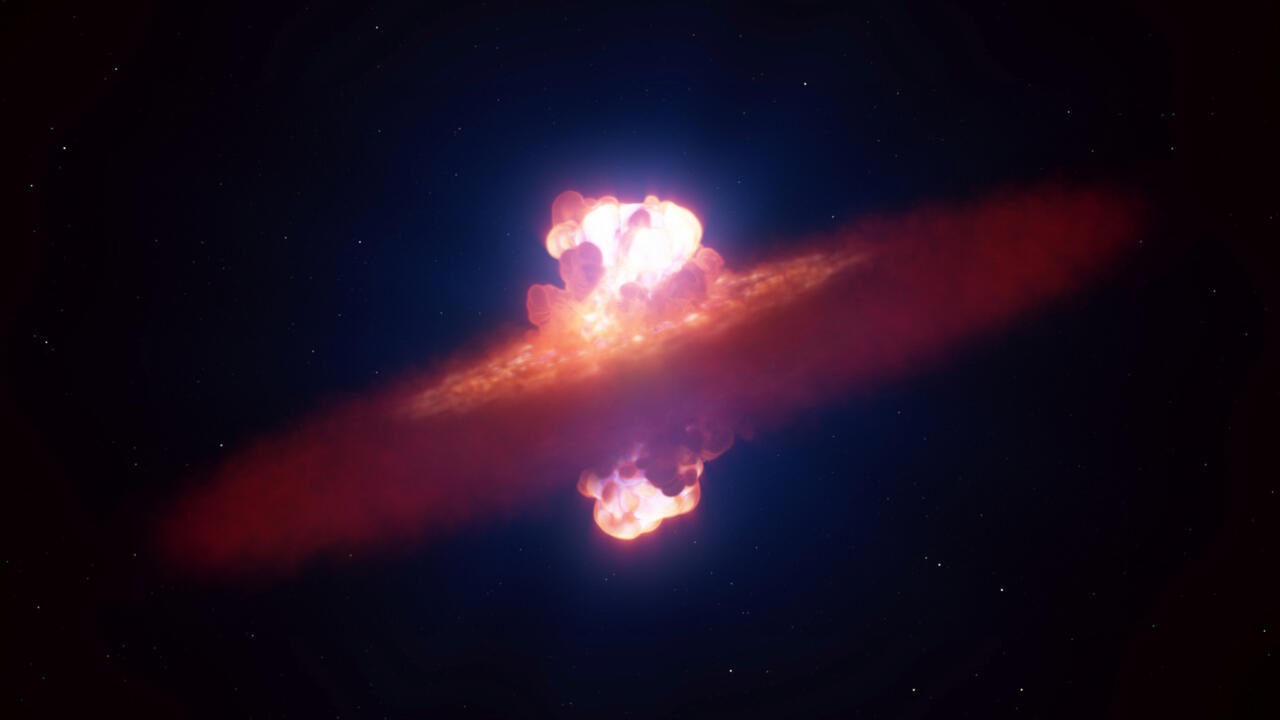 An artist's impression shows a star exploding at the end of its lifecycle, called a supernova, in this handout image released by the European Southern Observatory on November 12, 2025. © L. Calcada, ESO via Reuters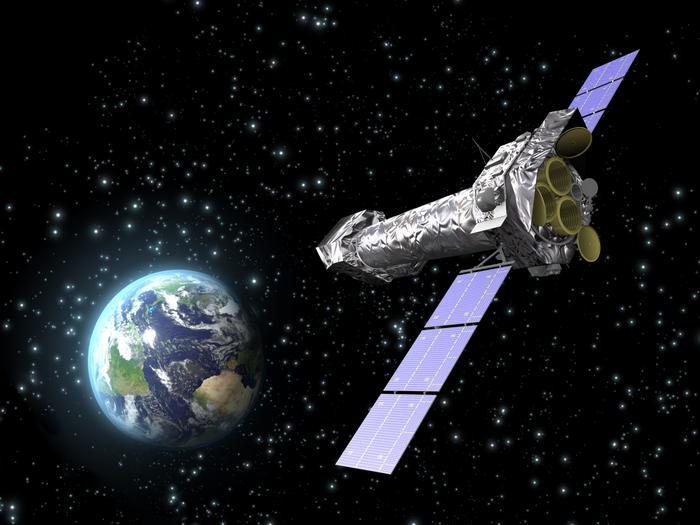


No comments:
Post a Comment