The future of corals – what X-rays can tell us
How exactly does the increasing acidification of the oceans in the wake of the climate crisis affects skeleton formation in corals? Tali Mass and Paul Zaslansky investigated it
Helmholtz-Zentrum Berlin für Materialien und Energie
image:
Tali Mass is an experienced diver. Here she is securing the nets to collect planula larvae after the corals have spawned.
view moreCredit: Hagai Nativ
Journal
Advanced Science
Method of Research
Experimental study
Subject of Research
Animal tissue samples
Article Title
4D Insights into Coral Biomineralization: Effects of Ocean Acidification on the Early Skeleton Development of a Stony Coral.
Stony corals in the Red Sea are rich ecosystems, hosting various fish and other marine organisms. The reef is formed by countless coral animals (polyps). The corals live symbiotically with certain algae, which give them their vibrant colour.
Credit
Tali Mass
Tali Mass
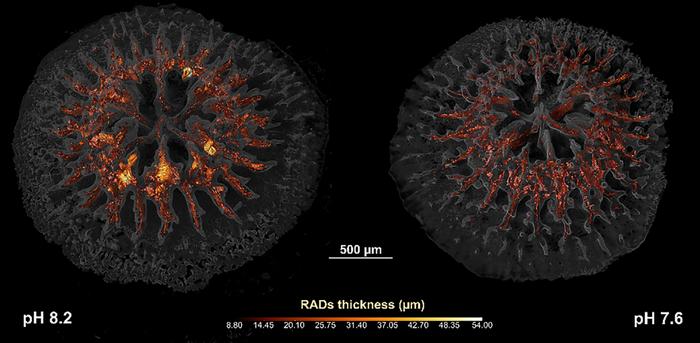
The tomographic reconstruction shows the 3D architecture of RADs (red/yellow) and TDs (semi-transparent gray) in coral primary polyps grown under normal (pH 8.2, left picture) and conditions of severe ocean acidification(pH 7.6, right picture).
Credit
Advanced Science (2025), DOI: 10.1002/advs.202508585
Advanced Science (2025), DOI: 10.1002/advs.202508585
Credit
Advanced Science (2025), DOI: 10.1002/advs.202508585
Advanced Science (2025), DOI: 10.1002/advs.202508585

No comments:
Post a Comment