COP30: 'Climate conference of truth' in Brazil?
Tim Schauenberg
Brazil's chance to lead amid uncertainty
For Brazil under President Lula, the conference is a top priority as it showcases the nation's ability to couple sustainable development with economic progress and take a leading role on the world stage.
Global uncertainty related to increasing trade conflicts, the war in Ukraine, and the situation in Gaza has unduly impacted multilateral climate policy. Meanwhile, the US, the world's second-largest greenhouse gas emitter, withdrew from the Paris climate agreement when Donald Trump took office and has since rolled back climate protections.
Observers view upcoming negotiations with concern
"It is important to have a host for the negotiations who inspires confidence in all countries," says Niklas Höhne of Climate Action Tracker — a consortium of German and international think tanks that examine how national climate targets are being implemented.
At the start of the conference, Brazil will present an initiative to protect tropical forests, which are particularly important for climate regulation and biodiversity: the Tropical Forest Forever Facility.

Tim Schauenberg One of DW's climate reporters, Tim Schauenberg is based in Brussels and Münster.twitter handle: tim_schauen
Tim Schauenberg
DW
November 10, 2025
At the COP30 climate summit, nations will again try to agree on targets to limit catastrophic global temperature rise. But many barriers remain before steep greenhouse gas cuts are realized.

At the COP30 climate summit, nations will again try to agree on targets to limit catastrophic global temperature rise. But many barriers remain before steep greenhouse gas cuts are realized.

With the world having breached the 1.5C global warming limit set in Paris, can the Brazil COP30 agree on greater climate ambition?
Image: Eraldo Peres/AP Photo/picture alliance
Two cruise ships are bobbing quietly in the specially expanded port near the city of Belem in northern Brazil on the edge of the Amazon. They will serve as alternative accommodation for more than 10,000 participants at this year's climate conference.
Between 40,000 and 50,000 people, including heads of state and government from almost 200 countries, are expected to attend the 30th UN Climate Change Conference, COP30, to discuss measures for greater climate protection.
From converted strip clubs to multi-story steamboats, Belem had to get creative with accommodation due to a lack of available rooms and high prices.
Belem is a symbolic choice of location for the summit due to its proximity to the Amazon, a region that is vital for both the regional and global climate — even as forest fires, droughts, and changing rainy seasons take their toll — and where local communities are on the frontline of a deforestation crisis.
The region is also one of the poorest in Brazil. Extreme weather events, which are becoming more frequent and severe due to rising temperatures associated with the burning of oil, gas and coal, have bigger impacts on low-income communities in the country, but also worldwide.
Implementing climate mitigation and emission reductions
Speaking ahead of the negotiations, Brazil's President Lula has labeled the event a "conference of truth," referencing the need to face the reality of climate change and need for action. Similarly, the host nation has called it a "conference of implementation."
This has definitely been lacking in recent years, with no single country currently doing enough to limit global warming to 1.5 degrees Celsius (2.7 degrees Fahrenheit) — the limit the world agreed to strive for under the Paris Agreement of 2015.
Climate change adaptation is set to be a key theme in Belem. As economies, ecosystems and communities begin to endure more frequent and severe climate impacts, there is a pressing need to mitigate these consequences.
Poorer and developing countries, many of which are very vulnerable to the consequences of increasing temperatures, are demanding significantly more financial support from rich countries that have contributed more to heating the planet.
The 1.5 C target for climate protection does not yet extend to adaptation, and vulnerable countries want to agree on indicators that will rate the success of adaptation measures.
There is also the key question of country commitments to reducing planet-heating emissions. All Parties to the Paris Agreement should have submitted new climate targets in September. But by November, according to COP President Andre Correa do Lago, fewer than 70 countries had submitted new targets.
"We are frustrated," said Do Lago. "Two deadlines have already passed without countries fulfilling their commitments. That is annoying."
Two cruise ships are bobbing quietly in the specially expanded port near the city of Belem in northern Brazil on the edge of the Amazon. They will serve as alternative accommodation for more than 10,000 participants at this year's climate conference.
Between 40,000 and 50,000 people, including heads of state and government from almost 200 countries, are expected to attend the 30th UN Climate Change Conference, COP30, to discuss measures for greater climate protection.
From converted strip clubs to multi-story steamboats, Belem had to get creative with accommodation due to a lack of available rooms and high prices.
Belem is a symbolic choice of location for the summit due to its proximity to the Amazon, a region that is vital for both the regional and global climate — even as forest fires, droughts, and changing rainy seasons take their toll — and where local communities are on the frontline of a deforestation crisis.
The region is also one of the poorest in Brazil. Extreme weather events, which are becoming more frequent and severe due to rising temperatures associated with the burning of oil, gas and coal, have bigger impacts on low-income communities in the country, but also worldwide.
Implementing climate mitigation and emission reductions
Speaking ahead of the negotiations, Brazil's President Lula has labeled the event a "conference of truth," referencing the need to face the reality of climate change and need for action. Similarly, the host nation has called it a "conference of implementation."
This has definitely been lacking in recent years, with no single country currently doing enough to limit global warming to 1.5 degrees Celsius (2.7 degrees Fahrenheit) — the limit the world agreed to strive for under the Paris Agreement of 2015.
Climate change adaptation is set to be a key theme in Belem. As economies, ecosystems and communities begin to endure more frequent and severe climate impacts, there is a pressing need to mitigate these consequences.
Poorer and developing countries, many of which are very vulnerable to the consequences of increasing temperatures, are demanding significantly more financial support from rich countries that have contributed more to heating the planet.
The 1.5 C target for climate protection does not yet extend to adaptation, and vulnerable countries want to agree on indicators that will rate the success of adaptation measures.
There is also the key question of country commitments to reducing planet-heating emissions. All Parties to the Paris Agreement should have submitted new climate targets in September. But by November, according to COP President Andre Correa do Lago, fewer than 70 countries had submitted new targets.
"We are frustrated," said Do Lago. "Two deadlines have already passed without countries fulfilling their commitments. That is annoying."
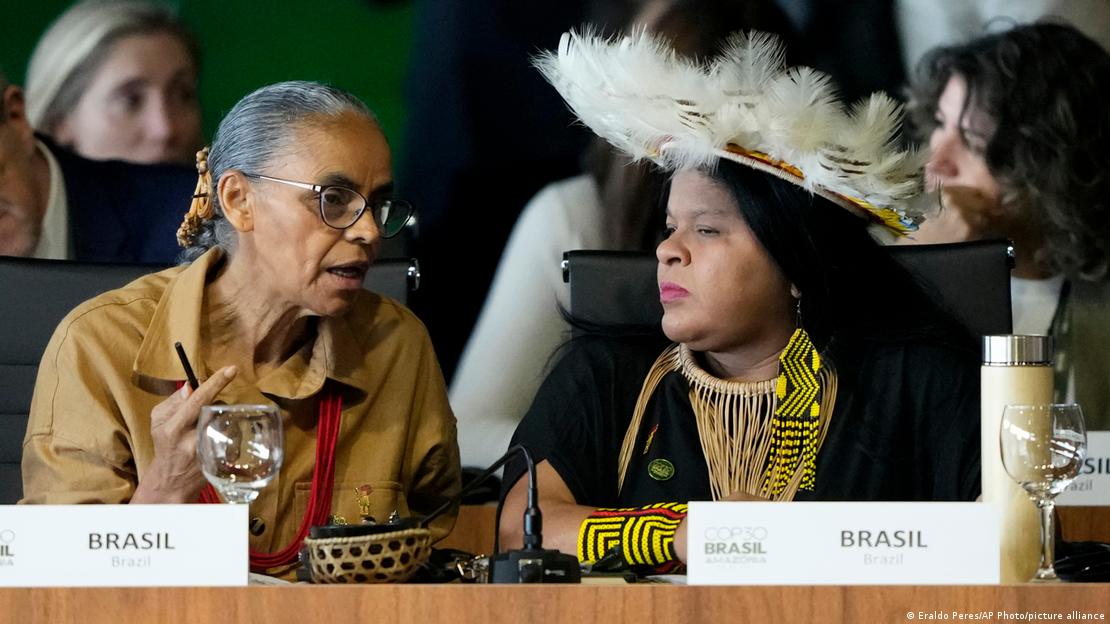
Brazilian Environment Minister Marina Silva, left, addressed climate impacts with Brazilian Indigenous Peoples Minister Sonia Guajajara ahead of COP30
Image: Eraldo Peres/AP Photo/picture alliance
Brazil's chance to lead amid uncertainty
For Brazil under President Lula, the conference is a top priority as it showcases the nation's ability to couple sustainable development with economic progress and take a leading role on the world stage.
Global uncertainty related to increasing trade conflicts, the war in Ukraine, and the situation in Gaza has unduly impacted multilateral climate policy. Meanwhile, the US, the world's second-largest greenhouse gas emitter, withdrew from the Paris climate agreement when Donald Trump took office and has since rolled back climate protections.
Observers view upcoming negotiations with concern
"It is important to have a host for the negotiations who inspires confidence in all countries," says Niklas Höhne of Climate Action Tracker — a consortium of German and international think tanks that examine how national climate targets are being implemented.
At the start of the conference, Brazil will present an initiative to protect tropical forests, which are particularly important for climate regulation and biodiversity: the Tropical Forest Forever Facility.
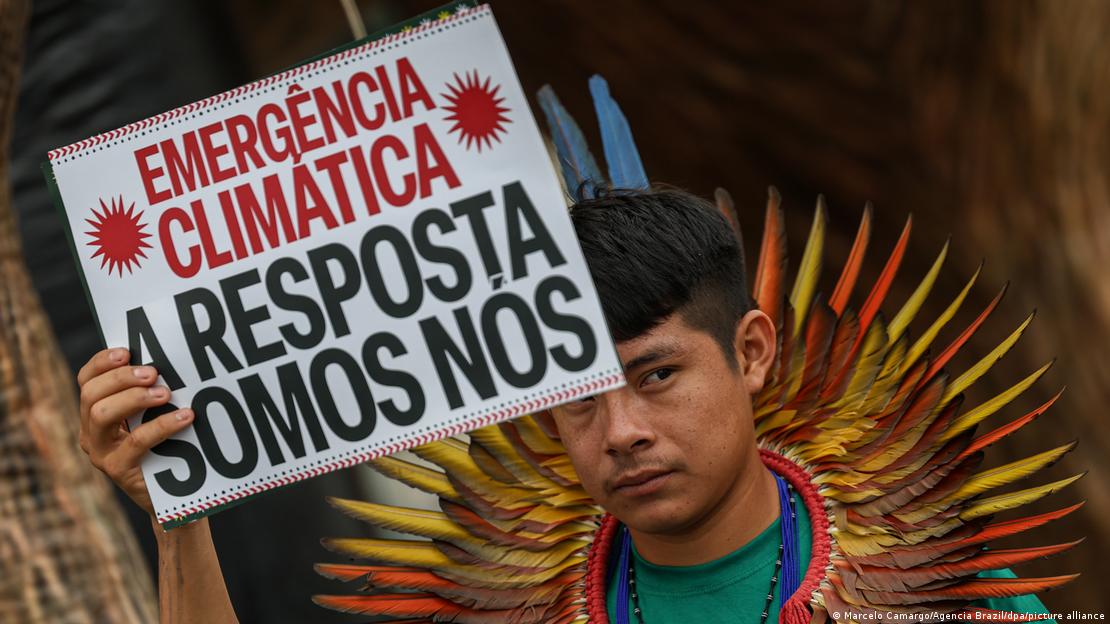
An Indigenous man holds up a sign reading "Climate Emergency: We Are the Answer," during a pre-COP meeting in the Brazilian capital Brasilia in October
Image: Marcelo Camargo/Agencia Brazil/dpa/picture alliance
This involves a new fund that will be established with government money and topped up by private investors. Countries that take special measures to protect their forests will be rewarded with profits from the fund. At least 20% of the payments are earmarked for Indigenous communities. The goal is to raise a total of US$125 billion (€108 billion) for the fund.
The initiative is a prestige project for host Brazil, though it remains to be seen how much of this total can be raised during the negotiations in Belem.
Why Germany is slowing its ambition
Germany will miss its target to become climate neutral by 2045 based on current projections. The government wants to further expand fossil gas infrastructure and is weakening its commitment to renewable energies.
This is not only worrying for Germany, but also for the EU, Niklas Höhne explained. "Germany is an extremely important player in the EU and is also working to relax climate protection measures in the EU," he said. "That in turn has an impact on a global level. If the EU doesn't take the lead, who will?"
As major economies like Germany lose climate ambition, China is increasingly taking on a pioneering role, according to Jan Kowalzig, climate expert at the global NGO Oxfam. However, he doubts that China will make an effort to encourage others to be more ambitious.
"In the past, China has been more concerned with protecting its national interests than with advancing collective progress on climate protection," Kowalzig said.
Mohamed Adow of the non-governmental organization, Power Shift Africa, says what is needed most from Belem is "concrete ambitions, concrete technology transfer, not the usual platitudes."
This article was originally written in German.
This involves a new fund that will be established with government money and topped up by private investors. Countries that take special measures to protect their forests will be rewarded with profits from the fund. At least 20% of the payments are earmarked for Indigenous communities. The goal is to raise a total of US$125 billion (€108 billion) for the fund.
The initiative is a prestige project for host Brazil, though it remains to be seen how much of this total can be raised during the negotiations in Belem.
Why Germany is slowing its ambition
Germany will miss its target to become climate neutral by 2045 based on current projections. The government wants to further expand fossil gas infrastructure and is weakening its commitment to renewable energies.
This is not only worrying for Germany, but also for the EU, Niklas Höhne explained. "Germany is an extremely important player in the EU and is also working to relax climate protection measures in the EU," he said. "That in turn has an impact on a global level. If the EU doesn't take the lead, who will?"
As major economies like Germany lose climate ambition, China is increasingly taking on a pioneering role, according to Jan Kowalzig, climate expert at the global NGO Oxfam. However, he doubts that China will make an effort to encourage others to be more ambitious.
"In the past, China has been more concerned with protecting its national interests than with advancing collective progress on climate protection," Kowalzig said.
Mohamed Adow of the non-governmental organization, Power Shift Africa, says what is needed most from Belem is "concrete ambitions, concrete technology transfer, not the usual platitudes."
This article was originally written in German.
Tim Schauenberg One of DW's climate reporters, Tim Schauenberg is based in Brussels and Münster.twitter handle: tim_schauen
The 30th UN climate summit opens in the Brazilian Amazon on Monday as nations fall short on emissions pledges and the world edges closer to dangerous warming. Fewer than half of all countries have updated their climate plans, while political rifts cloud hopes of progress on phasing out fossil fuels.
Issued on: 10/11/2025 - RFI
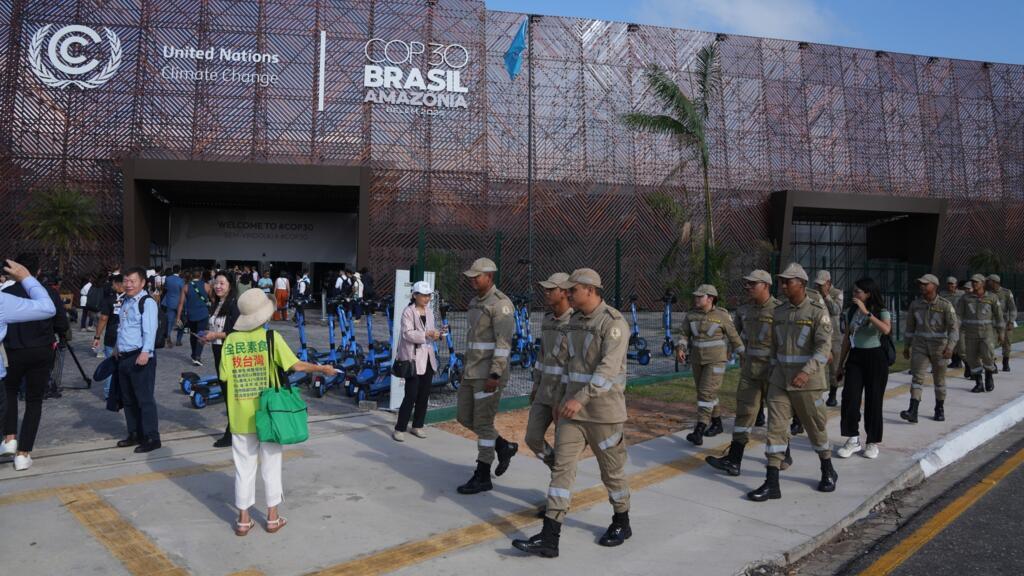
Brazilian firefighters and conference-goers outside the Cop30 venue in Belem on Monday, 10 November 2025. AP - Fernando Llano
By:Amanda Morrow
The conference is being held in Belém, at the gateway to the Amazon rainforest, bringing together nearly 190 national delegations and up to 50,000 participants.
Brazil’s presidency has called it the “Cop of the people, Cop of truth, Cop of action”, but the summit faces an unclear agenda and sharp disagreements over how – or even whether – a final declaration can be reached.
Just over a month ago, countries were due to publish their new climate plans. Barely more than half have done so, and their combined ambition falls short. The world is still heading for 2.4C of warming by the end of the century – which scientists warn is a catastrophe for humanity and the planet.
To avoid another failure, the Brazilian presidency is not attempting a grand final declaration. It wants instead to launch more concrete commitments with a group of willing states, in a bid to save what can be saved of global climate cooperation.
By:Amanda Morrow
The conference is being held in Belém, at the gateway to the Amazon rainforest, bringing together nearly 190 national delegations and up to 50,000 participants.
Brazil’s presidency has called it the “Cop of the people, Cop of truth, Cop of action”, but the summit faces an unclear agenda and sharp disagreements over how – or even whether – a final declaration can be reached.
Just over a month ago, countries were due to publish their new climate plans. Barely more than half have done so, and their combined ambition falls short. The world is still heading for 2.4C of warming by the end of the century – which scientists warn is a catastrophe for humanity and the planet.
To avoid another failure, the Brazilian presidency is not attempting a grand final declaration. It wants instead to launch more concrete commitments with a group of willing states, in a bid to save what can be saved of global climate cooperation.
Fossil fuel fight
At a summit of heads of state three days earlier, several leaders – including Brazilian President Luiz Inacio Lula da Silva – said it was necessary to prepare for the end of fossil fuels. But beyond that political signal, there is almost no chance of finding consensus, as oil-producing countries remain firmly opposed.
“How are we going to do this? Is there going to be consensus about how we are going to do it? This is one of the great mysteries of Cop30,” conference president André Corrêa do Lago said.
“My preference is not to need a Cop decision. If countries have an overwhelming desire for a Cop decision, we will certainly think about it and deal with it.”
Do Lago said emerging countries were appearing at this Cop with a different role. He noted the rise of China’s importance in the talks as the US seeks to exit the Paris Agreement in January and the European Union struggles to maintain its level of ambition amid worries over energy security.
“Emerging countries are appearing in this Cop with a different role. China is coming with solutions for everyone,” Do Lago added, pointing to inexpensive green technologies from China now leading the energy transition worldwide.
Indigenous voices
Civil society is making its return after three Cops in authoritarian countries, and it intends to be heard. Indigenous leaders in particular are demanding a real say in decisions that affect their lands and future.
Brazilian groups are joined by visiting delegations who arrived on Sunday evening by boat after travelling 3,000 kilometres from the Andes to the Brazilian coast.
They want stronger control over how their territories are managed as climate change worsens and industries such as mining, logging and oil drilling push deeper into forests.
“We want to make sure that they don’t keep promising, that they will start protecting, because we as indigenous people are the ones who suffer from these impacts of climate change,” said Pablo Inuma Flores, an indigenous leader from Peru, who also criticised oil spills and illegal mining along the river.
Civil society is making its return after three Cops in authoritarian countries, and it intends to be heard. Indigenous leaders in particular are demanding a real say in decisions that affect their lands and future.
Brazilian groups are joined by visiting delegations who arrived on Sunday evening by boat after travelling 3,000 kilometres from the Andes to the Brazilian coast.
They want stronger control over how their territories are managed as climate change worsens and industries such as mining, logging and oil drilling push deeper into forests.
“We want to make sure that they don’t keep promising, that they will start protecting, because we as indigenous people are the ones who suffer from these impacts of climate change,” said Pablo Inuma Flores, an indigenous leader from Peru, who also criticised oil spills and illegal mining along the river.
Money gap
Adaptation to natural disasters that are already hitting is another key issue for Southern countries, especially in Africa.
Negotiators are tasked with defining 100 indicators to measure how prepared countries are. But what vulnerable states say they mainly need to adapt is money.
Money is the final major challenge at this Cop. Last year’s summit ended in failure, with rich countries promising $300 billion per year within 10 years to help the poorest countries, when at least four times more would be needed.
Brazil wants to propose reaching $1.3 trillion, but the question of where to find the money is expected to cause tension.
Countries also want to address financial and action targets for adapting to a warmer world, with hopes that development banks can reform enough to ensure more money – including from the private sector – goes to these goals.
Ahead of the summit, scientists at dozens of universities and institutions from Asia, Africa and Europe sounded an alarm over the world’s thawing glaciers, ice sheets and other frozen areas.
“The cryosphere is destabilising at an alarming pace,” they said in an open letter to Cop30 published on Monday.
“Geopolitical tensions or short-term national interests must not overshadow Cop30. Climate change is the defining security and stability challenge of our time.”
The first point of order for Cop30 is to vote on an agenda.
Do Lago said countries had been wrangling for months over what to include, describing this as a healthy exchange of priorities.
By Monday morning, 106 governments had submitted new climate plans, with more expected this week.

No comments:
Post a Comment