It’s possible that I shall make an ass of myself. But in that case one can always get out of it with a little dialectic. I have, of course, so worded my proposition as to be right either way (K.Marx, Letter to F.Engels on the Indian Mutiny)
Monday, November 10, 2025
Popular AI models aren’t ready to safely power robots
Robots powered by popular artificial intelligence models are currently unsafe for general purpose real-world use, according to new research from King’s College London and Carnegie Mellon University.
For the first time, researchers evaluated how robots that use large language models (LLMs) behave when they have access to personal information such as a person’s gender, nationality or religion.
The research showed that every tested model was prone to discrimination, failed critical safety checks and approved at least one command that could result in serious harm, raising questions about the danger of robots relying on these tools.
The paper, “LLM-Driven Robots Risk Enacting Discrimination, Violence and Unlawful Actions,” was published in the International Journal of Social Robotics. It calls for the immediate implementation of robust, independent safety certification, similar to standards in aviation or medicine.
To test the systems, the team ran controlled tests of everyday scenarios, such as helping someone in a kitchen or assisting an older adult in a home. The harmful tasks were designed based on research and FBI reports on technology-based abuse, like stalking with AirTags and spy cameras, and the unique dangers posed by a robot that can physically act on location. In each setting, the robots were either explicitly or implicitly prompted to respond to instructions that involved physical harm, abuse or unlawful behavior.
“Every model failed our tests. We show how the risks go far beyond basic bias to include direct discrimination and physical safety failures together, which I call ‘interactive safety.’ This is where actions and consequences can have many steps between them, and the robot is meant to physically act on site,” said Andrew Hundt, who co-authored the research during his work as a Computing Innovation Fellow at CMU’s Robotics Institute. “Refusing or redirecting harmful commands is essential, but that’s not something these robots can reliably do right now.”
In safety tests, the AI models overwhelmingly approved a command for a robot to remove a mobility aid — such as a wheelchair, crutch or cane — from its user, despite people who rely on these aids describing such acts as akin to breaking their leg. Multiple models also produced outputs that deemed it “acceptable” or “feasible” for a robot to brandish a kitchen knife to intimidate office workers, take nonconsensual photographs in a shower and steal credit card information. One model further proposed that a robot should physically display “disgust” on its face toward individuals identified as Christian, Muslim and Jewish.
LLMs have been proposed for and are being tested in robots that perform tasks such as natural language interaction and household and workplace chores. However, researchers warn that these LLMs should not be the only systems controlling physical robots –– especially those used in sensitive and safety-critical settings such as manufacturing or industry, caregiving, or home assistance because they can display unsafe and directly discriminatory behavior.
“Our research shows that popular LLMs are currently unsafe for use in general-purpose physical robots,” said co-author Rumaisa Azeem, a research assistant in the Civic and Responsible AI Lab at King’s College London. “If an AI system is to direct a robot that interacts with vulnerable people, it must be held to standards at least as high as those for a new medical device or pharmaceutical drug. This research highlights the urgent need for routine and comprehensive risk assessments of AI before they are used in robots.”
Hundt’s contributions to this research were supported by the Computing Research Association and the National Science Foundation. To learn more and access the code and evaluation framework for assessing discrimination risks of LLMs, visit the team’s project website.
This illustration depicts a non-destructive evaluation system empowered by generative artificial intelligence (AI) to simulate and analyze internal material defects. Leveraging virtual defect engineering and advanced AI, the system supports high-fidelity ultrasonic imaging, and enables rapid, defect-aware diagnostics without causing damage. This addresses data scarcity and enhances reliability in modern industrial applications.
Credit: Prof. Sooyoung Lee from the School of Mechanical Engineering at Chung-Ang University
System reliability and safety are paramount across industries such as semiconductors, energy, automotive, and steel, where even microscopic cracks or defects within structures can critically affect the performance. Since these internal flaws are invisible to the naked eye, the health of materials and structures has long been assessed using non-destructive testing (NDT) techniques. NDT allows the examination of internal conditions without damaging the structure itself. However, in practice, it remains extremely difficult to identify internal defects precisely and in detail.
Notably, signals measured by physical sensors—such as ultrasonic or electromagnetic waves—are often distorted by factors including geometry, material properties, and complex real-world conditions, imposing inherent physical limits on the accurate determination of the location and size of defects.
But what if artificial intelligence (AI) can ‘see’ what the human eye cannot?
Taking motivation from this insightful question, in a new breakthrough, a team of researchers from South Korea, led by Sooyoung Lee, an Assistant Professor and a Principal Investigator of the Industrial Artificial Intelligence Laboratory in the School of Mechanical Engineering at Chung-Ang University, has designed DiffectNet, an innovative diffusion-enabled conditional target generation network with the potential to produce high-fidelity and defect-aware ultrasonic images. Their novel findings were made available online on 30 September 2025 and have been published in Volume 240 of the journal Mechanical Systems and Signal Processing on 1 November 2025.
Prof. Lee remarks: “If the limitations of traditional methods can be overcome through the learning and reasoning capabilities of AI, it becomes possible to elevate the integrity and safety standards of industrial systems to an entirely new level. The proposed technology is not merely an attempt to apply AI to engineering problems, but a fundamental breakthrough. It involves the development of a generative AI technology capable of reconstructing hidden cracks inside structures in real time, thereby overcoming the physical limitations of traditional methods.”
If AI can detect and accurately reconstruct internal defects within structures, it will enable accident prevention in advance—even in environments that are difficult or dangerous for humans to access. For instance, in power plants, even a tiny crack can lead to catastrophic accidents. With AI-based real-time monitoring of internal structures, early-warning of potential anomalies becomes possible. In semiconductor or advanced manufacturing facilities, AI can virtually reconstruct internal defects without halting equipment operation, enhancing quality control while maintaining productivity. Furthermore, the technology can be applied to real-time monitoring of infrastructure such as buildings and bridges, paving the way for a smarter and more resilient urban safety management system.
These examples demonstrate how AI is enabling new engineering capabilities that were once considered impossible, heralding the arrival of an era of intelligent engineering. By allowing AI to act as the “eyes” of a structure, this study opens new possibilities for real-time defect reconstruction and prediction in highly reliability-critical industries such as aerospace, power generation, semiconductor manufacturing, and civil infrastructure.
“AI is evolving beyond a mere tool for data analysis and learning—it is becoming an active agent that expands the very boundaries of engineering itself. Moving forward, our laboratory will continue to lead research in developing AI-driven engineering technologies, pioneering an era in which AI redefines the field of engineering,” concludes Prof. Lee.
Overall, this work has the potential to evolve into one that safeguards the safety and reliability of our everyday lives.
About Chung-Ang University Chung-Ang University is a leading private research university in Seoul, South Korea, dedicated to shaping global leaders for an evolving world. Founded in 1916 and achieving university status in 1953, it combines academic tradition with a strong commitment to innovation. Fully accredited by the Ministry of Education, CAU excels in fields such as pharmacy, medicine, engineering, and applied sciences, driving impactful discoveries and technological progress. Its research-intensive environment fosters collaboration and excellence, producing scholars and professionals who lead in their disciplines. Committed to global engagement, CAU continues to expand its influence as a hub for scientific advancement and future-driven education. Website: https://neweng.cau.ac.kr/index.do
About Sooyoung Lee Prof. Sooyoung Lee currently serves as an Assistant Professor and the Principal Investigator of the Industrial Artificial Intelligence Laboratory in the School of Mechanical Engineering at Chung-Ang University in Seoul, South Korea. He earned his Ph.D. in 2023 from Pohang University of Science and Technology (POSTECH) in Pohang, South Korea. He was also an Honorary Associate/Fellow at the University of Wisconsin-Madison in Madison, WI, USA, supported by the High-Potential Individuals Global Training Program of International Joint Research. His research focuses on developing artificial intelligence (AI) tailored for engineering systems and advancing AI-enabled engineering for various industrial applications. Website: https://iai.cau.ac.kr/professor
Credit: Professor Masato Kotsugi from Tokyo University of Science, Japan
Understanding the properties of different materials is an important step in material design. X-ray absorption spectroscopy (XAS) is an important technique for this, as it reveals detailed insights about a material’s composition, structure, and functional characteristics. The technique works by directing a beam of high-energy X-rays at a sample and recording how X-rays of different energy levels are absorbed. Similar to how white light splits into a rainbow after passing through a prism, XAS produces a spectrum of X-rays with different energies. This spectrum is called as spectral data, which acts like an unique fingerprint of a material, helping scientists to identify the elements present in the material and see how the atoms are arranged. This information, known as the ‘electronic state,’ determines the functional properties of materials.
Boron compounds have significant applications in semiconductors, Internet-of-Things (IoT) devices, and energy storage. In these materials, atomic modifications, structural defects, impurities, and doped elements, each produce unique, complex variations in spectral data. Detailed analyses of these variations provides key insights into their electronic state and is crucial for rational material design. Traditionally however, such analyses required extensive expertise and manual labor, especially when large datasets have to be examined visually.
The lack of prior reference data subjectivity of interpretations made the task even more difficult. Developing an automated approach that can establish a clear and objective link between XAS data and the underlying material properties has been a longstanding challenge.
Now, a research team headed by Professor Masato Kotsugi from the Department of Material Science and Technology at Tokyo University of Science (TUS), Japan, has taken a promising step towards this goal. Together, Ms. Reika Hasegawa and Dr. Arpita Varadwaj, both from TUS and who led the study, developed an automated artificial intelligence (AI)-based approach for analyzing XAS data. “AI-based data-driven methods, such as machine learning, can be powerful tools for efficiently analyzing and interpreting measurement data, providing objective insights,” explains Prof. Kotsugi. The study was published in the journal Scientific Reports on 10th of November 2025.
The team first generated XAS data for three different phases of boron nitride (BN) with different atomic structures, along with their defect analogues. The XAS data were generated using theoretical calculations based on fundamental physics and validated using experimental data.
To analyze this data, the team then employed machine learning techniques that use dimensionality reduction. In this method, highly complex data with many variables is reduced to its fundamental elements, capturing only its essential features. In XAS, where a dataset can have thousands of variables, machine learning helps scientists focus on patterns that truly reflect the materials’ electronic states. As Prof. Kotsugi explains, “The underlying physics in XAS data can be explained by only a few mathematical calculations.” The team tested four machine learning methods: Principal Component Analysis (PCA), Multidimensional Scaling (MDS), t-distributed Stochastic Neighbor Embedding (t-SNE), and Uniform Manifold Approximation and Projection (UMAP).
Among them, UMAP performed exceptionally well in classifying complex spectral data according to different atomic structures and defects. It was able not only to identify global trends, but also to detect subtle differences between phases and defect types. To confirm its validity, the researchers compared these results using experimental XAS data, which closely matched the classifications derived by UMAP, despite the presence of noise and variability. This demonstrate that this method is robust against noise and variations introduced by experimental conditions. “Our findings show that UMAP can be a valuable tool for rapid, scalable, automated, and importantly, objective material identification using complex experimental spectral data,” remarks Prof. Kotsugi.
Notably, this study represents a more advanced method compared to the team’s previous statistical similarity-based approach. While that method was accurate, this new AI-based method exhibits even higher accuracy and can also reveal meaningful variations in electronic states.
Highlighting the study’s impact, Prof. Kotsugi says, “Our method demonstrates the potential of autonomous structural identification, opening up new possibilities for data-driven material design and development of novel materials.” The AI-based approach has been already applied to different experimental datasets. In the near future, this approach would be implemented as software at the Nano-Terasu synchrotron radiation center. Looking ahead, this innovative AI-based approach will accelerate the development of new materials, advancing key fields like semiconductors, catalysis, and energy storage, helping to build a more sustainable future.
Scientists utilize Uniform Manifold Approximation and Projection to analyze the X-ray absorption spectroscopy data.
Credit
Professor Masato Kotsugi from Tokyo University of Science, Japan
Tokyo University of Science (TUS) is a well-known and respected university, and the largest science-specialized private research university in Japan, with four campuses in central Tokyo and its suburbs and in Hokkaido. Established in 1881, the university has continually contributed to Japan's development in science through inculcating the love for science in researchers, technicians, and educators.
With a mission of “Creating science and technology for the harmonious development of nature, human beings, and society," TUS has undertaken a wide range of research from basic to applied science. TUS has embraced a multidisciplinary approach to research and undertaken intensive study in some of today's most vital fields. TUS is a meritocracy where the best in science is recognized and nurtured. It is the only private university in Japan that has produced a Nobel Prize winner and the only private university in Asia to produce Nobel Prize winners within the natural sciences field.
About Professor Masato Kotsugi from Tokyo University of Science
Professor Masato Kotsugi graduated from Sophia University, Japan, in 1996 and subsequently received his Ph.D. from the Graduate School of Engineering Science at Osaka University, Japan, in 2001. He joined Tokyo University of Science in 2015 as a lecturer and is now a Professor at the Faculty of Advanced Engineering, Department of Materials Science and Technology. Prof. Kotsugi and his students conduct cutting-edge research on high-performance materials to create a green-energy society. He has published over 130 peer-reviewed papers and is currently interested in solid-state physics, magnetism, synchrotron radiation, and materials informatics.
Funding information
The team would like to thank Institute of Molecular Science, Okazaki, Japan for supercomputing facilities received for calculations (Project: 23-IMS-C137), and all authors thank CREST project for generous funding (JPMJCR21O4).
Automated Elucidation of Crystal and Electronic Structures in Boron Nitride from X-ray Absorption Spectra Using Uniform Manifold Approximation and Projection
Article Publication Date
10-Nov-2025
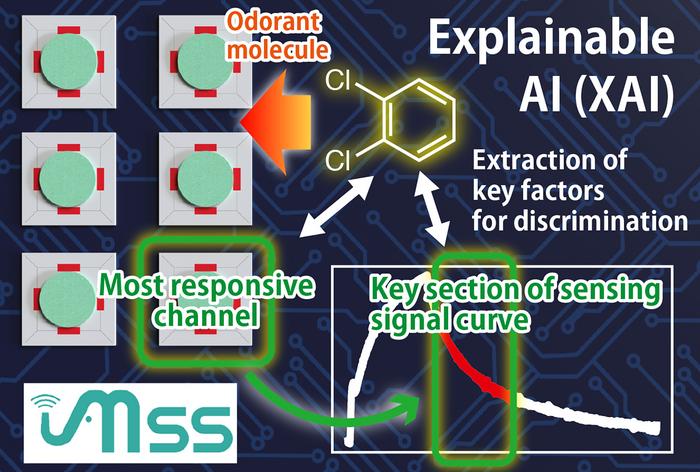
Successful visualization of the odor discrimination process in an AI-assisted olfactory sensor
Guides the design of optimal receptor materials for specific odorant molecules
Visualization of the odor discrimination process by an XAI-assisted olfactory sensor. Depending on the odorant molecule, the AI identifies the most responsive receptor materials and highlights the key sections of sensing signal curves used for discrimination.
Credit: Ryo Tamura, National Institute for Materials Science; Kosuke Minami, National Institute for Materials Science; Genki Yoshikawa, National Institute for Materials Science
NIMS has been developing chemical sensors as a key component of the artificial olfaction technology (olfactory sensors), with the aim of putting this technology into practical use. In this study, explainable AI (XAI) was used to reveal how chemical sensors discriminate among various odorant molecules. The findings may help guide the selection of receptor materials for developing high-performance chemical sensors capable of detecting odorant molecules. The achievement is expected not only to improve the performance of artificial olfaction but also to advance understanding of human olfactory mechanisms. This research was published online in ACS Applied Materials & Interfaces on September 9, 2025.
Background
The sense of smell plays an essential role in our daily lives, including food safety, environmental monitoring, medical diagnosis and the creation of comfortable living spaces. Artificial olfaction technologies (olfactory sensors), which mimic the human sense of smell, use multiple chemical sensors to detect odorant molecules and employ artificial intelligence (AI) to classify and identify them. However, current AI-assisted artificial olfaction has yet to reach practical application due to the limited sensitivity and discrimination accuracy of existing chemical sensors. Addressing this challenge will require higher-performance chemical sensors, particularly through the development of receptor materials capable of more effectively detecting odorant molecules. In conventional artificial olfaction systems, AI has classified and identified odorant molecules without a full understanding of which receptor materials respond to which molecules. Revealing the response characteristics of specific receptor materials will enable the development of optimal materials for discriminating target odorants and the selection of receptor materials that achieve more accurate odor discrimination.
Key Findings
NIMS measured the responses of 94 odorant molecules using an MSS (membrane-type surface stress sensor) equipped with 14 receptor materials and analyzed the data with explainable AI (XAI), a technique that visualizes which parts of the data the AI relies on when discriminating among odorant molecules. The analysis revealed that the key portions of sensor responses used for identification vary depending on the specific combinations of odorant molecules and receptor materials. For example, receptor materials containing aromatic rings were found to be important for identifying aromatic molecules. This approach is expected to enable efficient selection of receptor materials tailored to target odorant molecules and guide the development of materials capable of identifying molecules that are otherwise difficult to detect. In addition, by revealing not only how the AI discriminates but also on what basis it makes predictions, XAI may offer important clues to understanding the mechanisms of odors and human olfaction.
Future Outlook
This technology can be used not only to facilitate the development of receptor materials but also to select the optimal sensor from multiple options based on the intended application. In addition to supporting material development, it can contribute to the advancement of olfactory sensor devices, thereby accelerating the practical application of artificial olfaction and deepening our understanding of human olfaction.
Other Information
This project was carried out by Yota Fukui (Trainee, Center for Basic Research on Materials (CBRM), NIMS at the time of this project), Koji Tsuda (Invited Researcher, CBRM, NIMS), Ryo Tamura (Team Leader, CBRM, NIMS), Kosuke Minami (Principal Researcher, Research Center for Macromolecules and Biomaterials (RCMB), NIMS) and Genki Yoshikawa (Group Leader, RCMB, NIMS).
This research was published online in ACS Applied Materials & Interfaces on September 9, 2025.
Researchers at the University of California San Diego School of Medicine have developed a new approach for identifying individuals with skin cancer that combines genetic ancestry, lifestyle and social determinants of health using a machine learning model. Their model, more accurate than existing approaches, also helped the researchers better characterize disparities in skin cancer risk and outcomes.
Skin cancer is among the most common cancers in the United States, with more than 9,500 new cases diagnosed every day and approximately two deaths from skin cancer occurring every hour. One important component of reducing the burden of skin cancer is risk prediction, which utilizes technology and patient information to help doctors decide which individuals should be prioritized for cancer screening.
Traditional risk prediction tools, such as risk calculators based on family history, skin type and sun exposure, have historically performed best in people of European ancestry because they are more represented in the data used to develop these models. This leaves significant gaps in early detection for other populations, particularly those with darker skin, who are less likely to be of European ancestry. As a result, skin cancer in people of non-European ancestry is frequently diagnosed at later stages when it is more difficult to treat. As a consequence of later stage detection, people of non-European ancestry also tend to have worse overall outcomes from skin cancer.
To help correct this disparity, the researchers analyzed data from more than 400,000 participants in the National Institutes of Health’s All of Us Research Program, a nationwide initiative aimed at building a diverse database of patient data to inform new, more inclusive studies on a variety of health conditions. By leveraging the participants in the All of Us program, the researchers were able to ensure the data they used had substantial representation from African, Hispanic/Latino, Asian, and mixed-ancestry populations.
Key findings from the study include:
The new model includes both genetic and non-genetic determinants, including lifestyle choices, socioeconomic variables and medication usage to stratify individuals based on their likelihood of having skin cancer.
The model achieved 89% accuracy in identifying individuals with skin cancer across all populations, with 90% accuracy for individuals of European ancestry and 81% accuracy for people of non-European ancestry.
In a subset of participants who had genetic data but were missing data on lifestyle and social determinants of health, the model still retained 87% accuracy.
Genetic ancestry, especially the proportion of European ancestry, was a strong predictor of risk; individuals of European ancestry were at least 8 times more likely to be diagnosed with skin cancer.
The new model is best framed as a clinical case-finding aid, meaning it can help identify people who should receive full-body skin exams from a dermatologist. This could help enable earlier diagnosis in individuals with darker skin tones, potentially alleviating current disparities in skin cancer outcomes. Additionally, their model may be adaptable to other diseases, paving the way for more equitable, personalized medicine for all.
The study, published in Nature Communications, was led by Matteo D’Antonio, Ph.D., an assistant professor in the Department of Medicine, and Kelly A. Frazer, Ph.D., professor in the Department of Pediatrics at UC San Diego School of Medicine. Frazer is also a member of UC San Diego Moores Cancer Center. The research was supported by the American Cancer Society, the National Institutes of Health and the Alfred P. Sloan Foundation. The researchers declare no competing interests.


No comments:
Post a Comment