Op-Ed: Basel and the HKC are Legally Compatible
Note: This article responds to Dr Nikos Mikelis, Chair of BIMCO’s Ship Recycling Alliance, and his piece “Recycling Ships under Two Conventions: Misconceptions about Basel and the HKC” (TME, 29 October 2025), offering a corrective to his interpretation of the Basel Convention and its relationship with the Hong Kong Convention.
The long-running debate over whether the Basel Convention on the Control of Transboundary Movements of Hazardous Wastes and Their Disposal, 1989 (BC), and the Hong Kong International Convention for the Safe and Environmentally Sound Recycling of Ships, 2009 (HKC), are in conflict has divided policymakers, shipowners, and environmental advocates for years. It is often claimed that Basel’s strict export controls on hazardous waste contradict the HKC’s effort to establish a workable global framework for ship recycling. Yet this view misunderstands the concept of “conflict” in international law. The tension between the two regimes is not legal—it is economic and political.
Relying upon a recently adopted IMO Circular (HKSRC.2/Circ.1, 1 November 2024), proponents of the shipping and ship recycling alliance argue that States should apply the regime of whichever Convention they are party to, and that those party to both may notify under Article 11 of the Basel Convention to apply the HKC instead. Although non-binding, this guidance arguably misapplies Article 30 of the Vienna Convention on the Law of Treaties (VCLT) by incorrectly invoking the long established lex specialis and lex posterior principles to imply that the HKC can override or displace the Basel Convention.
Under the VCLT, a true conflict of law arises only when two treaties govern the same subject matter and impose mutually exclusive obligations, such that fulfilling one would necessarily violate the other. As the International Court of Justice and the International Law Commission have repeatedly affirmed, practical or financial difficulty in applying two treaties does not amount to a legal conflict. A conflict under Article 30 of the VCLT exists only where it is impossible to comply with both obligations simultaneously.
Article 30; the so-called “conflict clause”; states that when two treaties concern the same subject matter, the earlier one applies only insofar as it is compatible with the later. The ILC’s 1966 Commentary clarifies that Article 30 operates only where both cannot be applied at the same time. Overlap does not necessarily mean inconsistency. As Sir Ian Sinclair explained, the lex posterior rule presupposes an actual conflict of obligations; mere overlap or differing impact on States does not suffice. Likewise, Anthony Aust notes in Modern Treaty Law and Practice (4th ed., 2023) that economic difficulty or political inconvenience in performing a treaty does not constitute incompatibility under Article 30.
The ICJ’s 2012 judgment in Belgium v. Senegal confirmed that there is no conflict where both norms can be applied without one violating the other. WTO panels in EC–Hormones (1998) and EC–Biotech (2006) similarly found that environmental and trade treaties pursue similar objectives but regulate distinct subject matters. The ILC’s 2006 Fragmentation of International Law report encapsulated this principle: two norms are incompatible only where it is impossible to comply with both simultaneously.
Article 30 must be read alongside Article 59 (termination when a later treaty replaces an earlier one) and Article 103 of the UN Charter (which gives Charter obligations supremacy). Article 30 applies only to overlapping treaties that remain in force, and only when the conditions of identical subject matter and legal incompatibility are met. The decisive test is whether both treaties can be implemented concurrently without resulting in any illegality; if so, none of these provisions is applicable (Southern Bluefin Tuna (New Zealand v Japan; Australia v Japan), Arbitral Tribunal, Award on Jurisdiction and Admissibility, 2000).
The above frameworks clarify the Basel–HKC relationship. The BC was designed to prevent the dumping of hazardous waste from developed to developing countries across all industries, including ship recycling. It imposes prior informed consent (PIC) requirements and mandates environmentally sound disposal of hazardous waste. An end-of-life ship may fall under its scope only if it is declared waste and contains hazardous substances such as asbestos or PCBs.
The HKC, negotiated under the International Maritime Organization (IMO), focuses instead on regulating the process of ship recycling. It sets safety and environmental standards for ship design, preparation, and dismantling, requiring inventories of hazardous materials and authorization of recycling facilities. Basel governs export control; the HKC governs recycling operations—sequential, not overlapping, stages in a ship’s end-of-life cycle.
Legally, there is no contradiction. A flag State that is party to both treaties can comply with Basel by observing the Basel PIC procedure during export, while also ensuring that the receiving facility meets HKC’s IRRC (International Ready for Recycling Certificate) certification. Both treaties can operate together without leading to an illegal consequence - in other words simultaneous application is absolutely possible.
The real tension arises in practice: developing countries face capacity and cost barriers to implementing Basel’s strict procedures. In such a classic situation the duty under international law is harmonious interpretation (de Vries-Zou, 2020) not circumvention.
For major ship-recycling nations such as Bangladesh, India, and Pakistan, Basel’s administrative and technical demands—designed with developed-country capacities in mind—are difficult to meet. These nations often lack advanced treatment, storage, and disposal facilities (TSDFs). The HKC, by contrast, offers a more flexible and economically viable model. The disparity between the two systems is thus economic and institutional, not legal. As the ILC stressed in 2006, “differences in stringency or burden do not equate to incompatibility of norms.”
Claims that Basel is unaware about Flag State Jurisdictional concept and fails to bind flag States are unfounded. A State Party remains bound by its treaty obligations regardless of whether it acts as a flag, port, or recycling State. A flag State that is party to Basel cannot lawfully permit the export of an end-of-life ship to a yard that does not comply with Basel’s PIC requirements. If a State is bound by a treaty domestically, it cannot act inconsistently with that treaty when operating abroad.
Recognizing the potential rigidity of Basel’s system for any specific industry, Article 11 of the BC introduces a degree of flexibility by allowing “bilateral, multilateral or regional agreements” that deviate from its rules, provided they guarantee an equivalent level of environmental protection as envisioned in BC. This provision assumes that the importing State has adequate waste management and disposal facilities. In practice, few major ship-recycling States meet this standard—Bangladesh and Pakistan, in particular, lack any operational TSDFs suited for ship recycling industry. As such, invoking Article 11 to circumvent Basel’s PIC procedure would currently fail the equivalence test and thus be legally invalid.
The interpretation advanced by a proponent of the Ship Recycling Alliance, relying on IMO Circular HKSRC.2/Circ.1, appears difficult to reconcile with Article 30 of the VCLT , as it does not establish the existence of a genuine legal conflict between the Basel and HKC. Moreover, its approach seems difficult to reconcile with Article 11 of the BC , which permits alternative arrangements only where they provide an equivalent level of environmental protection—a standard that the current HKC arguably does not yet fulfil.
By incorporating robust due diligence provisions and establishing a Basel-compliant waste management chain, the shipping and ship recycling industries could, in the future, credibly invoke Article 11 and claim equivalence. This could bridge the regulatory gap between the two frameworks. However, such an approach would require substantive reform of the HKC itself. The argument advanced by the shipping & ship recycling industry to create an industry-specific exception through voluntary guidelines appears difficult to justify under existing binding international law.
In reality, there is no legal conflict between the BC and the HKC. Article 30 of the VCLT simply does not apply because both treaties can legally operate in parallel without generating any illegal consequence. The friction between them is economic, not legal—a product of uneven capacity and resources, not contradictory legal obligations. The lex posterior principle, often cited to justify prioritizing the HKC, cannot apply in the absence of an actual clash of legal obligations.
So, what the industry faces currently is a policy challenge, not a legal one. The path forward lies in strengthening the HKC so it aligns more closely with Basel’s environmental safeguards—by embedding due diligence, clarifying downstream waste responsibilities, and building capacity in recycling nations. These reforms would allow States to invoke Article 11 of the BC legitimately, bridging the regulatory gap without compromising environmental protection.
The real question, therefore, is not which treaty should dominate, but how both can they function in harmony—coherently, efficiently, and true to their original purposes. With a thoughtful approach, what was once seen as a legal impasse could evolve into a powerful platform for global cooperation—where trade, environmental protection, and maritime governance reinforce rather than restrain one another.
Author’s Biography: Dr. Ishtiaque Ahmed is a Professor and Chair of the Department of Law at North South University, Bangladesh. A former Merchant Marine Engineering Officer, he holds a Doctor of the Science of Law (J.S.D.) from the University of Maine School of Law, USA, where he specialized in International Ship recycling laws and policy. He contributed to the drafting of Bangladesh’s Ship Recycling Rule 2025 (proposed) and revising Bangladesh Ship Recycling Act 2018 as the sole Legal Consultant. Dr. Ahmed is also a qualified Barrister of England, an active member of Chartered Institute of Arbitrators (MCIArb) in England and an Advocate in Bangladesh Supreme Court. His expertise lies at the intersection of maritime law, environmental regulation, and sustainable ship recycling practices. He can be reached at ishtiaque.ahmed@northsouth.edu.
The opinions expressed herein are the author's and not necessarily those of The Maritime Executive.
The Hong Kong Convention Is Here, But Compliance Alone Will Not Save It
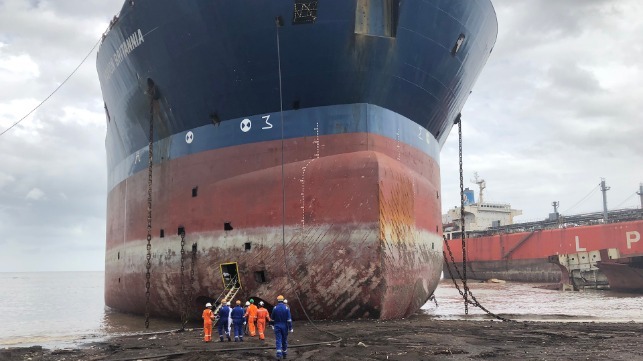
Three months after the Hong Kong Convention (HKC) came into force, the ship recycling industry looks much the same. The yards remain busy, the paperwork continues to grow, and the sweeping reform promised by the Convention has yet to take shape.
This slow start is no surprise. The industry had more than a decade to prepare. Many shipowners, some had already aligned with the European Union Ship Recycling Regulation (EU SRR), which set stricter standards and effectively pushed global compliance years in advance.
Since 2020, most trading vessels have carried an approved and regularly updated Inventory of Hazardous Materials (IHM). The discipline of maintaining one is now routine, so the HKC’s arrival has been more of a formalization than a transformation.
The real driver of progress has not been regulation but finance. Banks and investors, through Environmental, Social, and Governance (ESG) conditions, began requiring HKC-level standards as a prerequisite for lending. The industry did not wait for the IMO. The finance sector enforced compliance long before the Convention did.
That top-down pressure has raised awareness but not necessarily changed behavior. Compliance has become the expected minimum, not a marker of excellence.
The HKC does, however, change the landscape for shipowners. While it provides a long-awaited global framework for safe and sustainable recycling, ambiguity remains, particularly where end-of-life vessels are still treated as hazardous waste under the Basel Convention. In such cases, owners must meet both HKC and Basel obligations, creating overlapping legal and logistical challenges.
Relying on intermediaries is no longer enough. Shipowners must now take ownership of compliance, ensuring IHMs and recycling plans are accurate, auditable, and aligned with both frameworks. Outsourcing risk will no longer cut it. Compliance now demands active engagement, transparency, and informed decisions from the first voyage to the final one.
Across the vessel inspections Idwal has conducted since enforcement began, the change is subtle but clear. Owners are asking tougher questions, seeking verification that paperwork reflects reality. It is a small but positive sign that the Convention is beginning to influence conduct, not just administration.
Yet a new bottleneck is forming. Only a limited number of yards hold HKC certification, and many are already at capacity. Achieving and maintaining certification requires heavy investment and time, creating a two-tier market between compliant and non-compliant facilities. Owners with aging fleets should plan early as those who don’t may find compliant slots gone when they need them most.
The success of the HKC will depend less on its text and more on how it is enforced. Under the EU SRR, port state control made the difference. European authorities detained ships for IHM deficiencies, and similar action should now follow as HKC enforcement matures. Without random checks, firm penalties, and transparency, the Convention risks becoming a paper exercise. The industry does not need more certification. It needs accountability.
Passing an audit is not proof of compliance. True conformity requires independent verification, randomized inspections, and evidence that documentation matches the vessel’s physical state. From Idwal’s global inspection data, discrepancies between declared and observed hazardous materials remain common. That gap between paper and practice can only be closed by impartial, third-party inspection. Without it, the HKC’s promise of safe and sustainable recycling will remain unfulfilled.
Technology can help. Data-driven vessel inspection tools and shared verification frameworks bring transparency at scale and give owners the insight they need to demonstrate compliance with confidence. These tools should no longer be optional, they should define the standard.
The Hong Kong Convention has taken more than a decade to reach this point. Its credibility will depend on whether the industry treats compliance as a living standard rather than a filing exercise. Independent verification and transparent oversight are the only paths to meaningful progress.
Ensuring that HKC compliance is meaningful, and not just a matter of paperwork, requires independent verification, rigorous inspections, and ongoing oversight. Conducting inspections at multiple stages of a vessel’s lifecycle is essential to maintaining consistent compliance. Randomized inspections are particularly effective in ensuring that standards are upheld continuously, not just for scheduled audits, a challenge familiar across many areas of maritime regulation.
Tracking and analyzing deficiencies across fleets also provides valuable insight into recurring compliance issues, enabling shipowners and managers to take proactive corrective action. Integrating independent inspection and audit throughout the vessel’s operational life, not just at the end, ensures that documentation aligns with physical evidence, including IHMs, hazardous material plans, and supporting records.
Digital, data-driven reporting enhances this process by allowing for transparent tracking of findings, trend analysis, and risk-based decision-making. Alongside these technical measures, owners and managers must establish robust compliance management systems and provide ongoing training to crews and shore-based teams to sustain regulatory awareness.
By combining independent verification, data-led oversight, and strong management practices, shipowners and managers can ensure that HKC compliance is credible, auditable, and effective.
Three months in, the world has enough declarations. What it needs now is verification.
And what about the effect market conditions will have on physical recycling? Well, if recycling market rates remain low, the trend of shipowners selling or life extending older vessels rather than recycling them is likely to continue. Instead of heading straight for dismantling, some older ships may find renewed trade in domestic or regional trades, giving owners a chance to extend operational life and generate additional income before final disposal or generate a sale income above recycling rates.
Strategically, this environment underscores the need for fleet-level oversight, proactive condition monitoring, and data-driven decision-making.
Stephen Grist is Technical Manager at Idwal.
The opinions expressed herein are the author's and not necessarily those of The Maritime Executive.

No comments:
Post a Comment