The Sudanese who told the world what happened in El-Fasher
Port Sudan (Sudan) (AFP) – "Sixteen killed." "Seven killed." "Thirty-one killed." "People are eating cowhide to survive." "The bombs are getting closer." "They're shooting people trying to run away."
Issued on: 10/11/2025 - FRANCE24
Port Sudan (Sudan) (AFP) – "Sixteen killed." "Seven killed." "Thirty-one killed." "People are eating cowhide to survive." "The bombs are getting closer." "They're shooting people trying to run away."
Issued on: 10/11/2025 - FRANCE24
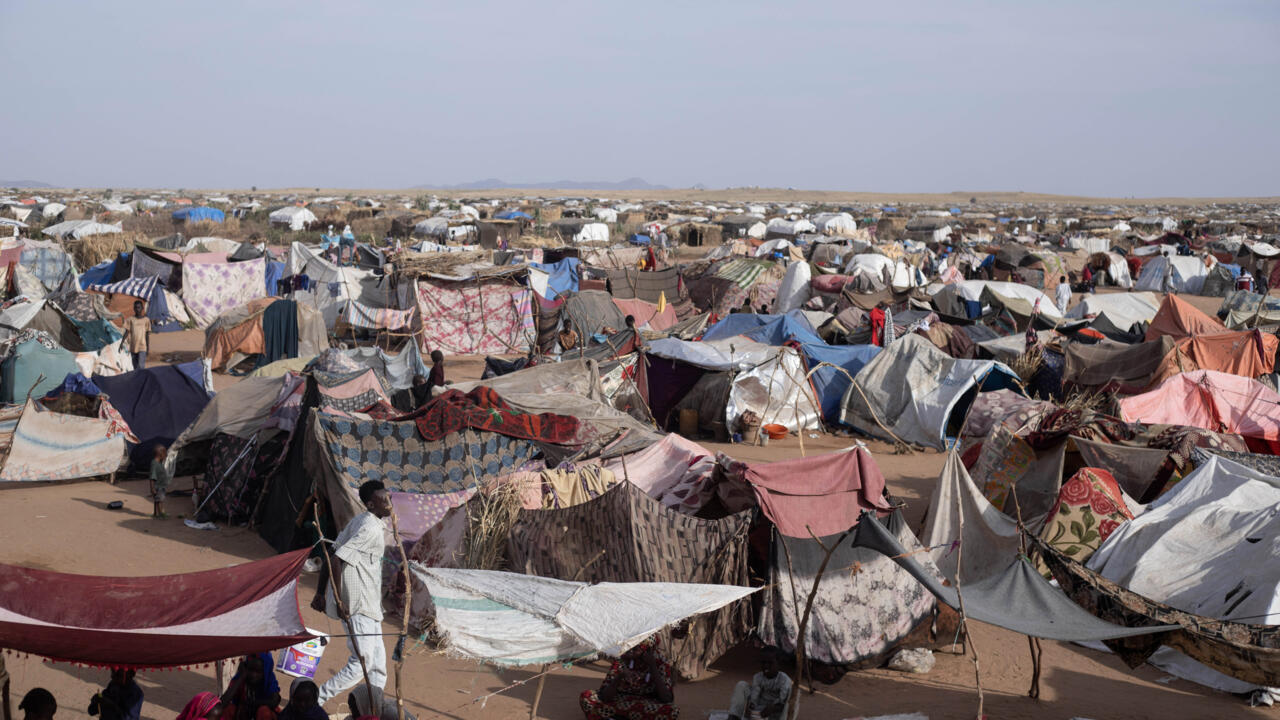
Survivors for the battle for El-Fasher have sought shelter in nearby Tawila © - / AFP
These were the grim updates shared with AFP's veteran Sudan correspondent Abdelmoneim Abu Idris Ali by people trapped in the 18-month-long siege of El-Fasher, a city overrun by the paramilitary Rapid Support Forces (RSF) two weeks ago.
Throughout the siege and ensuing battle, it was thanks to ordinary civilians that AFP and other news organisations were able to form a picture of what was happening there.
They were Dr Omar Selik, Dr Adam Ibrahim Ismail, Sheikh Moussa and activist Mohamed Issa -- men who relayed vital information from a city mostly cut off from communications.
They have all since been killed.
Until their deaths they played a crucial but, for security reasons, anonymous role in documenting Sudan's two-year war between the army and the RSF.
Ismail, a young physician, was detained by RSF fighters on October 26 as he tried to flee the city.
He was shot dead the following day.
Until his last moments, Ismail had been treating "the wounded and the sick" at the Saudi Hospital, El-Fasher's last functioning medical facility, according to the Sudanese Doctors' Union.
AFP's Abu Idris Ali learned of Ismail's death through that statement, having spoken to him only days earlier.
"His voice was weary," Abu Idris Ali recalled from Port Sudan.
"Every time we ended a call, he said goodbye as if it might be the last time."
'War machine'
In September, Abu Idris Ali had already lost three other local sources -- people who answered his calls and questions whenever communications allowed.
They were killed in a drone strike on a mosque in El-Fasher on September 16, which killed at least 75 people.
"Their voices painted a picture of El-Fasher," he said.
"Through them, I heard the groans of the wounded, the sorrow of the bereaved, the pain of those crushed under the war machine."
Before the war broke out in April 2023, AFP journalists criss-crossed the vast country, regularly visiting far-flung areas of Darfur.
It was there that Abu Idris Ali first met Sheikh Moussa, who opened the door to his modest hut in 2006, beginning a two-decade-long friendship.
Though he never met the tireless Dr Selik or the fiery 28-year-old Mohamed Issa, Abu Idris Ali said, "their voices ring in my ear every day."
Dr Selik, a kind-hearted medic who acted as a key source for journalists worldwide, witnessed the collapse of El-Fasher's health system before his own demise.
Hospitals were shelled, shuttered, or emptied of supplies, yet he continued to work tirelessly.
"He always tried to hide the tinge of sadness in his voice when he gave me toll figures," Abu Idris Ali recalled.
"He spoke like he was talking to a patient's family, breaking the news of the death of a loved one."
Fearful for his own family, he sent them to safety while staying behind to save lives.
Since his death, other doctors have taken up the mantle, but bombs fell daily, striking hospitals and killing medical staff.
'Another kind of grief'
Only days before his death, activist Issa told AFP he had fled the famine-hit Abu Shouk displacement camp, overrun by the RSF.
At 28, after months of crossing frontlines to deliver food, water and medicine to trapped families, he was killed.
"Every time I asked him what was happening in the city, his voice would ring out boisterous: 'nothing bad inshallah, I'm a little far away but I'll go find out for you!'" Abu Idris Ali said.
"You couldn't stop him -- and off he went."
Sheikh Moussa had been uprooted from his South Darfur village 22 years ago by the Janjaweed militia, from which the RSF would end up descending.
He spent the rest of his life in refugee camps.
"Violence broke out over and over outside his door, yet his laugh never faded," Abu Idris Ali recalled.
When bombs rained down on El-Fasher, Sheikh Moussa "would speak endlessly of the pain his people were facing, but if you ever asked him how he was, he would only ever say: al-hamdulillah, thank God".
"Every phone call, I could see him, always sitting cross-legged in the shade outside his door, always in a blindingly white jalabiya robe and matching prayer cap, always smiling despite the horrors around him."
Sheikh Moussa never made it home to his village, between El-Fasher and Nyala, the South Darfur state capital.
"Many of those 75 people gathered in that mosque had run for their lives just days before, but an RSF drone showed them there was no fleeing death," Abu Idris said.
"Every death is a tragedy, one we are accustomed to reporting. Yet it is another kind of grief when it is someone you have broken bread with, someone whose voice you heard every day."
© 2025 AFP
These were the grim updates shared with AFP's veteran Sudan correspondent Abdelmoneim Abu Idris Ali by people trapped in the 18-month-long siege of El-Fasher, a city overrun by the paramilitary Rapid Support Forces (RSF) two weeks ago.
Throughout the siege and ensuing battle, it was thanks to ordinary civilians that AFP and other news organisations were able to form a picture of what was happening there.
They were Dr Omar Selik, Dr Adam Ibrahim Ismail, Sheikh Moussa and activist Mohamed Issa -- men who relayed vital information from a city mostly cut off from communications.
They have all since been killed.
Until their deaths they played a crucial but, for security reasons, anonymous role in documenting Sudan's two-year war between the army and the RSF.
Ismail, a young physician, was detained by RSF fighters on October 26 as he tried to flee the city.
He was shot dead the following day.
Until his last moments, Ismail had been treating "the wounded and the sick" at the Saudi Hospital, El-Fasher's last functioning medical facility, according to the Sudanese Doctors' Union.
AFP's Abu Idris Ali learned of Ismail's death through that statement, having spoken to him only days earlier.
"His voice was weary," Abu Idris Ali recalled from Port Sudan.
"Every time we ended a call, he said goodbye as if it might be the last time."
'War machine'
In September, Abu Idris Ali had already lost three other local sources -- people who answered his calls and questions whenever communications allowed.
They were killed in a drone strike on a mosque in El-Fasher on September 16, which killed at least 75 people.
"Their voices painted a picture of El-Fasher," he said.
"Through them, I heard the groans of the wounded, the sorrow of the bereaved, the pain of those crushed under the war machine."
Before the war broke out in April 2023, AFP journalists criss-crossed the vast country, regularly visiting far-flung areas of Darfur.
It was there that Abu Idris Ali first met Sheikh Moussa, who opened the door to his modest hut in 2006, beginning a two-decade-long friendship.
Though he never met the tireless Dr Selik or the fiery 28-year-old Mohamed Issa, Abu Idris Ali said, "their voices ring in my ear every day."
Dr Selik, a kind-hearted medic who acted as a key source for journalists worldwide, witnessed the collapse of El-Fasher's health system before his own demise.
Hospitals were shelled, shuttered, or emptied of supplies, yet he continued to work tirelessly.
"He always tried to hide the tinge of sadness in his voice when he gave me toll figures," Abu Idris Ali recalled.
"He spoke like he was talking to a patient's family, breaking the news of the death of a loved one."
Fearful for his own family, he sent them to safety while staying behind to save lives.
Since his death, other doctors have taken up the mantle, but bombs fell daily, striking hospitals and killing medical staff.
'Another kind of grief'
Only days before his death, activist Issa told AFP he had fled the famine-hit Abu Shouk displacement camp, overrun by the RSF.
At 28, after months of crossing frontlines to deliver food, water and medicine to trapped families, he was killed.
"Every time I asked him what was happening in the city, his voice would ring out boisterous: 'nothing bad inshallah, I'm a little far away but I'll go find out for you!'" Abu Idris Ali said.
"You couldn't stop him -- and off he went."
Sheikh Moussa had been uprooted from his South Darfur village 22 years ago by the Janjaweed militia, from which the RSF would end up descending.
He spent the rest of his life in refugee camps.
"Violence broke out over and over outside his door, yet his laugh never faded," Abu Idris Ali recalled.
When bombs rained down on El-Fasher, Sheikh Moussa "would speak endlessly of the pain his people were facing, but if you ever asked him how he was, he would only ever say: al-hamdulillah, thank God".
"Every phone call, I could see him, always sitting cross-legged in the shade outside his door, always in a blindingly white jalabiya robe and matching prayer cap, always smiling despite the horrors around him."
Sheikh Moussa never made it home to his village, between El-Fasher and Nyala, the South Darfur state capital.
"Many of those 75 people gathered in that mosque had run for their lives just days before, but an RSF drone showed them there was no fleeing death," Abu Idris said.
"Every death is a tragedy, one we are accustomed to reporting. Yet it is another kind of grief when it is someone you have broken bread with, someone whose voice you heard every day."
© 2025 AFP

People who have fled El Fasher arrive in Tawila in North Darfur, Sudan. Photo Credit: UNOCHA
November 10, 2025
By IDN
By Alon Ben-Meir
The Sudanese civil war is one of the greatest tragedies we are witnessing today. The international community is disgraceful for sitting on its hands, watching with indifference this ongoing humanitarian catastrophe.
Sudan’s civil war erupted in April 2023, and so far, several rounds of peace talks have been of no avail in bringing an end to the horrific, ongoing conflict. Two generals who were aligned in bringing about the 2021 coup are now the leaders of the opposing sides: General Abdel Fattah al-Burhan is the head of the Sudanese Armed Forces (SAF) and, in essence, the country’s de facto president. His one-time deputy and now opponent is General Mohamed Hamdan Dagalo, leader of the 100,000-strong Rapid Support Forces (RSF).
In June 2025, the RSF won a significant victory when it seized control of the region along Sudan’s border with Libya and Egypt. Libyan strongman General Khalifa Haftar has been accused of supporting the RSF by providing it with weapons and fighters.
The RSF also controls most of Darfur and much of neighbouring Kordofan. In fact, there are fears that the country may once again be divided into two states if the RSF carries through with its declared plan to establish a rival government.
Unfathomable Atrocities
Perhaps the most horrifying consequence of the conflict is the rape and killing of innocents, including children and toddlers. The UN reports that over 40,000 people have been killed and more than 14 million have been displaced; the Integrated Food Security Phase Classification has identified widespread famine, which is affecting nearly 400,000 people. There’s also been horrifically extensive sexual violence against very young children, and reports of children attempting to end their own lives as a result of these attacks.
The Massalit people and other non-Arab communities in Sudan’s West Darfur state have been the target of ethnic cleansing. The RSF and allied Arab militias have perpetrated atrocities and relentless assaults in Massalit neighbourhoods in El Geneina, the capital of West Darfur, slaughtering thousands and leaving as many without a home or refuge.
In February, the Sudanese army bombed Nyala, South Darfur’s largest city, with unguided bombs. These strikes killed dozens and devastated civilian neighbourhoods — a textbook case of indiscriminate warfare. Meanwhile, UN convoys have been attacked multiple times, including in early June and late August, proving again that humanitarian workers are under siege too.
The Complicit Countries in Sudan’s Mayhem
General al-Burhan is primarily supported by Qatar, which provides him with financial backing and military equipment. He is also supported by Iran, which is reportedly supplying drones, and Eritrea, which hosts training camps for SAF-aligned groups, especially near the eastern borders.
The RSF is getting significant backing from the United Arab Emirates, which has been accused of sending them weapons and drones. Turkish defence firms have also been involved in providing drones that end up being used by both sides.
The Washington Post has reported on how the use of drugs – specifically Captagon, a synthetic amphetamine – by militia fighters “has introduced a dangerous new variable to an already lawless battlefield.” Captagon pills, which can be produced in the hundreds of millions, make fighters more prone to violence and more likely to commit unspeakable atrocities.
Half of Sudan’s population now depends on humanitarian aid to survive – over 25 million people relying on food deliveries just to make it through the day, in a country where bombs keep falling and villages are burned to ash.
Both the RSF and SAF are committing atrocities with impunity, with civilians trapped in the middle of this nightmarish war: targeted ethnic killings, gang rapes, airstrikes on hospitals and homes, looting of aid, and blockades that starve entire cities.
If either side pushes for total victory, which at this point seems all but unattainable, it will involve an escalation of the slaughter to truly catastrophic proportions – as it will mean that other states (Russia, Iran, UAE, Libya, Chad, Ethiopia, Egypt, etc.), which have thrown in with one side or the other, will have to significantly ramp up their support in military aid and the provision of more advanced weaponry.
Both sides remain utterly entrenched in their mutual opposition, and the states backing them do not seem willing to consider applying diplomatic pressure to change the status quo.
If the conflict continues to rage for years, it would destroy whatever is left of Sudan and only deepen the calamity that has been inflicted on millions of Sudanese civilians.
There is No Time to Lose
The civil war in Sudan is a moral and humanitarian outrage—a power squabble between two ruthless military leaders, neither of whom has the true interests of their country at heart, but each of whom is greedy for more power and wealth while civilians are paying an unfathomable price in death and destruction.
The international community must come to its senses and make a concerted diplomatic effort to bring an end to this senseless carnage and indiscriminate killing, rape, and pillage.
Such an effort may sound like wishful thinking, but how many more children must see their parents be murdered or sexually assaulted? How many more mothers must watch as their children are killed before their eyes? How many more women must be gang raped before being brutally killed by drug-fueled paramilitaries? How many more children must attempt to end their own lives to escape the horror of their existence?
The International Community Must Act Now
Several conditions must be met for the war to come to an end. Sadly, there is no reason to believe that Trump will do anything to end the war. His complicity in the genocide in Gaza speaks volumes about his apathy and callousness. Thus, ending the war would require a nuanced international diplomatic push, especially from the UN and the EU.Support credible investigations and impose a comprehensive arms embargo on all parties involved in Sudan to cut off the flow of weapons and end their cynical and self-serving support.
Coordinate targeted sanctions on individuals and entities supplying financial or military support to the combatants, and ensure protection for the millions still trapped in this war.
Push for an international-led peacekeeping mission to protect civilians and create safe zones for humanitarian aid.
Sponsor inclusive peace talks that involve not just the warring parties but also local civil society leaders and regional stakeholders.
Increase humanitarian funding and logistical support to ensure food, medical aid, and shelter reach those in need.
Establish an international inquiry or tribunal to document war crimes and hold perpetrators accountable, creating pressure for both sides to negotiate.
Leverage regional diplomacy by engaging neighbouring African and Middle Eastern countries to support a unified peace effort.
This is a war without any redeeming qualities – there are no lofty ideals at stake, and neither side, if victorious, is likely to ensure the country a better or brighter future. But an end to the war would mean halting an ever-growing crisis, which is affecting millions of men, women, and children whose lives are beset with starvation and the daily threat of sexual violence, mutilation, and death.
It is time for Western powers to act. Otherwise, their moral bankruptcy will be on full display, as conditions will continue to degenerate and ultimately devolve into an unimaginable living hell for tens of millions of innocent Sudanese.
Dr. Alon Ben-Meir is a retired professor of international relations, most recently at the Centre for Global Affairs at NYU. He taught courses on international negotiation and Middle Eastern studies.
IDN
IDN-InDepthNews offers news analyses, features, reports and viewpoints that impact the world and its peoples. It has been online since 2009. Its network spans countries around the world.
IDN
IDN-InDepthNews offers news analyses, features, reports and viewpoints that impact the world and its peoples. It has been online since 2009. Its network spans countries around the world.

No comments:
Post a Comment