Coast Guard Cutter Healy Returns to Seattle After 129-day Arctic Deployment
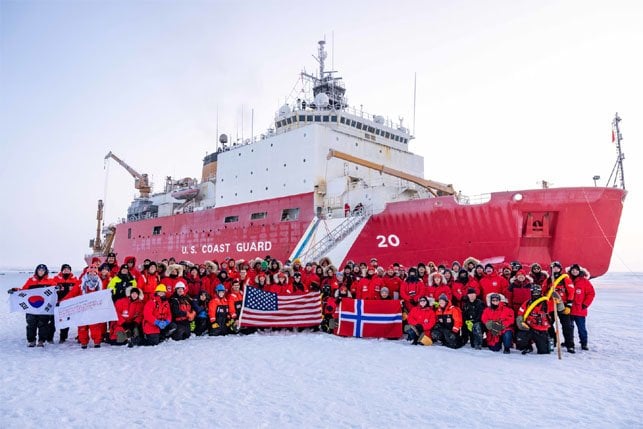
The U.S. Coast Guard Cutter Healy recently completed her annual missions to the Arctic. The vessel returned to Seattle, Washington, on October 26, following a 129-day patrol.
Healy, one of three Coast Guard polar icebreakers, steamed over 20,000 miles this deployment. She departed her homeport of Seattle on June 19 and, during her mission, was used to support Operation Arctic West Summer and Operation Frontier Sentinel as part of the USCG presence in the region.
“Healy’s unique and specialized capabilities allow us to operate in the most remote regions, conducting the highest priority missions of the Coast Guard,” said Capt. Kristen Serumgard, commanding officer of Healy. “Healy’s dynamic crew of active duty and civilian personnel showcased tremendous adaptability, dedication and resilience, steaming over 20,000 miles through ice-covered waters to complete the mission.”
As a part of Operation Frontier Sentinel, Healy queried and monitored three foreign research vessels operating in ice-covered waters over the U.S. Extended Continental Shelf and U.S. Exclusive Economic Zone. A total of five China-affiliated research vessels were operating in the Arctic region over the summer, and Healy was one of several Coast Guard assets deployed to monitor activity in the region. The Coast Guard works in conjunction with U.S. Northern Command and Alaskan Command to constantly monitor foreign vessels operating in and near U.S. waters.
Healy’s crew also supported two missions involving the deployment and recovery of subsurface oceanographic equipment throughout the U.S. Arctic, East Siberian Sea, and Laptev Sea. This work was performed in conjunction with the Office of Naval Research, the National Science Foundation, and other partner agencies. USCG reports that the data collected will help build a more cohesive picture of the physical, biological, and chemical properties of the Arctic Ocean, improving maritime domain awareness north of the Arctic Circle.
As part of the Coast Guard’s Arctic District’s multi-faceted response to a series of devastating storms that struck Western Alaska communities, Healy also diverted to the affected region. She supported search and rescue and disaster relief efforts.
Commissioned in 1999, Healy is the largest cutter in the U.S. Coast Guard at 420 feet in length and 16,000 tons. Healy is designed to break 4.5 feet of ice continuously at three knots and can operate in temperatures as low as -50 degrees Fahrenheit, enabling year-round access to the Arctic Ocean.
With Polar Star and the recent addition of Storis, Healy makes up the U.S. current polar icebreaker fleet. Construction is underway on the long-delayed new icebreaker Polar Sentinel, now expected for delivery in 2030, and the U.S. recently announced a new program with Finland to build up to 11 icebreakers at a projected cost of $6 billion. The program calls for expediting the construction using Finland’s capabilities so that the first new vessels will be delivered in 2028.
US Coast Guard Finishes a 16-Ship Life Extension, On Time and Under Budget
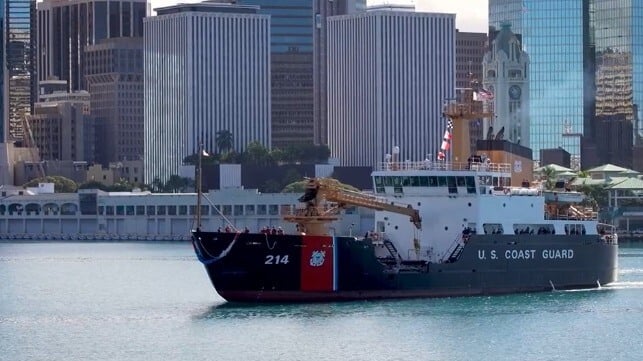
The U.S. Coast Guard buoy tender USCGC Hollyhock is back in service and at work in the Pacific, where she will maintain the service's aids to navigation in Hawaii and in far-flung island territories. The vessel is the last of the 16 Juniper-class hulls to complete a midlife refit and life extension, and the class-wide overhaul program is now complete - on time and under budget, a rarity in a large-scale government shipyard project.
For Hollyhock, the 800-day-long refit included upgraded machinery control systems, propellers and HVAC, along with hull repairs and replacement of obsolete equipment. Reliability and uptime will be key in the vast distances of the Pacific: When deployed on foreign-assistance missions to help out with buoy servicing in remote island chains, Hollyhock will often be the only American presence of any kind. "Our arrival enhances the Coast Guard’s capacity to maintain vital navigational aids that facilitate the safe flow of maritime commerce. This is especially crucial in Hawaii, where more than 90% of goods arrive by sea," said Cmdr. Jessica McCollum, commanding officer of the Hollyhock.
The refit program for the Junipers evolved from previous efforts to overhaul and extend the life of the medium-endurance cutter fleet; that earlier program was successful enough that some of the oldest examples of the WMEC class are still on patrol today, after six decades in seagoing operation. The buoy tender refit program spanned a difficult era for shipyard work - a 10-year timeline from the mid-2010s, which included two government shutdowns, COVID-19, a Coast Guard recruiting crisis, shipyard labor shortages and the post-pandemic period of heightened inflation - but through it all, the series of overhauls stayed on track.
“This outstanding accomplishment highlights the Coast Guard’s commitment to delivering reliable, mission-ready vessels both efficiently and cost-effectively,” said Kenneth King, the program manager for midlife maintenance, in a statement upon redelivery. “Completing these 16 major maintenance availabilities on time and under budget exemplifies the service’s strategic approach to recapitalization, ensuring greater operational availability, reduced lifecycle costs and enhanced readiness to meet the Coast Guard’s critical missions.”
By contrast, U.S. Navy repair programs generally struggled with delays and budget overruns during the same period - exemplified by the four-year effort to repair the brand new USS Gerald R. Ford, the six-year midlife refit for USS George Washington, and the $1.8 billion spent on refitting cruisers that were then decommissioned. These vessel classes all have far higher level of technical complexity than Coast Guard assets, and driving down maintenance cost and duration is a top priority for the Navy.

No comments:
Post a Comment