It’s possible that I shall make an ass of myself. But in that case one can always get out of it with a little dialectic. I have, of course, so worded my proposition as to be right either way (K.Marx, Letter to F.Engels on the Indian Mutiny)
Saturday, November 01, 2025
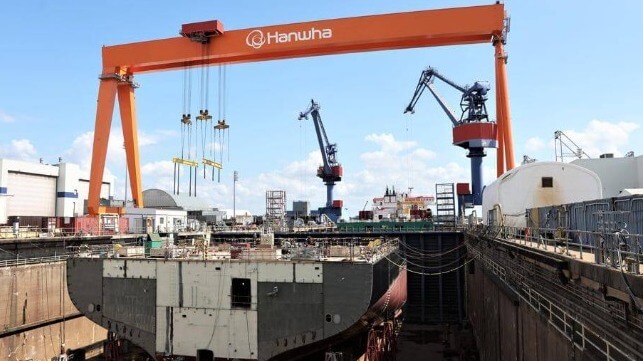
Hanwha Philly to Build Nuclear-Powered Submarine for South Korea
The Trump administration has reached an unexpected agreement with the government of South Korea on sharing one of America's most closely-held capabilities - nuclear-powered submarine technology. During a visit to Gyeongju, President Donald Trump approved South Korea's request to begin making naval reactor fuel, useful for nuclear propulsion and nuclear weapons. In addition, Hanwha will build one or more nuclear submarines at Hanwha Philly Shipyard for delivery to the ROK Navy.
The existing U.S.-South Korean mutual defense pact places limits on Seoul's ability to use nuclear technology for defense applications, and the treaty would have to be amended to allow uranium enrichment above 20 percent U-235. American naval reactors run on uranium enriched to about 94 percent U-235 (weapons-grade), far above the treaty's limit. "If fuel supply is permitted, we can build several submarines equipped with conventional weapons using our own technology to defend the waters around the Korean Peninsula, ultimately reducing the burden on U.S. forces," said South Korean President Lee Jae Myung in remarks Wednesday.
Trump said later in the day that he had approved Lee's request to revise the accord. “Our Military Alliance is stronger than ever before and, based on that, I have given [South Korea] approval to build a Nuclear Powered Submarine, rather than the old fashioned, and far less nimble, diesel powered Submarines that they have now,” President Trump said in a statement on his social media platform. Transfers of U.S. Navy submarine technology to South Korea will also be involved.
The plan has parallels with the AUKUS arrangement with Australia and the UK, and has potential advantages for all parties. South Korea would get access to high-endurance, stealthy, nuclear-powered subs at a sensitive time in the East Asian security environment. Since the fuel agreement would produce high-enriched uranium, it could also be a stepping-stone towards a sovereign nuclear weapons program for South Korea, which is exposed to a growing nuclear threat from Pyongyang. For the U.S., the deal would mean another ally equipped with advanced submarine capabilities - a potential asset in the event of a conflict - and the development of a third nuclear-capable private shipyard on American soil.
"Through Hanwha Philly Shipyard and other investments and partnerships, a revived American shipbuilding sector will benefit U.S. workers, foster prosperity for both the United States and Korea, and enhance our nations’ shared security," said a Hanwha official in a statement to NBC.
In addition to the submarine agreement, Trump received confirmation of South Korea's plans to invest a total of $150 billion in U.S. shipbuilding over time. The official announcement included smaller initial commitments from all of South Korea's "Big Three" shipbuilders: HD Hyundai and Cerberus Capital Management will partner on a $5 billion investment program for modernizing American shipyards; Samsung Heavy Industries and Vigor Marine Group will work together on naval drydockings (MRO) and shipyard automation; and Hanwha Ocean will invest $5 billion in infrastructure and workforce development at Hanwha Philly.
Royal Navy Tests Out Quantum Timing Aboard Unmanned Sub
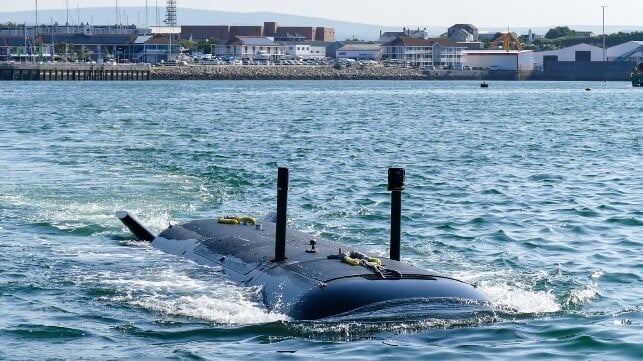
The Royal Navy has tested out a quantum atomic clock aboard an uncrewed submarine, marking the first time such technology has operated underwater at sea and potentially reshaping how submarines navigate in the depths.
The trial placed Infleqtion's Tiqker quantum optical atomic clock aboard the XV Excalibur, an extra-large autonomous underwater vessel that serves as a testing platform for emerging technologies. The experiment, conducted in partnership with the Submarine Delivery Agency's Autonomy Unit, could address one of submarines' most persistent challenges: maintaining precise navigation while remaining hidden beneath the waves.
Submarines face a fundamental problem that surface vessels do not. Cut off from GPS signals underwater, they have long relied on microwave-based clocks that gradually lose accuracy over extended missions. That drift can compromise inertial navigation, which requires precision timing.
The quantum clock offers a potential solution. By providing what engineers call a "time heartbeat" with laboratory-grade precision, the device can help submarines compensate for the navigational drift that accumulates during long underwater operations, allowing them to remain submerged for longer periods.
"This trial is a significant milestone in the development of extra large uncrewed underwater vehicle capabilities in the Royal Navy," said Commodore Marcus Rose, deputy director of underwater battlespace capability.
The implications extend beyond navigation. Precision timing affects other submarine systems too, including sonar, weapons targeting and secure communications.
According to the Royal Navy, the device proved reliable through multiple dive cycles in a replication of real-world sub operations. "We are laying the foundation for fleets to navigate, coordinate and operate with precision in any environment," said Ryan Hanley, Infleqtion's general manager for the United Kingdom. The service plans additional quantum timing trials aboard the Excalibur.
The test reflects the Royal Navy's broader push to accelerate the adoption of emerging technologies, including autonomous systems and artificial intelligence. Constrained by budget and recruitment limits, it seeks to cut costs, reduce manpower requirements, and enhance fleet capabilities through technological solutions - all more rapidly than traditional procurement allows.
Philippines Holds Containership with Radioactive Cargo Offshore
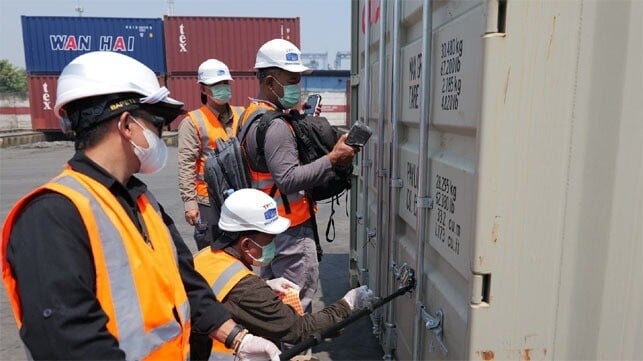
Indonesian teams tested the boxes and found Cesium-137 levels much higher than background (BAPETEN)
Officials in the Philippines are trying to understand how containers with radioactive dust were exported and now what to do with them since they have been sent back to the country. The Philippines is demanding that one of the country’s steel producers take responsibility for the cargo, while the company denies involvement and says only the government has the ability to handle the contaminated cargo.
The case has intensified, according to a report from Bloomberg, after the containership reached the outskirts of Manila last weekend. The unnamed vessel has been refused permission to offload the cargo until plans for its disposal are resolved.
The situation began in mid-September when a shipment of containers holding a cargo of zinc dust triggered alarms at Indonesia’s Tanjung Priok Port in Jakarta. The Nuclear Energy Supervisory Agency (BAPETEN) was notified, and it sent a secondary team that confirmed the high readings in nine out of 14 containers that had been received on September 10 from the Philippines. They performed a swab test on the exterior of the containers and said the radiation was limited to the interior of the boxes.
Days later, a second shipment of nine containers also showed high levels of radiation. Testing confirmed Cesium-137 levels significantly higher than acceptable background radiation doses. It was said to be up to 210 times above the background dose level. Testing showed it was present in five of the containers, and again, the exterior swabs were negative.
Indonesia refused entry for the containers and ordered the carrier to return them to the shipper in the Philippines.
The Philippine Nuclear Research Institute said it has researched the situation and said the boxes were exported to Indonesia by a company called Zannwann International Trading Corp., a Chinese company with operations in the Philippines. Zannwann, they asserted, had purchased the zinc dust from SteelAsia, a manufacturer in the Philippines. Zinc dust is used in industrial and chemical applications because it resists corrosion.
SteelAsia came out strongly denying any association with the contaminated materials. It contends Zannwann brought the product from multiple manufacturers, and the other company is the source of the contamination. SteelAsia says it only manufactures and exports reinforced steel bars, although reports contend the dust is a byproduct of manufacturing. The Philippine authorities are saying the other company’s facility is clean, and the contamination must have come from SteelAsia.
Media reports in Manila said SteelAsia agreed to voluntarily suspend production for testing in its facility. Both its warehouse and Zannwann’s are also to undergo testing, as well as approximately 100 workers at the two companies.
The Philippine Nuclear Research Institute is demanding that SteelAsia take custody of the contaminated containers and arrange for proper disposal by burying the material. For now, the unnamed ship is held in limbo waiting for the situation to be resolved so it can unload the containers.
Philippines Conducts Rare Interdiction Targeting Chinese Fishermen
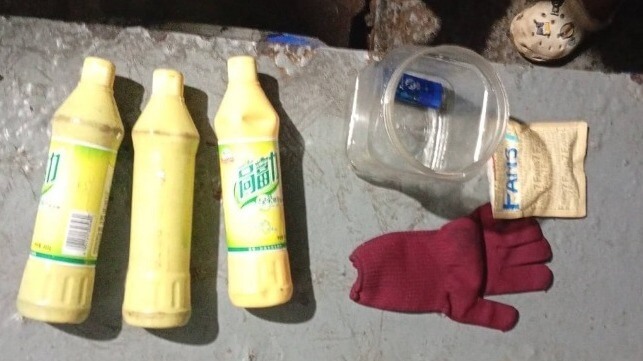
Items seized from the Chinese fishing boat included dish-soap bottles allegedly filled with cyanide, which is widely used for illegal reef fishing (AFP)
In a rare intercept and boarding operation, Philippine personnel seized alleged illegal fishing equipment from a Chinese boat near the BRP Sierra Madre, the decaying WWII landing ship that serves as a makeshift outpost at Second Thomas Shoal.
The Sierra Madre is a longtime flashpoint between Chinese and Philippine forces: China claims Second Thomas Shoal as its own, and has demanded that Manila withdraw and remove the wrecked landing craft from the reef. Chinese forces have repeatedly attempted to blockade the outpost, and in years past, water-cannoning and close-quarters maneuvers were tactics of choice for the China Coast Guard when encountering a Philippine supply convoy near the Sierra Madre. In June 2024, the site saw the most violent confrontation between China and the Philippines yet: during a supply drop, China Coast Guard personnel attacked a group of Philippine Marines in small craft alongside the base, costing one Filipino soldier his thumb and injuring others.
Last week's interaction was initiated not by China but by Philippine forces, a rare occurrence in a conflict marked generally by restraint from Manila's side. On October 24, Chinese fishing boats were operating "unauthorized" near Second Thomas Shoal, as is common in an area patrolled heavily by China's "maritime militia" state-sponsored fishing enterprises. This time, AFP forces intercepted the boat and confiscated illegal fishing gear - an unusually assertive response.
Among other items recovered from the Chinese boats, AFP forces claim to have seized bottles of cyanide, used to stun reef fish for live capture for the aquarium trade. This is an efficient method to extract economic value from pristine reef habitats, and is commonly practiced throughout Southeast Asia - notably in the fishing communities of the western Philippines. It has the unwanted side effect of killing coral, undermining the fishery's future productivity.
The boarding was certain to draw a forceful response from Beijing. In a pointed essay circulated by the People's Liberation Army, Chinese national interest scholar Ding Duo accused the Philippines of "banditry," "provocation, deliberate evidence fabrication, and a cynical propaganda campaign." He asserted that the Philippine troops damaged the boat's engine and dragged the vessel off, causing property damage and physical harm to the Chinese fishermen. He further suggested that the alleged cyanide bottles were nothing more than containers of a common brand of Chinese dish soap.
"The Philippines has perfected what can only be described as 'victimhood diplomacy' - orchestrating confrontations, selectively leaking images, and presenting carefully crafted narratives to dominate media cycles and solicit international sympathy," asserted Ding.
Second Thomas Shoal is within the Philippines' 200-nautical-mile EEZ boundary and 700 nautical miles away from mainland China; it submerges at high tide and does not constitute land for the purposes of UNCLOS claims. Despite the distance from its shores and its lack of jurisdiction under international law, China claims the reef - and the vast majority of the rest of the South China Sea - as its own. The Permanent Court of Arbitration in the Hague rejected these sweeping claims in 2016, finding them inconsistent with UNCLOS, but China refused to participate in the proceeding or to acknowledge the ruling.

No comments:
Post a Comment