India-Bound Tanker Caught in STS Transfer of Russian Oil Off Oman
A report published in the Financial Times, quoting investigations carried out by TankerTrackers.com, a maritime intelligence company, has shown clear evidence of transshipments of sanctioned Russian oil at transfer locations in the Gulf of Oman. The cargo was destined for delivery to the Guru Gobind Singh Refinery in Punjab, a facility co-owned by Mittal Energy.
The investigation tracked the outward voyages of four sanctioned tankers, which each loaded in Murmansk. VesselFinder details the tankers as the Belgorod (Russian-flagged, IMO: 9412359), Danshui (Benin-flagged, IMO: 9589750), Dignity (Russian-flagged, IMO: 9283241) and Primorye (IMO: 9421960). All four of these vessels are sanctioned by the United States (OFAC), United Kingdom (OFSI) and the EU.
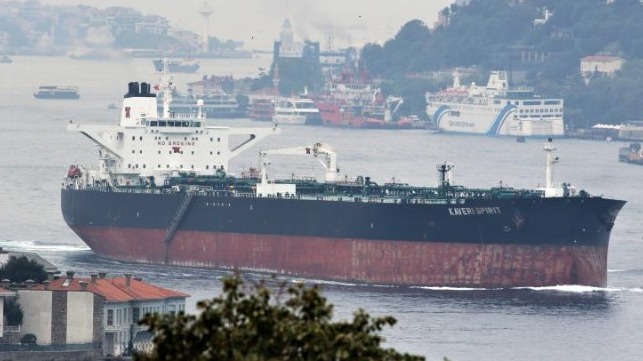
The receiving vessel in the transshipment from each of the four tankers was the Samadha (Sierra Leone-flagged, IMO: 9286281). The Samadha is owned by the Seychelles-registered Erika Freight Limited, which uses an address associated with multiple dark fleet vessels.
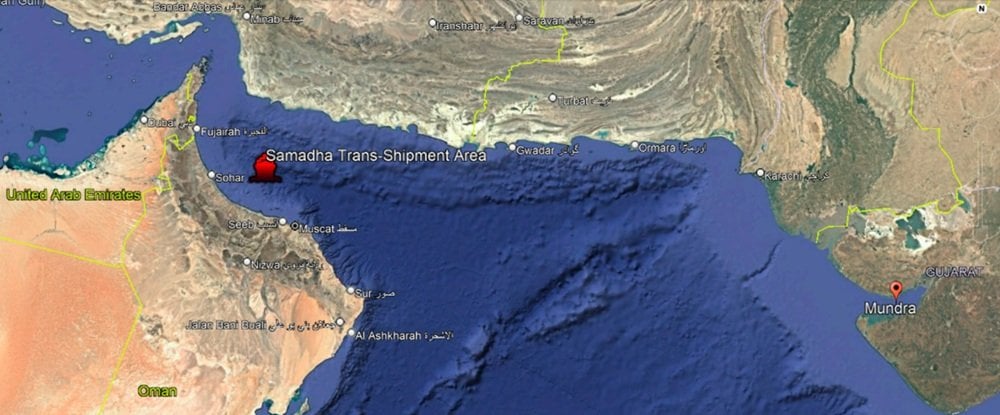
The transshipment area in the Gulf of Oman used by the tanker Samadha (Google Earth/Landsat/Copernicus/CJRC)
The trans-shipments in each case were identified in satellite imagery, taking place in an area 40 nautical miles due east of Sohar in the Gulf of Oman, outside Omani territorial waters. The four tankers from Murmansk switched off their AIS transponders as they approached the Gulf of Oman, whilst the Samadha sent out a spoofed AIS signal suggesting that it made a circular journey from India to Oman before turning back - all without meeting any of the Russian ships. The Financial Times' report published satellite imagery taken of each of transshipments as they took place. The value of the four loads transported between July and September has been estimated as $280 million.
The UK's OFSI sanctioned the Samadha on October 15, the EU having sanctioned the vessel on July 20 this year. The tanker for the moment remains free of OFAC sanctions. Sanctions databases link the Samadha at some point to what is now the NorthStandard P&I Association, but the post-sanctions insurance relationship is not clear.
In each instance the Samadha unloaded at Mundra on the Gujarati coast, the head of the 625-mile crude pipeline to the Guru Gobind Singh refinery.
The Guru Gobind Singh refinery is a joint venture between the state-owned Hindustan Petroleum Company and Mittal Energy Limited. The executive chairman of Arcelor Mittal is Lakshmi Mittal, who has recently announced that for tax reasons he will be giving up his UK residency.
The clear evidence of sanctions-breaking activities on the part of vessels sanctioned both by the EU and the UK's OFSI will present particular dilemmas for the regulatory and enforcement authorities. Arcelor Mittal has substantial steel and mining investments in both the EU and the UK. In an ongoing political dispute in the UK over a spy case dropped allegedly because it would upset the Chinese government, and hence jeopardize Chinese investments, the British government has shown a reluctance to take robust action against malefactors if its economic interests would be jeopardized. It also signed a trade agreement with India in July.
The United States has been seeking to tighten curbs on Indian consumers and Russian producers of Arco-grade crude, and has imposed sanctions on Russia's two biggest crude producers, Rosneft and Lukoil.
As for Samadha, the vessel may not need to conduct an STS transfer on her next voyage - at least, not in the role of the receiving ship. The latest AIS data puts the tanker off the coast of Russia's Kola Peninsula, en route to Murmansk.
Top image: Samadha, seen here as Kaveri Spirit (Cengiz Tokgöz / VesselFinder)
AD Ports Signs to Run Daily Container Train to Sohar

Noatum Logistics, a subsidiary of the AD Ports Group, has signed an agreement with Hafeet Rail to run a daily container freight train between Sohar in Oman, and the Emirati railway hub at Al Ain, which in turn is directly through-connected to Khalifa Port, but also to the ports of Jebel Ali, and Fujairah. This will be the first cross-border connection of what is planned to be a GCC-wide network. The train will be configured to carry 276 TEUs, equivalent to 15,000 tons of general cargo. A daily service in both directions will be offered from the start, to be expanded as demand increases.
Noatum Logistics already runs a similar such container service between Khalifa Port and Fujairah, and hence has the container handling infrastructure in place for dockside to rail operations.
The Hafeet Rail line between Al Ain and Sohar Port, not yet complete, is a joint project between Etihad Rail, Oman Rail and Mubadala Investment. When in service, there will be competition between Fujairah and Sohar Port to win traffic wishing to save on sailing time, insurance and shipping costs by avoiding passage through the Strait of Hormuz. The two ports are only 50 miles apart, but Sohar may have a marginal advantage as it is a safer distance from Iran, deeper into the Gulf of Oman and closer to the sea routes to Asia, Europe and Africa.
The Port of Sohar is operated by Asyad, Hutchinson and the Port of Rotterdam, and has seen rapid expansion in recent years as the Sohar Industrial Zone has grown. Besides steel, ferrochrome, polypropylene, aluminum and foodstuff production complexes, the Zone also hosts a large rare earth refining facility producing antimony trioxide.
Sohar has attracted foreign direct investment of more than $26 billion, and acreage allocated to its industrial zone has had to be significantly increased since it was first set up in 2002. The port handled a 15% growth in container traffic during 2024, rising to 942,000 TEUs, but bulk cargo handling grew by 72%.
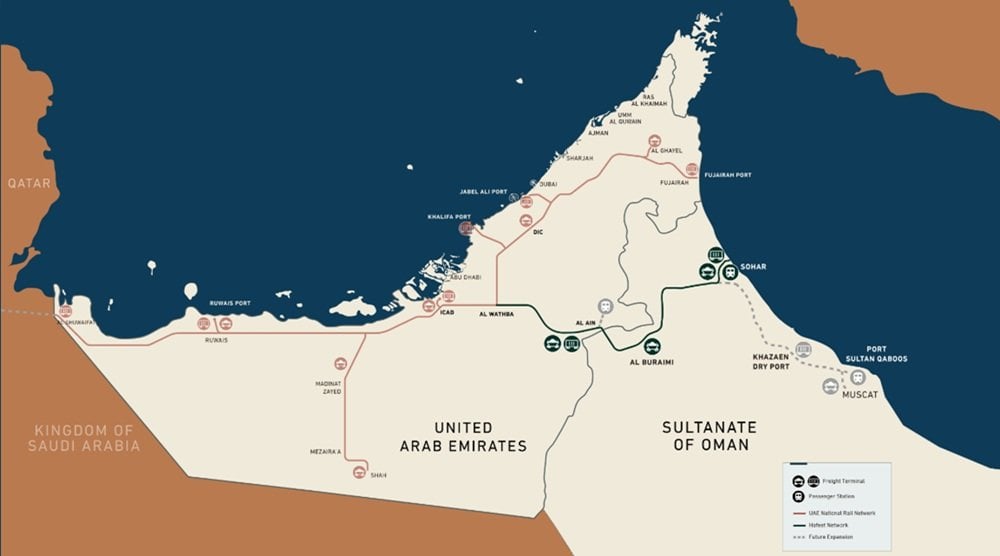
The planned rail network linking the UAE and Oman (Hafeet Rail)
In Hafeet Rail's next phase of construction, it is planned to add Port Sultan Qaboos in Muscat to the network. The final goal is then to add in Duqm and Salalah, providing a freight route for Saudi Arabia directly to the Arabian Sea.
Saudi Arabia has long sought a trade route to the Arabian Sea which avoids the perils of both the Red Sea and the Strait of Hormuz. Driving a route through Oman to Duqm and Salalah is a more realistic goal than attempting to create a similar egress through a permanently unstable Yemen.
HMS Prince of Wales Approaches Suez Canal
The UK carrier strike group (CSG) led by HMS Prince of Wales (R09) is safely through the Bab el Mandeb and past the coastline controlled by the Houthis in the southern Red Sea, the transit having been conducted on October 26. The CSG is expected to pass through the Suez Canal on the evening of October 29.
Since completing joint training with the Indian Navy in the Arabian Sea, the Royal Navy successfully put up a smokescreen around the whereabouts of the CSG, giving out that the CSG was involved in Exercise Bahr Guardian - about which no details were published, but which may have entailed final work-up training for the Red Sea transit.
For part of the scheduled exercise activity, the carrier and its escorts were however tied up and seen alongside on October 21 in the port of Duqm, leaving the next day.
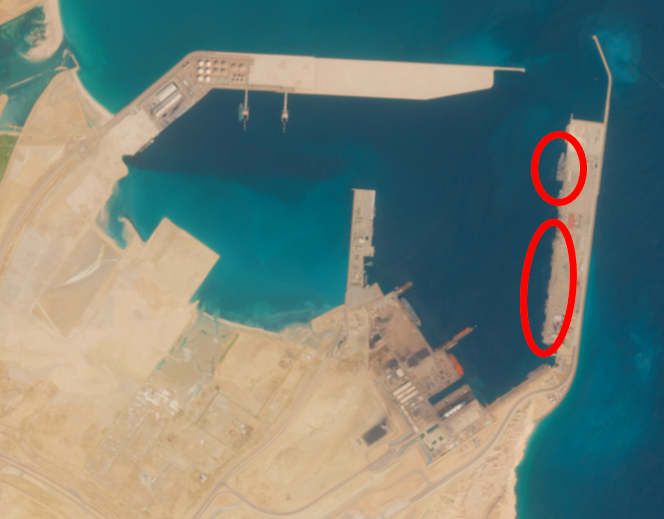
HMS Prince of Wales alongside in Duqm on October 21, with six other warships tied up further south (Sentinel-2)
The operation to transit the southern Red Sea will probably transpire to have been the most hazardous phase of the CSG's nine month deployment, particularly as having made the same transit (but in the opposite direction) back in June, the Houthis who might wish to threaten passage would know what to expect. A planning team from the UK's joint headquarters at Northwood helped plan a coordinated air and sea contingency operation to ensure that the passage went ahead without incident, with potential threats monitored and neutralized. This entailed deployment of extra surveillance assets, and also the mobilization of diplomatic support to secure assistance from parties who could assist.
At the time of the transit, the ever-acute MT Anderson observed that the US Navy presence in the Red Sea was at a minimum, with only the Arleigh Burke Class destroyer USS Forrest Sherman (DDG-98) on hand. The USS Forrest Sherman is likely to have assisted with provision of anti-drone and missile cover during the transit.
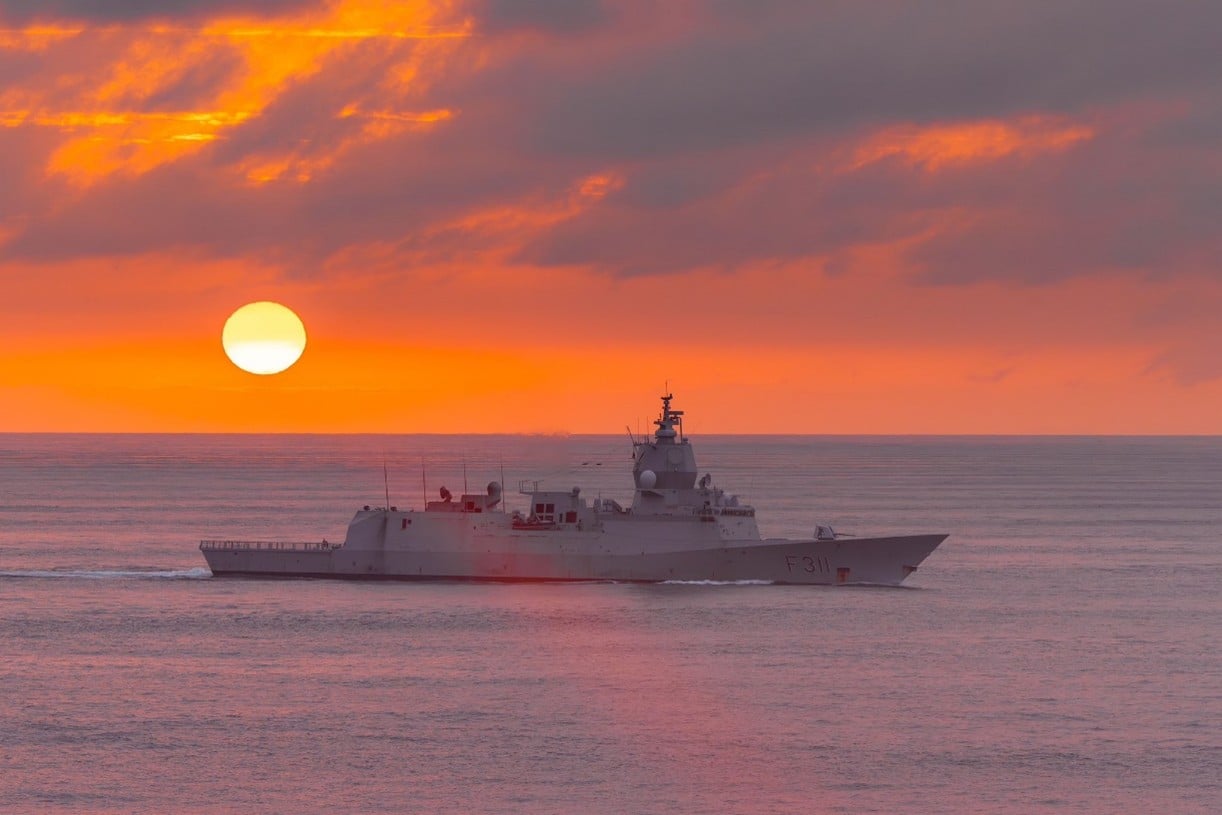
In recent days, the Norwegian Nansen Class frigate HNoMS Roald Amundsen (F311) as its most constant allied member has been operating as part of the CSG, as has the Japanese Murasame Class destroyer JS Akebono (F108) on an unusually far-distant deployment from home. Other ships in company are the Type 45 destroyer HMS Dauntless (D33) and the Type 23 frigate HMS Richmond (F239). According to @UKForcesTracker, the fleet resupply ship RFA Tideforce (A139) is already in the Mediterranean, waiting to support the CSG when it arrives. It is not clear where RFA Tidespring (A136) is, but she may possibly linger and escort HMS Lancaster (F229) on its return trip from Bahrain to the United Kingdom via the Cape. Which ships now make up the CSG should become clear following its transit of the Suez Canal.
Once through the Suez Canal, the CSG is scheduled to conduct Exercise Falcon Strike 25, involving joint air operations training with Harrier aircraft of the Italian Navy.

No comments:
Post a Comment