'Desperation': Food bank CEO says some Meals on Wheels recipients haven't eaten 'in weeks'
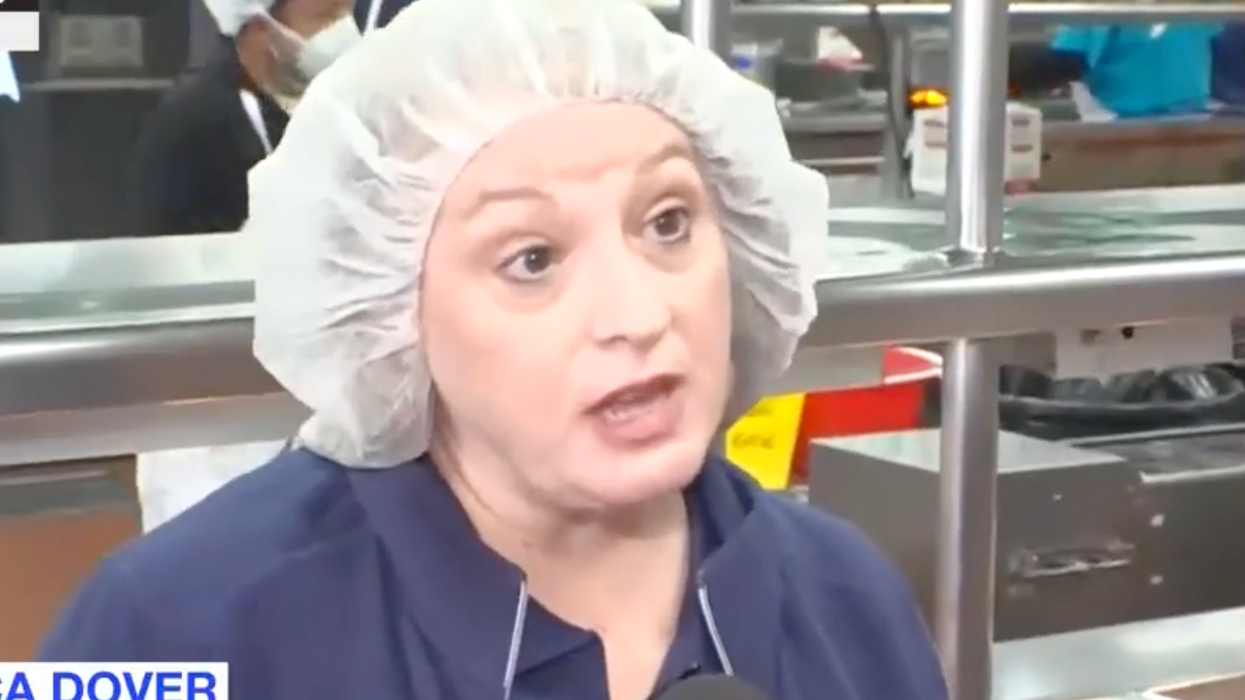
Veronica Dover, CEO of St. Vincent Meals on Wheels in Los Angeles, on MS NOW on November 27, 2025 (Image: Screengrab via YouTube / MS NOW)
Veronica Dover, CEO of St. Vincent Meals on Wheels in Los Angeles, on MS NOW on November 27, 2025 (Image: Screengrab via YouTube / MS NOW)
November 27, 2025
ALTERNET
For thousands of homebound seniors in the Los Angeles area unable to cook for themselves, Thanksgiving dinner will be delivered by St. Vincent Meals on Wheels. And for many of those people, this will be the first meal they've had in days — or even weeks.
That's according to St. Vincent Meals on Wheels CEO Veronica Dover, who told MS NOW on Thursday that she's seen more need from the people her organization serves in recent months than ever before. Dover told MS NOW reporter Jillian Frankel that while she expected demand would be higher on Thanksgiving Day, she wasn't expecting to see so much "desperation" from Meals on Wheels recipients.
"Some of these folks that are being referred to us haven't eaten in days, some of them in weeks. And so it's really sad to see the state of malnourishment that is really coming," she said. "So they're very, very desperate when they come to us and we're doing everything we possibly can to take on as many of these people as, as we possibly can."
St. Vincent Meals on Wheels volunteers were seen during the segment preparing more than 2,000 meals to be delivered across Los Angeles County. The organization will be delivering an estimated 300 pounds of roasted turkey, 200 pounds of freshly mashed potatoes and 100 gallons of gravy, along with various side dishes. Dover reminded MS NOW viewers that while lines at food banks have been particularly long this year given the sluggish economy and rising prices, the people who rely on Meals on Wheels aren't even physically able to stand in those lines.
"Most of the people that we serve are homebound. They're unable to get out and shop and cook for themselves. And where before they might have had food dropped off by people, that's not happening as often," she said. "We're getting referrals through the Department of Mental Health, through social services and other places of people who maybe get a bag of food dropped off every other week and the opposite week they weren't eating before they came to us. And so it's really sad situation, the desperation that we're seeing."
Frankel reported that St. Vincent Meals on Wheels workers were "stretching their resources here as far as possible," in order to provide a homemade Thanksgiving meal to needy homebound Angelenos, many of whom are seniors.
"Today's meals included turkey, stuffing, mashed potatoes and all of the fixings. Everything that these folks need to enjoy a Thanksgiving meal right from home this year," Frankel said.
Click here to visit St. Vincent Meals on Wheels' website, and watch the segment below.
For thousands of homebound seniors in the Los Angeles area unable to cook for themselves, Thanksgiving dinner will be delivered by St. Vincent Meals on Wheels. And for many of those people, this will be the first meal they've had in days — or even weeks.
That's according to St. Vincent Meals on Wheels CEO Veronica Dover, who told MS NOW on Thursday that she's seen more need from the people her organization serves in recent months than ever before. Dover told MS NOW reporter Jillian Frankel that while she expected demand would be higher on Thanksgiving Day, she wasn't expecting to see so much "desperation" from Meals on Wheels recipients.
"Some of these folks that are being referred to us haven't eaten in days, some of them in weeks. And so it's really sad to see the state of malnourishment that is really coming," she said. "So they're very, very desperate when they come to us and we're doing everything we possibly can to take on as many of these people as, as we possibly can."
St. Vincent Meals on Wheels volunteers were seen during the segment preparing more than 2,000 meals to be delivered across Los Angeles County. The organization will be delivering an estimated 300 pounds of roasted turkey, 200 pounds of freshly mashed potatoes and 100 gallons of gravy, along with various side dishes. Dover reminded MS NOW viewers that while lines at food banks have been particularly long this year given the sluggish economy and rising prices, the people who rely on Meals on Wheels aren't even physically able to stand in those lines.
"Most of the people that we serve are homebound. They're unable to get out and shop and cook for themselves. And where before they might have had food dropped off by people, that's not happening as often," she said. "We're getting referrals through the Department of Mental Health, through social services and other places of people who maybe get a bag of food dropped off every other week and the opposite week they weren't eating before they came to us. And so it's really sad situation, the desperation that we're seeing."
Frankel reported that St. Vincent Meals on Wheels workers were "stretching their resources here as far as possible," in order to provide a homemade Thanksgiving meal to needy homebound Angelenos, many of whom are seniors.
"Today's meals included turkey, stuffing, mashed potatoes and all of the fixings. Everything that these folks need to enjoy a Thanksgiving meal right from home this year," Frankel said.
Click here to visit St. Vincent Meals on Wheels' website, and watch the segment below.
The Shutdown Proved That the USA Needs SNAP
The short, natural experiment we all witnessed reinforces that SNAP is the nation’s first line of defense against hunger and food insecurity.
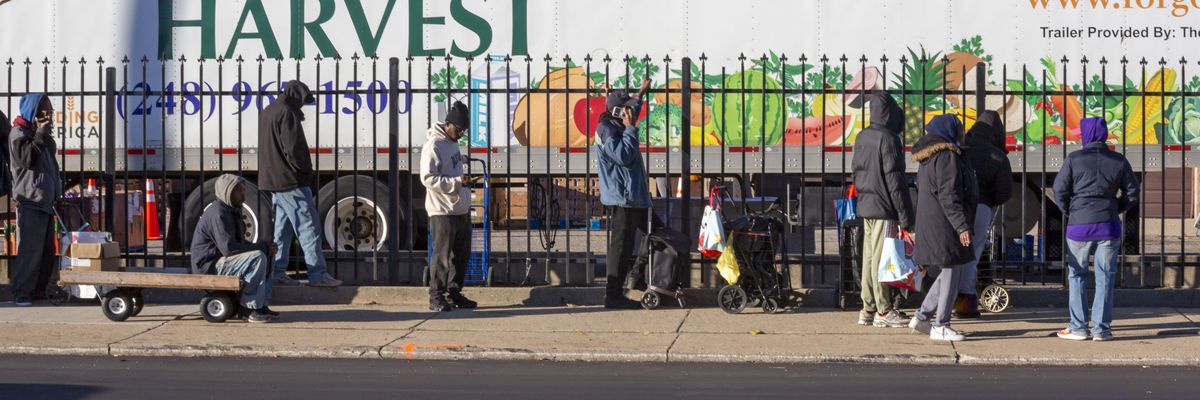
People wait in line to pick up groceries from the anti-hunger nonprofit Forgotten Harvest on November, 4 2025 as demand for emergency food at food pantries and soup kitchens rose dramatically during the federal government shutdown.
(Photo by Jim West/UCG/Universal Images Group via Getty Images)
Beth Daponte
Nov 27, 2025
Common Dreams
Since the Food Stamp Act of 1964 and until the recent government shutdown, the Food Stamp program (renamed the Supplemental Nutrition Assistance Program, or SNAP), had operated without interruption. Most SNAP participants have their grocery needs satisfied thanks to the SNAP subsidies, with only 35% of SNAP households also using community resources such as food pantries or food banks. That is, prior to the shutdown, 65% of the 22.4 million SNAP participating households (approximately 42 million people) did not rely on food pantries.
The shutdown created the conditions for a natural experiment where we could see what the USA would experience without SNAP outside of the conditions of a laboratory. We learned that the 12% of Americans who rely on SNAP find it vital for their household budgets. During the shutdown, lines at food pantries lengthened, and, to “stretch” resources, many food pantries provided households with less food. While many communities stepped up to provide food pantries with more resources, this short-term experiment left open the question of when donor fatigue would set in.
Since the Food Stamp Act of 1964 and until the recent government shutdown, the Food Stamp program (renamed the Supplemental Nutrition Assistance Program, or SNAP), had operated without interruption. Most SNAP participants have their grocery needs satisfied thanks to the SNAP subsidies, with only 35% of SNAP households also using community resources such as food pantries or food banks. That is, prior to the shutdown, 65% of the 22.4 million SNAP participating households (approximately 42 million people) did not rely on food pantries.
The shutdown created the conditions for a natural experiment where we could see what the USA would experience without SNAP outside of the conditions of a laboratory. We learned that the 12% of Americans who rely on SNAP find it vital for their household budgets. During the shutdown, lines at food pantries lengthened, and, to “stretch” resources, many food pantries provided households with less food. While many communities stepped up to provide food pantries with more resources, this short-term experiment left open the question of when donor fatigue would set in.
‘It Does Not Have to Be This Way’: Child Hunger Set to Surge as Trump Withholds SNAP Funds
‘Not Good Enough’: Trump to Pay Partial November SNAP Benefits After Court Rulings
Consider that in 2023, 9.3 million households (24.4 million persons) received free groceries from a food pantry or other community resource. Without SNAP, the 65% of SNAP participating households that had not previously relied on food pantries would likely start relying on food pantries, adding approximately 14.6 million households to food pantry lines.
Adding another 14.6 million households to the preexisting 9.3 million households that use food pantries would entail scaling up the network to an unprecedented level and restructuring it. This would come at a high cost and cannot be accomplished in the short-term. Further, the long-term resources available for such scaling up are uncertain—while Americans are generous in the short-term, establishing an equitable and resourced scaled-up network would require long-term private donations to food assistance at a scale never before shown. Donor fatigue would likely set in.
Reductions in SNAP will fall on the shoulders of communities.
But even if food pantries could provide food to millions more households, the amount of food that pantries typically provide is far less than average SNAP benefits. SNAP provides to participants, on average, approximately $188 per person per month in electronic benefits available to purchase groceries. A family of four receives approximately $750 per month, or $9,000 annually. In contrast, food pantries or food banks typically provide anywhere between the equivalent of two to five days’ worth of food per month. The US Department of Agriculture “thrifty” food plan costs out one week of food for a family of 4 at $231. That is, even if a family were lucky enough to get a full week of food per month from a food pantry, that value would be far less than the value of SNAP benefits (e.g., $2,770 vs. $9,000 per year).
During the government shutdown and pause in SNAP benefits, I toured a large food pantry 30 miles outside of Pittsburgh. Staff reported a surge in new enrollees (in one week getting approximately seven times the number of new families to serve than usual), calls from people outside of the pantry’s service area needing help, and needing volunteers to direct traffic during open hours. The increase in monetary and food donations could not keep pace with the surge in demand, forcing a reduction in each household’s food allotment. Participants lined up well before the pantry opened due to anxiety about food running out.
While SNAP is intended to make it possible for households to meet their monthly food needs, the food pantry and food bank network is not designed to do such. The network was originally designed to cover the period between when one applied for Food Stamps and when expedited benefits would start to flow, which used to be approximately four days but has increased to seven days.
The Trump administration is exploring ways to reduce the number of SNAP participants such as having shorter periods for recertification or making it mandatory for all SNAP households to reapply. The administration hopes that such barriers will discourage people from receiving SNAP.
Reductions in SNAP will fall on the shoulders of communities. The short, natural experiment we all witnessed reinforces that SNAP is the nation’s first line of defense against hunger and food insecurity and food pantries can only be a secondary and supplemental source of food. Food pantries and food banks cannot substitute for a robust, reliable, government-funded food safety net.

No comments:
Post a Comment