Lethal virus hits last rare blue macaws in Brazil wild
Rio de Janeiro (Brazil) (AFP) – The only wild specimens of a rare blue parrot, which were recently returned to their natural habitat, have been diagnosed with an incurable, likely lethal virus, Brazil's government told AFP Thursday.
Issued on: 27/11/2025 - FRANCE24
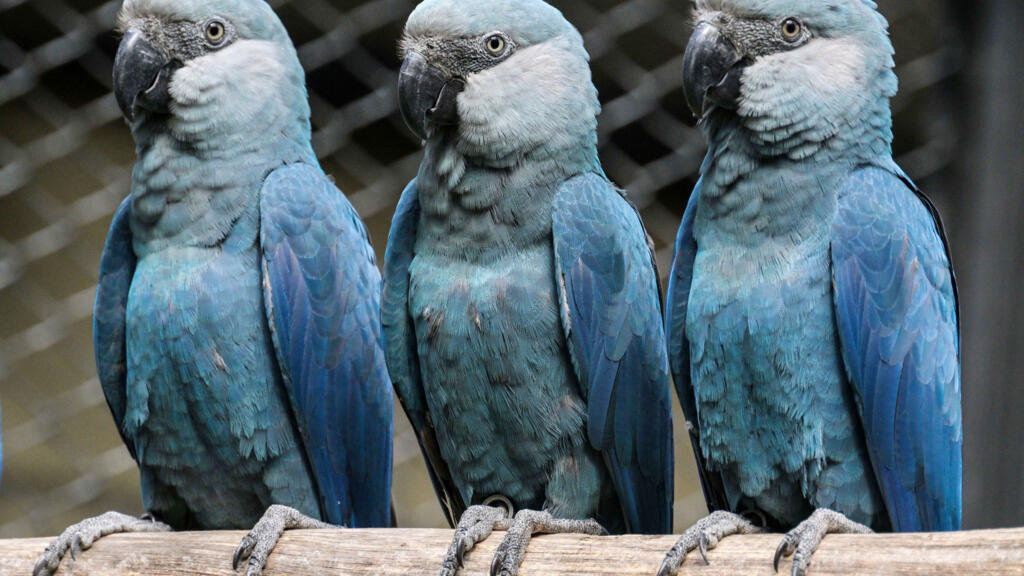
The disease strikes a major blow to a program seeking to return the Spix's macaw -- featured in the 2011 animated film "Rio" -- to its semi-arid natural habitat in northeast Brazil, 25 years after they were declared extinct in the wild.
Brazil's conservation agency, ICMBio, told AFP that since a first group of Spix's macaws arrived in the country from Germany in 2020, around 20 had been freed, only 11 of which had survived.
All of the survivors have tested positive for circovirus, which causes beak and feather disease in parrots but poses no danger to humans.
"The disease has no cure and kills the bird in most cases," ICMbio said in a statement.
Another 21 birds of around 90 still in captivity at a breeding center in the state of Bahia also tested positive.
The film "Rio" is about a Spix macaw that is raised in captivity in the United States and returns to Brazil to try to save its species.
Real-life efforts to save the parrot are more worthy of a high-stakes drama, marked by institutional conflict, concerns over unscrupulous breeders and sales to private collectors.
The BlueSky breeding center is a partner of the German Association for the Conservation of Threatened Parrots (ACTP), which holds 75 percent of the world's registered Spix's macaws, according to ICMBio.
Brazil terminated its partnership with ATCP in 2024 after the German organization sold 26 of the birds to a private zoo in India without its consent.
Brazil has repeatedly raised concerns at meetings of CITES, the global wildlife trade regulator, over loopholes that allow for the sale of captive-bred Spix's macaws and fuel demand for the fragile species.
Aside from habitat loss, demand from private collectors drove the extinction of the bird in the wild.
ICMBio has fined the BlueSky breeding center 1.8 million reais ($336,000) for failing to implement biosafety protocols to curb the spread of the virus.
Inspectors found "extremely dirty" bird feeders encrusted with faeces, while workers were handling the birds "wearing flip-flops, shorts and t-shirts."
The breeding center had fiercely resisted efforts to recapture the wild Spix's macaws, which a court ordered them to do in October.
It wrote on its website this week that parrots in South America were "more resistant" to circovirus than those elsewhere in the world.
Several had already recovered and were testing negative, according to the center.
BlueSky said it had increased sanitary measures, isolated healthy birds and built barriers to prevent contact between wild birds and captive birds.
"No birds died, all have excellent flight capacity and are feeding well."
© 2025 AFP
Bird flu viruses are resistant to fever, making them a major threat to humans
University of Cambridge
Bird flu viruses are a particular threat to humans because they can replicate at temperatures higher than a typical fever, one of the body’s ways of stopping viruses in their tracks, according to new research led by the universities of Cambridge and Glasgow.
In a study published today in Science, the team identified a gene that plays an important role in setting the temperature sensitivity of a virus. In the deadly pandemics of 1957 and 1968, this gene transferred into human flu viruses, and the resulting virus thrived.
Human flu viruses cause millions of infections every year. The most common types of these viruses, which cause seasonal flu, are known as influenza A viruses. They tend to thrive in the upper respiratory tract, where the temperature is around 33C, rather than deep in the lungs in the lower respiratory tract, where the temperature is around 37C.
Unchecked, a virus will replicate and spread throughout the body, where it can cause illness, occasionally severe. One of the body’s self-defence mechanisms is fever, which can cause our body temperature to reach as high as 41C, though until now it has not been clear how fever stops viruses – and why some viruses can survive.
Unlike human flu viruses, avian influenza viruses tend to thrive in the lower respiratory tract. In fact, in their natural hosts, which include ducks and seagulls, the virus often infects the gut, where temperatures can be as high as 40-42C.
In previous studies using cultured cells, scientists have shown that avian influenza viruses appear more resistant to temperatures typically seen in fever in humans. Today’s study uses in vivo models – mice infected with influenza viruses – to help explain how fever protects us and why it may not be enough to protect us against avian influenza.
An international team led by scientists in Cambridge and Glasgow simulated in mice what happens during a fever in response to influenza infections. To carry out the research, they used a laboratory-adapted influenza virus of human origin, known as PR8, which does not pose a risk to humans.
Although mice do not typically develop fever in response to influenza A viruses, the researchers were able to mimic its effect on the virus by raising the ambient temperature where the mice were housed (elevating the body temperature of the mice).
The researchers showed that raising body temperature to fever levels is effective at stopping human-origin flu viruses from replicating, but it is unlikely to stop avian flu viruses. Fever protected against severe infection from human-origin flu viruses, with just a 2C increase in body temperature enough to turn a lethal infection into a mild disease.
The research also revealed that the PB1 gene of the virus, important in the replication of the virus genome inside infected cells, plays a key role in setting the temperature-sensitivity. Viruses carrying an avian-like PB1 gene were able to withstand the high temperatures associated with fever, and caused severe illness in the mice. This is important, because human and bird flu viruses can ‘swap’ their genes when they co-infect a host at the same time, for example when both viruses infect pigs.
Dr Matt Turnbull, the first author of the study, from the Medical Research Council Centre for Virus Research at the University of Glasgow said: “The ability of viruses to swap genes is a continued source of threat for emerging flu viruses. We’ve seen it happen before during previous pandemics, such as in 1957 and 1968, where a human virus swapped its PB1 gene with that from an avian strain. This may help explain why these pandemics caused serious illness in people.
“It’s crucial that we monitor bird flu strains to help us prepare for potential outbreaks. Testing potential spillover viruses for how resistant they are likely to be to fever may help us identify more virulent strains.”
Senior author Professor Sam Wilson, from the Cambridge Institute of Therapeutic Immunology and Infectious Disease at the University of Cambridge, said: “Thankfully, humans don’t tend to get infected by bird flu viruses very frequently, but we still see dozens of human cases a year. Bird flu fatality rates in humans have traditionally been worryingly high, such as in historic H5N1 infections that caused more than 40% mortality.
“Understanding what makes bird flu viruses cause serious illness in humans is crucial for surveillance and pandemic preparedness efforts. This is especially important because of the pandemic threat posed by avian H5N1 viruses.”
The findings may have implications for the treatment of infections, though the team stresses that more research is needed before changes are considered for treatment guidelines. Fever is often treated with antipyretic medication, which include ibuprofen and aspirin. However, there is clinical evidence that treating fever may not always be beneficial to the patient and may even promote transmission of influenza A viruses in humans.
The research was funded primarily by the Medical Research Council, with additional funding from the Wellcome Trust, Biotechnology and Biological Sciences Research Council, European Research Council, European Union Horizon 2020, UK Department for Environment, Food & Rural Affairs, and US Department of Agriculture.
Reference
Turnbull, ML et al. Avian-origin influenza A viruses tolerate elevated pyrexic temperatures in Mammals. Science; 27 Nov 2025; DOI: 10.1126/science.adq4691
Journal
Science
Method of Research
Experimental study
Subject of Research
Animals
Article Title
Avian-origin influenza A viruses tolerate elevated pyrexic temperatures in mammals
Article Publication Date
27-Nov-2025
Research into zoonotic disease risks requires a One Health approach
A new evidence brief, based on a study by the Juno Evidence Alliance conducted in collaboration with CABI’s One Health Hub, has highlighted that a One Health approach is needed in research into zoonotic disease risks around the world.
CABI
A new evidence brief, based on a study by the Juno Evidence Alliance conducted in collaboration with CABI’s One Health Hub, has highlighted that a One Health approach is needed in research into zoonotic disease risks around the world.
The study, an evidence synthesis carried out by the Juno Evidence Alliance with Newcastle University and funded by UK International Development, did not find published research on zoonoses risks linked to agrifood systems for 46% of low- and middle-income countries (LMICs), which could point to an uneven distribution of research resources.
It adds that several key areas related to zoonotic disease occurrence remain underexplored in the published research. These include evidence from certain food system contexts using One Health perspectives, wild animal hosts, and how exposure to wild animals may influence occurrence in humans and domesticated animals.
Zoonotic diseases pose significant threats to human health and wellbeing, with around 60% of known human infectious diseases and 75% of newly emerging infections originating from animals.
Decision-makers lack evidence-based linkages
Dr Marie McIntyre, Fellow in Translational Food Safety at Newcastle University and lead subject expert of the study, said, “Zoonoses are responsible for 2.5 billion cases of human illness and 2.7 million human deaths globally each year. Agrifood systems play an integral part in the emergence of zoonotic diseases.
“Factors such as land use change, intensifying livestock production and wildlife trade all contribute to disease risks. Meanwhile, the impacts of climate change may pose further challenges.
“However, despite growing recognition of these relationships, our research shows that decision-makers lack evidence-based linkages connecting specific practices to the emergence of zoonotic diseases.”
The research presents the current evidence base on factors influencing zoonotic disease occurrence in agrifood systems in LMICs.
Researchers conducted systematic mapping and searching of five bibliographic databases and 17 organizational websites. In total, 7839 of the 49,038 unique publications were identified as potentially relevant using manual screening and machine learning. A 14% random sample (1034 publications) were screened at full text, and 424 of these were included in the map.
The four most investigated categories of factors were exposure to potential hosts or vector species, particularly livestock (featuring in 53% of publications), social and economic factors (47%), physical and environmental factors, including land use, climate and weather (46%), and domesticated animal practices (38%).
Zoonotic diseases linked to agrifood systems represent a significant risk
Dr Hazel Cooley, co-lead author of the study, said, “Zoonotic diseases linked to agrifood systems represent a significant risk to global health, but the factors behind their rise are not fully understood.
“While certain areas are well studied, knowledge gaps exist in other areas such as within certain food system contexts, geographic regions, and One Health perspectives.
“By advocating for systems-based research and policies to address these gaps, decision-makers can prioritize resources, improve preparedness, and reduce the risk of diseases spreading from animals to humans.”
Several recommendations
The study presents several recommendations for researchers, policymakers and decision-makers.
They include emphasis on understanding the transmission processes across the food chain. These include food processing, distribution and consumption systems. Research that focuses on an integrated, systems-based approach is vital, the researchers say. This will detail how changes in farming, land use, and food demand interact across agrifood systems.
Other recommendations include supporting international collaboration, particularly with LMICs to address country-specific research gaps and increase understanding of zoonotic risks.
Creating dialogue around One Health research
The findings from the Zoonoses Systematic Map contributes to a One Health research roadmap, published by CABI’s One Health Hub.
The FAO’s One Health Knowledge Nexus (OHKN) will be hosting a webinar to discuss these findings and their implications for global One Health research. The event will be held as part of the OHKN’s Community of Practice on ‘Drivers of Emerging Plant and Animal Pests and Diseases, including Zoonotic Spillover’.
The webinar will take place on 2 December at 14:00 GMT / 15:00 CET. Participants may register on: https://fao.zoom.us/webinar/register/WN_oo_-R9vyTmui-3V2an9nzw#/registration
Additional information
Main image: A One Health approach is needed in research into zoonotic disease risks around the world (Credit: Pixabay).
Report reference
Cooley, H., McIntyre, K.M., et al. (2025) What are the factors behind emerging zoonotic diseases associated with agrifood systems? A systematic map. Juno Reports 2025, 1 (1). https://doi.org/10.1079/junoreports.2025.0002
Evidence brief
Research into zoonotic disease risks need a One Health approach. Download here.
Webinar
Factors behind emerging zoonotic diseases in agrifood systems, a Community of Practice webinar by the FAO’s One Health Knowledge Nexus
Tuesday, 2 December at 14:00–15:15 GMT / 15:00–16:15 CET
Register on: https://fao.zoom.us/webinar/register/WN_oo_-R9vyTmui-3V2an9nzw#/registration
Juno Evidence Alliance
The Juno Evidence Alliance is a global platform working to ensure better evidence drives better decisions across agriculture and food systems. We provide high-quality evidence to help decision-makers address key challenges and create a more nutritious, food-secure, and climate-resilient future.
One Health Hub
The One Health Hub is a knowledge, evidence, and learning platform that promotes a cross-sectoral One Health agenda encompassing human, animal, plant, and ecosystem health. It identifies gaps in knowledge, analyses evidence, and helps to shape policies for a more interconnected approach to health.
The platform works with global and regional organizations to help mainstream a One Health approach in sustainable development. It also supports global development initiatives by helping them to embed One Health thinking in their programming.
The One Health Hub is managed by CABI with funding from UK International Development from the UK government and works in partnership with the Juno Evidence Alliance.
CABI
CABI is an international, intergovernmental, not-for-profit organization that improves people’s lives worldwide by providing information and applying scientific expertise to solve problems in agriculture and the environment.
Our approach involves putting information, skills and tools into people's hands. CABI’s 48 Member Countries guide and influence our work which is delivered by scientific staff based in our global network of centres.
Method of Research
Literature review
Subject of Research
Not applicable
Article Title
What are the factors behind emerging zoonotic diseases associated with agrifood systems? A systematic map

No comments:
Post a Comment