Op-Ed: Electric Containerships Won’t Work
But a fleet of auxiliary battery ships could clean up shipping
[By Anthony Wiskich]
Shipping moves 90% of global trade and produces nearly 3% of global emissions. The sector has proved challenging to clean up, as cargo ships can travel for weeks between ports and typically rely on cheap, energy-dense and extremely polluting heavy fuel oil.
Earlier this year, international efforts to move shipping towards net zero by using cleaner fuels fell apart under pressure from the United States. But as battery prices fall year on year, there might be another way forward.
Electric ferries already shuttle passengers and cars on short routes, while harbour tugs and inland cargo vessels are also going electric. At present, electrification works best over modest distances where charging can happen at the dock.
Could it ever work for container ships crisscrossing oceans? These giants can travel from China to Europe without refuelling due to the energy density of oil. The weight and expense of battery packs means it would be hard to swap oil for batteries.
But electrification isn’t all or nothing. Batteries would need to begin by operating alongside liquid fuels. In recent research, I lay out two potential ways to do this: using onboard battery packs and charging at ports, or connecting container ships to dedicated battery vessels.
How can batteries best help move cargo?
Electrification is worthwhile as a way to cut emissions and potentially save money. The question is how to do it – and whether it stacks up economically.
Placing batteries permanently on the ship is intuitive, matching the main way battery packs are used in electric cars, buses and trucks. In this scenario, ships would recharge in ports and also ideally at sea to make the most of the expensive batteries.
The second approach is different. Here, container ships able to propel themselves using fuel or electricity would tap into a global fleet of smaller battery vessels.
A container ship would link to a battery vessel and use its stored power as the vessel moves alongside it. The battery vessel would then peel off and return to port to charge up again. Battery vessels already exist, but at smaller scale. One option would be tightly integrating battery vessels, like the submarine swallowed by the ship in the Bond film The Spy Who Loved Me.
My modelling shows a container ship going from China to Europe could be powered by battery vessels between Chinese ports and Singapore. It would then use fuel to go from Singapore to Sri Lanka and then to the Horn of Africa. A lack of nearby land means battery vessels would have to power the ship for more than four days, which would be economical only if marine-rated battery prices fell extremely low (under A$100 per kilowatt-hour).
Once at the Horn of Africa, the ship could switch back to battery vessels that charge using the region’s booming solar capacity to go through the Red and Mediterranean Seas to Northern Europe. My modelling suggests it would take 33 battery vessels to go from China to Northern Europe.
Is it economically viable?
My modelling suggests it doesn’t make economic sense to install large battery packs on ships. For each giant New Panamax container ship, it would cost almost A$150 million to install 600 megawatt-hours of storage at $232,000 per MWh. Batteries rated for ocean conditions are more expensive. Fully charged, this giant battery pack would propel a container ship for 24 hours – about 700km.
The ship would have to be charged regularly to make the investment worthwhile. But long distances between some ports makes this difficult, and if the route had to change to go around Africa rather than through the Red Sea, the expensive battery would likely sit idle for weeks.
The off-ship battery vessel approach has more promise, as it offers a gradual approach and more flexibility.
Battery ships could be deployed first where renewable power is cheapest or where distances between stops are short. The benefits of partial electrification could potentially begin at today’s prices, assuming a carbon price was applied to shipping fuel.
While container ships are currently being built and retrofitted to allow electrical connectivity at port, this wouldn’t be enough. The giant engines of these ships would have to be modified to permit electric propulsion at the cost of 5–10% efficiency.
Fuel is a large cost for ship owners, as container ships burn more than 100 tonnes a day. A tonne of fuel costs about A$800 and provides the same useful power as about 6 megawatt-hours of electricity. When fuel is expensive, ships travel more slowly.
Even partial electrification would bring a speed boost. My research suggests running on electric propulsion could boost speeds by up to 50%.
If battery prices keep falling sharply, ship operators would gain a clear financial incentive to seek out electric options. Ships would travel slowly on fuel and faster on electricity.
Looking ahead
The shipping industry is looking to cut emissions and head towards net zero. This will require several technologies, ranging from clean fuels to more efficient engines and electrification where feasible.
To date, most research on shipping electrification has focused on short trips. But steep and ongoing price declines for batteries and renewables change this equation.
If carbon emissions are priced in more countries, the equation will change faster, as electricity would become far and away the cheaper option.
Giant battery packs on ocean-crossing container ships are unlikely ever to make financial sense. By contrast, the off-ship battery vessel is much more promising. Even if it ultimately proves infeasible, the idea deserves serious exploration.
About the author: Anthony Wiskich, Visiting Fellow in Economics, Australian National University; CSIRO
This article appears courtesy of The Conversation and may be found in its original form here.
Baleària Will Be First to Test Methanol-Powered Electricity Generation
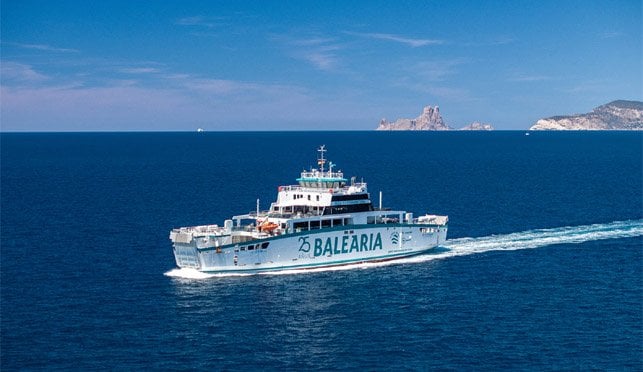
Spanish ferry operator Baleària announced it will begin operations on what is Europe's first autonomous e-methanol power generation system. The eNomad system, developed by Methanol Reformer, will enable renewable hydrogen to be produced from methanol to generate auxiliary electrical energy, and it will be incorporated into the operation of the company’s electric ferry Cap de Barbaria.
The Cap de Barbaria, which has been operating between Ibiza and Formentera since 2023, was designed to integrate a hydrogen system capable of supplying a portion of the energy required by the vessel. The ferry is 3,400 gross tons and sails between Ibiza and Formentera. It is 82 meters (269 feet) and carries up to 390 passengers and 50 vehicles. Known as the first electric ferry in Spain, it sails at speeds of 14 knots and is capable of zero-emission operations during port approaches and while docked.
“This compact equipment enables us to run a small-scale green hydrogen experimental laboratory in a real operating environment and on a route as sensitive and iconic as the one linking Ibiza and Formentera”, explains Javier Cervera, Corporate Director of Institutional Relations and the Energy Transition.
The eNomad system combines electricity generation from hydrogen, produced by reforming e-methanol, with a modular, compact, and autonomous design, capable of operating efficiently in port and maritime environments. Baleària says the pioneering European project will convert the ferry linking Ibiza and Formentera into a hydrogen research laboratory. They expect to validate the performance of the system in real-life operational conditions.
The hydrogen generated by this system will be used to power a fuel cell and produce auxiliary electricity. This electricity will support battery recharging and reduce the use of conventional generators, thereby lowering fuel consumption and emissions. In addition, Baleària will use this compact hydrogen production equipment to test different combinations of batteries and fuel cells in the ship's electric motor.
Through the pilot project, which is part of the BUCEMTO project financed by Net Generation Funds, Baleària reports it will be able to assess the potential of methanol as a flexible energy vector for maritime transport, combining the advantages of an easy-to-store liquid fuel with the possibility of generating hydrogen in situ, without the need for complex large-scale supply infrastructure. In addition, the shipping company will evaluate the hydrogen's contribution to overall consumption, reducing emissions, and the scalability of the solution to other ships and routes operated by the company.
Manufactured by a Catalan company specialising in sustainable energy solutions Methanol Reformer is expected to be available in the coming weeks for the start of the demonstration on the Cap de Barbaria.
The project is the next step in Baleària's efforts to reduce its carbon footprint. The company has 11 dual natural gas-powered vessels, three of which currently use bioLNG, and it is also making progress towards the total electrification of certain routes with 100% electric, zero-emissions fast ferry projects.

No comments:
Post a Comment