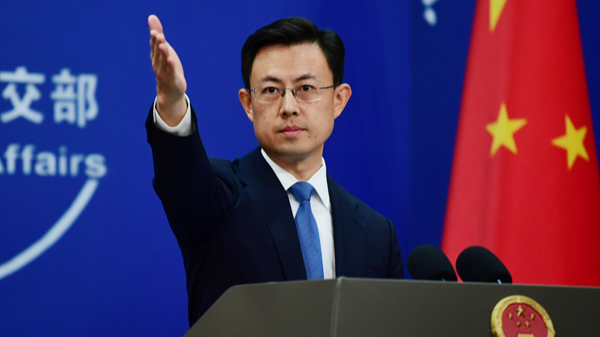
Chinese Foreign Ministry spokesperson Guo Jiakun
Responding to Japanese Prime Minister Sanae Takaichi’s claims that under the “San Francisco Peace Treaty,” Japan “is not in a position to determine or recognize the legal status of Taiwan,” Chinese Foreign Ministry spokesperson Guo Jiakun said on Thursday that Takaichi’s remarks deliberately ignore internationally binding documents while relying solely on the illegal and invalid “San Francisco Peace Treaty,” once again showing she remains unrepentant and disregards UN authority. Guo warned that the international community should also remain highly vigilant.
According to the Yomiuri Shimbun, during a parliamentary debate on Wednesday, Japanese Prime Minister Sanae Takaichi claimed that under the “San Francisco Peace Treaty,” Japan renounced all right, title, and claim to Taiwan, and Japan is not in a position to determine or recognize the legal status of Taiwan.
When asked to comment on Takaichi’s such remarks, Guo stressed at Thursday’s press briefing that Taiwan island’s return to China is an important part of the victory in World War II and the post-war international order. A series of internationally binding documents, including the Cairo Declaration, the Potsdam Proclamation, and Japan’s Instrument of Surrender, all confirmed China’s sovereignty over Taiwan.
Guo noted that the question of Taiwan’s status was thoroughly resolved in 1945 with the victory of the Chinese People’s War of Resistance Against Japanese Aggression. On October 1, 1949, the Central People’s Government of the People’s Republic of China (PRC) was proclaimed, becoming the sole legitimate government representing the whole of China.
“This is a change of government in which China, as a subject under international law, did not change and China’s sovereignty and inherent territorial boundaries stayed unchanged. Thus, the government of the People’s Republic of China naturally and fully enjoys and exercises China’s sovereignty, including sovereignty over the Taiwan region.” Guo said.
Guo noted that the 1972 Sino-Japanese Joint Statement clearly stipulates that, “the Government of Japan recognizes the Government of the PRC as the sole legitimate government of China;” “the PRC government reaffirms that Taiwan is an inalienable part of its territory; and the Government of Japan fully understands and respects this position of the Chinese Government and adheres to the stance specified in Article 8 of the Potsdam Proclamation.”
“The so-called ‘San Francisco Peace Treaty’ was a document issued to collude with Japan, excluding important WWII belligerents such as China and the Soviet Union,” Guo said.
Guo stressed that this treaty violates the provision prohibiting separate peace with enemy states as stipulated in the Declaration by United Nations signed by 26 countries including China, the US, the UK, and the Soviet Union in 1942, as well as the purposes and principles of the UN Charter and basic norms of international law. Any disposition under this treaty involving China’s territorial and sovereign rights as a non-signatory state, including the determination of Taiwan’s sovereignty, is illegal and invalid.
“Takaichi deliberately ignored the Cairo Declaration and the Potsdam Proclamation, which possess full international legal effect and are explicitly emphasized in bilateral documents, while solely highlighting the illegal and invalid ‘San Francisco Peace Treaty’,” Guo said.
“This once again demonstrates that she remains unrepentant to this day, continues to undermine the political foundation of China-Japan relations established with the spirit of the four political documents between the two countries, disregards UN authority, openly challenges the post-war international order and basic norms of international law, and even attempts to hype up the so-called ‘theory of undetermined Taiwan status,'” the spokesperson stressed. “This is adding insult to injury. China firmly opposes this, and the international community should also remain highly vigilant.”
China once again urges Japan to earnestly reflect on its mistakes, retract its erroneous remarks, honor its commitments to China with concrete actions, and fulfill the minimum obligations of a UN member state with practical deeds, Guo said.
Japan: Can The ‘Bond Vigilantes’ Decide The Fate Of Takaichi Administration? – Analysis
November 27, 2025
Anbound
By Wei Hongxu
Just one month into her tenure as Japan’s Prime Minister, Sanae Takaichi has already sparked diplomatic controversy. At the same time, the situation in the financial markets is creating more challenges for her. Investors who oppose her fiscal policies are driving down Japanese government bond prices. Amid this pushback, Takaichi may be forced to adjust her domestic policies, making it increasingly difficult for her to fulfill her campaign promises. She risks not only political attacks but also following in the footsteps of the short-lived tenure of the former UK Prime Minister Liz Truss.
As November progressed, with expectations of a Federal Reserve rate cut dwindling and the U.S. dollar strengthening, both the Japanese yen and Japanese government bonds found themselves in jeopardy once again. This was particularly true after Sanae Takaichi became Japan’s new prime minister and advocated for loose fiscal policies, which caused growing concerns in the market, further depressing both the yen and Japanese bonds. On November 19, the yield on Japan’s newly issued 10-year government bonds rose to 1.76%, the highest since June 2008. The yield on 20-year bonds climbed to 2.795%, marking a record high since statistics began in 1999, while the 40-year bond yield surged to a historic peak of 3.695%. The sharp rise in bond yields also had a ripple effect on other markets. On November 18, Japan experienced falling stocks, bonds, and currency. The Nikkei 225 index in Tokyo plunged by 3.22%, the largest drop since early April of that year. On the same day, the yen weakened, breaking through the 155 yen-per-dollar threshold, a level that had previously been seen as a potential intervention point. By November 19, the yen had fallen further to 157 yen per dollar, with investors testing whether the Japanese government would intervene in the market.
The decline in Japanese government bonds has been driven not only by concerns that Takaichi’s remarks could potentially damage Japan’s economy, but more significantly by market fears that the Japanese government’s new economic stimulus plan could worsen fiscal burdens. On November 21, Takaichi’s administration unveiled a JPY 21.3 trillion fiscal stimulus package, far exceeding the previously expected JPY 14 trillion. More than half of this package would be directed towards providing inflation subsidies to Japanese households. This move signals a fundamental shift in Japan’s previous policies of maintaining a budget balance and promoting exchange rate stability. The “radical” nature of the stimulus plan has led the market to draw comparisons between Takaichi’s approach and the “Truss storm” in the UK, referencing the rapid collapse of former UK Prime Minister Liz Truss’s economic policies. The yield on the 10-year Japanese government bond briefly surged above 1.8%, and by November 21, it remained above 1.78%. Meanwhile, the yen held steady at around JPY 156.4 per USD, signaling continued market uncertainty and skepticism about the government’s fiscal direction.
The “bond vigilantes” are making a comeback and could once again steer the market, influencing Japan’s fiscal policies. A recent report from Goldman Sachs highlighted that, as investors grow more cautious about Japan’s larger-than-expected stimulus plan, the Japanese bond market is likely to see a return of fiscal risk premiums, which would put pressure on long-term government bonds and the yen. Goldman Sachs noted that concerns are mounting about the Japanese government’s potential abandonment of its “annual budget balance” commitment and long-term fiscal targets. Even if the outcome does not turn out to be as extreme as feared, market sensitivity to fiscal issues has clearly increased. This means that any path toward eventual stabilization could be rocky, with the potential for volatility as investors closely watch how Japan navigates these fiscal challenges.
Japan’s government debt problem is longstanding and not solely the responsibility of Prime Minister Sanae Takaichi. As of the end of fiscal year 2024 (March 31, 2025), Japan’s total government debt has surged to JPY 1,323.72 trillion, marking an increase of JPY 26.554 trillion from the previous fiscal year and setting a record for the ninth consecutive year. Currently, Japan’s debt-to-GDP ratio stands at a staggering 264%, the highest in the world, far surpassing the United States’ 129% and China’s 76.9%. Takaichi’s more aggressive policy proposals are likely to exacerbate this issue. During her campaign, she mentioned plans to increase household subsidies to offset the impact of inflation on consumer spending. However, such a policy of expanded fiscal spending will inevitably push inflation higher, driving up food prices, which are already on the rise. In the long term, this approach is unlikely to significantly improve household income, thereby constraining domestic consumption. At the same time, fiscal loosening will continue to put downward pressure on the yen. While a weaker yen benefits Japan’s stock market and export trade, it also increases the cost of imports, particularly food and energy. The rising prices of these imports will have a restrictive effect on domestic demand, further complicating Japan’s economic challenges.
In fact, Japan’s economy has not fully escaped the danger of both domestic and external challenges. The latest data shows that Japan’s GDP shrank in the third quarter. Japan’s real GDP for Q3 contracted at an annualized rate of 1.8%, marking a return to negative growth since the first quarter of 2024. This suggests that, after emerging from deflation, Japan now faces the risk of stagflation. Recent inflation data also paints a concerning picture. In October, Japan’s core consumer price index (CPI), excluding fresh food, rose by 3.0% year-on-year to 112.1, marking the 50th consecutive month of year-on-year increases. The price increase surpassed September’s 2.9%, continuing to widen. On a month-to-month basis, the CPI rose 0.4%, also higher than the previous month’s increase. Food prices were even more dramatic, with the price of regular Japonica rice still up 39.6% year-on-year, despite a slight dip in its growth rate. On the external front, Japan’s exports have contracted for four consecutive months, partly due to U.S. tariffs. Domestically, private consumption, which accounts for more than half of Japan’s economic output, has seen a significant slowdown, dropping from a 0.4% growth in Q2 to just 0.1% in Q3. At the same time, real wages in Japan have continued to lag behind inflation, leading to a contraction in real household income. In August, inflation-adjusted real wages fell 1.4% year-on-year, marking the eighth consecutive month of decline.
The economic slowdown has provided a rationale for Takaichi’s government to restart the fiscal expansion of Abenomics. Japan’s economy has moved beyond the “Lost Thirty Years” and entered a new economic cycle. However, this does not mean that Japan can simply replicate the approach of Abenomics and apply it without adaptation. On one hand, Japan’s economic structure has undergone significant changes, and on the other, the external environment is vastly different from what it was during the Abenomics era. Therefore, in terms of prospects, the Takaichi government has limited options to choose from.
The most immediate consequence of fiscal expansion is likely to be higher inflation. Japan has run trade deficits for many years, and its current-account surplus relies heavily on investment income. A continued depreciation of the yen could alter capital flows. Since the COVID-19 pandemic, the yen has depreciated by more than 50%, and its drag on the economy has grown increasingly pronounced. This suggests that Takaichi’s policies, aside from pushing up inflation and inflating stock-market bubbles, may offer limited support to the real economy. At the same time, persistent yen weakness could reverse the recent return of overseas capital, thereby affecting Japan’s equity markets. In fact, Japanese stocks have seen sharp volatility in recent weeks. As of November 19, the Nikkei 225 had fallen for four consecutive trading days, dropping a cumulative 4.8% and wiping out roughly JPY 1.2 trillion in market value, the steepest decline in nearly three months. This is a clear indication of the growing erosion of investor confidence.
Relentlessly rising inflation will inevitably require the Bank of Japan (BOJ) to raise interest rates. Although the BOJ is under political pressure from the Takaichi administration and may postpone a rate hike in December, a yen rate increase in 2026 appears unavoidable if inflation remains uncontained. Even if Takaichi’s policies produce short-term results, over the longer term, they are likely to worsen inflation and interrupt the hard-won economic recovery cycle.
The issue is that, as the BOJ exits its ultra-loose stance and moves toward monetary-policy normalization, Japan’s growing government-bond supply may again face a shortage of buyers. This problem already surfaced during the bond-vigilante episode in May, when the Ministry of Finance had to adjust the maturity structure of its issuances and scale back long-term bond auctions. Yet, such measures address only the symptoms, not the root cause. Without increased fiscal revenue, if the Takaichi government presses ahead with expanding fiscal deficits regardless of the consequences, Japan’s sovereign credit standing could come under sustained pressure.
If investors withdraw further, the BOJ could eventually be forced to resume large-scale Japanese government bond (JGB) purchases, directly contradicting its inflation-fighting goals and ultimately pushing inflation even higher. Nomura Securities recently warned that, unless the government takes bond-market turmoil seriously, another round of “bond vigilante” action could be triggered. Amundi, Europe’s largest asset manager, issued a report noting that concerns over the new prime minister’s borrowing plans could drive long-maturity Japanese government bond yields to fresh historic highs in the coming months. Amundi cautioned that the “JGB sell-off storm” that once sent global equity, bond, and currency markets tumbling could potentially strike again, dealing another heavy blow to global financial markets.
Researchers at ANBOUND have previously noted that the growing impact of today’s “bond vigilante” actions, which are powerful enough to influence political trajectories, stems from the deepening financialization of sovereign fiscal systems. Although Takaichi has been in office for only about a month, she already faces multiple challenges. Among these, the bond vigilantes represent the most immediate and consequential threat to her ability to remain in power.
The foundation of bond-vigilante action lies in underlying economic and policy conditions. If Takaichi ignores market reactions and continues to push large-scale stimulus measures, the strength of the bond vigilantes could once again topple her. On the other hand, if she yields to market pressure and adjusts her fiscal policies, she will be seen as reneging on her campaign promises, thereby undermining her political base. In this sense, Takaichi has very little room to maneuver.
Final analysis conclusion:
Confronted with both domestic and external pressures, the Takaichi administration is facing growing concern from bond-market investors over its large-scale stimulus plans, concerns that have revived “bond vigilante” activity. This has driven Japanese government bond prices lower, weakened the yen, and contributed to heightened volatility and declines in Japan’s stock market. Given the deepening financialization of government finances and the discipline imposed by capital markets and economic fundamentals, the bond vigilantes pose an even more significant and immediate threat to Takaichi’s governance.
Dr. Wei Hongxu is a Senior Economist of China Macro-Economy Research Center at ANBOUND, an independent think tank.
Anbound
Anbound Consulting (Anbound) is an independent Think Tank with the headquarter based in Beijing. Established in 1993, Anbound specializes in public policy research, and enjoys a professional reputation in the areas of strategic forecasting, policy solutions and risk analysis. Anbound's research findings are widely recognized and create a deep interest within public media, academics and experts who are also providing consulting service to the State Council of China.

No comments:
Post a Comment