Trump’s BBC Lawsuit Seeks to Bully International Newsrooms Into Servility
MAGA’s vision of journalism isn’t even remotely compatible with democracy.
By Sasha Abramsky ,
November 18, 2025
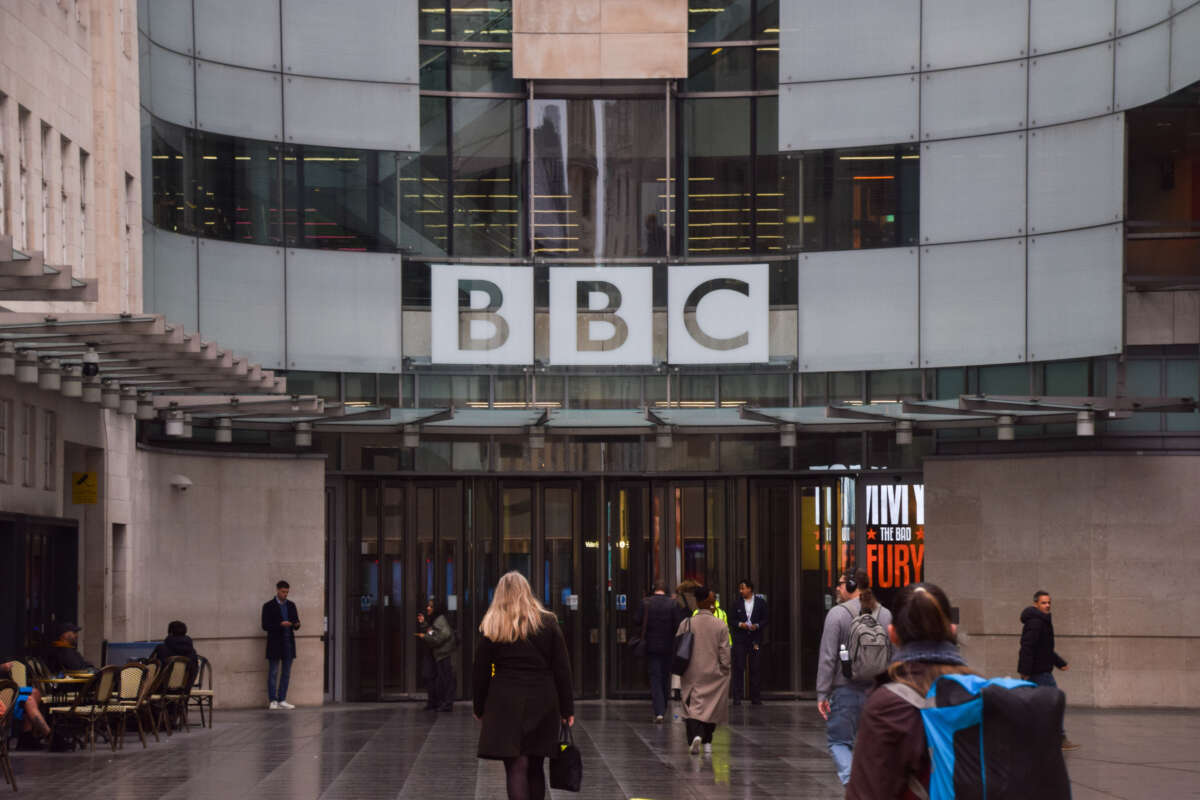
The BBC headquarters as seen in central London, UK, on November 10, 2025.
Vuk Valcic / SOPA Images / LightRocket via Getty Images
This past week, Donald Trump went global with his wrecking ball to the concept of a free press. For years, he has used lawsuits to intimidate major newspapers and broadcasters, in the process getting major outlets such as CBS and ABC to repeatedly bend the knee. Under his watch, the Federal Communications Commission (FCC) has reportedly pushed broadcasters to fire personalities, such as Jimmy Kimmel and Stephen Colbert, whom he disapproves of and has threatened to withhold broadcast licenses and to stymie lucrative mergers should those broadcasters not fall into line. He has, numerous times, attempted to sue The New York Times for libel — his ambitions falling short not for lack of trying, but because the libel laws in the U.S., giving the benefit of the doubt to news organizations in their coverage of public figures, make it extremely difficult for a public figure to successfully claim damages. Good faith errors do not, generally, result in a libel verdict against a news organization.
Now, however, Trump believes that he has been handed a gift horse by the British Broadcasting Corporation (BBC) which recently admitted to using a spliced video of Trump’s infamous January 6, 2021 speech urging his supporters to march to the U.S. Capitol. That video was included in a documentary produced by an independent production company but aired by the broadcaster a week before the 2024 election. The footage was edited in a way that made it look and sound as if Trump had explicitly ordered those marchers to conduct their assault, rather than simply riling up the mob to such a fever pitch that, once they had made the trek down Pennsylvania Avenue, they then took matters into their own hands: looting the Capitol building while engaging in a bloody struggle to find and punish members of Congress and Vice President Mike Pence in an attempt to steal the 2020 election.
Given how inflammatory Trump’s actual speech and actions on that day were — and, as the Congressional hearings into the January 6 mob and numerous investigations have shown, given Trump’s fixation on overturning the results of that election and preventing the peaceful transfer of power — it seems rather strange that the documentary makers felt the need to go the extra mile to make Trump’s words sound even worse than they were. But they did, splicing together a 12-second clip from separate sections of the speech, that made its way into the one-hour documentary, and the BBC is now dealing with the fallout.
A wide-ranging internal BBC inquiry, which had been launched months before issues surfaced around the video, after allegations by journalists with ties to the Conservative Party that the organization was politically biased, identified problems with the footage. It also came out swinging from the right against some of the institution’s coverage of transgender issues and of Israel’s brutal assault on Gaza.
Some of the conclusions from that inquiry were then leaked to the right-wing Telegraph newspaper in the U.K., which has long viewed the public broadcaster as ineffably liberal. Instead of trying to deal with the allegations head on, the BBC then made the inexplicable, ham-handed decision of refusing to comment on leaked materials. And, after more than a week of growing discontent within the organization, Director General Tim Davie — the top dog of the entire BBC — and Deborah Turness, the head of the news division, abruptly resigned.
Related Story
This past week, Donald Trump went global with his wrecking ball to the concept of a free press. For years, he has used lawsuits to intimidate major newspapers and broadcasters, in the process getting major outlets such as CBS and ABC to repeatedly bend the knee. Under his watch, the Federal Communications Commission (FCC) has reportedly pushed broadcasters to fire personalities, such as Jimmy Kimmel and Stephen Colbert, whom he disapproves of and has threatened to withhold broadcast licenses and to stymie lucrative mergers should those broadcasters not fall into line. He has, numerous times, attempted to sue The New York Times for libel — his ambitions falling short not for lack of trying, but because the libel laws in the U.S., giving the benefit of the doubt to news organizations in their coverage of public figures, make it extremely difficult for a public figure to successfully claim damages. Good faith errors do not, generally, result in a libel verdict against a news organization.
Now, however, Trump believes that he has been handed a gift horse by the British Broadcasting Corporation (BBC) which recently admitted to using a spliced video of Trump’s infamous January 6, 2021 speech urging his supporters to march to the U.S. Capitol. That video was included in a documentary produced by an independent production company but aired by the broadcaster a week before the 2024 election. The footage was edited in a way that made it look and sound as if Trump had explicitly ordered those marchers to conduct their assault, rather than simply riling up the mob to such a fever pitch that, once they had made the trek down Pennsylvania Avenue, they then took matters into their own hands: looting the Capitol building while engaging in a bloody struggle to find and punish members of Congress and Vice President Mike Pence in an attempt to steal the 2020 election.
Given how inflammatory Trump’s actual speech and actions on that day were — and, as the Congressional hearings into the January 6 mob and numerous investigations have shown, given Trump’s fixation on overturning the results of that election and preventing the peaceful transfer of power — it seems rather strange that the documentary makers felt the need to go the extra mile to make Trump’s words sound even worse than they were. But they did, splicing together a 12-second clip from separate sections of the speech, that made its way into the one-hour documentary, and the BBC is now dealing with the fallout.
A wide-ranging internal BBC inquiry, which had been launched months before issues surfaced around the video, after allegations by journalists with ties to the Conservative Party that the organization was politically biased, identified problems with the footage. It also came out swinging from the right against some of the institution’s coverage of transgender issues and of Israel’s brutal assault on Gaza.
Some of the conclusions from that inquiry were then leaked to the right-wing Telegraph newspaper in the U.K., which has long viewed the public broadcaster as ineffably liberal. Instead of trying to deal with the allegations head on, the BBC then made the inexplicable, ham-handed decision of refusing to comment on leaked materials. And, after more than a week of growing discontent within the organization, Director General Tim Davie — the top dog of the entire BBC — and Deborah Turness, the head of the news division, abruptly resigned.
Related Story
Trump Threatens Comcast After Seth Meyers Makes Jokes About Him
The president-elect claims to support free speech but frequently refers to the media as “enemies” of the US. By Chris Walker , Truthout January 15, 2025
Rather than accepting an apology from the BBC, and a promise not to rebroadcast the documentary, Trump appears determined to use the organization’s disarray to his own maximum financial and political advantage. After Davie and Turness resigned, he posted on social media that they were gone “because they were caught ‘doctoring’ my very good (PERFECT!) speech of January 6th.” That Trumpian interpretation is, to say the least, a vast distortion of the historical record regarding the content and quality of the heinous speech that preceded the mob’s assault on the Capitol building later in the day.
Regardless, Trump’s lawyers have threatened a $1 billion lawsuit, which, if the BBC ever had to pay up, would largely crush the world’s oldest news broadcasting organization. On November 14, Trump upped the ante even more, saying he would likely be suing for somewhere in the range of $5 billion. This year, the BBC’s revenue from all sources — including the money raised by the license fee charged to all television owners in the United Kingdom — is estimated to be just under £6 billion (about $8 billion). Trump is, in other words, floating a settlement equal to well over half of the entire annual revenue stream for the corporation. That isn’t a routine lawsuit; it’s the actions of a conqueror demanding a bone-crushing tribute.
If there is a silver lining to this ugliness, it is that the president is, apparently, planning to sue in his home state of Florida, which, like other states in the U.S. as well as the federal system — despite conservatives’ best efforts in recent years to undermine the first amendment protections codified in the famous New York Times vs. Sullivan ruling — still has defamation laws in place that tend toward protecting the media from frivolous lawsuits by public personalities and heavily protect the media’s right to free speech and controversial opinion. In Britain, where the libel laws make it far easier to succeed against news organizations, but where damages awarded tend to be orders of magnitude smaller than those handed out by U.S. juries, a statute of limitations would have required him to file the case against the BBC by the end of 2024. Since he didn’t do so, he is almost certainly going to have to file in the U.S. instead.
The BBC has expressed confidence that it would win such a court case — since the documentary wasn’t aired in the U.S.; since, given Trump’s election win, the film did not appear to do him material harm; and because the spliced quotes were, they argue, intended to provide highlights from a longer speech rather than to intentionally mislead the audience.
Unlike major U.S. broadcasters that have offered up large cash settlements to make their lawsuits disappear, the corporation has made no moves to financially placate Trump. Given the differences in how public broadcasters are funded compared to the near-bottomless wallets of large private media conglomerates, the broadcaster likely has no choice here; caving financially would throw the BBC into a death spiral. And that, ultimately, may be Trump’s real goal here. MAGA doesn’t want a free, critical press; rather, it craves supine coverage that neither criticizes nor investigates its leaders’ actions, and a largely neutralized first amendment that would offer only scant protection against libel suits. That vision of journalism isn’t even remotely compatible with democracy, and that is what will be on the line if and when Trump’s ghastly lawsuit is litigated in Florida’s courts.
This article is licensed under Creative Commons (CC BY-NC-ND 4.0), and you are free to share and republish under the terms of the license.

Sasha Abramsky
Sasha Abramsky is a freelance journalist and a part-time lecturer at the University of California at Davis. Abramsky’s latest book, American Carnage: How Trump, Musk, and DOGE Butchered the US Government, is available for pre-order now and will be released in January. His work has appeared in numerous publications, including The Nation, The Atlantic Monthly, New York Magazine, The Village Voice and Rolling Stone. He also writes a weekly political column. Originally from England, with a bachelor’s in politics, philosophy and economics from Oxford University and a master’s degree from the Columbia University Graduate School of Journalism, he now lives in Sacramento, California.

No comments:
Post a Comment