COMMENT: Russian pranksters trick top Biden official into admitting war in Ukraine was unnecessary
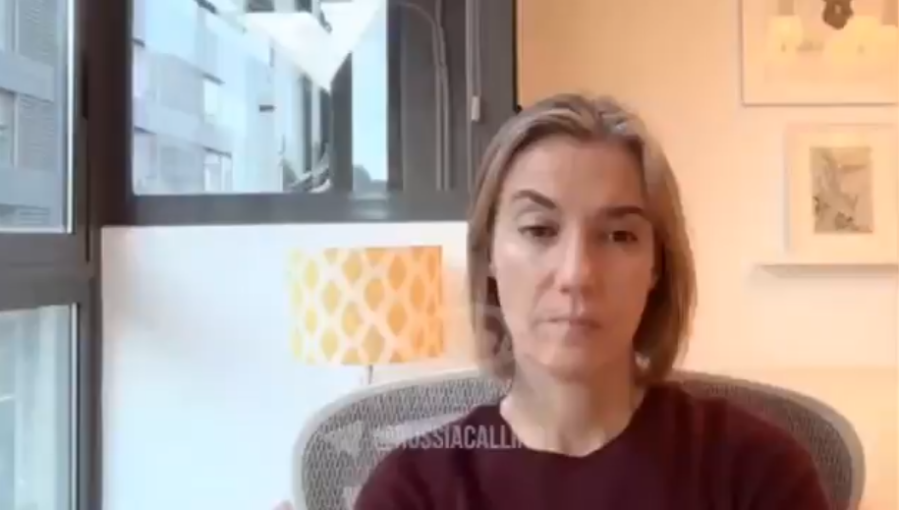
Nearly three years into the war in Ukraine, a former senior White House official has acknowledged that the conflict might have been avoided had the United States been willing to forgo Nato membership for Ukraine.
Amanda Sloat, who served as Senior Director for Europe at the US National Security Council and lead policy on the region for President Joe Biden – directly overseeing policy on Ukraine – admitted to Russian pranksters that if Kyiv had agreed to abandon its Nato aspirations in early 2022 during a round of diplomacy or shortly after the invasion at the Istanbul peace talks, it “may well have [prevented/stopped the war].” She added, “It certainly would have prevented the destruction and the loss of life.”
The interview with Sloat was conducted by two well-known Russian pranksters who go by the aliases Vovan and Lexus -- real names are Vladimir Kuznetsov (Vovan) and Alexei Stolyarov (Lexus) – who have regularly tricked western officials, often posing as foreign officials, into giving candid interviews and admitting embarrassing details as part of the deteriorating relations with Russia.
The interview with Sloat was particularly damning as she admitted that the Biden administration had no particular plan to protect Ukraine nor bring it into Nato, and simply refused to negotiate with Russia on principle in failed talks that led to war. Russian state TV aired the interview which bolsters the Kremlin’s claim that Russia is fighting a proxy war against Nato.
Sloat’s remarks prompted sharp criticism from foreign policy commentators, who described Sloat’s framing as both revealing and misleading.
“She’s being dishonest,” political commentator and IntelliNews contributor Arnaud Bertrand said. “By definition, neutrality for Ukraine wouldn’t have given Russia ‘some sort of sphere of influence’ but would have made it… neutral, i.e. in-between spheres of influence.”
Bertrand contends that the refusal to consider neutrality was based less on principle than on Washington’s reluctance to relinquish strategic leverage. “She [Sloat] was uncomfortable with the idea of implicitly giving Russia some sort of veto power,” he noted. “But that’s exactly what she wanted to preserve for the US—keeping the theoretical possibility of pulling Ukraine into Nato. It wasn’t even about an actual gain, just the optionality.”
The human cost of that decision has been catastrophic. Hundreds of thousands of men have died and Ukraine has been devastated. It stands in stark contrast to the abstract policy preferences that shaped US policy on Ukraine.
“Think about the cost equation,” Bertrand says. “Not even an actual security commitment, just the potential of one, outweighed any serious effort to prevent the war.”
The issue of Nato expansion has long been a fault line in relations between Russia and the West. Russian President Vladimir Putin has complained about Nato’s inextricable expansion eastwards that started in 1999, when Poland, Hungary and Czechia joined, eventually adding eight new members, starting with his famous speech at the Munich Security Conference (MSC) in 2007. In that speech he claimed that Nato had given verbal promises to Mikhail Gorbachev of “not one inch” expansion that was subsequently broken.
Ukraine’s supporters point to an essay that Putin wrote in July 2021 to claim that Russia wants to conquer all of Ukraine and recreate the Soviet Union. However, last year former Nato Secretary General Jens Stoltenberg admitted that the war in Ukraine began after Nato refused to respond and Russia’s security concerns were the root cause of the war in Ukraine in another embarrassing revelation. Sloat’s interview corroborates that revelation.
During the early stages of the war, Ukrainian and Russian delegations struck the Istanbul peace deal that included an agreement for Ukraine to give up its Nato ambitions. However, the deal failed after Ukrainian President Volodymyr Zelenskiy met with former UK Prime Minister Boris Johnson, who refused to sign off on security deals and told the Ukrainian president to “fight on.” Over a million men have been killed or wounded since.
At the Berlin meeting on December 14, between EU leaders, US President Donald Trump’s special envoys and Zelenskiy, all the same points that the Kremlin was pushing for in January 2022 before the invasion started have come up again.
Sloat’s comments now confirm that strategic discomfort in Washington played a direct role in foreclosing what may have been a viable diplomatic off-ramp. “She’s describing her own position and projecting it onto Russia,” Bertrand said.


No comments:
Post a Comment