Europe’s free-trade India play leaves Washington sidelined
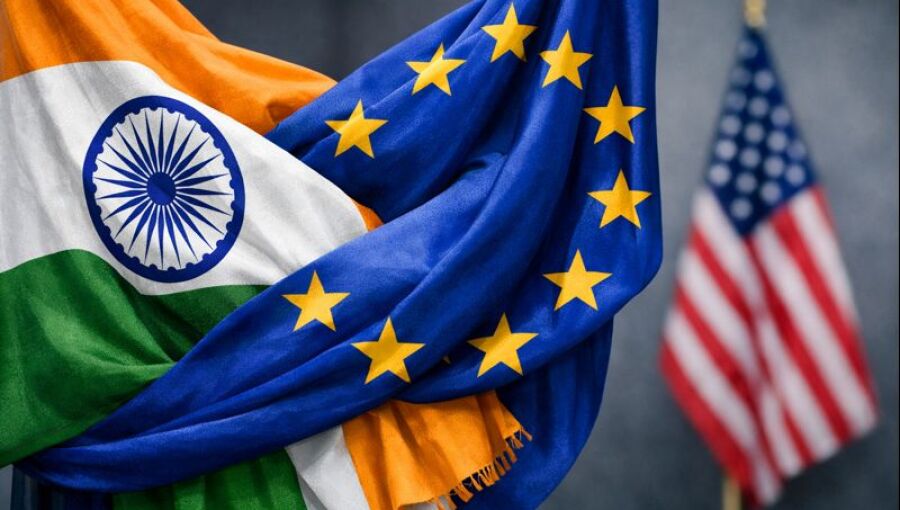
The European Union is moving to lock in a sweeping trade and security agreement with India, exploiting US tariff pressure to tilt one of Asia’s biggest economies further away from Washington’s orbit.
Branded a landmark free-trade pact alongside a defence partnership by the Europeans and European media reporting, the deal is less a gift to India than a strategic win for Brussels.
For the EU, the logic is blunt. Access to India’s fast-expanding market offers relief for European manufacturers squeezed by Chinese competition and US protectionism.
Lower Indian tariffs on cars and alcohol as DW reported recently as well as industrial goods would deliver immediate gains to European exporters in these and other sectors, while labour mobility arrangements would help plug chronic workforce shortages across the bloc. The agreement also strengthens Europe’s hand in setting standards across pharmaceuticals, technology and supply chains tied to future growth.
India’s benefits would be narrower and more defensive though. New Delhi is still scrambling to offset the impact of punitive US tariffs that have hit textiles and consumer exports. The EU offers an alternative outlet, but on terms that favour European industry and regulatory power. This imbalance in the short term at least reflects Europe’s position as India’s largest trading partner in terms of goods – consuming 12.2% of India’s trade in goods in 2023 – and a market New Delhi cannot afford to alienate.
Geopolitics at play
The geopolitical consequences may be more significant, however. By deepening economic and defence ties with Brussels, India reduces its exposure to US financial leverage and trade pressure. That loosening grip gives New Delhi greater room to manoeuvre internationally, making closer alignment with BRICS and the broader Global South easier to pursue without risking immediate economic retaliation from Washington.
Efforts to forge a comprehensive free trade agreement between the European Union and India have been among the most protracted in modern diplomacy. Negotiations first began in 2007, only to stall in 2013 amid disputes over market access, tariffs and regulatory standards. Talks resumed in earnest while COVID was at its peak in 2022, set against a backdrop of shifting global trade patterns. This has led to the current round of discussions bringing the deal closer to reality than ever before, with the EU’s top leadership openly championing its potential to reshape economic relations with Asia.
European Commission President Ursula von der Leyen has cast the pact as pivotal for both sides. In a recent message posted on the social media platform X, she stated that the EU and India had chosen a “The choice of strategic partnership, dialogue and openness.”
At time of typing she has even ‘pinned’ the message “The mother of all trade deals. We are closing in on the Free Trade Agreement. See you soon in Delhi.” to the top of her X account, and in a video aimed at promoting the deal says the world is on the “cusp of a historic trade agreement”.
As such, Brussels no doubt sees the agreement as a way to diversify trade links and reduce its dependence on China, while also signalling unity with long-standing partners such as the United States. The EU believes that deepening economic engagement with India will bolster global supply chains and offer alternatives to the polarised dynamics of US-China competition.
Yet this strategic framing carries unintended consequences. By positioning the EU–India free trade agreement in part as a complement to Western cohesion, Brussels risks overlooking New Delhi’s own diplomatic calculus. India has been quietly pursuing a more independent course, strengthening ties with emerging markets and fostering multi-currency trade within the Global South. Its leadership in New Delhi has expressed a desire to reduce reliance on the US-dollar-centric system and expand economic links with partners across Asia, Africa and Latin America. These are all moves that sit uncomfortably with a narrative anchored in alignment with Western blocs and in particular US dollar diplomacy.
The broader context of India’s reserve diversification away from US Treasuries, as reported by Bne IntelliNews, and engagement in BRICS-related initiatives suggests a gradual reorientation of its strategic preferences.
To this end, if Brussels misreads this as simple acquiescence to US-aligned strategy, it may underestimate the depth of India’s intent to balance multiple partners. New Delhi is unlikely to sign any agreement that appears to tether it too closely to Western economic priorities at the expense of its autonomy in the Global South.
The result is thus simple. The FTA, if concluded, could be a landmark in global trade. But the way it is framed could be just as important as its terms, affecting not only bilateral ties with Europe, but India’s broader geopolitical alignment and southern shift.
EU Chiefs Aim To Set Trump Aside And Close Bumper India Trade Deal
By EurActiv
By Alice Bergoënd
(EurActiv) — After two decades of talking, a trade accord between the EU and India couldn’t come at a better time for the bloc’s beleaguered leadership.
Fresh from fending off threats from Donald Trump over recent weeks, European Commission President Ursula von der Leyen and European Council President António Costa should sign a long-awaited trade deal with India’s Prime Minister Narendra Modi at an EU-India summit in New Delhi on Tuesday.
Its signing – should last minute chinks around climate policy be resolved – come as the EU seeks to diversify its trading partners amid rising trade tensions with the US.
“We are showing a fractured world that another way is possible,” von der Leyen said on Sunday of cooperation with India.
The accord will provide access to a market of around 1.5 billion people, with India emerging as a key strategic partner for Europe as the world’s largest democracy.
Top negotiators have already said the agreement, once dubbed the ‘mother of all deals’ owing to the size of India’s market, has been “extremely difficult” to close.
Art of the deal
Under the agreement, India is set to cut tariffs on cars imported from the EU, down from rates as high as 110% to potentially to 40%, Reuters reported over the weekend.
This would create major opportunities for European car manufacturers such as Volkswagen or Renault which have been struggling of late. Tariff reductions under the pact could also benefit sectors including automotive components, chemicals, and plastics, while the text is also expected to improve market access for EU wines and spirits.
“This is very good news for producers given the size of the market and the excise duties currently in place,” one EU diplomat told Euractiv.
In turn, India should benefit from easier exports for sectors such as textiles, jewellery, pharmaceuticals, machinery, and IT services.
As ever, the EU won’t get everything it wants.
New Delhi and Brussels clashed over the sustainability commitments within the deal.
While human rights and commitments around the Paris Agreement should be included in the deal, they are unlikely to be designated as ‘essential elements,’ an EU diplomat told Euractiv. This means that a breach would not allow the deal to be suspended, unlike for the EU-Mercosur agreement.
India also requested exemptions from EU climate laws, such as the carbon border tax (CBAM), which was refused. The issue appears unresolved.
“Both sides are working intensively to address the remaining challenges,” von der Leyen told The Times of India over the weekend.
Some sensitive areas will remain outside the deal, including agricultural products like dairy. Plans to protect traditional foods under the Geographical Indications (GI) system have been postponeduntil India finalises revisions to its own GI legislation.
Once signed, the agreement will still need to be ratified by the European Parliament before entering into force.
- Sofia Sanchez Manzanaro contributed reporting.
India is steadily trimming its exposure to US government debt, signalling a broader rethink of how the country shields itself in a more fractured and unpredictable global economy.
Holdings of US Treasuries have fallen to a five-year low of about $174bn, The Times of India writes, roughly a quarter below their 2023 peak. As a result, Treasuries now make up close to one third of India’s foreign exchange reserves, down sharply from around 40% a year ago. The shift marks a clear change in how Asia’s third-largest economy is managing risk.
Part of the explanation is tactical. The Indian rupee has been one of the weakest Asian currencies over the past year, prompting the Reserve Bank of India to step up market intervention. Scaling back Treasury holdings gives the central bank greater flexibility to deploy dollars in support of the currency when pressures build.
Decoupling in progress
However, the move is also strategic. Policymakers in New Delhi are becoming increasingly wary of over-reliance on dollar-denominated assets, a concern sharpened by recent geopolitical shocks and in many ways, US pressure on how India should conduct itself in global markets – not least in terms of imports of Russian crude. First and foremost among said ‘shocks’, the freezing of Russia’s reserves after the Ukraine invasion has become a reference point for many emerging economies seeking to reduce exposure to financial tools that can be weaponised by the US and her allies.
That caution sits alongside India’s deepening engagement with the Global South and its expanding and increasingly influential role within BRICS. New Delhi has been actively promoting trade settlement in local currencies, including rupee-based arrangements with partners such as Russia and several Asian and African economies of late.
These efforts are part of a wider push in Asia to normalise multi-currency transactions and reduce dependence on the dollar in cross-border trade.
As such, India’s evolving stance towards Washington has reinforced this logic. Trade frictions have intensified following the recent return, then supposed removal of punitive US tariffs on Indian exports, while the aforementioned continued imports of Russian oil have kept relations tense despite unproven US claims such imports have collapsed. Against this backdrop, diversifying reserves and payment channels is increasingly seen as prudent risk management rather than ideological positioning.
Gold has been a major beneficiary of the rebalancing. India now holds the world’s seventh-largest gold reserves after a steady increase in purchases. The trend mirrors moves by other emerging economies, including China and Brazil, which have also cut long-term Treasury exposure while boosting holdings of assets viewed as politically neutral.
This is not a rush for the exits though. Overseas ownership of US Treasuries remains near record highs, and the dollar continues to dominate global finance. This will not change for the foreseeable in any earth shattering manner, but India itself remains a smaller holder than Japan or China. Yet its actions add momentum to a growing debate about how durable dollar dominance will be in a more multipolar order.
There are clear limits to the shift. A stabilising rupee would ease the need for currency intervention, and any thaw in US-India trade relations could serve to slow diversification as dollar markets still offer unrivalled depth and liquidity at present.
Even so, the direction of travel is unmistakable. The subcontinent – both physically with the Indian tectonic plate even now edging closer and closer to China each year – and politically, is edging away from the dollar and US domination of global financial markets. The moves by New Delhi, for now at least, are less about rejecting the dollar outright and more about ensuring it is no longer the sole anchor of its financial security.

No comments:
Post a Comment