A New Era of Political Mobilization Is Dawning
From the Avenues of Paris to the Streets of Minneapolis, the Power of Broad-Based Movement Building Is Becoming Evident
Born in South Africa just a few years after the end of World War II and reared by activists in the anti-apartheid movement, I witnessed my parents’ struggle against fascism and its accompanying racism in both my country of birth and Europe. This created in me a sense of the fragility of democracy and fear of losing civil rights and collective values. The wave of brutal ICE raids and the Trump administration’s assault on political and legal norms prove this fear well-founded.
At the age of five, my father told me, “We fought fascism in Europe and then came home to see it develop here.” He explained that one of my relatives had fled Germany for South Africa, escaping alone as a young Jewish boy, and refused to run away again when, in 1948, fascists were elected to power there (by the white minority who could vote). He and his wife ended up in jail and, for decades, under house arrest. Left alone, their teenage son committed suicide. Unlike these cousins and other friends, my parents left South Africa after they lost their jobs and were blacklisted, and before they were arrested. I grew up in exile in England and the US.
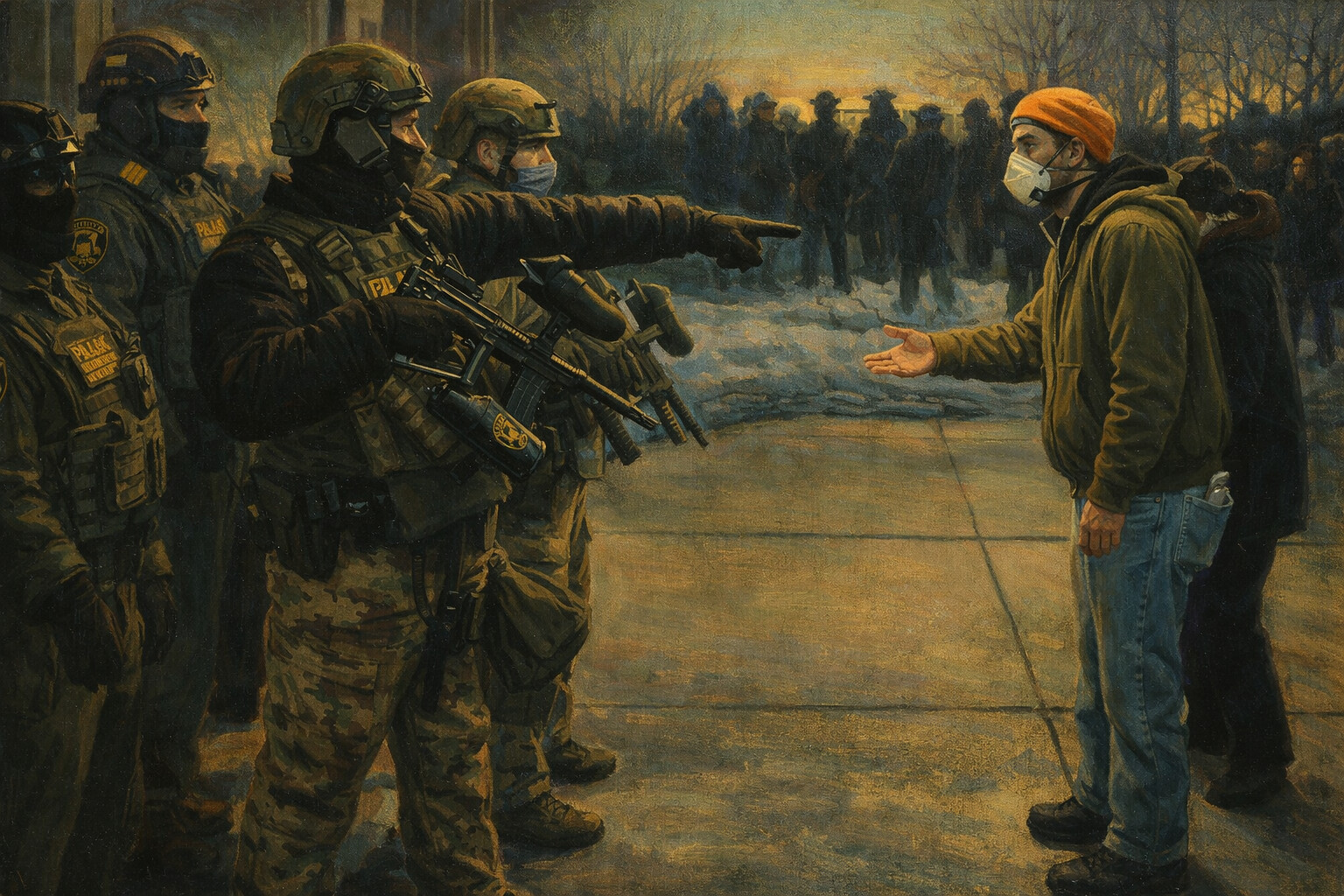
As I watch unidentified ICE guards with faces obscured, protruding gas masks, bulging army fatigues, and guns, I am convinced that we are witnessing a new form of fascism in the making. How should we react, and does popular resistance in the streets make a difference? What types of organizing are most effective? As an anthropologist who studies social movements, I’ve spent much of my professional life grappling with these questions.
That’s why I found myself studying the Yellow Vest movement that erupted on the streets of Paris in 2018. I embedded with this movement—which took its name from the yellow security vests participants donned—from its earliest stages and have continued to study it and its aftermath. The Yellow Vests were composed of “ordinary” citizens who were outraged by government policies to raise the gas tax, and whose anger quickly morphed into opposition to cutbacks in state transportation services, healthcare, and education. “They are stealing the state” was a popular refrain to describe the selling or privatizing of services and taking away the right to social welfare. Americans might not use the same language, but surely the spirit of this complaint registers as we watch shocking ICE raids, Trump’s gutting of public institutions, and the skyrocketing cost of essential items and services.
The Yellow Vests faced the kind of massive opposition from the state that we see on the streets of Minneapolis. Police in full military gear, with plastic shields and Lanceurs de balles de défense (LBDS) or “non-lethal” flash ball lancers, surrounded protesters, using facial surveillance to make arrests while the government tried to ban the photographing of police. Yellow Vests lost eyes, feet, and hands as they were hit by the missiles. They still didn’t back down, and they inspired future action. Their protests gave way to massive union marches and even more resistance. In the 2024 snap elections, a united progressive front, Le Nouveau Front Populaire, won the most seats in the National Assembly. The threat of fascism remains strong as Marine Le Pen’s party now holds the second largest number of seats, but the French mobilizations in the street, the unions, and in the ballot box are building an alternative vision.
In studying the Yellow Vests and their impact for nearly a decade, it became clear that the movement’s power lay largely in its ability to draw from a wide cross-section of society. Young and old, people with disabilities, people of all races and sexual orientations, and men and women found a home in the movement. Most weren’t usually politically active, and they hailed from all over France.
Critically, the Yellow Vests did not demand rigid ideological conformity. They allowed for disagreement and debated each other without losing sight of their common purpose. Past voting records or political affiliation mattered less than their commitment to ending the policies that robbed them of dignity and eroded their quality of life. A vibrant exchange of ideas fostered a robust intellectual climate that many protesters said benefited them both personally and politically. Participants commiserated about how they felt ashamed of their poverty and burdened by debt. In earlier elections, some had voted right and some left, but they looked beyond that to assert a common humanity and develop a cohesive set of demands that served the many instead of the few. As they built diverse communities in traffic circles across Paris, they raised questions of social justice and broader humanitarian visions; they tested their ideas; they challenged traditional political and identity categories to nurture solidarity and construct a durable front against 21st-century authoritarianism.
My research on the Yellow Vests shows that change came from a mutually reinforcing combination of street protests, unions, and political parties fighting for common rights to the streets and social welfare. In the US, we see the beginning of such resistance: Minneapolis called for an unprecedented general strike, supported by students, unions, churches, small businesses, and even corporate leaders. As in France, a broad swath of Americans is uniting based on a common desire for justice, freedom, and dignity. We see here the potential to stop the destruction of democracy in the US through mass mobilization emerging from street corners and neighborhood networks throughout the country. They are forcing political representatives, at least among the Democrats, who have withheld Senate approval for the funding of homeland security. Minnesota-based corporations, including Target and General Mills, have signed a petition calling for the de-escalation of tensions. Even the Republican political representatives have begun to call for an investigation of the shooting of activists.
The overlaps between the Yellow Vests and the protestors on the streets in Minneapolis and elsewhere in the US are clear to me. Americans have learned similar lessons about the importance of broad-based organizing from their successes in confronting police brutality and racism after the murder of George Floyd. Demonstrators all over the country are fighting to stop the obliteration of fundamental social norms and what appears to be Trump’s unfettered private army. Such a protest can generate a wider mobilization with the power to fundamentally alter the political landscape. We saw that in France, and we are starting to see it here. As the government pulls back slightly, popular counter-movements have already demonstrated their potential to stop repressive policies from the ground up. “After months of community resistance, the president backed down. Leadership from below succeeded when politics as usual failed, Aditya Chakrabortty recently noted in a Guardian article about the Minneapolis protests. He pointed to the expulsion of Gregory Bovino, the president’s immigration chief, from Minneapolis and the now precarious political future of Kristi Noem.
This is only the beginning, but signs of hope are emerging. In France, the Yellow Vests heralded a new era of popular resistance. Here, the people of Minneapolis, Los Angeles, Chicago, and Maine lead the way.
Minneapolis Epitomizes Dangerously Empathetic Samaritans
There is nothing more dangerous to ruling class interests than people getting in touch with their inborn sense of empathy and acting as their brothers’ and sisters’ keepers.
Empathy is the capacity to think and feel oneself into the inner life of another person. — Heinz Kohut
The ongoing face-off between federal immigration agents and well-organized neighborhood resistance in Minneapolis reminded me once again of the parable of the Good Samaritan and of how Dr. Martin Luther King Jr. frequently invoked it in his sermons.
According to Luke 10:24-37, Jesus told the parable of the Good Samaritan as part of a Socratic dialogue with an expert in Jewish law. Jesus had said something about “loving your neighbor,” and the lawyer (probably trying to stump Jesus) asked, “Who is my neighbor?” In response, he heard the now-famous parable.
In brief, “a certain man” is walking on the seventeen-mile road between Jerusalem and Jericho, a treacherous area where bandits and robbers were known to prey on travelers. The Samaritan sees a man who has been severely beaten and left half-dead, lying by the side of the road. The Samaritan administers first aid, takes him to an inn, remains with him overnight, and even pays the bill.
In his sermon of April 3, 1968, the day before he was assassinated, King preached about the parable and noted that two others had earlier bypassed the man lying beside the road after having asked themselves, ‘If I help this man, what will happen to me?’ But the Good Samaritan reverses the question and asks, “If I don’t help this man, what will happen to him?’ King was asking people to put themselves at some risk in service to what he called radical altruism, and I’ve chosen to call “dangerous empathy.” Recall that when King was murdered, he was in Memphis to support 1,300 striking sanitation workers. He was asking, “If I do not stop to help the sanitation workers, what will happen to them?”
However, we can’t underestimate a major cultural impediment to putting dangerous empathy into widespread practice. Setting aside the 2 to 3 percent among us that can be classified as psychopaths (those at the highest levels of government, business, and the military), we see a society that has generally displayed an anesthetized conscience toward the suffering of others at home and abroad, especially if they’re not white.
We hear “the cry of the people,” but the moral sound waves pass through cultural baffles as capitalism deadens natural feelings of empathy and moral responsibility. It’s an awkward turn of phrase, but I’ve described this as culturally acquired empathy-deficit disorder, having its roots in our dominant socioeconomic system. The late primate scientist Frans de Waal captures the system’s need for this callousness when he asserts that “You need to indoctrinate empathy out of people in order to arrive at extreme capitalist positions.”
Given this reality, it’s my sense that King would be fulsomely praising the actions of the brave citizens of Minneapolis as they respond to their immigrant neighborhood communities living in constant fear and dread of deportation. He would undoubtedly commend them for modeling their law-enforcement monitoring on tactics first employed by Black activists in Watts in 1965, the Black Panthers in Oakland, and the American Indian Movement, which was founded in Minneapolis.
Along with counseling massive, nonviolent civil disobedience involving arrests, King would encourage activists not to overlook the circumstances of economic injustice that require dangerous empathy, that, in his words, “it’s better to cure injustice at its source than to get bogged down with a single individual effort.” He was raising deeper questions about how dangerous empathy should proceed when he wrote, “For years I have labored with the idea of refining the existing institutions of society, a little change here, a little change there. Now I feel quite differently. I think you’ve got to have a reconstruction of the entire society, a revolution of values.”
In Minneapolis, ordinary citizens are asking themselves, “If I don’t help my undocumented neighbors, what will happen to them?”I want to believe that their practice of dangerous empathy in confronting Gestapo-like thugs portends promise for wholesale structural change in the country. We should remain open to the possibility that a particularly egregious event will create a tipping point toward our biological predisposition for empathy and, with it, a further step toward working-class consciousness.
What Do Minnesota and Venezuela Have in Common?
Former President Donald Trump has begun to speak openly about placing the federal government in charge of overseeing elections in as many as 15 states where, he claims, corruption is rampant. What might Minnesota and Venezuela have in common under this framing? The answer points toward an emerging imperial logic of rule—one that increasingly displaces the constraints associated with the United States as a constitutional republic.
Trump’s approach follows the logic of the South’s Lost Cause, now scaled up to the national level. This logic implies not merely the containment of the civil rights revolution, but its reversal. Where federal authority was once deployed to dismantle segregation and discrimination by limiting states’ rights, it is now mobilized against Democratic strongholds—not to advance civil rights, but to entrench Republican power. Pushing the analogy further, blue states are recast as the new rebel states: jurisdictions that resist the rightful initiatives of the federal government and must therefore be brought to heel for the sake of a Trumpian “union.”
Under this logic, blue states come to resemble Venezuela. They are portrayed as places incapable of ordering themselves, whose autonomy produces unacceptable political outcomes and therefore justifies external intervention. This framing helps make sense of the federal assault on Minneapolis, which has taken on the character of domestic gunboat diplomacy—implemented not through naval force, but through federal enforcement agencies such as ICE. Notable here was Attorney General Pam Bondi’s reported offer to Minnesota officials: hand over voter rolls and the pressure will stop.
In this emerging order, blue states are transformed into an internal frontier, directly analogous to the status long assigned to Venezuela and other “failed” or “rogue” states abroad. Recalcitrant regions are no longer treated as legitimate political communities with divergent preferences but as unsettled territories requiring pacification to be integrated into the dominant political order. When elections do not produce the “right” results, the conclusion is not political disagreement, but corruption, criminality, and disorder. What once applied to countries in the Global South—Guatemala in the 1950s offers a clear historical example—is now applied to domestic political opponents.
What had been a relatively stable federal system is giving way to a regime of revanchist political ordering. Political space is no longer organized as a constitutional republic of coequal states but increasingly as a frontier to be subdued. This transformation reflects deeper shifts: the exhaustion of neoliberalism, the discrediting of the elites who attempted to manage its contradictions, and the emergence of a new nationalist project that operates through coercion rather than consent. The frontier is no longer external to the polity. It has become the organizing logic of U.S. power both at home and abroad.
What unifies these domains is the collapse of restraint. Liberalism once functioned as a set of constitutional limits on power, binding legitimacy to law, procedure, and universal principles. As those restraints erode, power no longer needs to justify itself in neutral or inclusive terms. It is exercised openly, territorially, and punitively. The United States begins to resemble less a settled constitutional republic embedded in a rule-governed international order than a frontier empire turned inward. The same repertoire—delegitimation, exceptional measures, and moralized coercion—is deployed against foreign states and domestic political opponents alike. Blue states become internal Venezuelas; neighboring countries become buffer zones to be bullied into compliance. Elections themselves are recoded as tests of territorial loyalty rather than expressions of popular sovereignty.
These new exertions of imperial sovereignty have not gone uncontested. Residual commitments to constitutional federalism remain, as illustrated by Senate Majority Leader John Thune’s reluctance to pursue national control over state elections. Trump’s political standing has also weakened during the first year of his presidency. Yet what he retains is access to the coercive apparatus of the state—federal law enforcement agencies and, ultimately, the military. Whether these institutions become the battering rams of a new imperial sovereignty remains an open and deeply consequential question.

No comments:
Post a Comment