Flooding across Malawi following heavy rains that began in December has displaced thousands and destroyed the country's agricultural heartlands, with experts linking the increased rainfall to climate change.
Issued on: 08/02/2026 - RFI
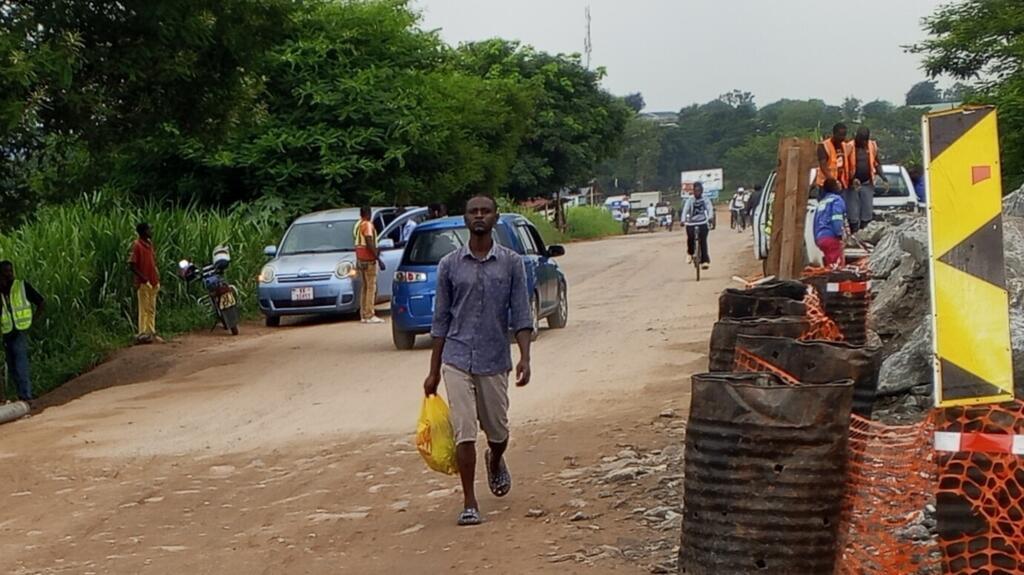
part of rehabilitated Dwangwa bridge which was washed away by the water cutting off the road which is is vital for transport agricultural products and commodities across the country . © RFI/Charles Pensulo
By: Charles Pensulo in Malawi
Kakuyu, in Malawi’s central district of Nkhotakota, provides hundreds of farmers with their livelihoods. Close to both the Dwangwa River and Lake Malawi, its swampy delta land makes it easy to grow crops such as rice and maize twice a year, without the need for fertilisers.
But a heavy downpour in December displaced these farmers and washed away their crops, which were about to be harvested.
Authorities say Nkhotakota and the surrounding districts received continuous rainfall from 25 December straight through to the end of the month, leading to rising water levels in rivers and streams which culminated in flooding of low lying areas.
Malawi's Department of Disaster Management Affairs (DoDMA) said on 22 January that "at least 40 people have died while more than 36,000 households have been affected by rain-related disasters during the 2025/26 rainfall season", the Malawi News Agency reported.
The statement, by Wilson Moleni, commissioner for Disaster Management Affairs, added that "209 people have sustained injuries, while 23 deaths were caused by lightning strikes and 17 by collapsing walls".
DoDMA and its humanitarian partners have responded by providing maize flour, clothes, blankets and medical supplies, while the Malawi Defence Force has been involved in search and rescue operations.
By: Charles Pensulo in Malawi
Kakuyu, in Malawi’s central district of Nkhotakota, provides hundreds of farmers with their livelihoods. Close to both the Dwangwa River and Lake Malawi, its swampy delta land makes it easy to grow crops such as rice and maize twice a year, without the need for fertilisers.
But a heavy downpour in December displaced these farmers and washed away their crops, which were about to be harvested.
Authorities say Nkhotakota and the surrounding districts received continuous rainfall from 25 December straight through to the end of the month, leading to rising water levels in rivers and streams which culminated in flooding of low lying areas.
Malawi's Department of Disaster Management Affairs (DoDMA) said on 22 January that "at least 40 people have died while more than 36,000 households have been affected by rain-related disasters during the 2025/26 rainfall season", the Malawi News Agency reported.
The statement, by Wilson Moleni, commissioner for Disaster Management Affairs, added that "209 people have sustained injuries, while 23 deaths were caused by lightning strikes and 17 by collapsing walls".
DoDMA and its humanitarian partners have responded by providing maize flour, clothes, blankets and medical supplies, while the Malawi Defence Force has been involved in search and rescue operations.
.jpg)
Global warming
For Julius Ng'oma, national coordinator for the country's Civil Society Network on Climate Change (CISONECC), the cause of the disaster is clear: "The recent flooding in Malawi follows a pattern that can be attributed to climate change, suggesting that this is likely being amplified by the global warming phenomenon."
Leah Phiri, 53 who has lived in the Kakuyu area for 30 years, educating her seven children with the proceeds of her crops, said she had never seen anything like the downpour.
The waters had reached shoulder height before officials from the Red Cross sounded the alarm and boats arrived to rescue residents.
"We were told that only people and no possessions were allowed in the boat," said Phiri, who is still sheltering at a former school along with 700 others.
She had watched as her maize, rice and beans – which were almost ripe – were submerged in the water.
Now, she's sharing a room with 50 other people and relying on beans and flour, along with other necessities, donated by the government, the Red Cross and other donors. She is afraid that an outbreak of cholera could erupt due to the overcrowding and lack of hygiene facilities.
"We’ve stayed in that area for decades and it became our home. It hosts over 800 people and is composed of dambos [wetlands] which are ideal for growing different crops like rice and maize. We can’t go back now, and all our possessions have been destroyed."
For 62-year-old Nancy Nthali, Kakuyu was like "a place God gave us to make a living".
For her and her six children – including two orphans she looks after – the disaster has plunged their future into uncertainty.
Livelihoods lost
This is not the first time Kakuyu and the surrounding areas have experienced rising water levels due to rains. But for the first time, residents have seen the water create gullies and streams which make it almost unusable for farming.
Leonard Chiphwanya, who has lived in the area for almost a decade, said families have been torn apart. His own four children were taken in by relatives while he stayed at the camp, agonising over the family's next move. He should have been in the field working, he said.
Chiphwanya recalled how the district had an abundance of rice and maize, in an area that has now been destroyed – and said this plentiful supply meant an affordable price for these commodities compared to in other areas. There were excess harvests, he says, because people were able to "grow crops twice, during rainy season and dry season".
He added: "We were growing crops due to the type of soil and proximity to the water. In the past, the area was neglected... until [people] discovered its worth and one by one, they stayed permanently. Imagine people harvesting between 30, 50 up to 100 bags of rice and maize. This has been a source of livelihood to our families."
For Ng'oma of CISONECC: "Malawi needs to ensure that tangible adaptation measures to the impact of heavy rains and flooding are put in place to secure property, livelihoods and lives in the near and long term. Careful planning in consideration of climate hazards and risk is essential. Climate proofing is key for infrastructure."

No comments:
Post a Comment