The Perfect Storm In Oil Caught Markets Off Guard
Editor OilPrice.com
Sat, June 18, 2022
Two years ago, at the height of the pandemic, BP wrote in its annual Energy Outlook that global oil demand had peaked at around 100 million bpd in 2019, and it was only going to go down from then on because of the effects of the pandemic and the accelerated energy transition.
Just two years later, BP is admitting it may have underestimated the world’s thirst for oil, although it heroically stuck to its long-term forecast that the electrification of transport will eventually usher in the era of peak oil demand.
Investment banks, meanwhile, foresaw the rebound in demand because it was the natural thing to happen after the pandemic depression caused by all the lockdowns. What they did not foresee—because it is impossible to foresee—was the extent and speed of the rebound.
Goldman Sachs’ Jeffrey Currie recently acknowledged this gap between expectations and reality in an interview with Bloomberg, saying, “The markets moved faster and the fundamental tightness is deeper than what we would have thought three or six months ago.
“This is where we should be, but it is a lot deeper than we would have initially thought. Energy and food right now, as we go into the summer months, are severely skewed to the upside,” Currie added.
It may be interesting to note that even three to six months ago, long before Russian supply became a factor in the upward potential of oil prices, there were few but authoritative voices that argued the oil market is, in fact, in balance.
Citi’s Ed Morse was one of these voices. In February, he told Bloomberg’s Javier Blas he expected the oil market to move into surplus territory thanks to increased oil production from the United States—the Permian, specifically—Brazil, and Canada.
Indeed, the Energy Information Administration recently forecast oil production in the Permian would hit a record high this month, but that does not appear enough to offset the global oil imbalance, with many U.S. producers signaling they are unwilling—or are unable because of shortages and delays—to boost production.
In Canada, production is rising, and according to Alberta’s Premier, Jason Kenney, the country’s total could rise by close to 1 million bpd, but this has yet to happen. In Brazil, production is also on the rise but has so far failed to make a difference in the price department.
Of course, the reasons for this price situation are first, the sanctions against Russia, which happens to be the world’s largest oil and fuel exporter, and second, OPEC’s inability to produce as much as it agreed to because of chronic problems with some members of the cartel. Meanwhile, the two OPEC members that have enough spare capacity to offset the loss of Russian barrels, Saudi Arabia and the UAE, are wary of tapping it.
Related: What Biden Is Getting Wrong About Big Oil’s Profits
Perhaps somewhere there is a genius oil analyst that foresaw this state of affairs. Perhaps it doesn’t take a genius to spot the patterns: those OPEC members that cannot hit their own production quotas have been finding it difficult to boost production for years; relations between the Middle Eastern oil states and the West have been deteriorating also for years. And the fact that Russia is the world’s biggest oil exporter is not exactly news.
Perhaps the biggest surprise, the thing that was extremely difficult to foresee, was the speed with which demand for oil rebounded and how resilient this demand has turned out to be despite much higher oil prices that the world has seen for years. In hindsight, it’s easy to attribute it to pent-up demand after the lockdowns, but hindsight is known to make it easier to explain events that have been near impossible to forecast.
The trouble with oil and any other analysis is, of course, that there are always assumptions that need to be made for lack of all the necessary information. Assumptions are often safe to make but sometimes, when a wild card enters the game, assumptions quickly become worthless. In this case, the wild card was Russia, but even the known cards refused to play into the assumptions of analysts.
U.S. production is not growing as much or as fast as some expected as WTI soared above $100 and stayed there. The electrification of transport is not undermining demand because the electrification of transport is happening a lot more slowly than expected. And, perhaps more importantly, OPEC+ may say it will boost production by 1 million additional barrels daily but whether words will translate into actions is very far from certain.
These seem to be all the necessary ingredients for a perfect oil storm, spiced up with the latest massive oil field outage in Libya. Things are, indeed, worse than pretty much everyone expected, and, what is perhaps more worrying, they will remain so for a while yet because there is no quick fix on the table.
The latest from the world’s biggest consumer is putting limits on exports. This would certainly lead to lower domestic prices but will push international prices further still and maybe hurt Washington’s friendship with Brussels. The latest from the world’s biggest importer is that it is stocking up on crude while refinery output declines. Stocking up does seem like the smart thing to do during this storm.
By Irina Slav for Oilprice.com
Monday, June 20, 2022

Biden’s plan for addressing high shipping prices is bogus
June 17, 2022

June 17, 2022
US president Joe Biden has signed into law a bipartisan bill designed to lower ocean shipping costs and reduce inflation.
The new law seeks to bring down shipping costs by forcing ships that drop off cargo at US ports to fill their remaining cargo space with US exports, instead of racing back to Asia or Europe with empty containers onboard. It also directs the Federal Maritime Commission to investigate the late fees shipping lines charge their customers when cargo gets stuck in gridlocked ports.
Both Biden and Congress seek to blame an anti-competitive oligopoly of foreign shipping lines for colluding to artificially raise prices on American consumers. “They raked in the profits and the costs got passed on, as you might guess, directly to consumers,” Biden said at a June 16 signing ceremony for the law. “Sticking it to American families and businesses because they could.”
But the law—and the narrative the Biden administration is crafting around it—offer a simplistic and inaccurate narrative about what caused shipping rates to rise during the pandemic and what might cause them to come back down.
US infrastructure and US consumers created a shipping shortage
US companies are paying sky-high shipping prices because US ports can’t bring in cargo fast enough to satisfy the demand of US consumers.
Americans, flush with an extra $957 billion in disposable income in 2020 thanks to US fiscal stimulus, spent 15% more on goods in 2021 than they did pre-pandemic. Many of those goods are manufactured in Asia, resulting in record-high demand for shipping from Asian ports to the US west coast in 2021.
But America’s west coast ports, built at the start of the 20th century, don’t have the capacity to handle such high volumes of cargo. By September 2021, ships were waiting weeks for a turn to dock at the ports of Los Angeles and Long Beach, California, and containers were piling up in shipyards and the surrounding streets. There was, in other words, a shortage of shipping capacity.
That shortage allowed shipping lines to raise their prices. US retailers, desperate to stock their shelves ahead of the 2021 holiday season, were willing to outbid each other to buy space on cargo ships. As a result, shipping rates rose nearly 10-fold from pre-pandemic levels, and shipping lines made record profits totaling more than $110 billion in 2021.
The free market, not a foreign oligopoly, drove up shipping prices
Biden argued that shipping prices rose because of an anti-competitive scheme by monopolistic shipping lines. “One of the factors affecting prices is this: Nine major shipping companies consolidated into three alliances control the vast majority of ocean shipping in the world,” Biden said. “And each of these nine is foreign-owned. During the pandemic, these carriers increased their prices by as much as 1,000% while families and businesses struggled around the world.”
But that line of argument isn’t very convincing to US economists. “Consumers are paying higher prices this holiday season for a variety of reasons, but not because of some sinister plot from freight companies to exploit consumers,” as Eric Jessup, director of the Freight Policy Transportation Institute at Washington State University’s School of Economic Sciences, told Quartz in November 2021.
“Introductory economics argues that when demand exceeds some constrained supply, then the market has to ration,” Northwestern University economist Ian Savage explained at the time.”[W]hat we are seeing in freight and also warehousing is no different in principle from Superbowl tickets, surge pricing by ride-hailing companies when a concert lets out, [or] airline tickets on the day before Thanksgiving.”
“Whether we call it profiteering or just the free market system might be a matter of semantics,” Savage added.
As for the late fees on stuck cargo, the extra charges grievously annoy importers, but don’t make up the majority of increased shipping costs.
Infrastructure investment and lower consumer spending can ease shipping costs
Shipping rates won’t fall until US consumer demand for goods balances out with the US’s capacity to import goods. There are two ways that can happen.
First, the US could update its aging ports to increase the amount of cargo they can handle. The US infrastructure law passed in 2021 includes $17 billion to do exactly that, but infrastructure upgrades take years to complete.
Second, Americans can stop buying so much stuff. A weakening economy is already causing US consumers to spend less, which has helped bring Asia-US shipping rates down 20% to 30% from their peak.
The new US shipping law won’t address either of these root causes of high shipping costs. But it could prompt shipping lines to lower their prices a bit, if only to appease US lawmakers and avoid further regulatory scrutiny. At the very least, it will give lawmakers a chance to pass blame for inflation onto a foreign enemy and tell voters in an election year that they’re doing something about rising prices.
The post Biden’s plan for addressing high shipping prices is bogus appeared first on Quartz.

As Israel investigates the killing of a Palestinian journalist, many doubt there will be justice
Raf Sanchez
Sat, June 18, 2022
JERUSALEM — Israel’s military says it is still investigating the killing last month of Shireen Abu Akleh, a veteran Palestinian American correspondent for Al Jazeera.
But few Palestinians are holding their breath that they will see justice served.
In interviews across Jerusalem and the occupied West Bank, many Palestinians said they are skeptical that the Israel Defense Forces, or IDF, would fully investigate the May 11 death or hold its own troops accountable if warranted.
“We have no confidence in their judiciary or in their military investigations. When it comes to the Palestinians, we are a people under occupation with no rights, fully dehumanized, fully unprotected, and Israel acts with impunity,” Hanan Ashrawi, a prominent former senior Palestinian official, told NBC News.

Israeli security forces confront Palestinian mourners
(Ahmad Gharabli / AFP - Getty Images)
According to Al Jazeera, which cited eyewitness accounts of its staff, 51-year-old Abu Akleh was shot by an Israeli soldier while covering a military raid in the city of Jenin.
But Israel’s military says it hasn’t yet determined whether Abu Akleh was shot by an Israeli soldier or a Palestinian gunman. The IDF says its probe has been hampered by the Palestinians’ refusal to hand over the fatal bullet for ballistic testing and their refusal to mount a joint investigation.
The Palestinian Authority justified its denial by saying that information handed over would be used for “a new lie, a new narrative” by Israel.
Israeli military investigations into the deaths of Palestinians often drag on for months, or sometimes years, without reaching firm conclusions or leading to prosecutions.
Data compiled by Yesh Din, an Israeli human rights group, found that of 273 complaints filed in 2019 and 2020 against Israeli troops for violence against Palestinians or damage to their property, only four led to indictments of soldiers. One case, striking for its parallels to the killing of Abu Akleh, is held up as an example of why the distrust runs so deep.
Yasser Murtaja was a Palestinian journalist who was killed by an Israeli sniper in April 2018 during mass protests in the Gaza Strip, according to the Palestinian health ministry. Murtaja ran a small news agency known for its drone footage and had worked with Ai Wei Wei, the Chinese visual artist, on a documentary about refugees.
Like Abu Akleh, Murtaja, 31, was wearing a vest clearly labeled “Press.” And like with Abu Akleh, the Israeli military promised to investigate the killing after an international outcry.
But in the days after his death, senior Israeli officials, including the defense minister, accused Murtaja of being a senior Hamas operative, holding a rank equivalent to captain. Israel never provided evidence for the allegation, which Murtaja’s family strongly denied. Moreover, Murtaja’s company had been approved for a United States government grant — a process that includes extensive background vetting.
Israel’s claims immediately sparked confusion about whether Murtaja was killed deliberately for his alleged Hamas activities, or was shot by accident in the chaos of often violent protests at the fence separating Gaza from Israel.
Four years on, Israel’s military investigation offers few answers.
According to Al Jazeera, which cited eyewitness accounts of its staff, 51-year-old Abu Akleh was shot by an Israeli soldier while covering a military raid in the city of Jenin.
But Israel’s military says it hasn’t yet determined whether Abu Akleh was shot by an Israeli soldier or a Palestinian gunman. The IDF says its probe has been hampered by the Palestinians’ refusal to hand over the fatal bullet for ballistic testing and their refusal to mount a joint investigation.
The Palestinian Authority justified its denial by saying that information handed over would be used for “a new lie, a new narrative” by Israel.
Israeli military investigations into the deaths of Palestinians often drag on for months, or sometimes years, without reaching firm conclusions or leading to prosecutions.
Data compiled by Yesh Din, an Israeli human rights group, found that of 273 complaints filed in 2019 and 2020 against Israeli troops for violence against Palestinians or damage to their property, only four led to indictments of soldiers. One case, striking for its parallels to the killing of Abu Akleh, is held up as an example of why the distrust runs so deep.
Yasser Murtaja was a Palestinian journalist who was killed by an Israeli sniper in April 2018 during mass protests in the Gaza Strip, according to the Palestinian health ministry. Murtaja ran a small news agency known for its drone footage and had worked with Ai Wei Wei, the Chinese visual artist, on a documentary about refugees.
Like Abu Akleh, Murtaja, 31, was wearing a vest clearly labeled “Press.” And like with Abu Akleh, the Israeli military promised to investigate the killing after an international outcry.
But in the days after his death, senior Israeli officials, including the defense minister, accused Murtaja of being a senior Hamas operative, holding a rank equivalent to captain. Israel never provided evidence for the allegation, which Murtaja’s family strongly denied. Moreover, Murtaja’s company had been approved for a United States government grant — a process that includes extensive background vetting.
Israel’s claims immediately sparked confusion about whether Murtaja was killed deliberately for his alleged Hamas activities, or was shot by accident in the chaos of often violent protests at the fence separating Gaza from Israel.
Four years on, Israel’s military investigation offers few answers.

A picture of the martyr Yasser Murtaja
The IDF said in a brief statement that Murtaja’s death was investigated by a military body known as the Fact-Finding Assessment Mechanism. The findings were then passed on to military prosecutors who determined “no suspicion was found of a crime having been committed” and closed the case. No indictments were brought.
“The IDF does not deliberately fire at civilians or journalists. Moreover, the use of live fire is done after all other options have been exhausted and in accordance with the standard operating procedures that comply with the rules of international law and the IDF values,” the IDF said.
The IDF did not respond to a series of questions by NBC News, including a request for details of the investigation’s findings and whether Israel still stands by the allegation that Murtaja was a Hamas operative.
Officials also did not respond to questions about Palestinian fears that an investigation into Abu Akleh’s death would not be fair and balanced.
Friends of Abu Akleh say they expect Israel’s military will provide similarly scant information when the investigation finishes.
“These Israeli investigations are methods of whitewashing,” said Dalia Hatuqa, a journalist close to Abu Abkleh. “It’s fair for any journalist and for any Palestinian to believe that there will be no investigation, there will be no justice, and there will be no accountability for Shireen.”
An IDF spokesman said: “All complaints received regarding offenses committed by IDF soldiers are examined in a professional manner. A criminal investigation is launched in a case where there is a reasonable suspicion of a criminal offense.”
One factor may help ensure that Abu Akleh’s case is dealt with differently: She was a U.S. citizen, and her death has attracted attention on Capitol Hill, including from Sens. Mitt Romney, R-Utah, and Jon Ossof, D-Ga.
“We insist that the Administration ensure a full and transparent investigation is completed and that justice is served for Ms. Akleh’s death,” the senators wrote in a June 6 letter to Secretary of State Anthony Blinken. They requested “a detailed update” within 30 days.
The Biden administration appeared to dismiss an investigation by the Palestinian Authority, which concluded on May 26 that Abu Akleh had been deliberately targeted by Israeli troops.
“We are looking for an independent, credible investigation. When that investigation happens, we will follow the facts, wherever they lead,” Blinken said at a conference on June 8.

(Louisa Gouliamaki / AFP via Getty Images)
A State Department spokesperson would not say whether Blinken considers the Israeli military probe independent and credible.
“There has been no change in our approach. We continue to call for a thorough, credible investigation that culminates in accountability,” they said in a statement to NBC News.
Reporters Without Borders, a press freedom group, urged the U.S. and other countries to keep the pressure up until there was accountability for Abu Akleh’s death.
“We must not resign ourselves to seeing the investigation buried,” said Christophe Deloire, the group’s secretary-general. “Countries that called for an investigation must apply pressure and not be fobbed off with empty declarations that are only humiliating.”
A State Department spokesperson would not say whether Blinken considers the Israeli military probe independent and credible.
“There has been no change in our approach. We continue to call for a thorough, credible investigation that culminates in accountability,” they said in a statement to NBC News.
Reporters Without Borders, a press freedom group, urged the U.S. and other countries to keep the pressure up until there was accountability for Abu Akleh’s death.
“We must not resign ourselves to seeing the investigation buried,” said Christophe Deloire, the group’s secretary-general. “Countries that called for an investigation must apply pressure and not be fobbed off with empty declarations that are only humiliating.”
Once-Common California Bumble Bees Have Gone Missing
Fri, June 17, 2022

A Western bumble bee. Rich Hatfield / Xerxes Society
A census of California bumble bees failed to locate several once-common species, including the formerly abundant Western bumble bee, a key pollinator for many wild plants and crops.
“We didn’t find it even once,” said University of California Riverside entomologist Hollis Woodard, a co-author of the study. “If it was okay, we should have seen it.”
In the first statewide survey of bumble bees in nearly 40 years, scientists collected hundreds of bees at 17 sites in largely mountainous parts of Northern California. The team attempted to collect bees at four additional sites in Southern California, but they could not find more than 10 bees in those areas and so excluded them from the study.
In total, their search turned up just 17 of the 25 bumble bee species historically known to reside in the state. The findings were published in the journal Ecology and Evolution.
While scientists said they may have found additional species had they broadened their search, their study nonetheless attests to the growing threats facing California bees, with even the most commonly found species, the yellow-faced bumble bee, seeing its range shrink.
“Even the most dominant species has lost a lot of suitable habitat since the last large-scale survey,” Woodard said. “The winner is not doing great.”
Globally, bees are in decline, imperiled by habitat loss, widespread use of pesticides, and climate change. Their shrinking numbers pose a critical threat to agriculture. In the U.S. alone, bumble bees help pollinate $3 billion worth of crops each year, including tomatoes, peppers, and cranberries.
ALSO ON YALE E360
Will Putting Honey Bees on Public Lands Threaten Native Bees?
Fri, June 17, 2022
A Western bumble bee. Rich Hatfield / Xerxes Society
A census of California bumble bees failed to locate several once-common species, including the formerly abundant Western bumble bee, a key pollinator for many wild plants and crops.
“We didn’t find it even once,” said University of California Riverside entomologist Hollis Woodard, a co-author of the study. “If it was okay, we should have seen it.”
In the first statewide survey of bumble bees in nearly 40 years, scientists collected hundreds of bees at 17 sites in largely mountainous parts of Northern California. The team attempted to collect bees at four additional sites in Southern California, but they could not find more than 10 bees in those areas and so excluded them from the study.
In total, their search turned up just 17 of the 25 bumble bee species historically known to reside in the state. The findings were published in the journal Ecology and Evolution.
While scientists said they may have found additional species had they broadened their search, their study nonetheless attests to the growing threats facing California bees, with even the most commonly found species, the yellow-faced bumble bee, seeing its range shrink.
“Even the most dominant species has lost a lot of suitable habitat since the last large-scale survey,” Woodard said. “The winner is not doing great.”
Globally, bees are in decline, imperiled by habitat loss, widespread use of pesticides, and climate change. Their shrinking numbers pose a critical threat to agriculture. In the U.S. alone, bumble bees help pollinate $3 billion worth of crops each year, including tomatoes, peppers, and cranberries.
ALSO ON YALE E360
Will Putting Honey Bees on Public Lands Threaten Native Bees?
Did climate change kill 2,000 Kansas cows? Farmers can’t afford to ignore science

Charlie Riedel/Associated Press file photo
The Kansas City Star Editorial Board
Fri, June 17, 2022,
Extreme weather conditions that caused thousands of cattle to perish in Kansas feedlots this past weekend may or may not have been caused by climate change. Either way, it seems farmers in that region are beginning to believe the science alerting them to long-term climate trends. And that’s good news for all of us.
Kansas State University climatologist Xiaomao Lin spends a significant amount of time talking with Kansas farmers about climate change. The farmers “will challenge us, because that’s what they do,” said Lin, who is also the state’s official climatologist. But they are also adjusting the way they farm because of climate change, he said.
Maybe the farmers and cattle ranchers are realizing they can’t afford not to trust the science-supported warnings from Lin and other experts: Unless they make adjustments, climate change will greatly diminish their livelihood, Lin said.
“The way they deal with their crop in terms of water reserves is a major concern,” Lin said. “A drought situation is for certain. The science is there. It’s true. It just is what it is,” he said.
It’s been a tough row to hoe to get farmers to accept the science. But the work is showing results. Last year, an Iowa State University poll showed Midwest farmers overwhelmingly — 80% — believe climate change is real. Just eight years earlier, a 2013 survey found that only 8% of farmers in the Midwest believed that “climate change is occurring, and it is caused mostly by human activities.”
Some Kansas Republican lawmakers, however, continue to recklessly deny the science around climate change, views that threaten not only the survival of Kansas farms but food supplies for the nation.
Kansas state Sen. Mike Thompson, a Johnson County Republican and a retired television meteorologist, presented a seminar on the “weaponizing” of climate change. Speaking at the Kansas Independent Oil & Gas Association event in Wichita in August, he called climate change a natural-recurring cycle. Human behavior had little to do with it, he said, and called warnings from scientists about climate change “propaganda.”
Weather-related phenomena, like what killed an estimated 2,000 cows in Kansas, are studied over a long period of time before scientists link them to climate change, Lin said.
So is long-term global warming responsible for the cattle deaths? “It’s a good question, but we can’t answer that yet,” Lin told us, adding that scientists will be looking to see what happens in years to come before they make that call.
Does that sound like someone “weaponizing” science? Hardly.
Meanwhile, there’s no denying the scorching hot temperatures that hit triple digits in the region and barely cooled down in the evenings, which normally would happen, said Chip Redmond, a Kansas State University meteorologist.
Cattle are adaptable to heat, but they don’t sweat like humans. They absorb the heat of the day and expend it through panting. But since it never cooled off enough last weekend, the cattle never got a break and died of heat stress, said A.J. Tarpoff, a veterinarian at K-State.
Yes, it’s still early to determine whether the combined heat, humidity and breezeless conditions that killed the cattle were the result of long-term climate change.
Regardless, Kansas lawmakers need to stop denying, for political reasons, what their constituents have already come to know: Climate change is real. It’s time to get behind every legislative effort to help the farmers and ranchers in these changing climate conditions
Charlie Riedel/Associated Press file photo
The Kansas City Star Editorial Board
Fri, June 17, 2022,
Extreme weather conditions that caused thousands of cattle to perish in Kansas feedlots this past weekend may or may not have been caused by climate change. Either way, it seems farmers in that region are beginning to believe the science alerting them to long-term climate trends. And that’s good news for all of us.
Kansas State University climatologist Xiaomao Lin spends a significant amount of time talking with Kansas farmers about climate change. The farmers “will challenge us, because that’s what they do,” said Lin, who is also the state’s official climatologist. But they are also adjusting the way they farm because of climate change, he said.
Maybe the farmers and cattle ranchers are realizing they can’t afford not to trust the science-supported warnings from Lin and other experts: Unless they make adjustments, climate change will greatly diminish their livelihood, Lin said.
“The way they deal with their crop in terms of water reserves is a major concern,” Lin said. “A drought situation is for certain. The science is there. It’s true. It just is what it is,” he said.
It’s been a tough row to hoe to get farmers to accept the science. But the work is showing results. Last year, an Iowa State University poll showed Midwest farmers overwhelmingly — 80% — believe climate change is real. Just eight years earlier, a 2013 survey found that only 8% of farmers in the Midwest believed that “climate change is occurring, and it is caused mostly by human activities.”
Some Kansas Republican lawmakers, however, continue to recklessly deny the science around climate change, views that threaten not only the survival of Kansas farms but food supplies for the nation.
Kansas state Sen. Mike Thompson, a Johnson County Republican and a retired television meteorologist, presented a seminar on the “weaponizing” of climate change. Speaking at the Kansas Independent Oil & Gas Association event in Wichita in August, he called climate change a natural-recurring cycle. Human behavior had little to do with it, he said, and called warnings from scientists about climate change “propaganda.”
Weather-related phenomena, like what killed an estimated 2,000 cows in Kansas, are studied over a long period of time before scientists link them to climate change, Lin said.
So is long-term global warming responsible for the cattle deaths? “It’s a good question, but we can’t answer that yet,” Lin told us, adding that scientists will be looking to see what happens in years to come before they make that call.
Does that sound like someone “weaponizing” science? Hardly.
Meanwhile, there’s no denying the scorching hot temperatures that hit triple digits in the region and barely cooled down in the evenings, which normally would happen, said Chip Redmond, a Kansas State University meteorologist.
Cattle are adaptable to heat, but they don’t sweat like humans. They absorb the heat of the day and expend it through panting. But since it never cooled off enough last weekend, the cattle never got a break and died of heat stress, said A.J. Tarpoff, a veterinarian at K-State.
Yes, it’s still early to determine whether the combined heat, humidity and breezeless conditions that killed the cattle were the result of long-term climate change.
Regardless, Kansas lawmakers need to stop denying, for political reasons, what their constituents have already come to know: Climate change is real. It’s time to get behind every legislative effort to help the farmers and ranchers in these changing climate conditions
Sunday, June 19, 2022
Fires burn through Shanghai chemical plant

Leo Sands - BBC News
Sat, June 18, 2022,
Fires at a large chemical plant in the Chinese city of Shanghai have killed at least one person.
They broke out around 04:00 on Saturday (20:00 GMT Friday) at one of the country's largest refining and petrochemical plants.
Flames could be seen engulfing parts of the sprawling complex and spewing thick columns of black smoke into the sky.
Shanghai is China's economic hub and only recently emerged from a strict pandemic lockdown lasting two months.
The cause of the fires, which affected an ethylene glycol facility, is still unclear.
Sinopec - the state-owned company that operates the plant in the suburb of Jinshan - said the driver of a transport vehicle had been killed and a company employee had been injured.
Residents living up to 6km (four miles) away reported hearing an explosion, local media report.
Shanghai's fire department dispatched more than 500 personnel to the scene.
State media say the fires are now under control but protective burning is being carried out.
Drone footage shared on social media showed the sky above Shanghai, China's most populous city, turning black from smoke.
Sinopec said it was monitoring for environmental impact and no damage to the surrounding water environment had been recorded.
The ministry of emergency management has dispatched an expert group to the scene.
Shanghai had been under a strict lockdown imposed by officials to curb a coronavirus outbreak driven by the spread of the Omicron variant.
For two months residents in the global trading hub were forbidden from leaving their homes - shutting down factories with far-reaching consequences for both the local economy and global supply chains.
The government is pursuing a "zero Covid" policy requiring everyone who catches the virus to quarantine.
New rules have now been introduced with residents required to show a green health code on their smartphone to leave their residential compounds and to enter most places.
Leo Sands - BBC News
Sat, June 18, 2022,
Fires at a large chemical plant in the Chinese city of Shanghai have killed at least one person.
They broke out around 04:00 on Saturday (20:00 GMT Friday) at one of the country's largest refining and petrochemical plants.
Flames could be seen engulfing parts of the sprawling complex and spewing thick columns of black smoke into the sky.
Shanghai is China's economic hub and only recently emerged from a strict pandemic lockdown lasting two months.
The cause of the fires, which affected an ethylene glycol facility, is still unclear.
Sinopec - the state-owned company that operates the plant in the suburb of Jinshan - said the driver of a transport vehicle had been killed and a company employee had been injured.
Residents living up to 6km (four miles) away reported hearing an explosion, local media report.
Shanghai's fire department dispatched more than 500 personnel to the scene.
State media say the fires are now under control but protective burning is being carried out.
Drone footage shared on social media showed the sky above Shanghai, China's most populous city, turning black from smoke.
Sinopec said it was monitoring for environmental impact and no damage to the surrounding water environment had been recorded.
The ministry of emergency management has dispatched an expert group to the scene.
Shanghai had been under a strict lockdown imposed by officials to curb a coronavirus outbreak driven by the spread of the Omicron variant.
For two months residents in the global trading hub were forbidden from leaving their homes - shutting down factories with far-reaching consequences for both the local economy and global supply chains.
The government is pursuing a "zero Covid" policy requiring everyone who catches the virus to quarantine.
New rules have now been introduced with residents required to show a green health code on their smartphone to leave their residential compounds and to enter most places.
Aboriginal flag set to fly permanently on Sydney Harbour Bridge

SYDNEY (Reuters) - The Aboriginal flag will fly permanently on the Sydney Harbour Bridge as part of a "healing process" and reconciliation efforts with Australia's indigenous community, New South Wales Premier Dominic Perrottet said on Sunday.
The distinctive black, red and yellow flag will fly alongside the Australian flag and New South Wales state flag at the top of the landmark bridge.
The Aboriginal flag, recognised as an official flag of Australia since 1995, is flown from government buildings and embraced by sporting clubs and athletes of Aboriginal heritage.
The government of Australia's most populous state said it would spend $A25 million ($17 million) to permanently install a third flagpole on the bridge by the end of the year to fly the flag.
Perrottet said the move represented a continuation of "the healing process as part of the broader move towards reconciliation", efforts that seek to promote better ties between the wider Australian community and Aboriginal and Torres Strait Islander peoples.
"It's an important decision that we've made, I think it brings unity to our country and it's a small price to pay for that unification," he told reporters in Sydney.
The federal government this year acquired copyright to the Aboriginal flag so it could be freely used, resolving a commercial dispute that had limited sporting teams and Aboriginal communities from reproducing the image.
The flag's colours represent the Aboriginal people and their spiritual connection to the land. It was first raised in 1971 at a land rights rally in the state of Victoria.
($1 = 1.4430 Australian dollars)
Amazon says it knows it could run out of available workers for its warehouses, according to leaked memo

A cart full of Amazon packagesCARLO ALLEGRI/Reuters
Gabrielle Bienasz
Fri, June 17, 2022
Recode reported on a leaked memo from Amazon raising the alarm about running out of workers from mid-2021.
A NYT story last year said Amazon executives were worried about this.
Amazon said in May it is overstaffed now, but attrition is likely still huge at the company, and a union push looms.
Amazon is going to have to do something to avoid potentially running out of workers, according to an internal memo from last year obtained by Recode.
A New York Times investigation from June 2021 found a turnover rate for hourly workers of about 150% each year and reported that Amazon executives were worried about running out of people to hire.
However, this newly leaked memo from that time period provided an in-depth look at Amazon's understanding of its own labor issues and how it might solve them. Insider did not independently verify the memo.
"If we continue business as usual, Amazon will deplete the available labor supply in the US network by 2024," the memo says, according to Recode.
The leaked document "reads like an attempted wake-up call," Recode added.
The memo reportedly says Amazon could use six methods for its warehouse workers, including raising wages or increasing reliance on robots, to fix the issue, but that the problem is coming at the company pretty quickly, especially in certain parts of the country.
Those areas include Phoenix, and the places in and around Memphis, Tennessee, and Wilmington, Delaware.

Another understaffed danger area, the memo said, is the "inland empire" region of California, where the company could potentially run out of interested workers by 2022 because of hiring competition from other logistics companies.
The memo said the models used for those labor predictions were 94% accurate when it came to figuring out where in the US the company would not have enough workers to meet June 2021 Amazon Prime Day-related demand, Recode noted.
The report goes through various solutions, Recode writes. If the company raised wages a dollar, it would see a corresponding increase in the number of people in its hiring pool of 7%, per the memo.
Its existing staff could work more or use a budding tool to transfer workers from warehouse to warehouse depending on demand. And the company could take into account the available labor pools for warehouses where the location is more flexible.
It's unclear how relevant this memo is to Amazon's current operations, especially given anxiety over a recession and overstaffing in retail after the omicron variant.
The company did dispute its relevance in a statement to Insider. "There are many draft documents written on many subjects across the company that are used to test assumptions and look at different possible scenarios, but aren't then escalated or used to make decisions. This was one of them," an Amazon spokesperson wrote via email.
"It doesn't represent the actual situation, and we are continuing to hire well in Phoenix, the Inland Empire, and across the country," the company added.
In mid-May, Amazon's Chief Financial Officer Brian Olsavsky said the company had "quickly transitioned from being understaffed to being overstaffed." He added that the issue would "dissipate."
On Thursday, as Recode noted, The Wall Street Journal reported that now-gone Amazon executive Dave Clark proposed that the company should cull its worker base through attrition.
Amazon workers have long reported tough conditions, and the company even aims to get rid of a certain number of workers a year, Insider has reported — which jibes, in some ways, of Jeff Bezos' management ethos, a New York Times investigation revealed.
The first Amazon warehouse in Staten Island, New York, unionized in April.
A cart full of Amazon packagesCARLO ALLEGRI/Reuters
Gabrielle Bienasz
Fri, June 17, 2022
Recode reported on a leaked memo from Amazon raising the alarm about running out of workers from mid-2021.
A NYT story last year said Amazon executives were worried about this.
Amazon said in May it is overstaffed now, but attrition is likely still huge at the company, and a union push looms.
Amazon is going to have to do something to avoid potentially running out of workers, according to an internal memo from last year obtained by Recode.
A New York Times investigation from June 2021 found a turnover rate for hourly workers of about 150% each year and reported that Amazon executives were worried about running out of people to hire.
However, this newly leaked memo from that time period provided an in-depth look at Amazon's understanding of its own labor issues and how it might solve them. Insider did not independently verify the memo.
"If we continue business as usual, Amazon will deplete the available labor supply in the US network by 2024," the memo says, according to Recode.
The leaked document "reads like an attempted wake-up call," Recode added.
The memo reportedly says Amazon could use six methods for its warehouse workers, including raising wages or increasing reliance on robots, to fix the issue, but that the problem is coming at the company pretty quickly, especially in certain parts of the country.
Those areas include Phoenix, and the places in and around Memphis, Tennessee, and Wilmington, Delaware.

Another understaffed danger area, the memo said, is the "inland empire" region of California, where the company could potentially run out of interested workers by 2022 because of hiring competition from other logistics companies.
The memo said the models used for those labor predictions were 94% accurate when it came to figuring out where in the US the company would not have enough workers to meet June 2021 Amazon Prime Day-related demand, Recode noted.
The report goes through various solutions, Recode writes. If the company raised wages a dollar, it would see a corresponding increase in the number of people in its hiring pool of 7%, per the memo.
Its existing staff could work more or use a budding tool to transfer workers from warehouse to warehouse depending on demand. And the company could take into account the available labor pools for warehouses where the location is more flexible.
It's unclear how relevant this memo is to Amazon's current operations, especially given anxiety over a recession and overstaffing in retail after the omicron variant.
The company did dispute its relevance in a statement to Insider. "There are many draft documents written on many subjects across the company that are used to test assumptions and look at different possible scenarios, but aren't then escalated or used to make decisions. This was one of them," an Amazon spokesperson wrote via email.
"It doesn't represent the actual situation, and we are continuing to hire well in Phoenix, the Inland Empire, and across the country," the company added.
In mid-May, Amazon's Chief Financial Officer Brian Olsavsky said the company had "quickly transitioned from being understaffed to being overstaffed." He added that the issue would "dissipate."
On Thursday, as Recode noted, The Wall Street Journal reported that now-gone Amazon executive Dave Clark proposed that the company should cull its worker base through attrition.
Amazon workers have long reported tough conditions, and the company even aims to get rid of a certain number of workers a year, Insider has reported — which jibes, in some ways, of Jeff Bezos' management ethos, a New York Times investigation revealed.
The first Amazon warehouse in Staten Island, New York, unionized in April.
Why is Turkey Blocking Sweden & Finland from joining NATO? Erdogan, Kurds, Terrorism & the PKK


Kurds in Sweden on edge as Turkey presses government to ditch them in exchange for NATO membership
As Sweden’s government survived a non-confidence vote today, its fate was tied to Kurdish lawmaker and former guerrilla Amineh Kakabaveh.
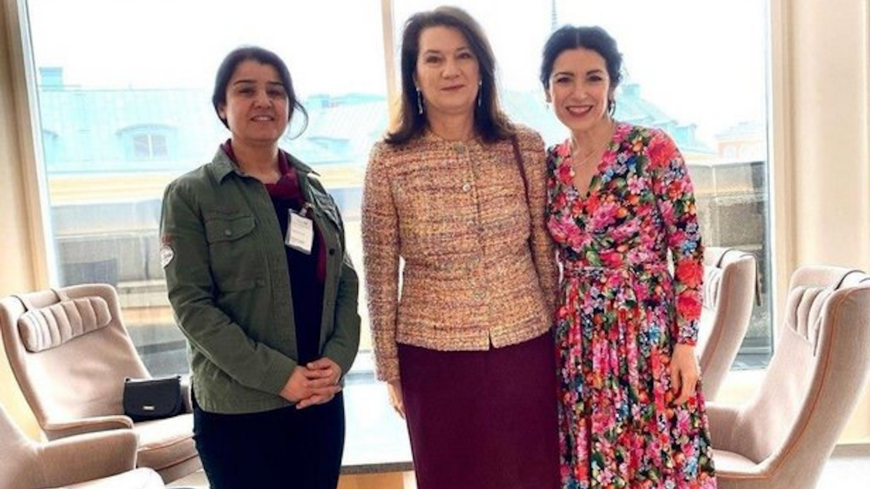
An image of Nesrin Abdullah, Ann Linde and Amineh Kakabaveh that prompted a reaction from Turkish officials. - TWITTER
June 6, 2022
STOCKHOLM & UPPSALA, Sweden — Sweden’s bid to join the NATO alliance following Russia’s invasion of Ukraine and Turkey’s threats to block it have thrust this Nordic nation’s Kurdish minority center stage in a Netflix style drama that is rocking the government of Prime Minister Magdalena Andersson and prompting anguished debate over Swedish identity.
On June 7, Andersson and her minority government of Social Democrats faced a no-confidence vote in parliament over the Justice Minister’s failure to curb record levels of gang violence, pushed by a right-wing opposition that smells blood ahead of nationwide elections in September. Its fate seemingly hinged on the decision of Amineh Kakabaveh, an ethnic Kurdish lawmaker and former guerrilla whose swing vote has allowed the government to pass key legislation, notably the budget. Kakabaveh, an independent, lent that support on the condition that the Social Democrats grant their own to the Kurdish-led autonomous administration in northeast Syria.
Turkey deems the body a threat to its own national security. It cites the fact that many of its top cadres were previously active in the Kurdistan Workers Party (PKK), the armed group that has been fighting the Turkish army since 1984 for Kurdish self-rule. Turkey is now threatening to launch a fresh military offensive against the US-backed Syrian Kurdish People’s Protection Units (YPG), who led the fight against the Islamic State (IS), on similar grounds.
The controversial deal sealed between the Social Democrats and Kakabaveh in November last year infuriated Turkey and bolstered its demands that Sweden end its alleged support for Kurdish “terrorists” as a pre-condition for greenlighting Sweden’s accession to NATO. Turkey’s ambassador to Sweden suggested that Kakabaveh, who makes no secret of her sympathy for the PKK, should be extradited to Turkey before discovering she was a Kurd from Iran, not Turkey.
Andersson, Sweden’s first female prime minister, had threatened to resign if the no-confidence motion went through, saying her opponents are acting recklessly at a time when the country is faced with major security challenges.
Kakabaveh stuck to her guns, saying she would not support the government on June 7 unless it reaffirms its backing for the Syrian Kurds. “Why, when the Kurds are attacked by DAESH, by Turkey, why should they not get support?” asked Kakabaveh in a June 6 interview with Al-Monitor, using the Arabic acronym for IS. “They fought for the whole world to be free from terrorism, from DAESH. If Sweden accepts Turkey’s demands, that means DAESH will be strong again,” she fumed.
Kakabaveh said the government delivered the assurances she was demanding just hours before the vote. She abstained. The government is holding steady — for now.
For many Swedes, caving to Ankara goes well beyond concerns about IS. For Europeans writ large, Sweden’s predicament speaks to Turkey’s ability as they see things to blackmail their governments into submission. Among the most striking examples of the horse-trading in play is the 2016 deal whereby Turkey agreed to not flood Europe with Syrian refugees in exchange for billions of euros in aid.
“Swedish foreign policy is driven by values and the self-perception of many Swedes is of a country that stands up for democracy and human rights,” noted Paul Levin, director of Stockholm University’s Institute for Turkish Studies. “The stark choice between principles and security that Ankara has placed Sweden before is arguably shocking to many here. There is little will to abandon Sweden’s traditional role on the world stage,” he told Al-Monitor.
Turkey has imposed similar conditions on Finland, but its real target is Sweden.
Jens Orback, a veteran Social Democrat and a former minister for Democracy, Integration and Gender Equality, recalled that Sweden is among a handful of EU countries that backs Turkey’s accession to the European bloc. “Sweden and the Social Democrats have been good friends of Turkey,” he told Al-Monitor.
Sweden became the first Scandinavian state to recognize the modern Turkish Republic in 1924 and signed a friendship treaty with Ankara the following year. A shared wariness of Russia dates back to 18th century when the Swedish King Charles XII fleeing the Tsarist army in the Great Northern War was offered sanctuary by the Turks in their Moldovan suzerainty, Bender. But the Ottomans then cut a deal with Catherine, the wife of the Russian emperor Peter the Great, who allegedly seduced the Turkish Grand Vizier in her imperial tent, leaving Charles out in the cold. The parallels with history are not lost on the Swedes. Who but Russia benefits most from Turkey’s current stance?
“[Recep Tayyip] Erdogan’s blockage of Finland and Sweden’s NATO application with flimsy arguments regarding Turkey’s security perceptions is essentially in the service of Putin’s aggressive stand against the West,” said Cengiz Candar, a senior associate research fellow at the Middle East and North Africa Program at the Swedish Institute of International Affairs and a regular contributor to Al-Monitor.
Candar dismissed the idea that had Turkey been accepted as a full EU member that it would have acted differently. “It has more to do with Erdogan’s ideology and Turkey’s autocratic regime,” he said.
Orback insists that Sweden will hold its ground. “We have human rights in our laws, freedom of press and protection of minorities. We should stick to those values.” As it happens, the same values are enshrined in NATO’s charter and Sweden’s job ought to be to see them upheld when it joins. “We are a party that is loyal to the decisions it takes,” Orback asserted.
But is it really? Will the proudly pacifist Swedes rediscover their Viking valor in the face of Turkish bullying?
The question is weighing ever more heavily and no more so than on the minds of Sweden’s estimated 150,000 Kurds. Kakabaveh insists that the government’s muted response to Turkish President Recep Tayyip Erdogan’s continued salvoes is a form of capitulation in and of itself. She’s never felt more vulnerable — or betrayed — she said.
Erdogan now wants Andersson to sack her defense minister, Peter Hultqvist, because he attended a 2014 gathering to celebrate the 33rd anniversary of the founding of the PKK.
“Is the YPG more dangerous than Vladimir Putin? Is NATO going to stick with authoritarians like Turkey at the expense of democracies like Finland and Sweden?” asked Kurdo Baksi, a nonpartisan Kurdish community leader and frequent commentator on Swedish television. “Erdogan is paralyzing NATO, European security,” he told Al-Monitor.
Ridvan Altun, a spokesman for the Democratic Kurdish Society Center, a group that embraces the ideology of imprisoned PKK leader Abdullah Ocalan, says pressure from the Swedish authorities has been growing for some time. “Turkey’s long arm and its policy of labeling those who do not conform to its views as terrorist is being felt here now,” Altun told Al-Monitor.
Altun said the squeeze began in 2018 when the government began to refuse to extend residency permits to like-minded Kurds and submit their files to Sweden’s national intelligence services. “We know of at least 57 such cases,” Altun said, citing figures garnered by Swedish radio. “My brother is among them.” The reason given by the authorities to deny his brother continued residency was that his wife, a Swedish national, “is active in [pro-PKK] politics.” In 2020, Zozan Buyuk, a Belgian Kurd married to a Swedish Kurd, was deported back to Belgium on similar grounds, triggering uproar in the Kurdish community.
“It is because of these concessions that Turkey feels entitled to make such brazen demands,” Altun said. “As a Kurd and as a Swedish citizen, I feel deeply worried.”
In fact, the moves against the PKK date back to 1984 when Sweden became the first country after Turkey to designate the group as a terrorist organization. The EU and the United States followed suit.
The conflict averse Swedes were horrified when two former PKK operatives were killed on their soil upon orders from Ocalan. This prompted another top PKK member to threaten the Social Democratic government of Sweden’s then prime minister, Olof Palme, who was assassinated by an unknown assailant in 1986. The PKK was counted among the suspects, though the theory has since been discredited.
The PKK’s admonishments together with the 2002 “honor” killing of a Turkish Kurd by her father for having a relationship with a Swedish man stained the Kurds’ reputation for many years, said Baksi the community leader. Kurdish kids joining criminal gangs didn’t help.
But the negative image was dramatically reversed when the women fighters of the YPG shot to global fame with their fearlessness in the battle against IS. Today, pro-PKK groups have more influence in Sweden than any other of their rivals, not least because they are the best organized.
Efforts championed by Kakabaveh, among others, to have the PKK delisted have failed so far. But the YPG continues to be held in the highest regard in Swedish officialdom.
Turkey’s claims that it has nothing against the Kurdish people and only targets “terrorists” ring hollow in Uppsala, a picturesque university town renowned for its splendid gothic cathedral and Europe’s most successful Kurdish soccer team, Dalkurd.
It was founded in 2004 by members of the Kurdish diaspora in Dalarna county — hence “Dal” — to keep their children off the streets. The club’s giddying rise fueled by feelings of Kurdish pride to the top tier of the Sweden’s premier league in 2017 awed the public. Hudqvist, the defense minister, is a big fan.
Its fortunes have since fluctuated, and Dalkurd slipped to the third division before clawing its way back up to the second tier this year. Finances remain a big problem and Turkish meddling is one of the causes. When the Chinese telecom giant Huawei offered to sponsor the team, Ankara threatened to ban sales of its products in Turkey, according to Dalkurd’s manager, Welat Kilincaslan.
The club was forced to change its corporate name to DK Elite AB after Turkish state lender Halkbank refused to transfer funds on behalf of Dalkurd’s chief sponsor, a telecom company called FASTLINK owned by Iraqi Kurdish businessman Kawa Junad. “The bank said it would not deal with an entity that has the word ‘Kurd’ in it,” Kilincaslan told Al-Monitor during a recent tour of the team’s headquarters at Uppsala stadium.
He added, “We steer clear of politics. Nobody is allowed to chant any political slogans in favor of that party or the other. Turkey’s hostility is incomprehensible to us.” All the more so because the Iraqi Kurdish government used to deposit its oil revenues in Halkbank’s coffers until the bank was tried in a US Federal Court for laundering billions of dollars in an oil for gold scheme on behalf of Iran.

Members of Dalkurd hold a Kurdish flag. (Courtesy of Dalkurd)
Despite Turkey’s best efforts, the Kurds command growing influence in Sweden where they account for over 1 percent of the total population of 10 million. There are currently six ethnic Kurdish members of parliament.
“In the old days, Turkey used to be hailed in Europe and the United States as the sole Muslim country that was pro secular, pro-Western and where women had more freedom than in any other. The Kurds have snatched that crown,” said Baksi. “Turkey is now seen as anti-Western and pro-DAESH,” he said.
Nesrin Abdullah, commander of the YPG’s all-female arm, is a frequent visitor to Stockholm where she enjoys hero status and is received by top officials. They include the foreign minister, Ann Linde, a long-time campaigner for minority rights. Photos showing Abdullah, Linde and Kakabaveh together in the Swedish parliament in May drove Ankara mad, leading Turkish Foreign Minister Mevlut Cavusoglu to blast her at a NATO gathering last month for her “so-called feminist policies.”
Turkey says no such visits can be repeated. All support for the YPG, which enjoys the protection of US forces in Syria, needs to end. The activities of PKK-leaning groups inside Sweden must be banned. Ankara also wants Sweden to extradite individuals, mainly Kurds and associates of Fethullah Gulen, the Sunni preacher accused of orchestrating the failed attempt to violently overthrow Erdogan in 2016.
Various versions of Turkey’s alleged wanted list are circulating in the media. One includes the name of a Kurdish author who died seven years ago.
“For extraditions, there must be solid evidence about offenses that are considered serious crimes according to Swedish law,” said Bitte Hammargren, an independent Turkey and Middle East analyst and a senior associate fellow of the Swedish Institute of International Affairs. “It seems that the names on Turkey’s list have been floating around for some years, and they are requests that have been turned down by the Swedish court system,” Hammargren told Al-Monitor.
Turkey’s claims that Sweden had provided $367 million in “terrorism financing” to the Syrian Kurds are “disinformation,” she said. The figure equals the total funds disbursed over the past five years for humanitarian aid and support to Syria’s neighbors hosting large refugee populations such as Turkey and Lebanon. Moreover, Sweden has never supplied arms to the YPG. All of the above was relayed by a Swedish delegation that traveled to Ankara last month to help defuse the crisis. It returned empty-handed.
Hopes that Washington would ride to Sweden’s rescue have also proved empty. “Sweden’s membership is not for the United States to deliver,” said a well-placed source speaking on condition of strict anonymity.
The reckoning in Stockholm is that the row will not be resolved in time for the NATO summit that is scheduled to be held in Madrid on June 30, and that while this is “deeply irritating, particularly for Washington, it won’t be the end of the world,” the source contended.
Turkey’s other demand — that Sweden scrap an arms embargo imposed by it and fellow EU member states in the wake of Turkey’s latest invasion of northeast Syria in October 2019 — can be more easily met.
The Swedish Inspectorate of Strategic Products that vets applications for arms sales insists that there “is no arms embargo" on Turkey and that Sweden examines applications based on their individual merits. “This may be interpreted that some sales are up for grabs — I guess primarily material that is not directly lethal,” Hammargren speculated. Either way, Sweden’s previous weapons sales to Turkey are “peanuts” compared to what it wants from the United States after it imposed sanctions on Ankara chiefly over its acquisition of Russian S-400 missiles.
“My guess is that the government will try to offer some compromises,” Levin concurred.
“There may be some other moderate concessions as well. The PKK has long been listed as a terrorist group in Sweden, so to offer to be more vigilant in pursuing them and not allowing them to operate on Swedish soil would not really be 'caving in.' But anything that could be construed as selling out our principles I would guess is off-limits,” Levin said.
Before Russia’s invasion of Ukraine, the idea that Sweden would end 200 years of determined neutrality after losing large chunks of territory to Russia in the Napoleonic wars would have been laughed off as a fantasy. Therefore, the idea that it would make some concessions to Ankara for the sake of its own security cannot be entirely dismissed.
Jenny White, a Stockholm-based anthropologist and expert on Turkey, says Sweden is gripped by fear. “Crank radios and iodine pills sold out across the country. The government began rehabilitating its network of bomb shelters.”
“The daily visual diet of destruction and violence coming out of Ukraine and Russia’s belligerence to other countries on or near its borders has convinced the population and the politicians to seek safety and protection by bigger powers,” White told Al-Monitor.
“There was anxiety about the period between seeking NATO admission and receiving it — that Russia would take advantage of that period to attack Gotland, the Swedish island in the Baltic Sea that would be a strategic prize for Russia. It never occurred to anyone that the danger would be enhanced by another NATO member, Turkey,” White added. “Turkey is seen as an unreliable, authoritarian land that has no respect for and doesn’t understand countries like Sweden because it doesn’t share their values.”
Not all Swedes feel the same way. Adam Mohammed, an ethnic Somali worker at the Chinese-owned Swedish car manufacturer Volvo, accused his government of “hiding behind America’s skirts” and said Sweden should not join NATO. Erdogan, his fellow Muslim, was right in expecting Sweden’s support against “Kurdish terrorists,” he told Al-Monitor. “NATO is supposed to be family. Then why is one member, America, supporting terrorists against another member, Turkey?” he asked. “And why are we?”
Editor's note: June 7, 2022. This article was updated after its initial publication to reflect the result of the no-confidence vote in the Swedish parliament.
As Sweden’s government survived a non-confidence vote today, its fate was tied to Kurdish lawmaker and former guerrilla Amineh Kakabaveh.
An image of Nesrin Abdullah, Ann Linde and Amineh Kakabaveh that prompted a reaction from Turkish officials. - TWITTER
June 6, 2022
STOCKHOLM & UPPSALA, Sweden — Sweden’s bid to join the NATO alliance following Russia’s invasion of Ukraine and Turkey’s threats to block it have thrust this Nordic nation’s Kurdish minority center stage in a Netflix style drama that is rocking the government of Prime Minister Magdalena Andersson and prompting anguished debate over Swedish identity.
On June 7, Andersson and her minority government of Social Democrats faced a no-confidence vote in parliament over the Justice Minister’s failure to curb record levels of gang violence, pushed by a right-wing opposition that smells blood ahead of nationwide elections in September. Its fate seemingly hinged on the decision of Amineh Kakabaveh, an ethnic Kurdish lawmaker and former guerrilla whose swing vote has allowed the government to pass key legislation, notably the budget. Kakabaveh, an independent, lent that support on the condition that the Social Democrats grant their own to the Kurdish-led autonomous administration in northeast Syria.
Turkey deems the body a threat to its own national security. It cites the fact that many of its top cadres were previously active in the Kurdistan Workers Party (PKK), the armed group that has been fighting the Turkish army since 1984 for Kurdish self-rule. Turkey is now threatening to launch a fresh military offensive against the US-backed Syrian Kurdish People’s Protection Units (YPG), who led the fight against the Islamic State (IS), on similar grounds.
The controversial deal sealed between the Social Democrats and Kakabaveh in November last year infuriated Turkey and bolstered its demands that Sweden end its alleged support for Kurdish “terrorists” as a pre-condition for greenlighting Sweden’s accession to NATO. Turkey’s ambassador to Sweden suggested that Kakabaveh, who makes no secret of her sympathy for the PKK, should be extradited to Turkey before discovering she was a Kurd from Iran, not Turkey.
Andersson, Sweden’s first female prime minister, had threatened to resign if the no-confidence motion went through, saying her opponents are acting recklessly at a time when the country is faced with major security challenges.
Kakabaveh stuck to her guns, saying she would not support the government on June 7 unless it reaffirms its backing for the Syrian Kurds. “Why, when the Kurds are attacked by DAESH, by Turkey, why should they not get support?” asked Kakabaveh in a June 6 interview with Al-Monitor, using the Arabic acronym for IS. “They fought for the whole world to be free from terrorism, from DAESH. If Sweden accepts Turkey’s demands, that means DAESH will be strong again,” she fumed.
Kakabaveh said the government delivered the assurances she was demanding just hours before the vote. She abstained. The government is holding steady — for now.
For many Swedes, caving to Ankara goes well beyond concerns about IS. For Europeans writ large, Sweden’s predicament speaks to Turkey’s ability as they see things to blackmail their governments into submission. Among the most striking examples of the horse-trading in play is the 2016 deal whereby Turkey agreed to not flood Europe with Syrian refugees in exchange for billions of euros in aid.
“Swedish foreign policy is driven by values and the self-perception of many Swedes is of a country that stands up for democracy and human rights,” noted Paul Levin, director of Stockholm University’s Institute for Turkish Studies. “The stark choice between principles and security that Ankara has placed Sweden before is arguably shocking to many here. There is little will to abandon Sweden’s traditional role on the world stage,” he told Al-Monitor.
Turkey has imposed similar conditions on Finland, but its real target is Sweden.
Jens Orback, a veteran Social Democrat and a former minister for Democracy, Integration and Gender Equality, recalled that Sweden is among a handful of EU countries that backs Turkey’s accession to the European bloc. “Sweden and the Social Democrats have been good friends of Turkey,” he told Al-Monitor.
Sweden became the first Scandinavian state to recognize the modern Turkish Republic in 1924 and signed a friendship treaty with Ankara the following year. A shared wariness of Russia dates back to 18th century when the Swedish King Charles XII fleeing the Tsarist army in the Great Northern War was offered sanctuary by the Turks in their Moldovan suzerainty, Bender. But the Ottomans then cut a deal with Catherine, the wife of the Russian emperor Peter the Great, who allegedly seduced the Turkish Grand Vizier in her imperial tent, leaving Charles out in the cold. The parallels with history are not lost on the Swedes. Who but Russia benefits most from Turkey’s current stance?
“[Recep Tayyip] Erdogan’s blockage of Finland and Sweden’s NATO application with flimsy arguments regarding Turkey’s security perceptions is essentially in the service of Putin’s aggressive stand against the West,” said Cengiz Candar, a senior associate research fellow at the Middle East and North Africa Program at the Swedish Institute of International Affairs and a regular contributor to Al-Monitor.
Candar dismissed the idea that had Turkey been accepted as a full EU member that it would have acted differently. “It has more to do with Erdogan’s ideology and Turkey’s autocratic regime,” he said.
Orback insists that Sweden will hold its ground. “We have human rights in our laws, freedom of press and protection of minorities. We should stick to those values.” As it happens, the same values are enshrined in NATO’s charter and Sweden’s job ought to be to see them upheld when it joins. “We are a party that is loyal to the decisions it takes,” Orback asserted.
But is it really? Will the proudly pacifist Swedes rediscover their Viking valor in the face of Turkish bullying?
The question is weighing ever more heavily and no more so than on the minds of Sweden’s estimated 150,000 Kurds. Kakabaveh insists that the government’s muted response to Turkish President Recep Tayyip Erdogan’s continued salvoes is a form of capitulation in and of itself. She’s never felt more vulnerable — or betrayed — she said.
Erdogan now wants Andersson to sack her defense minister, Peter Hultqvist, because he attended a 2014 gathering to celebrate the 33rd anniversary of the founding of the PKK.
“Is the YPG more dangerous than Vladimir Putin? Is NATO going to stick with authoritarians like Turkey at the expense of democracies like Finland and Sweden?” asked Kurdo Baksi, a nonpartisan Kurdish community leader and frequent commentator on Swedish television. “Erdogan is paralyzing NATO, European security,” he told Al-Monitor.
Ridvan Altun, a spokesman for the Democratic Kurdish Society Center, a group that embraces the ideology of imprisoned PKK leader Abdullah Ocalan, says pressure from the Swedish authorities has been growing for some time. “Turkey’s long arm and its policy of labeling those who do not conform to its views as terrorist is being felt here now,” Altun told Al-Monitor.
Altun said the squeeze began in 2018 when the government began to refuse to extend residency permits to like-minded Kurds and submit their files to Sweden’s national intelligence services. “We know of at least 57 such cases,” Altun said, citing figures garnered by Swedish radio. “My brother is among them.” The reason given by the authorities to deny his brother continued residency was that his wife, a Swedish national, “is active in [pro-PKK] politics.” In 2020, Zozan Buyuk, a Belgian Kurd married to a Swedish Kurd, was deported back to Belgium on similar grounds, triggering uproar in the Kurdish community.
“It is because of these concessions that Turkey feels entitled to make such brazen demands,” Altun said. “As a Kurd and as a Swedish citizen, I feel deeply worried.”
In fact, the moves against the PKK date back to 1984 when Sweden became the first country after Turkey to designate the group as a terrorist organization. The EU and the United States followed suit.
The conflict averse Swedes were horrified when two former PKK operatives were killed on their soil upon orders from Ocalan. This prompted another top PKK member to threaten the Social Democratic government of Sweden’s then prime minister, Olof Palme, who was assassinated by an unknown assailant in 1986. The PKK was counted among the suspects, though the theory has since been discredited.
The PKK’s admonishments together with the 2002 “honor” killing of a Turkish Kurd by her father for having a relationship with a Swedish man stained the Kurds’ reputation for many years, said Baksi the community leader. Kurdish kids joining criminal gangs didn’t help.
But the negative image was dramatically reversed when the women fighters of the YPG shot to global fame with their fearlessness in the battle against IS. Today, pro-PKK groups have more influence in Sweden than any other of their rivals, not least because they are the best organized.
Efforts championed by Kakabaveh, among others, to have the PKK delisted have failed so far. But the YPG continues to be held in the highest regard in Swedish officialdom.
Turkey’s claims that it has nothing against the Kurdish people and only targets “terrorists” ring hollow in Uppsala, a picturesque university town renowned for its splendid gothic cathedral and Europe’s most successful Kurdish soccer team, Dalkurd.
It was founded in 2004 by members of the Kurdish diaspora in Dalarna county — hence “Dal” — to keep their children off the streets. The club’s giddying rise fueled by feelings of Kurdish pride to the top tier of the Sweden’s premier league in 2017 awed the public. Hudqvist, the defense minister, is a big fan.
Its fortunes have since fluctuated, and Dalkurd slipped to the third division before clawing its way back up to the second tier this year. Finances remain a big problem and Turkish meddling is one of the causes. When the Chinese telecom giant Huawei offered to sponsor the team, Ankara threatened to ban sales of its products in Turkey, according to Dalkurd’s manager, Welat Kilincaslan.
The club was forced to change its corporate name to DK Elite AB after Turkish state lender Halkbank refused to transfer funds on behalf of Dalkurd’s chief sponsor, a telecom company called FASTLINK owned by Iraqi Kurdish businessman Kawa Junad. “The bank said it would not deal with an entity that has the word ‘Kurd’ in it,” Kilincaslan told Al-Monitor during a recent tour of the team’s headquarters at Uppsala stadium.
He added, “We steer clear of politics. Nobody is allowed to chant any political slogans in favor of that party or the other. Turkey’s hostility is incomprehensible to us.” All the more so because the Iraqi Kurdish government used to deposit its oil revenues in Halkbank’s coffers until the bank was tried in a US Federal Court for laundering billions of dollars in an oil for gold scheme on behalf of Iran.
Members of Dalkurd hold a Kurdish flag. (Courtesy of Dalkurd)
Despite Turkey’s best efforts, the Kurds command growing influence in Sweden where they account for over 1 percent of the total population of 10 million. There are currently six ethnic Kurdish members of parliament.
“In the old days, Turkey used to be hailed in Europe and the United States as the sole Muslim country that was pro secular, pro-Western and where women had more freedom than in any other. The Kurds have snatched that crown,” said Baksi. “Turkey is now seen as anti-Western and pro-DAESH,” he said.
Nesrin Abdullah, commander of the YPG’s all-female arm, is a frequent visitor to Stockholm where she enjoys hero status and is received by top officials. They include the foreign minister, Ann Linde, a long-time campaigner for minority rights. Photos showing Abdullah, Linde and Kakabaveh together in the Swedish parliament in May drove Ankara mad, leading Turkish Foreign Minister Mevlut Cavusoglu to blast her at a NATO gathering last month for her “so-called feminist policies.”
Turkey says no such visits can be repeated. All support for the YPG, which enjoys the protection of US forces in Syria, needs to end. The activities of PKK-leaning groups inside Sweden must be banned. Ankara also wants Sweden to extradite individuals, mainly Kurds and associates of Fethullah Gulen, the Sunni preacher accused of orchestrating the failed attempt to violently overthrow Erdogan in 2016.
Various versions of Turkey’s alleged wanted list are circulating in the media. One includes the name of a Kurdish author who died seven years ago.
“For extraditions, there must be solid evidence about offenses that are considered serious crimes according to Swedish law,” said Bitte Hammargren, an independent Turkey and Middle East analyst and a senior associate fellow of the Swedish Institute of International Affairs. “It seems that the names on Turkey’s list have been floating around for some years, and they are requests that have been turned down by the Swedish court system,” Hammargren told Al-Monitor.
Turkey’s claims that Sweden had provided $367 million in “terrorism financing” to the Syrian Kurds are “disinformation,” she said. The figure equals the total funds disbursed over the past five years for humanitarian aid and support to Syria’s neighbors hosting large refugee populations such as Turkey and Lebanon. Moreover, Sweden has never supplied arms to the YPG. All of the above was relayed by a Swedish delegation that traveled to Ankara last month to help defuse the crisis. It returned empty-handed.
Hopes that Washington would ride to Sweden’s rescue have also proved empty. “Sweden’s membership is not for the United States to deliver,” said a well-placed source speaking on condition of strict anonymity.
The reckoning in Stockholm is that the row will not be resolved in time for the NATO summit that is scheduled to be held in Madrid on June 30, and that while this is “deeply irritating, particularly for Washington, it won’t be the end of the world,” the source contended.
Turkey’s other demand — that Sweden scrap an arms embargo imposed by it and fellow EU member states in the wake of Turkey’s latest invasion of northeast Syria in October 2019 — can be more easily met.
The Swedish Inspectorate of Strategic Products that vets applications for arms sales insists that there “is no arms embargo" on Turkey and that Sweden examines applications based on their individual merits. “This may be interpreted that some sales are up for grabs — I guess primarily material that is not directly lethal,” Hammargren speculated. Either way, Sweden’s previous weapons sales to Turkey are “peanuts” compared to what it wants from the United States after it imposed sanctions on Ankara chiefly over its acquisition of Russian S-400 missiles.
“My guess is that the government will try to offer some compromises,” Levin concurred.
“There may be some other moderate concessions as well. The PKK has long been listed as a terrorist group in Sweden, so to offer to be more vigilant in pursuing them and not allowing them to operate on Swedish soil would not really be 'caving in.' But anything that could be construed as selling out our principles I would guess is off-limits,” Levin said.
Before Russia’s invasion of Ukraine, the idea that Sweden would end 200 years of determined neutrality after losing large chunks of territory to Russia in the Napoleonic wars would have been laughed off as a fantasy. Therefore, the idea that it would make some concessions to Ankara for the sake of its own security cannot be entirely dismissed.
Jenny White, a Stockholm-based anthropologist and expert on Turkey, says Sweden is gripped by fear. “Crank radios and iodine pills sold out across the country. The government began rehabilitating its network of bomb shelters.”
“The daily visual diet of destruction and violence coming out of Ukraine and Russia’s belligerence to other countries on or near its borders has convinced the population and the politicians to seek safety and protection by bigger powers,” White told Al-Monitor.
“There was anxiety about the period between seeking NATO admission and receiving it — that Russia would take advantage of that period to attack Gotland, the Swedish island in the Baltic Sea that would be a strategic prize for Russia. It never occurred to anyone that the danger would be enhanced by another NATO member, Turkey,” White added. “Turkey is seen as an unreliable, authoritarian land that has no respect for and doesn’t understand countries like Sweden because it doesn’t share their values.”
Not all Swedes feel the same way. Adam Mohammed, an ethnic Somali worker at the Chinese-owned Swedish car manufacturer Volvo, accused his government of “hiding behind America’s skirts” and said Sweden should not join NATO. Erdogan, his fellow Muslim, was right in expecting Sweden’s support against “Kurdish terrorists,” he told Al-Monitor. “NATO is supposed to be family. Then why is one member, America, supporting terrorists against another member, Turkey?” he asked. “And why are we?”
Editor's note: June 7, 2022. This article was updated after its initial publication to reflect the result of the no-confidence vote in the Swedish parliament.
Subscribe to:
Posts (Atom)