
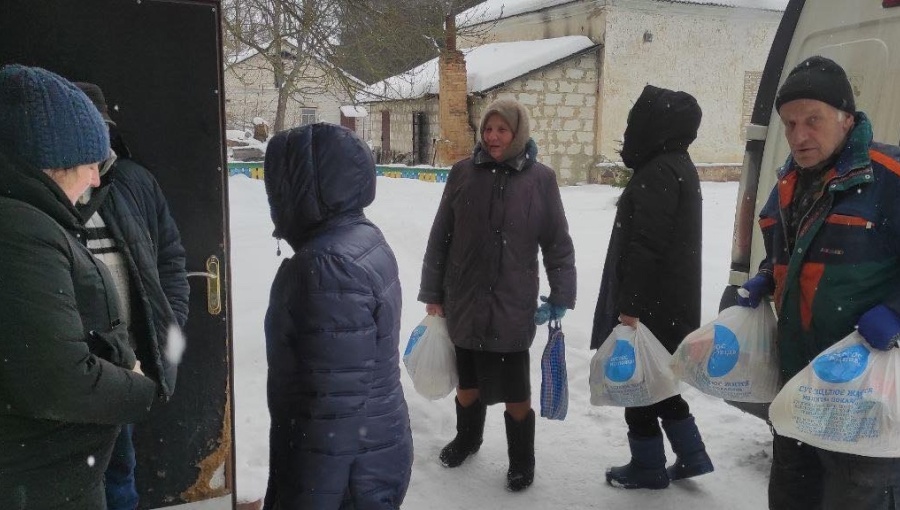
Ukraine has emerged from what officials describe as the most punishing winter since the war began in 2022, after months of record sub-zero temperatures and an intensified air campaign that pushed the country’s energy system to the brink, reported The Kyiv Independent.
In the first three months of 2026 alone, Russia launched more than 1,700 attack drones and 700 missiles, according to Ukrainian authorities. President Volodymyr Zelenskiy said that during the final week of winter, Moscow fired over 1,720 drones, nearly 1,300 guided aerial bombs and more than 100 missiles of various types.
Over the entire winter period, Russia launched more than 14,670 guided aerial bombs, 738 missiles and nearly 19,000 attack drones, most of them Iranian-designed Shahed models, Zelenskiy said.
“But despite everything, Ukrainians made it through this difficult winter, when Russia did not even try to seek justification for its bestial strikes on civilian critical infrastructure,” Zelenskiy wrote on X.
The winter of 2025–2026 combined heavy Russian strikes on the energy system with severe frosts that saw daytime temperatures plunge to minus 20 degrees Celsius, bringing parts of the country close to a humanitarian crisis.
In January and February, repeated attacks on power plants and substations forced grid operators to move from scheduled outages to emergency blackouts lasting more than eight hours at a time. Kyiv, particularly districts on the eastern bank of the Dnipro River, was among the hardest hit, with hundreds of high-rise apartment blocks left without heating as centralised systems struggled to operate until the end of March.
Russia carried out its most severe strike on February 7, targeting substations connected to Ukraine’s nuclear power plants. The attack temporarily reduced electricity output from the nuclear fleet by around 50%, according to Vitaliy Zaichenko, head of state grid operator Ukrenergo.
The assaults were part of a broader energy campaign. State oil and gas company Naftogaz said Russia conducted 229 attacks on its facilities last year – more than in the previous three years combined.
Yet despite the scale of the bombardment, the grid held. Analysts and Ukrainian officials describe this as a strategic setback for the Kremlin, which they say had hoped to trigger a humanitarian collapse that would sap morale and force Kyiv to negotiate from a position of weakness.
Instead, officials are framing the end of winter as a psychological turning point – a “March of Hope” that marks a shift from survival to adaptation.
According to Yuriy Boyechko, chief executive of humanitarian organisation Hope For Ukraine, the country is now entering a phase of industrial and military transformation. “Russia bet on darkness and despair. It did not get either,” he said.
While front lines remain largely static in a high-casualty stalemate, Ukraine is increasingly relying on technological innovation to offset manpower shortages. The domestic defence sector is projected to double production capacity in 2026, officials say, with tens of thousands of first-person-view (FPV) drones rolling off assembly lines alongside domestically produced long-range cruise missiles.
Zelenskiy has linked Russia’s use of Iranian-designed drones in Ukraine to their deployment in the Middle East amid a new regional conflict.
“The same Iranian drones are now being used elsewhere,” he said. “Evil must be confronted in every part of the world.”
He added that when the United States and its partners show sufficient resolve, “even the bloodiest dictators ultimately pay for their crimes”.
The coming months will test whether Ukraine’s transition from winter resilience to industrial mobilisation can alter the strategic balance. Although Russia retains numerical advantages in personnel and ammunition, Kyiv’s leadership argues that precision strikes, drone swarms and improved air defences could erode Moscow’s ability to sustain its offensive.
For now, the survival of the energy system – despite record bombardment and freezing temperatures – stands as a symbol of endurance. As the frost thaws, Ukraine’s focus is shifting from simply keeping the lights on to reshaping the tools of war itself.
Local And Regional Media In Russia Play Major Role In Promoting Putin’s War In Ukraine As ‘A Given’ And Entirely ‘Normal’ – OpEd
March 4, 2026
By Paul Goble
When people talk about propaganda on the war in Ukraine, they typically focus on outrageous statements of Moscow TV personalities; but the NeMoskva portal suggests that local and regional media play a major role in delivering the message that the Kremlin now wants, that the war is “a given” of Russian life and entirely “normal.”
The portal examined more than 200 outlets in regions and localities across the country and spoke with numerous experts on the Russian media scene and said that the propaganda in this part of the Russian scene is less propagandistic and often isn’t even recognized as such by viewers and readers (nemoskva.net/2026/02/26/propaganda-dlya-normisov/).
That is because local and regional media do not cover the war as such and seek to include stories about those from the region who have been touched by it within the normal flow of coverage about life more generally. That encourages Russians to think about the war as something “entirely normal” and more simply “a given.”
In reporting the study and especially its conversations with media experts who appear to be in universal agreement, NeMoskva says there are a number of ways in which these outlets are promoting such a view: They talk about how the area is “making its own contribution;” their main hero is “the local soldier, ‘one of us;” they celebrate as “another hero the regional volunteer;” they “heroize those who have died” in the conflict; and they either “idealize” or at least minimize the problems of veterans coming home.
Such messaging is calmer and more reassuring that the comments of Moscow figures like Vladimir Solovyev and thus corresponds to the way most Russians want to think about it: “They simply want to live their own lives” and see the war as something in the background, according to several commentators.
One of these commentators pointedly notes that “the regional media do not ‘sell’ the war directly but ‘combine’ it with the whole information flow.” That gives the media at the local and regional levels a kind of “therapeutic effect,” one that makes the war something very much like the weather: it just is – and no one needs to do more than support it.
And NeMoskva concludes: “Regional propaganda integrates into normalcy and creates a context that becomes acceptable to the audience. All of this, taken together, “holds together the social fabric” in the face of prolonged conflict and helps people feel at least some sense of support.”
As a result, for the consumers of this media, “the fighting becomes a backdrop and that helps the authorities achieve both of their goals: ensuring an influx of people and resources and preventing people from thinking that what is going on in Ukraine is an all-out war” that is going to radically change their lives or even force them to do more than they are doing now.
Paul Goble
Paul Goble is a longtime specialist on ethnic and religious questions in Eurasia. Most recently, he was director of research and publications at the Azerbaijan Diplomatic Academy. Earlier, he served as vice dean for the social sciences and humanities at Audentes University in Tallinn and a senior research associate at the EuroCollege of the University of Tartu in Estonia. He has served in various capacities in the U.S. State Department, the Central Intelligence Agency and the International Broadcasting Bureau as well as at the Voice of America and Radio Free Europe/Radio Liberty and at the Carnegie Endowment for International Peace. Mr. Goble maintains the Window on Eurasia blog and can be contacted directly at paul.goble@gmail.com .


No comments:
Post a Comment