Wednesday, June 29, 2022

Why wealthy countries should shield developing countries in times of crises

Unlike previous periods of energy turbulence, which typically centred on oil disruptions, today’s troubles are multi-faceted

Last weekend, police shot at motorists protesting against fuel shortages in a town north of Colombo, Sri Lanka. Moody’s further downgraded Laos’s sovereign rating into “junk” territory as people queue at petrol stations. Lebanon’s electricity company provides four hours of power daily at best, as a hot summer approaches and generators become unaffordable for many. Quito, Ecuador, was paralysed on Wednesday by demonstrations against expensive food and fuel.

These countries are not the wealthy European states who are themselves struggling with high bills and worrying about a cut-off of Russian gas before winter. They are not the US, which considers an ineffective cut in petrol taxes to mollify angry drivers. With few financial resources, they are on the front line of energy shortages, hunger and often climate crises.

The most vulnerable are those lower- and middle-income countries heavily dependent on imports of energy and agricultural goods, fiscally-constrained by already high debt levels, often suffering climatic problems such as drought and heatwaves, and frequently with political problems, including the legacies of civil wars, insurgencies and violent drug gangs.

Depreciation makes basic necessities even more expensive in local currencies. Subsidies become unaffordable but cuts trigger protests, violence and even revolution.

Such crises matter in four ways. First, in the human suffering they impose in inflation, unemployment, hunger, collapsing living standards and forced migration. Second, in the effect on their neighbours, who may be drawn into wider regional downturns.

Third, in the danger for contagion, the rise in interest rates and a slowing in trade, that could repeat global emerging-market debt crises. Sri Lanka’s first ever sovereign default may be an omen

In the longer term, TunisiaEgyptPakistan and Ghana are at risk. Emerging market debt has leapt to 67 per cent from 52 per cent of gross domestic product before the coronavirus pandemic.

Fourth, in the danger of cascading interruptions, as production or transit of oil, gas, important minerals or agricultural goods is interrupted by protests, strikes and insecurity — tightening global markets even further.

Governments who fear domestic discontent often restrict food exports, worsening the situation for others. This would be reminiscent of the 2011 uprisings which, often sparked by hunger, led to the revolution in Libya and a major surge in oil prices.

Unlike previous periods of energy turbulence, which typically centred on oil disruptions, today’s troubles are multifaceted.

For example, Codelco of Chile, the world’s largest copper miner, has been hit by strikes, while Peru, the world’s second-biggest producer, has suffered repeated protests in recent months at its Las Bambas mine.

Copper is an essential component of renewable energy systems and electric vehicles (EVs). Battery cars require two to four times as much copper as their petrol equivalents, driving up their cost just as more EVs are needed to save oil and cut carbon dioxide emissions.

The Ecuadorean protests forced Petroecuador to declare force majeure on its oil exports when it was unable to meet contractual deliveries.

Rising oil prices encourage greater American and European use of biofuels, but more of the corn, soybeans and sugar cane harvest is burnt in vehicles rather than appearing on dinner tables. Meanwhile, high gas prices drive up the cost of fertiliser, for which gas is an essential feedstock.

The source of the most acute recent trouble, and the intensification of pre-existing conditions, come from Russia's invasion of Ukraine. Gas to Europe has been throttled. Ukraine’s grain ports are blockaded, and silos bombed. But high-income countries have exported the pain of their own misguided policies.

Absurdities such as price caps and fuel tax cuts subsidise consumption. Export bans would cut off those most in need. Tariffs and trade barriers prevent poorer states from exporting their way out of trouble. Neither European countries nor the US are making any serious efforts on boosting energy efficiency and conservation, hoping to spare voters inconvenience.

European countries have to import more liquefied natural gas (LNG) to replace supplies from Russia. This is unavoidable now but the result of prewar foolishness. Germany is pressing ahead to close nuclear power plants that could still have a few years of viable operation.

The result is that LNG prices have gone through the roof for everyone, and many countries cannot afford the bill.

Several of Pakistan’s suppliers, such as Eni and Gunvor, have defaulted on long-term contractual deliveries, as it is more profitable for them to pay a 30 per cent penalty and resell the cargo elsewhere at a much higher price.

The country then must go on the spot market for a replacement — it received only one bid for supplies in July at an eye-watering $39.8 per million British thermal units, equivalent to $230 for a barrel of oil. Combined with a severe heatwave, Pakistan has suffered four- to six-hour power cuts and had to cut the working week.

Some of the struggling states have brought ruin on themselves: Lebanon through feckless and gridlocked politics, Sri Lanka by corruption and a disastrous ban on artificial fertilisers. But any country may have structural problems or episodes of misrule; some are unable to spend their way out of trouble. Their vulnerable populations need support. GCC oil exporters have at times sent fuel or financial aid; helpful, but a relative drop in the bucket.

Wealthy western states have their own low-income people to think about. But they need to shield developing countries from beggar-thy-neighbour policies. Otherwise, they will undercut the global economy, security, and their own stand against Russia.

Robin M. Mills is CEO of Qamar Energy, and author of The Myth of the Oil Crisis


As Trump looks on, Illinois Republican hails overturn of Roe as “victory for white life”

The Supreme Court decision abolishing the constitutional right to abortion has put wind in the sails of the fascist forces headed by Donald Trump that dominate the Republican Party.

Exuberant over the long-sought victory of clerical reaction over the elementary rights and social needs of millions of working women—and the promise of more rollbacks in democratic rights to come—some are letting slip the racist and anti-Semitic views they have up to now sought to conceal in their public statements.

At a Trump “Save America” rally outside of Quincy, Illinois, on Saturday night, the ex-president campaigned for two far-right candidates in this Tuesday’s Republican primary elections in the state: freshman Representative Mary Miller, who is running for U.S. Congress in a newly drawn district against a veteran GOP lawmaker and state Senator Darren Bailey, who is seeking the Republican nomination for the November gubernatorial race.

After hailing the destruction of a basic right in place for nearly 50 years as a “victory for the Constitution … the rule of law and, above all, a victory for life” and attacking the House committee investigating his January 6 coup attempt as a “vile group of unhinged partisans and craven lunatics,” Trump introduced Miller as “pro-life, pro-gun, pro-police, pro-American energy and pro-MAGA.”

Miller proceeded to tell the crowd: “It’s such an honor to be able to welcome you to God’s country. … President Trump, on behalf of all the MAGA patriots in America, I want to thank you for the historic victory for white life in the Supreme Court yesterday.”

Trump, beaming behind Miller on the platform, did not bat an eye as the crowd cheered.

Miller continued: “I’m running against a RINO [Republican in name only] named Rodney Davis, who betrayed conservatives. He betrayed us by voting against President Trump in 2016 … voting for red flag gun confiscation, voting for the January 6 witch hunt commission. This race is between MAGA and a RINO establishment member.”

Representative Mary Miller (Republican-Illinois) speaking at a news conference 
in Washington on July 29, 2021. (AP Photo/Andrew Harnik File)

Miller added: “We will never surrender to the Marxists in Washington. We are the Christians who put our faith in God, not in the government.”

Following the rally, when some local press outlets began to publicize Miller’s racist outburst, her spokesperson called it a “mix-up of words,” telling the Associated Press that she had intended to call the court ruling a victory for the “right to life.”

There was no attempt to explain why Miller’s supposed “mix-up” took the form of a paean to “white life.” There is, in fact, nothing mysterious about this.

Miller was chastised shortly after she assumed office in January 2021 for giving a speech at the U.S. Capitol in which she cited in a positive way the example of Adolf Hitler. Speaking at a January 5 rally held by “Moms for America,” a far-right group that promotes Trump’s lie of a “stolen election,” she said, “Hitler was right on one thing. He said, ‘Whoever has the youth has the future.’”

The next day, January 6, Trump’s mob of fascist paramilitaries, assembled with the aid and support of White House officials and Republican lawmakers, stormed the Capitol and came within seconds of seizing and likely killing Mike Pence, Nancy Pelosi and other officials in a bid to block the official certification of Joe Biden’s Electoral College victory. Miller was among the 147 Republican members of Congress who voted against certification in the early morning hours of January 7, some hours after the rampaging insurrectionists had finally been cleared out of the Capitol.

At the same rally, Trump announced his endorsement of Bailey, until recently considered a dark horse behind the more establishment figure Richard Irvin, the African American mayor of Aurora, Illinois. Billionaire GOP donor Ken Griffin ploughed $50 million into Irvin’s campaign, staking him to an early lead in a six-man primary race. But in recent weeks, after a pilgrimage to Trump’s estate in Mar-a Lago and some $17 million in campaign funding from the billionaire Republican kingmaker Richard Uihlein, Bailey has moved ahead in the polls.

Trump hailed Bailey for his defiance of anti-COVID mandates imposed in the early stages of the pandemic by Democratic Governor J.B. Pritzker, the billionaire owner of the Hyatt Hotel chain.

In 2019, Bailey joined six other state Republicans in sponsoring a resolution calling for the city of Chicago to leave Illinois and become its own state. The resolution stated that “the majority of residents in downstate Illinois disagree with City of Chicago residents on key issues such as gun ownership, abortion, immigration, and other policy issues.”

After announcing his bid for governor, Bailey backtracked on the resolution, calling it “old” and “a warning shot” to Chicago. However, in a debate between Republican gubernatorial candidates earlier this month, he called Chicago a crime-ridden “hellhole” and attacked Irvin as a “corrupt Democrat.”

The cowardly failure of Biden and the Democrats to prosecute Trump or any of his top accomplices in the attempted overthrow of the Constitution, in the name of “unity” with their Republican “colleagues,” has allowed Trump and the Republicans to bring the attack on democratic rights to a new level and strengthened the fascist forces they are seeking to mobilize.

But the cynical machinations of the Democrats go even further. Pritzker and the Democratic Governors Association have spent $34 million on TV ads attacking Bailey for his far-right, pro-Trump politics. They have made no secret that the ad campaign is designed to build support for Bailey in the Republican primary within the GOP’s active base, particularly in the more rural, downstate regions, because they believe Pritzker has a better chance of winning in November against Bailey than against Irvin.

Thus, on the basis of the most narrow electoral calculations, the Democrats are actually working to bolster the openly fascist wing of the Republican Party.

Despite Supreme Court of Canada ruling, Robinson Treaties advocate hopeful for negotiated settlement

Last week the Supreme Court of Canada ruled that the Ontario government could move forward on its appeal of the Robinson Huron-Superior Treaty annuity case.

The Robinson Treaties, signed in 1850, provided for the augmentation of the perpetual annuity if revenues generated in the territory allowed the Crown to increase the payment without incurring a loss. The annuity was augmented once in 1875 to one pound (or four dollars equivalent) per person. It has not been augmented since.

The initial trial concluded that the Crown had a mandatory and reviewable obligation to increase the Treaties’ annuities when economic circumstances so warranted and that it should reflect a fair share of the value of the net Crown resource-based revenues generated from the territory.

The Ontario Court of Appeal upheld the trial decision.

However, on June 23 the Supreme Court said Ontario can present its argument at the highest court in the country.

That decision is disappointing but not unexpected, says Mike Restoule, chair of the Robinson-Huron Treaty Litigation Fund (RHTLF), which represents the 21 Anishinabek Nations that began legal action against Ontario and Canada in 2014.

“Ontario was the one who... sent an application to the Supreme Court for leave to appeal,” said Restoule. “But after awhile Canada wrote to the Supreme Court to say they were willing to participate in an appeal. I guess once the two governments got together on an application to appeal, I guess the Supreme Court decided it was … proper on their part to hear the case.”

Although Canada has not appealed any decisions in the litigation, court records indicate that the Attorney General of Canada filed a form letter Feb. 21 in response to Ontario’s application for leave to appeal.

“Canada’s substantive positions in response to Ontario’s appeal will be set out in documents to be filed on a timeline to be set by the Court,” said Randy Legault-Rankin, spokesperson for Crown-Indigenous Relations and Northern Affairs in an email to Windspeaker.com.

“Canada agreed with Ontario that the case met the criteria for granting leave. In that sense they supported Ontario’s application,” said Catherine J. Boies Parker, Q.C., legal counsel for RHTLF.

The criterion for granting leave is whether the case raises issues of public and national importance, she added.

Restoule says he doesn’t understand how this case is of national interest as the Robinson Treaties are unique in Canada. They are the only treaties with an augmentation clause that’s connected with an annuity.

“We don’t yet know what position Canada will be taking on the appeal itself. Hopefully they will support (the lower court’s) decision, since they have not appealed it,” said Boies Parker.

“Canada continues to believe that negotiations remain the best forum for addressing outstanding issues. We look forward to continuing to work with Ontario and the First Nations at the negotiation table to try to find common ground for resolving this litigation outside of the courts,” said Legault-Rankin.


The majority decision of the Court of Appeal directed the parties to negotiate a modern agreement for the implementation of the Treaty.

Restoule is hopeful that the Ontario government will continue the work it began prior to the provincial election. The parties met twice on the issue before talks ended to go to the polls.

Also prior to the election, Premier Doug Ford met with Ontario chiefs in a virtual question-and-answer session. In response to a question from Wikwemikong First Nation Chief Duke Peltier, Ford said he was “committed to get the Robinson Huron Treaty done. It’s fallen on all our laps…After probably more than 150 years of government-after-government-after-government ignoring it, I’m committed to getting it done. I think we’re very close without getting into details.”

Ford and his Conservative government were returned to office in the election.

“We’re trying to get out of the court action…by requesting that the parties come together in negotiations to settle out of court because our feeling is that that’s the only way we can get reconciliation,” said Restoule.

The litigation, which has been broken into three stages, was scheduled to proceed with stage three in October. That stage is focused on determining the value of the compensation owed and the respective liabilities of Canada and Ontario.

At issue, says Restoule, is that resource revenue is collected by the province, but Canada pays the annuity.

Stage three “was to solve that argument: If you’re going to collect the money, you should pay the annuity too,” he said.

Now Restoule is uncertain as to whether stage three will proceed as the same legal team will be involved in preparing for the Supreme Court argument.

Even with a potential hearing at the Supreme Court—and it is unknown when that will happen—Restoule says he sees the light at the end of the tunnel.

“I’m very hopeful. I’m hoping that either through negotiations or through stage three ruling or Supreme Court of Canada ruling that we will get a just settlement, someway, somehow,” he said.

Restoule has been involved in this battle for 30 years. He was appointed by the chief to represent the Nipissing First Nation when he was elected to the council in 1992. He says First Nations holding chief and council elections every two to four years has caused challenges.

“The leadership changes and when the leadership changes that’s when things seem to bog down and you have to start up again, so that was kind of the ebb and flow that we experienced,” he said.

But the work stabilized in 2010 when the chiefs created the RHTLF and Restoule moved on to head it. Four years later, the case was filed in court. The actual hearing didn’t begin until 2017.

“I’m extremely tired but, you know, I don’t want to stop doing it because I have an interest in it, first of all. It’s part of me now. It’s part of who I am,” said Restoule.

Windspeaker.com

By Shari Narine, Local Journalism Initiative Reporter, Windspeaker.com, Windspeaker.com


HOW TO WIN FRIENDS AND INFLUENCE PEOPLE
'It's intimidation': Judge faces threats after Freedom Convoy hearings

Brigitte Bureau - 


One of the judges who presided over the court hearings of Freedom Convoy organizers is speaking out after receiving threats considered serious enough to require police intervention, according to information obtained by Radio-Canada and CBC.

The judge in question confirmed that supporters of the convoy from Canada and the United States sent several offensive messages, but the message that prompted police to react threatened their physical safety, the judge said.

CBC has agreed to withhold the judge's identity to protect their safety.

"I thought, should I tell my children not to come home for a while?" the judge said.

"I changed my alarm system. I was advised not to take the same route every day," the judge added. "You feel vulnerable in your house, in your own home."


© Evan Mitsui/CBCPolice enforce an injunction against protesters on Parliament Hill on Feb. 19, 2022.

The judge believes most Canadians respect the justice system, but said a vocal minority is seeking to undermine it.

"It's intimidation. It's trying to influence a court decision, and that's serious," the judge said.

Supreme Court of Canada Chief Justice Richard Wagner expressed similar concerns in a recent speech in Montreal.

"The pandemic has forced many people to live online during lockdowns. And it is at times like these that lies and conspiracies spread like wildfire," Wagner said in French on June 9.

"As we have seen around the world, disinformation poses a real threat to democratic institutions."

The demonstrations that took place in Ottawa this winter stemmed in part from this disinformation, Wagner said. He encouraged people to "inform, instruct and educate" their fellow citizens.
Ministry silent on further threats

Ontario's Ministry of the Attorney General would not say if any other judges have received threats from Freedom Convoy supporters.

"It would be inappropriate for the ministry to comment on a potential or ongoing police investigation," wrote ministry spokesperson Brian Gray in an email to Radio-Canada.

He wrote that the ministry "takes court security and the safety of all those in our courthouses ... very seriously," and that local police or Ontario Provincial Police provide security "to ensure the highest level of protection."

The Ontario Court of Justice and the Ontario Superior Court of Justice both declined to comment, saying it would be inappropriate to do so.

CBC News reached out to a number of key figures of the weeks-long demonstration in Ottawa, but requests for comment were either declined or went unanswered.

No charges have been laid in this matter. It's not known whether the investigation is ongoing at this time, nor would police comment.
THE LIONS CLUB TOO
Supporters shocked as Salvation Army bans Pride walkers
SALLY ANN OPPOSED SAME SEX MARRIAGE

Organizers of a Pride-related event scheduled for Thursday, June 29, in Grand Falls-Windsor say they had to cancel at the last minute after being told the Salvation Army leadership refused to allow them on church property.

“Pride GFW would like to thank the leadership of this church for yet another reminder of why the Pride movement remains important in 2022,” Pride Grand Falls-Windsor announced on its Facebook page. “We have clearly not reached equality for 2SLGBTQ+ folks in the eyes of all people.”

No one at the Park Street Citadel responded to a phone message asking for comment, but Pride GFW did issue a statement later in the day.

“Pride GFW looks forward to being guests at the Lions Club walking program in the very near future, which will be held in a place where ALL people will be welcome to join and walk together,” it said.

The walk was actually sponsored by the local Lions Club as one of its weekly Healthy Living Walks held on the citadel’s property.

The event was supposed to start at 6 p.m., and included a walk around the church trail followed by refreshments.

The Lions also announced the cancellation online, say it was due to “circumstances beyond the club’s control.”

“(W)e continue to explore other offers with the hopes of remounting the walk next week,” a Lions spokesman said in a statement to The Telegram.

He said Pride members will still be the invited guests.

Pride GFW’s Facebook was flooded with messages of support Wednesday, as well as condemnation of the citadel’s stance.

The group added a note of thanks later in the day.

“The members of Pride GFW are deeply appreciative of all of the support, kind words and offers we are receiving from individuals, organizations and businesses. We realize this support is for us as a group, but is also very much for every 2SLGBTQ+ person who felt hurt or demoralized after reading the post earlier today. We will work our way through all of the comments and messages and make another post tomorrow. Thank you all from the bottom of our hearts.”

Charlie Murphy, executive director of the 2SLGBTQ advocacy organization Quadrangle, said Wednesday faith groups like the Salvation Army seem to be “hit or miss” in terms of tolerance for the Pride movement.

Non-discrimination statements on the national Salvation Army website suggest it is not official church policy to ban or discriminate against any specific class or group of people.

Murphy says Quadrangle hasn’t encountered any institutional resistance in any of its activities — other than individual insults and slurs — but that the Pride season of June and July are when intolerant views pop up.

He cited the example of a rainbow crosswalk proposal initially being rejected by the town of Stephenville five years ago.

A year later, the Springdale town council did the same thing.

“It’s hurtful for our community who are simply trying to come together during the summer months to celebrate,” Murphy said.

Meanwhile, a member of Memorial United Church in Grand Falls-Windsor was quick to jump in when he first heard about the cancellation Tuesday night.

David Anthony, clerk of session, says Rev. Kim Waite called him to help co-ordinate an alternative venue at the church while she was out of town.

“The United Church prides itself on openness in every way, shape and form,” Anthony told The Telegram, adding that embracing gender diversity is a central tenet of its national policy.

He pointed to an official statement contained on the United Church of Canada website. It reads, in part:

“The United Church affirms that gender and sexuality are gifts of God, and that all persons are made in the image of God. We welcome into full membership and ministry people of all sexual orientations and gender identities. The United Church is opposed to discrimination against any person on any basis by which a person is devalued (search “Commitment to Inclusion” on United Church Commons.

“The struggle for justice against sexism and gender-based violence, and towards justice for people of all gender identities and sexual orientations, are fundamental ways in which the United Church seeks to transform structures and systems and be faithful to God's vision for humanity.”

Anthony said Rev. Waite is personally focused on the cause of 2SLGBTQ acceptance, and has offered to open the church doors for kitchen and bathroom facilities for the walk, should organizers take up the offer.

“To quote (the reverend), ‘If they come with their tonne of crayons, colour our parking lot rainbow,’” he said. “Now I think that’s as sweet as it can get.”

Peter Jackson, Local Journalism Initiative Reporter, The Telegram
A PITBULL MOM
9 puppies rescued after ‘amazing mom’ leads B.C. SPCA to her hidden den

Doyle Potenteau - 


© B.C. SPCATwo of the puppies that were rescued after a four-year-old dog led the B.C. SPCA to her den, where her nine puppies were hiding.

Nine puppies, which were rescued last week in B.C.’s Fraser Valley, will soon be up for adoption.

On Wednesday, the B.C. SPCA said the puppies have an amazing mom, a pitbull cross that had apparently been abandoned and wound up leading an animal protection officer to where she hid her puppies.

“Dallas had been left to fend for herself on a property near Agassiz when she gave birth,” said Eileen Drever of the SPCA.

Read more:
120 cats, 3 dogs seized from feces filled B.C. trailer: BC SPCA

Drever said the SPCA received a call about the dog, and when an animal protection officer arrived on scene, Dallas immediately met the person and led her into nearby thick brush.

The SPCA said Dallas, a four-year-old dog, led the officer 500 feet through dense brush, until she stopped at a bush and waited. Under that bush: a den that Dallas had created.

“Huddling in the den were nine, two-week-old puppies,” said Drever. “Our officer placed the puppies into a small crate and hiked back out to the road, with Dallas eagerly following.”

The SPCA says Dallas and her nine puppies were then placed in a larger crate and transported to the SPCA branch in Chilliwack.

Video: SPCA Raising Awareness During “Kitten Season”

“We would never have found these puppies if Dallas hadn’t led us there,” said Drever. “She is an amazing mom who knew her puppies needed help.”

The dog’s owner was contacted, with the SPCA saying the owner believed she had fell prey to predators.

“He recognized that he could not provide Dallas and her puppies with the care they required and chose to surrender them to the B.C. SPCA,” said Drever.

Video: SPCA helps dog recovering from gunshot wounds

The SPCA says Dallas and her puppies were given a full checkup, and that mom is underweight but is on a feeding program. All are currently in a foster home for the time being.

“Dallas is a very friendly, remarkable dog who will be available for adoption once her puppies are ready to leave her and she has been spayed,” said Drever. “The puppies will be available for adoption in approximately six to seven weeks.”

For more information about the B.C. SPCA, visit their website.

EU countries approve climate measures after long talks

SAMUEL PETREQUIN
Wed, June 29, 2022

A luxury Audi car is surrounded by exhaust gases as it is parked with a running engine in front of the Chancellery in Berlin, Germany, Wednesday, Nov. 20, 2019. Germany's transport minister said Thursday that he opposes plans to ban the sale of new cars with combustion engines across the European Union in 2035, arguing this would discriminate against vehicles powered with synthetic fuels. EU lawmakers voted Wednesday to back the measure that requires automakers to cut carbon-dioxide emissions by 100% by the middle of the next decade, effectively prohibiting the sale in the 27-nation bloc of new cars powered by gasoline or diesel. 
(AP Photo/Michael Sohn, File) 

BRUSSELS (AP) — European Union countries reached a deal following hard-fought talks that dragged into early Wednesday to back stricter climate rules that would eliminate carbon emissions from new cars by 2035.

The 27 EU members found agreement on draft legislation aimed at slashing EU greenhouse gases by at least 55% in 2030 compared with 1990 rather than by a previously agreed 40%.

“A long but good day for climate action: The council’s decisions on Fitfor55 are a big step towards delivering the EU Green Deal," said Frans Timmermans, the European Commission vice-president in charge of the Green Deal, after the meeting of environment ministers in Luxembourg.

The agreement on the five laws proposed by the EU's executive arm last year paves the way for final negotiations with the European Parliament. EU lawmakers are backing ambitious bloc-wide targets. final approval of the legislative package requires the Parliament to resolve differences with the bloc’s national governments over various details.

“The council is now ready to negotiate with the European Parliament on concluding the package, thereby placing the European Union more than ever in the vanguard of fighting climate change," said Agnès Pannier-Runacher, the French Minister for the energy transition.

The decision to introduce a 100% CO2 emissions reduction target by 2035 for new cars and vans would effectively prohibit the sale in the 27-nation bloc of new cars powered by gasoline or diesel.

Europe’s leading clean transport campaign group, Transport and Environment, said the EU government's agreement was “historic" as it “breaks the hold of the oil industry over transport."

“It’s game over for the internal combustion engine in Europe," the group said.

Greenpeace was more skeptical, saying the 2035 deadline is too late to limit global warming to below 1.5 degrees Celsius (2.7 degrees Fahrenheit).

The deal poses a mighty challenge for German automakers, who have long relied on sales of increasingly big, gas-guzzling vehicles for their profits.

Following intense haggling within the three-party government, particularly between the environmentalist Greens and the pro-business Free Democrats, German officials voted in favor of the compromise overnight.

The German government said the deal will also see the Commission make a proposal that will allow cars which run exclusively on climate neutral e-fuels to continue to be sold after 2035.

“This is a huge step forward and steers the transport sector onto the path of climate neutrality,” Environment Minister Steffi Lemke, a member of the Greens, said. By declaring that only cars and light utility vehicles which emit no CO2 can be sold from 2035, “we are sending a clear signal that we need to meet the climate targets. This gives the car industry the planning security it needs.”

The EU wants to drastically reduce gas emission from transportation by 2050 and promote electric cars, but a report from the bloc’s external auditor showed last year that the bloc is lacking the appropriate charging stations. Transportation accounts for about 25% of all greenhouse gas emissions in the EU,

In addition to the landmark agreement on cars, the package also features a reform of the EU’s carbon market and the creation of a social climate fund to help vulnerable households cope with the planned clean-energy revamp. That issue has become more politically sensitive as Russia’s war in Ukraine has sent fuel prices soaring.

The overall goal is to put the EU on track to become climate-neutral in 2050 and to prod other major polluters, including the United States and China, to follow suit.

___

Frank Jordans in Berlin contributed to this story.

Climate tech firm to launch scaled-up plant sucking CO2 from air


Facility for capturing CO2 from air of Swiss Climeworks AG in Hinwil

Tue, June 28, 2022 
By Kate Abnett

BRUSSELS (Reuters) - Construction is due to begin on Wednesday on what could become the world's biggest plant to capture carbon dioxide from the air and deposit it underground, the company behind the nascent green technology said.

Swiss start-up Climeworks AG said its second large-scale direct air capture (DAC) plant will be built in Iceland in 18-24 months, and have capacity to suck 36,000 tonnes of CO2 per year from the air.

That is a sliver of the 36 billion tonnes of energy-related CO2 emissions produced worldwide last year. But it is a 10-fold increase from Climeworks' existing DAC plant, currently the world's largest, and a leap in scale for a technology that scientists this year said is "unavoidable" if the world is to meet climate change goals.

The new "Mammoth" plant will contain around 80 large blocks of fans and filters that suck in air and extract its CO2, which Icelandic carbon storage firm Carbfix then mixes with water and injects underground where a chemical reaction turns it to rock. The process will be powered by a nearby geothermal energy plant.

Co-CEO Christoph Gebald said once this plant launches, Climeworks intends to build a far bigger facility capturing roughly half a million tonnes of CO2 per year - and then replicate multiple plants of that size, backed by project financing, towards the end of the decade.

Mammoth was part-financed by a 600 million Swiss Franc ($627 million) financing round Climeworks announced in April. The firm also sells among the world's most expensive carbon removal credit - costing up to 1,000 euros per tonne - to buyers including Microsoft, Audi and Boston Consulting Group.

"It's the cost of scaling up," Gebald told Reuters. "This is, so to say, the investment we have to do as a company to move forward."

The world currently has 18 direct air capture facilities, according to the International Energy Agency. U.S. oil firm Occidental also plans to launch a large-scale DAC facility, in late-2024, to collect 1 million tonnes per year of CO2.

The U.N.'s Intergovernmental Panel on Climate Change has said energy-intensive and costly technologies like DAC will be needed to remove CO2 on a large scale in the coming decades, to limit global warming to 1.5C and avoid increasingly severe climate impacts.

Heleen De Coninck, an IPCC author and professor at Eindhoven University of Technology, said DAC must be powered by CO2-free energy to be useful, and should not replace urgent reductions in greenhouse gas emissions.

"It can backfire if it leads to avoiding doing what’s necessary right now," she said. (This story refiles to fix word in fourth paragraph)

($1 = 0.9563 Swiss francs)

(Reporting by Kate Abnett; Editing by Lincoln Feast.)

Climate Not Fuels Drive Large Blazes


JUNE 28, 2022 JUNE 28, 2022

Post-fire logging, Gifford Pinchot National Forest, Washington Cascades. Photo: Jeffrey St. Clair.

Logging proponents fail to acknowledge that climate is the ultimate arbitrator of wildfires. That is why the coastal forests of Oregon and Washington, which contain more “fuel” than any place in the northern Rockies, seldom burn. Why? It’s too cool and moist.

Vegetation responds to climate, and today’s climate is considerably different than even a couple of hundred years ago when we were coming out of the cool, moist climate of the Little Ice Age.

We are in the worse drought in over a thousand years. We are seeing record high temperatures. Average wind speeds are increasing. These factors are responsible for the increase in wildfire spread and severity. For instance, for every 1-degree rise in temperature, fire risk is increased by up to 25%. Wind impact is also exponential, with high winds responsible for every large fire across the West.

We have historical references demonstrating the correlation between climate and fires—long before anyone can claim “fire suppression” created large fires. For example, the 1910 Big Burn that consumed more than 3 million acres of the Northern Rockies occurred long before anyone could assert that “fire suppression” led to fuel accumulation. And 1929(i.e., the beginning of the Dust Bowl), as much as 50 million acres were burned across the West. This acreage is five times what we now call a record year if 10 million acres burn.

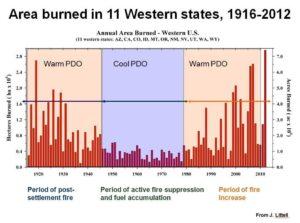
A mid century cool, moist period 1940-1980 led to a decline in fire igntions and fire spread which many use as the “norm” for fire behavior. Nature (climate) did a good job of fire suppression. 

However, our view is skewed by a decline in fires in the mid-century between the 1940s-1980s. Some logging proponents assert that “fire suppression led to fuel accumulations. In reality, the West was in the midst of a cycle of cool, moist conditions, which resulted in few ignitions and limited fire spread, and glaciers were growing in the PNW. During this period, Nature (climate) did a fine job suppressing fires, but in typical human arrogance, we try to take credit for it.

Furthermore, there is abundant evidence from large blazes around the West that logging does not preclude large blazes. For example, the town of Paradise, California, which the Camp Fire consumed, was surrounded by clearcuts, hazardous fuel reduction projects, and even two previous fires-all of which “reduced” fuels, yet propelled by 60 mph winds, the fire spread as fast as one football field a second.

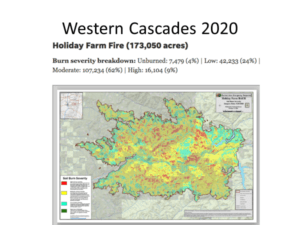
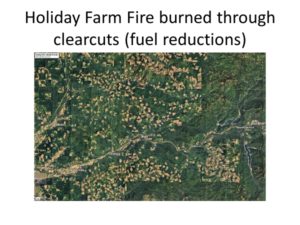
The area burned by the Holiday Farm Fire in 2020 was under “active forest management.” (Google Earth)

The Holiday Farm Fire charred the western slopes of the Oregon Cascades in 2020; the Dixie Fire, California’s largest blaze, and Bootleg Fire in Oregon were respectfully the largest blazes last year in each state, burned through substantial areas of past logging. Here’s a link to a Google Earth view of clearcuts that made up the bulk of the area charred by the Holiday Farm fire.

Numerous studies confirm that climate drives large blazes and logging exacerbates fire spread, and recently more than 200 scientists sent a letter to Congress.

Though much made by ill-informed commentators who argue that fuel build-up due to alleged fire suppression in low elevation pine and Doug fir has created the current situation for large blazes. However, dry montane forests dominated by ponderosa pine and Douglas fir make up only 4% of northern Idaho and western Montana forests. Therefore, even if fire suppression had led to a fuel build-up, these forests could not be responsible for the massive acres being burned since they make up a small percentage of all forest types.

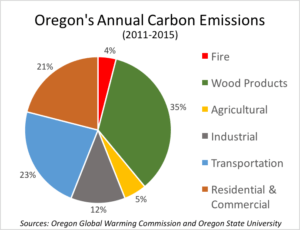
The Wood Products Industry (green)  is the largest contributor to GHG emissions in Oregon. 

The irony of logging as a cure for large wildfires is that the wood products industry significantly contributes to Greenhouse Gas Emissions. For instance, 35% of the GHG emissions in Oregon are due to the logging industry. Thus, more logging only puts more CO2 into the atmosphere resulting in even greater climate warming.

Spending funds logging forests in the false hope that one can reduce large blazes are looking in the rear-view mirror. Unless we reduce GHG emissions, we will continue to see large blazes driven by climate warming. In the meantime, rather than log our forests, the best way to protect communities and structures is home hardening working from home outward.

George Wuerthner has published 36 books including Wildfire: A Century of Failed Forest Policy

Climate change is driving 2022 extreme heat and flooding
By Gloria Dickie - Yesterday 

© Reuters/CHRISTOPHE VAN DER PERREFILE PHOTO: Cyclone Batsirai hits Madagascar

By Gloria Dickie

LONDON (Reuters) - Extreme weather events – from scorching heatwaves to unusually heavy downpours – have caused widespread upheaval across the globe this year, with thousands of people killed and millions more displaced.

In the last three months, monsoon rains unleashed disastrous flooding in Bangladesh, and brutal heatwaves seared parts of South Asia and Europe. Meanwhile, prolonged drought has left millions on the brink of famine in East Africa.


© Reuters/JAYANTA DEYFILE PHOTO: A girl carries her brother as she wades through a flooded road after heavy rains on the outskirts of Agartala

Much of this, scientists say, is what's expected from climate change.

On Tuesday, a team of climate scientists published a study https://iopscience.iop.org/article/10.1088/2752-5295/ac6e7d in the journal Environmental Research: Climate. The researchers scrutinized the role climate change has played in individual weather events over the past two decades.


© Reuters/STEPHANE MAHEFILE PHOTO: Cracked and dry earth is seen in the wide riverbed of the Loire River in Ancenis-Saint-Gereon

The findings confirm warnings of how global warming will change our world - and also make clear what information is missing.

For heatwaves and extreme rainfall, "we find we have a much better understanding of how the intensity of these events is changing due to climate change," said study co-author Luke Harrington, a climate scientist at Victoria University of Wellington.

Less understood, however, is how climate change influences wildfires and drought.

For their review paper, scientists drew upon hundreds of "attribution" studies, or research that aims to calculate how climate change affected an extreme event using computer simulations and weather observations.


© Reuters/ALKIS KONSTANTINIDISFILE PHOTO: Aftermath of Cyclone Batsirai

There are also large data gaps in many low- and middle-income countries, making it harder to understand what's happening in those regions, said co-author Friederike Otto, one of the climatologists leading the international research collaboration World Weather Attribution (WWA).


© Reuters/MARCELO DEL POZOFILE PHOTO: Spain to face first heatwave of the year

HEATWAVES

With heatwaves, it's highly probable that climate change is making things worse.

Related video: 
Heatwaves, floods, wildfires and thunderstorms across US


"Pretty much all heatwaves across the world have been made more intense and more likely by climate change," said study co-author Ben Clarke, an environmental scientist at the University of Oxford.

In general, a heatwave that previously had a 1 in 10 chance of occurring is now nearly three times as likely — and peaking at temperatures around 1 degree Celsius higher – than it would have been without climate change.

An April heatwave that saw the mercury climb above 50C (122 Fahrenheit) in India and Pakistan, for example, was made 30 times more likely by climate change, according to WWA.

Heatwaves across the Northern Hemisphere in June - from Europe to the United States - highlight "exactly what our review paper shows … the frequency of heatwaves has gone up so much," Otto said.

RAINFALL AND FLOODING

Last week, China saw extensive flooding, following heavy rains. At the same time, Bangladesh was hit with a flood-triggering deluge.

Overall, episodes of heavy rainfall are becoming more common and more intense. That's because warmer air holds more moisture, so storm clouds are "heavier" before they eventually break.

Still, the impact varies by region, with some areas not receiving enough rain, the study said.

DROUGHT

Scientists have a harder time figuring out how climate change affects drought.

Some regions have suffered ongoing dryness. Warmer temperatures in the U.S. West, for example, are melting the snowpack faster and driving evaporation, the study said.

And while East African droughts have yet to be linked directly to climate change, scientists say the decline in the spring rainy season is tied to warmer waters in the Indian Ocean. This causes rains to fall rapidly over the ocean before reaching the Horn.

WILDFIRE

Heatwaves and drought conditions are also worsening wildfires, particularly megafires - those that burn more than 100,000 acres.

Fire raged across the U.S. state of New Mexico in April, after a controlled burn set under "much drier conditions than recognized" got out of control, according to the U.S. Forest Service. The fires burned 341,000 acres.

TROPICAL CYCLONES

On a global scale, the frequency of storms hasn't increased. However, cyclones are now more common in the central Pacific and North Atlantic, and less so in the Bay of Bengal, western North Pacific and southern Indian Ocean, the study said.

There is also evidence that tropical storms are becoming more intense and even stalling overland, where they can deliver more rain on a single area.

So while climate change might not have made Cyclone Batsirai any more likely to have formed in February, it probably made it more intense, capable of destroying more than 120,000 homes when it hit Madagascar.

(Reporting by Gloria Dickie; Editing by Katy Daigle and Lisa Shumaker)