Orientation
Situating my article
Often the rise of China and the Middle East appears to many Westerners as something recent, maybe 30 years old. Before that? Is Western dominance beginning with the Greeks and Romans – right? Wrong, not even close! The rise of the East and the South has roughly a 1,300 year history of dominance from 500 CE to 1800 CE. What is happening in the East today is no “Eurasian Miracle”. With the wind of 1,300 years at its back, it is returning to its long historical prominence today.
In two my recent articles, Neocon Realists and Global Neoliberals Dead on Arrival and The Myopia of Anglo Saxons Rulers, I attempted to show how narrow International Relations Theory is in its systematic exclusion of the Eastern and Southern parts of the world from its theoretical history. In his book The Eurocentric Conception of World Politics, John Hobson rightfully accuses the West of Eurocentrism, paternalism, and imperialism. But in an earlier book, The Eastern Origins of Western Civilization, he methodically shows how the West first depended on and then denied that Eastern and Southern civilizations were a source of most of their technological, scientific and cultural breakthroughs. This article is based on The Eastern Origins of Western Civilization.
Western claims about their place in world history
- Charles Martel’s victory over the Saracens at the battle of Tours and Poitiers 732 CE
- Europe pioneers the medieval agricultural revolution 600-1000 CE
- Italian pioneers long-distance trade and early capitalism. Italy the leading global power 1000 CE
- European crusaders assert control over the Islamic Middle East Post 1095 CE
- Italian Renaissance and scientific revolution 1400-1650 CE
- China withdraws from the world, leaving a vacuum filled by Europeans 1434 CE
- Guttenberg invents the movable metal-type printing press 1455 CE
- Bartolomeu Diaz is the first to reach the Cape of Good Hope 1487-88 CE
- European Age of Discovery and the emergence of early Western globalization Post 1492 CE
- The Spanish plunder the gold and silver bullion of Indigenous Turtle Islanders post 1492 CE
- Da Gama makes its first contact with “primitives” and isolate Indigenous people 1498 CE
- The Europeans defeat the Asians and monopolize world trade 1498-1800 CE
- European military revolution 1550-1660 CE
- First industrial miracle happens in Britain 1700-1850 CE
- British industrialization is the triumph of domestic or self-generated change 1700-1850 CE
- Commodore Perry opens up isolated Tokugawa Japan 1853 CE
- Meiji Japan industrializes by copying the West 1853 CE
- Britain reverses its trade deficit with China in the 1820s CE
- Opium wars and unequal treaties force open and rescue China’s “backward” economy 1839-1858 CE
Stopping Eurocentric thinking in its tracks
You might not suspect that European goods were considered inferior both in terms of quality and price by Easterners. Public health and clean water were more advanced in China than in Europe. By 1800, as much as 22% of the Japanese population were living in towns, a figure that exceeds Europe. Even as late as 1850, the Japanese standard of living was higher than that of the British. In conclusion, Europe invented very little for themselves. The only genuine innovations that they made before the 18th century were the Archimedean screw, the crankshaft or camshaft and alcoholic distillation process.
Countering the Eurocentric Myth of the Pristine West
John M. Hobsons claims in his book The Eastern Origins of Western Civilisation are:
- The West and the East have been fundamentally and consistently interlinked through globalization ever since 500 CE.
- The East was more advanced than the West between 500-1800 CE. It wasn’t until 1800 that the West first caught up with and then surpassed China.
- The East and South were not only not passive bystanders, but in the overwhelming number of cases, they were the initiator of technological, economic and even cultural change.
- The West did initiate new inventions and ways of life but only beginning in the 19th century.
- It was also in the 19th century that the West began its denial of Eastern and Southern influence.
- This denial of pioneering role of Western leadership in world history requires a revisionist history of virtually the whole world of the last 1500 years.
Eurocentric Propaganda Maps
Eurocentrism has multiple sides to its denial, neglect and outright lying about its place in world history. One piece of black propaganda can be seen is in the ways its maps are constructed. Hobson points out that on the realistic map, the actual landmass of the southern hemisphere is exactly twice that of the Northern hemisphere. And yet in the Mercator map the landmass of the North occupiers 2/3 of the landmass. Secondly, while Scandinavia is about a third of the size of India, they are accorded the same amount of space on a map. Lastly, Greenland appears almost twice the size of China even though the latter is almost four times the size of Greenland.
Placement of National and Regional Formations in World History Textbooks
I remember my textbooks on world history. While they might start with Africa and Asia, the chapters were relatively short. But as soon as we got to Europe there are long chapters on technology, economics, politics and philosophy. It might not be until the end of the book than the rest of the world is reintroduced again. It’s as if there was no interaction going on between the West and the rest of the world between the time of the Greeks and the 20th century.
Orientalist and Patriarchal Construction of the West vs the East
The West is presented as a dynamic, ingenious, proactive, rational, scientific disciplined, ordered, self-controlled, sensible, mind-oriented, scientific, paternal, independent, functional, free, democratic, tolerant, honest, civilized morally and economically progressive (capitalist), parsimonious, and individualistic.
On the other hand, the East (China, India and the Middle East) and the South (mostly Africa) is conceived of as unchanging, imitative, ignorant, passive, irrational superstitiously ritualistic, lazy, chaotic, erratic, spontaneous, emotional, body-oriented, exotic, alluring and childlike. Furthermore they are dependent, dysfunctional, enslaved, despotic, and intolerant. They are presented as corrupt, barbaric, savages, who are morally regressive economically stagnant, indolent, cruel and collectivist. Ten Western social scientists from the 19th century down to the present have accepted these dualistic stereotypes. It is out of these extremely unjust characterizations that the myth of the pristine Western development was born.
Hobson writes that there is no dualist more extreme in categorizing the East and West than Max Weber. See Table 1 below.
Table 1 Max Weber’s Orientalist View of the East and the West
| Occident Modernity | Orient tradition |
| Rational public law | Ad hoc private law |
| Double entry bookkeeping | Lack of rational accounting |
| Free and independent cities | Political/Administrative camps |
| Independent urban bourgeoise | State controlled merchants |
| Rational bureaucracy | Patrimonial despotic state |
| Rational science | Mysticism |
| Protestant ethics and the emergence of the rational individual | Repressive religions and the predominance of the collective |
| Basic institutional constitutions of the West are fragmented civilizations with balance of social power between all groups and institutions | Basic institutional constitution of the East is a unified civilization with no social balance between groups and institutions |
| Multi-state system of nation-states | Single state system – empires |
| Separation of the public and private | Fusion of public and private |
The Western Falsification of the World Before 1500 CE
Furthermore, standard picture of the world before 1500 is presented by Eurocentrism as:
- the world mired in stagnant tradition;
- a fragmented world divided between insulated and backward regional and; civilizations governed by a despotic states, mainly of the East.
This concept was consciously reconstructed by Eurocentric intellectuals in the 19th century so that first Venice and later Portugal, Spain, The Netherlands and Britain were represented as the leading global powers in the post 1000 period. Please see Table 2 for Hobson’s rebuttals
Table 2 The Status of World Civilizations before 1500
| Eurocentric Myths | Hobson’s Rebuttals |
| Major regional civilizations were insulated from each other | Persians, Arabs, Africans Jews, Indians and Chinese created and maintained a global economy |
| Political costs were too high to allow global trade | Globalization in the East was a midwife if not the mother of the Medieval and Modern West |
There was an absence of capitalist institutions
credit, money changes, banks, contract laws | There was plenty of commercial activity among Muslims and Chinese before 1500 |
| Transport technologies were too crude to be effective | Use of camels 300-500 was more cost effective than horses |
| Trade in the East was only in luxury goods | Mass consumer products in China and the Middle East. Africans imported beads cowries, copper and copper goods, grain, fruits and raisons, wheat and later on, textiles which were mass-based goods, not luxuries |
| Global flows were too slow to be of consequence | Transcontinental trade pioneered by Islamic merchants reached from China to the Mediterranean |
| Global processes were not robust enough to have a major reorganizational impact | The rise of Tang China (618-907), the Islamic empire (661-1258) and North Africa 909-1171) were plenty robust |
| There was no iron production in the world prior to the British | Muslims dominate the Europeans in iron production and in steel production until the 18th century. China as well |
The Eastern Origins of Western Civilization
Middle Ages and the Islamic state
We are now in a position to compare the Western claims of civilization and what happened when the East and South are given their due. First, much greater than the victory of Charles Martel, between 751-1453 there was the Arab victory in the Battle of Talas which established Islamic domination in West Central Asia. In addition, the Ottoman Turks took over Constantinople in 1453. Nine hundred years before the Europeans developed an agricultural revolution, the Chinese pioneered many technologies that enabled the European agricultural revolution of the 18th and 19th centuries.
There was no comparison between the primitive and hopeless agriculture of Europe before the 18th century and the advanced agriculture of China after the 4th century BCE (57)
Technology of the agricultural revolution
The basic technological ingredients of the medieval agricultural revolution were:
- watermills;
- windmills;
- heavy moldboard plough which created drainage furrows;
- new animal harnesses; and
- iron horseshoes.
Contrary to Eurocentric historians, none of these technological innovations were pioneered by Europeans. Either it was diffused to the West by the East, or Westerners innovated after the Eastern raw materials made them available. For example, Hobson tells us the plough entered Eastern Europe through the East from Siberia in the 9th century. The collar harness was clearly pioneered by the Chinese in the 3rd century CE. The invention of the stirrup really came from India in the late 2nd century and the Chinese bronze and cast-iron stirrup in the 3rd century. Other inventions adapted from China included the rotary winnowing machine and seed drills. Some of the revolutionary rotational crops used by the British in the 18th century were being used by the Chinese some 12 centuries earlier.
Italian Trade
Hobson’s central claim is that virtually all the major innovations that lay behind the development of Italian capitalism were derived from the more advanced East, especially the Middle East and China. The Italians might have been pioneers of long-distance trade that established merchant capitalism in Europe, but not on a world scale. The Italians were late arrivals to an Afro-Asian led global economy. The globalization enabled the diffusion of Eastern inventions to enable the development of a backward West. Neither did the European Crusades assert control over the Islamic Middle East. They remained dependent on the Islamic Middle East as well as Egypt. One last point about the Italians. Six-hundred years before the Italian Renaissance of 1400-1650 there was an Eastern and Islamic Renaissance which was the foundation for not only the Western Renaissance, but the scientific revolution of the 17th century.
Eastern origins of the financial revolution
Italians did not invent the bills of exchange, credit institutions, insurance and banking. Sumerians and Sassanids were using banks, bills of exchange and checks before the advent of Islam, although it was the Muslims who took these early beginnings the furthest. In the West, single entry bookkeeping was the most widespread use right down to the end of the 19th century. The Italian traders only began to use mathematics to replace the old abacus system once the Pisan merchant Fibonacci relayed eastern knowledge in 1202.
The Eastern Renaissance
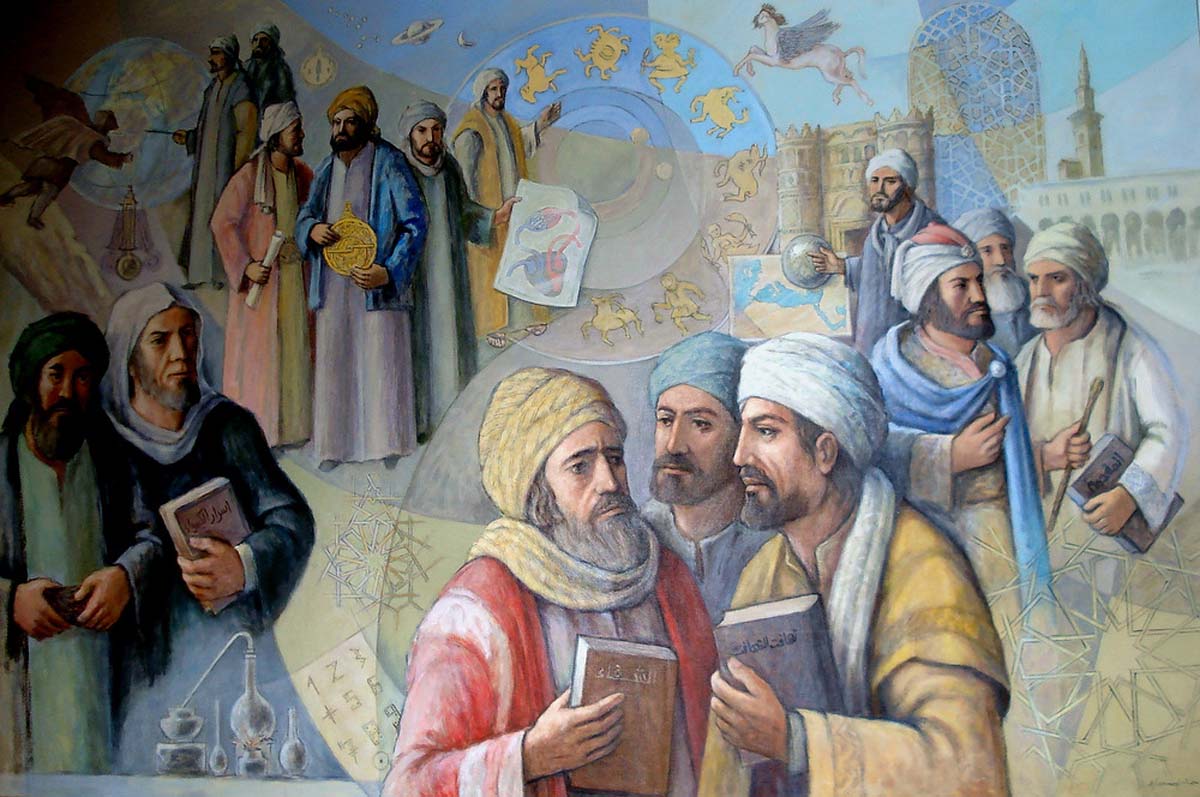
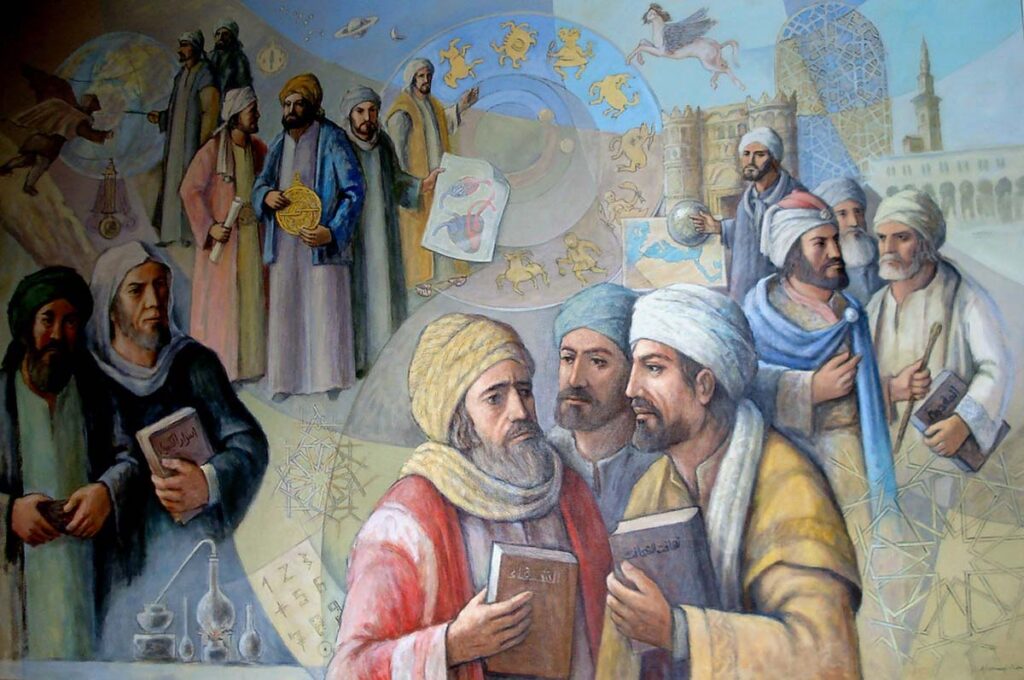
Arab scholars drew heavily on Persian and Indian as well as Chinese sources on medicine, mathematics philosophy theology, literature, and poetry that lay the foundation for the Italian Renaissance. It’s true that Leonardo Fibonacci, wrote a book rejecting the old abacus system in favor of the new Hindu-Arabic system. However, by the beginning of the 10th century all six of the classical trigonometric functions had been defined and tabulated by Muslim mathematicians. Ibn al-Shatir of the Maragha school develop a series of mathematical models which were almost the same as those developed 150 years later by Copernicus in his heliocentric theory of the heavens.
The Eastern origins of the navigational revolution
The foundation of the navigational revolution was the astrolabe and mariners’ compass. The compass could be used even in cloudy weather when the stars were covered. These breakthroughs allowed Europeans to take to the oceans. However, most of them were invented and all were refined in the East. It was the Muslims who undertook all the major innovations.
Qualification about Italy
This is not to say that Italy was unimportant to the fortunes of European commerce. However, Venice prevailed over its rival Genoa not because of its so-called ingenuity but because of its lucrative access to the East via Egypt and the Middle East. Italians played a vitally important role in spreading commercialization through Christendom (not the world). According to Hobson, the belief that Italy was important or the development of Europe in the medieval period seems reasonable. But the notion that Italians pioneered these inventions is a myth
The myth of the European Age of Discovery
When we examine the so-called European Age of Discovery we find that that over 1,000 years before Bartolomeu Diaz circled the Cape of Good Hope the Arabs sailed around the Cape and into Europe. The Chinese did so in the 9th century and in the third century the “primitive” Polynesians and Indians sailed to the Cape and the East Coast of Africa.
Chinese ships were striking in both their size and quantity. In the 8th century some 2,000 ships were working on the Yangtze. It can be safely said that the Chinese were the greatest sailors in history. For nearly two millennium they had ships and sailing techniques far in advance of the rest of the world that comparisons are embarrassing. (58)
As for the Portuguese, they borrowed Islamic innovations in mathematics in order to work out latitude, a longitude relying on the Islamic tables developed by an 11th century Muslim astronomer. The European age or the “Vasco da Gama epoch of Asia” turns out to be retrospective Eurocentric wishful thinking
The myth of Spanish gold ruling the world
As for the globalization of the economy in the 15th century, one thousand years ago, the Afro-Asian age expanded to a globalized market while not choosing to initiate imperialism. In the late 15th century, the Spanish plundered New World civilizations for their gold and silver. But 40 years before this, the Chinese initiated a silver currency and provided a strong demand for European silver.
India was not isolated
It is said that Vasco Da Gama made the first contact with Indian civilization which is presented as isolated. However, John Hobson tells us India was not isolated but had trading contact with the rest of Eurasia. In fact, Indians were economically superior to their Portuguese discoverers. Furthermore, the Chinese, Indian, Islamic and maybe Black African science and technology provided the basis for Portuguese ships and navigation.
China and the Ming Dynasty
When we turn to China, we hear the common claim that China withdrew in 1434, inexplicitly renouncing an opportunity to compete with Western imperialism. Supposedly they left a gap which the West filled. But the truth is China maintained its power as a world trader all the way from 1434 to well into the 19th century (1840). Hobson tells us that:
The original documents were distorted by the Chinese state in an attempt at being seen as maintaining a Confucius-like isolationist ideal. It was clear that one way or another Chinese merchants continued their extremely lucrative trading with or without official sanctioning. Many European scholars had been therefore easily seduced by the rhetoric of the Chinese state. (63,70)
One typical myth of Chinese state was that in true oriental despotic form, they crushed all capitalist activities. The reality is that the system was simply too large and the state too weak to be able to set up a command economy. The second myth is that the Ming state only dealt with luxury commodities. The truth, according to Hobson is that the majority of textiles produced in India were aimed at mass markets.
Hobson says half the world was in China’s grip. China could have had the greatest colonial power 100 years before the great age of European exploration. They simply were not interested in imperialism (nor are they today). China was the most powerful economy between 1100 to 1800/1840. Even as late as roughly 1800-1850, Chinese population growth rates increased at a phenomenal rate and would only be matched by Britain after its industrialization.
China and the printing press
As for the Gutenberg printing press and the movable mental type printing press, the Chinese had this by 1095. In addition, the Koreans invented the first metal type thirty years before the Guttenberg press. By the end of the 15th century, the Chinese published more books than all the other countries combined. Even as early as 978, one of the Chinese libraries contained 80,000 volumes. It was exceeded by the holdings of some of the major Islamic libraries. It was only in the 19th century that the European printing press became faster than its Asian counterparts.
Myth of European pioneering of a military revolution
Before the military revolution, swords, lances, mace and cross-bows were used in warfare. These were replaced by gunpowder, guns and cannons. Much has been made about the European military revolution between 1550 and 1660. But at most, 700 years before this between 850-1290, the Chinese developed all three that underly that military revolution. While the Europeans eventually took these military technologies further, (certainly by the 19th century) the fact remains that without the available advances from the East, there would have been nothing to have been taken further. It was the Jesuits who persuaded Europeans to face the fact that gunpowder, the compass, paper and printing all were invented in China.
England drug-dealing opium
Lastly we turn to the relationship between the British and the Chinese. Up until 1820, the Chinese matched the British industrially and it was the British who had a trade deficit. Eurocentric historians congratulate the British in reversing its trade imbalance, not bothering to mention the way they did that was by pushing opium. Even radicals like Marx and Engels looked the other way when the British “opened up” China, rescuing it, according to Marx and Engels, from Oriental despotism. There is a slight problem according to Hobson. Since as far back as 850 China has been open to world trade and achieved great economic progress long before the British had any industrialization of comparative commercial relations.
Respect for China until the 19th century
Many Enlightenment thinkers positively associated with China and its ideas including Montaigne, Leibniz, Voltaire, Wolf, Quesnay, Hume and Adam Smith. Voltaire’s book in 1756 has been described as the perfect compendium of all the positive feeling of the time in Europe about the Far East. Martin Bernal reminds us that no European of the 18th century (before 1780) could claim that Europe had created itself.
Britain as a late developer of the industrial revolution
For Eurocentric historians, the British genius was responsible for the industrial revolution unaided by anyone else, non-Europeans especially. But almost 2,000 years earlier, the Chinese had developed industry.
The first cast-iron object dated from 513 BCE. Steel was being produced by the 2nd century BCE. China produced 13,500 tons of iron in 806, some 90,400 tons by 1064 and as many as 125,000 by 1078. Even as late as 1788 Britain was producing only 76,000. Chinese iron was not confined to weapons and decorative art but to tools and production. All this was made possible by the breakthroughs in smelting… and the use of blast furnaces. It was the assimilation of what the Chinese had built that made possible the industrial revolution in Britain. Further, the industrialization process was made possible not by some independent British know-how but through the exploitation of multiple African resources. (51-53)
The steam engine, pride of the British industrial revolution, was antedated by the Chinese as early as 1313 CE. The cotton industry, Hobson says, was the pacemaker of British industrialization. But here too, the cotton industry first found its home in both China and India centuries earlier.
Japan industrialized before England
When we turn to Japan, we find that Eurocentric historians agree that the Meiji empire underwent a powerful industrialization process, but they imagine that the process happened late, after 1853. Furthermore, it was only through Commodore Perry “opening up” the isolated Tokugawa Japan that industrialization began. But little did they know that Tokugawa Japan was tied to the global economy ever since 1603! Independent Tokugawa development provided a starting point for the subsequent Meiji industrialization. In other words, Japan was an early developer of industry, even before the industrial revolution in Britain.
English Racist Identity in Justifying Imperialism
In my article The Myopia of Anglo-American Rulers I went into great detail about the Eurocentrism, paternalism and racism that is involved in Western international relations theory. This described how Westerners convinced themselves of their superiority over the East and South. I will just briefly add George Fredrickson’s two kinds of racism, implicit and explicit in the eightieth and 19th centuries. Implicit racism occurs in the 18th and first half of the 19th centuries. Its foundation was cultural, institutional and environmental. People were not conscious of practicing it and their way of expressing imperialism was to imagine they were on a civilizing mission. They had a “Peter Pan” theory of East as childlike, alluring and exotic.
In Britain after 1840 there was a new kind of racism which Fredrickson called explicit. Here the criteria for this “scientific” racism was genetic or physical characteristics of the Easterners and Southern civilizations. This racism was overt and conscious, and the superiority of the West was understood as permanent. Their ways of justifying imperialism were a mixture of optimism and pessimism. It was optimistic in its Social Darwinist mentality of subjugation at the hands of the superior British. However, it was also pessimistic because the English feared contact with other races might contaminate the Westerners.
Evolution of Western Identity 500 CE to 1900 CE
Westerners also divided societies into civilized (British, Germany) barbaric (China, India, Japan) and savage (Africa). Each type had a skin color, temperament, religion, climatic character, type of government, self, manner of thinking, ontogenesis, social and political legitimizing and social pathology.
Table 3 The Construction and Consequences of Western Identity
| Time period | Western Identity | Eastern and Southern Projections | Western Appropriation Strategies |
| 500-1453 | Constructed as Christendom | Hostile and evil threat
Islamic Middle East and Persia | Attacking Islam through the first round of the Crusades |
| 1453- 1780 | Increasingly as the
advanced West | Ottoman Turk as hostile and barbaric threat | Attacking Islam through the second Crusades initiated by da Gama, Columbus |
| | Africans and indigenous Americans considered as pagans or savages ripe for exploitation and repression | Appropriating bullion and circulating through global silver recycling process
Slave trading and commodification of labor |
| 1780- 1900 | Superior and carrier of advanced civilization | Either inferior or evil savages or barbarians | Slave trading in Britain and US |
| | | Appropriation of Asian and African land, labor and markets through formal and informal imperialism |
How Than Did Contingency Enable The Rise of the Oriental West?
The prominent anti-Eurocentric scholars Kenneth Pomeranz and James Blaut emphasize contingency (the fortuitous accident) as the critical factor in the rise of the West. The West was lucky that:
- The more powerful Eastern societies did not seek to colonize Europe.
- The Mongols turned to China – not Europe.
- Mongols delivered both goods and Eastern resources.
- The Muslims were not interested in conquering Western Europe.
- The Spanish stumbled on the Americas where gold and silver lay in abundance.
- The Native Americans had inadequate immune systems.
- African slaves had adequate immune systems.
- The East Indian company happened to be in India at a time when the Mughal polity began to disintegrate of its own accord
Conclusion
I began this article by situating it within two previous articles I wrote showing how narrow International Relations Theory is cross-culturally in the exclusion of the Eastern and Southern civilizations from its theoretical understanding of world events. Embedded in this theory was Eurocentrism, paternalism, racism and imperialism. In this article, thanks to John M. Hobson’s book Eastern Origins of Western Civilization I show how in 19 areas of its history Western claims to superiority and leadership in relationship to science, technology, world trade, military weaponry, industry the West was dependent on the East from the 5th to the 19th centuries. It only clearly took the lead around 1840.
So how did the West first deny its dependency and then insist on its superiority over the civilizations it once depended on? I begin by pointing out how on a microlevel its propaganda can be experienced in the areas of map-making and textbook construction. I name Max Weber as the historian with the most extreme hostility to the East and South in his study of Eastern and Western civilizations. I identify eight European myths about the status of world civilizations at the dawn of the modern West, 1500 CE. I then comb through the West’s dependency on Islamic, Chinese, Indian and African civilizations from 500 to 1900 BCE. I close my article by showing the extent to which the West did become more powerful was based on luck more than skill.
So what does this have to do with the world today? It has been clear to me through my study of political economists and world historians that the West has been in decline since the mid 1970s and as China, Russia and Iran are rising along with BRICS. My article attempts to show that the rise of the West has not been a glorious 500 year trek, beginning with the Renaissance or two thousand year triumph beginning with Greeks. It has been a short 130-year history which is ending. The rise of the East and the South has roughly a 1,300 year history with the wind at its back and is returning to its long historical prominence today.FacebookTwitterRedditEmail
Bruce Lerro has taught for 25 years as an adjunct college professor of psychology at Golden Gate University, Dominican University and Diablo Valley College in the San Francisco Bay Area. He has applied a Vygotskian socio-historical perspective to his three books found on Amazon. He is a co-founder, organizer and writer for Socialist Planning Beyond Capitalism. Read other articles by Bruce, or visit Bruce's website. 
 The monument to Roman Shukhevych near the Ukrainian Youth Association in Edmonton, Alberta, Canada. © Artur Widak/NurPhoto via Getty Images