Saturday, December 14, 2024

ALT. BUSINESS NEWS

Warren Bill Would Stop Companies From Placing Shareholder Paydays Over Worker Rights


"Following the most lucrative election in history for special interests," said the senator, "my bill will empower workers to hold corporations to responsible decisions that benefit more than just shareholders."
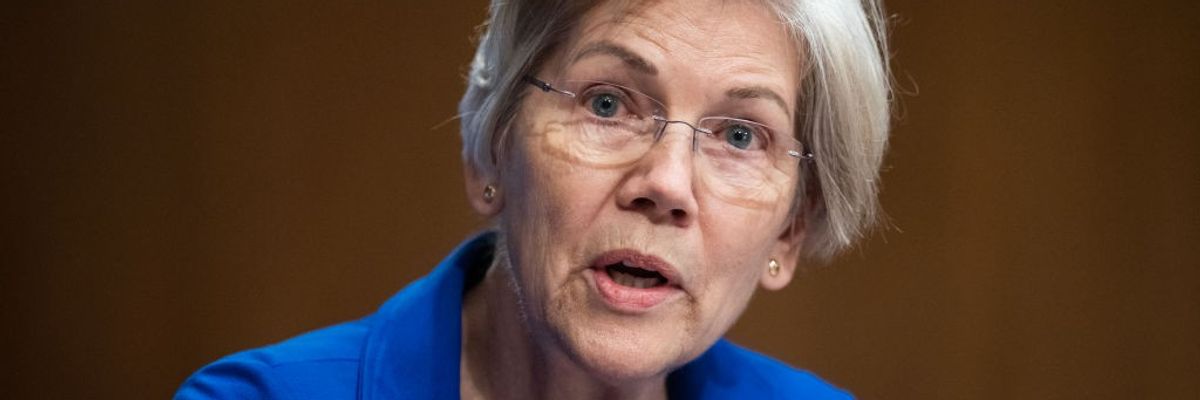

U.S. Sen. Elizabeth Warren (D-Mass.) speaks during a January 11, 2024 hearing on Capitol Hill in Washington, D.C.
(Photo: Tom Williams/CQ-Roll Call, Inc. via Getty Images)


Julia Conley
Dec 11, 2024
COMMON DREAMS


Aiming to confront "a root cause of many of America's fundamental economic problems," U.S. Sen. Elizabeth Warren on Wednesday unveiled a bill to require corporations to balance growth with fair treatment of their employees and consumers.

The Massachusetts Democrat introduced the Accountable Capitalism Act, explaining that for much of U.S. history, corporations reinvested more than half of their profits back into their companies, working in the interest of employees, customers, business partners, and shareholders.

In the 1980s, said Warren corporations began placing the latter group above all, adopting "the belief that their only legitimate and legal purpose was 'maximizing shareholder value.'"

That view was further cemented in 1997 when the Business Roundtable, a lobbying group that represents chief executives across the country, declared that the "principal objective of a business enterprise is to generate economic returns to its owners."


Now, Warren said in a policy document, "around 93% of American-held corporate shares are owned by just 10% of our nation's richest households, while more than 40% of American households hold no shares at all."


"This means that corporate America's commitment to 'maximizing shareholder return' is a commitment to making the rich even richer, while leaving workers and families behind," said Warren in a statement.

The Accountable Capitalism Act would require:Corporations with more than $1 billion in annual revenue to obtain a federal charter as a "United States corporation," obligating executives to consider the interests of all stakeholders, not just investors;
Corporate political spending to be approved by at least 75% of a company's shareholders and 75% of its board of directors; and
At least 40% of a company's board of directors to be selected by employees.

The bill would also prohibit directors of U.S. corporations from selling company shares within five years of receiving them or within three years of a company stock buyback.

Warren noted that as companies have increasingly poured their profits into stock buybacks to benefit shareholders, worker productivity has steadily increased while real wages have gone up only slightly. The share of national income that goes to workers has also significantly dropped.

"Workers are a major reason corporate profits are surging, but their salaries have barely moved while corporations' shareholders make out like bandits," said Warren told The Guardian. "We need to stand up for working people and hold giant companies responsible for decisions that hurt workers and consumers while lining shareholders' pockets."

The senator highlighted that big business interests invested heavily in November's U.S. presidential election.

"Following the most lucrative election in history for special interests," she said, "my bill will empower workers to hold corporations to responsible decisions that benefit more than just shareholders."

Doing For-Profit Tax Industry's Bidding, GOP Calls On Trump to Cancel Direct File Program


"This is the most efficient way and cost-efficient way for millions of people to pay their taxes," said one advocate.
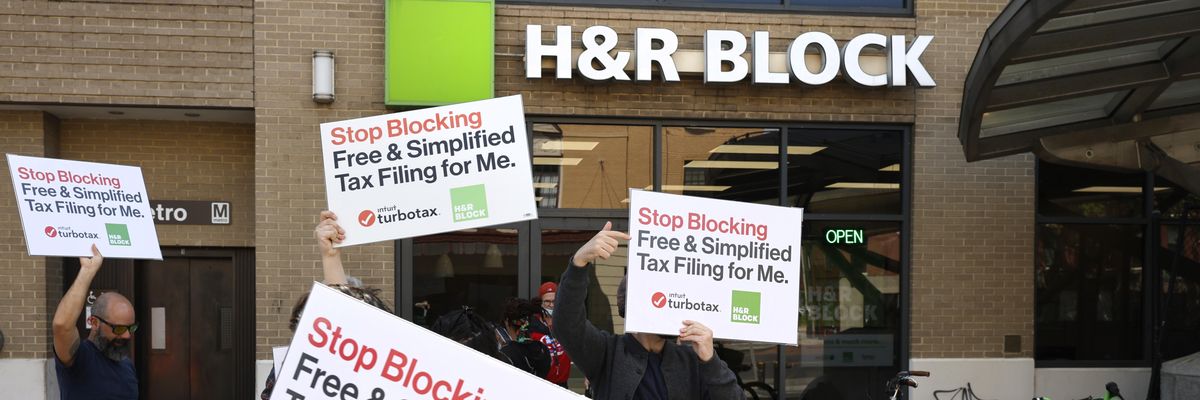


Advocates gather in Washington, D.C. to call out tax prep companies like Intuit TurboTax and H&R Block for blocking simplified filing and to support Internal Revenue Service (IRS) exploration of alternative free tax filing on April 17, 2023.
(Photo: Tasos Katopodis/Getty Images for Economic Security Project)

Julia Conley
Dec 11, 2024
COMMON DREAMS

Responding to the "absurd" news that more than two dozen U.S. House Republicans are calling on President-elect Donald Trump to end the Internal Revenue Service's Direct File program, Rep. Gerry Connolly came to one conclusion: "Republicans want to make your lives more difficult."

The Virginia Democrat wasn't alone in denouncing a letter penned by Reps. Adrian Smith (R-Neb.) and Chuck Edwards (R-N.C.) and signed by at least 27 other Republicans who called on Trump to sign a "day-one executive order" to end the free tax-filing program that allowed roughly 140,000 taxpayers to save an estimated $5.6 million in filing costs this year.


Direct File, which was introduced as a pilot program in 12 states in the last tax filing season and is set to be expanded to 24 states and more than 30 million eligible taxpayers this year, is "a free, easy way for people to file their taxes directly online with IRS," said Sen. Elizabeth Warren (D-Mass.).

The software allows taxpayers to keep their entire tax refund "rather than paying $150 to a sleazy tax prep company," said the senator, adding that Republicans evidently want Americans "to keep wasting money on TurboTax," the popular tax filing program run by Intuit, which reported a net income of $2 billion in 2023 and spent $3.5 million on federal lobbying the previous year. The private tax filing industry has spent decades lobbying to ensure a system like Direct File wouldn't be made available to Americans.


In the letter, the Republicans claim the Direct File system is "unauthorized and wasteful" and that "the program's creation and ongoing expansion pose a threat to taxpayers' freedom from government overreach."

The Republican lawmakers also sent the letter to billionaire businessmen Elon Musk and Vivek Ramaswamy, Trump's nominees to lead the proposed Department of Government Efficiency (DOGE).

In the letter they claim to want to protect "hardworking Americans" from the "overreach" of the IRS, but as In the Public Interest founder and executive director Donald Cohen told Common Dreams on Wednesday, the Direct File program is "incredibly popular" with those who have used it.

"This is the most efficient way and cost-efficient way for millions of people to pay their taxes," Cohen said. "So what the Republicans want to do is make it more costly, more complicated, and more profitable for the big tax software vendors."

Cohen also questioned how Smith and Edwards could argue, as they do in the letter, that Direct File is a "clear conflict of interest."

"It is in all of our interests for the federal government to... collect taxes in the most efficient and cheapest way," he told Common Dreams.

On the contrary, he said, private tax software companies like Intuit and H&R Block are incentivized to fight against Direct File, which keeps them from collecting about $1 billion in filing fees as well as users' data.

At the Center on Budget and Policy Priorities, vice president of tax policy Chuck Marr said Republicans who signed Wednesday's letter are essentially pushing for "a tax on paying taxes."

Ernie Tedeschi, director of economics at the Yale Budget Lab and the former chief economist of the White House Council of Economic Advisers, argued that Direct File "does what policymakers should be in favor of: It makes a core government function more efficient and user-friendly, in a way that's accessible for everyone."

With Defeat of Megamerger, Sanders Thanks Khan for Taking On 'Corporate Greed'


"The proposed Kroger-Albertsons merger would have led to higher prices at the grocery store and harmed workers," said the Vermont senator.
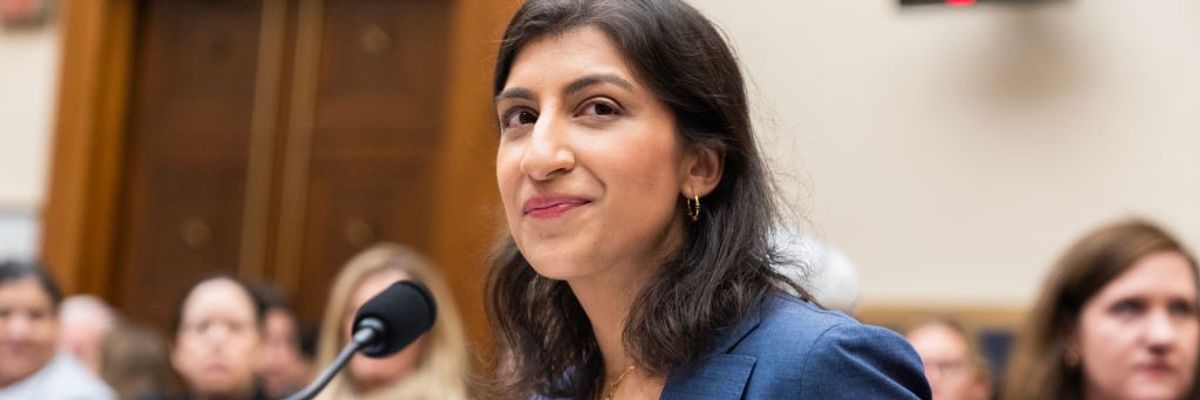


FTC Chair Lina Khan prepares to testify during a congressional hearing in Washington, D.C. on July 13, 2023.
(Photo: Tom Williams/CQ-Roll Call, Inc. via Getty Images)

Jessica Corbett
Dec 11, 2024
COMMON DREAMS

Praise for Federal Trade Commission Chair Lina Khan continued to pour in on Wednesday after a pair of judges blocked the merger of grocery chains Kroger and Albertsons following challenges by the FTC and state attorneys general.

"The proposed Kroger-Albertsons merger would have led to higher prices at the grocery store and harmed workers," said U.S. Sen. Bernie Sanders. "Let me thank FTC Chair Lina Khan for successfully fighting this merger and standing up to corporate greed."


Congressman Mark Pocan (D-Wis.) also welcomed the rulings and sent "a big thank you to Lina Khan and her team at the FTC."

Their comments on Wednesday followed similar applause from Sen. Elizabeth Warren (D-Mass.) and Rep. Pramila Jayapal as well as groups including the American Economic Liberties Project (AELP) and Groundwork Collaborative.

Khan addressed the win during a Tuesday stream with political commentator Hasan Piker, noting that "this is the first time that the FTC has ever sought to block a merger not just because it's gonna be bad for consumers, but also because it's gonna be bad for workers."


Khan, an appointee of outgoing Democratic President Joe Biden, has won praise from progressives for taking on not only grocery giants and other companies trying to build monopolies but also Big Pharma and Big Tech.

Sanders recently called her "the best FTC chair in modern history" and AELP earlier this year published a document detailing how, under Khan's leadership, the agency "has entered a new era of more effective, modern, and democratic enforcement to better protect consumers, workers, and independent businesses."

Examples included in the AELP roundup include Khan's "crackdown on deceptive 'junk fees,'" a ban on noncompete clauses that's being challenged in court, a historic lawsuit against Amazon.com, and a "click-to-cancel" rule that requires sellers to "make it as easy for consumers to cancel their enrollment as it was to sign up."

However, the new era of the FTC is set to soon come to an end. Since President-elect Donald Trump's victory last month, speculation has been building that he would replace Khan with someone who would do the bidding of big business. Amid celebrations of the rulings against the Kroger-Albertsons merger on Tuesday, the Republican announced Andrew Ferguson as his pick for chair.

As Common Dreamsreported earlier Wednesday, Basel Musharbash, principal attorney at Antimonopoly Counsel, said that elevating Ferguson, who already sits on the FTC, to chair, "is an affront to the antitrust laws and a gift to the oligarchs and monopolies bleeding this country dry."

Although the agency is expected to be friendlier to mergers under the next Trump administration, Albertsons responded to the Tuesday rulings by bailing on the $24.6 billion deal and suing Kroger for billions of dollars on Wednesday, rather than appealing or moving to in-house FTC hearings.

That move could reflect industry fears of U.S. courts that are willing to block major mergers, as The American Prospect executive editor David Dayen pointed out after the federal court decision on Tuesday.

"The important thing here is not that Biden's enforcers blocked a merger... it's that courts are increasingly comfortable with merger enforcement," he said. "States can sue under the Sherman Act, and they will. The real change to track is in the judiciary. Wall Street, take note."


Judges Block Kroger-Albertsons Merger in 'Win for Farmers, Workers, and Consumers'

"We applaud the FTC for securing one of the most significant victories in modern antitrust enforcement," said one advocate.
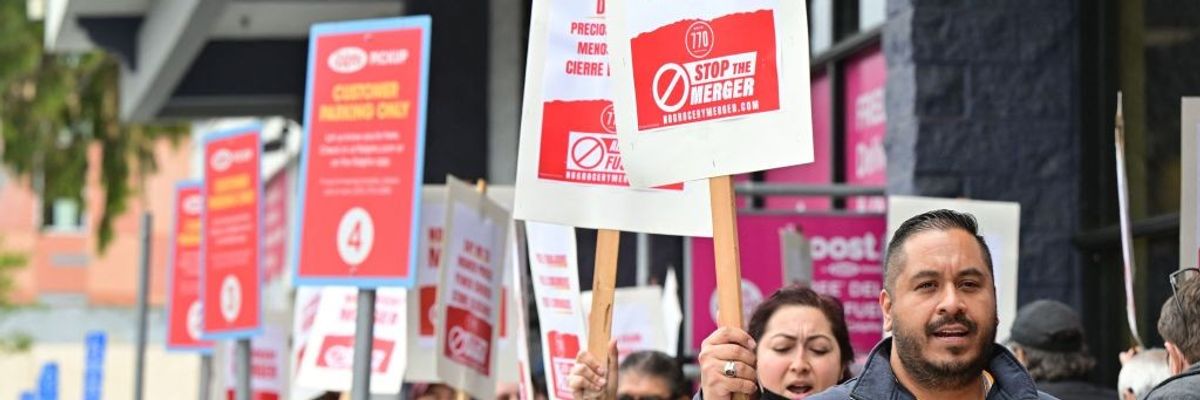


Unionized grocery store workers rally to oppose the proposed merger of Kroger and Albertsons outside a Ralph's supermarket in Los Angeles, California on April 13, 2023.
(Photo: Frederic J. Brown/AFP via Getty Images)

Jessica Corbett
Dec 10, 2024
COMMON DREAMS

Antitrust advocates on Tuesday welcomed a pair of court rulings against the proposed merger of grocery giants Kroger and Albertsons, which was challenged by Federal Trade Commission Chair Lina Khan and multiple state attorneys general.

"The FTC, along with our state partners, scored a major victory for the American people, successfully blocking Kroger's acquisition of Albertsons," said Henry Liu, director of the commission's Bureau of Competition, in a statement. "This historic win protects millions of Americans across the country from higher prices for essential groceries—from milk, to bread, to eggs—ultimately allowing consumers to keep more money in their pockets."

"This victory has a direct, tangible impact on the lives of millions of Americans who shop at Kroger or Albertsons-owned grocery stores for their everyday needs, whether that's a Fry's in Arizona, a Vons in Southern California, or a Jewel-Osco in Illinois," he added. "This is also a victory for thousands of hardworking union employees, protecting their hard-earned paychecks by ensuring Kroger and Albertsons continue to compete for workers through higher wages, better benefits, and improved working conditions."

While Liu was celebrating the preliminary injunction from Oregon-based U.S. District Court Judge Adrienne Nelson, later Tuesday, King County Superior Court Judge Marshall Ferguson released a ruling that blocked the merger in Washington state.

"We're standing up to mega-monopolies to keep prices down," said Washington Attorney General Bob Ferguson. "We went to court to block this illegal merger to protect Washingtonians' struggling with high grocery prices and the workers whose jobs were at stake. This is an important victory for affordability, worker protections, and the rule of law."


Advocacy groups applauding the decisions also pointed to the high cost of groceries and the anticipated impact of Kroger buying Albertsons—a $24.6 billion deal first announced in October 2022.

"American families are the big winner today, thanks to the Federal Trade Commission. The only people who stood to gain from the potential merger between Albertsons and Kroger were their wealthy executives and investors," asserted Liz Zelnick of Accountable.US. "The rest of us are letting out a huge sigh of relief knowing today's victory is good news for competitive prices and consumer access."

Describing the federal decision as "a victory for commonsense antitrust enforcement that puts people ahead of corporations," Food & Water Watch senior food policy analyst Rebecca Wolf also pointed out that "persistently high food prices are hitting Americans hard, and a Kroger-Albertsons mega-merger would have only made it worse."

"Already, a handful of huge corporations' stranglehold on our food system means that consumers are paying too much for too little choice in supermarkets, workers are earning too little, and farmers and ranchers cannot get fair prices for their crops and livestock," she noted. "Today's decision and strengthened FTC merger guidelines help change the calculus."

Like Wolf, Farm Action president and co-founder Angela Huffman similarly highlighted that "while industry consolidation increases prices for consumers and harms workers, grocery mergers also have a devastating impact on farmers and ranchers."

"When grocery stores consolidate, farmers have even fewer options for where to sell their products, and the chances of them receiving a fair price for their goods are diminished further," Huffman explained. "Today's ruling is a win for farmers, workers, and consumers alike."

Some advocates specifically praised Khan—a progressive FTC chair whom President-elect Donald Trumpplans to replace with Andrew Ferguson, a current commissioner who previously worked as chief counsel to Senate Minority Leader Mitch McConnell (R-Ky.) and as Republican counsel on the Senate Judiciary Committee.


"Today's decision is a major win for shoppers and grocery workers. Families have been paying the price of unchecked corporate power in the food and grocery sector, and further consolidation would only worsen this crisis," declared Groundwork Collaborative executive director Lindsay Owens in a statement.

"FTC Chair Lina Khan's approach is the blueprint to deliver lower prices, higher wages, and an economy that works for everyone," Owens argued. "The rebirth of antitrust enforcement has protected consumers against the worst of corporate power in our economy and it would be wise to continue this approach."

Laurel Kilgour, research manager at the American Economic Liberties Project, called the federal ruling "a resounding victory for workers, consumers, independent retailers, and local communities nationwide—and a powerful validation of Chair Khan and the FTC's rigorous enforcement of the law."

"The FTC presented a strong case that Kroger and Albertsons fiercely compete head-to-head on price, quality, and service. The ruling is a capstone on the FTC's work over the past four years and includes favorable citations to the FTC's recent victories against the Tapestry-Capri, IQVIA-Propel, and Illumina-Grail mergers," Kilgour continued.

"The court also cites long-standing Supreme Court law which recognizes that Congress was also concerned with the impacts of mergers on smaller competitors," she added. "We applaud the FTC for securing one of the most significant victories in modern antitrust enforcement and for successfully protecting the public interest from harmful consolidation."

Despite the celebrations, the legal battle isn't necessarily over. The Associated Pressreported that "the case may now move to the FTC, although Kroger and Albertsons have asked a different federal judge to block the in-house proceedings," and Colorado is also trying to halt the merger in state court.


Booze Hound! Lina Khan, Not Done Yet, Targets Nation's Largest Alcohol Seller

"The FTC is doing what our government should be doing: using every tool possible to make life better for everyday Americans," said one advocate.
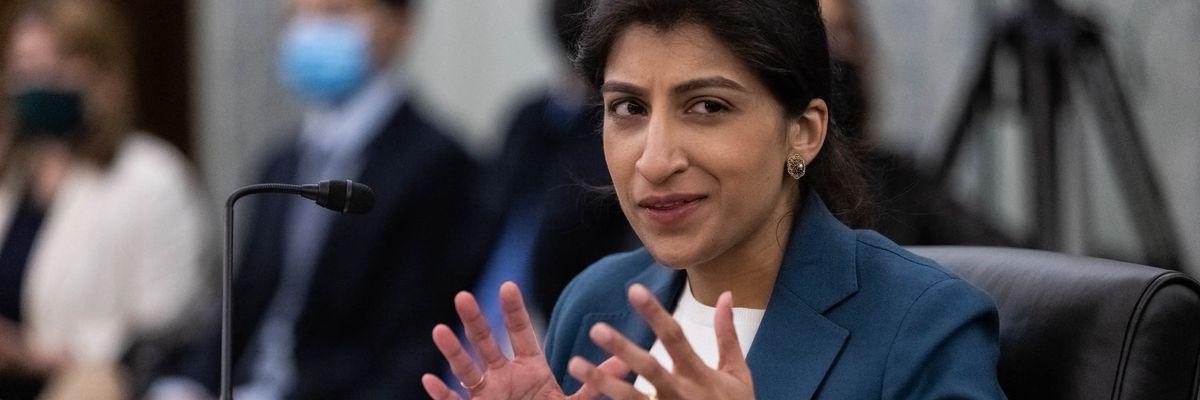

Federal Trade Commission Chair Lina Khan testifies before the House Judiciary Committee on Capitol Hill in Washington, D.C. on July 13, 2023.
(Photo: Graeme Jennings/Pool/AFP via Getty Images)


Brett Wilkins
Dec 12, 2024
COMMON DREAMS

The U.S. Federal Trade Commission on Thursday sued Southern Glazer's Wine and Spirits, alleging that the nation's largest alcohol distributor, "violated the Robinson-Patman Act, harming small, independent businesses by depriving them of access to discounts and rebates, and impeding their ability to compete against large national and regional chains."

The FTC said its complaint details how the Florida-based company "is engaged in anticompetitive and unlawful price discrimination" by "selling wine and spirits to small, independent 'mom-and-pop' businesses at prices that are drastically higher" than what it charges large chain retailers, "with dramatic price differences that provide insurmountable advantages that far exceed any real cost efficiencies for the same bottles of wine and spirits."

The suit comes as FTC Chair Lina Khan's battle against "corporate greed" is nearing its end, with U.S. President-elect Donald Trump announcing Tuesday that he plans to elevate Andrew Ferguson to lead the agency.

Emily Peterson-Cassin, director of corporate power at Demand Progress Education Fund, said Thursday that "instead of heeding bad-faith calls to disarm before the end of the year, the FTC is taking bold, needed action to fight back against monopoly power that's raising prices."

"By suing Southern Glazer under the Robinson-Patman Act, a law that has gone unenforced for decades, the FTC is doing what our government should be doing: using every tool possible to make life better for everyday Americans," she added.


According to the FTC:
Under the Robinson-Patman Act, it is generally illegal for sellers to engage in price discrimination that harms competition by charging higher prices to disfavored retailers that purchase similar goods. The FTC's case filed today seeks to ensure that businesses of all sizes compete on a level playing field with equivalent access to discounts and rebates, which means increased consumer choice and the ability to pass on lower prices to consumers shopping across independent retailers.

"When local businesses get squeezed because of unfair pricing practices that favor large chains, Americans see fewer choices and pay higher prices—and communities suffer," Khan said in a statement. "The law says that businesses of all sizes should be able to compete on a level playing field. Enforcers have ignored this mandate from Congress for decades, but the FTC's action today will help protect fair competition, lower prices, and restore the rule of law."

The FTC noted that, with roughly $26 billion in revenue from wine and spirits sales to retail customers last year, Southern is the 10th-largest privately held company in the United States. The agency said its lawsuit "seeks to obtain an injunction prohibiting further unlawful price discrimination by Southern against these small, independent businesses."

"When Southern's unlawful conduct is remedied, large corporate chains will face increased competition, which will safeguard continued choice which can create markets that lower prices for American consumers," FTC added.

Southern Glazer's published a statement calling the FTC lawsuit "misguided and legally flawed" and claiming it has not violated the Robinson-Patman Act.

"Operating in the highly competitive alcohol distribution business, we offer different levels of discounts based on the cost we incur to sell different quantities to customers and make all discount levels available to all eligible retailers, including chain stores and small businesses alike," the company said.

Peterson-Cassin noted that the new suit "follows a massive court victory for the FTC on Tuesday in which a federal judge blocked a $25 billion grocery mega-merger after the agency sued," a reference to the proposed Kroger-Albertsons deal.

"The FTC has plenty of fight left and so should all regulatory agencies," she added, alluding to the return of Trump, whose first administration saw relentless attacks on federal regulations. "We applaud the FTC and Chair Lina Khan for not letting off the gas in the race to protect American consumers and we strongly encourage all federal regulators to do the same while there's still time left."


'A Gift to the Oligarchs': Trump Pick to Replace Lina Khan Vowed to End 'War on Mergers'


"Andrew Ferguson is a corporate shill who opposes banning noncompetes, opposes banning junk fees, and opposes enforcing the Anti-Merger Act," said one antitrust attorney.
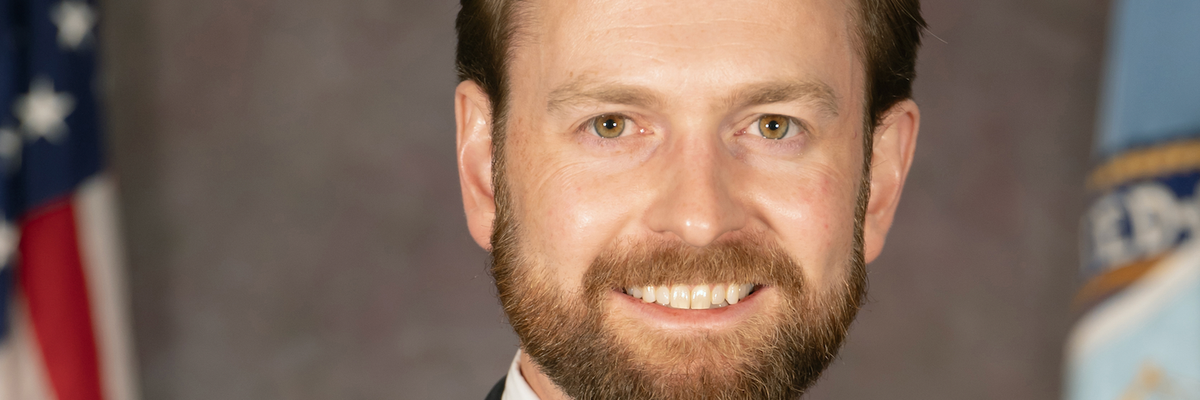

Andrew Ferguson, a Republican member of the Federal Trade Commission, was selected by President-elect Donald Trump to lead the agency on December 11, 2024.
(Photo: Federal Trade Commission)


Jake Johnson
Dec 11, 2024
COMMON DREAMS


President-elect Donald Trump's pick to lead the Federal Trade Commission vowed in his job pitch to end current chair Lina Khan's "war on mergers," a signal to an eager corporate America that the incoming administration intends to be far more lax on antitrust enforcement.

Andrew Ferguson was initially nominated by President Joe Biden to serve as a Republican commissioner on the bipartisan FTC, and his elevation to chair of the commission will not require Senate confirmation.

In a one-page document obtained by Punchbowl, Ferguson—who previously worked as chief counsel to Sen. Mitch McConnell (R-Ky.)—pitched himself to Trump's team as the "pro-innovation choice" with "impeccable legal credentials" and "proven loyalty" to the president-elect.

Ferguson's top agenda priority, according to the document, is to "reverse Lina Khan's anti-business agenda" by rolling back "burdensome regulations," stopping her "war on mergers," halting the agency's "attempt to become an AI regulator," and ditching "novel and legally dubious consumer protection cases."

Trump announced Ferguson as the incoming administration's FTC chair as judges in Oregon and Washington state blocked the proposed merger of Kroger and Albertsons, decisions that one antitrust advocate called a "fantastic culmination of the FTC's work to protect consumers and workers."


According to a recent report by the American Economic Liberties Project, the Biden administration "brought to trial four times as many billion-dollar merger challenges as Trump-Pence or Obama-Biden enforcers did," thanks to "strong leaders at the FTC" and the Justice Department's Antitrust Division.
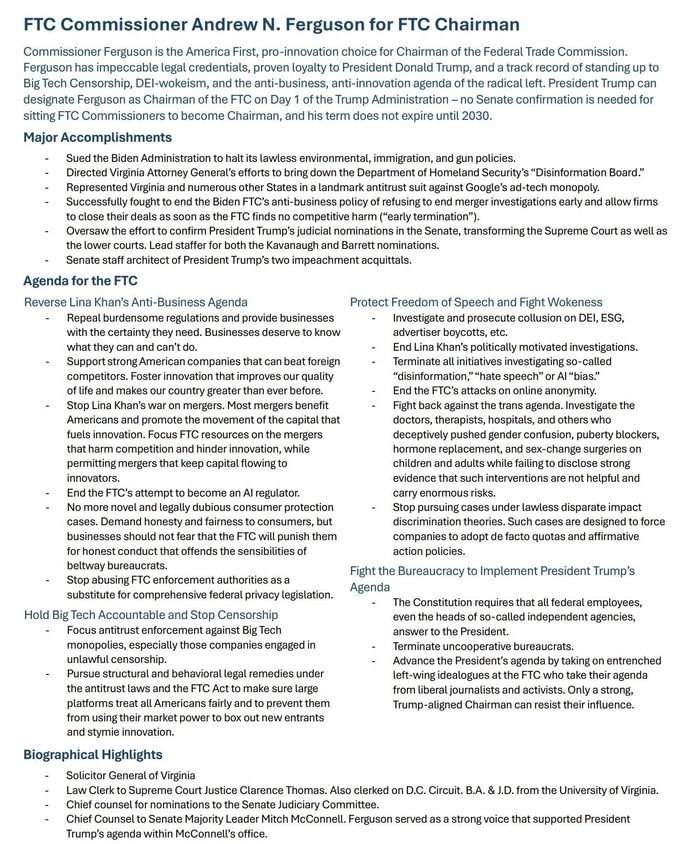


In a letter to Ferguson following Trump's announcement on Tuesday, FTC Commissioners Alvaro Bedoya and Rebecca Kelly Slaughter wrote that the document obtained and published by Punchbowl "raises questions" about his priorities at the agency mainly "because of what is not in it."

"Americans pay more for healthcare than anyone else in the developed world, yet they die younger," they wrote. "Medical bills bankrupt people. In fact, this is the main reason Americans go bankrupt. But the document does not mention the cost of healthcare or prescription medicine."

"If there was one takeaway from the election, it was that groceries are too expensive. So is gas," the commissioners continued. "Yet the document does not mention groceries, gas, or the cost of living. While you have said we're entering the 'most pro-worker administration in history,' the document does not mention labor, either. Americans are losing billions of dollars to fraud. Fraudsters are so brazen that they impersonate sitting FTC commissioners to steal money from retirees. The word 'fraud' does not appear in the document."

"The document does propose allowing more mergers, firing civil servants, and fighting something called 'the trans agenda,'" they added. "Is all of that more important than the cost of healthcare and groceries and gasoline? Or fighting fraud?"

As an FTC commissioner, Ferguson voted against rules banning anti-worker noncompete agreements and making it easier for consumers to cancel subscriptions. Ferguson was also the only FTC member to oppose an expansion of a rule to protect consumers from tech support scams that disproportionately impact older Americans.

"Andrew Ferguson is a corporate shill who opposes banning noncompetes, opposes banning junk fees, and opposes enforcing the Anti-Merger Act," said Basel Musharbash, principal attorney at Antimonopoly Counsel. "Appointing him to chair the FTC is an affront to the antitrust laws and a gift to the oligarchs and monopolies bleeding this country dry."
Despite 100% Pentagon Audit Failure Rate, House Passes $883.7 Billion NDAA


"Instead of fighting the rising cost of healthcare, gas, or groceries, this Congress prioritized rewarding the wealthy and well-connected military-industrial complex," said Defense Spending Reduction Caucus co-chairs.


U.S. soldiers drive a tank through the Vistula River during NATO military defense drills on March 4, 2024 in Korzeniewo, Poland.
(Photo: Omar Marques/Anadolu via Getty Images)


Jessica Corbett
Dec 11, 2024
COMMON DREAMS

Despite the Pentagon's repeated failures to pass audits and various alarming policies, 81 Democrats in the U.S. House of Representatives voted with 200 Republicans on Wednesday to advance a $883.7 billion annual defense package.

The Servicemember Quality of Life Improvement and National Defense Authorization Act (NDAA) for Fiscal Year 2025, unveiled by congressional negotiators this past Saturday, still needs approval from the Senate, which is expected to vote next week. U.S. Sen. Bernie Sanders (I-Vt.) said Wednesday that he plans to vote no and spoke out against the military-industrial complex.

The push to pass the NDAA comes as this congressional session winds down and after the U.S. Department of Defense (DOD) announced last month that it had failed yet another audit—which several lawmakers highlighted after the Wednesday vote.


Reps. Mark Pocan (D-Wis.) and Barbara Lee (D-Calif.), co-chairs and co-founders of the Defense Spending Reduction Caucus, said in a joint statement, "Time and time again, Congress seems to be able to find the funds necessary to line the pockets of defense contractors while neglecting the problems everyday Americans face here at home."

"Instead of fighting the rising cost of healthcare, gas, or groceries, this Congress prioritized rewarding the wealthy and well-connected military-industrial complex with even more unaccountable funds," they continued. "After a seventh failed audit in a row, it's disappointing that our amendment to hold the Pentagon accountable by penalizing the DOD's budget by 0.5% for each failed audit was stripped out of the final bill. It's time Congress demanded accountability from the Pentagon."

"While we're glad many of the poison pill riders that were included in the House-passed version were ultimately removed from the final bill, the bill does include a ban on access to medically necessary healthcare for transgender children of service members, which will force service members to choose between serving their country and getting their children the care they need," the pair noted. "The final bill also failed to expand coverage for fertility treatments, including in vitro fertilization (IVF), for service members regardless of whether their infertility is service-connected."


Several of the 124 House Democrats who voted against the NDAA cited those "culture war" policies, in addition to concerns about how the Pentagon spends massive amounts of money that could go toward improving lives across the country.

"Once again, Congress has passed a massive military authorization bill that prioritizes endless military spending over the critical needs of American families. This year's NDAA designates $900 billion for military spending," said Rep. Ilhan Omar (D-Minn.), noting the audit failures. "While I recognize the long-overdue 14.5% raise for our lowest-ranking enlisted personnel is important, this bill remains flawed. The bloated military budget continues to take away crucial funding from programs that could help millions of Americans struggling to make ends meet."

Taking aim at the GOP's push to deny gender-affirming care through TRICARE, the congresswoman said that "I cannot support a bill that continues unnecessary military spending while also attacking the rights and healthcare of transgender youth, and for that reason, I voted NO."

As Omar, a leading critic of the U.S.-backed Israeli assault on the Gaza Strip, also pointed out: "The NDAA includes a provision that blocks the Pentagon from using data on casualties and deaths from the Gaza Ministry of Health or any sources relying on those statistics. This is an alarming erasure of the suffering of the Palestinian people, ignoring the human toll of ongoing violence."

Israel—which receives billions of dollars in annual armed aid from the United States—faces a genocide case at the International Court of Justice and the International Criminal Court last month issued arrest warrants for Israeli Prime Minister Benjamin Netanyahu and former Israeli Defense Minister Yoav Gallant. The NDAA includes over $627 million in provisions for Israel.


Congresswoman Delia Ramirez (D-Ill.), who voted against the NDAA, directed attention to U.S. President-elect Donald Trump's proposed Department of Government Efficiency (DOGE), set to be run by billionaires Elon Musk and Vivek Ramaswamy.

"How do we know that DOGE is not a good-faith effort to address wasted funding and unaccountable government? The NDAA passed today," Ramirez said. "Republicans overwhelmingly supported the $883.7 billion authorization bill even though the Pentagon just failed its seventh audit in a row."


"Billions of dollars go to make defense corporations and their investors, including Members of Congress, rich while Americans go hungry, families are crushed by debt, and bombs we fund kill children in Gaza," she added. "No one who voted for this bill can credibly suggest that they care about government waste."


Rep. Ro Khanna (D-Calif.), who also opposed the NDAA, wrote in a Tuesday opinion piece for MSNBC that he looks forward to working with DOGE "to reduce waste and fraud at the Pentagon, while strongly opposing any cuts to programs likeSocial Security, Medicare, the Department of Veterans Affairs, or the Consumer Financial Protection Bureau."


"We should make defense contracting more competitive, helping small and medium-sized businesses to compete for Defense Department projects," Khanna argued. "The Defense Department also needs better acquisition oversight. Defense contractors have gotten away with overcharging the Pentagon and ripping off taxpayers for too long."


"Another area where we can work with DOGE is reducing the billions being spent to maintain excess military property and facilities domestically and abroad," he suggested. "Finally, DOGE can also cut the Nuclear-Armed Sea-Launched Cruise Missile program."

The congressman, who is expected to run for president in 2028, concluded that "American taxpayers want and deserve the best return on their investment. Let's put politics aside and work with DOGE to reduce wasteful defense spending. And let's invest instead in domestic manufacturing, good-paying jobs, and a modern national security strategy."

As Senate Prepares for NDAA Vote, Progressive Caucus Says It Is 'Past Time' to Slash Pentagon Budget

"This legislation on balance moves our country and our national priorities in the wrong direction," said Rep. Pramila Jayapal.


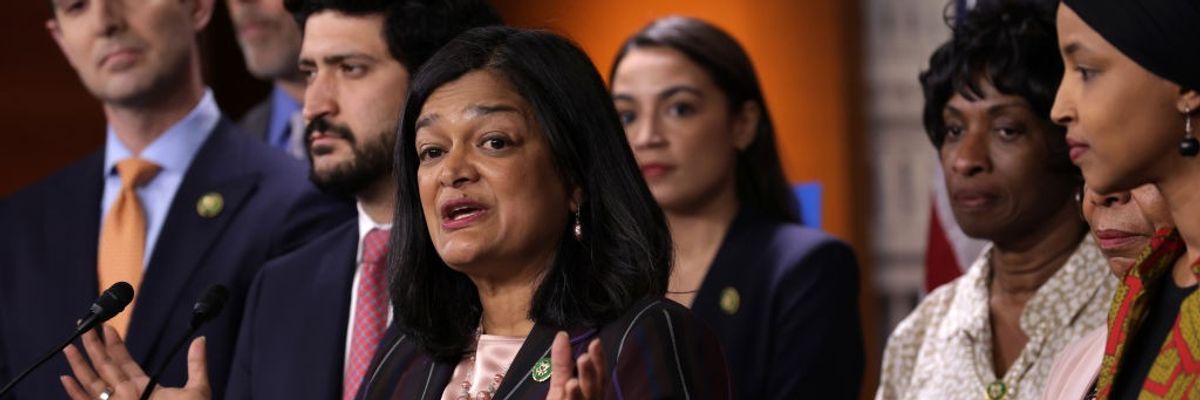
Flanked by Congressional Progressive Caucus members, CPC Chair Pramila Jayapal (D-Wash.) speaks during a news conference at the U.S. Capitol in Washington, D.C. on May 24, 2023.
(Photo: Alex Wong/Getty Images)

Julia Conley
Dec 12, 2024
COMMON DREAMS

As Senate Democrats prepared to move forward with a procedural vote on the annual defense budget package that passed in the House earlier this week, the Congressional Progressive Caucus outlined its objections to the legislation and called for the Pentagon budget to be cut, with military funding freed up to "reinvest in critical human needs."


CPC Chair Pramila Jayapal (D-Wash.) said following the passage of the Servicemember Quality of Life Improvement and National Defense Authorization Act (NDAA) for 2025 (H.R. 5009) that "it should alarm every American taxpayer that we are nearing a trillion-dollar annual budget for an agency rampant with waste, fraud, and abuse."

Jayapal, who was one of 140 lawmakers to oppose the package, emphasized that the Pentagon has failed seven consecutive annual audits.


Despite being the only federal agency to never have passed a federal audit, said Jayapal, the Department of Defense "continues to receive huge boosts to funding every year. Our constituents deserve better."

As Common Dreams reported last month, more than half of the department's annual budget now goes to military contractors that consistently overcharge the government, contributing to the Pentagon's inability to fully account for trillions of taxpayer dollars.

The $883.7 billion legislation that was advanced by the House on Wednesday would pour more money into the Pentagon's coffers. The package includes more than $500 million in Israeli military aid and two $357 million nuclear-powered attack submarine despite the Pentagon requesting only one, and would cut more than $621 million from President Joe Biden's budget request for climate action initiatives.


Jayapal noted that the legislation—which was passed with the support of 81 Democrats and 200 Republicans—also includes anti-transgender provisions, barring the children of military service members from receiving gender-affirming healthcare in "the first federal statute targeting LGBTQ people since the 1990s when Congress adopted 'Don't Ask, Don't Tell' and the Defense of Marriage Act."

"This dangerous bigotry cannot be tolerated, let alone codified into federal law," said Jayapal.

Senate Majority Leader Chuck Schumer (D-N.Y.) said Thursday that the legislation "has some very good things we Democrats wanted in it, it has some bad things we wouldn't have put in there, and some things that were left out," and indicated that he had filed cloture for the first procedural vote on the NDAA.

The vote is expected to take place early next week, and 60 votes are needed to begin debate on the package.

Sen. Bernie Sanders (I-Vt.), a longtime critic of exorbitant U.S. military spending, said in a floor speech on Wednesday that he plans to vote no on the budget.

"While middle-class and working-class families are struggling to survive, we supposedly just don't have the financial resources to help them," he said. "We just cannot afford to build more housing, we just cannot afford to provide quality childcare to our kids or to support public education, or to provide healthcare to all."

"But when the military industrial complex and all of their well-paid lobbyists come marching in to Capitol Hill," he continued, "somehow or another, there is more than enough money for Congress to provide them with virtually everything that they need."


Jayapal noted that the funding package includes substantive pay raises for service members and new investments in housing, healthcare, childcare, and other support for their families.

"Progressives will always fight to increase pay for our service members and ensure that our veterans are well taken care of," said Jayapal. "However, this legislation on balance moves our country and our national priorities in the wrong direction."

By cutting military spending, she said, the federal government could invest in the needs of all Americans, not just members of the military, "without sacrificing our national security or service member wages."

"It's past time we stop padding the pockets of price gouging military contractors who benefit from corporate consolidation," said Jayapal, "and reallocate that money to domestic needs."


In Wake of UN Climate Summit, Azerbaijan Targets Independent Journalists

"Azerbaijan's international partners should take note and urge the authorities to end the crackdown," said a major human rights group.


The logo of the COP29 climate conference appears on the facade of a building under renovation in the Azerbaijani capital of Baku on September 11, 2024.
(Photo by TOFIK BABAYEV/AFP via Getty Images)

Eloise Goldsmith
Dec 11, 2024
COMMON DREAMS

Mere weeks after thousands of delegates descended on Baku, Azerbaijan for the COP29 climate summit in Baku, Azerbaijan, authorities in the country arrested multiple independent journalists on charges that one prominent human rights group called "bogus."

On December 6, police arrested six employees with the independent media organization Meydan TV: Ramin Deko (Jabrailzade), Aynur Elgunesh (Ganbarova), Aysel Umudova, Aytaj Tapdig (Ahmadova), Khayala Agayeva, and Natig Javadli on suspicion of smuggling, according to a statement from Meydan TV. Another media worker, Ulvi Tahirov, was also arrested that day. All seven have been given four months pretrial detention, according to Human Rights Watch.

In a statement released December 6, Meydan TV—which is headquartered in Berlin—said that "since the day we started our activities over a decade ago, our brave journalists have been arrested, and they and their families have been subjected to persecution. Journalists who cooperate with us have been illegally banned from leaving the country, and have been surveilled by Pegasus spyware, among other forms of pressure." Meydan TV has also called the charges "unfounded" and the detention of its journalists "illegal."

Since launching in 2013, Meydan TV has become one of the most important sources of independent news in Azerbaijan, broadcasting interviews with opposition politicians and publishing investigative reporting, according to the Eurasianet, an outlet that covers South Caucasus and Central Asia.

As part of its coverage of COP29, Meydan TV addressed the scrutiny that the Azerbaijani government has engendered for its human rights record.

Members of the Azerbaijani media were also arrested last year. Reporters with Abzas Media, Toplum TV, and Kanal 13 were arrested in 2023 and remain in pretrial custody, and like those targeted in this most recent wave of arrests they face smuggling charges, according to Human Rights Watch.

"Having created a network of laws and regulations in Azerbaijan designed to make it virtually impossible for journalists and activists carrying out legitimate work in full compliance, the government then invokes such bogus charges as politically convenient to silence critics," wrote Arzu Geybulla, a research assistant with Human Rights Watch.

Geybulla added: "Azerbaijan's international partners should take note and urge the authorities to end the crackdown, including releasing all those arbitrarily detailed, and dropping all politically motivated prosecutions."

Another rights group, Reporters Without Borders, urged the Azerbaijani government to release these journalists, as well as others that have been "arbitrarily detained."

Jeanne Cavelier, head of Reporters Without Borders' Eastern Europe and Central Asia desk, said that "barely a month after Ilham Aliyev's regime used the glitz of COP29 to polish its international image, it has resumed its relentless repression of journalists."
SLAPP HAPPY

Balkan journalists battle deluge of malicious lawsuits

Belgrade (AFP) – Serbian journalist Radmilo Markovic has gone over every full stop and comma of an article about the powerful mayor of Belgrade that has landed him in court.

Issued on: 11/12/2024 -
'No free country without a free press': A Reporters Without Border protest 
© Tobias Schwarz / AFP

Aleksandar Sapic is demanding 100,000 euros ($105,000) in damages from the investigative news site where Markovic works -- an enormous sum for such a case in the Balkans.

The Balkan Investigative Reporting Network (BIRN) -- one of the best outlets of its kind in Eastern Europe -- fears they could go bankrupt if they lose.

The case is far from uncommon. Serbia is bottom of the class in the region for abusive lawsuits designed to muzzle the media, according to the Europe-wide legal watchdog CASE.

It says SLAPPs -- or strategic lawsuits against public participation -- are being increasingly used by the rich and powerful to bully and silence journalists, activists and NGOs.


Sapic, a member of the governing right-wing Serbian Progressive Party (SNS), sued BIRN, claiming two articles about alleged corruption involving two of his properties damaged his reputation and caused him mental anguish.

While the mayor insists he is only defending himself, BIRN and rights groups argue that the lawsuits are blatant SLAPPs.

"The deployment of abusive lawsuits (SLAPPs) is a growing trend in the Balkans," Pavol Szalai, head of the Europe desk of media watchdog Reporters Without Borders (RSF), told AFP.

A string of other outlets in Serbia, including the Crime and Corruption Reporting Network (KRIK), are also facing highly questionable lawsuits, with journalists in neighbouring Montenegro, North Macedonia, Kosovo, Bosnia and Herzegovina saying they too are being targeted.
Psychological pressure

Activists say SLAPPs are designed to cow critics with the threat of having to mount a long and costly legal defence.

"The biggest problem is psychological, knowing that it will drag on for who knows how long," Markovic said.

"It's stressful for the entire office."

Investigative Reporting Lab (IRL) in neighbouring North Macedonia has already gone through what BIRN and Markovic are now facing.

It was sued for defamation by the country's former deputy premier Kocho Angjushev, a businessman who was blacklisted for corruption by the US last year.

He sued only for symbolic damages of one euro. But the legal battle drained IRL.

Editor-in-chief Saska Cvetkovska said the real goal was to intimidate and hamstring them.

"We were spending most of our time on crisis management instead of doing our job as journalists. I was diagnosed with PTSD, severe burnout, and anxiety because of this," Cvetkovska told AFP.

Their ordeal ended in legal stalemate, with the court ruling that IRL was not a media outlet but an NGO, and should not have published such content.

The decision sparked protests and a furious reaction from Macedonian journalists.
Judges need training

Kocho Angjushev, North Macedonia's former deputy premier, sued the Investigative Reporting Lab for alleged defamation © HANS PUNZ / APA/AFP

Angjushev nearly won again last month when he and Sapic were nominated for a satirical "Obstructor of Transparency" award by the European Fund for the Balkans.

Instead Sapic shared the rather dubious honour with Tirana's former chief prosecutor Elizabeta Imeraj, who sued a journalist after he reported the threats he got for his coverage of her vetting process.

The mock contest is meant to highlight the SLAPP problem in the Balkans and prod the courts into action.

"Neither prosecutors nor judges recognise SLAPP in legal proceedings," said Uros Jovanovic of Civic Initiatives, one of the NGOs that organised the competition.

"We have something in our legislation called abuse of rights. This is something we have recognised as a way for judges to identify SLAPP," Jovanovic added, but up to now they have not been using it to counter malicious lawsuits.

Reporters Without Borders has urged Balkan nations to adopt EU guidelines on the issue.

These "include monitoring of SLAPPs, their early dismissal in court, sanctions against their authors, as well as compensation and assistance for the victims.

"Training of judges is also very important as is their independence," RSF's Szalai told AFP.

But if the experience of Croatia, the only Balkan nation to have so far been admitted into the European Union, is anything to go by, the road may be long.

The Croatian Journalists' Association (HND) has counted several hundred lawsuits brought against reporters there.

© 2024 AFP
34 US Lawmakers Urge Biden to Pardon Steven Donziger

"We are deeply concerned about the chilling effect this case will have on all advocates working on behalf of other frontline communities, victims of human rights violations, and those seeking environmental justice."


Steven Donziger speaks at a "Free Donziger" rally held in front of the Manhattan Court House in New York City on October 1, 2021.
(Photo: Tayfun Coskun/Anadolu Agency via Getty Images)

Brett Wilkins
Dec 11, 2024
COMMON DREAMS

More than 30 Democratic members of Congress on Wednesday called on outgoing U.S. President Joe Biden to pardon environmental and human rights lawyer Steven Donziger, who endured nearly 1,000 days in prison and house arrest after successfully representing Ecuadoreans harmed by Big Oil's pollution of the Amazon rainforest.

In a letter to Biden led by Rep. Jim McGovern, (D-Mass.), 33 House and Senate Democrats plus Independent U.S. Sen. Bernie Sanders of Vermont noted the "troubling legal irregularities" in Donziger's case, which have been "criticized as unconstitutional or illegal by three federal judges, 68 Nobel laureates, and five high-level jurists from the Working Group on Arbitrary Detention of the United Nations."


Donziger represented a group of Ecuadorean farmers and Indigenous people in a 1990s lawsuit against Texaco—which was later acquired by Chevron—over the oil company's deliberate dumping of billions of gallons of carcinogenic waste into the Amazon. He played a key role in winning a $9.5 billion settlement against Chevron in Ecuadorian courts.


However, Chevron fought Donziger in the U.S. court system, and when the attorney refused to disclose privileged client information to the company, federal District Judge Lewis Kaplan—who was invested in Chevron—held him in misdemeanor contempt of court. Loretta Preska, Kaplan's handpicked judge to preside over Donziger's contempt trial, is affiliated with the Chevron-funded Federalist Society.

Donziger's case drew worldwide attention and solidarity, with human rights experts and free speech groups joining progressive U.S. lawmakers in demanding his release. He was released in April 2022 after 993 days in prison and house arrest.

"Donziger is the only lawyer in U.S. history to be subject to any period of detention on a misdemeanor contempt of court charge," the 34 lawmakers wrote. "We believe that the legal case against Mr. Donziger, as well as the excessively harsh nature of the punishment against him, are directly tied to his prior work against Chevron. We do not make this accusation lightly or without evidentiary support."

The legislators warned:

Notwithstanding the personal hardship, this unprecedented legal process has imposed on Mr. Donziger and his family, we are deeply concerned about the chilling effect this case will have on all advocates working on behalf of other frontline communities, victims of human rights violations, and those seeking environmental justice. Those who try to help vulnerable communities will feel as though tactics of intimidation—at the hands of powerful corporate interests, and, most troublingly, the U.S. courts—can succeed in stifling robust legal representation when it is needed most. This is a dangerous signal to send.

"Pardoning Mr. Donziger," the lawmakers added, "would send a powerful message to the world that billion-dollar corporations cannot act with impunity against lawyers and their clients who defend the public interest."

The lawmakers join more than 100 environmental and human rights groups that have urged Biden to pardon Donziger.


In an April opinion piece published by Common Dreams, Donziger contended that "I need this pardon because I am the only person in U.S. history to be privately prosecuted by a corporation."

"More specifically, the government (via a pro-corporate judge) gave a giant oil company (Chevron) the power to prosecute and lock up its leading critic," he continued. "As a result of this unprecedented and frightening private prosecution, I still cannot travel out of the country and I have been prohibited from meeting with clients I have represented for over three decades. Nor can I practice law, maintain a bank account, or earn a livelihood."

"No matter where one stands on the political spectrum," Donziger added, "we should all be able to agree that what happened to me should not happen to anybody in any country that adheres to the rule of law."

The appeal for a Donziger pardon comes amid a wave of eleventh-hour pleas from lawmakers for Biden to grant clemency to figures ranging from WikiLeaks founder Julian Assange and National Security Agency whistleblower Edward Snowden to Indigenous activist Leonard Peltier—often described as the nation's longest-jailed political prisoner—and federal death row inmates including Billie Jerome Allen, who advocates say was wrongly convicted of murder.
Once Again, Tom Cotton Blocks Bill to Shield Journalists From Betraying Sources


Responding to the GOP senator's latest thwarting of the PRESS Act, Democratic Sen. Ron Wyden vowed to "keep trying to get this bill across the finish line" before Republicans take control of the Senate next month.


Sen. Tom Cotton (R-Ark.) walks through the Senate subway after a vote in the U.S. Capitol on January 9, 2024.
(Photo: Bill Clark/CQ-Roll Call, Inc. via Getty Images)


Brett Wilkins
Dec 10, 2024
COMMON DREAMS

Republican U.S. Sen. Tom Cotton of Arkansas on Tuesday again blocked the passage of House-approved bipartisan legislation meant to shield journalists and telecommunications companies from being compelled to disclose sources and other information to federal authorities.

Sen. Ron Wyden (D-Ore.) brought the Protect Reporters from Exploitative State Spying (PRESS) Act—which would prohibit the federal government from forcing journalists and telecom companies to disclose certain information, with exceptions for terroristic or violent threats—for a unanimous consent vote.

Senate Majority Leader Chuck Schumer (D-N.Y.) argued Tuesday that passing the PRESS Act is "more important now than ever before when we've heard some in the previous administration talk about going after the press in one way or another," a reference to Republican President-elect Donald Trump's threats to jail journalists who refuse to reveal the sources of leaks. Trump, who has referred to the press as the "enemy of the people," repeatedly urged Senate Republicans to "kill this bill."


Cotton, who blocked a vote on the legislation in December 2022, again objected to the bill, a move that thwarted its speedy passage. The Republican called the legislation a "threat to national security" and "the biggest giveaway to the liberal press in American history."


The advocacy group Defending Rights and Dissent lamented that "Congress has abdicated their responsibility to take substantive steps to protect the constitutional right to a free press."


However, Seth Stern, director of advocacy at the Freedom of the Press Foundation, noted ways in which Senate Democrats can still pass the PRESS Act before Republicans gain control of the upper chamber next month:
Senate Democrats had all year to move this bipartisan bill and now time is running out. Leader Schumer needs to get the PRESS Act into law—whether by attaching it to a year-end legislative package or bringing it to the floor on its own—even if it means shortening lawmakers' holiday break. Hopefully, today was a preview of more meaningful action to come.

Responding to Tuesday's setback, Wyden vowed, "I'm not taking my foot off the gas."

"I'll keep trying to get this bill across the finish line to write much-needed protections for journalists and their sources into black letter law," he added.
Arrests of US Journalists Surged in 2024 Amid Crackdown on Gaza Protests

Police use of "catch-and-release" tactics is particularly worrying for press freedom advocates, according to the U.S. Press Freedom Tracker.


Police arrest New York students protesting Israel'
s assault on Gaza on April 22, 2024.
(Photo: Fatih Aktas/Anadolu via Getty Images)

Eloise Goldsmith
Dec 12, 2024
COMMON DREAMS

Arrests and detainments of journalists in the United States surged in 2024 compared to the year prior, according to the U.S. Press Freedom Tracker, a project of the Freedom of the Press Foundation.

The tracker reports that journalists were arrested or detained by police at least 48 times this year—eclipsing the number of arrests that took place in the previous two years combined, and constituting the third highest number of yearly arrests and detentions since the project began cataloging press freedom violations in 2017. 2020, however, still stands as far and away the year with the most arrests and detentions.

The 48 arrests and detentions this year is also part of a larger list of "press freedom incidents" that the tracker documents, including things like equipment damage, equipment seizure, and assault.

While a year with a high number of protests typically leads to more arrests, "it was protests in response to the Israel-Gaza war that caused this year's uptick," according to the tracker.

The vast majority of the arrests and detainments out of the total 48 were linked to these sorts of demonstrations, and it was protests at Columbia University's Manhattan campus that were the site of this year's largest detainment of journalists.

The report also recounts the story of Roni Jacobson, a freelance reporter whose experience on the last day of 2023 was a harbinger of press freedom incidents to come in 2024. Jacobson was on assignment to cover a pro-Palestinian demonstration for the New York Daily News on December 31, 2023 when she was told to leave by police because she didn't have city-issued press credentials with her. She recounted that she accidentally bumped into an officer and was arrested. She was held overnight at a precinct and then released after the charges against her, which included disorderly conduct, were dropped.

Even five arrests that the tracker deems "election-related" took place at protests that were "at least partially if not entirely focused on the Israel-Gaza war." Three of those election-related arrests took place at protests happening around the Democratic National Convention in August.

One police force in particular bears responsibility for this year's crackdown: Nearly 50% of the arrests of journalists this year were at the hands of the New York Police Department (NYPD). Many of those taken into custody had their charges dropped quickly, but the tracker notes that the NYPD's use of "catch-and-release" tactics was particularly worrying to press freedom advocates.

Two photojournalists, Josh Pacheco and Olga Federova, were detained four times this year in both New York City and Chicago while photographing protests. They were both "assaulted and arrested and [had] their equipment damaged" while documenting police clearing a student encampment at Manhattan's Fashion Institute of Technology; however, they were released the next day and told their arrests had been voided.

"While [we are] glad that some common sense prevailed by the NYPD not charging these two photographers with any crime, we are very concerned that they are perfecting 'catch-and-release' to an art form,” Mickey Osterreicher, general counsel for the National Press Photographers Association, told the tracker.

"The fact that they took two photojournalists off the street, preventing them from making any more images or transmitting the ones they already had on a matter of extreme public concern, is very disturbing," he said.

Besides covering protests, 2024 also saw the continued practice of "criminally charging journalists for standard journalistic practices," according to the tracker. For example, one investigative journalist in Los Angeles was repeatedly threatened with arrest while attempting to cover a homeless encampment sweep in the city, and then was detained in October, though he was let go without charges.
Reports Target Israeli Army for 'Unprecedented Massacre' of Gaza Journalists

"In Gaza, the scale of the tragedy is incomprehensible," wrote Thibaut Bruttin, director general of Reporters Without Borders.


Al Jazeera correspondent Wael Dahdouh mourns his son and another journalist killed by an Israeli airstrike on January 7, 2024 in Rafah, Gaza.
(Photo: Ahmad Hasaballah/Getty Images

Eloise Goldsmith
Dec 12, 2024
COMMON DREAMS

Reports released this week from two organizations that advocate for journalists underscore just how deadly Gaza has become for media workers.

Reporters Without Borders' (RSF) 2024 roundup, which was published Thursday, found that at least 54 journalists were killed on the job or in connection with their work this year, and 18 of them were killed by Israeli armed forces (16 in Palestine, and two in Lebanon).

The organization has also filed four complaints with the International Criminal Court "for war crimes committed by the Israeli army against journalists," according to the roundup, which includes stats from January 1 through December 1.

"In Gaza, the scale of the tragedy is incomprehensible," wrote Thibaut Bruttin, director general of RSF, in the introduction to the report. Since October 2023, 145 journalists have been killed in Gaza, "including at least 35 who were very likely targeted or killed while working."

Bruttin added that "many of these reporters were clearly identifiable as journalists and protected by this status, yet they were shot or killed in Israeli strikes that blatantly disregarded international law. This was compounded by a deliberate media blackout and a block on foreign journalists entering the strip."

When counting the number of journalists killed by the Israeli army since October 2023 in both Gaza and Lebanon, the tally comes to 155—"an unprecedented massacre," according to the roundup.

Multiple journalists were also killed in Pakistan, Bangladesh, Mexico, Sudan, Myanmar, Colombia, and Ukraine, according to the report, and hundreds more were detained and are now behind bars in countries including Israel, China, and Russia.

Meanwhile, in a statement released Thursday, the International Federation of Journalists (IFJ) announced that at least 139 Palestinian journalists and media workers have been killed since the war in Gaza began in 2023, and in a statement released Wednesday, IFJ announced that 104 journalists had perished worldwide this year (which includes deaths from January 1 through December 10). IFJ's number for all of 2024 appears to be higher than RSF because RSF is only counting deaths that occurred "on the job or in connection with their work."

IFJ lists out each of the slain journalists in its 139 count, which includes the journalist Hamza Al-Dahdouh, the son of Al Jazeera's Gaza bureau chief, Wael Al-Dahdouh, who was killed with journalist Mustafa Thuraya when Israeli forces targeted their car while they were in northern Rafah in January 2024.