Tuesday, February 25, 2025

The Purge of the Deep State and the Road to Dictatorship

February 24, 2025
Source: Scheerpost


This article is read by Eunice Wong, a Juilliard-trained actor, featured on Audible’s list of Best Women Narrators. Her work is on the annual Best Audiobooks lists of the New York Times, Audible, AudioFile, & Library Journal. www.eunicewong.actor


This is a reading of an article riginally posted Feb. 18, 2025

The Trump administration’s war with the deep state is not a purgative. It is not about freeing us from the tyranny of intelligence agencies, militarized police, the largest prison system in the world, predatory corporations or the end of mass surveillance. It will not restore the rule of law to hold the powerful and the wealthy accountable. It will not slash the bloated and unaccountable spending — some $1 trillion dollars — by the Pentagon.

All revolutionary movements, on the left or the right, dismantle the old bureaucratic structures. The fascists in Germany and the Bolsheviks in the Soviet Union, once they seized power, aggressively purged the civil service. They see in these structures, correctly, an enemy that would stymie their absolute grip on power. It is a coup d’état by inches. Now we get our own.

Rearguard battles — as in the early years of the Soviet Union and Nazi Germany — are taking place in the courts and media outlets openly hostile to Trump. There will be, at first, pyrrhic victories — the Bolsheviks and the Nazis were stalled by their own judiciaries and hostile press — but gradually the purges, aided by a bankrupt liberalism that no longer stands or fights for anything, ensures the triumph of the new masters.

The Trump administration has expelled or fired officials who investigate wrongdoing within the federal government, including 17 inspectors general. Federal law enforcement and intelligence agencies, such as the FBI and Homeland Security, are being purged of those deemed hostile to Trump. Courts, as they are stacked with compliant judges, will be mechanisms for the persecution of state “enemies” and protection rackets for the powerful and the rich. The Supreme Court, which has granted Trump legal immunity, has already reached this stage.

“The original purge after the Shah’s fall sought to rid the ministries of senior-level holdovers from the former regime and to provide the revolutionary faithful with jobs,” reads a declassified CIA memo, dated Aug. 28, 1980, on the then newly formed Islamic Republic of Iran. “The second wave of purges began last month after a series of Khomeini speeches. Lower-level individuals who had been part of the Shah’s bureaucracy, those with Western training, or those who were deemed to lack full Revolutionary fervor have been retired or fired on an increasingly large scale.”

We are repeating the steps that led to the consolidation of power by past dictatorships, albeit with our own idiom and idiosyncrasies. Those naively lauding Trump’s hostility towards the deep state — which I concede did tremendous damage to democratic institutions, eviscerated our most cherished liberties, is an unaccountable state within a state and orchestrated a series of disastrous global interventions, including the recent military fiascos in the Middle East and Ukraine — should look closely at what is being proposed to take its place.

The ultimate target for the Trump administration is not the deep state. The target is the laws, regulations, protocols and rules, and the government civil servants who enforce them, which hinder dictatorial control. Compromise, limited power, checks and balances and accountability are slated to be abolished. Those who believe that the government is designed to serve the common good, rather than the dictates of the ruler, will be forced out. The deep state will be reconstituted to serve the leadership cult. Laws and the rights enshrined in the Constitution will be irrelevant.

“He who saves his Country does not violate any Law,” Trump boasted on Truth Social and X.

The chaos of the first Trump administration has been replaced with a disciplined plan to throttle what is left of America’s anemic democracy. Project 2025, the Center for Renewing America and the America First Policy Institute compiled in advance detailed blueprints, position papers, legislative proposals, proposed executive orders and policies.

The legal cornerstone for this deconstruction of the state is the unitary executive theory, articulated by Supreme Court Justice Antonin Scalia in his dissenting opinion in the case of Morrison v. Olson. In Scalia’s opinion, Article II of the Constitution means that everything not designated as legislative or judicial power must be executive power. The executive branch, he writes, can execute all the laws of the United States outside of everything that is not explicitly given to Congress or the judiciary in the Constitution. It is a legal justification for dictatorship.

Although the Heritage Foundation’s Project 2025 does not use the term “unitary executive theory,” it advocates for policies that align with the theory’s principles. Project 2025 recommends firing tens of thousands of government employees and replacing them with loyalists. Key to this project is the weakening of labor protections and rights of governmental employees, making it easier for them to be fired at the behest of the executive branch. Russell Vought, the founder of Center for Renewing America and one of the key architects of Project 2025, has returned as director of the Office of Management and Budget, a position he also held in Trump’s first term.

One of Trump’s final acts in his first term was signing the order “Creating Schedule F in the Excepted Service.” This order removed employment protections from career government bureaucrats. Joe Biden rescinded it. It has been resurrected with a vengeance. It too has echoes from the past. The Nazis’ 1933 “Law for the Restoration of the Professional Civil Service” saw political opponents and non-Aryans, including Germans of Jewish descent, dismissed from the civil service. The Bolsheviks likewise purged the military and civil service of “counter-revolutionaries.”

The firing of over 9,500 federal workers — with 75,000 others accepting a less-than-ironclad deferred buyout agreement amid plans to cut 70 percent of staff from various government agencies — freezing of billions of dollars in funding and ongoing seizure of confidential data by Elon Musk’s so-called Department of Government Efficiency (DOGE) is not about downsizing and efficiency.

The cuts to federal agencies will do little to curb the rapacious spending by the federal government if the military budget — Congressional Republicans are calling for at least $100 billion in additional military spending during the next decade — remains sacrosanct. And while Trump wants to end the war in Ukraine, part of his effort to build an alliance with the autocrat in Moscow he admires, he backs the genocide in Gaza. The purge is about gutting oversight and protections. It is about circumventing thousands of statutes that set the rules for government operations. It is about filling federal positions with “loyalists” from a database compiled by the Conservative Partnership Institute. It is about enriching private corporations — including several owned by Musk — that will be handed lucrative government contracts.

This deconstruction is also, I suspect, about increasing Musk’s cloud capital, his algorithmic and digital infrastructure. Musk plans to turn X into the “everything app.” He is launching “X Money,” an add-on to the social media app, which gives users a digital wallet “to store money and make peer-to-peer transfers.”

A few weeks after the announcement of X Money’s partnership with Visa, DOGE requested access to classified Internal Revenue Service data, including millions of tax returns. The data includes Social Security numbers and addresses, details on how much individuals earn, how much money they owe, properties they own and child custody agreements. In the wrong hands, this information can be commercialized and weaponized.

Musk is pursuing an “AI-first” agenda to increase the role of artificial intelligence (AI) across government agencies. He is building “a centralized data repository” for the federal government, according to Wired. Oracle founder, business associate of Elon Musk and longtime Trump donor Larry Ellison, who recently announced a $500 billion AI infrastructure plan alongside Trump, urged nations to move all of their data into “a single, unified data platform” so it can be “consumed and used” by AI models. Ellison has previously stated that an AI-based surveillance system will guarantee that “Citizens will be on their best behavior because we are constantly recording and reporting everything that’s going on.”

Trump has, like all despots, long enemy lists. He has pulled security details from former officials from his previous administration, including retired Gen. Mark Milley, who was the highest-ranking officer in the military during Trump’s first term, and Mike Pompeo, who was Trump’s Director of the Central Intelligence Agency and Secretary of State. He has revoked or threatened to revoke, the security clearances of President Biden and former members of his administration including Antony Blinken, the former secretary of state, and Jake Sullivan, the former national security adviser. He is targeting media outlets he deems hostile, blocking their reporters from covering news events at the Oval Office and evicting them from their working spaces in the Pentagon.

These enemy lists will expand as larger and larger segments of the population realize they have been betrayed, widespread discontent becomes palpable and the Trump White House feels threatened.

Once the new system is in place, laws and regulations will become whatever the Trump White House says they are. Independent agencies such as the Federal Election Commission, the Consumer Financial Protection Bureau and the Federal Reserve System will lose their autonomy. Mass deportations, the teaching of “Christian” and “patriotic” values in schools — Trump has vowed to “remove the radicals, zealots, and Marxists who have infiltrated the federal Department of Education” — along with the gutting of social programs, including Medicaid, low-income housing, job training, and assistance for children, will create a society of serfs and masters. Predatory corporations, such as the healthcare and pharmaceutical industries, will be licensed to exploit and pillage a disempowered public. Totalitarianism demands complete conformity. The result, to quote Rosa Luxemburg, is the “brutalization of public life.”

The hollowed-out remnants of the old system — the media, the Democratic Party, academia, the shells of labor unions — will not save us. They mouth empty platitudes, cower in fear, seek useless incremental reforms and accommodation, and demonize Trump supporters regardless of their reasons for voting for him. They are fading into irrelevance. This ennui is a common denominator in the rise of authoritarian and totalitarian regimes. It engenders apathy and defeatism.

The “Trump’s Birthday and Flag Day Holiday Establishment Act,” introduced by Congresswoman Claudia Tenny, is a harbinger of what lies ahead. The act would designate June 14 as a federal holiday to commemorate “Donald J. Trump’s Birthday and Flag Day.” The next step is choreographed state parades with oversized portraits of the great leader.

Joseph Roth was one of the few writers in Germany to understand the attraction and inevitable rise of fascism. In his essay “The Auto-da-Fé of the Mind,” which addressed the first mass burning of books by the Nazis, he counseled fellow Jewish writers to accept that they had been vanquished: “Let us, who were fighting on the front line, under the banner of the European mind, let us fulfill the noblest duty of the defeated warrior: Let us concede our defeat.”

Roth, blacklisted by the Nazis, forced into exile and reduced to poverty, did not delude himself with false hopes.

“What use are my words,” Roth asked, “against the guns, the loudspeakers, the murderers, the deranged ministers, the stupid interviewers and journalists who interpret the voice of this world of Babel, muddied anyhow, via the drums of Nuremberg?”

He knew what was coming.

“It will become clear to you now that we are heading for a great catastrophe,” Roth, after going into exile in France in 1933, wrote to Stefan Zweig about the seizure of power by the Nazis. “The barbarians have taken over. Do not deceive yourself. Hell reigns.”

But Roth also argued even if defeat was certain, resistance was a moral imperative, a way to defend one’s dignity and the sanctity of the truth.

“One must write, even when one realizes the printed word can no longer improve anything,” he insisted.

I am as pessimistic as Roth. Censorship and state repression will expand. Those with a conscience will become an enemy of the state. Resistance, when it happens, will be expressed in spontaneous eruptions which coalesce outside the established centers of power. These acts of defiance will be met with brutal state repression. But if we do not resist, we succumb morally and physically to the darkness. We become complicit in a radical evil. This, we must never allow.


Chris Hedges worked for nearly two decades as a foreign correspondent for The New York Times, National Public Radio and other news organizations in Latin America, the Middle East and the Balkans. He was part of the team of reporters at The New York Times who won a Pulitzer Prize for their coverage of global terrorism. Hedges is a fellow at the Nation Institute and the author of numerous books, including War is a Force That Gives Us Meaning.
Black History Testifies to the Impossible Creative Power of Black Resistance

Literary scholar Farah Jasmine Griffin discusses how Black yearning keeps surviving in the face of racist violence.
February 24, 2025
Source: Truthout


There is a powerful traditional saying within Black cultural spaces, one that speaks of “making a way out of no way.” This saying captures the resilience, agency and creativity that Black people have embodied within the context of mightily resisting the pervasive and systemic anti-Blackness in the United States. The saying conveys how Black people have developed the approaches necessary to create space for impossible passage through impassable barriers, despite the obstacles designed to keep us “in our place.”

In The Fire Next Time, James Baldwin reminds us that Black history “testifies to nothing less than the perpetual achievement of the impossible.” And Cornel West builds on this idea when he points out that Black people have been terrorized, traumatized and brutalized for 400 years and yet are still able to create so much beauty. Even as our Black bodies didn’t belong to us legally, we danced; even though our family relationships were violated, we found togetherness; even though our voices were repressed, we sang; even though we were deemed intellectually “inferior,” we articulated prose and poetry that was nothing less than sheer genius. Collectively, we are a protean people who refuse to be silenced, oppressed and dictated to by the machinations of white supremacy, which includes its current iteration in the narcissistic, neofascist tendencies of Donald Trump.

After Trump won the 2024 presidential election, a Black philosophy graduate student sent me a text asking what they should do. They felt the dystopic moment. I immediately communicated the history of Black suffering under the maliciousness of white power in the United Sates. My point was clear: “Don’t be surprised. We’ve been here before!” We’ve seen this before in the White Citizens’ Councils, Alabama Gov. George Wallace, Eugene “Bull” Connor — you name it. I then very quickly reminded the student of the indefatigable spirit of Ida B. Wells-Barnett who, in the face of racist threats, fought against the gratuitously violent spectacle of white mobs lynching Black people. My point was to emphasize that we are a people who refuse to accept white tyranny, that we are prepared to resist in the name of freedom, and that we are a proud and audacious people who will continue to make a way out of no way.

Our capacity to be otherwise than what whiteness dictates is what drew me to interview Farah Jasmine Griffin, the William B. Ransford Professor of English and Comparative Literature and African American Studies at Columbia University. Griffin’s most recent book is entitled, Read Until You Understand: The Profound Wisdom of Black Life and Literature. Griffin beautifully speaks to the power of Black yearning, showing how Black people continue to transcend to greater heights of creative expression, despite the obstacles that have been used to deny Black humanity. Griffin’s scholarship communicates with such clarity how Black people embody a profound and indomitable spirit of self-determination, self-worth and self-inventiveness in various forms (aesthetic, somatic, literary) amid pernicious and ongoing threats to our very being.

Black History Month continues to be an important moment to shine a spotlight on the achievements of Black people. That spotlight should teach the world, as Griffin argues, about what it means for a people to continue to fight for “perpetual achievement of the impossible.” That is an indispensable Black History Month message to the United States and to the world.

George Yancy: In Read Until You Understand: The Profound Wisdom of Black Life and Literature, you state, “Following the path opened by [Toni] Morrison, many contemporary Black writers posit death as the central marker, the major experience of Blackness.” This is an important place to begin when theorizing Black existence. Black people in the U.S. understand death and dying as constitutive of what it means to live precariously within a country founded upon anti-Blackness. However, you also discuss in your book In Search of a Beautiful Freedom how as a child you discovered Billie Holiday. You write about how her voice communicated a certain longing and yearning that you couldn’t find the words to express. You write, “To long for something you will never have, to aspire for a destination you will never reach—that is what I heard in Billie Holiday’s voice.” Black death and Black yearning are two important existential motifs that constitute Black life. Say more about the power of Black yearning. What is it that sustains Black yearning under conditions of continued Black oppression?

Farah Jasmine Griffin: What a fascinating question. The two are related, I think. They both speak to the prevalence of Black death in our tradition of writing, our death at the hands of racist violence, our foreshortened life chances, the lack of possibility and the power of Black yearning, which constitute our persistent ability to imagine freedom, and to project ourselves into an imagined future where such freedom might exist. It involves our capacity to imagine that place other than the one we presently occupy and to keep reaching for it. It’s a yearning that fuels our constant creativity and innovation whether it be in music, dance, language or style. What is, is never enough. How do we make it better, make it not just more bearable, but more desirable, more beautiful, worth getting through another day — worth reaching for and creating something viable for those who will follow? It’s in the longing for a home that we never knew, and the yearning for a future where we are safe from violence and want. It’s as if we know the process of transformation is in the very act of longing itself.

What I find fascinating is that Black people in fact create under haunting conditions of social death. Despite the reality of social death, Black people experience embodied joy and deep ecstasy. In Read Until You Understand, you quote from James Baldwin’s The Fire Next Time, where he writes, “We had the liquor, the chicken, the music, and each other, and had no need to pretend to be what we were not.” Baldwin, of course, isn’t describing “Black stereotypes,” but Black social life. When I think of Black music, I think of the active sense of Black musicking, Black joy expressed at those cultural sites called juke or jook joints, the power of Black bodies in motion and modes of Black agency. In her powerful text, To ’Joy Our Freedom, historian Tera W. Hunter writes, “In slavery, blacks were denied ownership of their bodies.” Talk about how Black resistance, claiming of Black embodiment, is embedded within Black musicking.


James Baldwin reminds us that Black history “testifies to nothing less than the perpetual achievement of the impossible.”

What a powerful Baldwin quotation! He also says, “We sometimes achieved with each other a freedom that was close to love.” Within the limits, within the conditions of oppression we find each other, and we have “no need to pretend to be what we are not,” and we find a freedom close to love. I love that Baldwin quote. It encapsulates so much of what has driven my work. I am always seeking those moments, identifying, explicating and trying to theorize them. They are often found in moments of Black sociality. That love and joy is deeply embodied. Music is central to those moments and so is love and laughter. So much of how we experience music is in our bodies. It isn’t only cerebral, though it is that as well. It is in the tap of our feet, the sway of our hips, the nod of our heads, a feeling deep in our hearts, the very beat of our hearts; it’s an embodied knowledge carried at the cellular level. It is a sonic and movement vocabulary that informs gesture and speech. I was watching a clip of a young Aretha Franklin singing on a television show and Darlene Love was one of her backup singers. They were singing a pop tune, “It’s in His Kiss.” One of those girl group pop tunes that Aretha transformed into something soulful and transcendent. The person who posted the clip, the writer Brandon Ousley, pointed out a moment when Darlene, in the middle of background singing and choreography is so blown away by what Aretha does vocally that her body does a small back bend without losing a beat and she turns and smiles in Aretha’s direction before waving her hand like one might do in church — all in time. A soulful, sisterly gesture of love, appreciation and recognition in the midst of a broader performance. It is a moment of embodied musicking with and against the grain of mainstream American popular music, which is what Aretha and her generation of soul artists did. They brought the body in, refused to separate it from the brilliance, the genius.

Farah, it is not lost on me that the root meaning of the name Aretha comes from the Greek word, Arete, which means excellence. It is Aretha’s genius that generates creative excellence and that produces that which is both soulful and transcendent. Part of the historical process of anti-Black racism was not only to deny Black people the capacity for creativity, but to legally and politically repress their desire for intellectual flourishing. In fact, in North Carolina (in 1831), there was a slave code that read: “Whereas the teaching of slaves to read and write, has a tendency to . . . produce insurrection and rebellion . . . any free person who shall hereafter teach or attempt to teach any slave within this state to read or write . . . shall be liable to indictment.” As you know, for Frederick Douglass, reading and writing were forms of freedom, self-worth and yet anguish. Speak to the importance of encouraging robust reading and writing among young Black people in the U.S. As I ask this question, I am aware of the cowardly and despicable anti-democratic reality that right-wing conservatives are banning books, which is an attack on critical thinking and knowledge production, and which speaks to a form of toxic anti-intellectualism.

Right-wing conservatives are banning books at the same time that American children across the board have lost ground in reading ability. The children of elites will be fine, but non-elite children of all races will continue to suffer. We are increasingly an illiterate society, which is why we are increasingly an anti-democratic one. For generations, Black people knew that literacy was an integral part of our quest for freedom. And while African Americans insisted that schools teach children to read, they did not solely rely on these institutions. I think that in the current moment one of the greatest things we can do is to instill a love of reading in our young people. Reading expands their sense of the world, their sense of what is possible and their sense of themselves and the universe to which they belong. Reading stretches them back into a rich past and forward into a dynamic future that they can help to build. Reading fuels their imaginations and their critical thinking abilities. For young people, we can ask them, “You love Kendrick?” Now suppose we also encouraged them to read everything that Kendrick read for a particular album?

Reading together also helps to create intergenerational, loving bonds of community. We need to create reading communities. We are in a very dangerous period. As Kimberlé Crenshaw and Jamelle Bouie have brilliantly pointed out, the current administration is hell-bent on destroying the entire civil rights infrastructure of the last 60 years. It is what Bouie calls the “segregationist intent” of the administration’s policy. Banning books is only the start. We will have to address this on multiple fronts. But as our forebears knew, literacy will be central. That’s why they created Sabbath Schools and Freedom Schools for children and for adults. Over the past 50 years, Black people have produced an extraordinary body of literary and scholarly work. It’s time to create or utilize existing spaces for sharing and teaching that material. There is also an important move to translate some of that work into beautiful, lovely children’s books. I’d like to see more of this. Books for Black children have always been part of our tradition. Langston Hughes, Toni Morrison, Ann Petry, and other literary greats wrote for children. However, the genre of children’s books also produced wonderful writers who wrote only for young readers, like Muriel Feelings, Virginia Hamilton, and others. Recall that it was W. E. B. Du Bois who edited the monthly children’s magazine The Brownies’ Book and later, in 1973, the Johnson Publishing Company produced, Ebony, Jr! (Recently Karida L. Brown and Charly Palmer published the exquisite New Brownies’ Book: A Love Letter to Black Families.) The point here is to say that as a community we historically centered our children’s literacy and took it on as a community responsibility to teach them to learn and love to read. It’s time to do so again. We can utilize new technologies to assist us in introducing children to reading and to lead them into long-form works beyond the quick satisfaction of scrolling on a screen.

You have mentioned that your father would write notes in books he gave you. In one of those books, he wrote, “Baby, read it until you understand.” Being only in the third grade, what did you make of that powerful message? It is diametrically opposed to anti-intellectualism.

I adored my father, and reading was one of the things we did together. We went to bookstores and libraries, and for me that was daddy/daughter time. It could have been anything — fishing, sports, cars, whatever… I just enjoyed the time with him. So, I would read and then he’d ask me about what I read, what I remembered and what I thought. It wasn’t like a test, it was like a game, playful and fun. It was also the way I learned to listen to and love Black music. He taught me the alphabet, he taught me to read, he taught me scales, he taught me to read music. He bought me small instruments and he bought me books. Time spent with my father was precious time spent learning about our people and their genius and it was an adventure. But then shortly after writing that note, my father died, so the note took on a sense of urgency and became a lifelong project. I’m not sure that would have been the case had he not passed away at that time. In fact, had he lived, I might have rebelled at some point. But in his absence, it became a way of keeping him close. It kind of takes us back to where we started this interview. It became a way of trying to fulfill my yearning for him. My intellectual pursuit was an effort to fulfill a yearning for something I would never achieve — connection with my father. But my, what a rich life I received along the way. Yes, one that is diametrically opposed to anti-intellectualism. And one that is committed to seeking justice as well.

It is Black History Month. Please share a few book titles by Black authors that you think are necessary to read during this time and why those titles?

Toni Morrison’s Paradise because it is a challenging take on the attempt to create a Black utopia.

Edwidge Danticat’s most recent collection of essays, We’re Alone, which is a series of meditations on history, politics, immigration and environmental/climate disaster.

Joshua Myers’s Of Black Study, which is a brilliant take on the thought of five Black intellectuals and their critique of Western knowledge. It is a compelling work for anyone wanting a deeper engagement with Black thought.

Since we spoke about Black children’s books, two of my favorites:indigo dreaming, by Dinah Johnson is a gorgeous book about a young girl on the coast of South Carolina dreaming about a possible relative, also a girl, on the shore of West Africa. It encourages a wide-ranging diasporic imagination in young readers.
Blue: A History of the Color as Deep as the Sea and as Wide as the Sky by Nana Ekua Brew-Hammond. This book will inspire dreams, storytelling, vocabulary and new art. It is joyful.

Neocon Platform “The Bulwark” Offers Up Ecomodernist Climate Propaganda

Those sketchy Democratic Party election alliances deliver ongoing pain
February 24, 2025


The Democratic Party and their satellite media-sphere have an abysmal record on climate with all time fossil fuel champion Joe Biden – the Mike Tyson of carbon emissions – and Kamala “I love to frack in my spare time” Harris defining the so-called green segment of the US environmental continuum. The Donald “Drill Baby Drill” Trump other end of that continuum gave us a choice between burning as much industrial extinction as we possibly can, and firing up (in theory) a tiny (inconsequential) bit less.

The Democratic strategy, ever since the chain saw wielding Trump has cut the nuts off of all the morally degraded bits of flotsam that still call themselves Republicans, has been to welcome the old Bush neocons into the blue party. One well known faction of renegade Bush whackers is The Bulwark, and for some strange reason, the algorithms fill up my Email and YouTube feed with Bulwark content. Thus I got a full on dose of “bipartisan/centrist” climate happiness this morning – an interview with the Bulwark’s own John Avlon tossing one softball question after another to self proclaimed environmentalist, Rachel Pritzker.

Pritzker is affiliated with The Breakthrough Institute, noted for the promotion of nuclear energy. Pritzker, a Hyatt Hotel scion, calls herself a philanthropist and an ecomodernist, and if she added flat earther or palm reader (she did not, unfortunately) to her bio, those would be the least concerning parts of her self embraced identity. The Breakthrough Institute just received a half billion dollar grant from The Gates Foundation, and if the climate schemes of billionaire cheerleaders for nuclear power don’t keep you awake at night, send me your sleep secrets – I need to catch up on rest.

The Breakthrough Institute and their brainchild, ecomodernism, has, for the past decade inspired a cult devoted to the worship of technology. In our unravelling times of fascist movements, environmental catastrophes and runaway inequity, it may be hard to imagine an organization bursting with optimistic faith in future innovations and free markets, but that is the giddy vibration that people like Rachel Pritzker convey. The Breakthrough Institute denies accepting money from the nuclear power industry, but it does not take professional scrutiny to blow up that claim once we realize that Bill Gates is both a massive investor in Nuclear energy and one of The Breakthrough Institute’s most lavish donors.

The Avlon interview with Pritzker offered no surprises – this is climate narrative so denuded of introspection, and serious analysis as to be fully accessible background noise to be ingested simultaneously with Steph Curry highlights on YouTube. The Pritzker interview lasted for about 12 minutes while you can watch Curry highlights non-stop for hours. Even in our dark age, some elements of proportional satisfaction still prevail.

The Pritzker interview began with a long rant by Avlon complaining that Trump has aligned himself with Putin. He then segued to Pritzker by calling for a “centrist vision for global energy policy” that left me wondering what – other than a centrist energy policy – has been busily destroying the planet since the end of WW II.

Pritzker, for her part, pointedly broke with Avlon on the bile directed at Trump. She rather offered an optimistic view of Energy Secretary, Chris Wright, noting that his confirmation hearings revealed bipartisan support for (you guessed it) nuclear energy. Pritzker launched into Breakthrough Institute talking points about avoiding shrinking “the human footprint” and focusing on the need for “abundance.” In addition to nuclear development, she talked about bipartisan support for “unleashing” the ability to mine rare earth metals by removing the “sludge” (I took sludge to be a euphemism for the treaties giving indigenous people rights to their lands – upon which over 50% of the rare earth metals needed for “renewables” are located globally.

Pritzker confusingly attempted to both distance herself from nuclear energy’s association with atomic weapons, while lauding nuclear energy as a cornerstone of “national security.” This train left the station about seven years ago when Michael Shellenberger, a co-founder of The Breakthrough Institute, “learned to love the bomb.”

I am quoting from the above referenced piece by Jim Green:

“The new sales pitch openly links nuclear power to weapons and argues that weapons programs will be jeopardised unless greater subsidies are provided for the civil nuclear industry. The US Nuclear Energy Institute, for example, tried in mid-2017 to convince politicians in Washington that if the only reactor construction projects in the US ‒ in South Carolina and Georgia ‒ weren’t completed, it would stunt development of the nation’s nuclear weapons complex.”

The simple realities that make climate mitigation nearly impossible is this: climate narratives reflect the influence of money – organizations like The Bulwark and The Breakthrough Institute have fabulously wealthy supporters. It did not trouble me much when The Bulwark or The Lincoln Project made cutesy videos skewering Trump, but I now realize this came at a steep price. Do we really want the Bulwark to now morph into an organization spewing ecomodernist climate disinformation?

Neither Jason Hickel or Kohei Saito (the most prominent voices for Degrowth) have access to the kind of cash dispensed by “Saving Democracy Together,” which donates to The Bulwark, nor to The Gates Foundation which supports The Breakthrough Institute. The public is being continuously bombarded with low quality, deceptive and manipulative climate propaganda bankrolled by wealthy interests. The progressive media, what little there is of it, has to battle a much more powerful foe.

Phil Wilson writes the blog Nobody’s Voice.


Climate Populism is Coming, But Not The Way Progressives Think

February 23, 2025
Source: Originally published by Z. Feel free to share widely.


Credit: Chris Yakimov / Flickr

Recently, the concept of “climate populism” has started appearing on the radar of progressives. In a UK context, an article in the New Statesman ran the headline “It’s time for climate populism” with a sub-headline of “as politics turns against net zero, we need to mobilise a genuine mass movement against ecological catastrophe”. In a US context, an article in E&E News by Politico ran the headline “Democrats think they’ve found a winning climate message” with a sub-headline of “the beleaguered party is counting on a populist approach to fight Republican attacks on climate policies”. Like a hipster dad looking at his daughter’s TikTok feed, progressives think they know what’s going on having read some hashtags but ultimately embarrass themselves when trying to slip them—or populism—into conversation.

What progressives get wrong on climate populism

Progressives are right inasmuch as something along the lines of climate populism is coming, but they fundamentally don’t understand the form it is going to take. For example, the New Statesman article offers the following as examples of what climate populism could look like: “planting fruiting tree and bush varieties that are able to cope with higher summer temperatures”; “the kind of visionary community retrofit programme exemplified by Retrofit Balsall Heath in a deprived part of Birmingham, a Victorian house transformed into a zero-carbon dwelling”; and “restoration of wetlands and peatlands to reduce the danger of flooding closer to source”. These are all kind of interesting things to any climate conscious person, but they do not contain one iota of populism.

The New Statesman article highlights an error at the heart of progressive thinking on this matter: they believe they can take their existing agenda and “make it populist” through some cunning trick of messaging. In short, they think they are going to win on climate by stealthily turning more people progressive: they think that by calling themselves “populist” they will become “popular”. Not only does this strategy not work, but it assumes regular folks are a bit dim; and because they are absolutely not dim, they pick up on that assumption immediately and are put further offside.

The E&E News article is illustrated by a picture of Democrat elite Chuck Schumer, his fist punching the air like some 1960s student radical. Again, trying to summon the dark forces of populism he states, “our theme is we’re on the side of working families; they’re on the side of the wealthy”. Here we see another fundamental—dual—error on behalf of progressives. First, progressives seem oblivious to the fact that—rightly or wrongly—it is them who are perceived as the elites who have been distancing themselves from working families for the past 30 years. Second, they don’t understand who the “enemy” in populism actually is: it is not as simple as “the wealthy” because while this may stir existing progressives with a penchant for pseudo-populism, the “basket of deplorables” are less concerned about the wealthy and more concerned about political corruption which the progressives are again perceived to embody. In short, progressives just don’t get it: it’s populist cosplay, revolutionary LARPing.
So what does climate populism actually look like?

Here are the top ten themes for an authentic climate populism. In essence, it is impossible to remain a traditional progressive while being a climate populist: it requires both an expansion of self-identity and political ideology that transforms any well-meaning progressive into something altogether different.Prioritise the economic wellbeing of regular folks. It is necessary to ensure that any climate policies look after the economic wellbeing of regular folks so they can afford the cost of decarbonisation; this will probably come in the form of a massive carbon fee and dividend scheme in combination with quantitative easing, akin to a carbon-backed Universal Basic Income.
Promote cheap and secure energy. Many people do not have the mental or emotional bandwidth to worry about the future of climate change when they are worried about getting through today; this can be helped by access to affordable renewable energy, which also offers the co-benefit of energy security in geopolitically volatile times.
Transcend the left/right binary. If you tell a progressive that climate populism cannot be progressive, they will automatically assume that means it is regressive; this ignores the possibility of a more integrative political movement where people work together on a common interest and allow civilised room for differences.
Position regular folks in opposition to the elites. Populism is at heart an “us versus them” dynamic, but we need a “them” that works for a broad spectrum of people; this will be something like “the polluters and their cronies in government” where the “polluters” satisfies historical progressives who hate billionaires and “cronies in government” the historical conservatives who dislike state corruption.
Renew class consciousness. In English-speaking countries, the days of mainstream political parties having any duty of care toward the working class are long gone. Even progressives who take great pride in parroting inclusivity seem to have a special disdain for “rednecks” in the US and “chavs and gammon” in the UK: this has to stop immediately.
Talk simply. Many people are excluded from the subject of climate because it is not articulated in a language they understand: this means less “carbon drawdown” and more “pollution”, “clean air”, “clean water” and so on. And while we’re at it, balance out all the journalistic coverage of peer-reviewed science with more discussion of real-life climate impacts.
Platform charismatic leaders. There is a tendency among climate progressives to be anti-hierarchical, echoing the consensus decision-making of the Occupy movement. Climate populism needs hierarchy and stand-out leaders who ideally look and sound like the people they represent and come from outside the current political establishment.
Embrace nature. While this discussion is about “climate populism” it is not just about climate, but also nature; indeed, nature is an easier sell than climate as it is perceived as less political and draws a far broader spectrum of support.
Abandon incremental change. Most theories of change in the climate movement typically seek to influence the current power structure, which has been a total failure. The time for reformism is over: the time for revolution is here, and those theories of change need to take inspiration from Malcolm X and his statement “by any means necessary”.
Embody the right kind of energy. Most people in the climate movement—whether corporate, NGO or activist—are utterly flaccid: they do not have what it takes to move people in the current political zeitgeist. This is because they largely want to succeed within the current system rather than replace it, so they play it safe in the hope they’ll be given a job or board seat next year. The current system is dead, so burn that bridge and send a strong signal of FAFO.
But, but, but…

It is here that progressives will start rattling off a long list of why this will never work or, even worse, retreating into why it shouldn’t work and how everyone should think like they do instead. Or if they can imagine it working, they will claim it will end up being right-wing/racist/anti-democratic/authoritarian/just as bad as everyone else, yadda yadda yadda. But progressives radically underestimate two key points.

First, the climate crisis is an historically unprecedented problem that will require an historically unprecedented solution. So, because a movement such as the climate populism described above has never appeared before is of no significance as to whether it can do so now.

Second, progressives simply do not understand the nature of the “Great Realignment”. They think it is about a few people “switching sides”: of some free speech hippies switching to Trump and some suburbanites switching to Harris. They do not understand that the people are not switching sides, the sides are changing.

Something along the lines of climate populism is coming soon. The only question open for debate is who will lead it: will it be some bad actor who capitalises upon the opportunity to further their own unsavoury agenda; or will it be someone with integrity, who is genuinely in service to life on Earth?


ZNetwork is funded solely through the generosity of its readers.  Donate


Joseph Gelfer is a London-based sustainability strategist. He has a special interest in advocating for green jobs and a just transition to a green economy. His previous books include “Masculinities in a Global Era” and “Numen, Old Men: Contemporary Masculine Spiritualities and the Problem of Patriarchy”. He has written for numerous publications such as The Guardian, The Conversation and Vice.


MOTHER AFRICA

1884 Berlin Conference: The Rise of Military Intervention and the Birth of Youth Political Participation in Africa
February 24, 2025
Source: African Arguments


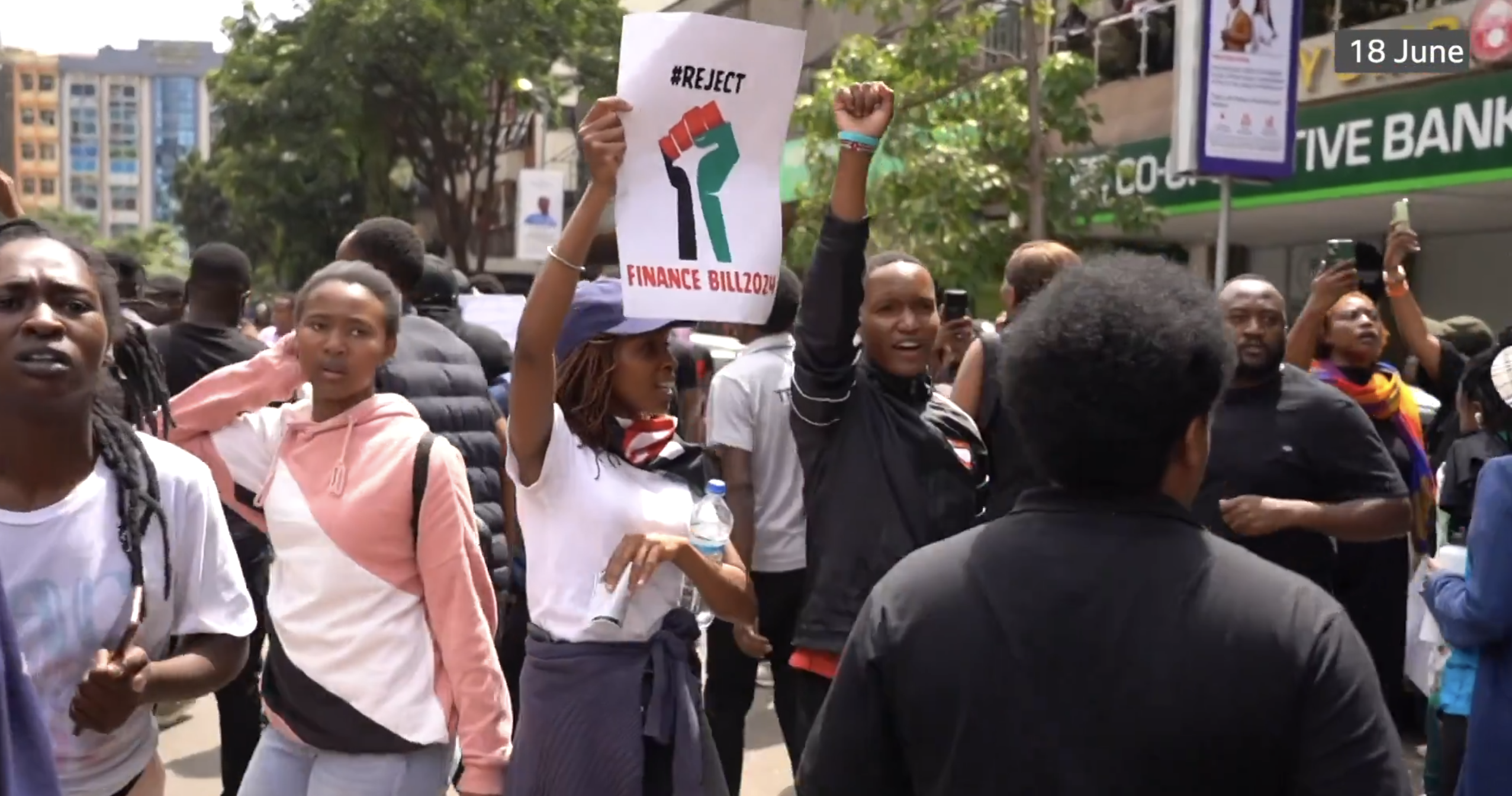
Protesters take to the streets of Nairobi, June 18, 2024 | Image: screen grab from @BBCAfrica / Twitter

In November 1884, diplomats from Europe and America gathered in Berlin to divide the African continent amongst themselves. These outcomes infantilized Africa and treated its people as lacking in agency. A wave of colonial partitioning and occupation followed without regard for the wishes, customs, or political boundaries of Africans. This was the beginning of cultural suppression and the exploitation of Africa’s many resources.


The disruption and division of the continent would eventually birth a new movement that would challenge colonial powers and call for the reunification of African people. Pan-Africanism is the idea that people of African descent have common interests and should be unified. Since its inception in the mid-19th century, it has evolved into a political or cultural movement encompassing elements including a commitment to global partnerships and multilateralism, a movement for emancipation, decolonization and peace, a demonstration of African agency, and a vision for African regional integration. The latter two strands emerged from the struggle against colonialism and imperial rule and aimed to tackle common issues affecting the continent.

Pan-Africanism was pioneered by visionary leaders like Kwame Nkrumah of Ghana, President Gamal Abdel-Nasser of Egypt, and other revolutionary African leaders. These movements aimed to forge a future for Africa free of Western imperialism. Committed to the unity and liberation of African nations, these revolutionaries first fought for their countries’ independence and later worked to spread their vision by raising awareness among the people of Africa through media.

The vision of these founding postcolonial leaders inspired the creation of Organisation of African Unity (now the African Union) in 1963 to advance cooperation and solidarity between newly independent states and fight against colonialism.

The struggle against imperial rule would later evolve into a democratic movement, with the Pan-African movement aiming to eliminate all African heads of government that reinforced imperialist influence and demanding good governance from leaders. Consequently, numerous historic coups were orchestrated by the Pan-Africanists to achieve freedom for the people. In that era, coups were often bloodless and used to defeat widespread corruption and inefficiencies. Coups were liberation movements in power that often began as revolutionary groups that would later transform into ruling parties. Notable amongst them was the Egyptian revolution led by the Free Officers, led by Gamal Abdel Nasser, who carefully planned and executed a coup in 1952 to overthrow King Farook. Nasser would become president in 1956 and led Egypt to become the first modern African state to initiate revolutionary land reforms and nationalize industries in Egypt.

Colonel Muammar Gaddafi of Libya also planned and overtook leadership from the Senussi monarchy of King Idris, an administration strongly supported by the British. Gaddafi set out to tackle the unfair economic legacy of foreign domination. Gaddafi’s government nationalized the oil reserves and used the revenue to fund redistributive programmes for the people. In a short time, Libya became a beacon of hope for all of Africa with the highest standard of living on the continent. Gaddafi is remembered as the man who fought against the hegemony of the West in Africa. Gaddafi supported a borderless “United States of Africa” to transform the continent into a single nation-state ruled by a single government and funded several revolutionary and reactionary groups in Africa. Although Gaddafi’s vision ultimately led to policies that were contrary to fundamental rights – such as full control of the media, and funding rebel groups within Africa that depleted Libya’s resources, leading to economic decline and internal rebellion in Libya – many still consider Gaddafi as a revolutionary hero.

Thomas Sankara overthrew the government in Burkina Faso, formed the National Council of Revolution, and became the president. The main aim of Sankara’s democratic revolution was to create some of the most widespread social programmes in Africa. Sankara implemented educational programmes that increased the literacy rate of Burkina Faso from 17 to 73 percent, appointing women to high positions of the administration while outlawing forced marriage and building infrastructure to develop the country, all with the larger goal of disbanding imperial domination.

These Pan-Africanist-military leaders advocated ending imperialism at an exceptionally young age. Gaddafi was 27 at the start of his rule, and Nasser and Sankara were both 34 at the inception of their rule. It is unsurprising, therefore, that Nasser repeatedly emphasized the role of youths in raising awareness about the ideals of Pan-Africanism among their peers and communities. To Nasser, by organizing protests, marches, and campaigns to highlight issues affecting the continent, the youths were driving change and unifying the continent.

Nasser’s position accurately represented the power and influence of African youths. Africa is the continent with the highest youth representation, with about 70 percent of its population aged below 30. They are stakeholders in shaping any movement within the continent including the Pan-African vision. They continue to raise consciousness on the struggles of the continent and fight against political rule that supports imperialist ideas while demanding good governance.

By way of example, the success of the recent military junta in Niger was largely driven by the strong support of the youth in Niger and neighbouring countries. Niger’s Sahel is a resource rich region; the seventh largest uranium producer in the world. This region is also a huge exporter of gold, coal, and oil, amongst other resources. However, the immense wealth of Niger does not benefit the people. The wealth of Niger, like the wealth of most African countries, is exploited by imperialists. Uranium extracted from Niger fuels one in three light bulbs in France – while the indigenous people of Niger live in penury. To worsen matters, Niger lost over $906 million in World Bank arbitration cases against French multinationals while France holds 50 percent of Niger’s monetary reserves. Recent takeovers in Mali, Burkina Faso and Chad replaced neo-colonial regimes with military juntas. The military juntas have strong anti-imperialist sentiments and strong nationalist foundations.

Although ECOWAS did not support the military junta and set up a no-fly zone in Niger, in an attempt reinstate president Bazoum, Burkina Faso and Mali showed solidarity by pledging to defend Niger from any foreign military intervention. Guinea-Conakry also expressed the intention to refuse to take any action against Niger if ECOWAS requested it, while Algeria warned against any foreign military intervention. The support of Burkina Faso and Mali would eventually lead to the exit of Burkina Faso, Mali and Niger from ECOWAS, sparking concerns about the future of regional unity and, by extension, the Pan-African vision.

The Mali military junta was fuelled by weeks of protests from the youths who were demanding the resignation of President Ibrahim Boubacar Keita. The people condemned his administration for its inability to restore security, the mismanagement of the economy, and failure to improve living standards. These factors were elements that Thomas Sankara highlighted as important to guaranteeing Pan-Africanism. Although the coup sparked international criticism, Malian youths welcomed the military junta and the leadership of Colonel Assimi Goita, who was 38 years old at the time of the junta.

It was the same with the military coup in Burkina Faso. The people have long voiced their discontentment with the deepening security crisis in their country, which had killed over 7,569 people and displaced more than 1.6 million, according to UN estimates. In response to the discontent expressed by the people, President Roch Kabore’s administration was terminated, and Ibrahim Traore took over leadership of the country at the age of 34. Traore’s leadership resonated deeply with the African youth, who see in him a leader unafraid to confront exploitative structures of global financial institutions and foreign powers.

The advocacy of the youth in Africa and their boldness towards challenging governance that does not serve the interest of the people is an indication of Pan-Africanism and calls for rethinking the political structures of African states. Many of these political structures were adopted from the colonialists, and by challenging them, the youths moved towards building a political system more suitable to African needs. Their activism aligns with Kwame Nkrumah’s “Seek ye first the political kingdom.” African youths recognize that by achieving political empowerment, whether as gaining independence from colonial powers or demanding good governance, other desirable outcomes like social and economic benefits will naturally follow.

In line with Nasser’s ideologies, the youth have also used the media to raise awareness about Pan-Africanism. The quest for freedom amongst African youth birthed movements such as Y’en a Marre in Senegal, Balai Citoyen in Burkina Faso, Filimbi and La Lucha in DRC and Ça Suffit Comme Ça in Gabon as well as the Pan African Youth Union which operates under the AU with the specific mandate of gathering and rallying young Africans to realize the objective of the African Union. However, the extent to which the aim of AU can be achieved with its continuous dependence on the colonial nations is questionable.

In this digital age, youth have leveraged technology both to raise awareness about Pan-Africanism and amplify their call for better governance. Groups like Pan-African Worldwide, Pan-African Review, and School of Pan-African Thought, amongst others on Facebook and Twitter, consistently share insights on the fight against imperialism. In their push for better governance, the youth have used hashtags, including the #Feesmustfall in South Africa; #EndSARS in Nigeria, and #RejectFinanceBill2024 in Kenya to share their struggles and tell their own stories, free from the influence of imperialist narratives.

Certainly, the youth have not achieved these without resistance as governments have resorted to violence to manage public dissent. But, despite political intimidation and attempts to suppress them, the youth have remained determined in their fight against imperialism and demand for good governance.
WATER IS LIFE

Protest Rights Are at Stake as Pipeline Company Brings Greenpeace to Trial

Greenpeace faces a $300 million lawsuit from Energy Transfer Partners, the company behind the Dakota Access Pipeline.
February 24, 2025
Source: Truthout

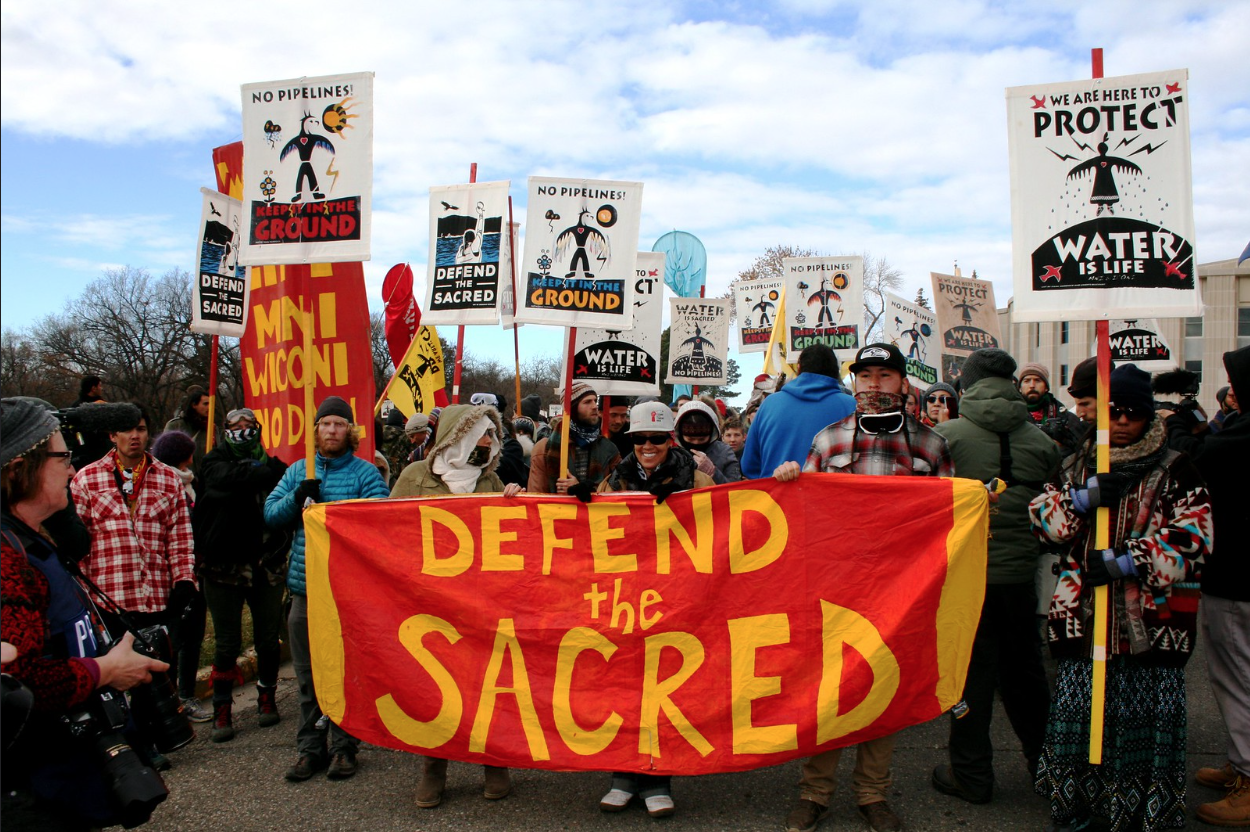
Photo by Leslie Peterson

A civil trial commences on February 24 that will determine whether Greenpeace must pay $300 million in damages to Energy Transfer Partners, the corporation behind the Dakota Access Pipeline (DAPL). The lawsuit alleges that Greenpeace “incited” and masterminded the NoDAPL Water Protectors uprising of 2016-2017, in which thousands of Indigenous people and allies gathered on Standing Rock Sioux lands to protest DAPL construction. On the basis of a legally circumspect theory of collective liability, the lawsuit seeks financial compensation for crimes committed by protesters, as well as damages for business relationships frayed by a successful divestment campaign directed at DAPL investors.

In 2016, protests began against DAPL, a pipeline slated to ferry fracked oil underneath a fragile water crossing a mere half mile north of the Standing Rock Sioux Nation. Using tactics ranging from confrontational demonstrations to divestment campaigns, protesters stalled construction, forced environmental reevaluation of the permit and caused investors to pull out of the project. Although Donald Trump approved the pipeline during his first administration in 2017, the movement successfully delayed construction and increased the cost of the project.

After the dust settled, Energy Transfer Partners sought someone to blame. At first glance, Greenpeace was an unlikely target. From the outset, the movement was led by the Standing Rock Lakota/Dakota people. But the law firm behind Energy Transfer Partners’ suit had a playbook ready. A year prior, the firm sued Greenpeace over its advocacy against a forestry company harvesting in a sensitive boreal forest. In 2017, Energy Transfer Partners filed a civil RICO suit alleging that Greenpeace, along with other major environmental advocacy organizations, ran an illegal racketeering enterprise. Written in order to catch slippery members of the Mafia, RICO statutes employ a vague definition of extortion. Corporations have exploited this breadth to pursue constitutionally circumspect cases against activist organizations of all political leanings. In the 2017 suit, Energy Transfer Partners filed an 187-page complaint making a staggering array of allegations, including that Greenpeace facilitated interstate drug trafficking and that Democracy Now! promulgated a disinformation campaign.

That case was thrown out of federal court, but Energy Transfer Partners filed a subsequent lawsuit in North Dakota state court, this time alleging conspiracy and defamation. The suit comprised three major allegations: that Greenpeace made false statements to “incite” protests; that Greenpeace organized and funded property destruction and violence; and that Greenpeace defamed Energy Transfer Partners by making false statements to DAPL lenders and investors. The key ingredient — an aggrieved corporation alleging defamation over First Amendment-protected speech — places this suit squarely within the category of Strategic Lawsuits Against Public Participation (SLAPPs), with an added element of collective liability for protest. Thirty-five states and Washington, D.C. have SLAPP protections, but North Dakota has none.
“Inciting Protest”

In 2016, when Greenpeace received word that Indigenous groups at Standing Rock needed outside support, the organization put boots on the ground in North Dakota. Greenpeace supported the Indigenous People’s Power Project, a nonprofit group that teaches protesters nonviolent direct action tactics.

“We were working to empower others to teach and share skills, particularly around deescalation. Nonviolence is something we care deeply about, and we believed in supporting that,” Deepa Padmanabha, senior legal advisor to Greenpeace, told Truthout.

Conscious of the history of environmental movements ignoring Indigenous activism, Greenpeace sought out the opportunity to play a support role in the NoDAPL fight.

“Big Greens have a problematic history of white supremacy, patriarchy, all of the things,” Padmanabha said, using the term “Big Greens” to refer to large environmental advocacy nonprofits. “And this was an example of how a Big Green could actually be there in solidarity and be an ally for frontline fights led by impacted communities.”

From the point of view of Greenpeace — and many Indigenous organizers — Greenpeace showed up to provide support at a critical juncture, at the upswell of the Sacred Stone protest camp. According to the lawsuit, the direct action training covered how protesters could lock their bodies to construction equipment and form blockades.


Energy Transfer Partners will argue that Greenpeace should be held liable for any illegal conduct of individuals that took place at protests.

Led by Indigenous organizers, protesters blocked roads, locked themselves to construction equipment and held mass demonstrations. At one point, the sheriff of Morton County issued orders to halt construction due to the safety hazard posed by protesters. Delays in construction bought time — time for legal cases to proceed through court, for the movement to grow and for divestment campaigns to proceed.

When police and private security responded to protests by bringing in attack dogs and injuring hundreds by blasting water cannons in subfreezing weather, NoDAPL hit international headlines. At its peak, during Thanksgiving of 2016, several thousand people occupied the Sacred Stone protest camp. Indigenous people from around the country turned out in solidarity with the Standing Rock Lakota/Dakota people. An Indigenous veteran of the 1973 Pine Ridge standoff remarked that these DAPL protests were reminiscent of the American Indian Movement uprising at Wounded Knee.

During the trial, lawyers for Energy Transfer Partners will argue that Greenpeace orchestrated the protests. Both Greenpeace and Indigenous organizers of the movement expressed outrage at the narrative woven by the pipeline company.

“It’s history repeating itself,” said Indigenous NoDAPL organizer Waniya Locke, responding to a question from Truthout about how the lawsuit’s allegations were received among Indigenous communities. “It’s very, very discomforting that they’re trying to erase the Indigenous narrative straight across the boards, from education, to big media, down to this lawsuit.”

In court, Greenpeace will be forced to defend itself against allegations that the organization — rather than Indigenous organizers — led DAPL protests. Energy Transfer Partners will argue that Greenpeace should be held liable for any illegal conduct of individuals that took place at protests, going so far in the complaint as to allege that Greenpeace served as a “front organization” for a particularly militant wing of the movement. Engaging a dangerous theory of collective liability, Energy Transfer Partners’ lawsuit seeks to hold Greenpeace responsible for protesters who threw Molotov cocktails, burned construction equipment and brought knives to protests. Under this theory, organizations and individuals providing training could hold almost unlimited liability for the downstream actions of other people, regardless of whether crimes committed were in violation of the principles espoused. Earlier this year, a district court ruled that a protest organizer could not be held liable for violence committed by an attendee acting against the intent of the organizer. The ruling did not deter Energy Transfer Partners.

Padmanabha expressed concern about the impacts an adverse ruling would have on civil society: “By creating that sort of collective liability, anybody who has any involvement in training, principles of safety, of nonviolence, of deescalation, can be held accountable for anything that happens. That precedent is intended to have a chilling impact.”
SLAPPed for Speech

Retaliation for First Amendment-protected speech is a hallmark of SLAPPs, and Energy Transfer Partners’ suit fits the pattern. Energy Transfer Partners is seeking the last word — and $300 million in damages — on points of political contention between the pipeline company and the Standing Rock Lakota/Dakota people.

At the epicenter of the DAPL fight was concern over the risks to the water supply posed by the pipeline’s crossing under Lake Oahe. The land at issue, aside from being part of broader unceded Lakota/Dakota homelands, also belonged to Standing Rock under the treaty establishing the reservation until 1944, when the U.S. government seized the land under eminent domain. Greenpeace, along with virtually every other organization supporting the NoDAPL struggle, affirmed the Standing Rock nation’s claim to the land. In the suit, Energy Transfer Partners seeks damages over this political — and constitutionally protected — assertion.

“If a member of the Standing Rock Sioux, or really anyone, gets up in public and says ‘this land was stolen,’ that is protected speech,” Sarah Ludington, law professor and director of the First Amendment Clinic at the Duke University School of Law, told Truthout. “Said in the context of a protest, for rhetorical or hyperbolic effect, the Supreme Court has held that that kind of speech is covered by the First Amendment.”

Awarding damages requires proving financial harm, and in laying out its arguments, Energy Transfer Partners seeks restitution for Greenpeace’s role in a divestment campaign to pressure lenders and investors to drop out of the project. In many ways, the suit affirms the success of the movement. As Greenpeace, Indigenous activists, and other protesters (including me) held demonstrations at physical bank locations, encouraged the closure of personal bank accounts and demanded meetings with executives, the dominoes began to fall.

Energy Transfer Partners was forced to field queries from DAPL’s financial backers, and as the campaign escalated, stakeholders began to drop the project. ABN AMRO announced it would not pursue new business with Energy Transfer Partners. Five other banks sold their shares in Energy Transfer Partners and/or the pipeline loan.

In the lawsuit, Energy Transfer Partners seeks retribution for the everyday type of advocacy employed by the divestment campaign. The suit alleges that the rhetoric Greenpeace employed in organizational letters, meetings, social media posts and email campaigns amounted to a defamation campaign impacting relationships with investors and creditors. While Energy Transfer Partners has denied that its suit infringes upon free speech, the suit has been widely condemned as a SLAPP, with ramifications for advocacy and civil society.

“The first thing a libel defense attorney says to a client being sued, is ‘don’t say another word on this matter,’” said Ludington. “These suits are absolutely a way to shut people up.”
Striking a Defiant Posture

The suit has a gloomy outlook in North Dakota, where DAPL protests were assessed largely negatively by surrounding (predominantly white) communities. Ludington noted that North Dakota courts have not made sympathetic rulings toward protesters suing over police misconduct. Earlier this year, a dark money group mailed the potential jury pool fake newspapers maligning the protests and lauding Energy Transfer.

Greenpeace has struck a defiant tone, and will appeal to state and federal Supreme Courts if necessary. The organization launched a “We Will Not Be Silenced” campaign, looping in grassroots supporters and civil society. Over 290 organizations signed a letter of solidarity. (Disclosure: My former employer, a nonprofit organization called Defending Rights & Dissent, is a signatory.) In the face of a SLAPP suit intended to dissuade future advocacy, Greenpeace’s defiant tone sends a critical message to the rest of civil society.

The suit “is meant to silence us,” said Greenpeace USA National Program Director Rolf Skar. “And in response we need to give them the exact opposite, to show that this tactic backfires.”
USA

Genocide and Beyond


Monday 24 February 2025, 
by Against the Current Editors


The sadistic savagery of the U.S.-enabled Israeli genocide, and Donald Trump’s executive coup-in-progress in the United States, intersect at Trump’s proclamation of intent to take over, “develop” and ethnically cleanse Gaza of its two million Palestinian residents.

Such pronouncements may have been previously unimaginable, but no longer. As divorced from reality as Trump’s Gaza fantasy is, we must not see that corner of the world as a mere local crime scene: It epitomizes what’s become the normalized collapse of what was thought to be a secure, “rule-based” global system, along with a looming explosion in U.S. domestic politics. We will attempt here to explore the interconnections.

The colossal scale of Gaza’s destruction, the reality of perhaps ten thousand unrecovered bodies under the debris, the annihilation of the health care system, the targeted killings of 200 or more Gaza journalists — all these are only pieces of the picture of the Israeli state’s attempt to pulverize an entire society beyond hope of reconstruction.

And yet, despite everything — January 27 saw hundreds of thousands of Palestinians returning to northern Gaza, seeking to rebuild shattered homes, families and communities out of almost nothing. It’s criminal for anyone to fantasize that Gaza or Palestine have “won” this hideous war, but the mass return to the area that the Netanyahu government openly intended to depopulate shows that Israel hasn’t “won” either.

The people of Gaza, even amidst the rubble, have reclaimed their agency to make clear that no Arab regime, no matter how corrupt or servile to U.S. imperialism, could afford to indulge Israel’s ultimate ethnic-cleansing fantasy.

During Phase One of the fragile ceasefire that may never see Phase Two, the release of some of the Israeli captives held hostage by the military wing of Hamas or other factions, and freedom for a few hundred among tens of thousands of Palestinian prisoners held by Israel, was of course welcome. This can’t hide the magnitude of the Gaza horror, or the fact that an unknown number of the hostages have died in Israeli air strikes or building demolitions. Nor are we justifying the fact that on an incomparably smaller scale, the Hamas-led attack on October 7, 2023 committed murderous crimes against civilians.

Right now, might the European Union be prepared to punish Israel over its blatant ceasefire violations and threat to renew the assault on Gaza that Netanyahu promised, with all its catastrophic consequences? And will Israeli society — despite the revenge lust that has consumed much of it since the October 7 attack — continue to support a government that would sacrifice the remaining hostages’ lives to satisfy its ambitions of conquest?

Without knowing any of that, it is possible to reflect on some lessons of the past and present. How could what passes for “the international community” allow the annihilation of Gaza to happen in broad daylight? A stunning juxtaposition of events on January 27 may help to highlight this tragic question.
Then and Now

The march of half a million Palestinians returning to what remains of northern Gaza happened to coincide with the ceremonies on the 80th anniversary of the liberation of the Auschwitz-Birkenau death camp complex in Nazi-occupied Poland.

Watching these events side by side was overpowering, not least as Auschwitz survivors in their 90s spoke of their fears that “it could happen again” in a world of rising nationalist and racist hatreds. It’s an invitation, even a commandment, to face why it is indeed happening again when it’s so much more visible and preventable.

Regarding the Nazi holocaust, historian Arno J. Mayer wrote his book Why Did the Heavens Not Darken? to explore the world’s relative indifference to the genocide as it became known. What about today? It’s not that genocidal crimes should be measured against each other in terms of their scale, or the meaningless question of which is “worse” — but one can compare how global powers responded or failed to respond in their respective times.

The Nazi holocaust occurred in the context of an all-consuming world war that for many countries posed the question of physical survival. Second and related, as the Verso Books publisher’s summary observes:

“Mayer demonstrates that, while the Nazis’ anti-Semitism was always virulent, it did not become genocidal until well into the Second World War, when the failure of their massive, all-or-nothing campaign against Russia triggered the Final Solution.”

The real extent of the Nazi exterminationist campaign had begun to emerge around late 1942, and only by 1943 was it becoming widely known. (The early mass slaughters in Nazi-occupied eastern territories were mostly under the radar.) Furthermore, whatever the Allied powers knew and when, there was effectively no way to stop it — despite some wishful thinking, for example, that they “could have bombed the rail lines to the death camps,” which were at the outer limit of the air capacity of the time — except by defeating Nazi Germany in the war.

Antisemitism of course played a role in why there was not great wartime concern over the fate of the Jews of Europe. But this would become a much bigger factor after the war, when the great Western democracies mostly closed their doors to desperate holocaust survivors, leaving masses of Jewish refugees nowhere to go — except to Palestine where the Zionist movement needed them to come, setting the stage for what became the 76-year, and continuing, Palestinian catastrophe.

Unlike the World War II Nazi genocide, the Israeli-U.S. Gaza assault has happened in the open, “the first live-streamed genocide” as it’s been accurately described. The only way not to see it is by deliberately choosing not to look.

Further, halting this genocide could not have been simpler: Only with the massive continuous supply of U.S. weapons could the Israeli military sustain the pace of the war beyond a few weeks. A “Stop” order from Washington at any time would have suspended the slaughter.

It’s not that this would have resolved the fundamental issues of occupation and ethnic cleansing that preceded and led to October 7 — issues that the war in any case has only made worse — but tens of thousands of Palestinian lives and hundreds of thousands gravely wounded, several hundred Israeli soldiers, and dozens of hostages, would not have been needlessly lost.

Keep in mind too that unlike the 1940s when there was general unconcern (with heroic exceptions) for the fate of Jews, today there is overwhelming global popular sympathy for Palestinian lives and freedom.

By and large the world’s elites either don’t care, or align with what the critical historian Ilan Pappe calls “Global Israel” — spearheaded by U.S. imperial power and Christian Zionism — but among the people the tide is with “Global Palestine.” (Professor Pappe’s new book on Lobbying for Zionism in the United States and Britain is reviewed elsewhere in this issue of Against the Current.)

All this is why we must continue to insist that the Gaza genocide is the permanent record of Joe Biden’s presidency. Nothing else comes close, and nothing is more pathetic than the question of whether Gaza “tarnishes his legacy.” Gaza is Biden’s legacy, and nothing can “tarnish” or varnish it — including the lunatic acts of his successor in the White House, who promised to end the disaster and instead is expanding it. What was Biden’s war is now Trump’s.

As for the most ominous comparison, go back to the observation from Arno Mayer that the Nazis’ vicious antisemitism became fully genocidal with “the failure of their massive, all-or-nothing campaign against Russia.” The comparison is not exact, but we see today the failure of a “massive, all-or-nothing campaign” by the Israeli state against Palestinian society, whose people refuse to capitulate despite the indescribable destruction inflicted on them.

That points to the chilling potential for Israel’s endless war against Palestine to become literally exterminationist in the coming period. Equally, it shows how much is at stake for the movement globally and especially for that in the United States in defense of Palestinian rights and freedom. We must also fight for the defense of basic rights of speech, dissent and organizing here in the United States, which the Trump gang and the Zionist lobby intend to destroy.
Irreparable Harms

The irreparable harm that’s been done in Gaza only begins with the “official” documented 47,000 deaths — grotesquely undercounted — close to half of whom are children. The loss of limbs, the profound psychological and physical trauma, the destruction of education and health care, and more, will affect the next two generations at a minimum. And the rampage of military and settler pogroms are sweeping through the occupied West Bank shows what the entire Palestinian population is confronting.

The particularly brutal impact on women in Gaza is a huge story in itself, which we briefly discuss elsewhere in this issue of Against the Current. As for the effects on Israeli society, it suffices here to point out how soldiers have filmed themselves, and posted on social media, committing war crimes for their own and friends’ amusement. Add to this the evidence of mass execution sites in Gaza, about which we’ll be learning more in coming months.

Even as Israel has become an international human rights blot, Israeli soldiers’ open glee in displaying their crimes is an indicator of where much of that society is heading, and the poison that will feed back into its polarized politics. Antiwar activists in Israel concede that progressive forces there are unable to bring change from within, and that international action is required to prevent the resumption of all-out — and as we’ve suggested, potentially exterminationist — war.

The Home Front
If Gaza shows us what “the rule-based international order” ultimately amounted to, it really can’t be seen separately from the wreckage of what were supposedly impregnable safeguards in the U.S. political structure.

Donald Trump and Elon Musk’s intentions to destroy constitutional protections and institutional barriers against presidential dictatorship and the destruction of labor, racial justice, gender rights and any other obstacles to unrestrained corporate greed, show as little concern for the “security” of people’s lives in the United States as they have for Gaza.

Trump’s promises to bring down grocery costs won’t be kept anytime soon, or ever. (Have you checked the price of eggs lately?) For the lives of U.S. working-class families and communities, the rhetoric about the “new golden age of prosperity” will be soon enough be shown for the fraud it is.

Two points stand out about the Trump-Musk agenda and the blizzard of overreaching executive orders. First, it’s a war against the majority of the U.S. population, even though most folks don’t yet recognize that reality. It’s about more than arbitrarily slashing the federal work force, as damaging as those cuts will be for essential services, freezing Congressionally-approved spending on programs, denying transgender medical care, or targeting prosecutors for doing their jobs investigating the January 6 Capitol riot. These are chaotic, but systematic elements of an emerging program of austerity along with authoritarian presidential rule.

Second, the transactional and corrupt character of this administration is amazingly open. New York mayor Eric Adams is being shielded from prosecution, in exchange for his collaboration with Trump’s mass-deportation program. Ukraine is about to be thrown under Putin’s tanks, with U.S. aid to depend on the supply of Ukraine’s vital minerals to the United States. Private prisons, the Trump family and cronies, and uber-billionaire Musk himself will be gorging at the trough of contracts while basic government services are gutted.

Why much of the U.S. capitalist class is opting for Trump’s virulent economic nationalism, trade wars against allies as much as against strategic adversaries (China), and destruction of basic government functions, requires a deeper analysis than is possible here. How far the rampage will go, the effects on the global and U.S. economy, the outcome of rulings in the courts and whether Trump might defy them, and what happens in Congressional budget battles — all are also open questions.

We do know that our movements, above all the struggles for immigrant communities, gender rights and justice for Palestine, are in the crosshairs. The bits of good news include the rapid-response networks forming in cities across the country against deportations, and the beginning of the fightback by federal workers and their unions.

The current U.S. administration is both a center of the anti-democratic global white-nationalist far right and an Amen Corner for Israel’s more extreme factions. It’s clear that domestic as well international popular pressure on our own imperialist government is now even more urgent, not just for the survival of Palestine but ultimately for our own.

Against the Current->https://againstthecurrent.org/atc235/genocide-and-beyond/] 19 February 2025

Attached documentsgenocide-and-beyond_a8867.pdf (PDF - 919.6 KiB)
Extraction PDF [->article8867]


Against the Current Editors
Against the Current is published by Solidarity, USA, a sympathizing organization of the Fourth International. It is a bi-monthly analytical journal explaining its goal: as part of our larger project of regroupment and dialogue within the U.S. Left, the journal presents varying points of view on a wide variety of issues. As such, debates are frequent and informative, with the goal of promoting discussion among activists, organizers, and scholars on the Left.


International Viewpoint is published under the responsibility of the Bureau of the Fourth International. Signed articles do not necessarily reflect editorial policy. Articles can be reprinted with acknowledgement, and a live link if possible.

Cowardice and Cancellation:

Creative Australia and the Venice

Biennale


Cowardice is the milk that runs in the veins of many event organisers, especially when it comes to those occasions that might provoke the unmanaged unexpected.  The same organisers will claim to be open minded, accommodating to stirring debate, and open to what is trendily termed in artistic lingo as “provocations”.

The dropping by Creative Australia of Lebanese-born artist Khaled Sabsabi as Australia’s representative for the 2026 Venice Biennale, along with the curator of the pavilion’s artistic team, Michael Dagostino, shows that true artistic subversion is not the game, and uncontroversial subservience the form.  If an arts body fears that the milch cow will be starved, if not killed altogether, they will slight, blight and drop the artist in question and prostrate before Mammon’s moneyed throne.

In Australia’s febrile, philistine and increasingly hysterical atmosphere on matters controversial, debate that supposedly tests what is tepidly termed social cohesion has been cut and mauled to the point of non-recognition.  Journalists are given to following strict talking points on matters of international interest, from President Donald Trump (criticism of all his moves, marvellous) to the issue of Israel (criticism, not quite so marvellous, entailing avoidance of such words as “massacre”, “genocide”, “ethnic cleansing”).

Criticism of Israel’s policies in levelling Gaza and creating an open-air theatre of massacre in real time have led agitating voices in both Israel and Australia to claim that the demon of antisemitism is more virulent than usual.  Threats have been inflated and the opposition leader, Peter Dutton, inspired to secure votes in the months leading up to the federal election.  A pathology has taken root, from art circles to universities.

It began with an intervention by the Australian newspaper, an outlet that Israel can rely on as its pro bono propagandistic emissary down under.  The paper’s sympathetic correspondent, Yoni Bashan, had been embedded with Israeli forces in Gaza.  After receiving a number of messages, Bashan took an interest in Creative Australia’s choice for the biennale, thinking he had scored a coup by going through Sabsabi’s previous work.  This preschool hackwork found a 2007 video installation titled You, which features Hassan Nasrallah, the former leader of the Lebanese Shiite militia group Hezbollah.

Nasrallah, whose voice and image appears in the montage, was slain in the latest conflict between Israel and Hezbollah.  The buffoonish, hatchet assessment (“I’m not an arts reporter,” Bashan conceded in a podcast, calling the art industry “a bit too fluty for me”) claimed that Creative Australia’s selection of Sabsabi was a “creative form of racism”.  Instead of understanding the broader context of the horrors of war which Sabsabi has been preoccupied with, himself a refugee from the Lebanese civil war, the paper was thrilled to have uncovered a terrorist sympathiser.

The falsely revelatory nature of the Australian’s intervention, coupled with a discussion in the Australian Parliament that also scorned a 2006 video titled Thank you very much showing the 9/11 attacks and then US President George W. Bush, was pitifully juvenile.  Tony Burke’s expression of shock was craven, a capitulation that necessitates his immediate resignation as Minister for the Arts.  Within hours of the parliamentary exchange – one could hardly call it a debate – Creative Australia convened an emergency board meeting that unanimously endorsed cancelling the contract regarding the Venice Biennale representation featuring Sabsabi and Dagostino.  It had taken all but six days from the announcement that praised the artist’s work for exploring “human collectiveness” and questioning “identity politics and ideology, inviting audiences to do the same.”

Thankfully, this indecent chapter did provoke resignations and stinging criticism.  Mikala Tai, an important figure in Creative Australia’s visual arts departments over the last four years, wrote to Chief Executive Adrian Collette stating that she had resigned “in support of the artist.”

To the list of resignations can be added artist and board member, Lindy Lee and Simon Mordant, twice commissioner at the Venice Biennale, who told ABC Arts that he “immediately resigned” his role and terminated financial support. “There was a question asked in parliament [on Thursday, February 13] and that subsequently resulted in an unprecedented move by Creative Australia to rescind the contract.”  For Mordant, he could not think of any other situation “in any country in the world” where something of this nature had happened, and “certainly” not in Australia.

To its credit, Sydney’s Museum of Contemporary Art (MCA), which accepted You and exhibited it in 2009, rightly wondered how the decision was reached.  In a statement to the Australian Financial Review on February 21, the gallery expressed concern with “the lack of transparency in Creative Australia’s process.”  The decision had “major ramifications for the arts in Australia and the reputation of Australia in the world at a time when creating space for diverse artist voices and ideas has never been more important.”

Other galleries have been committedly cowardly and silent on the decision, even those whose funding does not depend on Creative Australia.  The Art Gallery of NSW, which ran Sabsabi’s solo show in 2019, is a case in point, merely stating that it was “not commenting on this matter at this time”.  Liz Ann Macgregor, who ran the MCA for over two decades till 2021, offers a cast iron reason for the cringeworthy reticence.  “I think people are second-guessing that they might upset some of their donors if they say something.”

The teams shortlisted to join the biennale pavilion were also keen to express their views in an open letter addressed to the Creative Australia board.  “We believe that revoking support for the current Australian artist and curator representatives for Venice Biennale 2026 is antithetical to the goodwill and hard-fought artistic independence, freedom of speech and moral courage that is at the core of arts in Australia, which plays a crucial role in our thriving and democratic nation.”

The letter goes on to ask the salient question.  “If Creative Australia cannot even stand by its expert-led selection for a matter of hours, abandoning its own process at the first sign of pressure, then what does that say about its commitment to artistic excellence and freedom of expression?”  The answer: everything.FacebookTwitterRedditEmail

Binoy Kampmark was a Commonwealth Scholar at Selwyn College, Cambridge. He lectures at RMIT University, Melbourne. Email: bkampmark@gmail.comRead other articles by Binoy.