Tuesday, March 25, 2025

Source: Originally published by Z. Feel free to share widely.

There was a time when the university was imagined as a space of intellectual risk, where thought could move freely, unrestricted by the anxieties of power or professional survival. That time is long gone. Today, for students and faculty alike, the act of writing – of producing knowledge, of articulating critique—is suffused with fear. Not the productive fear that accompanies intellectual rigor, but the dull ache and exhausting fear of consequence. What will this essay, this paper, this published article mean for my future? Will it cost me a job? A fellowship? A visa? Will it mark me, quietly and irrevocably, as a threat? I remember drafting an abstract for a Marxist conference in Berlin, excited by the possibility of engaging with ideas beyond the sanitized limits of our classrooms. It was a small act – writing a 300-word abstract and submitting – but one that felt, for once, intellectually honest. A faculty member, someone I trusted, pulled me aside. Their warning was not unkind. It was pragmatic, even protective: “You have postgrad applications coming up in a few months. Why invite the wrong kind of attention?” I nodded, understanding what was left unsaid. A line on my CV, a question in an admissions interview, an invisible mark against my name – were risks worth taking? The abstract was never sent. But I realised my mistake a day too late. 

The neoliberal university does not need overt censorship; it has perfected the art of silent control. It is not that one is explicitly told what cannot be written—it is that over time, one simply learns what is too dangerous to say. Controversial words disappear from syllabi. Faculty stop assigning texts that might provoke discomfort in the wrong quarters. Students internalize the limits of acceptable inquiry, sculpting their research to fit within an increasingly narrow, apolitical frame. And so, without official prohibitions, entire fields of thought shrink. The range of permissible discourse is not policed through direct suppression but through precarity – through the quiet, unspoken understanding that dissent has consequences.

For many, this fear is not abstract. It is deeply personal, woven into the reality of insecure contracts, shrinking academic jobs, and the quiet but ruthless surveillance of CVs and publication records. A single article, a single critique in the wrong place, can close doors before they even open. In a system where everything – from research funding to job prospects – depends on demonstrating compliance, the most rational choice is silence. And so the university, once imagined as a site of knowledge production, becomes instead a space of careful omission, where what is not written, not spoken, not thought, tells us more than what remains. 

The Violence of Silencing: When Ideas Become Personal

At its core, academia is not just a site of learning – it is a space where ideologies collide, evolve, and take form. Disciplines are not built on neutral facts but on contestations, on the ability to question, challenge, and defend ideas. Every field, from history to law, from literature to political theory, is shaped by the ideological commitments of those who inhabit it. To study is not just to accumulate knowledge; it is to position oneself within a larger intellectual and political tradition. And for many scholars, especially those engaged in critical, radical, or anti-establishment thought, this positioning is not merely academic – it is deeply personal. To curb discourse is not just to control what can be said, it is to suffocate the intellectual life of a scholar who is committed to their politics. The violence of this is not always visible, but it is relentless. It is in the quiet revisions of a research proposal to remove a politically charged term. It is in the hesitation before citing a scholar whose work has been deemed controversial. It is in the exhaustion of constantly assessing whether a thought is “safe” enough to articulate. Over time, this does not just limit discourse – it hollows out the very purpose of intellectual inquiry. For those who enter academia not as a careerist project but as a site of political engagement, this erasure is not just professional; it is existential. 

A scholar who writes against the grain, who studies capitalism critically, who engages with Marxism, feminism, anti-caste thought, or anti-imperialism, does not do so as an abstract exercise. Their work reflects the world they live in and the world they seek to change. To tell them to self-censor, to sanitize their arguments, to “choose their battles wisely,” is not just a professional warning – it is an instruction to sever a part of themselves, to dilute their own convictions for the sake of survival. The result is an academic culture that is not just fearful but profoundly uncreative. The kind of intellectual risks that produce new ways of thinking are abandoned in favour of work that is acceptable, palatable, and ultimately safe. Scholars who might have produced groundbreaking work instead learn to work within the narrow confines of what will not jeopardize their careers. 

And so, the university, which should be a space of intellectual possibility, becomes instead a space of intellectual resignation. What is lost in this process is not just the vibrancy of academic debate but something more fundamental – the ability to think freely, to create without fear, to exist in a field of study without constantly negotiating one’s own silence. A scholar whose politics are central to their work is not just losing a platform; they are losing a piece of their own mind. And what remains is not scholarship, but survival. 

The University as a Site of Precarity and Control

The university, once imagined as a space of critical inquiry, has been hollowed out by the logic of neoliberalism. No longer an intellectual commons, it now functions as a corporate entity –  managed, bureaucratized, and increasingly detached from the very idea of free thought. The language of learning has been replaced by the language of capital: students are “consumers,” faculty are “service providers,” and knowledge is only as valuable as its ability to secure funding. In this landscape, risk-taking is not just discouraged – it is actively penalized. 

At the heart of this transformation is precarity. Tenure is disappearing, replaced by a workforce of adjuncts, visiting faculty, and contract teachers who have no institutional protection. Their continued employment is contingent on remaining uncontroversial – on being docile enough to secure another short-term contract, on ensuring their research does not antagonize funders, on performing intellectual labour that aligns with the university’s market logic. Even full-time faculty are not exempt; tenure tracks are narrowing, and promotions are increasingly tied to grant money, which in turn is tied to political and corporate interests. 

The fear that this system produces is not just external – it is internalized. I have caught myself altering my arguments, choosing softer language, avoiding certain keywords even when they are the most accurate descriptors of reality. Sometimes, I do this without even realizing it, as if my mind has already adapted to the consequences of speaking too freely. It was a comrade who first pointed this out to me after reading a draft of mine. “Why are you holding back?” they asked. “This isn’t how you actually talk about this.” They were right. Without meaning to, I had sanded down the rough edges of my argument, made it more palatable, more “academic.” Not out of intellectual dishonesty, but out of habit – out of an unspoken knowledge that writing a certain way would make my work more acceptable, more publishable, less risky. 

I have seen the same fear in my peers, in professors who once spoke more freely but now hesitate, glancing over their shoulders before making a critical remark. It is in the small revisions we make to our papers, the choice of conference panels we avoid, the reluctance to cite scholars who have been marked as “too political.” This is not just about avoiding direct punishment – it is about survival.

We instinctively understand that funding, fellowships, and even future job opportunities depend not just on the quality of our work but on how well we navigate the silent, unwritten rules of academic acceptability. Funding is the unspoken gatekeeper of academia. Research that attracts state or private sponsorship flourishes, while work that interrogates capitalism, caste, state violence, or majoritarianism struggles to survive. The politics of publishing mirrors this dynamic – journals, conferences, and institutional support all subtly, but decisively, steer scholars away from work that is too radical, too unsettling. The choice is clear: conform or be pushed to the margins. 

The cost of this is not just intellectual stagnation – it is the slow death of the university as a space of critical thought. When scholars are forced into self-censorship, when students internalize fear before they even begin writing, when entire fields are shaped not by the pursuit of knowledge but by the imperatives of funding and employability, what remains is a university in name only. A space where learning is reduced to careerism, where thought is managed rather than nurtured, and where the most dangerous thing one can do is think freely. 

The Right-Wing’s Academic Takeover

The shift of universities toward the right is no accident; it is a deliberate restructuring of academic spaces to align with the interests of the state and capital. Administrators actively discourage dissent, not necessarily through direct prohibitions, but through institutional inertia – by making it difficult for radical voices to thrive, by ensuring that funding and career security are tied to compliance. The result is an academic culture where right-wing professors can openly declare, “I am a Zionist,” without consequence, while leftist or critical faculty must navigate their words with caution, knowing that a single misstep could make them targets of smear campaigns, job insecurity, or worse. 

Surveillance, both formal and informal, has become an unspoken reality of the classroom. Students record lectures. Colleagues report each other. A passing comment, a critical remark on state policy, a casual mention of Marx or Ambedkar, can be flagged, weaponized, and used to justify administrative action. This culture of policing does not need state intervention to function – it is internalized, operating within the university itself. Fear replaces discussion. Silence replaces critique. The classroom ceases to be a space of inquiry and becomes one of performance, where the safest thing to do is to say nothing at all. 

The Death of Intellectual Thought

This is not about silencing the right – it is about the left not even being allowed to speak. Academia was never meant to be a monologue; it was meant to be a collision, a space where ideas clashed, where arguments were sharpened through debate, where thought was forced to evolve. What remains when only one side is allowed to speak? What is left to synthesize when a thesis is denied its antithesis? Nothing. Nothing but the slow, quiet death of intellectual thought.

Samyuktha Kannan is a student of law, based out of India. Her work includes research and writing on Kashmir, Political Economy and Carcerality. Her works have previously appeared in places such as ZNetwork.org, Human Geography and Groundxero. 


“Silence”, street mural by Carlos Gomilo | Image via PXHere, Creative Commons CC0

Giving Putin All He Wants
March 25, 2025
Source: Originally published by Z. Feel free to share widely.


Image by Presidential Press and Information Office (Михаил Метцель, ТАСС), Creative Commons 4.0

One thing seems clear to me about these talks: Vladimir Putin is in an enviable position to get what he wants—maybe not all of what he wants, but most of it. In the two-hour conversation between Putin and Trump, Putin agreed only to a pause on attacks on Ukraine’s energy infrastructure—a promise he violated one hour later. He would not agree to a 30-day cease-fire, which to my mind means the Trump plan has already failed. l

As I believe Putin sees it, the Ukraine army is on the run and Donald Trump wants out. Trump has already made concessions even before his telephone conversation with Putin—agreeing to keep Volodymr Zelensky on the outside looking in, agreeing that Ukraine cannot become a member of NATO, and agreeing that Ukraine will have to make territorial concessions. Trump’s team in talks with the Russians is amateurish. People like Steve Witkoff can’t praise Putin enough, believing his every word and assuring one and all that the Russian leader wants peace.

US intelligence is reported to have concluded that Putin aims to have a dominant position vis-à-vis Ukraine once an agreement is reached. He reportedly wants international recognition of Russian-occupied territory and no NATO troops deployed to Ukraine for peacekeeping. Most far-reaching is his demand during his conversation with Trump: termination of all aid to Ukraine, both military and intelligence. Putin, on the other hand, has not been asked to give up anything.

To the contrary, Putin’s agenda is probably very much larger than the above, as Laurie Bristow points out in a recent issue of Foreign Policy. When he says that any agreement must address the “underlying causes” of the war, he means the very existence of Ukraine, which Putin regards as an “anti-Russian project” of the West. He also means that Russia’s security needs go beyond keeping Ukraine out of NATO. Bristow believes it means that “Russia has a veto over other countries’ security arrangements.” And Putin wants to “cut the United States down to size” by decoupling it from Europe.

Does Trump have any leverage over all these Putin’s demands? Sanctions? Sanctions on Russia seem highly unlikely to be used, first, because Trump values Putin’s friendship more than he values Europe’s, and second, because sanctions on Russia would have little impact on its economy. Trump’s threats to use sanctions on Russia to get a deal are, in a word, empty.
Peace Talks with a Limited Future

Beyond the US-Russia negotiations lie two other major issues that are likely to doom them even if Trump and Putin can reach agreement: Ukraine’s likely adverse reaction to a deal, and problems implementing a cease-fire.
Pres. Zelensky has approved the limited cease-fire.

But, quite reasonably, he wants Ukraine to approve every other agreement the US and Russia reach. He certainly is not going to endorse Russia’s occupation of Ukrainian land; nor will he agree to limits on what the Europeans might provide by way of security assistance.

And what about Ukraine’s 20,000 stolen children, and Putin’s war crimes? Zelensky will have to steel himself for the predicted Trump pressure tactics to force his acquiescence. He is very likely to say that no one has the right to sacrifice another country’s sovereignty.

Should a permanent cease-fire be arranged, myriad problems will need attention. Those include international supervision of the cease-fire, agreement of how to handle violations, the locations of a cease-fire along the Russian-Ukraine border, permissible troop and weapon movements, and post-cease-fire arrangements for next steps. Agreement on these matters will be difficult to reach.
Trump’s Strategic Triangle

Trump’s approach to resolving the Ukraine war may have an additional twist that benefits Russia. Recent comments by Trump and Secretary of State Marco Rubio suggest that the US wants to strengthen Russia so as to wean it away from China.

It’s a reversal of the Nixon strategy in the 1970s, when (as part of Henry Kissinger’s strategic triangle idea) US policy was to engage with China in order to weaken the Soviet Union. Rubio said:

“I don’t know if we’ll ever be successful completely at peeling them [the Russians] off of a relationship with the Chinese. I also don’t think having China and Russia at each other’s neck is good for global stability because they’re both nuclear powers, but I do think we’re in a situation now where the Russians have become increasingly dependent on the Chinese and that’s not a good outcome either if you think about it.”

If reducing Russian dependence on China is indeed the US strategy, it further helps explain why Trump has asked nothing of Putin and everything of Ukraine. What better incentives for Putin to move away from China than delivering Ukraine and Europe to him?

Thus does Trump become an easy mark for Putin—his best hope for ensuring that Russia will have predominant influence in Europe—not mainly through military moves, though the threat is there all along Russia’s borderland, but in political influence over far-right parties.

Yet the strategy has numerous holes in it. The Russia-China strategic partnership is tighter than ever, and strongly focused on creating a new world order that can compete with the US bloc. China has far more material benefits to offer Russia than does Trump.

Playing the Russia card, moreover, could easily backfire: Russia takes its gains in Europe without shedding its close ties with Beijing, leaving Trump with nothing to show for having sacrificed an independent country to a very ambitious dictator.

Mel Gurtov, syndicated by PeaceVoice, is Professor Emeritus of Political Science at Portland State University and blogs at In the Human Interest.

UK 

MPs and campaigners demand a free and united Ukraine and an end to Russian occupation

An international coalition of MPs, trade unionists and campaigners have demanded that peace negotiations between Russia and Ukraine bring an end to Russian occupation, justice for war crimes and the return of abducted Ukrainian children. 

Former shadow chancellor and Labour MP John McDonnell, Labour MP for Norwich South Clive Lewis and Labour MP for Nottingham East Nadia Whittome are among the signatories of the Ukraine Solidarity Campaign’s statement, which warns against appeasing Putin and surrendering Ukrainian territory to Russian occupation.

They are joined by representatives from the National Union of Mineworkers, the train drivers union ASLEF and the PCSU, as well as human rights campaigner Peter Tatchell and US-Ukrainian senator Tanya Vyhovsky, as well as a number of Ukrainian trade unionists and labour rights activists. 

The statement comes as Trump sidelines Ukraine in peace negotiations while repeating Russian propaganda, such as false claims that the Zaporizhzhia nuclear power station is on the Russian-Ukraine border. Trump’s favourable approach to Putin, combined with false statements that Ukraine bears responsibility for Russia’s full-scale invasion, raises concerns that any peace deal will favour Russian aggression and punish Ukraine.

People living in Russian-occupied regions of Ukraine endure torture, homelessness, sexual violence, summary executions and daily oppression. Prisoners in the occupied regions are held in terrifying conditions, malnourished and beaten. And the ongoing horror of child abductions with the intent of Russifying Ukrainian children is a form of genocidal violence.

The Ukraine Solidarity Campaign is therefore demanding that any peace negotiations end Russia’s occupation of Ukraine, with justice for war crimes committed by Russian forces, and the return of Ukrainian children to their homes and families. 

The statement also makes clear that Ukraine must be given the aid it needs to win this war, with frozen Russian assets in Europe released to help fund military aid and a fair, just reconstruction. Signatories recommend a Save Ukraine summit that brings European and other leaders together to plan for a sustainable and fair peace, while rejecting Trump’s coercive approach that seeks to extract Ukraine’s mineral wealth in exchange for support. 

“If Britain is to maintain credibility in its steadfast support for Ukraine, it cannot afford strategic ambiguity,” said Clive Lewis MP. “It must anchor itself firmly within a European security architecture. Any lingering fantasy of an unbreakable ‘special relationship’ with the US must confront the cold truth: America, under Trump’s isolationist spell, is more unreliable than ever.”

Here is the full statement:

A FREE AND UNITED UKRAINE: AN ALTERNATIVE TO RUSSIAN OCCUPATION

The UK government, the labour and trade union movement, and wider civil society, must oppose the imposition of an unjust peace that cements Russia’s occupation of Ukraine.

Ukraine’s natural resources must not be exploited for the benefit of Western corporations and oligarchs. Instead, deals must serve the interests of Ukrainian people and protect the environment under democratic oversight.

A just and lasting peace must align with the Ukrainian people’s right to a free, democratic and united Ukraine.   

Key Points:

1. Aid to Ukraine: Increase aid with critical weapons to restore frontline confidence, strengthening military capabilities, and rejecting any loss of sovereignty.

2. Economic Measures: Transfer frozen Russian assets to Ukraine, cancel Ukraine’s international debt, and implement stronger sanctions against Putin’s regime and the oligarchs who support it.

3. International Support: Convene an emergency “Save Ukraine” summit of European and allied nations for necessary military and financial support, ensuring Ukraine can negotiate freely without coercion.

4. Justice for War Crimes: Establish international mechanisms for justice and accountability for Russia’s war crimes and the crime of aggression. The abducted Ukrainian children must be returned, and the perpetrators brought to justice.

5. Reconstruction of Ukraine: Support a progressive, socially just reconstruction with democratic participation that empowers Ukrainian trade unions and civil society.  Withdraw the proposed Labour Code that restricts workers’ rights and unions.

6. Opposition to Trumpist Reaction: Recognise Trump’s alignment with Putin and his coercion of Ukraine, posing a threat to global democracy. The government should rescind its offer of a state visit and rally Europe to act independently.

7. Reverse Foreign Aid Cuts: Finance Ukraine’s defence by seizing Russian assets, imposing taxes on billionaires and corporations, and relaxing fiscal regulations. Cutting foreign aid is counterproductive and weakens support for Ukraine.

 Signed:

John McDonnell,  Labour MP for Hayes and Harlington

Clive Lewis, Labour MP for Norwich South

Nadia Whittome, Labour MP for Nottingham East 

 Chris Kitchen, General Secretary, National Union of Mineworkers

Mick Whelan, General Secretary, ASLEF

John Moloney, Asst General Secretary Public and Commercial Service Union (personal capacity)

 Mick Antoniw, Welsh Senedd Member for Pontypridd

Tanya Vyhovsky, Progressive/Democrat Senator, Vermont, USA

 Olena Ivashchenko, Director  of Campaign for Ukraine

Christopher Ford, Ukraine Solidarity Campaign

Mariia Pastukh, Vsesvit Ukraine Solidarity Collective

 Vasyl Andreyev, President of the Construction and Building Materials Workers Union of Ukraine,

Yury Levchenko, Chairman People Power, Ukrainian labour party

Oksana Holota, KVPU, Confederation of Free Trade Unions of Ukraine (pc)

Daryna Korostii,  President of Ukrainian Student Society (UL)

Pavlo Holota, NGPU, Independent Trade Union of Mineworkers of Ukraine (pc)

 Peter Tatchell, Human Rights Campaigner

Mark Serwotka, General Secretary, PCSU (2005-2024).

Meeting tonight:

On 24th March Ian Lavery MP is hosting a special meeting in Parliament on behalf of Ukraine Solidarity Campaign, with two left-wing political leaders of Ukrainian heritage from the US and UK, both speaking in person:

• Tanya Vyhovsky is a State Senator in Vermont. She is a member of the Vermont Progressive Party, and works with Bernie Sanders (who lives in her district!)

• Mick Antoniw is a member of the Welsh Senedd and was Counsel General for Wales 2021-24. He is a member of Ukraine Solidarity Campaign’s steering committee.

Alongside the discussion, we will be launching the above charter of demands for stronger UK and international solidarity with Ukraine and with its workers’ movement. Please join us for this important event. Register here: http://bit.ly/tanyavmeeting.

Please note that this event is only for those who have registered. It is a free event, but please consider buying a paid ticket. Funds will go to our new appeal in support of the “Step To Victory” Humanitarian Headquarters social centre in Pershotravensk / Shakhtarske, in the Dnipropetrovsk region. 

Source: LittleSis.org

Last week, thousands of people gathered in Houston, Texas for CERAWeek 2025, perhaps the most significant annual meet-up of the network of oil executives, investors, consultants, government officials, and more, that make up and support the fossil fuel industry. 

Inside the gathering, oil, finance, and tech executives joined a slew of panels discussing a range of energy industry topics. Top Trump officials spoke, including US Energy Secretary Chris Wright and US Interior secretary Doug Burgum. According to Guardian climate reporter Dharna Noor, “Wright said global warming was merely a needed “side-effect” of modernization, while Burgum called to “take our natural resources and turn them into natural assets.” 

Meanwhile, outside CERAWeek, hundreds of climate activists protested the conference’s display of billionaire power and celebration of fossil fuels, with several activists arrested. 

What is CERAWeek, anyways? Who or what is the power behind CERAWeek? What functions does CERAWeek perform for the fossil fuel industry power structure? Who were some of the key billionaires at CERAWeek? This primer will address these questions.

What is CERAWeek?

CERAWeek is a massive, transnational gathering of powerful people tied to the energy industry, including top fossil fuel executives, big financial investors, and high-level government officials and regulators.

The Houston Chronicle — newspaper of the fossil fuel capital of the US, where CERAWeek is held — has labelled the event the “Super Bowl of energy,” awash with “energy insiders.” Climate activist Bill McKibben has referred to it as “the hydrocarbon world’s biggest festival, a Davos for carbon.”

CERAWeek performs several functions for the energy industry. These include serving as a space to discuss and debate industry trends; engage in networking and dealmaking; hold high-level conversations between executives, investors and regulators; and broadly, to promote and legitimize the industry with a high-profile event.

Thousands of participants attend CERAWeek. In 2023, around 7,200 people from 90 countries flocked to the event. It claims to be rated among the top five “corporate leader conferences” worldwide.

Leaders from the highest heights of politics and industry attend CERAWeek. Past speakers have included Bill Clinton, George W. Bush, Justin Trudeau, Narendra Modi, Henry Kissinger to Bill Gates.

This year, new Trump Energy Secretary Chris Wright and Interior Secretary Doug Burgum were speakers, along with CEOs or other top executives of fossil fuel companies that span the gamut of the industry, from Big Oil giants to LNG export companies, oil pipeline corporations to utilities. Some of these include ExxonMobil, Chevron, Shell, ConocoPhillips, Oxy, BP, Cheniere, Pioneer, Enbridge, NRG, EQT, Baker Hughes, Hunt Energy, Williams Companies, Hess, NextEra, National Grid, and Freeport LNG — just to name a few. 

Harold Hamm of Continental Resources — maybe the industry’s closest ally to Donald Trump — was a speaker. Top leaders from industry groups like American Petroleum Institute, American Gas Association and Edison International attended. 

Critically, major Wall Street investors and tech giants also attended CERAWeek. These include asset managers like BlackRock, private equity firms like Carlyle, Apollo, and Blackstone, and tech corporations like Amazon, Microsoft and Alphabet (the parent company of Google).

Nor is CERAWeek a solely U.S. affair. Government and corporate representatives from countries all over the world — Saudi Arabia to Canada, Turkey to Nigeria, South Korea to Kuwait — attended as well.

Who Rules CERAWeek?

While CERAWeek is filled with industry representatives, it’s dominated by major corporate players. Different “Partners” sponsor the conference, presumably through hefty fees, and the biggest sponsors gain the most access and power in shaping the event’s tone and content.

For example, according to the sponsorship brochure from the 2024 CERAWeek conference, the highest level of sponsorship, which is limited to just a few corporations and firms, is “Foundational.” 

These sponsors “benefit from the highest levels of access, visibility, and executive support” and “play a leadership role within the CERAWeek community and are provided premier engagement and contribution.” Foundational Partners also “may collaborate with CERAWeek to develop a customized Special Program or community aligned with specific objectives.”

This year’s Foundational Partners were Chevron, Amazon, and BlackRock, as well as professional services firm Marsh McLennan and the coal company Xcoal. 

The next level of Partners are “Strategic,” which “supports active engagement and access across a wide range of the CERAWeek community.” Among other things, Strategic Partners’ “objectives are supported by the CERAWeek Steering Committee,” and these Partners “receive priority consideration to contribute content and access to CERAWeek Private Communities.

Strategic Partners for CERAWeek 2025 included ExxonMobil, BP, Shell, EQT, Freeport LNG, NextEra, Carlyle Group, Microsoft, and dozens more.

Notably, a major power player behind CERAWeek is Daniel Yergin, a Pulitzer-prize winning author who helped found the conference over four decades ago and serves as chairman of CERAWeek and Vice Chairman of S&P Global, the well-known financial services company that runs CERAWeek (read more on Yergin below).

The Fossil Fuel Industry, the Houston Power Elite & the Houston Police Foundation

The power elite of Houston is deeply intertwined with the fossil fuel industry. Energy companies dominate the board of the city’s main chamber of commerce, the Greater Houston Partnership, making up around a quarter of its membership. Houston is one of the fossil fuel corporate headquarters of the world, home to key global and regional offices of many numerous companies including ExxonMobil, ConocoPhillips, Phillips 66, Occidental, and many others.

The fossil fuel industry also has a close relationship with the Houston Police Department through the Houston Police Foundation, a non-profit that channels corporate donations to city police. Oil billionaires like Jeffery Hildebrand sit on the Houston Police Foundation board, and the foundation helps fund police programs, including the Mounted Patrol that aided attacks on climate activists during CERAWeek. 

The Houston Police Department used horses to try to disperse activists peacefully protesting CERAWeek, injuring and nearly trampling people in the process. Several fossil fuel corporations sponsor the Houston Police Department’s Mounted Patrol horses through the Adopt-A-Horse program. Credit: Luigi Morris.

In fact, oil companies like Chevron, Shell and Valero sponsor individual Mounted Patrol horses. (For more on police foundations and their ties to the fossil fuel industry, check out our 2020 story and our 2021 report coauthored with Color of Change).

CERAWeek and the Fossil Fuel Industry Power Structure

CERAWeek performs several roles within the fossil fuel industry and wider energy power structure. 

Legitimizing the Fossil Fuel Industry

While CERAWeek ultimately functions as a show of force for the fossil fuel industry and a space for it to hash things out, it has a veneer of legitimizing wonkiness and expertise. 

CERAWeek was founded by Daniel Yergin in the early 1980s, a decorated author who has carved out a space as a benign interlocutor between the fossil fuel industry and civil society — an author with intellectual bona fides who has deep and direct personal ties to the corporate energy world. 

Yergin has numerous influential ties to academic institutions, like MIT and Columbia University, and government-aligned think tanks like the Council on Foreign Relations and the Brookings Institution. He has authored several well-known books about the fossil fuel industry — most notably his award-winning The Prize: The Epic Quest for Oil, Money & Power — while also serving on advisory boards and boards of directors of key industry groups and think tanks worldwide.

Over his career, Yergin has run high-profile energy consulting firms and serves as a Senior Advisor with private equity giant Carlyle Group (a “Strategic Partner” of CERAWeek that is also a major fossil fuel investor).

All told, the spectacle of a massive, public-facing conference, well covered by the media, celebrating and discussing the energy industry and its fossil fuel giants, all given a wonkish gloss by analysts, academics and consultants, provides cover for an industry whose core operations are widely known to be driving climate chaos.  

Networking, Schmoozing, Dealmaking

Gatherings like CERAWeek are critical sites for industry networking. CERAWeeks says it convenes “over 450 C-Suite executives, 80 ministers and top officials, and 325 media representatives.” 

Participants chat, schmooze and socialize behind closed doors or at any number of extended Happy Hours. This helps build and cultivate relationships and allows for conversations that lead to new contracts, deals, positions, and so on.

At CERAWeek, this networking is all the more important because many high-level representatives of government and international companies are attending. The energy priorities that are hashed out through these conversations — the formal panels, and also the backroom discussion — can have deep implications for global energy policy and geopolitics (one of the event’s themes).

Taking Stock of Industry Trends and Fractions

CERAWeek’s huge numbers and ambitious agenda also present a moment for taking stock of the energy industry’s present and its future. Conference themes explore the gamut of areas within the corporate energy world. This year’s themes included Policy and Regulation, Oil and Gas, Power, Grid and Electrification, Trade and Supply Chains, Business Strategies, Minerals and Mining, Technology and Innovation, and more.

Different fractions of the energy industry, some aspiring, can also use CERAWeek to make their case. “AI and Digital,” for example, is a conference theme this year. 

The rise of data centers needed to power AI has strengthened the nexus between the fossil fuel industry, Big Tech, and financial investors, at the expense of a green energy transition.

The event is also filled with the world’s top private equity firms and asset managers, who remain not only wedded to fossil fuels but retreated from previous net zero commitments – indeed, Finance (“The Capital Transition”) was a theme of CERAWeek this year.

Greenwashing

CERAWeek is also a performance in greenwashing. The fossil fuel industry today is simultaneously doubling down on its core business of oil and gas extraction and production while also giving lip service to concerns over carbon emissions and seeking to capture and profit from false solutions like carbon capture and hydrogen.

CERAWeek allows the fossil fuel industry to do both these things. The conference is dominated by fossil fuel giants who are currently racing to drill and burn more oil and gas, but also to gobble up subsidies and produce hydrogen plants — falsely promoting hydrogen as a climate “solution.”

Indeed, CERAWeek 2025 included themes like “Managing Emissions,” “Climate and Sustainability,” and “Hydrogen and Low-Carbon Fuels.” But as Kate Aronoff reported on a previous CERAWeek: “There’s some people involved with copper and lithium and various things, but the main focus is oil and gas, and with a pretty specific focus within oil and gas on some of the bigger companies.” 

CERAWeek’s Billionaires

Among the most powerful people at CERAWeek are a slew of oil billionaires, tech titans, and fossil fuel financiers who, whether they show up in person, stand to benefit from the discussions and deal-making that occur at the gathering. Among these are:

  • Harold Hamm, worth $18.5 billion, who is the founder, chairman and CEO of Continental Resources, a top ten U.S. independent oil producer. Hamm, who mobilized industry support for Trump’s reelection, may be the key liaison between the fossil fuel industry and the Trump administration. Hamm celebrated Trump’s inauguration by hosting “an exclusive fossil fuel industry celebration on Inauguration Day” whose guests included Interior Secretary Doug Burgum, according to the New York Times. Hamm was a speaker at CERAWeek 2025.
  • Larry Fink, worth $1.2 billion, who is the founder, chairman, and CEO of BlackRock, the world’s biggest asset manager and a top “Foundational Partner” of CERAWeek 2025. BlackRock is a top shareholder of nearly every publicly-traded fossil fuel company, and Fink may be the most influential CEO on Wall Street. BlackRock was a top sponsor of CERAWeek and, as Dharna Noor of the Guardian reported, Fink wore a silicone bracelet at the gathering that read “make energy great again” — a far cry from his lip service to climate change just a few years ago. Fink was also a speaker at CERAWeek.
  • David Rubenstein, worth $3.8 billion, who is a cofounder and co-executive chairman of private equity giant Carlyle Group, a “Strategic Partner” sponsor of CERAWeek which has numerous fossil fuel holdings. Even when it sold off a hefty portfolio of gas-fired power plants in late 2024, the Private Equity Stakeholder Project said that Carlyle was “perpetuating the climate crisis” by offloading them “rather than responsibly transitioning the assets to clean energy generation or retiring and remediating the damage caused by the assets.”
  • Jeff Bezos, the founder and executive chairman of Amazon worth $214 billion, whose Amazon Web Services was a top “Foundational Partner” of CERAWeek. Amazon and other tech companies that oversee cloud infrastructure stand to profit from the technification of everything and especially the AI boom. As journalist Kate Aronoff writes: “Amazon, Microsoft, and Meta all control cloud computing infrastructure that’s poised to benefit from the energy-intensive vision of AI development these developers are pushing.”

Hundreds of Climate Activists Protest CERAWeek

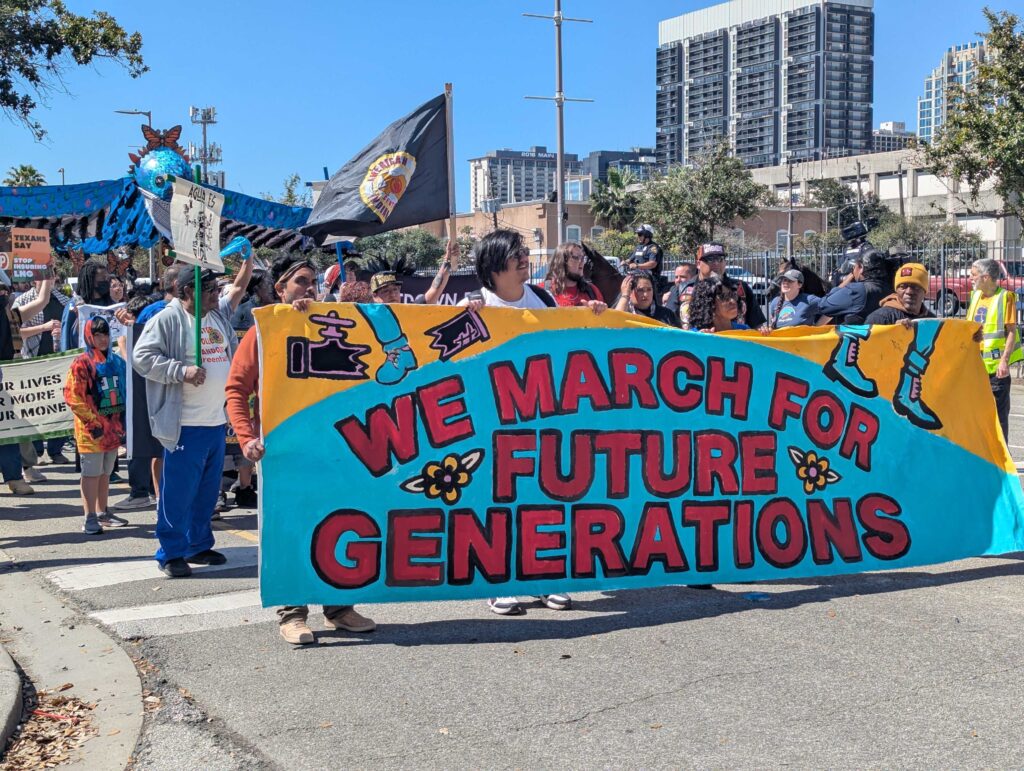
Recognizing the opportunity to disrupt mainstream messaging about CERAWeek, and to confront the fossil fuel industry and lift up the stories of frontline communities fighting fossil fuel infrastructure, dozens of climate justice groups participated in coordinated days of actions protesting CERAWeek. Hundreds of elders, young people, and residents of rural areas and cities, marched to demand an end to fossil fuels and accountability of wealthy polluters.

Hundreds of climate activists marched in downtown Houston to protest CERAWeek. Credit: Lauren Parker.

Activists specifically focused on the build out of methane gas (also known by euphemism “liquified natural gas”) export terminals along the Gulf South. These export terminals rely on transporting fracked gas via pipelines and have notoriously imperiled local communities due to toxic air releasesoverdrawing water resources, and destroying precious marine habitats. In June of 2022, the Freeport LNG terminal actually exploded, sending a 450-foot ball of fire and pollutants into the air, shaking the houses of nearby residents.

Freeport LNG’s CEO, billionaire Michael Smith, was a featured speaker at CERAWeek, stating that methane gas was “necessary”, echoing other speakers’ sentiments which downplayed the urgent need for renewable energy sources.

At the culmination of the march, eight frontline and Indigenous activists and allies sat in the intersection in front of the CERAWeek conference. The Houston Police Department violently attacked these activists with Mounted Patrol horses before conducting arrests.

As noted above, major oil and gas corporations sponsor these horses, underscoring the tight and varied relationships between policing and the energy industry to suppress struggles against fossil fuels.

CERAWeek, an extravagant display of billionaire power and the convergence of the fossil fuel industry, government, tech and finance, stood in stark contrast to those in the march – everyday people fighting for clean water and air in their hometowns, sovereignty for Indigenous communities, an end to extractive energy systems, and a liveable future for generations to come.