Gender Norms in Today’s United States: Cruel, Inhuman, Degrading
May 29, 2025
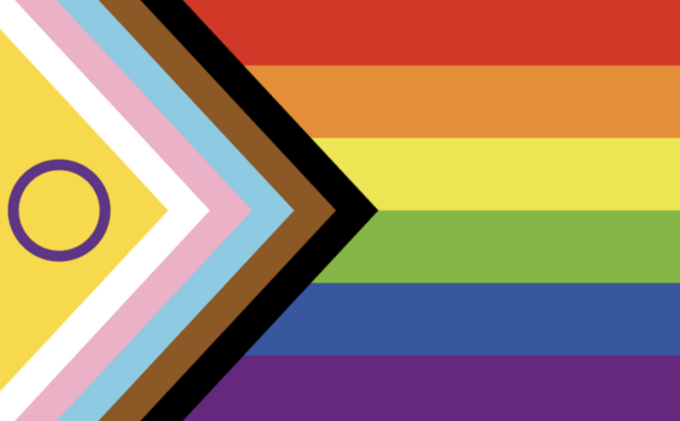
Intersex-inclusive pride flag by Nikki, CC0 1.0 Universal Public Domain Dedication.
Contrary to the opinion of the Trump regime, which recently proclaimed there are only two sexes, the gender binary is false. Nearly two in every hundred people have intersex traits, according to figures often cited by advocates, and by the UN Office of the High Commissioner for Human Rights.
Intersex people have biological variations in their sex characteristics—whether of genitals or internal sex organs, chromosomes or hormones. These traits are sometimes called “ambiguous”—only because we’re taught to perceive sex as two opposites, rather than the varied, rich, resilient tapestry it is.
Additionally, among LGBTQI+ people aged 18-60 in the United States, 1,219,000 are reportedly nonbinary—that is, with a sense of self that can’t be confined to either category, male or female.
New studies might revise or fine-tune the statistics; yet the point remains. Gender diversity is our collective experience.
But to the capitalist patriarchy, sex is an inflexible binary. The norm, which must be preserved, is a reliably sex-stratified society, from board leadership to sports to military conscription. Promoting resentment of nonstandard sex and gender identities is a handy way to divide people who could be allies.
Transgender rights, migrant rights, and the rights of the unhoused are linked, Olivia Wood observes, as “the same mechanisms of the state are used to oppress all of them and deepen capitalist exploitation for the entire working class.”
That’s worth considering when anyone wonders why Trump felt compelled, on Inauguration Day 2025, to make “two sexes” into federal policy. In short, the gender binary serves as a mechanism for social control. It’s high time we refused to be divided, ranked, and conquered.
Taking on the System
In early 2006, the parents of an adopted child went to court. Their mission? To take on a medical system that problematizes intersex kids.
A few years earlier, South Carolina’s social services department, together with doctors at the Medical University of South Carolina, noted that one-year-old M.C. had a physically evident intersex condition. They concluded that the child could be raised on either side of the social binary.
Rather than resist the urge to impose a gender on another human being, they took it upon themselves to assign M.C. to the female category. They cut M.C.’s healthy genital tissue just before he was adopted.
By age seven, M.C. had grown into a male sense of self. M.C.’s adoptive parents sued in the name of their child for medical malpractice. Imposing an identity on an intersex kid causes serious, long-term medical problems. Yet many intersex people avoid medical help on account of deep mistrust.
“They disfigured him because they could not accept him for who he was,” said M.C.’s adoptive mother.
Ultimately, in July 2017, the defendants settled with M.C., offering an annuity policy to cover medical debt.
The Act of Assigning
The United Nations Special Rapporteur on Torture and Other Cruel, Inhuman or Degrading Treatment or Punishment has urged countries to stop “genital-normalizing” surgeries on intersex persons. Human Rights Watch has also urged U.S. doctors to stop. So has the American Bar Association.
In 2024, Rep. Sylvia Garcia of Texas introduced the Protect Intersex Children Act to bar these surgeries on children in the U.S. foster care system. Alas, it did not receive a vote.
Re-Thinking Genital Surgeries on Intersex Infants, a report from three former surgeons general, recommends waiting for children to become ready to decide whether or not to undergo surgery. The week before Trump took office, the U.S. Department of Health and Human Services called for an end to a surgical paradigm that enforces sex assignments of intersex children, stating “the over 5 million intersex people in our nation deserve to live healthy and fulfilling lives free from stigma and discrimination.”
And this begins with respect for a person’s own identity. Whether that person decides to use she, he, they, or other pronoun(s). “Rigid gender norms,” the World Health Organization warns, “negatively affect people with diverse gender identities, who often face violence, stigma and discrimination as a result, including in healthcare settings.”
Longtime intersex advocate Curtis Hinkle believes the surgical enforcement of conformity on babies and kids underscores the “violence perpetrated on all of us, to some degree—by the very act of assigning a gender.” This is not to say that all intersex people reject gender norms or participate in LGBTQI+ activism. And being intersex doesn’t necessarily mean being nonbinary. Nonbinary identity involves a deeply held sense of gender-expansiveness, rather than anatomy or chromosomal makeup.
Geography of Gender Expression
Before European colonization, gender-diverse people played integral and meaningful roles in many cultures. Nonbinary lives have been respected for more than 2000 years.
Traditional Hindu texts reverently describe the third gender or Hijra of Bangladesh, India, Nepal, and Pakistan. Third-gender people number in the millions. Many, as observed by Adnan Hossain, attain their cultural identity through “acts of devotion to both Muslim saints and Hindu mother goddesses.”
In Fiji, before colonial rule devastated their communities, gender-expansive people known as vakasalewalewa flourished. Some Fijians have begun reviving the vakasalewalewa presence.
On the island of Samoa, there are four cultural genders: male and female, fa’afafine and fa’afatama. As noted by the Natural History Museum of Los Angeles County:
“Fa’afafine and fa’afatama are fluid gender roles that move between male and female worlds. These third and fourth gender groups tend to care for elders in the community and educate others about sex, a topic considered taboo in public conversations for male and female genders.”
Then there are the akava’ine of the Cook Islands, gender-expansive people of Māori descent. And so on. Accordingly, several countries have adopted a third or neutral sex category on passports and other official documents. Among them: India, Pakistan, Bangladesh, Nepal, Australia, and New Zealand, as well as Canada, Denmark, Germany, Malta, and the Netherlands. In the United States, too, many jurisdictions have begun issuing official ID documents with the gender-neutral X as well as F and M markers.
Irrepressible Spirits
On what’s now the North American continent, there were, and still are, the Two-Spirit people—indigenous persons whose identity isn’t confined to female or male. Trump, of course, is vandalizing the U.S. government website that acknowledges them. First, the webpage disappeared altogether. After a court ordered U.S. Health and Human Services to bring the website back in February, the Trump gang stuck a petulant post on top of the page, under a red “NOTICE” bar:
“Any information on this page promoting gender ideology is extremely inaccurate, and disconnected from the immutable biological reality that there are two sexes, male and female. The Trump Administration rejects gender ideology and condemns the harms it causes to children, by promoting their chemical and surgical mutilation, and to women, by depriving them of their dignity, safety, well-being, and opportunities. This page does not reflect biological reality and therefore the Administration and this Department rejects it.”
Some have pointed to the above verbiage as a nod to feminism. But is a society that mistrusts, silences, and sidelines anyone living outside the confines of prescribed gender roles a feminist society? In the decades before Trump, courts have come to acknowledge that protections against “sex” discrimination are intersectional, involving sexual orientation and gender identity.
To my mind, any attempts to enforce gender conformity, no matter the rationale, echo colonial violence. And if this is so, then those who would repress gender diversity will be met with ever more determined resistance. What’s real cannot be suppressed.

Crackdown on Personal Freedoms
“These sexes are not changeable and are grounded in fundamental and incontrovertible reality,” Trump opined in an executive order to put the kibosh on federal support for gender-affirming care.
Gender-affirming care is not a bundle of consumer-discretionary goods and services. Gender-affirming care is a need. Clinics prescribe it to prevent anxiety, depression, and self-harm in young people. Even changing one’s name, or the gender marker on an official ID card, is gender-affirming, with substantial mental health benefits for the transgender and nonbinary among us.
Trump’s inaugural rant declared: “As of today, it will henceforth be the official policy of the United States government that there are only two genders, male and female.” If Trump’s only two sexes edict is wrong—and it is wrong—then Trump’s only two genders pronouncement is wronger still.
The Biden Department of State changed passport gender markers upon request, offering M, F, or X. The X was a big step forward. But if we’d forgo the binary in the first place, there’d be no gender markers on the passports of nonbinary and trans people for Donald Trump to now come along and vandalize.
Given that marking each person by gender is still obligatory, Trump’s denial of nonbinary identities requires the official misgendering of intersex and nonbinary people. And if you happen to be trans, a “corrected” passport to show a gender you’ve left behind can subject you to intrusive airport searches, and out you as trans wherever your journey takes you. In Saudi Arabia, being transgender is outlawed. Russia not only bans trans people from existing—it even bans adoptions of its children to nations where they do exist.
What a shame that Britain has lent credence to such repressive social structures. In April, in the case For Women Scotland v. The Scottish Ministers, the Supreme Court of the United Kingdom declared that “woman” and “sex” in the 2010 Equality Act apply only to those who were designated female at birth. The decision dismisses the reality of transgender persons. It holds that a Gender Recognition Certificate will no longer establish an individual’s legal sex.
So now, Britain’s highest court says trans women are men, trans men are women, and nonbinary people are whatever the hospital said they were at birth. Wherever sex is typically segregated—such as hostels, shelters for the unhoused, and prisons—they will be placed precisely where, as they’ve explained a thousand times, they face discomfort, disrespect, and danger. Maggie Chapman, the Scottish Green Member of the Scottish Parliament (MSP), called the decision “a deeply concerning ruling for human rights.”
Meanwhile, in the United States, Attorney General Pam Bondi compares gender-affirming surgery to female genital mutilation when announcing plans to investigate the doctors of transgender youths. Bondi’s appalling comparisons aside, doctors must provide (and insurance companies must cover) gender-affirming care under anti-discrimination laws in a number of states. Denying medical services to people on account of their gender status flies in the face of those anti-discrimination laws.
Alas, about half the states ban such offerings—typically making exceptions for nonconsensual medical interventions that disfigure intersex youths. State medical associations and chapters have been struggling for years to maintain medical services for transgender persons.
What’s Unnatural? The Rigid Binary
We—together with other living communities—are woven into far richer experiences than Trump’s worldview comprehends. Intersex individuals arise in all species, human and nonhuman, domesticated or untamed. When a whale turns out to have XXY chromosomes, making them the first southern right whale ever identified as intersex, we could only imagine all that scientists miss because their basic tests only anticipate binary results. Their conception of sex as an either-or matter is mistaken. Moreover, some members of the living world change from one sex to another and some reproduce without binary sex.
The way we understand sex and gender will influence medical systems, the design of public spaces, and our ability to know each other. Is gender-expansiveness respected, or pathologized? Because this question deals with social attitudes, advocacy matters. With transgender people thrust into an existential struggle, we need strong, empathetic voices demanding cultural awareness and support.
There’s plenty of precedent for things to go the other way. Reports of infanticide or abortion of intersex babies appear from time to time. The underlying message: People are less likely to want to raise intersex kids to whom society offers no affirming place. With the advancement of prenatal detection of indicators of sexual diversity, medical erasure is not a far-fetched concern.
Meanwhile, everyday repression of the self is erasure. Being misgendered because people assume they “just know” is erasure. And yes, you can bet you’re misgendering some individuals—if you speak to or about other people as she or he or Ms. or Mr. without being asked to do so.
Help a Sibling Out
If you want to know ways in which you can help—along with legal advocacy—here are some additional thoughts. They’re just my thoughts, and I’m just one person. Consider making time to hear from other individuals who might use pronouns that surprise you, or who have introduced themselves as transgender or gender-diverse. Each one of us has an individual perspective.
First, there’s value in assuming you don’t know another person’s gender unless they let you know. Refusing to consign someone to a gender (unless asked to do so) helps gender-expansive folk in the course of an ordinary day. The reason for putting pronouns in Zoom bios and signature bars is precisely this. It offers an opportunity for everyone to identify themselves. It sends the message that simply guessing someone else’s gender is a habit best broken.
Learn more about who nonbinary people are, as well as the difference between being nonbinary, being intersex, and being transgender—as well as how these realities can overlap.
You might also decide to avoid corporations that once crowed about their commitment to freedom of gender expression, yet have since backed away from diversity, equity, and inclusion initiatives, including LGBTQI+ policies.
Most important of all, imagine. Imagine a world in which binary gender weren’t something to be enforced. Imagine if sex categories were never brandished to prevent migrants from joining each other as spouses, or wielded to erase the offerings of talented people from history. Imagine if no one tried to pigeonhole you and surround you with a set of assumptions about what you like, what you do, and what you can achieve.
Life on Earth is much bigger, much richer, than anyone’s unchangeable binary. Step up to love and appreciate it, celebrate it in its fullness, and speak out for those pressured to be anything less than our authentic selves.


Christianity Has Long Revered Saints Who Would be Called ‘Transgender’ Today
May 29, 2025
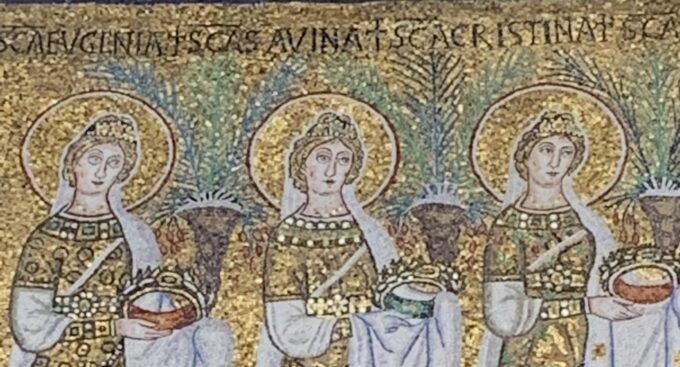
Saint Eugenia in the Basilica of Sant’Apollinare Nuovo, Ravenna, Italy.
Several Republican-led states have restricted transgender rights: Iowa has signed a law removing civil rights protection for transgender people; Wyoming has prohibited state agencies from requiring the use of preferred pronouns; and Alabama recently passed a law that only two sexes would be recognized. Hundreds of bills have been introduced in other state legislatures to curtail trans rights.
Earlier in the year, several White House executive orders pushed to deny trans identity. One of them, “Eradicating Anti-Christian Bias,” claimed that gender-affirming policies of the Biden administration were “anti-Christian.” It accused the Biden Equal Employment Opportunity Commission of forcing “Christians to affirm radical transgender ideology against their faith.”
To be clear, not all Christians are anti-trans. And in my research of medieval history and literature, I found evidence of a long history in Christianity of what today could be called “transgender” saints. While such a term did not exist in medieval times, the idea of men living as women, or women living as men, was unquestionably present in the medieval period. Many scholars have suggested that using the modern term transgender creates valuable connections to understand the historical parallels.
There are at least 34 documented stories of transgender saints’ lives from the early centuries of Christianity. Originally appearing in Latin or Greek, several stories of transgender saints made their way into vernacular languages.
Transgender saints
Of the 34 original saints, at least three gained widespread popularity in medieval Europe: St. Eugenia, St. Euphrosyne and St. Marinos. All three were born as women but cut their hair and put on men’s clothes to live as men and join monasteries.
Eugenia, raised pagan, joined a monastery to learn more about Christianity and later became abbot. Euphrosyne joined a monastery to escape an unwanted suitor and spent the rest of his life there. Marinos, born Marina, decided to renounce womanhood and live with his father at the monastery as a man.
These were well-read stories. Eugenia’s story appeared in two of the most popular manuscripts of their day – Ælfric’s “Lives of Saints” and “The Golden Legend.” Ælfric was an English abbot who translated Latin saints’ lives into Old English in the 10th century, making them widely available to a lay audience. “The Golden Legend” was written in Latin and compiled in the 13th century; it is part of more than a thousand manuscripts.
Euphrosyne also appears in Ælfric’s saints’ lives, as well as in other texts in Latin, Middle English, and Old French. Marinos’ story is available in over a dozen manuscripts in at least 10 languages. For those who couldn’t read, Ælfric’s saints’ lives and other manuscripts were read aloud in churches during service on the saint’s day.

A small church in Paris built in the 10th century was dedicated to Marinos, and relics of his body were supposedly kept in Qannoubine monastery in Lebanon.
This is all to say, a lot of people were talking about these saints.
Holy transness
In the medieval period, saints’ lives were less important as history and more important as morality tales. As a morality tale, the audience was not intended to replicate a saint’s life, but learn to emulate Christian values. Transitioning between male and female becomes a metaphor for transitioning from pagan to Christian, affluence to poverty, worldliness to spirituality. The Catholic Church opposed cross-dressing in laws, liturgical meetings and other writings. However, Christianity honored the holiness of these transgender saints.
In a 2021 collection of essays about transgender and queer saints in the medieval period, scholars Alicia Spencer-Hall and Blake Gutt argue that medieval Christianity saw transness as holy.
“Transness is not merely compatible with holiness; transness itself is holy,” they write. Transgender saints had to reject convention in order to live their own authentic lives, just as early Christians had to reject convention in order to live as Christians.
Literature scholar Rhonda McDaniel explains that in 10th-century England, adopting the Christian values of shunning wealth, militarism and sex made it easier for people to go beyond strict ideas about male and female gender. Instead of defining gender by separate male and female values, all individuals could be defined by the same Christian values.
Historically and even in contemporary times, gender is associated with specific values and roles, such as assuming that homemaking is for women, or that men are stronger. But adopting these Christian values allowed individuals to transcend such distinctions, especially when they entered monasteries and nunneries.
According to McDaniel, even cisgender saints like St. Agnes, St. Sebastian and St. George exemplified these values, exhibiting how anyone in the audience could push against gender stereotypes without changing their bodies.
Agnes’ love of God allowed her to give up the role of wife. When offered love and wealth by men, she rejected them in favor of Christianity. Sebastian and George were powerful Roman men who were expected, as men, to engage in violent militarism. However, both rejected their violent Roman masculinity in favor of Christian pacifism.
A life worth emulating
Although most saints’ lives were written primarily as morality tales, the story of Joseph of Schönau was told as both very real and worthy of emulation by the audience. His story is told as a historical account of a life that would be attainable for ordinary Christians.
In the late 12th century, Joseph, born female, joined a Cistercian monastery in Schönau, Germany. During his deathbed confession, Joseph told his life story, including his pilgrimage to Jerusalem as a child and his difficult journey back to Europe after the death of his father. When he finally returned to his birthplace of Cologne, he entered a monastery as a man in gratitude to God for returning him home safely.
Despite arguing that Joseph’s life was worth emulating, the first author of Joseph’s story, Engelhard of Langheim, had a complicated relationship with Joseph’s gender. He claimed Joseph was a woman, but regularly used masculine pronouns to describe him.

Even though Eugenia, Euphrosyne and Marinos’ stories are told as morality tales, their authors had similarly complicated relationships with their gender. In the case of Eugenia, in one manuscript, the author refers to her with entirely female pronouns, but in another, the scribe slips into male pronouns.
Marinos and Euphrosyne were also frequently referred to as male. The fact that the authors referred to these characters as male suggests that their transition to masculinity was not only a metaphor, but in some ways just as real as Joseph’s.
Based on these stories, I argue that Christianity has a transgender history to pull from and many opportunities to embrace transness as an essential part of its values.
This article is republished from The Conversation under a Creative Commons license. Read the original article.


.jpg)
