Saturday, May 31, 2025

Democratic Voters Choose Fighting Corporate Power Over Neoliberal Abundance 'Scam': Poll

"At a moment when U.S. democracy is threatened by MAGA authoritarianism and deep inequality, doubling down on private-sector solutions while ignoring redistributive policy is a dangerous distraction," said one critic.


Critics of the so-called "abundance agenda" point to the huge crowds drawn by U.S. Sen. Bernie Sanders (I-Vt.) and Rep. Alexandria Ocasio-Cortez (D-N.Y.)—even in red states, like this April 14, 2025 rally inNampa, Idaho—as evidence that Democratic voters prefer candidates who focus on fighting corporatism.

(Photo: Natalie Behring/Getty Images)

Brett Wilkins
May 29, 2025
COMMON DREAMS

Democratic voters overwhelmingly prefer a populist program that takes on oligarchy and corporate power over the so-called "abundance agenda" that's all the rage among many liberals as party leaders examine why they lost the White House and Congress in 2024 and strategize about how to win them back.

That's according to a new Demand Progress poll of 1,200 registered voters "to test the resonance of the 'abundance agenda' being promoted as a potential policy and political refocus for the Democratic Party."

"What these voters want is clear: a populist agenda that takes on corporate power and corruption."

The poll revealed that 55.6% of all surveyed voters said they were somewhat or much more likely "to vote for a candidate for Congress or president who made the populist argument," compared with 43.5% who said they were likelier to cast their ballot for a candidate promoting the abundance agenda.

Among Democratic respondents, 32.6% said they were somewhat or much likelier to vote for abundance candidates, compared with 40.6% of Independents and 58.8% of Republicans. Conversely, 72.5% of surveyed Democrats, 55.4% of Independents, and 39.6% of Republicans expressed a preference for candidates with populist messaging.

"To get out of the political wilderness, and win over not just Democrats but also Independent and moderate voters, policymakers need to loudly state their case for helping middle- and working-class Americans," Demand Progress corporate power program director Emily Peterson-Cassin said in a statement Thursday.


"What these voters want is clear: a populist agenda that takes on corporate power and corruption," Peterson-Cassin added. "The stakes are too high for Democrats to fixate on a message that only appeals to a minority of independent and Democratic voters."

Inspired by San Francisco's YIMBY—or "yes-in-my-backyard"—movement to build as much market-rate housing as possible with scant consideration for the fact that only relatively wealthy people like themselves can afford to live there, New York Times columnist Ezra Klein and Atlantic staff writer Derek Thompson earlier this year published Abundance, which topped the Times' nonfiction bestseller list.

Klein and Thompson assert that well-meaning but excessive regulation in Democrat-controlled cities is thwarting progress, and that U.S. liberals' focus on blocking bad economic development has come at the expense of good development over the past half-century. They cite environmental and zoning regulations, as well as burdensome requirements attached to public infrastructure projects and housing construction, as some of the barriers to development.

The Demand Progress poll found that Republicans were much more likely to have a positive view of candidates embracing the abundance agenda. However, the movement has been gaining traction among centrist and even left-of-center Democrats in cities like San Francisco, where the Abundance Network, a YIMBY nonprofit, has become a major player in city politics and has bankrolled a tech-backed takeover of the local Democratic Party, as Mission Local's Joe Rivano Barros and others have detailed.


Leftist critics have pulled no punches in calling out the abundance agenda as neoliberalism dressed in progressive clothes.

"The abundance movement is a scam," Brandee Marckmann of the progressive San Francisco Education Alliance told Common Dreams on Thursday. "It's a rebranded Trumpian movement that punches down on working-class families. The only abundance these guys want is for themselves, and they want to line their pockets through political schemes that steal money from our public schools, public housing, and public transportation."


As Phoenix Project, a grassroots San Francisco group fighting dark money in politics, recently noted, "Ezra Klein and Derek Thompson's Abundance helped rebrand Reagan-era economics for a new generation, but behind the gloss lies a familiar web of tech, real estate, and right-wing influence."

"At a moment when U.S. democracy is threatened by MAGA authoritarianism and deep inequality, doubling down on private-sector solutions while ignoring redistributive policy is a dangerous distraction," the group added.

Pointing to the Demand Progress poll, The Lever's Veronica Riccobene wrote Thursday that "Democratic voters know who their real enemy is."

"A majority believe the 'big problem' in America is that corporations and their executives have too much economic and political power," she said. "It's not surprising, considering Sen. Bernie Sanders (I-Vt.) and Rep. Alexandria Ocasio Cortez (D-N.Y.) are pulling huge crowds on their 'Fighting Oligarchy' tour, even in deep-red states."

"Meanwhile, fewer Democratic voters believe the country's big problem is regulatory bottlenecking, a core argument of the neoliberal 'abundance' movement," Riccobene added.


As progressive political strategist Dan Cohen said in response to the new poll, "The voters are demonstrating that they understand the problem with quite a traditional view of American politics and economics: that there is too much power and influence in corporate hands and everyday Americans aren't getting their fair share."

"Democrats would be wise to listen to the voters and respond directly to those views with their rhetoric and actions," he added.


DC insider reveals how the 'super-rich' flipped the script on taxes — and how to fix it
SHAWN THEW/Pool via REUTERS
May 31, 2025
COMMON DREAMS

Former Secretary of Labor Robert Reich says middle and low-income U.S. taxpayers should not be paying wealthy Americans to finance debt Republicans are determined to heap upon them last week.

“I’m old enough to remember when the US’s super-rich financed the government with their tax payments,” Reich wrote in The Guardian. “Under Dwight Eisenhower … the highest marginal tax rate was 91%. … But since the Reagan, George W Bush and Trump 1 tax cuts, tax rates on the super-rich have plummeted. So instead of financing the government with their taxes, the super-rich have been financing the US government by lending it money.”

Reich points out that the majority of U.S. debt is not held by foreigners, that more than 70% of it is owned by Americans, and it is to these “super-rich” that taxpayers must pay incrementally more every year to cover the nation's ballooning debt.

And “[t]hey’ll pay even more interest on the growing debt – to the super-rich,” if Republicans pass the budget bill coursing through Congress, he warns, and “they’ll pay higher interest rates on all other long-term debt.” This will inevitably mean higher borrowing costs on everything from mortgages to auto loans as higher rates on treasury bonds filter through the U.S. economy.

In addition, the rising debt crisis gives lawmakers “even more excuse to do what they’re always wanting to do: slash safety nets. So many Americans could lose benefits they rely on, such as Medicaid and food stamps.”

But that debt crisis is still a very real argument, claims Reich, pointing out that Moody’s ratings firm announced the government’s rising debt levels would grow further if Republicans extended Trump’s 2017 tax cuts.

“So-called ‘bond vigilantes’ have already been selling the U.S. government’s debt, as the Republican tax package moves through Congress,” Reich said, and “they’re expected to sell even more, driving long-term interest rates even higher to make up for the growing risk of holding US debt.”

The solution? Reduce the federal debt by ending Trump tax cuts “that mainly benefit the wealthy and big corporations – and instead raise taxes on them.”

Read the full Guardian report here.


Neoliberalism Cannot Be Rehabilitated

Deregulation. Privatization. Tax cuts. Free trade. Stagnant pay for most. A soaring stock market for the top. That’s the legacy of neoliberalism. It also brought us Trump. We cannot go back to that place. There's a better path.


Then U.S. President Ronald Reagan (1911 - 2004) shakes hands with then-real estate developer and now U.S. President Donald Trump in a reception line in the White House's Blue Room, in Washington D.C. on November 3, 1987.
(Photo: White House Photo Office/PhotoQuest/Getty Images)

Robert Reich
May 30, 2025
Inequality Media


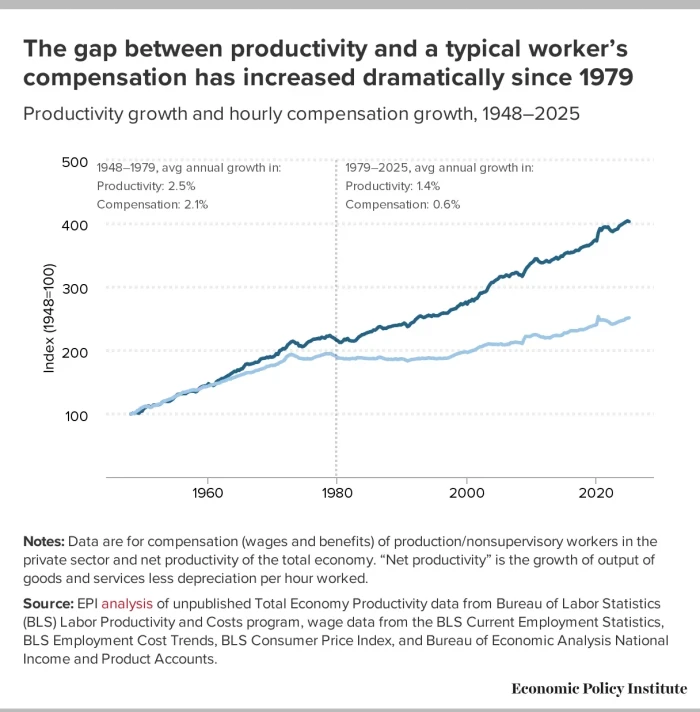
I rarely ask you to look at charts. Today is an exception. This one is from the Economic Policy Institute. It compares the typical American’s pay starting just after World War II (light blue line) with the nation’s increasing productivity since then (dark blue).

The chart shows the widening divergence between the rise of pay and the yields from productivity.

In the first three decades after World War II, the typical American’s pay rose in tandem with the nation’s growing productivity. The benefits from higher productivity were broadly shared.

But then, starting in the late 1970s and dramatically after 1980, pay barely grew, even as productivity continued to soar. The benefits from higher productivity went increasingly to the top.


Why?

I’ve been looking into this question for a long time.

I’ve also been living it, as head of policy for the Federal Trade Commission under Jimmy Carter, secretary of labor in the Clinton administration, and an economic adviser to Obama. I’ve chronicled this in my upcoming memoir, Coming Up Short.

Much of the answer has to do with a giant upward shift in power.

It started in 1971, with a memo written for the U.S. Chamber of Commerce by Lewis Powell exhorting corporations to play a far more active role in American politics. They did, and their increasingly active role paid off, at least for their CEOs and top investors.

It continued through Reagan’s tax cuts and deregulation, his legitimization of union bashing, and the emergence of corporate raiders who insisted that corporations maximize shareholder value above all else.

And onward through George H.W. Bush and Bill Clinton’s North American Free Trade Agreement, their support for China’s accession to the World Trade Organization, and their deregulation of Wall Street.

And then through George W. Bush’s tax cut — again, mainly for big corporations and wealthy individuals — and Barack Obama’s bailout of Wall Street after it nearly destroyed the world economy.

Deregulation. Privatization. Tax cuts. Free trade. Stagnant pay for most. A soaring stock market for the top.

That’s the legacy of neoliberalism.

It also brought us Trump — who exploited the anger and resentment stirred up by all this and pretended to be a strongman on the side of the working class (while quietly giving the emerging American oligarchy everything else it wanted, including a giant tax cut; he’s readying another as you read this).

Now some neoconservatives, posing as “moderates,” are hijacking the story and trying to rehabilitate neoliberalism.

Consider David Brooks, who wrote recently in The New York Times that:

— “wages really did stagnate, but they did so mostly in the 1970s and 1980s, not in the supposed era of neoliberal globalism.” (Brooks is wrong. Look at the above chart. Pay did begin to head up again in the 2000s but the pay-productivity gap has continued to widen.)

— there was “a return to higher productivity and higher wage growth, from 1994 to today. That is to say: Median wages have grown since NAFTA and the W.T.O., not declined.” (Wrong again. Look at the chart.)

— “the inequality gap is not as great as one might think.” (Well, I think it significant, and most analysts agree.)

— “the basic approach to economic policymaking that prevailed between 1992 and 2017 was sensible and … our job today is to build on it.” (Sensible only as compared to Trump’s first and second terms. But as I said, hardly sensible when you consider that widening inequality combined with unbridled globalization, deregulation, and union-bashing contributed to the rise of Trump.)

Neoliberalism should not and cannot be rehabilitated.

We need instead a strong, bold progressive populism that strengthens democracy and widens prosperity by:

— busting up big corporations,

— stopping Wall Street’s gambling addiction (e.g. replicating the Glass-Steagall Act),

— getting big money out of politics, even if this requires amending the Constitution,

— requiring big corporations to share their profits with their average workers,

— strengthening unions, and

— raising taxes on the super-wealthy,

— to finance a universal basic income, Medicare for all, and paid family leave.

Those now trying to rehabilitate neoliberalism won’t like any of this, of course, but we cannot return to the path we were on. It will just lead to more Trumps, as far as the eye can see.

© 2025 Robert Reich


Robert Reich
Robert Reich, is the Chancellor's Professor of Public Policy at the University of California, Berkeley, and a senior fellow at the Blum Center for Developing Economies. He served as secretary of labor in the Clinton administration, for which Time magazine named him one of the 10 most effective cabinet secretaries of the twentieth century. His book include: "Aftershock" (2011), "The Work of Nations" (1992), "Beyond Outrage" (2012) and, "Saving Capitalism" (2016). He is also a founding editor of The American Prospect magazine, former chairman of Common Cause, a member of the American Academy of Arts and Sciences, and co-creator of the award-winning documentary, "Inequality For All." Reich's newest book is "The Common Good" (2019). He's co-creator of the Netflix original documentary "Saving Capitalism," which is streaming now.
Full Bio >
Major shift in GOP views on same-sex marriage: report

David Badash,
 The New Civil Rights Movement
May 30, 2025 

A gay couple's wedding. (Shutterstock)


A decade after the U.S. Supreme Court’s landmark ruling affirming that the Constitution guarantees same-sex couples the same rights and responsibilities of marriage as different-sex couples, public support for marriage equality remains robust at 68 percent—ten points higher than just a month after the 2015 Obergefell decision, though slightly below the all-time high of 71 percent. While Democratic support has continued to climb, Republican backing has declined sharply.

Nearly nine in ten Democrats (88%) say marriages between same-sex couples should be recognized by law as valid, according to Gallup, but less than half that—just 41 percent—of Republicans agree. That’s a fourteen-point drop from the highest level recorded for right-wing voters, 55 percent, in 2021 and 2022.

“The current 47-point gap between Republicans and Democrats is the largest since Gallup first began tracking this measure 29 years ago,” the polling firm reported.

Asked whether they “personally believe that in general” gay or lesbian relations are “morally acceptable or morally wrong,” even fewer Republicans, just 38 percent, said they are morally acceptable. The national average is 64 percent, and the average among Democrats is 86 percent.

Diving deeper, Gallup found that a majority “of U.S. adults in most demographic subgroups think same-sex marriage should be legal and say same-sex relations are morally acceptable.”


The only subgroup listed on Gallup’s graphic where a majority disagreed are weekly church-goers, “a group that is more Republican.”

“One-third of these frequent churchgoers support same-sex marriage, while 24% of them consider gay or lesbian relations as morally acceptable.”

Gallup also delivered a warning for marriage equality supporters, noting that “the widening political divide suggests potential vulnerabilities in the durability of LGBTQ+ rights.”

“In 2022, Supreme Court Justice Clarence Thomas wrote in his concurring opinion in the Dobbs v. Jackson Women’s Health Organization decision that the high court ‘should reconsider’ its past rulings, including those on same-sex relationships and marriage. Since then, Republican lawmakers in some states have introduced resolutions asking the Supreme Court to overturn Obergefell. During his second term, President Donald Trump has implemented policies that significantly roll back LGBTQ+ protections, particularly affecting transgender individuals. These occurrences suggest that same-sex marriage in the U.S. could face renewed legal and political challenges.”


Dem on DOGE committee pounces on 'out of control' Musk's reported drug problem

Krystina Alarcon Carroll
May 30, 2025 


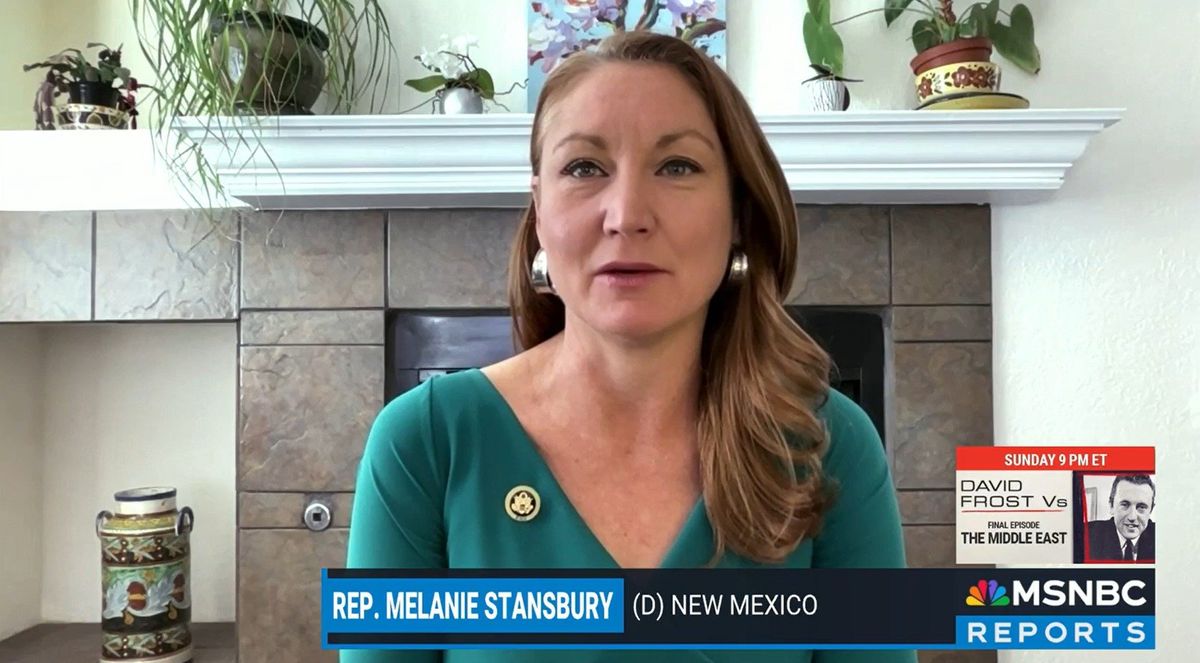
Congresswoman Melanie Stanbury speaking on Elon Musk (MSNBC Screenshot) 2025-05-30

Elon Musk is “out of control” with his alleged drug use, and now House Democrats have filed a Civil Liability against Musk to hold him personally liable for the work he’s done at the Department of Government Efficiency, according to Congresswoman Melanie Stanbury (D-NM).

The revelation came while she was speaking on Ana Cabrera Reports Friday morning.

First, Stanbury railed against Musk’s alleged drug use, which the New York Times first reported, saying, “If you observed his behavior over the last three and a half months, it's very obvious that he was completely out of control.”

“Just like, you know, other rich dudes who want to tinker with what they think are toys, this is not a joke,” Stanbury said. “This is the democracy that is our country and the American people's lives. So, you know, there's going to be very serious consequences, and we will hold Elon Musk accountable for the damages that he's done.”


She added, “Musk wreaked havoc on the federal government. And so it does not surprise me that it was being enhanced by, you know, substances that make you act crazy. But I think, you know, it's not a joke because he [has] literally shattered thousands of American lives. He's disrupted our entire federal government.”

The Congresswoman noted that there isn't a lot democrats can do because they are not in control of Congress. However, she “and Jamie Raskin (D-MD) have also filed legislation for civil liability against Elon Musk and any special government employee. But it also necessitates that we win back the House and use the tools of Congress to hold them accountable. Right now, the courts are a primary tool.”


She later noted some of the unethical and illegal actions Musk has purportedly taken while head of DOGE, saying, “We know that there are DOGE staff sitting in the cabinet secretary offices of almost every major agency, and we've seen this play out even over the last week at the Department of Interior.”

Watch the full interview below or click the link.


'Buying favors': AOC sounds alarm on tech tycoons who captured Trump presidency

Matthew Chapman
May 30, 2025
RAW STORY


FILE PHOTO: Tesla CEO and X owner Elon Musk stands with Republican presidential candidate former U.S. president Donald Trump during a campaign rally in Butler, Pennsylvania, U.S., October 5, 2024. REUTERS/Brian Snyder/File Photo


Rep. Alexandria Ocasio-Cortez (D-NY) sounded the alarm in a new interview with Rolling Stone's Lorena O'Neil published Friday about how, in her view, the Trump presidency has become a vessel for the will of tech billionaires, who are behind some of the most destructive policy initiatives against working people.

This comes at a moment when one of the most visible of these billionaires, Elon Musk, is formally exiting the White House — though perhaps not going away entirely — after installing his Department of Government Efficiency (DOGE) task force to help Trump purge the civil service.

"There is almost no area of our lives that has not been affected by this tech-billionaire class because they’re buying elections," said Ocasio-Cortez, an outspoken progressive lawmaker. "The balance of the Senate has been shifted because of the crypto lobby dumping millions of dollars into right-wing authoritarian candidates. And it’s important to note that this money is not going into just issue-lobbying alone."

What makes this particularly chilling, she continued, is that crypto billionaires aren't just doing the usual lobbying and favor-seeking for their industry: "This is about crypto billionaires trying to install and support authoritarians and fascists, because they believe that if those fascists are personally close to them, then they can control far beyond the regulation of financial instruments. They think they can really start imposing this dystopian worldview that includes everything from the subjugation of women to democracy itself."

The GOP's fight to pass a "big, beautiful bill" that cuts hundreds of billions from Medicaid — something even some MAGA Republicans are uncomfortable with — is part and parcel of that, she argued.

"Elon Musk dumped hundreds of millions of dollars into trying to buy the U.S. presidential election, and he is trying to recoup that investment by getting one of the largest tax cuts for billionaires in American history — which the Republican Party is trying to pay for through massive cuts to Medicaid, for Americans with disabilities, health care for the poor," she said. "They’re trying to cut Medicaid and SNAP food assistance to pay for additional tax cuts for Elon Musk and his industries, as well. And so it’s really important for people to understand that this goes beyond tech. This is about the extreme concentration of money and power."

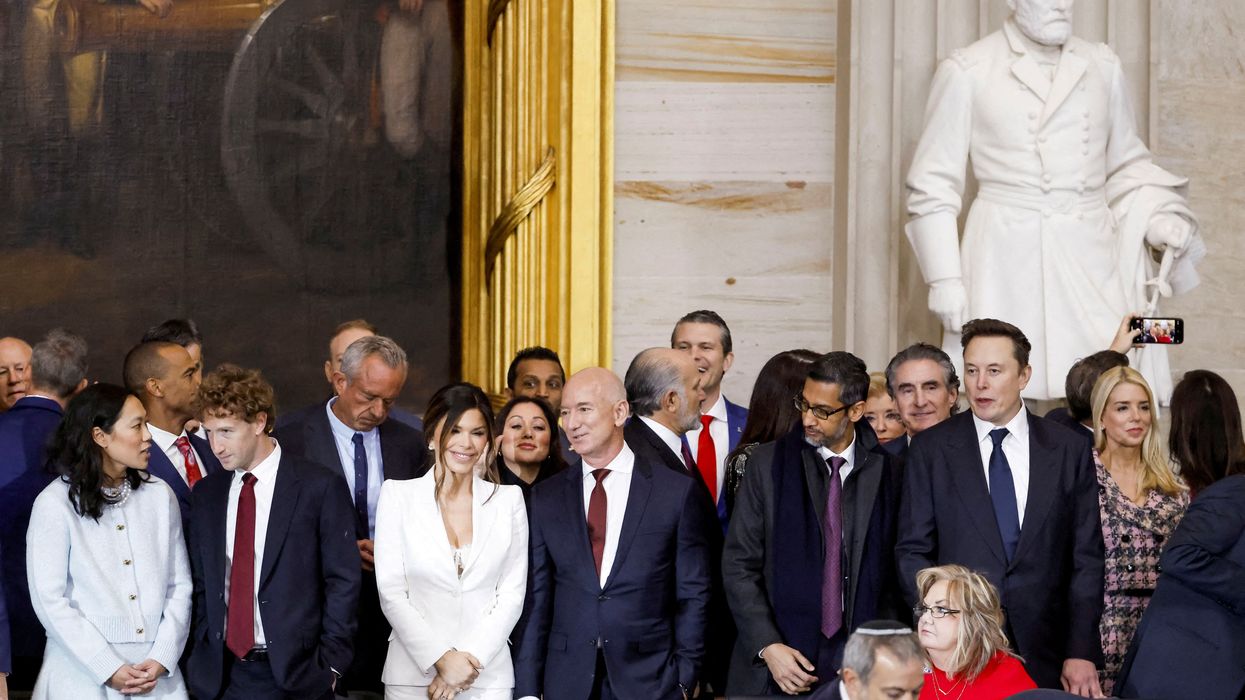
The scene of tech CEOs like Musk, Amazon's Jeff Bezos, and Meta's Mark Zuckerberg sitting close to Trump at his inauguration, she continued, is "a moment in history personified."

"This is not just people buying favors," Ocasio-Cortez said. "This is about who controls this country, and everyone else is just a formality, and that is the worldview that we are up against right now. This is the stakes of the present moment. And when Sen. Sanders and I talk about oligarchy, this really is what this is. It is beyond partisan as well. It is concentrated. It is most concentrated in the Republican Party. But it’s also the power that controls our politics writ large."


Musk Might Be Gone, But Watchdogs Warn Trump/DOGE Carnage Will Continue


"Musk's departure obscures but does not actually change the continuity of DOGE's staff and mission to destroy everything that protects the public from the depredations of the most rapacious oligarchs," said one critic.


Demonstrators protest the Trump administration's evisceration of the federal government—spearheaded by Elon Musk's Department of Government Efficiency (DOGE)—during a February 5, 2025 protest on Capitol Hill in Washington, D.C.
(Photo: Tom Williams/CQ-Roll Call, Inc. via Getty Images)


Brett Wilkins
May 30, 2025
COMMON DREAMS


Critics of the so-called Department of Government Efficiency cautioned Friday against undue elation or complacency over Elon Musk stepping down as de facto DOGE chief, warning that officials at the contentious agency are pressing ahead with U.S. President Donald Trump's mission of eviscerating key agencies and the ability of the federal government to properly function.

With Musk's official departure from DOGE this week—returning to the private sector to run his beleaguered business empire—most of the agency's leadership and rank-and-file staff remain in place. As the Revolving Door Project (RDP) noted Friday, key DOGE officials "maintain extensive ties to Musk's corporate empire, with many of them having come to DOGE directly from one of Musk's companies."

According to RDP research, "at least 46 former or current DOGE members have substantial and direct ties to Elon Musk."

"DOGE isn't going anywhere, according to the Trump administration's own officials," RDP said. The watchdog group warned specifically about Office of Management and Budget (OMB) Director Russell Vought, who they said "seems to be the new boss in town."

The visions of the two men, said RDP, "have been aligned from the start. Musk endorsed Vought's view of the unconstitutionality of the Impoundment Control Act and said that DOGE would work 'closely with [OMB].'"


Vought co-authored the policy portion of Project 2025, a far-right blueprint for gutting the government and expanding executive power.

"There is no daylight between Elon Musk and Russ Vought on the aim of greenlighting corporate abuse, as anyone can see from their joint destruction of the Consumer Financial Protection Bureau," RDP executive director Jeff Hauser said Friday. "DOGE's Musk-tied staffers have already burrowed into the government, and having a new boss who has coordinated extensively with Musk isn't likely to change their actual actions much at all."

"Musk's departure obscures but does not actually change the continuity of DOGE's staff and mission to destroy everything that protects the public from the depredations of the most rapacious oligarchs," Hauser added.

Another watchdog, Accountable.US, noted Friday that Vought "has a nearly 20-year record working on Republican efforts to cut Social Security and Medicare—including overseeing numerous Trump budget proposals."

"It's proof that DOGE's extreme agenda, which is causing ordinary families to fall behind, is full steam ahead as Trump and his allies in Congress push forward deep cuts to Americans' essential benefits," the group continued. "Last week, congressional Republicans advanced the largest cuts to Medicaid and [Supplemental Nutrition Assistance Program] in history, which would result in 14 million Americans losing health coverage, 3 million households without food assistance, and an increased burden for millions with higher education and energy costs. All while adding over $4 trillion to the deficit."

"Americans deserve real government reforms to cut red tape, eliminate waste, and ensure taxpayers are able to access the services they pay for," Accountable.US added. "That was never DOGE's goal. Instead Trump and Musk tried to gut Medicare, Medicaid, and Social Security, to line their own pockets and those of their billionaire friends with tax cuts, and the administration is only just getting started."

As one staffer at the DOGE-beset National Institutes of Health told Politico, "DOGE is still hungry. We've still got to feed the fucking dog."
Trump backers slammed by leading conservative for 'dabbling in Marxism'

Matthew Chapman
May 30, 2025 3:48PM ET
RAW STORY


Longtime right-wing strategist and commentator Erick Erickson accused President Donald Trump's supporters on Friday of effectively embracing what he called a core trait of Marxism in order to pass their agenda.

NO SUCH THING AS THIS SO CALLED HALLMARK 

"One of the hallmarks of Marxism is a redefinition of words and control of language," wrote Erickson on X. "Marxists believe if you control language, you control reality and thereby acquire power. Some on the right are dabbling in Marxism, now insisting tariffs are not tax."

Marxism is an economic and political theory primarily based on rejecting capitalism and free enterprise, and promoting collective ownership of capital. "Control of language" is not inherently a plank of Marxism although, in practice, many countries whose political systems were founded on Marxist ideology ended up repressive of speech, which often had societal consequences even after these countries abandoned their systems.

Trump's aggressive worldwide tariff policy, which was struck down by a federal court earlier this week but is currently still in effect while an appellate court reviews the issue, has been widely criticized by economists and even some conservative politicians for imposing steep taxes that will ultimately be paid by consumers.

The administration has denied this is the case and even put political pressure on retail giants like Walmart not to raise their prices in response to the tariffs.

Erickson, who previously worked on the George W. Bush presidential campaign and advised several GOP politicians in Georgia, has had a fraught relationship with Trump and the MAGA movement, at times endorsing it, but on many other occasions calling out elements of Trump's agenda and inner circle he believes are harmful to the country or the Republican Party.
\

Trump announces he's firing 'highly partisan' art director from Smithsonian

ANTI-DEI = RACISM, SEXISM, HOMOPHOBIA

Travis Gettys
May 30, 2025 
ALTERNET

President Donald Trump announced the firing of the Smithsonian's National Portrait Gallery director.

The president terminated Kim Sajet from the post she's held since 2013, saying the Nigerian-born, Australia-raised Dutch citizen was too in thrall to the ideals of diversity, equity and inclusion to oversee the museum's collection of about 26,000 objects that draws about 2 million yearly visitors.

"Upon the request and recommendation of many people, I am herby terminating the employment of Kim Sajet as Director of the National Portrait Gallery," Trump posted Friday afternoon on his social site, Truth Social. "She is a highly partisan person, and a strong supporter of DEI, which is totally inappropriate for her position. Her replacement will be named shortly. Thank you for your attention to this matter!"

Sajet said in a recent interview that Trump's portrait has been completed but would remain in storage until 2029, after he leaves office, as is customary, but a 2017 photo is on display with a delicately worded, 161-word caption.

"Impeached twice, on charges of abuse of power and incitement of insurrection after supporters attacked the U.S. Capitol on January 6, 2021, he was acquitted by the Senate in both trials," the caption reads. "After losing to Joe Biden in 2020, Trump mounted a historic comeback in the 2024 election. He is the only president aside from Grover Cleveland (1837-1908) to have won a nonconsecutive second term.”

Read it here.

As Covid Subvariant Spreads, 
CDC Maintains Child Vaccine Guidance Despite RFK Announcement

Experts said the new guidance would likely prevent insurers from refusing to cover the vaccines, but some said mixed messages from the Trump administration could still lead to confusion.

Julia Conley, 
Common Dreams
May 30, 2025


FILE PHOTO: Robert Kennedy Jr., U.S. President-elect Donald Trump's nominee to run the Department of Health and Human Services, walks in the U.S. Capitol subway on Capitol Hill in Washington, U.S., December 17, 2024. REUTERS/Benoit Tessier/File Photo


Amid reports of a new Covid-19 subvariant spreading in several U.S. states, the Centers for Disease Control and Prevention on Friday failed to update guidance on receiving vaccines against the coronavirus that contradicted a controversial recent announcement from the nation's top health official.

The CDC's schedule for vaccines for children aged 6 months to 17 years retained the Covid-19 shot, advising parents and doctors to engage in "shared clinical decision-making" when determining if a child should be vaccinated—meaning children can receive the shots if their parents and physicians agree.

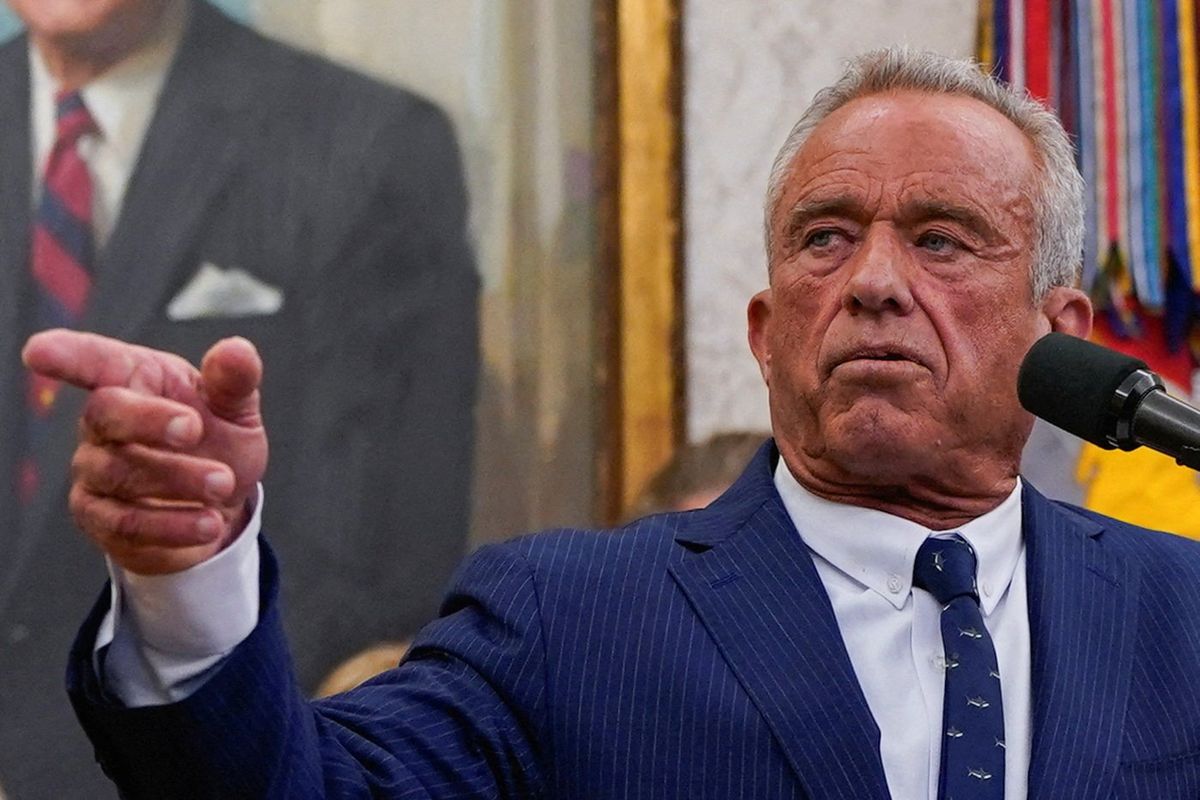
That guidance contradicts a statement from Health and Human Services Secretary Robert F. Kennedy, Jr. earlier this week. Kennedy claimed Tuesday that there was a "lack of any clinical data to support the repeat booster strategy in children" for Covid vaccines as he announced, alongside National Institutes of Health Director Dr. Jay Bhattacharya and Food and Drug Administration (FDA) Commissioner Dr. Martin Makary, that the shots would no longer be recommended for pregnant women or healthy children.

"Where the parent presents with a desire for their child to be vaccinated, children six months and older may receive Covid-19 vaccination, informed by the clinical judgment of a healthcare provider and personal preference and circumstances," the new guidelines read.


"At least how some clinicians perceive it is, 'You guys are the experts, and if you don't know what the right thing to do is, how are we supposed to have that conversation in a 10-minute office visit?'"

Kennedy's announcement earlier this week alarmed public health experts, as did an earlier statement that the vaccines would only be made available to people over age 65 and those with certain medical conditions.

Kennedy, who baselessly called the Covid-19 vaccine "the deadliest ever made" in 2021—when the shots were estimated to have saved 140,000 lives—said at the time that new clinical trials would be needed to see if the vaccines continued to provide protection to people under 65.

Sean O'Leary, the chair of the American Academy of Pediatrics' infectious disease committee, said the CDC's new guidance could still cause confusion among parents and doctors, compared to an across-the-board recommendation like those that exist for other childhood vaccines.

"At least how some clinicians perceive it is, 'You guys are the experts, and if you don't know what the right thing to do is, how are we supposed to have that conversation in a 10-minute office visit?'" O'Leary told The Washington Post.

But the new guidance could stop insurance companies from refusing to cover the shots, as experts were worried they might after Kennedy's earlier statements, and will preserve the shots' availability for about 38 million low-income children who rely on the Vaccines for Children program.

The out-of-pocket cost for a Covid vaccine at a CVS pharmacy—where some patients could opt to go if their doctors don't want to administer the vaccine—is $198.99.

Experts remained concerned on Friday about the CDC's approach to Covid vaccines for pregnant women; the agency said there is officially "no guidance" for people who are pregnant.

Public health experts have warned that research shows pregnant women's risk of death and hospitalization is heightened if they have a Covid infection, and that the illness raises the risk of stillbirth.


The CDC's new guidance—and Kennedy's push to pivot away from Covid vaccines for the general population—come as a new, highly transmissible Covid subvariant has been detected in states including California, Rhode Island, New York, and Washington.

The subvariant, NB.1.8.1, was first detected in January and has been spreading in Europe and Asia since then, with the World Health Organization saying there has been a "concurrent increase in cases and hospitalizations in some countries where NB.1.8.1 is widespread."

Dr. Yvonne Maldonado, an infectious disease expert at Stanford University, told The Los Angeles Times that NB.1.8.1 does not cause more severe illness, "but it is more transmissible, at least from what we’re seeing around the world and also from lab experiments."

Meanwhile, Kennedy's push to reduce the availability of vaccines is "kind of chilling," Dr. Peter Chin-Hong of the University of California, San Francisco, told the Times. "It's out of step with the system we've learned to trust and follow... Most people would agree that kids should be targeted for flu vaccines. It seems kind of weird to have Covid as an outlier in that respect."

O'Leary said in a statement that despite the Trump administration's recent statements, scientific data about the vaccines is clear.

"Pregnant women, infants, and young children are at higher risk of hospitalization from Covid," he said, "and the safety of the Covid vaccine has been widely demonstrated."
White House MAHA report cited ‘invented studies’: analysis

Erik De La Garza
May 30, 2025 
RAW STORY


FILE PHOTO: Robert F. Kennedy Jr. speaks in the Oval Office of the White House, on the day he is sworn in as secretary of Health and Human Service in Washington, D.C., U.S., February 13, 2025. REUTERS/Nathan Howard/File Photo


A White House report warning of a national health crisis is drawing fresh scrutiny after a Washington Post analysis revealed signs of not only artificial intelligence but also the apparent use of “invented studies” in the report’s citations.

The “Make America Health Again” report, released this week by the Trump administration, claims to highlight the causes of declining life expectancy among Americans. But the Post reviewed more than 500 citations and found several that appeared to be invented, with AI experts confirming “the use of artificial intelligence in the initial version of the report provided to journalists.”

According to the Post, the MAHA report cited academic studies that don’t exist, referenced “garbled citations,” and used phrases consistent with AI-generated text.

“Trump administration officials have been repeatedly revising and updating the report since Thursday as news outlets, beginning with NOTUS, have highlighted the discrepancies and evidence of nonexistent research,” the Post reported Friday.

A spokesperson for the Department of Health and Human Services, Andrew Nixon, downplayed the issue, which he called “minor citation and formatting errors,” which he said “have been corrected."


“The substance of the MAHA report remains the same — a historic and transformative assessment by the federal government to understand the chronic disease epidemic afflicting our nation’s children,” he said, according to the Post.
Panama launches maintenance work at contested mine


By AFP
May 31, 2025


Central America's biggest copper mine, the Cobre Panama pit, closed in 2023 following crippling protests over its environmental impact - Copyright AFP/File MARTIN BERNETTI

Panama’s government said Friday it would start maintenance work at a major mine forced to shut by protests, but insisted the project was not tantamount to the pit reopening.

Central America’s biggest copper mine, the Canadian-owned Cobre Panama pit, closed in 2023 following weeks of crippling protests over its environmental impact.

Maintenance will be carried out by a subsidiary of Canada’s First Quantum Minerals “to prevent environmental damage” from materials stored at the mine, Trade and Industry Minister Julio Molto told a news conference.

“This decision (…) does not imply the reactivation of the mine,” Molto said.

First Quantum Minerals said it would finance the work by exporting 121,000 tonnes of copper concentrate stored at the site since it closed down.

Panama’s President Jose Raul Mulino said last month that his government was working toward reopening the mine, without clarifying how he plans to tackle legal hurdles.

The country’s Supreme Court ruled in November 2023 that a contract allowing First Quantum Minerals to continue operating the site was unconstitutional.

Environmentalist Raisa Banfield criticized Friday’s announcement as the Canadian giant “can’t manage the mine.”

She called for an external audit to “establish the definitive closure plan.”

Cobre Panama, which began operations in 2019, had produced about 300,000 tonnes of copper concentrate a year, representing 75 percent of the country’s exports and about five percent of its national economic output.

It employed around 37,000 workers directly and indirectly.


Revelations on the history of leprosy in the Americas


Leprosy existed in America long before the arrival of Europeans: a new study reveals the history of a neglected pathogen


Institut Pasteur

Archaeological tooth from human remains in South America. 

image: 

From this type of sample, ancient DNA techniques enable the reconstruction of human and pathogen genomes from the past. In the back, a Wiphala flag representing Indigenous communities of South America.

view more 

Credit: © Nicolas Rascovan, Institut Pasteur


Long considered a disease brought to the Americas by European colonizers, leprosy may actually have a much older history on the American continent. Scientists from the Institut Pasteur, the CNRS, and the University of Colorado (USA), in collaboration with various institutions in America and Europe, reveal that a recently identified second species of bacteria responsible for leprosy, Mycobacterium lepromatosis, has been infecting humans in the Americas for at least 1,000 years, several centuries before the Europeans arrived. These findings will be published in the journal Science on May 29, 2025.

Leprosy is a neglected disease, mainly caused by the bacterium Mycobacterium leprae, affecting thousands of people worldwide: approximately 200,000 new cases of leprosy are reported each year. Although M. leprae remains the primary cause, this study focused on another species, Mycobacterium lepromatosis, discovered in the United States in 2008 in a Mexican patient, and later in 2016 in red squirrels in the British Isles. Led by scientists from the Laboratory of Microbial Paleogenomics at the Institut Pasteur, also associated with the CNRS, and the University of Colorado, in collaboration with Indigenous communities and over 40 scientists from international institutions including archaeologists, this study analyzed DNA from nearly 800 samples, including ancient human remains (from archaeological excavations) and recent clinical cases presenting symptoms of leprosy. The results confirm that M. lepromatosis was already widespread in North and South America long before European colonization and provide insights into the current genetic diversity of pathogenic Mycobacteria.

"This discovery transforms our understanding of the history of leprosy in America," said Dr. Maria Lopopolo, the first author of the study and researcher at the Laboratory of Microbial Paleogenomics at the Institut Pasteur. "It shows that a form of the disease was already endemic among Indigenous populations well before the Europeans arrived."

The team used advanced genetic techniques to reconstruct the genomes of M. lepromatosis from ancient individuals found in Canada and Argentina. Despite the geographic distance of several thousand kilometers, these ancient strains dating from similar periods (approximately 1,000 years ago) were found to be surprisingly genetically close. Although they belong to two distinct branches in the evolutionary tree of the genus Mycobacterium, these branches are genetically closer to each other than to any other known branch. This genetic proximity, combined with their geographical distance, necessarily implies a rapid spread of the pathogen across the continent, likely within just a few centuries.

The scientists also identified several new lineages, including an ancestral branch that despite having diverged from the rest of the known species’ diversity over 9,000 years ago, it continues to infect humans today in North America — a discovery suggesting an ancient and long-lasting diversification on the continent, as well as a largely unexplored diversity that likely remains to be found.

Notably, the analyses also suggest that the strains found in red squirrels in the UK in 2016 are part of an American lineage that was introduced to the British Isles in the 19th century, where it subsequently spread. This discovery highlights the recent ability of the pathogen to cross continents, likely through human or commercial exchanges.

"We are just beginning to uncover the diversity and global movements of this recently identified pathogen. The study allows us to hypothesize that there might be unknown animal reservoirs," said Nicolás Rascovan, the lead author of the study and head of the Laboratory of Microbial Paleogenomics at the Institut Pasteur. "This study clearly illustrates how ancient and modern DNA can rewrite the history of a human pathogen and help us better understand the epidemiology of contemporary infectious diseases."

The project was conducted in close collaboration with Indigenous communities, which were involved in decisions regarding the use of ancestral remains and the interpretation of results. Ancient DNA and remaining materials were returned when requested, and the generated data was shared via ethical and adaptable platforms designed to allow data sharing that meets the specific expectations of Indigenous communities.