Saturday, May 31, 2025

Trump doesn't just think of himself as the president


REUTERS/Kevin Lamarque

The Conversation
May 30, 2025 |

The American Revolution was a result of the tyranny experienced by colonists under the British monarchy. Many Americans had fled from Europe where they had been persecuted under the rule of powerful monarchs. The government produced by the revolution was designed to ensure no such tyranny could be reproduced in the newly formed United States.

The framers of the constitution created a checks-and-balances system of government to ensure that no single branch of the federal government (executive, judicial or legislative) could dominate the others. Each branch has powers to curtail or empower the others.

However, some Americans are concerned about a return of absolute rule due to the steps taken by Donald Trump’s second administration. This has sparked around 100 “no kings” protests all over the US, organised to coincide with Trump’s birthday on June 15.

Increasing presidential power


The second Trump administration has made a determined effort to strengthen presidential power and reduce oversight of the executive branch (the presidency). Achieving this could mean the president acting in an arbitrary manner similar to absolute monarchs of the past, free of congressional or judicial interference.

Trump’s “big beautiful bill”, which has been passed in the House of Representatives and now must go to the Senate, contains certain provisions that strengthen the role of the president and undermine the checks-and-balances system.

Previous presidents, such as Franklin D. Roosevelt during the New Deal era of the 1930s, had many of their executive orders cancelled by Supreme Court rulings. Over the last five months, the judiciary has ruled on the constitutionality of Trump’s executive actions, putting at least 180 on hold.

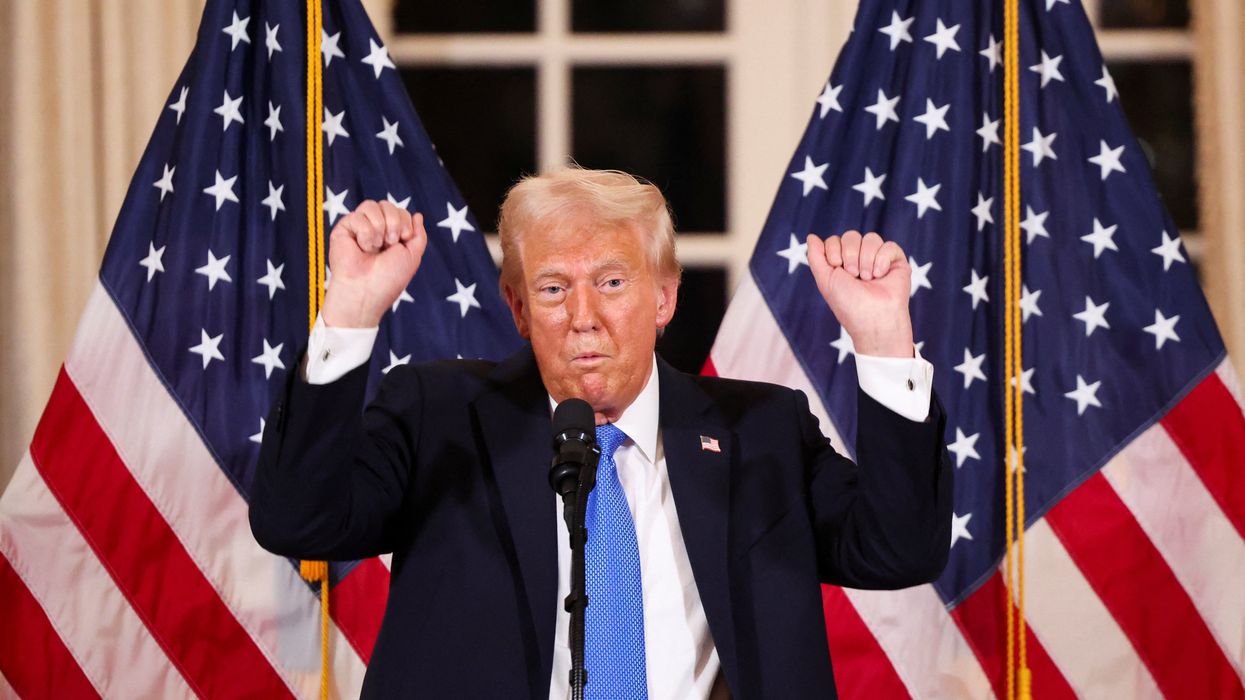
As a consequence, the president has continually questioned the validity of the courts to act. At last week’s West Point graduation ceremony, Trump claimed that last November’s election result “gives us the right to do what we wanna do to make our country great again”.

As Robert Reich, the former US secretary of labor, wrote recently, this “big beautiful bill” will remove the courts’ ability to hold executive officials in contempt and undermine any efforts to stop the administration. Supreme Court rulings could be ignored by the executive branch, and Congress would be unable to enforce its subpoenas and laws. “Trump will have crowned himself king,” Reich concluded.

Just like the judicial branch, the legislative branch (Congress) also has the ability to check the executive branch. Congress can override the presidential veto if both the House and Senate pass legislation with a two-thirds majority. And the executive branch (the president) cannot fund any initiatives without the budget being approved by Congress first.

But Trump and his supporters have minimised the impact that Congress can have on this particular bill by including all of the provisions within a budget reconciliation bill. This is a special legislative procedure that is designed to pass bills through Congress quickly.

Bills usually require 60 votes to bypass a filibuster – a tactic used by senators to delay voting on the bill by refusing to end the debate and speaking for exceptionally long times without a break.

But because this is a budget reconciliation, it only requires a majority – 51 votes – to pass the Senate. And because the Republicans have 53 seats in the Senate, Trump is confident the bill will pass without any Democratic interference.

The House narrowly passed the bill, despite some opposition from Republicans. And some Republican senators have also expressed concerns. But this is the latest move to centralise greater power within the presidency.

ABC NEWS: Trump makes the commencement speech at the West Point military academy.

Trump v the courts

Trump’s apparent belief that he is above the law has, in part, been supported by last year’s Supreme Court ruling which stated that former presidents had immunity from prosecution for official presidential acts. The Trump v United States decision decided such acts included command of the military, control of the executive branch, and execution of laws.

However, this week’s federal court ruling on the legality of Trump’s economic tariffs represents a setback to the administration’s efforts to strengthen presidential power. The Court of International Trade ruled that the White House’s use of emergency powers did not grant it the authority to impose tariffs on every country, and that the constitution states such power resides within Congress.

The Trump administration immediately said it would be appealing the decision. “It is not for unelected judges to decide how to properly address a national emergency,” Kush Desai, the White House deputy press secretary, said on the ruling, and that Trump would use “every lever of executive power” to “restore American greatness”.

All of which has led Trump to quote another authoritarian leader, Napoleon, on social media. His post – “He who saves his Country does not violate any Law” – was a clear rebuke to those who have tried to limit executive authority while he has been in office, and echoes that of former president Richard Nixon who, in an interview with David Frost about the Watergate scandal, argued that the constitution allowed the president to break the law.

This is an extension of the notion that Article II of the constitution has granted the president the authority to act without checks and balances when dealing with the executive branch. It is a theory much touted within Project 2025, believed to be the blueprint for the Trump presidency.

There are other historical comparisons that could be made of Trump’s authoritarian actions, such as the rule of Charles I of England (1625-49), who believed he could govern without consulting parliament except when he needed to raise taxes to conduct overseas campaigns. Ultimately, this led to a period of civil wars and the execution of the king for treason.

While none of these consequences are likely to be replicated, it is clear the US is currently in a constitutional crisis. The Supreme Court has a number of rulings to make on the judicial challenges to Trump’s executive authority. These will have generational consequences – but it is unclear in which way the court, where conservative judges have a 6-3 majority, will lean.

While Trump may not be seeking a crown for his head, he is certainly arguing that he has the right to control the executive branch in the way he sees fit, without any interference from Congress or the judiciary. This is not the separation of powers as prescribed by the framers of the US constitution, but more like the absolutism of medieval monarchs.

Dafydd Townley, Teaching Fellow in US politics and international security, University of Portsmouth

This article is republished from The Conversation under a Creative Commons license. Read the original article.


'Nothing can stop what is coming': MAGA staff fueling Trump's belief ‘he is a tool of God’


Adam Lynch
May 30, 2025
ALTERNET

Politico Magazine reporter Michael Kruse says President Donald Trump has always “seen himself as special, and he has always, of course, been notably self-aggrandizing,” but the president is now moving into a new phase.

“His rhetoric has gone from borderline nihilistic to messianic,” writes Kruse.

Many of Trump’s followers have described him as “chosen,” or “anointed,” or a “savior,” or “the second coming” or “the Christ for this age.” Only now Kruse says Trump is in on it and his “narcissism and grandiosity has metastasized into notions of omnipotence, invincibility and infallibility.”

READ MORE: No administration has ever been this corrupt – and you just can't look away anymore

And that matters, says Kruse, “because it offers a window into how he is approaching his second term — even more emboldened, even more unilaterally oriented, even more apparently uncheckable and untouchable than the first.”

“I run the country and the world,” Trump told The Atlantic last month.

“I have no reason to doubt that he would … prefer to believe he was saved [from assassination] by a supreme being because he himself is special rather than the would-be assassin was a lousy shot or he got lucky,” said former Trump consultant and publicist Alan Marcus to Kruse in an interview. “… His world is fantasy, scripted like a movie — not biblical unless, of course, that helps bring a particular scene or chapter to life.”


Marie Griffith, the director of the John C. Danforth Center on Religion and Politics tells Kruse it is likely a combination of “opportunism and genuine belief” driving the president’s evolving self-view, while author Stephen Mansfield (‘Choosing Donald Trump: God, Anger, Hope, and Why Christian Conservatives Supported Him’, 2018, by Baker Publishing) said Trump probably believes “he is a tool of God.”

And now, four months into his term, Kruse says “Trump is on a spree of a show of supremacy.”

“He’s pledged a ‘Golden Age.’ He’s punished Trump and MAGA unbelievers. He’s exacted or attempted to exact subservience and acquiescence from media execs and tech titans and major law firms and top universities and both chambers of Congress that he and his party control,” Kruse writes. “He’s tried to command the global economy and crack intractable issues of war and peace as if he were wielding a scepter over subjects far and wide.”

Kruse notes a point from journalist Ezra Klein that a big difference between Trump’s first and second terms is the willingness of his staff to buy into the belief, too. The first group was “perfectly comfortable thinking: President Donald Trump is very wrong about this. His judgment is bad. His impulses need to be foiled. We are the resistance inside the Trump administration,” said Klein. “In Trump 2.0 … there is both a sense that they’re there to serve him but also a sense there is something in Trump … that exists beyond argumentation,” Klein said.

One late Wednesday post from Trump on Truth Social features a meme of the president walking confidently down a dark city street.

“HE’S ON A MISSION FROM GOD,” read the words. “NOTHING CAN STOP WHAT IS COMING.”

“Does the president mean with the post of this meme,” Kruse says he asked White House communications director Steven Cheung, “that he’s literally on a mission from God?”

“As people of faith, we are all on missions from God,” Cheung responded. “The President has the biggest mission — to Make America Great Again and to help bring peace across the world. And he’s doing just that.”

Read the full Politico Magazine report here.


'Almost cartoonish': Expert says 'Trumpy style' of MAGA women about 'signaling allegiance'

BLOND WHITE WOMEN WITH CROSS JEWELRY

Attorney General Pam Bondi and White House Press Secretary Karoline Leavitt. (screengranb, Fox News)

May 30, 2025 
ALTERNET

Many fashion critics suggest that men and women aligned with President Donald Trump's ideology tend to embrace a distinct style.

In a report published Friday, the New York Times noted that Trump along with his close advisers and family members, plunged into the traditionally subdued world of government attire with a bold and unwavering aesthetic.

The fashion choices of key Make America Great Again (MAGA) figures: makeup, and even physical appearances have followed a clearly defined and attention-grabbing theme, the report notes.

If fashion serves as a form of expression, and politics is deeply rooted in messaging, then the emergence of a distinct "MAGA look" during Trump’s second term is a cultural shift worth paying attention to, the piece argues.

Vanessa Friedman, The Times’s fashion critic, weighed in on the MAGA world's style and fashion.

When asked by reporter Jess Bidgood what the "key elements of MAGA beauty" are, she said it "encompasses Mar-a-Lago face and conservative girl makeup — plays up classically feminine features to an almost cartoonish degree, thus underscoring a retrograde gendered paradigm."

"Think long, blow-dried, bouncy Breck girl hair; false eyelashes and lots of mascara; plumped lips; and, often, filler in the cheeks. Fashion is there to essentially reinforce that proposition. Hence the figure-hugging sheath dress and high heels," she added.

Friedman noted that during Trump’s first term, several fashion designers were vocal about refusing to style Melania Trump. However, in his second term, the fashion and beauty industry seems to be taking a more muted, hands-off approach — largely avoiding public statements and opting for neutrality.

Bidgood then asked, "There is an important distinction between the style we see in Trump’s world — his close aides, his social circle, the people who frequent Mar-a-Lago — and the style that his followers have embraced at Trump rallies or gatherings like CPAC, where people wear themed T-shirts or fake Trump hair. How do you think about those differences?"

"I think of it as the difference between dressing to be a member of a private club and dressing to be a member of the larger community. In both cases, however, it’s about belonging and signaling allegiance," Friedman responded.

When asked if the "Trumpy style" sends a political message, she said: "What’s so effective and powerful about these choices is that they serve as representations of many of Trump’s positions, be it the two-gender executive order or his relentless claim that he loves the country so much and is the only one who can make America great again."

"See something often enough, and it sinks into your subconscious without your even realizing it, and before you know it a Pavlovian call-and-response situation has been created in your lizard brain. Thinking a suit or a hairdo is simply about beauty or fashion is to miss the strategic role that image now plays in shaping opinion," Fiedman added.
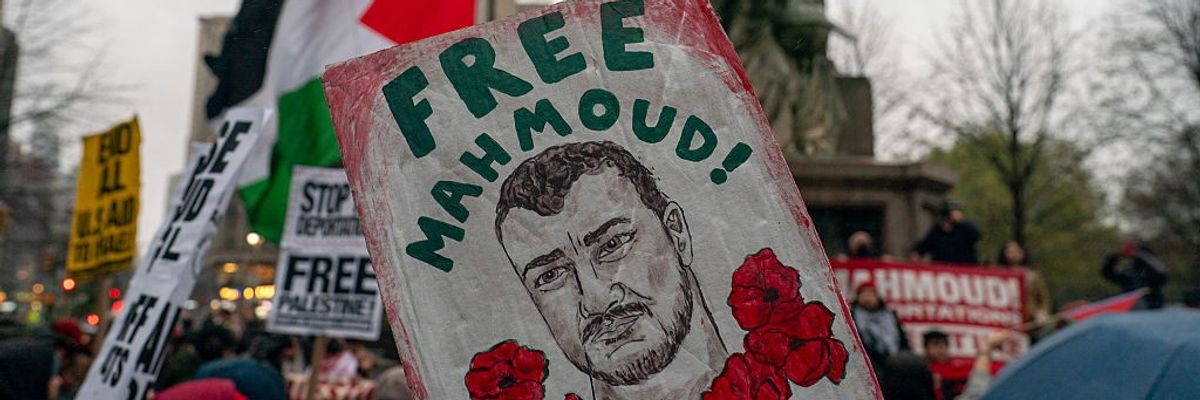
Mahmoud Khalil Team Files FOIA Request to Expose Trump Collusion With Anti-Palestinian 'Agents of Repression'


One attorney for the targeted U.S. resident accused the doxxing groups of "weaponizing inflammatory rhetoric and conflating criticism of Israel with hate speech in order to chill activism for Palestinian rights."


Demonstrators gather in Columbus Circle to demand the release of Mahmoud Khalil on April 12, 2025 in New York City.
(Photo: David Dee Delgado/Getty Images)

Jessica Corbett
May 29, 2025
COMMON DREAMS


Mahmoud Khalil's legal team on Thursday demanded records from the federal government to expose the Trump administration's "collusion with anti-Palestinian doxxing groups" that have worked to get people including their client deported from the United States.

“For years, these anti-Palestinian doxxing groups have served as agents of repression, weaponizing inflammatory rhetoric and conflating criticism of Israel with hate speech in order to chill activism for Palestinian rights," said Ayla Kadah, an attorney and justice fellow at the Center for Constitutional Rights (CCR), one of the groups representing Khalil, in a statement.

"Now, evidence seems to point to the Trump administration colluding with them as they escalate their crusade to target noncitizens for detention and deportation, with Mahmoud Khalil serving as their latest target," Kadah continued. "Mahmoud deserves answers, and so does the public."

"Evidence seems to point to the Trump administration colluding with them as they escalate their crusade to target noncitizens for detention and deportation."

Khalil is a legal permanent resident of Palestinian origin and a former Columbia University student organizer who has been in federal immigration custody since being accosted by plainclothes agents with his pregnant wife, Noor Abdalla, outside their New York City apartment in March. Abdalla, a U.S. citizen, gave birth to their son while her husband remained detained in Louisiana.

So far, the Trump administration has maintained its effort to deport Khalil over his on-campus activism against Israel's U.S.-backed assault on the Gaza Strip, claiming that despite his green card, he can be removed from the country because U.S. Secretary of State Marco Rubio has "reasonable grounds to believe that Khalil's presence or activities in the United States would have potentially serious adverse foreign policy consequences."

CCR sent the 15-page records request to the U.S. departments of Homeland Security (DHS), Justice, and State, as well as the Federal Bureau of Investigation and Immigration and Customs Enforcement (ICE). The group also publicly released the document, which states that "Khalil has long been targeted by anti-Palestinian organizations, including individuals and groups who have sought his deportation or later taken credit for his arrest and detention."

"Days prior to his arrest by ICE, he sought Columbia University protection from these hostile groups, seeing that the groups were calling for the federal government to effectuate his deportation," notes the Freedom of Information Act filing. "In this FOIA request, Khalil seeks information that would illuminate the reported origins of his targeting and the bases of the Rubio determination."

"Specifically, he seeks information that would document and expose the reported collaboration between federal officials and private, anti-Palestinian organizations who have identified, doxxed, and reported him and others for purposes of securing the deportation of student activists advocating on behalf of Palestinian human rights," the document says.

The filing lists "the most prominent groups" subject to the FOIA request—Betar USA, CAMERA, Canary Mission, Capital Research Center, Columbia Alumni for Israel, Documenting Jew Hatred on Campus, Middle East Forum, and Shirion Collective—and details their targeting of Khalil, his university, and other individuals dealing similar cases, including Badar Khan Suri, Mohsen Mahdawi, and Rümeysa Öztürk, who have all been released from ICE custody recently.

"The correlation is clear, and not a coincidence: To date, not a single reported visa revocation and detention of an individual based on pro-Palestine activism occurred absent prior doxxing by one of these groups."

"Patterns of arrests and detention by ICE and DHS strongly suggest that these federal agencies are acting at the encouragement of the groups," the document says. "The groups also appear to be coordinating amongst themselves and amplifying each other's efforts to solicit federal agencies to punish individuals for protesting for Palestinian rights."

"These groups often take credit for ICE and DHS's adverse actions against those they have identified or reported, further corroborating the connection between the groups' targeting and the agencies' punitive actions," the filing adds. "The correlation is clear, and not a coincidence: To date, not a single reported visa revocation and detention of an individual based on pro-Palestine activism occurred absent prior doxxing by one of these groups."

The filing was first reported by Zeteo. A State Department spokesperson told the outlet, "Given our commitment to and responsibility for national security, the department uses all available tools to receive and review concerning information when considering visa revocations about possible ineligibilities."

CCR's request for records came a day after U.S. District Court Judge Michael Farbiarz in New Jersey ruled that Rubio likely violated constitutional law in his attempt to use Section 1227 of the U.S. Code to deport Khalil. Despite this, the judge declined to release Khalil on bail or to move him to a facility in New Jersey, closer to his family.

In response to Wednesday's ruling, Khalil's legal team said that "we will work as quickly as possible to provide the court the additional information it requested supporting our effort to free Mahmoud or otherwise return him to his wife and newborn son."
Defunding Truth: Trump’s Attack on NPR and the War on Independent Media

The attack on NPR is not incidental. It is part of a broader, systematic effort to hollow out the institutions that sustain a shared civic life.


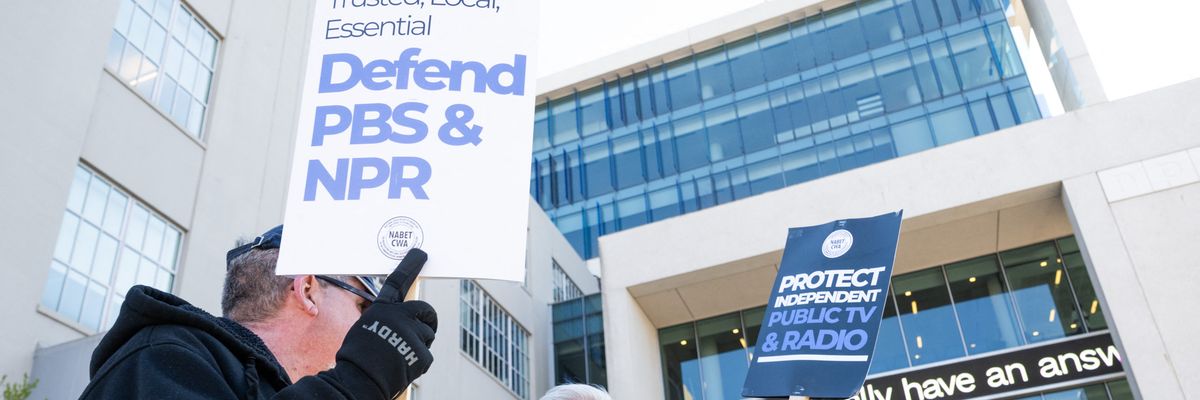
People participate in a rally to call on Congress to protect funding for U.S. public broadcasters, Public Broadcasting Service (PBS) and National Public Radio (NPR), outside the NPR headquarters in Washington, D.C., on March 26, 2025.
(Photo: Saul Loeb/AFP via Getty Images)


Matt Watkins
May 30, 2025
Common Dreams


On May 27, 2025, NPR and three of its member stations filed a federal lawsuit against President Donald Trump and senior administration officials, challenging the legality and constitutionality of a sweeping executive order that seeks to eliminate all federal funding for public media. The order, signed in secret on May 1 and titled “Ending Taxpayer Subsidization of Biased Media,” instructs federal agencies and the Corporation for Public Broadcasting to sever direct and indirect support for NPR and PBS.

The White House claims public broadcasters have become ideologically compromised—too progressive, too elite. But the lawsuit lays bare what this order truly represents: an act of retaliation against protected speech, an attempt to coerce editorial compliance through financial pressure, and a direct violation of the First Amendment and the Public Broadcasting Act of 1967.

This isn’t just a legal question. It’s a campaign to punish an institution for refusing to perform ideology—or worse, for refusing to perform for profit.

Calling NPR “left-wing” isn’t just a complaint—it’s a tactic. It frames the pursuit of truth as bias, and intellectual legitimacy as partisanship.

The attack on NPR is not incidental. It is part of a broader, systematic effort to hollow out the institutions that sustain a shared civic life. It arrives amid a sweeping retreat from democratic infrastructure, in a media environment already distorted by market forces and polarized spectacle. The point is not to shrink government, but to starve the parts of it that still serve public truth.

And when that truth is no longer institutionalized—when public media is stripped away—we are left with a brittle and binary media ecosystem. One pole is built on the commodification of dissent: branded, aestheticized resistance packaged for affirmation but divorced from redistribution. The other is built on grievance-fueled nationalism: disinformation-heavy, algorithmically weaponized, and driven by a hunger for cultural control.

To be clear: This is not a critique of independent movement journalism, which continues to speak truth to power. The critique is directed at large-scale, corporate liberal media that simulates transformation while avoiding structural change. Between that and right-wing propaganda lies a collapsing middle—where nuance, contradiction, and collective understanding once lived.

Over the past decade, American institutions have developed a method of control that depends not on silencing dissent, but absorbing it. Dissent becomes aestheticized. A movement becomes a marketing slogan. A crisis becomes a campaign. Moral performance replaces material change. The result is a politics of gesture—rhetorically progressive, materially stagnant.

This logic has reshaped journalism itself. Newsrooms adopt the language of equity while preserving internal hierarchies. Social platforms reward provocation, not precision. Engagement becomes the end goal. As backlash rises, even institutions that once embraced equity quietly retreat—rewriting mission statements, cutting DEI staff, and recasting structural critique as reputational risk.

In this context, public media has held a distinct line. NPRhasn’t turned itself into a lifestyle brand. It hasn’t gamified its coverage or collapsed journalism into performance. Its reporting focuses on infrastructure—housing, public health, rural economies—topics long abandoned by commercial outlets because they don’t scale.

What’s at stake isn’t just funding—it’s whether journalism can still exist as a civic discipline rather than a partisan weapon or a market product.

And yes, it has a tone. That tone reflects a commitment to method, verification, and proximity to academic and professional norms. That is precisely what’s under attack. Calling NPR “left-wing” isn’t just a complaint—it’s a tactic. It frames the pursuit of truth as bias, and intellectual legitimacy as partisanship. The same campaign now targeting NPR has already targeted public universities, climate science, and historical scholarship.

This executive order wasn’t born of fiscal conservatism. It came from a worldview where facts are threats unless they’re profitable or loyal. On the surface, this is about money. Beneath it lies a deeper question: Can democracy survive without institutions committed to unmonetized, unmanipulated truth?

Public media is one of the last places where journalism operates outside of market logic. If it falls, we’re left with only two choices: branded content that performs outrage for engagement, or weaponized narrative designed to dominate. In that void, journalism becomes either commercialized or coerced.

We’re already living in the early stages of that collapse. Local papers are gone. Regional reporting has been gutted. What remains is a patchwork of influencers and platforms, each calibrated to a target audience, each echoing a self-reinforcing narrative.

Public media’s refusal to conform—to accelerate, to provoke, to monetize—is now treated not as moderation, but as provocation.

The lawsuit NPR has filed is necessary. But it also marks a threshold. What’s at stake isn’t just funding—it’s whether journalism can still exist as a civic discipline rather than a partisan weapon or a market product.

Public media is quiet. It’s moderate. It rarely declares. But in a media economy built on spectacle and churn, quietness itself has become an act of resistance.

The attack on NPR is not just political retaliation. It is a warning. It shows how intolerable independent institutions have become in a country where truth is measured by allegiance and journalism is judged by its usefulness to power.

The refusal to commodify dissent, the refusal to monetize distrust, is no longer just a professional standard. It is a political act.

And in a democracy increasingly organized around spectacle, that act may be the last thing keeping the lights on.

The revolution, Gil Scott-Heron once wrote, would not be televised. If NPR falls, it will not be broadcast at all. Not because no one is speaking—but because the signal has been cut


Our work is licensed under Creative Commons (CC BY-NC-ND 3.0). Feel free to republish and share widely.


Matt Watkins
Matt Watkins is CEO of Watkins Public Affairs, where he has helped organizations secure over $1.6 billion in public and philanthropic funding. His writing has appeared in Slate, Crain’s Chicago Business, and the South Bend Tribune, with upcoming pieces in Governing and the Chronicle of Philanthropy.
Full Bio >
9th Circuit Rules Trump Order for Mass Firings 'Far Exceeds' Constitutional Authority

The coalition behind the legal challenge the Court's decision "rightfully maintains the block on the Trump-Vance administration's unlawful, disruptive, and destructive reorganization of the federal government."


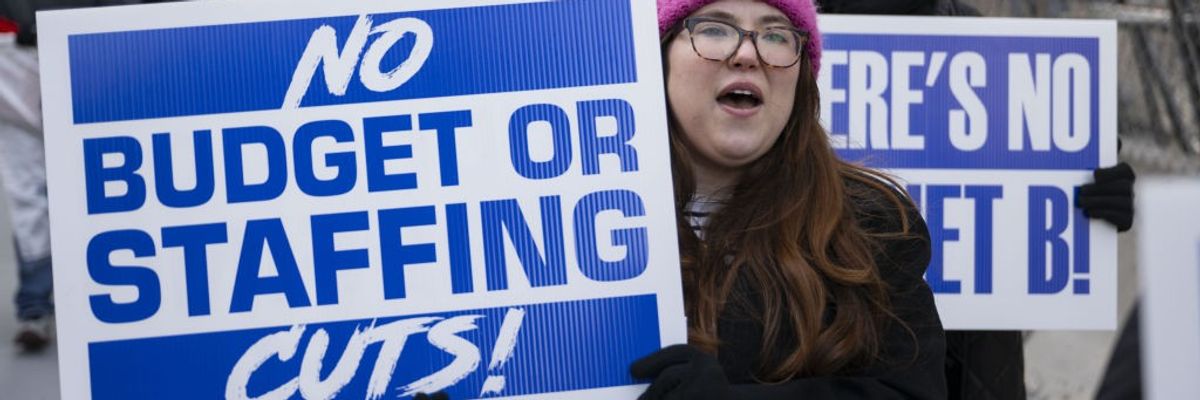
People holding banners chant during a rally outside Jacob K. Javits Federal Building against the firings of thousands of federal workers by U.S. President Donald Trump and Elon Musk's Department of Government Efficiency (DOGE). New York City, U.S., February 19, 2025.
(Photo by Mostafa Bassim/Anadolu via Getty Images)

Jon Queally
May 31, 2025
COMMON DREAMS


The 9th Circuit Court of Appeals on Friday night kept in place a block on President Donald Trump's efforts for massive firings and agency restructuring across the federal government, saying a far-reaching executive order signed in February went way beyond his constitutional authority and that the potential harm caused by the terminations warrants the hold while legal challenges continue to play out in the courts.

"The Executive Order at issue here far exceeds the President's supervisory powers under the Constitution," the appeals court wrote in its 2-1 decision.

The majority decision, written by Senior Circuit Judge William Fletcher, noted that while "the President enjoys significant removal power with respect to the appointed officers of federal agencies," the kind of far-reaching approach represented by Trump's executive order "has long been subject to Congressional approval."

According to the Associated Press:
The Republican administration had sought an emergency stay of an injunction issued by U.S. Judge Susan Illston of San Francisco in a lawsuit brought by labor unions and cities, including San Francisco and Chicago, and the group Democracy Forward.

The Justice Department has also previously appealed her ruling to the Supreme Court, one of a string of emergency appeals arguing federal judges had overstepped their authority.

In a statement late Friday, the coalition behind the lawsuit that challenge Trump's order—which includes nationwide labor unions and non-profit groups as well as cities and counties in California, Illinois, Maryland, Texas, and Washington—welcomed the ruling as it once again slammed Trump's assault on the nation's federal workforce and the rule of law.

The 9th Circuit's decision, the coalition said, "rightfully maintains the block on the Trump-Vance administration's unlawful, disruptive, and destructive reorganization of the federal government."

Trump's actions, the statement continued, "have already thrown agencies into chaos, disrupting critical services to people and communities across our nation. Each of us represents communities deeply invested in the efficiency of the federal government – laying off federal employees en masse and reorganizing government functions haphazardly does not achieve that. We are gratified by the court's decision today to allow the pause of these harmful actions to endure while our case proceeds."

"The Trump administration's reckless attempt to dismantle our government without congressional approval threatens vital services Americans depend on every day—from caring for veterans and safeguarding public health, to protecting our environment and maintaining national security," said Everett Kelley, president of the American Federation of Government Employees (AFGE) union, the nation's largest federal worker union and a party to the suit, in response to the ruling. “This illegal power grab would gut federal agencies, disrupt communities nationwide, and put critical public services at risk. AFGE is proud to stand shoulder-to-shoulder with this coalition to protect not just the patriotic public servants we represent, but the integrity of American government and the essential services that our nation deserves."

The Nuclear Trump Factor

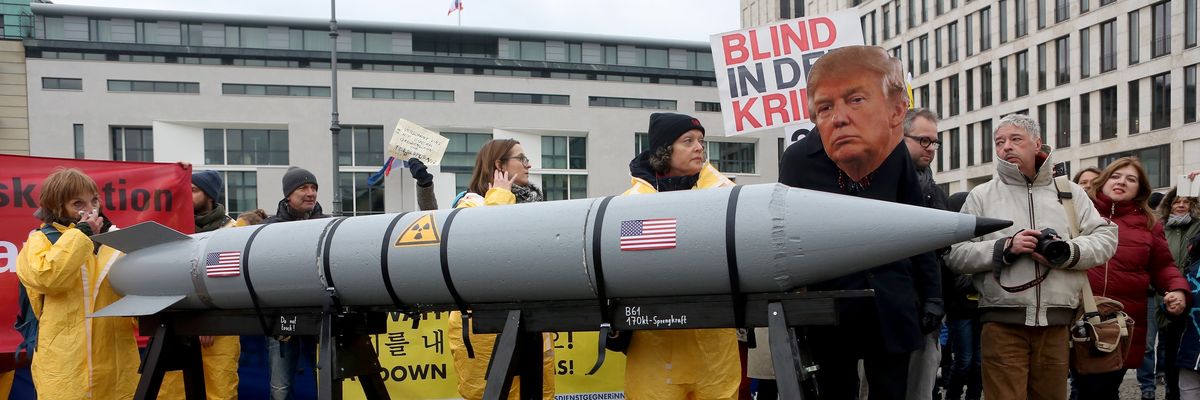
The threat of nuclear war has never been greater than today. The self-proclaimed peacemaker in Washington is to blame.


An activist with a mask of U.S. President Donald Trump marches with a model of a nuclear rocket during a demonstration against nuclear weapons on November 18, 2017 in Berlin, Germany.
(Photo: Adam Berry/Getty Images)

David Goessmann
May 31, 2025
Common Dreams

Hardly a day goes by without the phrase "Donald Trump is a danger to the world" being given new life. The threat posed by the U.S. president applies of course to the U.S. itself, which is in danger of sliding into fascist authoritarianism, and to the planetary boundaries that the billionaire cabinet is enthusiastically trampling all over with its "drill, baby, drill" policy.

What is less noticed is another global threat being driven by the MAGA insurrection movement in the White House, which has declared war on democracy, the state, and the planet. It is the risk of nuclear war. Although Trump is calling for an end to the fighting in Ukraine, which would reduce the threat of nuclear weapons being used in this crisis hotspot, the overall dangers have increased with the new administration.

First of all, it should be kept in mind that in the U.S., the president has sole authority, without restrictions or consultation, to order a nuclear attack against any target at any time, for any reason. He does not have to consult with anyone, and the decision is beyond any control. This is made possible by the so-called "nuclear football" (officially called the "presidential emergency satchel"). Military personnel who carry it accompany the president wherever he goes.

Trump's hara-kiri and doomsday politics, which destroy trust and rely on macho gestures instead of nuclear restraint and international cooperation, are a permanent source of instability and escalation.

The U.S. president can therefore carry out nuclear strikes at any time, which would mean hundreds of millions of deaths and probably the end of humanity. Experts and some politicians in Congress warn that this is a risky, vulnerable, and undemocratic procedure, established by the Eisenhower administration in the late 1950s, which places the decision about the possible end of the world in the hands of a single person. On the other hand, this arrangement is a central element of the U.S. nuclear deterrence strategy, which is intended to send a frightening message to the world.

The mere fact that Donald Trump has once again concentrated this power in his own hands is a danger in terms of the possible use of nuclear weapons. The reasons for this are obvious. Trump has shown himself to be unpredictable, erratic, and emotionally unstable as a person and political leader. His endless lies, provocations, humiliations, and calls for violence are widely known. When he lost the 2020 election to Joe Biden, he initiated and supported an attempted coup on January 6, 2021. As the new president, he ultimately pardoned 1,500 convicted violent criminals, including neo-Nazi leaders who participated in the storming of the Capitol. He also faces multiple charges, including for his efforts to overturn the 2020 election results in his favor, and was convicted of rape by a New York court last year.

In October 2024, over 200 mental health experts warned before the election that Donald Trump was dangerous due to his symptoms of severe, untreatable personality disorder, which they diagnosed as "malignant narcissism." This makes him completely unfit for leadership, according to the health experts. Mary Trump, Donald Trump's niece and a clinical psychologist, also warned against his reelection. In her book Too Much and Never Enough: How My Family Created the World's Most Dangerous Man, she calls her uncle a sociopath. In it, she describes his upbringing in a dysfunctional family that promoted greed, cruelty, and racist and sexist behavior.

At first glance, it may seem reassuring that Trump declared during his first term that nukes were "the biggest problem in the world" and that his goal was to get rid of them. In February 2025, after taking office again, he said, "There's no reason for us to be building brand new nuclear weapons. We already have so many." Unfortunately, this is just rhetoric. Trump has done nothing in this direction so far and has actually increased the nuclear risks through his actions.

In 2018, during his first term as president, Trump announced his withdrawal from the nuclear agreement with Iran, which had successfully limited the uranium enrichment of nuclear fuel in exchange for sanctions relief. Since then, Iran has accelerated its nuclear weapons program. Estimates suggest that Iran could produce several bombs in a matter of months or even weeks. Shortly thereafter, following a series of escalating threats, Trump suggested that North Korea had agreed to denuclearization. Talks followed, but an agreement never materialized.

Furthermore, the first Trump administration indicated to the U.S. Congress that if deterrence against China failed, the U.S. would have to "win" militarily. Peter Kuznick, professor of history and director of the Nuclear Studies Institute at American University, toldTruthout: "U.S. politicians seem so panicked about China's enormous growth and the way it is challenging U.S. hegemony in the Pacific that they are willing to risk nuclear annihilation to prevent it."

Researchers at the Bulletin of Atomic Scientistswarned earlier this year, as they moved the Doomsday Clock to 89 seconds before midnight—midnight means "game over" for humanity—that the United States has "embarked on the world's most expensive nuclear modernization" and that "the 2024 election results suggest the United States will pursue a faster, more expansive nuclear investment program. It is possible that the United States will expand its nuclear efforts to include more nuclear options, rely more on nuclear brinkmanship to advance its security and deterrence goals, and shun proven efforts to reduce nuclear dangers. The United States is now a full partner in a worldwide nuclear arms race."

This is taking place amid chaotic DOGE (Department of Government Efficiency) attacks led by Elon Musk against the National Nuclear Security Administration (NNSA), in which hundreds of scientists and experts responsible for the country's nuclear security were fired. It is unclear whether all of them have returned to the agency after the layoffs were reversed and whether security gaps are to be feared.

The Trump administration is meanwhile pursuing a "peace through strength" strategy in its foreign policy. This is the motto of former U.S. President Ronald Reagan, under which the U.S. launched a historic wave of rearmament. Republicans in the U.S. Congress also support this concept. They want to fuel the arms race by increasing the already historically high U.S. defense budget. There are calls on Trump to demonstrate to Russia that the U.S. holds global supremacy. And there is pressure to resume nuclear testing in order to win the arms race, which observers view as very worrying. The military establishment is even calling for the reintroduction of tactical nuclear weapons into the U.S. arsenal, which can be used in regional wars, which would mean further dramatic destabilization.

But what increases the nuclear risks above all is that, just months after taking office, the Trump administration has triggered "potentially the fastest and most dangerous acceleration of nuclear arms proliferation around the world since the early Cold War." His repeated "America First" statements, saying that the U.S. no longer feels bound by partnerships and would not come to the rescue of allies in an emergency, have left them feeling abandoned by the United States.

This has sparked a debate in European capitals about whether the U.S. nuclear umbrella can still be relied upon. France and the U.K. have offered to fill the gap. In an interview in March before his election as Germany's new chancellor, Friedrich Merz did not even rule out the idea of developing his own nuclear bomb. And in Poland, Prime Minister Donald Tusk is now talking about his country "must reach for the most modern capabilities also related to nuclear weapons." In Ukraine, President Volodymyr Zelenskyy is openly considering reintroducing a nuclear deterrent.

The risk of nuclear weapons spreading further across the globe is greatest in East Asia. During his 2016 election campaign, Trump said that Japan and South Korea might have to develop nuclear weapons. "It's only a matter of time," he said. Former South Korea's right-wing president, Yoon Suk Yeol, finally welcomed the deployment of U.S. tactical weapons in South Korea and intended to arm his country with nuclear weapons. Even though Democratic Party candidate Lee Jae-myung, who is leading in the presidential election polls (official vote is on Tuesday, June 3), is skeptical about South Korea going nuclear, the debate continues in the country. Political scientists Jami Levin and Youngwon Cho see this as a fatal development:
While Trump has been busy burning bridges in Europe and North America, his allies in East Asia—South Korea and Japan—have been watching the implosion of the U.S.-led international order in dismay. They have no alternative to the American nuclear umbrella but to build their own deterrent capabilities.

Polls show that more than two-thirds of South Koreans support their country acquiring nuclear weapons independently of the U.S.

Above all, the increasing confrontation with China is viewed with concern. The tariff war that Trump started against Beijing could exacerbate the security crisis in the Pacific and end in a military conflict, according to fears. Trump's trade attacks are reinforcing the trend toward "decoupling," i.e., the economic disentanglement of the two economies from one another. This, in turn, could lead to a rivalry in which both sides are tempted to harm each other through proxy conflicts and attacks on national security. At the same time, strategy papers from the Pentagon show how easily an economic war can escalate into a military conflict (which would put the nuclear option on the table between the two nuclear powers), according to Jack Werner of the Quincy Institute for Responsible Statecraft in the U.S.:
In a context of mounting economic pain on both sides, with surging nationalism in both countries becoming a binding force on leaders, both governments are likely to choose more destructive responses to what they regard as provocations from the other side. A single misstep around Taiwan or in the South China Sea could end in catastrophe.

Trump's economic and military advisers in the White House are geared toward confrontation with China. That is also the purpose of the presidential order to build a new space-based missile defense system, known as the "Golden Dome." Since Reagan, there have been repeated attempts to initiate such programs. U.S. President Barack Obama wanted to build ABMs (anti-ballistic missiles) in Eastern Europe, but it was only in the wake of the Ukraine war that the Czech Republic gave the green light.

However, all these missile defense systems are not about the possible interception of nuclear intercontinental ballistic missiles, i.e., self-defense, which cannot work technically, as military analysts have determined. ABM is, as the Rand Corporation, among others, explains, "not just a protective shield, but an enabler of U.S. actions." Lawrence Kaplan, professor at the U.S. Army War College and former senior editor of The New Republic, sums it up as follows: "In other words, missile defense is about preserving America's ability to exercise power abroad. It's not about defense. It's about offense. And that's exactly why we need it."

Even if such defense systems are incapable of preventing nuclear first strikes, they have the advantage of theoretically intercepting retaliatory strikes by enemies in response to a first strike. This means that there would be no threat of self-destruction, which could encourage military planners in the U.S. to launch first strikes while other nuclear powers lose their deterrent capability. And the message of Trump's "Golden Dome" has been received by those who were targeted. China, like Russia, has described the announcement from Washington as a "destabilizing" initiative.

While Trump has initiated negotiations in the Ukraine war that could reduce the nuclear dangers between NATO and Russia, he is simultaneously increasing them in the Pacific in an economic and military confrontation now focused on his main adversary, China, which increases the likelihood of a nuclear conflict.

The same applies to the Middle East. The Gaza war waged by Israel's Netanyahu government, a nuclear power, continues to be enabled by the U.S. with weapons and diplomatic blockade, while Trump has promoted the ethnic cleansing of the completely sealed-off enclave with his "Riviera Plan" remarks. The massacre of Palestinians, which has been going on for over a year and a half, has the potential to set the entire region ablaze. This is evident from the military exchanges with the Houthis in Yemen, Hezbollah in Lebanon, and Iran. Israeli Minister of Heritage Amichai Eliyahu even suggested in an interview that dropping a "nuclear bomb" on the Gaza Strip was "an option."

Israel is also regularly indicating that one prepares for an attack on Iranian nuclear facilities. Tehran has declared that it will hold Washington responsible if this happens. This could spark a full-scale war in the region that would draw the U.S. into the conflict, with all the dangers that this entails. At the same time, Trump is exacerbating the conflict himself. Although he wants to negotiate with Iran, he has announced military action if Tehran does not agree to his deal and end all uranium enrichment—which experts consider a dangerous hardline demand that will ultimately lead to war. They argue that it is unnecessary and unacceptable for the country because it would also rule out the civilian use of nuclear power for Iran. Trump threatened that if Tehran did not completely shut down its nuclear program, there would be "all hell to pay," while "all options are on the table"—which is an implicit threat of a nuclear strike.

A similar threat was directed at Russia. On social media, Trump stated on May 28: "What Vladimir Putin doesn't realise is that if it weren't for me, lots of really bad things would have already happened in Russia, and I mean REALLY BAD. He's playing with fire." Putin's confidant and Deputy Chairman of the Security Council of the Russian Federation, Dmitry Medvedev, replied: "Regarding Trump's words about Putin 'playing with fire' and 'really bad things' happening to Russia. I only know of one REALLY BAD thing—WWIII."

It is at this point a war of words between two nuclear powers. But Trump's hara-kiri and doomsday politics, which destroy trust and rely on macho gestures instead of nuclear restraint and international cooperation, are a permanent source of instability and escalation. It is therefore important to raise public awareness of the existential threat once again as civil society pressure on governments especially in countries that possess nuclear arms has to increase by seeking ways to revive the policy of détente—i.e. negotiations on disarmament and arms control, as took place in the 1970s under U.S. President Richard Nixon and in Germany with Chancellor Willy Brandt's Ostpolitik. Even under President Bush senior, there were initiatives launched that reduced the risks. These deescalation efforts are the results of organized peace movements that made a difference. Even in the dark times today there are still possibilities for addressing the dangers of atomic annihilation.


Our work is licensed under Creative Commons (CC BY-NC-ND 3.0). Feel free to republish and share widely.


David Goessmann
David Goeßmann is a journalist and author based in Berlin, Germany. He has worked for several media outlets including Spiegel Online, ARD, and ZDF. His articles appeared on Truthout, Common Dreams, The Progressive or Progressive International. In his books he analyzes climate policies, global justice, and media bias.
Full Bio >
After US Abortion Provider’s Murder, Clinics Became Safer; Let’s Not Undo That Progress

Rolling back protections in the name of political ideology puts lives at risk and undermines decades of work to keep patients and staff safe.


Sandra Peters of Wichita makes her feelings known about slain Dr. George Tiller during a candlelight vi

In the wake of Dr. Tiller’s assassination, health centers across the country strengthened their security, determined to protect patients and staff from violence. Now that protection hangs by a thread. In March, the Trump administration announced that it would stop enforcing the Freedom of Access to Clinic Entrances (FACE) Act, a federal law that prohibits the threat or use of force, obstruction, and property damage to reproductive health care centers and protects people like Dr. Tiller and clinic escorts who try to ensure patients’ access to care. Rolling back these protections in the name of political ideology puts lives at risk and undermines decades of work to keep patients and staff safe.

Let me tell you what this looks like in real life.

As we remember and honor Dr. Tiller's life, I urge Congress to uphold the FACE Act. Dismantling this critical legislation sends a message that condones political violence.

As a volunteer escort with Planned Parenthood of Greater Ohio, I try to help patients feel safe when they come to access healthcare. I do it because, regardless of the care patients are seeking, they are needlessly subjected to name-calling, shaming, and harassment. Sometimes I use a large umbrella to visually block protestors filming patients without consent. Sometimes I help someone park farther away, where it is quieter and feels safer. I do what I can to offer warmth and dignity during a moment that can feel vulnerable, stressful, and deeply personal.

In return, I have been screamed at, had my photo taken by strangers, and have been threatened. I am not alone.

Attacks against reproductive healthcare centers, staff, and clinic escorts are not an anomaly. In the United States between 2023 and 2024, there were 621 incidents of trespassing in reproductive health centers; 296 death threats or threats of harm to abortion providers, patients, and clinic escorts; and at least 37 incidents of stalking. Behind these numbers are providers and volunteers like me and Dr. Tiller, who put their lives on the line to ensure that patients receive the care they need.

Since the overturning of Roe v. Wade in 2022, states throughout the Southeast and Midwest have enacted extreme abortion bans. Patients drive to our Ohio health centers with license plates from all over the country for vital reproductive healthcare. I help them find secure parking spaces away from protestors so they can enter and exit their vehicles safely. My fellow volunteers and I distract patients from the vitriol that protestors throw their way as they walk from their cars to enter our health centers. We all show up because we believe everyone deserves access to compassionate, quality care without harassment.

The people shouting at our patients do not speak for the majority. In 2023, Ohioans voted decisively to protect reproductive rights in our state constitution. Voters sent a clear message: We believe in bodily autonomy, privacy, and access to healthcare. Yet the federal government is abandoning us at the doorway where we are most vulnerable.

The FACE Act matters. It protects patients and providers facing harassment and threats just for seeking or providing healthcare. This is not abstract policy—it is about our neighbors, friends, and family. Everyone should be able to access medical care without fear.

As we remember and honor Dr. Tiller's life, I urge Congress to uphold the FACE Act. Dismantling this critical legislation sends a message that condones political violence. Ensuring safety is the bare minimum we can offer to the doctors, nurses, and volunteers who make great sacrifices to keep our communities healthy. We cannot let personal feelings and political ideology override public health and safety.

We all deserve to feel safe when we seek medical care. And those of us who help make that care possible deserve to be protected, too.

Our work is licensed under Creative Commons (CC BY-NC-ND 3.0). Feel free to republish and share widely.


Jennifer Mcnally
Jennifer McNally is a Planned Parenthood Advocates of Ohio (PPAO) board member and volunteer clinic escort.
Full Bio >
New Illegal Settlements Show Israel Is 'Blatantly Working to Destroy the Palestinian People'

"The international community is enabling Israel's crimes by standing aside while millions of Palestinians are subjected to this racist and brutal regime of the Israeli government," said the Israeli human rights group B'Tselem.


Palestinian women look at the ruins of what used to be their home in Nour Shams Refugee Camp in the occupied West Bank on May 29, 2025.
(Photo: Wahaj Bani Moufleh/Middle East Images via AFP)\

Jake Johnson
May 30, 2025
COMMON DREAMS

Israeli government officials confirmed Thursday that they have approved the largest expansion of unlawful settlements in the occupied West Bank in decades, including the construction of new settlements and the "legalization" under Israeli law of existing outposts in the Palestinian territory.

The decision, reportedly made during a secret Israeli security cabinet meeting last week, drew sharp backlash from Israeli human rights organizations. A spokesperson for B'Tselem said the latest expansion of settlements—which the International Court of Justice has condemned as part of an illegal annexation campaign—shows that "Israel continues to promote Jewish supremacy through the theft of Palestinian land and the ethnic cleansing of the West Bank."

"The Israeli government is openly and blatantly working to destroy the Palestinian people, and any chances for a normal future for the people living between the Jordan River and the sea," the spokesperson said. "The international community is enabling Israel's crimes by standing aside while millions of Palestinians are subjected to this racist and brutal regime of the Israeli government."

Israeli settlements in the West Bank have grown rapidly since the Hamas-led attack of October 7, 2023, with the United Nations Human Rights Office estimating that Israel moved ahead with plans to build more than 20,000 housing units in new or existing settlements between November 2023 and October 2024.

"This extremist Israeli government is trying by all means to prevent the establishment of an independent Palestinian state," Nabil Abu Rudeineh, a spokesperson for Palestinian President Mahmoud Abbas, toldReuters on Thursday.

Israeli Defense Minister Israel Katz confirmed that's the government's objective, declaring that settlement expansion "prevents the establishment of a Palestinian state that would endanger Israel."

"The Israeli government no longer pretends otherwise: The annexation of the occupied territories and expansion of settlements is its central goal."

The new expansion will add nearly two dozen settlements, according to far-right Israeli Finance Minister Bezalel Smotrich, who lives in a West Bank settlement and vocally supports annexation of the Palestinian territory.

"This is a great day for settlement and an important day for the state of Israel," Smotrich wrote in a social media post on Thursday.

The announcement came amid continued Israeli raids and home demolitions in the West Bank, alongside the Israeli military's devastating assault on the Gaza Strip. Israel's attacks have displaced tens of thousands of people in the West Bank and virtually the entire population of Gaza.

It's unclear where the new settlements will be located in the West Bank, given that the expansion decision was made in secret. The Israeli anti-occupation group Peace Now suggested that the secrecy could stem from "concerns about the proceedings in the International Criminal Court, which has begun investigating Israel's settlement construction and development as possible war crimes."

The Wall Street Journalreported earlier this week that the chief prosecutor of the International Criminal Court was considering arrest warrants against Smotrich and Israeli National Security Minister Itamar Ben-Gvir for their roles in expanding West Bank settlements.

"The Israeli government no longer pretends otherwise: The annexation of the occupied territories and expansion of settlements is its central goal," Peace Now said in a statement Thursday. "The cabinet's decision to establish 22 new settlements—the most extensive move of its kind since the Oslo Accords, under which Israel committed not to establish new settlements—will dramatically reshape the West Bank and entrench the occupation even further."

"At a time when both the Israeli public and the entire world is demanding an immediate end to the war, the government is making clear—again and without restraint—that it prefers deepening the occupation and advancing de facto annexation over pursuing peace," the group added.
On Top of All of Israel's Other Bombs in Gaza, Study Reveals a War-Driven Carbon Bomb


"What we are facing is severely impacting all life in Gaza, and also threatening human rights in the region, and even globally, due to the aggravation of climate change," said one United Nations special rapporteur.


Firefighting teams extinguish the blaze after Israeli military targeted a house belonging to the Yaziji family and several commercial shops in Gaza Strip on May 30, 2025.
(Photo: Hamza Z. H. Qraiqea/Anadolu via Getty Images)

Eloise Goldsmith
May 30, 2025
COMMON DREAMS

A group of researchers has released an updated analysis detailing the devastating impact that Israel's war on Gaza has had in terms of greenhouse gas emissions—in addition to loss of human life.

The study, first reported on by The Guardian and posted to SSRN on Friday, found that the projected planet-warming carbon emissions of "direct war activities" over 15 months of Israel’s military assault on Gaza were greater than the individual annual emissions of 36 countries and territories.

According to local health officials in Gaza, over 54,000 people have been killed in the enclave following October 7, 2023, when a deadly Hamas attack on Israel spurred a devastating military response.

"For over 600 days, Israel has been saying it's targeting Hamas, but it is civilians who have been corralled, bombed, and killed en masse every day," said Bushra Khalidi, policy lead in the Occupied Palestinian Territory for the anti-poverty group Oxfam, on Wednesday.

According to the study, 15-months of war, a period from October 2023 to January 2025, resulted in an estimated 1.89 million tonnes of carbon dioxide equivalent emissions. According to The Guardian's write up of the study, 99% of that 1.89 million tonnes of carbon dioxide equivalent was generated by Israel's ground invasion and aerial attacks on Gaza.

In January 2025, a cease-fire went into effect, but Israel ended the cease-fire in mid-March.

The estimated tonnes of carbon dioxide equivalent increases to 32.2 million tonnes when the study accounts for "pre-conflict and post-conflict related construction activities."

The pre-conflict emissions include the construction of security-related concrete infrastructure in both Israel and Gaza over the past 16 years, including Hamas' network of tunnels and Israel's "iron wall." Post-conflict relates to the future reconstruction needs of Gaza following extensive Israeli attacks.

"This updated research evidences the urgency to stop the escalating atrocities, and make sure that Israel and all states comply with international law, including the decisions from the [International Criminal Court] and the [International Court of Justice]," Astrid Puentes Riaño, U.N. special rapporteur on the human right to a clean, healthy, and sustainable environment, told The Guardian.

"Whether or not states agree on calling it a genocide, what we are facing is severely impacting all life in Gaza, and also threatening human rights in the region, and even globally, due to the aggravation of climate change," she added.

The study, which according to The Guardian is under peer review by the journal One Earth, follows a study released last year authored by some of the same researchers who tackled this same question of the climate costs of the war on Gaza.

"These calculations point to the urgent need for increased visibility and mandatory reporting of military emissions for both war and peacetime through the U.N. Framework Convention on Climate Change," the more recent study states, referencing a treaty ratified by nearly 200 countries in the 1990s to combat "dangerous" human interference with climate systems.
In Dissent, Jackson Warns of 'Devasting' Impacts as Supreme Court OKs Trump Ending Protections for 500K Migrants

One immigration lawyer wrote that the order "simply ignores the human costs and blesses the Trump admin's stripping of status of hundreds of thousands of people who entered the country legally."


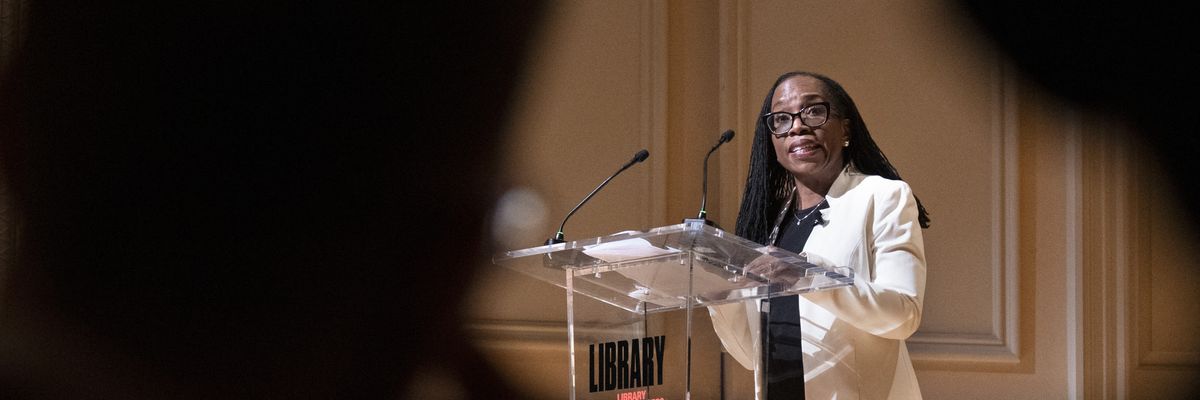
U.S. Supreme Court Justice Ketanji Brown Jackson speaks to the 2025 Supreme Court Fellows Program, on February 13, 2025, at the Library of Congress in Washington, D.C.
(Photo: JACQUELYN MARTIN/POOL/AFP via Getty Images)


Eloise Goldsmith
May 30, 2025
COMMON DREAMS

The U.S. Supreme Court on Friday cleared the way for the Trump administration to end, for now, legal protections for more than 500,000 Haitian, Cuban, Nicaraguan, and Venezuelan migrants with a ruling that liberal Supreme Court Justice Ketanji Brown Jackson blasted in a dissent as deeply harmful.

The decision puts on hold a ruling from U.S. District Judge Indira Talwani, who in April issued a stay on the Trump administration's move to end a humanitarian program extended to this group under former U.S. President Joe Biden. The ruling means the immigrants are at risk of being deported under President Donald Trump's mass deportation effort, even as the core legal issues in the case continue to play out in lower courts.

The unsigned order from the Supreme Court focuses on the so-called CHNV parole program, which allows certain individuals from those four nations to apply for entry into the U.S. for a temporary stay, so long as they have a U.S.-based sponsor, go through security vetting, and meet other conditions. In some cases, beneficiaries of the program work in the U.S.

On his first day in office, Trump issued an executive instructing the U.S. Secretary of Homeland Security to "[t]erminate all categorical parole programs," including CHNV.

"The court has plainly botched this assessment today. It requires next to nothing from the government with respect to irreparable harm" wrote Jackson in her dissent, joined by Justice Sonia Sotomayor. "And it undervalues the devastating consequences of allowing the government to precipitously upend the lives of and livelihoods of nearly half a million noncitizens while their legal claims are pending."

Friday's ruling is the second time this month that the Supreme Court has permitted the Trump administration to halt a program aimed at protecting immigrants who leave their home countries for humanitarian reasons. Earlier in May, the court issued an unsigned order allowing Trump to cancel Temporary Protected Status protections specifically extended to 350,000 Venezuelans immigrants while the legal case winds its way through lower courts.

The court's decision on Friday is a temporary order and litigation is still playing out, but it signals that a majority of the justices think the Trump administration is likely to prevail in the case, according to The New York Times.

"Respondents now face two unbearable options," according to Jackson's dissent. Jackson wrote that immigrants in the program could either chose to leave the U.S. and potentially confront dangers in their home countries, and other adverse outcomes, or "risk imminent removal at the hands of government agents, along with its serious attendant consequences."

"The court allows the government to do what it wants to do regardless, rendering constraints of law irrelevant and unleashing devastation in the process," she concludes in the dissent.

Aaron Reichlin-Melnick, senior fellow at the American Immigration Council, wrote: "an incredibly devastating decision which simply ignores the human costs and blesses the Trump admin's stripping of status of hundreds of thousands of people who entered the country legally."

Josh Gerstein, a legal reporter at Politico, wrote that the ruling "may spell trouble for Ukrainians/Afghans with similar status."