Monday, July 21, 2025


Russia bookstore fined for LGBTQA+ ‘propaganda’ by selling books
A Moscow court fined the bookstore Falalster 800,000 rubles (approximately $10,000) and its founder, Boris Kupriyanov, 100,000 rubles (approximately $1,300) on the charges of LGBTQA+ “propaganda,” according to local media.

Charges were reportedly based on the bookstore selling books like More Happy Than Not by Adam Silvera, Satanic Feminism by Per Faxneld, Fruit of Knowledge by Liv Strömquist, The Miseducation of Cameron Post by Emily M. Danforth, and Fence: Volume Two by C.S. Pacat. The court found that the removed literature “propagandizes non-traditional relationships and sex change.”

Kupriyanov plead not guilty, elaborating that the books are not banned, are not found on prohibited or extremist lists, and were not deemed “problematic” until the trial. He also questioned the expertise of the expert used to determine the “problematic” nature of the books, stating that he is unaware of their level of education and that, in some cases, the “problematic” parts of the books were taken out of context.

The founder of the bookstore also criticized the trial process, sharing that he was not aware of the expertise analysis taking place or of the rights that he is entitled to. Kupriyanov concluded with a challenge, rationalizing that the expert needs to read all 38,000 books sold in the bookstore to make sure that there are no other complaints.

Falalster was fined 80,000 rubles (approximately $1,000) and Kupriyanov 40,000 rubles (approximately $500) earlier this year for selling “On the Way to Magadan” by Belarusian anarchist Ihar Alinevich. The book was registered as “undesirable” in 2024. Kupriyanov pled not guilty then as well, noting that the publication of the book was incorrectly identified on the Ministry of Justice’s “undesirable” booklist. 

Bookstores in Russia have been facing intensified prosecution for the sale of “undesirable” books, with books accused of “LGBTQA+ propaganda” currently taking the spotlight. Earlier this month, a Saint Petersburg Court announced a case against bookstore Подписные издания (Subscription Editions) on the aforementioned charges. The bookstore was previously fined 800,000 rubles (approximately $10,000) on the same charges. In May of this year, employees of publishing houses Eksmo and Popcorn Books were arrested amidst a LGBTQA+ “propaganda” investigation.


CRIMINAL CAPITALI$M

Pakistan's fighter jets win top awards at Royal Air Show in Britain


Last updated: July 20, 2025 | GULF TIMES

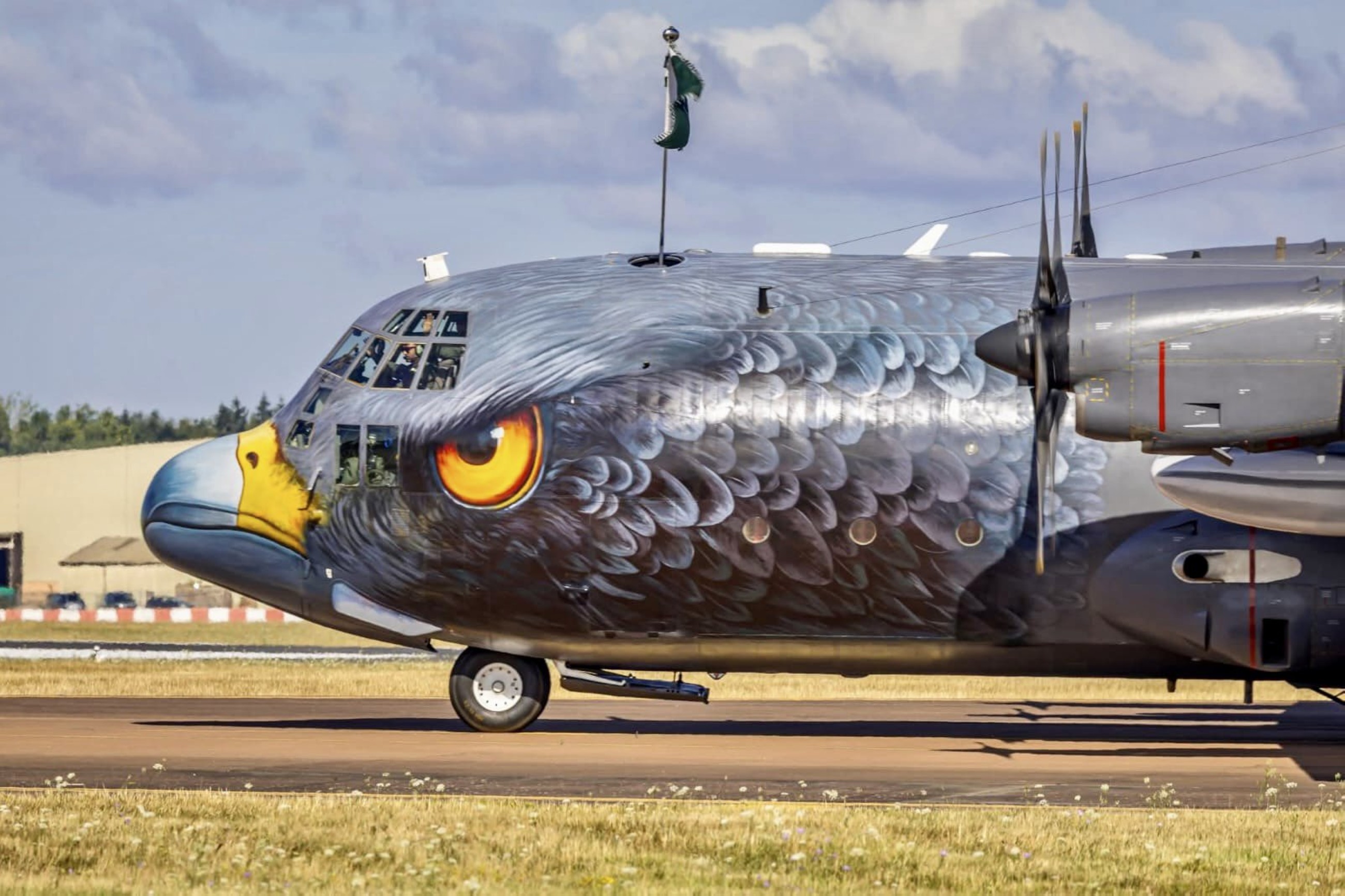
A stunning Pakistan Air Force C-130 Hercules at RAF Fairford, UK, for the 2025 Royal International Air Tattoo Show. Photo / X

Tariq Butt, Correspondent

Fighter jets of the Pakistan Air Force (PAF) won top awards in two categories at the Royal International Air Tattoo (RIAT) 2025 in Britain, state-run Pakistan Television (PTV) reported.

RIAT, which runs from July 18 to 20, is one of the world’s largest military airshows, has been running for over 50 years and powers the Royal Air Force Charitable Trust, according to its website.

On Thursday, a PAF contingent comprising "state-of-the-art JF-17 Thunder Block-III fighter aircraft and the C-130 Hercules transport aircraft, landed at the Royal Air Force Base Fairford in the UK to participate in the prestigious” RIAT 2025, a statement from the Inter-Services Public Relations (ISPR) said.

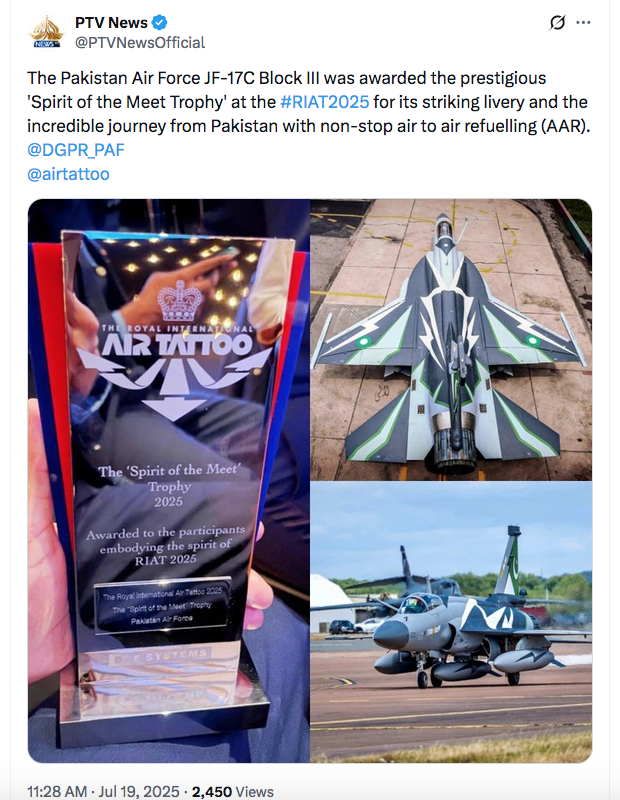
The JF-17 Block-III was awarded the "Spirit of the Meet Trophy” for its striking livery and the incredible journey from Pakistan with non-stop air-to-air refuelling, PTV said.


The ISPR had said that the JF-17 Thunder Block-III fighters executed successful Air-to-Air Refueling operations en route to the UK with the support of a PAF IL-78 aerial refueling tanker.


Meanwhile, the C-130H Hercules was awarded the "Concours d’Elegance Trophy”. These awards were given in recognition of the aircrafts’ excellent flying and technical skills. The JF-17C Block III represents Pakistan’s "advanced defence technology”. This success honoured Pakistan’s aviation sector on an international level, the state broadcaster said.


The PYB called the success at RIAT a "testament to the recognition of the capabilities of the Pakistan Air Force.”


In May, when Pakistan downed Indian jets as retaliation for late-night strikes during the Pakistan-India conflict, the PAF formally acknowledged a month later that it was the Kamra-based 15 Squadron that led the charge in shooting them down.


US escalates Brazil tensions as Rubio revokes visas of judges involved in Bolsonaro case


US Secretary of State Marco Rubio on Friday announced the revocation of US visas for eight of Brazil’s 11 Supreme Court justices, in what officials described as part of a broader effort to support former Brazilian President Jair Bolsonaro, who is currently fighting prosecution for his alleged attempt to overturn the 2022 election.

The announcement follows escalating diplomatic actions by the Trump administration, including a 50 percent tariff on Brazilian imports scheduled to take effect August 1. Rubio stated that the visa revocations were implemented in response to what he called a “political witch hunt” against Bolsonaro, who is on trial in Brazil’s Supreme Court and faces up to 43 years in prison.

In March, Brazil’s Supreme Court unanimously voted to initiate a trial against Bolsonaro on charges of conspiring to overthrow the government. Prosecutor General Paulo Gonet Branco charged Bolsonaro and 34 others with crimes including attempted violent abolition of democratic rule, coup d’état, and participation in a criminal organization. The charges stem from the violent January 8, 2023, storming of government buildings in the nation’s capital by Bolsonaro supporters, and include allegations of voter intimidation and an assassination plot against incumbent President Luiz Inácio Lula da Silva. The trial against Bolsonaro is expected to begin later this year, with potential prison time of several decades if convicted.

The visa revocations affect judges including Alexandre de Moraes, who is leading the investigation, along with Luís Roberto Barroso, José Antonio Dias Toffoli, Cristiano Zanin, Flávio Dino, Cármen Lúcia Antunes Rocha, Luiz Edson Fachin, and Gilmar Ferreira Mendes. Three justices—André Mendonça, Kassio Nunes Marques and Luiz Fux—were not included.

President Lula condemned the US actions on Saturday, calling them “arbitrary and completely baseless.” Lula said, “Brazil will not tolerate foreign interference in our judicial process, and our democracy will not be intimidated by external pressures.”

The measures have triggered backlash across Brazil, including criticism from conservative outlets like Estado de São Paulo, which called them “unacceptable external interference in Brazil’s domestic matters.” Supporters of Bolsonaro, including his son Eduardo, praised the move, while some analysts have warned of potential economic blowback, especially in Bolsonaro-supporting regions that rely heavily on exports to the US.


Angola police accused of using excessive force against peaceful protesters
Angolan police used excessive force and carried out arbitrary arrests during a peaceful protest in Luanda on July 12, Human Rights Watch alleged Friday. According to reports, officers fired tear gas and rubber bullets without justification, assaulted demonstrators, and detained 17 protesters, some of whom were released only after legal intervention.

The demonstration, organized by youth groups and civil society organizations, was a response to the Angolan government’s decision to raise fuel prices and eliminate public transport subsidies without public consultation. Hundreds of people marched from Luanda’s São Paulo neighborhood toward Largo 1º de Maio before being violently dispersed by security forces.

“Angolans should be able to peacefully protest government policies without being met with excessive force and other violations of their basic rights,” said Ashwanee Budoo-Scholtz, deputy Africa director at Human Rights Watch. “The government needs to open an impartial investigation into these abuses and hold those responsible accountable.”

Despite receiving official authorization for the protest route, demonstrators were attacked upon nearing their destination. “Without any prior warning, the crackdown began brutally,” said activist and protest spokesperson Aidilson Manuel. He confirmed that four people suffered serious injuries, including one individual who “was hit directly in the face by a tear gas canister, causing a deep cut that required surgery.”

The Angolan Police General Command defended the operation, stating it was meant “to maintain public order and tranquility, since the protesters did not follow the route.” However, Manuel stated that the correct legal procedures had been followed and official approval for the demonstration had been granted the day before.

These concerns echo long-standing warnings from Amnesty International, which in a November 2024 report, urged Angolan authorities to hold police accountable for killing or injuring demonstrators between November 2020 and June 2023. According to Amnesty, at least 17 people were killed across eleven protests during that period, and no officers have been prosecuted to date.

In the November 2024 report, Amnesty has accused Angolan police of using live bullets, batons, and tear gas against peaceful demonstrators and has criticized repeated delays in justice. Amnesty also called on the attorney general’s office and the ombudsman to investigate police violence, stating that Angola must uphold its human rights obligations under the ICCPR and ACHPR.

Russian Far East Not Some African ‘Colony’ as Some Moscow Officials Appear to Believe, Kamchatka Residents Say

Paul Goble

Sunday, July 20, 2025

            Staunton, – The Moscow official responsible for preventing the spread of disease in animals and plants suggested in language that was both incautious and revelatory that the center should block individuals from carrying caviar to the Far East in their luggage just as one would expect any government to do about antelope meat in luggage going to Africa.

            Not surprisingly, the words of Sergey Dankvert, the head of the Federal Service for Veterinary and Phytosanitary Monitoring, struck a nerve and prompted both the regional media and the population to denounce his analogy (vostok.today/53561-dalnij-vostok-ne-kolonija-on-chast-rossii-s-kamchatki-otvetili-glave-rosselhoznadzora.html).

            In an open letter to Dankvert that Vostok.Today has published and that the Tallinn-based regionalist portal Region.Expert has picked up to highlight, the people of Kamchatka made it clear how angry they are not just about his words but about the habit of mind of many in Moscow that lies behind them:

Respected Sergey Alekseyevich!

Your comparison of the Far East with Africa and red caviar with dried antelope meat has become a clear example of how bureaucrats in the capital talk about the regions which feed them. Allow us to explain something to you.

You speak about our products as if they were contraband from the third world. But Kamchatka, the Primorye, and Sakhalin are also Russia just like Moscow. The difference is only that we harvest the fish, oil, gas and forest and you use them.

If one fears parasites, then one should be looking not in caviar but in the corrupt schemes which for decades you have taken our resources in exchange of misery payments.

You praise Europe for its control over products. But somehow European officials don’t compare their regions with Africa – perhaps because their regions don’t feed the capital but instead live in a worthy fashion themselves?

You prohibit carrying caviar in baggage but you take no notice of the fact that tons of seafood products are going to China via various ‘gray’ schemes … In this way, you are struggling not with parasites but with ordinary people who want to bring caviar as a present.

You talk about ‘government spending’ on cures but for some reason don’t remember that the Far East gives Moscow enormous sums through taxes and in return gets impassable roads, dying villages and the outflow of the population. Our salaries are low and our prices are high. You ban people bringing in caviar but don’t provide normal air tickets or other necessities of development.

If you want to find parasites, then perhaps you should begin with those who sit for 20 years in government offices and give back to the country only reports full of pretty words.

You demand that we not carry caviar to Moscow, but when we ask for normal roads, pay and air tickets, you act as if the Far East is somewhere in a parallel universe.

If you want to struggle with something dangerous, then you should look at your salaries which are ten times those of fishmen, at your reports, and at your logic which compares Kamchatka with Africa and Moscow apparently with Switzerland.

If you are so afraid of parasites, then invest in labs in the regions … and give the regions more rights so that we ourselves can decide how to develop fishing and stop exporting our natural resources for next to nothing.

And if you aren’t prepared to do that, well, then, the next timeyou want to compare the Far East with Africa, look in the mirror. Immediately, you’ll see that very “exotic guest.”

            The authors of this letter don’t say but they clearly feel as have many people east of the Urals have for two centuries of more that the central government really does view their regions as colonies and themselves as natives. At a time when many are talking about decolonization, statements like Dankvert’s risk provoking more people about taking more steps in that direction.


Prominent human rights group leaves El Salvador under government pressure and repression

El Salvador’s most prominent human rights organization officially ceased operations in the country Thursday due to increasing repression against civil society groups. The organization, Cristosal, cited the “criminalization of human rights defenders, the imposition of [a] Russian-style Foreign Agents Law (LAEX), and the weakening of institutional independence” as key reasons for its decision. While operations in El Salvador are suspended, Cristosal confirmed it will continue its mission in Guatemala and Honduras.

According to Cristosal, Salvadoran President Nayib Bukele’s administration has sharply curtailed basic rights, including the rights to free expression, peaceful protest, and civic engagement. The May arrest of Ruth López, Cristosal’s head anti-corruption lawyer and human rights defender, marked a turning point. López was detained after advocating for transparency and speaking out against corruption. During her detention by the National Civil Police, López was allegedly denied access to her lawyers, which is an act Cristosal condemned as a serious breach of due process and international legal standards. In response to the short-term enforced disappearance, Cristosal called on National authorities to comply with their constitutional and international obligations. Cristosal argued that López’s case is part of a broader strategy of exemplary punishment meant to intimidate.

Cristosal also reported ongoing government intimidation, including legal harassment, surveillance of both its activities and the private homes of staff, and various administrative obstacles. In May, a Foreign Agents Law was approved in El Salvador, requiring organizations receiving funding from abroad to register as “foreign agents” and imposing a 30 percent tax on donations received by non-governmental organizations whose activities are financed internationally. Cristosal called El Salvador’s Foreign Agents Law an authoritarian measure designed to punish independent civil society groups through excessive regulation, punitive taxes, and state monitoring.

Despite the decision, Cristosal reaffirmed its dedication to defending human rights throughout the region.

Not a fun day: Delta pilot's 'aggressive manoeuvre' evades B-52 bomber collision

The flight, operated by SkyWest as Delta Connection Flight 3788, was heading to its destination when the military jet suddenly appeared on a converging path. The pilot of the commercial Embraer 175 aircraft immediately took action to avoid the US bomber.


Minot is home to a US Air Force base, which operates B-52 bombers.

India Today World Desk
 Jul 21, 2025 
Written By: Satyam Singh

In Short

Pilot made sharp turn to prevent crash during flight to Minot

No prior warning given despite radar at Minot Air Force Base

Passengers informed and shaken but landed safely


A Delta regional jet flying from Minneapolis to Minot, North Dakota, had a terrifying moment in the sky on July 18 when the pilot had to make a sudden and sharp turn to avoid a possible crash with a US Air Force B-52 bomber.

The flight, operated by SkyWest as Delta Connection Flight 3788, was heading to its destination when the military jet suddenly appeared on a converging path. The pilot of the commercial Embraer 175 aircraft immediately took action to avoid the bomber.

Once safely on the ground in Minot, the pilot explained what happened to passengers.

"Given his speed ... I don't know how fast they were going, but they were a lot faster than us, I felt it was the safest thing to do to turn behind it," the pilot said, according to an audio recording of the cabin announcement. "So sorry about the aggressive manoeuvre. It caught me by surprise. This is not normal at all. I don't know why they didn't give us a heads-up, because the Air Force base does have radar ... long story short, it was not fun, but I do apologise for it and thank you for understanding. Not a fun day at work."
PASSENGERS SHAKEN BUT SAFE

The regional jet managed to land safely after circling around to try the landing again. It's not known how close the two aircraft came or whether the cockpit systems gave any warning before the pilot took manual control to steer away from danger.

Minot is home to a US Air Force base, which operates B-52 bombers. However, the Air Force has not yet released any details about the near-collision.

SkyWest Airlines confirmed the incident and said it is under investigation.

"SkyWest flight 3788, operating as Delta Connection from Minneapolis, Minnesota to Minot, North Dakota, landed safely in Minot after being cleared for approach by the tower but performed a go-around when another aircraft became visible in their flight path. We are investigating the incident," a SkyWest spokesperson told ABC News.

The pilot’s comments suggest that the Delta crew was not informed in advance that a military aircraft might be nearby, even though Minot Air Force Base uses radar systems that should detect nearby flights. Passengers were terrified by the sudden motion of the plane.

- Ends
Los Angeles Mayor Karen Bass blames immigration crackdown for decimating car wash industry

Los Angeles Mayor Karen Bass says the Trump administration’s immigration enforcement efforts have sent chills through the community, hurting the city’s car washes. 
File photo credit: Wirestock Creators via Shutterstock. 

By Seth McLaughlin - The Washington Times - Sunday, July 20, 2025

Los Angeles Mayor Karen Bass says the Trump administration’s immigration enforcement efforts have sent chills through the community, hurting the city’s car washes.

Ms. Bass, a critic of President Trump’s deployment of National Guard troops in response to immigration protests in Los Angeles, said the scenes of migrants getting detained by armed, masked Immigration and Customs Enforcement agents in unmarked cars have pushed some immigrants into the shadows.

“For the average citizen, it looks like it’s a violent kidnapping,” Ms. Bass, a Democrat, said Sunday on CBS’ “Face the Nation.” “They don’t identify themselves, and furthermore … how on earth do they know that they’re a threat when they’re just chasing random people through parking lots at Home Depots, going to car washes and rounding up people.”

“It’s difficult to get your car washed in Los Angeles now, because most of the car washes, the employees won’t come to work out of fear that a raid will take place,” she said.

Mr. Trump’s crackdown on illegal immigration has sparked fierce blowback from Ms. Bass and other Democrats across the country, who have focused some of their criticism on the nonviolent migrants swept up in the enforcement efforts.

Ms. Bass also pushed back against immigration officials who say ICE agents are wearing masks because they are afraid of retaliation.

“The masked men are not from Los Angeles, and so how their families could be retaliated against?” she said. “And then what is that to say to local law enforcement, the Los Angeles Police Department, none of whom are ever masked, who always identify themselves and even hand someone a business card.

“So that makes absolutely no sense at all,” Ms. Bass said.
The Mask is Off. Why Kenyan #GenZs are Rising Against a Regime Stuck in its Colonial Past

#GenZs Redefine Kenyan politics: Protests challenge Kenya’s outdated colonial governance model.

July 21, 2025
By Mwalimu Mutemi wa Kiama 
This Is Africa 

A storm is sweeping through Kenya, and it is not the work of shadowy conspirators in dark, smoky backrooms. It is a reckoning long overdue — a rupture in the facade of a system that has ruled through brutal coercion, cooption, ethnic manipulation, and performative democracy since the advent of colonialism. Kenya’s #GenZ uprising that has taken root in the last one year, culminating in the events of recent weeks, is not just to protest finance bills but a national awakening, a rupture with the past. Mu people the Gīkūyū call it “ituīka”, which brings to mind the image of a landslide, a severing of an entire hillside or mountain hitherto standing tall and proud. Mapinduzi. It is the loud, collective refusal of a generation that sees everything clearly — and is no longer afraid to say that the emperor has no clothes!

For decades, the Kenyan state has operated under a thin democratic veil, disguising its violent, extractive roots. Borrowing heavily from its colonial predecessor, the post-independence state has (dis)functioned not as a servant of the people, but as a nyapara (colonial overseer) and gatekeeper for compandor elites — administering resources upward, and repression downward. The civil service, the police force (service?), and even education and infrastructure have been organized around the principle of control, not care. To extract.

This is not just about President Ruto or any single administration. The #GenZ protests are confronting something deeper: the continuity of a colonial governance model that has mutated, adapted, but never transformed. “KANU will rule for 100 years after Moi”, someone opined during the struggle for multipartyism in the 1990s. The British may have left, but their tools of domination — manipulation of ethnicity, brute policing, and exclusionary economics — remain firmly in place, now in the hands of African elites. The Kenyan regime has refused to change its software. Worse still, it is trying to run outdated code in a country that has completely evolved. A totally different demographic. It’s akin to running a modern computer using Windows 3.11 or Mac OS 1.

We are no longer in the Kenya of the ‘80s or ‘90s Mr. Ruto! Today’s Kenyan population is overwhelmingly young, urbanized, digitally connected, and fiercely literate in civic & political language. #GenZs doesn’t just read the Constitution — they code it. They livestream it. They dissect legislation on TikTok. They organize protests on X spaces and then go out into the streets with poetry, placards, water, phones, flags, and power. They are not loyal to tribal chiefs or regional kingpins either. Their identity is not beholden to where they were born, but to what they believe in, and what they firmly believe is that the status quo has failed — utterly and completely.

Yet this regime behaves as if it’s still operating in the single-party era, where silence was safety, and dissent meant death. The tactics of teargas, abductions, and extrajudicial killings might have worked in the Kenyatta 1 and Moi eras, but they are tone-deaf and self-defeating today. A smartphone is now more powerful than a VoK/KBC propaganda broadcast beginning with “mtukufu rais…”. A 20-year-old with a data of Wi-Fi connection can out-message a government with a billion-shilling PR budget. Ask Itumbi, this regime’s Goebbels. Brutality no longer breeds fear. It breeds fury. It breeds resoluteness.

From a Tiger to a domestic cat: How Raila betrayed the liberation cause 35 years later

This new Kenyan generation has grown up watching their parents struggle under the weight of corruption, ethnic division, and economic betrayal. They have seen iconic opposition leaders turn into government apologists, seen once respected fiery reformers and human rights defenders, now seated at the table of the oppressor. The betrayal has been quite bipartisan, thankfully, making it easier for the #GenZ to clearly see the entire enemy landscape. Both government and opposition politicians have recycled the same promises, the same lies, and made the same excuses, even while they eat and fatten themselves from the same trough. They realize that there is no messianic saviour in sight, that they are on their own, which is precisely what makes this a movement so powerful.

 The movement is “leaderless” because it is led by everyone.

In this moment, it is crucial to understand that the #GenZ uprising is not a prelude to a crisis. It is the crisis. It is the state shedding the last remnants of democratic theatre and responding with the only tool it has ever trusted: violence. But it is also the public shedding its illusions — the myth that democracy exists because we hold regular elections, the myth that politicians represent the people, the myth that national unity is real unless it is tested.

As Author Sakwah Ongoma aptly put it: “We always live as brothers and sisters until politicians are asked to be accountable… Suddenly, we become Luhyas, Kikuyus, Luos, Kalenjins, Somalis…” This is the oldest trick in the colonial playbook — divide and rule. But, lo and behold, for the first time in living memory, that trick is failing. It’s kaput. Kwisha! Kenyan streets are filled with young Kenyans from all communities, all shades of economic backgrounds, chanting in unity, creating new songs of freedom, refusing to be fragmented. 

And this is what scares the colonial regime.

For the first time since Kenya’s “independence”, there is a mass movement that cannot be bought, co-opted, or silenced. Not even by mass deaths. It is not driven by NGOs, political parties or tribal kingpins. It is not seeking political office or promising voters wheelbarrows or “empowerment” handouts. It is demanding something far more dangerous and nefarious: utu, dignity, truth, and accountability. And our politicians have no answer for it!

A Kenya police officer kicks a tear gas canister during protests in Nairobi against tax hikes on 25 June 2024. Luis Tato/AFP via Getty Images

So the colonial state has responded the only way it knows how: with brute, unadulterated force. Unfortunately for it, each bullet fired and each abduction reveals its cluelessness and desperation. Each #GenZ killing peels back its mask. The “open recklessness” is not madness — it is strategy. As @0xChura put it on Twitter, the regime’s calculus has changed: it no longer needs consent, only submission. It is no longer invested in the myth of legitimacy, only the naked loyalty of its security forces.

But this is a fatal miscalculation.

What we are witnessing is not just protests — it is the dirge at the funeral of an era. The sun is setting (pun intended) on the generation of KANU scions who inherited their power from the British Empire, not through merit or service, but through betrayal of their people and proximity to the so-called founding fathers. They believed they could rule forever, recycling old slogans and weaponizing nostalgia and old hurts, real or imagined. But history has caught up with them. #GenZs are not beholden to the ghosts of independence heroes. They are seeking leaders who speak to their present reality — joblessness, indignity, injustice, and hopelessness.

The KANU-era style of governance — with its gatekeeping tribal elders and kingpins, its patriarchal arrogance, and its disdain for youth calling the “kids” — is dying. But like all dying monsters, it is violent in its death throes. The danger now is that in its desperation to cling to power, the regime may escalate its repression. Already, we have seen the bodies. The state has killed our young in broad daylight. Not in a dark, underground detention centre. Not in the shadows of Nyayo House and Nyati House. But in the open, in front of cameras, in the age of livestreams and hashtags. The revolution is being livestreamed.

And still, they keep coming. Like dust, they keep rising.

Still, #GenZ marches on. With placards made from manila paper. With hands raised high. With phone recording. With flags waving. With songs on their lips and courage in their chests. Because something irreversible has happened: the people are no longer afraid. The genie cannot be put back in the bottle.

This moment is historic not because of the finance bills, but because of the firewall that has been broken. A generation has finally realized that their voice matters — and that they are many. That they are powerful. That the people in power are a few scared, clueless lot. That no messianic saviour is coming — and so they must save each other or perish.

A Conclave?

Let the Kenyan political class take heed. The solutions of yesterday will not work. Conclaves, ethnic coalitions and alliances, and recycled opposition rhetoric are useless against a generation that demands nothing short of total transformation. #GenZs do not want to be “ruled” better — they want to be governed differently. With respect. With dignity. With purpose. They do not want a kinder slave master — they want their freedom.

And so the political elite have but one choice left: evolve or perish!

Message to the public, to civil society, to religious leaders, and to the diaspora watching from afar — know this: neutrality is complicity. If we do not stand with our young people in their hour of courage, we’ll have no moral authority left to claim patriotism. If our voices are not raised in defense of their right to protest, to live, to breathe, then we are siding with the tyrant.

Kenya is at a proverbial crossroads. One road leads back to repression, fear, arrested development, and economic servitude. The other births a new republic — one founded not on inherited trauma or elite pacts, but on utu, justice, truth, and dignity for all.

WaKenya Watahiri Heshima.

This is not just the funeral of an era; it is the birthing of something beautiful.

Mzalendo Mutemi wa Kiama is the Founder of Mzalendo Halisi Foundation and a Community Organizer with Kongamano La Mapinduzi Movement.