It’s possible that I shall make an ass of myself. But in that case one can always get out of it with a little dialectic. I have, of course, so worded my proposition as to be right either way (K.Marx, Letter to F.Engels on the Indian Mutiny)
Friday, March 06, 2026
Royal Caribbean Group Proposes Ship Repair Yard for Panama's Pacific Coast
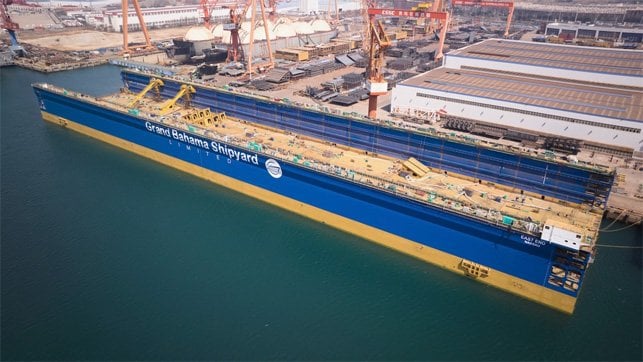
Royal Caribbean is proposing a repair yard with a dry dock on Panama's Pacific coast similar to the capabilities it invested in for the Bahamas (Grand Bahama Shipyard)
Officials from Panama are responding positively to the concept of creating a shipyard on the Pacific coast of the country. Royal Caribbean Group met with the president of Panama, Jose Raul Mulino, and other government executives to outline its proposal, which would see a yard with capabilities to handle large ships in operation by 2031.
Royal Caribbean is proposing that the shipyard be established in the Punta Pierdra sector, near the city of Puerto Armuelles, which is located in the northwest near the border with Costa Rica. They proposed a 130,000-ton floating dry dock with a length of 400 meters (over 1,300 feet), which would be able to accommodate the company’s largest cruise ships.
During the presentation, the company explained that the rationale would be to create a repair facility to service ships on the Pacific coast. It noted that currently, large ships have to go to Asia for their maintenance and dry dockings. By placing the yard in Panama, the company could service its ships sailing on the Pacific coast and would also have the option of bringing ships through the Panama Canal to the yard. They noted that the yard would also be available to other large ships, such as container vessels, which also do not have suitable repair facilities in the area.
Panama has a smaller shipyard in Balboa near the Pacific terminus of the Panama Canal. The country has been working to revitalize that yard, but it only has dry dock capabilities for smaller ships.
According to the Panama Maritime Authority, President Mulino affirmed that he will support the effort to make the Pacific shipyard a reality while noting that investments could start this year. He highlighted that the project would contribute to elevating Panama’s strategic importance as a maritime hub. Mulino also said it would create jobs, helping to rescue an area that has been abandoned for years.
Royal Caribbean estimated the operation could create 500 to 800 jobs in the coming years.
In the 1990s, Royal Caribbean and Carnival Corporation joined together to invest with Freeport in the Bahamas to create a shipyard that could handle cruise ships close to their homeport in South Florida. The companies remain the primary investors in Grand Bahamas Shipyard, which is currently completing a large expansion. In February, the yard undertook the first dry dock project with the first of two new large dry docks built in China. The first dry dock, East End, is 357 meters long and is capable of lifting 93,500 tons. The second dry dock, expected to arrive in 2026, called Lucayan, is due to arrive at Freeport in 2026.
Having a capable shipyard on the Pacific coast could help the company pursue expansion and the use of larger ships in the region. Currently, they are more limited with the capabilities on the Pacific coast, where, for example, Carnival Cruise Line had to partially dismantle the funnel of one of its cruise ships to reach a dry dock for urgent repairs.
Report: MSC and BlackRock Push to Complete Hutchison Deal for Port Ops
CK Hutchison had agreed to sell its global terminal operations but the deal became caught in global politics (Hutchison file photo)
Nearly a year after the deal was first announced for a consortium of MSC Mediterranean Shipping Company and U.S. investment group BlackRock to acquire the global port operations of Hong Kong-based CK Hutchison, the Financial Times reports negotiations are back underway. The newspaper writes that the companies believe that now that Panama has been removed, terms can be reached for the larger global portfolio.
The companies had agreed in 2025 on two deals, with BlackRock leading the purchase of the Panama Ports Company, which operated the terminals at each terminus of the Panama Canal, and MSC’s Terminal Investment Limited (TiL) as a minority investor. It later emerged that MSC would be the lead investor for the other 41 global port operations in 23 countries, ranging from Europe to Southeast Asia and the Middle East. The deal was expected to place a valuation of $23 billion on the portfolio, while CK Hutchison would have retained the port operations in China.
The transaction became caught in a political battle between the United States and China as Donald Trump asserted that China was running the Panama Canal. The Chinese and Hong Kong governments objected to the deal largely due to the political issues, and China reportedly insisted that COSCO had to become a partner. Later reports said that China wanted COSCO to control the new company.
The Financial Times cites two unnamed sources that it says reported the negotiations are back underway after Panama annulled the concession for the operations in Balboa and Cristobal. CK Hutchison is starting what is likely to be an extended legal battle with Panama, including an arbitration for financial damages.
MSC is reportedly anxious to acquire the remaining 43 terminals worldwide to add to TiL’s operations. The Financial Times suggested that the upcoming state visit by Donald Trump to China and meeting with Chinese leader Xi Jinping was “likely to offer tailwinds for the agreement.”
It had previously been reported that MSC and BlackRock were proposing to break up the CK Hutchison portfolio into smaller segments. COSCO’s participation would vary based on China’s relationship with the various countries and the government’s views of strategic importance. It would also permit COSCO to have a smaller share in jurisdictions hostile to China, reports the FT.
TiL is reported as of 2025 to already have operations in more than 30 countries and over 70 terminals. It has an annual handling capacity of approximately 70 million TEU. The acquisition of the CK Hutchison portfolio would position TiL as the largest terminal operator, surpassing PSA, which reported it handled 105 million TEU in 2025.

No comments:
Post a Comment