It’s possible that I shall make an ass of myself. But in that case one can always get out of it with a little dialectic. I have, of course, so worded my proposition as to be right either way (K.Marx, Letter to F.Engels on the Indian Mutiny)
Friday, March 06, 2026
After Strikes on Dubai, UAE May Target Iran's Shadow Fleet Operators
The financial and operational networks that undergird Iran's sanctioned oil trade pass through Dubai, where they operate in the shadows in a lightly-regulated market. That may soon become a problem for Tehran. According to the Wall Street Journal, the UAE - growing tired of Iran's missile and drone attacks - has warned the Iranian government that in retaliation, it may start seizing assets linked to these shell companies.
The freewheeling business environment of the UAE's free trade zone system has been a home for sanctioned oil trading for years, both for Iranian and Russian grades. The shadow fleet of tankers that serve gray-market crude is managed in no small part out of Dubai. As an example, one of the most prominent shadow fleet operators to work in the city, Indian shipowner Capt. Jugwinder Singh Brar, has been accused by the U.S. Treasury of working with Yemen's al-Jamal network to move Iranian oil - a double violation of U.S. sanctions. Brar stands accused of using his fleet of small tankers to pick up Iranian oil cargoes, then blending them with other grades to obfuscate the real source. "The Iranian regime relies on its network of unscrupulous shippers and brokers like Brar and his companies to enable its oil sales and finance its destabilizing activities," said Treasury Secretary Scott Bessent last year.
Operations like Brar's now-sanctioned network could be a target of opportunity for the UAE, which could use asset seizures to clamp down on Iranian oil smuggling. Iran's kinetic attacks threaten to undermine the Emirates' carefully cultivated reputation for security and stability, the ingredients underpinning the runaway success of Dubai as a luxury destination and financial hub. Iran's drone and missile attacks have created unwanted optics: well-publicized strikes on a hotel, the city's U.S. consulate, and on a tank farm at Fujairah have caused damage to physical infrastructure, but the potential for reputational damage is even more concerning.
An asset seizure targeting Iran's facilitator network in the UAE could be a devastating blow. The Treasury believes that UAE-based front companies account for about 60 percent of the covert Iranian financial activity that passes through the American banking system, the Journal reports, suggesting a target-rich environment.
Beyond financial measures, the UAE is contemplating direct action to seize Iranian shadow fleet tankers in Emirati waters, officials told the WSJ - a major escalation for a nation that maintained neutrality between the U.S. and Iran just last week.
Iranian Bomb Boat Targeted Sonangol Tanker off Kuwait
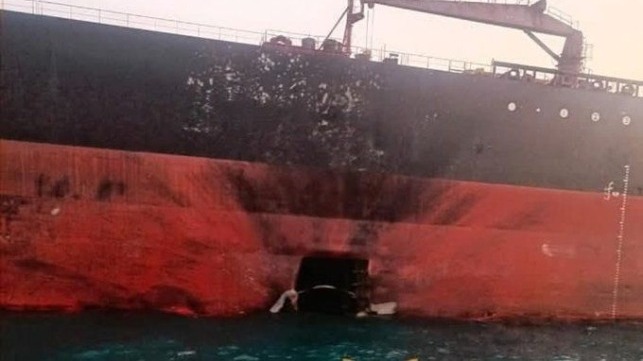
New footage appears to suggest that Iranian forces used a drone boat to attack the tanker Sonangol Namibe off the coast of Kuwait.
The tanker was at anchor about 30 nm to the southeast of Kuwait's Mubarak al Kabeer port on Wednesday night when an explosion occurred on the port side. The hull was penetrated and the ship has taken on water, according to UKMTO. However, there were no injuries, and the blast did not start a fire, according to the security agency.
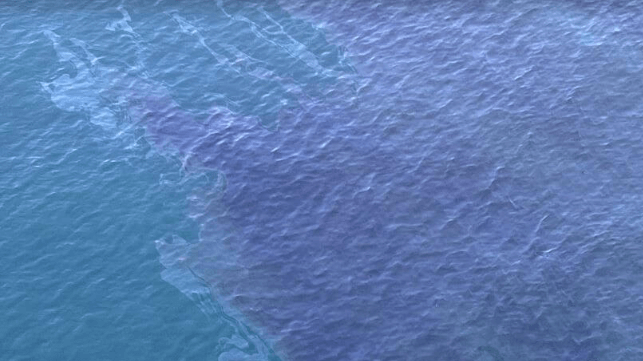
The vessel was in ballast at the time of the blast, but satellite imaging taken the day after the strike shows a small petroleum slick emanating from the tanker.
The strike expanded the proven kinetic risk zone to the far northeastern end of the Gulf, confirming the possibility of an Iranian strike at any location within the area. It also showed that the threat picture for shipping will continue to include surface attacks, even though Iran's larger combatant vessels have substantially been eliminated by U.S. forces.
Iran is a longtime operator of unmanned bomb boats: it began providing the technology to Yemen's Houthi rebel group years before the concept was adopted and developed by Ukraine. Drone boats require a different defense strategy to prevent kinetic strikes, and they are difficult to defeat in swarms, as demonstrated by the Black Sea campaign targeting Russian warships and tankers.
The strike may have outsize importance for regional energy production. According to local Basra News, Sonangol Namibe was due to call at an Iraqi loading terminal to take on oil. Iraq is so short on shoreside storage space that it has begun to shut in production; A proven threat to tanker tonnage in Iraq has more immediate implications for the global crude oil supply than a similar threat in Saudi Arabia or the UAE, as Iraq's tank farm capacity is low and any production shut-in will take weeks to restart.
The UKMTO has reported an apparent attack on a tanker at a position off the coast of Kuwait, resulting in a hull breach.
The tanker - identified as the Suezmax Sonangol Namibe - was at anchor about 30 nm to the southeast of Kuwait's Mubarak al Kabeer port on Wednesday night. An explosion occurred on the port side, witnessed by the master. A small craft was seen departing the scene.
The blast penetrated a cargo tank, resulting in a spill of oil in the water, according to UKMTO. In a later statement, the operator said that a ballast tank was breached, but that no oil was spilled. The ship has taken on water as well, according to UKMTO.
No fires have been reported, and the crew are unharmed. Contrary to the initial report, the vessel was in ballast at the time of the blastInvestigations into the circumstances of the attack are under way.
The apparent attack is materially different from other recent maritime strikes in the region, in several ways. Geographically, it is the furthest point west from the Strait of Hormuz, suggesting that the warlike risk zone fully spans the length of the Arabian Gulf. The presence of a small craft also suggests a hand-placed charge - a limpet mine - which would be consistent with past operations attributed to Iran.
In June 2019, two vessels were hit by suspected limpet mine attacks in the Gulf of Oman. One of the devices was spotted intact on the hull of the tanker Kokuka Courageous, and it closely resembled a known Iranian device, according to U.S. Central Command. Suspected Iranian operatives removed the device and departed before U.S. forces could arrive. Cmdr. Sean Kido, a dive team leader with CENTCOM, told Reuters at the time that blast damage elsewhere on the Kokuka Courageous was consistent with a limpet mine attack - not an airborne munition.
Positioning of Unladen Tankers Signals Shipping's Risk-Reward Calculations
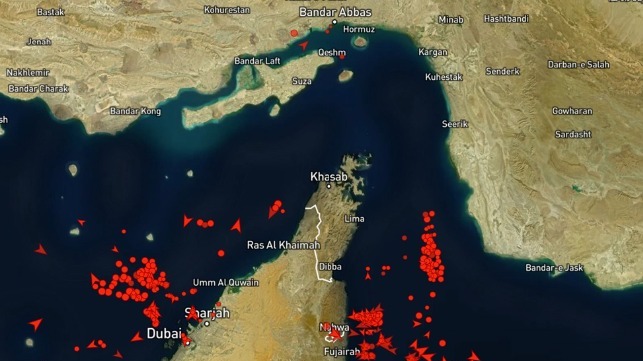
Still expecting to profit: empty tankers lined up off Fujairah, Khor Fakkan and Dibba (MarineTraffic)
Shipowners and managers, and ultimately ship masters, have the ultimate responsibility for assessing risk to their vessels and their cargoes. Governments may be keen to persuade operators that the coast is clear, in support of attaining political objectives, but captains always need to be the final arbiter, not the least because lives are at risk.
Hence the behavior of tankers, in particular those with freedom of movement outside the Gulf, gives an indication of how the non-government world is assessing the potential course of the ongoing war with Iran.
If unladen tankers give up holding off Fujairah and Oman, then it is because they assess the risk of loading from terminals on the Gulf of Oman outweighs the reward of record profits to be had from Mideast-to-Asia voyages - or, alternatively, that there is little prospect of the Straits of Hormuz being opened up in the short term. For such tankers, the commercial choice then is to sail away and to find cargoes elsewhere.
From insiders in the oil and gas trading community, it appears that some regard it as too risky to load at present. But most of the unladen tankers off Fujairah and Oman are still sticking around, implying that ship owners and managers consider there is a good prospect of the Iranian grip over the Straits of Hormuz being broken soon. There are for example 17 unladen LNG carriers currently loitering in the Gulf of Oman off Ras al Hadd, numbers not depleted by more than one or two who have given up waiting. This implies there is confidence that the American war plan will move - once local air superiority is achieved - to suppressing the still-active drone threat.
The Iranian threat extends well beyond the immediate Strait of Hormuz area, as it appears that Iran has the wider objective of closing down all oil and gas movements within the region, presumably with the objective of mobilizing oil and gas consuming nations - and China in particular - to press for a cessation of hostilities.
This threat the Gulf nations are having to deal with on their own, with the Americans clearly having their hands full dealing with the primary threat from Iran. But it seems extraordinary that Western nations, and other consumer nations in Asia, do not consider that their national and economic security interests need to be protected and defended from these Iranian attacks. On the contrary, the British Prime Minister, for example, speaking in the House of Commons on March 4, appeared to be only concerned with evacuating British citizens from the area - seemingly unconcerned about the lack of Royal Navy presence in the Gulf or capability to defend other British interests and those of historic and economic partners.
Bandar Abbas Naval Harbor Smoking from Multiple Hits
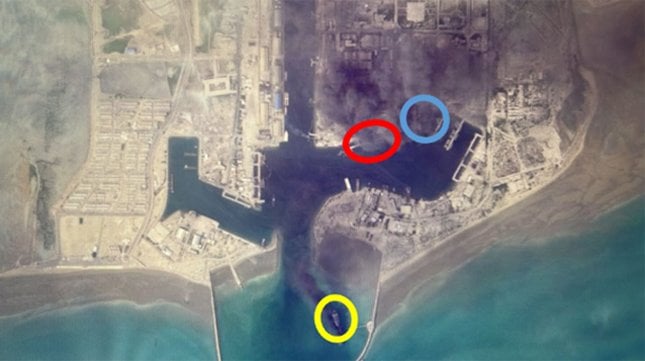
Bandar Abbas Naval Harbor at 12.00 (UTC) on March 2 (Sentinel-2/CJRC) Yellow: berth of IRINS Kurdestan (K442). Red: berth recently of 2 x Moudge Class frigates. Blue: Berth area of IRINS Zagros (H313) and Hengam Class logistic vessels.
Imagery taken over Bandar Abbas at midday (UTC) on March 2 shows the Naval Harbor wreathed in black smoke. From the smoke pattern and dispersal, it appears that there have been at least three strikes on ships berthed in the harbor.
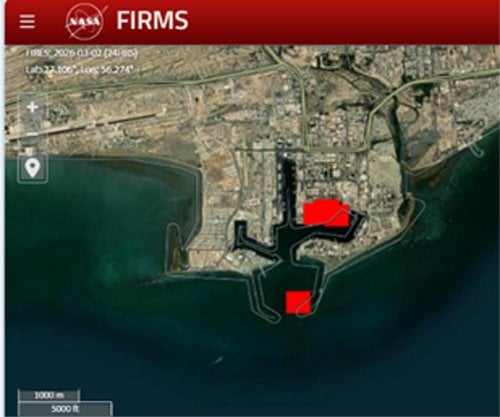
The heat spots are confirmed in NASA FIRMS imagery, which suggests that the heat spots were initiated perhaps up to 24 hours previously.
The regular Iranian Navy (Nedaja) has consistently moored classes of ships on particular berths in the Naval Harbor, making it easy to predict which ships lie beneath the smoke. Moreover, clear imagery of the harbor was obtained in the immediate days before the launch of Operation Epic Fury, so that one can make a good guess from which particular ships smoke is belching.
At its normal pier in the outer harbor, still afloat, is IRINS Kurdestan (K442), or possibly IRINS Makran (K441), still on fire at its stern.
These two converted tankers have given the Nedaja the ability to provide logistic support for long-range deployments, a capability that the Nedaja lost when IRINS Kharg (K431) caught fire and sank in mysterious circumstances off the coast of Jask on June 2, 2021.
The dockside alongside which three Moudge Class frigates were moored several days ago is ablaze along its length. The vessels concerned, therefore, may be IRINS Sabalan (F73), IRINS Sahand (F74), and/or IRINS Jamaran (F76), which had been spotted moored here on February 27. It has been tentatively reported, however, that IRINS Jamaran (F76) was sunk alongside its berth at the Konarak Naval Base in Chah Bahar.
A large area of smoke covers the area where the Moudge Class intelligence collection frigate IRINS Zagros (H313) is normally berthed, which in turn is adjacent to a pier that normally is home to Hengam Class logistic vessels, veteran but heavily used in support of short and medium range deployments.
On the eastern side of the Naval Harbor, the piers which normally house Kaman Class fast attack craft, and Kilo and Fateh Class diesel electric submarines, are not covered by smoke. Potentially targets in this area could have sunk, hiding any indicators of attack beneath the waters of the harbor.
The evident damage apparent in the imagery of the harbor correlates with the statement from President Donald Trump that nine Iranian Navy ships have been destroyed in Operation Epic Fury. U.S. Central Command on Monday also claimed to have sunk the drone carrier Shahid Bagheri, saying U.S. forces had struck the ship within hours of launching Operation Epic Fury. However, it should be noted that these easy targets were all old ships, which tended to be used for conventional naval operations, rather than the missile-equipped speed boats and fast attack craft used by the IRGC Navy in harassment operations in the Straits of Hormuz.
Jebel Ali Port Resumes Operations as Most Regional Ports Remain Operational
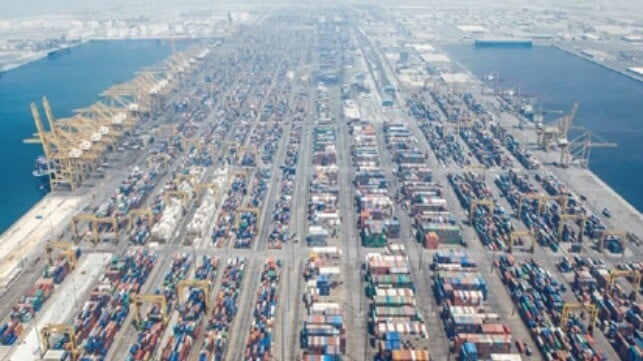
Jebel Ali, the largest container port in the region, briefly suspended operations (DP World)
After widespread reports of a possible missile strike and a fire at the Jebel Ali Port in Dubai, operations resumed on Monday. Most ports across the Middle East report operations are continuing despite the efforts by the Iranians to target ports as part of their campaign to disrupt the region.
Videos circulating online showed a smoke cloud rising from the container port in Dubai, creating concerns as Jebel Ali is the largest port in the region. In addition to being a key import and export location, it is a transshipment hub for much of the region. Reports began circulating that operations were suspended.
The Dubai City Defense force confirmed that it was quickly able to bring the fire under control with minimal damage. Officials are asserting that it was debris from a successful intercept of a drone that caused the fire and not a missile or drone strike on the port. Dubai, however, has been one of the areas heavily targeted by the Iranians, with reports of multiple intercepts and strikes, including on hotels and residential buildings.
DP World, which operates the container port, is saying operations were suspended as a precaution, and they undertook a safety review. As of Sunday evening local time, March 1, it was reporting that all four terminals were operating normally. The Dubai Ports Authority confirmed the operations while saying it was “monitoring developments closely” and would remain in close coordination with the relevant authorities. It said that “enhanced safety and security measures” would remain in place across the Jebel Ali Port.
Ports in the UAE, Kuwait, Saudi Arabia, Iraq, and Qatar, as well as further afield in Jordan, Egypt, Lebanon, Israel, and Cyprus, are also said to be operating normally. Inchcape, one of the leaders in providing port services, compiled a comprehensive report on the status of the port.
Ports in Bahrain have reportedly suspended operations temporarily, while Oman has partial restrictions. This comes after the countries were targeted by the Iranians. The Oman News Agency had earlier reported that two drones had targeted the port area and that one person was injured.
The key LNG terminals have, however, also been closed after their operations came under attack. Citing safety concerns, Qatar Energy said it had suspended operations at its Ras Laffan facility, with Inchcape also reporting that Qatar had suspended processing crew visas at Ras Laffan Port. Severe GPS signal interference was also being reported at Ras Laffan.
While the ports remain mostly operational, ships have stopped transits of the Straits of Hormuz due to the repeated attacks by the Iranians and a suspension of war risk insurance. In addition, many of the major shipping lines are reporting that they have placed restrictions on operations. MSC Mediterranean Shipping reported that it was suspending all bookings of the Middle East, while Ocean Network Express also reported it will temporarily suspend acceptance of new bookings for cargo moving both to and from the Persian Gulf until further notice. Maersk and HAPAG-Lloyd were among the companies that reported their vessels would stop transits in the Persian Gulf region. Maersk reported it was suspending reefer, dangerous/special cargo acceptance in and out of UAE, Oman, Iraq, Kuwait, Qatar, Bahrain, and Saudi Arabia, and not taking new bookings, including to parts of the Indian subcontinent. It also said all vessels would divert from the Suez Canal – Red Sea corridor.
In response to the ongoing missile attacks, U.S. commanders said they were focusing on quickly addressing Iran’s capabilities to strike neighboring facilities. U.S. Central Command reported on Monday, March 2, that because “Iran continues to maliciously launch ballistic missiles, indiscriminately targeting military and civilian locations throughout the region,” its efforts were being increased. It reported overnight that the massive B-1 bombers had been deployed to strike deep inside Iran to degrade Iranian ballistic missile capabilities. The U.S. released videos of mobile missile launchers being targeted and destroyed, while Iran responded with a video of underground bunkers storing large numbers of drones and missiles that it said it would be launching at the American forces and their supporters.
Cruise Lines Navigate Gulf Conflict Amidst Continued Iranian Strikes
Given the centrality of the oil trade to the GCC states, tankers have rightfully received the most attention of any vessel class in the new conflict in the Gulf. But cruising is increasingly popular in the region, and at least half a dozen cruise ships are in the affected area - including some which may be staying longer than expected due to ongoing Iranian strikes.
One of these vessels is newly homeported in the region. The Saudi cruise ship Aroya Manara (ex name World Dream) is currently moored in Dubai, and independent operator Aroya is deferring plans for a round-trip cruise through the Strait of Hormuz to visit Muscat.
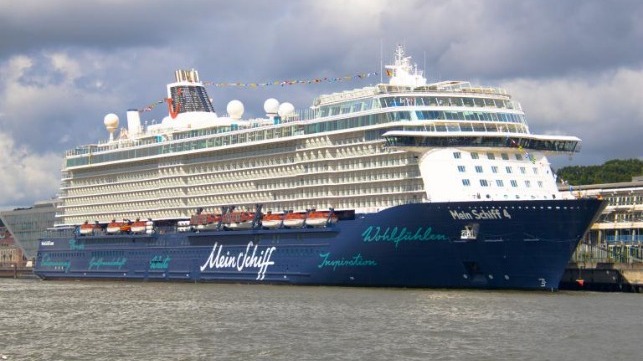
Many others are temporarily based in the UAE or Qatar. German firm TUI Cruises has two vessels berthed in the area - the Mein Schiff 4 in Abu Dhabi and the Mein Schiff 5 in Doha. Abu Dhabi was attacked by Iran in a missile strike over the weekend, and passengers aboard Mein Schiff 4 were able to see Iranian drones hit the water from on board the vessel. Mein Schiff 5 is scheduled to conduct a series of round-trip cruises in the Gulf, and was slated to depart Doha on Saturday.
TUI has temporarily suspended sailings for both vessels, but it is unclear when passengers or crew will be able to depart: with airspace restrictions in place, travel in or out of the GCC is currently difficult.
Shipping giant MSC's cruise division has one vessel currently moored at Doha, MSC Euribia. The ship has about 5,000 passengers on board from its previous voyage, but it will not be departing as planned for its next seven-night cruise in the Arabian Gulf. Instead, it will be staying in port "due to the current situation and the air space closure in the Middle East."
Privately-held Celestyal Cruises, based in Athens, operates two cruise ships; both are in the Gulf, west of Hormuz. The line said in a statement Sunday that the next departures for Celestyal Journey (departing Doha) and Celestyal Discovery (departing Dubai) have been canceled: both were due to sail on Monday, but the line intends to put passenger and crew safety first in light of current circumstances. Guests of the Journey have the option to stay aboard or to go ashore in Doha, but authorities in Dubai have instructed Celestyal Discovery not to disembark passengers for the time being. The UAE has suspended all flights to and from Dubai amidst ongoing Iranian missile and drone attacks, so passengers would have few options for onward travel.


No comments:
Post a Comment