The current flare-up between Thailand and Cambodia feels different from previous disputes. What initially appeared to be a limited skirmish over disputed borderland and nationalist rhetoric now carries the faint, unmistakable whiff of escalation.
Should this bilateral tension spiral into a broader conflict, the ramifications for neighbouring Vietnam and indeed for the wider region could be far-reaching, dragging in not just ASEAN members but also the United States and China.
To begin with, Vietnam shares cultural, political and economic ties with both Thailand and Cambodia, though it has a complex and often fraught historical relationship with Phnom Penh. The legacy of Vietnam’s occupation of Cambodia in the 1980s still casts a long shadow, particularly among older Cambodians, while Hanoi remains wary of any instability spilling across its long and porous southwestern border.
If the current border standoff between Thailand and Cambodia worsens into outright conflict, Vietnam will be forced to make difficult choices.
It has no formal defence obligations to either side, but it would not sit back and allow chaos to unfold next door. The Vietnamese military, one of the most capable in mainland Southeast Asia, would likely ramp up its border presence and increase surveillance, especially in the Mekong Delta region. Intelligence sharing within the region would spike, with Vietnam quietly cooperating with Laos and perhaps even with Thailand, depending on how the conflict evolves.
The real risk, however, lies in how this crisis might fracture ASEAN unity. The ten – soon to be eleven – member bloc has long prided itself on consensus-building, non-interference and the ability to manage disputes internally. Yet recent years have seen growing doubts over its effectiveness, particularly in dealing with issues like Myanmar’s civil war or Chinese aggression in the South China Sea. If fighting were to erupt in earnest between two ASEAN members, it could well paralyse the organisation further, or worse, expose the limits of regional diplomacy altogether.
Vietnam, which currently maintains a delicate balancing act between resisting Chinese maritime pressure and fostering trade ties with the US, would find itself under new geopolitical pressure. An escalating Thailand-Cambodia conflict would create a vacuum that the world’s great powers would be tempted to fill – but likely for their own strategic purposes.
China, for its part, has deep ties with Cambodia, including significant investments under the Belt and Road Initiative. Phnom Penh is seen in many circles as Beijing’s closest ally within ASEAN.
An embattled Cambodian government would almost certainly look to China for diplomatic cover, military assistance, or at the very least, intelligence support. Beijing might seize the opportunity to expand its influence in mainland Southeast Asia under the guise of stabilisation or "conflict prevention".
Vietnam would see such a move as a direct threat. Already locked in an uneasy relationship with China over the South China Sea, Hanoi would be deeply alarmed by any large-scale Chinese involvement in Cambodia. It would prompt calls within the Vietnamese leadership to accelerate its diversification strategy – strengthening security ties with India, Japan, and most significantly, the United States.
Washington, meanwhile, would not remain a passive observer. The US has been gradually increasing its military and diplomatic presence in Southeast Asia as part of its broader Indo-Pacific strategy. Any major disruption to ASEAN stability would give Washington both cause and justification to become more assertively engaged. If Cambodia were to lean more heavily on China, the US might pivot towards Thailand and there are already indications this has happened. At the same time, it might use the opportunity to deepen strategic ties with Vietnam, offering security cooperation, port visits or even expanded arms deals, something Hanoi has previously approached with cautious pragmatism.
However, the risk here is not merely of great power competition playing out across ASEAN capitals, but of the entire region becoming polarised. A divided Southeast Asia, with states pulled towards either China or the US, would threaten the very cohesion that has underpinned the region’s economic success and relative peace over the past three decades.
For Vietnam, therefore, the ideal response would need to be agile and multifaceted. It cannot afford to appear beholden to either Beijing or Washington. More than any other country in the region, Vietnam has demonstrated a unique capacity for hedging – building partnerships with the West while maintaining stable, if wary, ties with China. Should conflict erupt on its doorstep, that balancing act would become even more critical, and considerably more perilous.
In the best-case scenario, ASEAN would intervene early, appointing a special envoy or facilitating shuttle diplomacy before matters spiral out of control. Vietnam could and should play a leading role in that process, using its clout and experience to defuse tensions and push for dialogue. Failing that, the region faces not only a humanitarian crisis, but a fundamental reshaping of Southeast Asia’s geopolitical map.
Cambodia denounces Thai assault on Preah Vihear Temple, calls for immediate end to hostilities
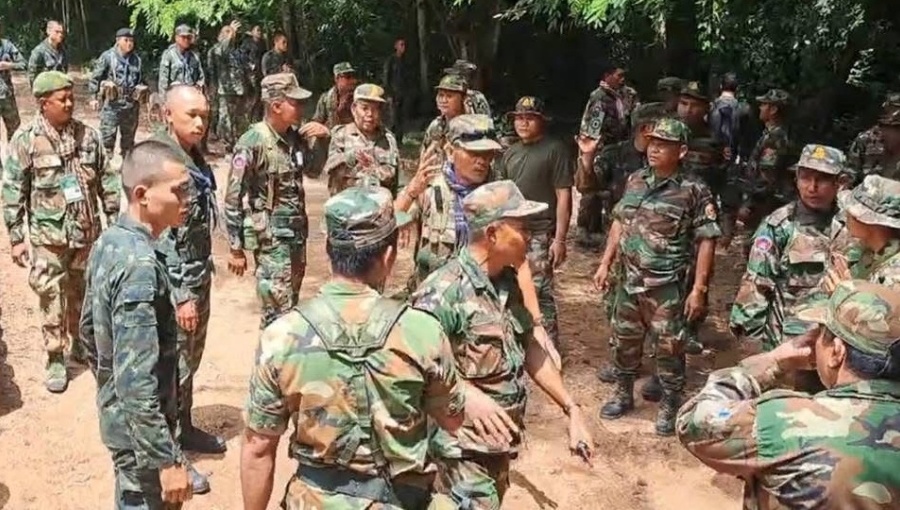
Cambodian and Thai soldiers met at the Ta Moan Thom temple on July 15, 2025. / Cambodian Ministry of National Defense FB
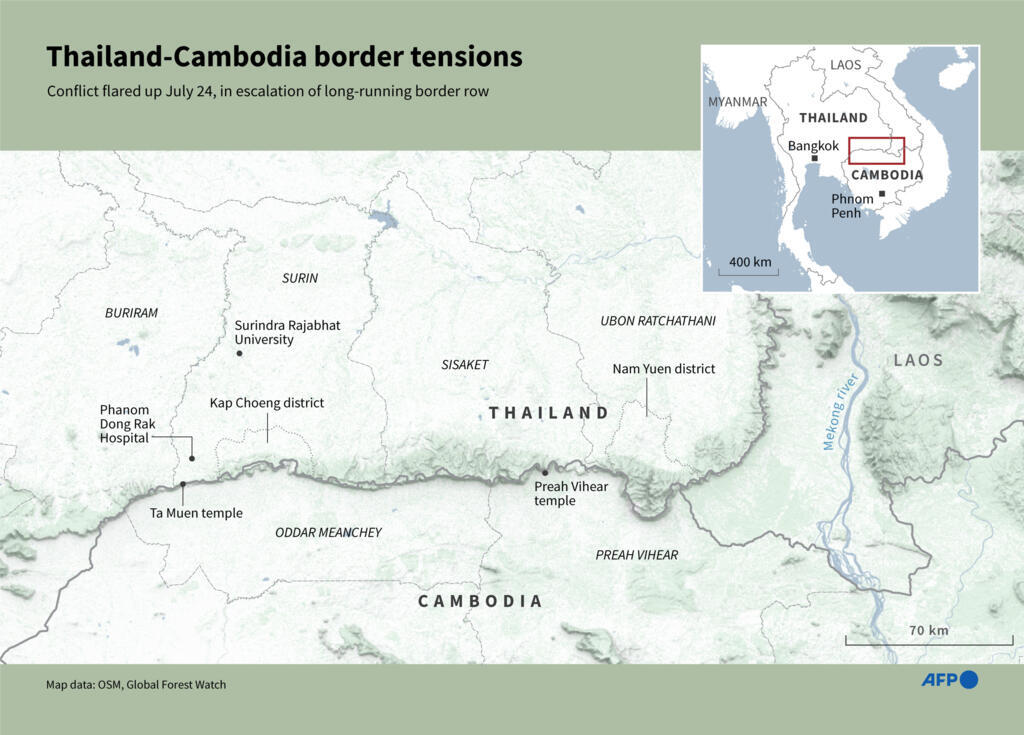
Cambodia’s Ministry of Culture and Fine Arts has strongly condemned recent Thai military actions that have caused serious damage to the Preah Vihear Temple, a sacred site and UNESCO World Heritage monument. The ministry has called for an immediate cessation of all military activity in and around the temple area, according to Cambodianess.
In an official statement released on July 24, the ministry described the attacks, which reportedly included artillery shelling and airstrikes, as a blatant violation of international law and a direct threat to cultural heritage.
Preah Vihear Temple, which was inscribed as a UNESCO World Heritage Site in 2008, holds immense historical and cultural significance for Cambodia and is regarded as part of the shared heritage of humanity. The ministry stated that its destruction constitutes a breach of multiple international treaties aimed at safeguarding cultural property.
The attacks were described as violations of the 1954 Hague Convention for the Protection of Cultural Property in the Event of Armed Conflict, its Second Protocol adopted in 1999, and the 1972 UNESCO Convention Concerning the Protection of the World Cultural and Natural Heritage.
As a signatory to these agreements, Thailand is legally bound to respect and protect cultural heritage sites, including by avoiding their use for military purposes and refraining from any actions that could compromise their Outstanding Universal Value.
“The deliberate targeting of cultural property, as well as violations of international law, may amount to war crimes,” the ministry warned.
Initial assessments indicate that several parts of the ancient temple complex have sustained damage, including the first, second, third, and fifth gopuras (gate towers), the northern staircase, Ta Di ravine, and adjacent areas.
Situated atop the Dangrek mountain range, Preah Vihear Temple is a symbol of Khmer civilisation and national identity. The Ministry of Culture underscored that any attack on the site not only endangers Cambodia’s cultural legacy but also threatens the global community’s shared heritage.
The ministry further criticised the Thai military’s actions as a “serious breach” of international obligations, demonstrating what it described as a wilful disregard for the preservation of humanity’s irreplaceable cultural treasures.